Posts

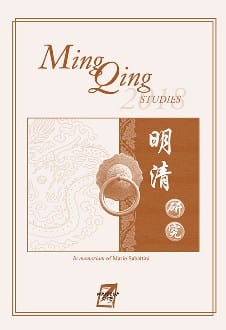
Ming Qing Studies 2018

MING QING STUDIES 2018
edited by PAOLO SANTANGELO Sapienza University of Rome

We are glad to inform you that Ming Qing Studies 2018 has been issued in November by “Write Up Site”: http://www.writeupsite.com/ming- qing-studies-2018.html.

MING QING STUDIES is an annual publication focused on late imperial China and the broader geo-cultural area of East Asia during the premodern and modern period. Its scope is to provide a forum for scholars from a variety of fields seeking to bridge the gap between ‘oriental’ and western knowledge. Articles may concern any discipline, including sociology, literature, psychology, anthropology, history, geography, linguistics, semiotics, political science, and philosophy. Contributions by young and post-graduated scholars are particularly welcome. Continue reading Ming Qing Studies 2018

WeChat exposes

Source: China Media Project (1/5/19)
WECHAT EXPOSES
by 

WeChat Exposes

This round-up of Chinese Media stories, which covers the holiday period, offers us an encouraging glimpse of how social media platforms, including the super-platform WeChat, can potentially provide an avenue for writers and journalists to expose malfeasance — something we have seen far less in China under Xi Jinping than we did prior to 2012.

First, we have an expose by “Ding Xiang Yisheng” (丁香医生) that alleges that Quanjian, a company marketing various drug regimens, including cancer treatments, has cheated unsuspecting customers, mostly the poor. This follows another big WeChat story earlier in 2018 about tainted vaccines making it onto the Chinese market. Both of these stories, says one media expert, are cases of “knight-errant journalists” (新闻游侠) who were formerly with traditional media, such as newspapers, finding a way to pursue stories in the tougher media environment of the “new era.”

We’re not holding our breath — after all, our other stories here are mostly about tighter controls. But the “Ding Xiang Yisheng” is important to note. Continue reading WeChat exposes

Unstoppable population decline

Source: CNN (1/7/19)
Study: China faces ‘unstoppable’ population decline by mid-century
By Euan McKirdy , CNN

While China still boasts the world's largest population, social engineering looks to have precipitated an "unstoppable" decline, a recent study suggests.

While China still boasts the world’s largest population, social engineering looks to have precipitated an “unstoppable” decline, a recent study suggests.

(CNN)China will face an “unstoppable” population decline over the coming decades, with fewer and fewer workers struggling to support an increasingly aging society, according to a report by a leading state-sponsored Chinese thinktank.

The report, which comes more than three years since China officially ended its controversial decades-long one-child policy, warns that the “the era of negative population growth is almost here,” forecasting that the country’s population will peak at 1.44 billion in 2029.

The Chinese Academy of Social Sciences report suggests that the decline in fertility rates will lead to a decrease in overall population to 1990-era levels of 1.172 billion by 2065. World Bank data from 2017 showed a Chinese population of 1.386 billion. Continue reading Unstoppable population decline

Open letter to democratic Taiwan

Source: Taipei Times (1/9/19)
Open letter to democratic Taiwan

We the undersigned scholars, former government and military officials, and other friends of Taiwan who have witnessed and admired Taiwan’s transition to democracy for many decades wish to express to the people of Taiwan our sense of urgency to maintain unity and continuity at this critical moment in Taiwan’s history.

It is obvious that during the past two years, the People’s Republic of China has left no stone unturned in its attempts to squeeze Taiwan’s international space, threaten it with a buildup of military power and make it appear as if Taiwan’s only future lies in integration with an authoritarian China.

This pressure culminated on Wednesday last week with a speech by Chinese President and Chinese Communist Party General Secretary Xi Jinping (習近平), telling the Taiwanese people that “the Taiwan question” was a Chinese internal affair, that unification under China’s “one country, two systems” principle was the only option for the future and Taiwan independence was a “dead end.” Continue reading Open letter to democratic Taiwan

Uyghur philanthropist sentence to death for unsanctioned Hajj

This piece dates from late November of last year, but still bears disseminating.–Kirk

Source: Radio Free Asia (11/21/18)
Xinjiang Authorities Sentence Uyghur Philanthropist to Death For Unsanctioned Hajj
By Gulchehra Hoja

Abdughapar Abdurusul in an undated photo.

Abdughapar Abdurusul in an undated photo. Photo courtesy of Abdusattar Abdurusul

Authorities in northwest China’s Xinjiang Uyghur Autonomous Region (XUAR) have sentenced a prominent Uyghur businessman and philanthropist to death for taking an unsanctioned Muslim holy pilgrimage to Saudi Arabia, according to his brother.

Abdughapar Abdurusul, of Bakyol district in Ili Kazakh (in Chinese, Yili Hasake) Autonomous Prefecture’s Ghulja (Yining) city, “was arrested in July or August,” his brother Abdusattar Abdurusul recently told RFA’s Uyghur Service, citing Abdughapar’s Kazakh business partners living in Kazakhstan’s Almaty city. Continue reading Uyghur philanthropist sentence to death for unsanctioned Hajj

The Handsome Monk

Dear Colleagues,

I’m pleased to announce that my translation of The Handsome Monk and Other Stories, by Tsering Döndrup, is now available, published by Columbia University Press.

Tsering Döndrup is a Mongolian-Tibetan author from Amdo (Qinghai Province). He is one of the most popular and acclaimed authors writing in Tibetan today, and is renowned for his humorous and penetrating critiques of contemporary Tibetan society. Of particular interest will be the manner in which he treats the experiences of Tibetans in modern China, including the major impact of Chinese on the modern Tibetan language.

Here is the link to the publisher’s page. There is a 30% discount with the code CUP30:

https://cup.columbia.edu/book/the-handsome-monk-and-other-stories/9780231190237

The distributor in the UK, Europe, Africa, the Middle East, and South Asia is John Wiley & Sons (customer@wiley.com), and Footprint Books in Australia and New Zealand (http://www.footprint.com.au/)

best,

Christopher Peacock <cp2657@columbia.edu>

Looking for Kafka

Source: Taipei Times (1/3/18)
FILM REVIEW: Looking for Kafka
An opportunity to interpret the enduring theme of the love triangle and the precise pain of suddenly losing a romantic partner is missed as the film tries to do too much in too little time
By Sherry Hsiao  /  Staff reporter

Lin Che-hsi plays Lin Chia-sheng, the son of a wealthy businessman who is kidnapped, in Looking for Kafka. Photo courtesy of Flash Forward Entertainment

Twenty-six years after her best-selling novel Men Wanted (徵婚啟事) was published, author Jade Chen (陳玉慧) has made her debut as a film director with Looking for Kafka (愛上卡夫卡), which had its festival premiere at the 21st Shanghai International Film Festival in June last year and will be in theaters tomorrow.

In the film, Pineapple (Jian Man-shu, 簡嫚書), an assistant at an avant-garde stage production of Franz Kafka’s novella Metamorphosis, finds herself in the uncomfortable position of having to help the girlfriend, Julie (Julia Roy), of the man she was unofficially dating, Lin Chia-sheng (Lin Che-hsi, 林哲熹), look for him after he goes missing. (Those familiar with Men Wanted or the impressive array of films, television shows, and stage productions it inspired will notice the striking recurrence of the missing love interest.) Continue reading Looking for Kafka

China targets Uighur intellectuals

Source: NYT (1/5/18)
China Targets Prominent Uighur Intellectuals to Erase an Ethnic Identity
阅读简体中文版 | 閱讀繁體中文版
By Austin Ramzy

Rahile Dawut, above with camera, is an anthropologist at Xinjiang University who studied Islamic shrines, traditional songs and folklore. She was detained in December 2017 and has not been heard from since. Credit Lisa Ross

ISTANBUL — As a writer and magazine editor, Qurban Mamut promoted the culture and history of his people, the Uighurs, and that of other Turkic minority groups who live in far western China. He did so within the strict confines of censorship imposed by the Chinese authorities, who are ever wary of ethnic separatism and Islamic extremism among the predominantly Muslim peoples of the region.

It was a line that Mr. Mamut navigated successfully for 26 years, eventually rising to become editor in chief of the Communist Party-controlled magazine Xinjiang Civilization before retiring in 2011.

“My father is very smart; he knows what is the red line, and if you cross it you are taken to jail,” said his son, Bahram Sintash, who now lives in Virginia. “You work very close to the red line to teach people the culture. You have to be smart and careful with your words.” Continue reading China targets Uighur intellectuals

Mystifying China’s Southwest Ethnic Borderlands review

MCLC and MCLC Resource Center are pleased to announce publication of Yanshuo Zhang’s review of Mystifying China’s Southwest Ethnic Borderlands: Harmonious Heterotopia (Lexington 2018), by Yuqing Yang. The review appears below and at its online home: https://u.osu.edu/mclc/book-reviews/yanshuo-zhang/. My thanks to Nicholas Kaldis, MCLC literary studies book review editor, for ushering the review to publication.

Kirk A. Denton, editor

Mystifying China’s Southwest 
Ethnic Borderlands: Harmonious Heterotopia

By Yuqing Yang


Reviewed by Yanshuo Zhang
MCLC Resource Center Publication (Copyright January, 2019)


Yuqing Zhang, Mystifying China’s Southwest Ethnic Borderlands: Harmonious Heterotopia. Lanham, MD: Lexington Books, 2018. vii-x + 251 pp. ISBN: 978-1-4985-0297-9 (Hardback $110.00); 978-1-4985-0298-6 (eBook $104.50)

In Chinese literary scholarship in the U.S., the literary and cultural achievements made by China’s ethnic minority groups (shaoshu minzu 少数民族) remain a largely uncharted territory in clear need of more serious investigation. Some recent scholarship on ethnic minority literatures in China includes Mark Bender’s edited ethnic poetry anthology The Borderlands of Asia: Culture, Place, Poetry (Cambria Press 2017) and the chapters on Tibetan literature and the ethnic concerns of the prominent modern writer Lao She (老舍) in Sinophone Studies: A Critical Reader (Columbia University Press 2013).

Despite the wonderful insights on minority literatures developed in these studies, single-authored monographs on non-Han literatures are severely lacking in our field, and Chinese literary studies in the U.S. as a whole seems to be dominated by a Han-focused perspective. Yuqing Yang’s 2018 monograph, Mystifying China’s Southwest Ethnic Borderlands: Harmonious Heterotopia contributes to enriching the research on Chinese shaoshu minzuliteratures. An ethnic Bai scholar trained at the University of Oregon and currently teaching at Minzu University of China, Yang charts the cultural myths and fantasies surrounding three minority regions in southwest China, revealing an entanglement between representation and reality—“textual and extratextual formats”—in the making of the Bai, Mosuo, and Tibetan identities in reform-era China (227). Continue reading Mystifying China’s Southwest Ethnic Borderlands review

Yesterday’s stray dog becomes today’s guard dog

Source: China Heritage (1/4/19)
Yesterday’s Stray Dog 喪家狗, Today’s Guard Dog 看門狗
Dog Days (VIII)

This latest addition to Dog Days — a series of canine-themed articles, essays, translations and art works marking The Year of the Dog (16 February 2018—4 February 2019) — takes as its theme China’s most famous ‘stray dog’ 喪家狗, the pre-Qin thinker and latter-day Sage, Confucius. In it, the irrepressible thinker, critic and essayist Liu Xiaobo 劉曉波 reviews the controversy surrounding Peking University professor Li Ling’s 2007 book, Stray Dog: Reading ‘The Analects’ 李零著《喪家狗——我讀論語》. Continuing his two-decade-long critique of the intellectual world, Liu then discusses the history and fate of China’s intellectuals as Homeless Dogs, Guard Dogs, Lap Dogs, Whipping Dogs and even Running Dogs.

Liu’s observations on State Confucianism, as well as on the benighted state of China’s intelligentsia, are even more relevant today, in 2019, than when he made them in 2007.

Acknowledgements: The following translation is taken from Liu Xiaobo, No Enemies, No Hatred: Selected Essays and Poems, edited by Perry Link, Tienchi Martin-Liao and Liu Xia, Cambridge, MA: The Belknap Press of Harvard University Press, 2012, pp.188-200. We are grateful to Perry Link and Lindsay Waters for supporting our request to reprint this essay and to The Belknap Press for their kind permission. (The typographical style of the original has been retained.)

Yesterday’s Stray Dog Becomes Today’s Guard Dog
Liu Xiaobo
translated by Thomas E. Moran

Chinese people are talking excitedly these days about the rise of China as a great nation. First we spoke of an economic rise, then a cultural rise; we started spreading money around the globe, then exported soft power. There have been fads for reading the classics, for honoring the memory of Confucius, and for promoting Confucian ethics. China Central Television (CCTV), pressing to reestablish an orthodoxy in China, has used its program Lecture Hall to touch off a fad for reading The Analects. The government has put big money into “Confucius Institutes” around the world in an effort to spread soft power. The dream of ruling “all under heaven,” repressed for a century or more, is now resurgent and is taking Confucius the sage as its unifying force. The craze for Confucius grows ever more fierce. Continue reading Yesterday’s stray dog becomes today’s guard dog

Photographer’s quest to reverse historical amnesia

Source: NYT (1/1/18)
A Photographer’s Quest to Reverse China’s Historical Amnesia
By Amy Qin

A rally at a stadium in Harbin, China, in 1966, attended by the photographer Li Zhensheng. A Communist Party secretary and the wife of another official were denounced and splattered with ink.CreditLi Zhensheng, via Chinese University Press

HONG KONG — The photographer Li Zhensheng is on a mission to make his fellow Chinese remember one of the most turbulent chapters in modern Chinese history that the ruling Communist Party is increasingly determined to whitewash.

“The whole world knows what happened during the Cultural Revolution,” Mr. Li said. “Only China doesn’t know. So many people have no idea.”

Clad in a dark blue photographer’s vest, Mr. Li, 78, spoke in a recent interview in Hong Kong, where the first Chinese-language edition of his book “Red-Color News Soldier” was published in October by the Chinese University Press of Hong Kong. Continue reading Photographer’s quest to reverse historical amnesia

Patriotism of not speaking Uyghur

Source: Sup China (1/2/18)
The ‘Patriotism’ Of Not Speaking Uyghur
By DARREN BYLER

Urumqi No. 1 Primary school, 2018: Uyghur script “disappeared.” Photo by Joanne Smith Finley

Uyghur “patriotism” now requires the active disavowal of the Uyghur way of life. Vague euphemisms like “patriotism,” “harmony,” “stability,” “vocational training,” and “poverty elimination” gaslight the erasure of a native system of knowledge and the basic elements that make Uyghur life Uyghur: language, religion, and culture.

On October 27, 2018, Memtimin Ubul, a Communist Party deputy secretary of Kashgar’s Qaghaliq County, stated publicly something that had increasingly become the norm over the past two years in the Uyghur homeland. In the Xinjiang Uyghur Autonomous Region, it was now officially unpatriotic for Uyghur state employees to speak or write in Uyghur language. In a statement that was circulated to more than 750,000 readers, the ethnically Uyghur state official wrote that any state employee who spoke Uyghur in public “should be classified as a ‘two-faced person.’” This is a charge that has resulted in the detention of hundreds, if not thousands, of Uyghur public figures, in addition to the untold number (possibly more than a million) who have been sent to “transformation through education” prison camps.

Memtimin wrote that the patriotic duty of state employees extended throughout all aspects of their lives. Patriotism should be present in the way they dressed, talked, and ate. Even in one’s home life, Uyghurs should refuse to speak Uyghur and instead speak Chinese. From his perspective, government employees had the “highest levels of knowledge and culture” in Uyghur society, and as such they had “immeasurable social influence.” It was therefore up to them to demonstrate what it meant to be patriotic Uyghur citizens. “Speaking the ‘language of the country’ should be the minimum requirement for patriotism,” he wrote. Chinese was no longer the language of Han people, but the language of reeducated patriotic Uyghurs.

A short documentary on rural Uyghur life in the county where Memtimin Ubul works as Party official. The documentary demonstrates the richness of Uyghur rural traditions before the mass detention of Uyghurs and the rise of new forms of “patriotism” across the Uyghur homeland. Continue reading Patriotism of not speaking Uyghur

Arthouse film “breaks box office records”

Source: The Guardian (1/2/18)
Chinese arthouse film breaks box office records after viewers mistake it for romcom
A Long Day’s Journey Into Night took $38m on its opening day, but some viewers complained that marketing suggested it was a seasonal romcom, rather than a challenging drama
By Catherine Shoard

Artful … a scene from A Long Day’s Journey Into Night by Bi Gan.

Artful … a scene from A Long Day’s Journey Into Night by Bi Gan. Photograph: ©LIU HONGYU

When Bi Gan’s latest drama premiered at Cannes in May 2018, critics were quick to praise its challenging, languorous narrative about a man returning to his home town in search of a former flame, as well as the ambitious single-take, hour-long dream sequence, and a shorter section in 3D.

Early box office projections anticipated a modest increase on the takings for Gan’s previous film, Kaili Blues, about two depressed rural doctors. Yet A Long Day’s Journey Into Night took $38m in China on its opening night on 31 December, beating the likes of Venom. Continue reading Arthouse film “breaks box office records”

Xi warns Taiwan

Source: NYT (1/1/19)
Xi Jinping Warns Taiwan That Unification Is the Goal and Force Is an Option
By Chris Buckley and Chris Horton

China’s president, Xi Jinping, in Beijing on Wednesday. “We make no promise to abandon the use of force,” he said in a speech about Taiwan. CreditPool photo by Mark Schiefelbein

BEIJING — China’s president, Xi Jinping, warned Taiwan that unification must be the ultimate goal of any talks over its future and that efforts to assert full independence could be met by armed force, laying out an unyielding position on Wednesday in his first major speech about the contested island democracy.

Mr. Xi outlined his stance one day after Taiwan’s president, Tsai Ing-wen, urged China to peacefully settle disputes over the island, whose 23 million people, she said, want to preserve their self-rule. But Beijing treats Taiwan as an illegitimate breakaway from Chinese rule, and Mr. Xi said unification was unstoppable as China rose. Continue reading Xi warns Taiwan

HK Cinema through a Global Lens MOOC

HKU MOOC: HONG KONG CINEMA THROUGH A GLOBAL LENS

Registration is now open for the fifth offering of Hong Kong Cinema through a Global Lens, the first MOOC (Massive Open Online Course) on Hong Kong cinema to be produced anywhere in the world.  The online course starts on January 22, 2019. Enjoy the conversation on Hong Kong cinema with internationally-recognized film studies scholars Professor Gina Marchetti and Dr. Aaron Han Joon Magnan-Park from the HKU Department of Comparative Literature and Dr. Stacilee Ford from the HKU Department of History and American Studies Program with the creative assistance of HKU TELI (Technology-Enriched Learning Initiative).

The edX platform hosts Hong Kong Cinema through a Global Lens, which is free of charge on the Internet. Lively and student-centered, this MOOC is appropriate for secondary, tertiary, and lifelong learners from all corners of the globe, who have a good command of the English language. Teachers are welcome and encouraged to adapt various modules and materials for their own classroom or e-learning needs. The course explores globalization through Hong Kong cinema featuring crisp analyses of the actors and filmmakers whose lives and films connect the local Hong Kong scene to global histories, events, and trends. Throughout the six-week course, students will encounter stars including Bruce Lee, Jackie Chan, and Maggie Cheung as well as award-winning directors such as John Woo, Mabel Cheung, Andrew Lau, and Wong Kar Wai. Continue reading HK Cinema through a Global Lens MOOC