Posts

How Black Myth: Wukong navigates China’s political and cultural trends

Source: Think China (9/10/24)
How Black Myth: Wukong navigates China’s political and cultural trends
By Ying Zhu

Black Myth: Wukong has revived interest in everything Monkey King, but the Chinese video game has also been criticised for not fully capturing the original myth. Even so, the game has given the Chinese gaming industry a boost, even though government endorsement may shift the focus from design to politics. Academic Ying Zhu explores the magic of Monkey King.
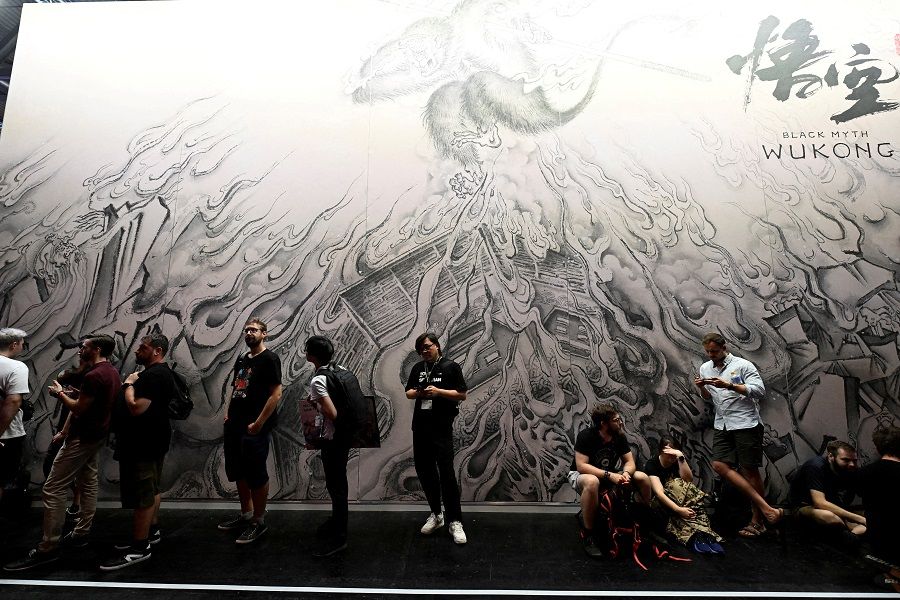
People wait in line to play Black Myth: Wukong at Gamescom 2023, in Cologne, Germany, on 23 August 2023. (Jana Rodenbusch/Reuters)

People wait in line to play Black Myth: Wukong at Gamescom 2023, in Cologne, Germany, on 23 August 2023. (Jana Rodenbusch/ Reuters)

In summer 2015, a Chinese animation film, Monkey King: Hero Is Back, made headline news for breaking the Chinese animation box-office record previously held by DreamWorks’ Kungfu Panda 2 (2011). The film features the Monkey King, a legendary trickster known for his mischief and magical powers, drawn from the beloved 16th-century Chinese literary classic Journey to the West.

Journey to the West narrates the 7th-century pilgrimage of Chinese Buddhist monk Xuanzang, who travels from Xi’an (the Tang Dynasty capital) to India in search of Buddhist scriptures. This whimsical and fantastical tale chronicles Xuanzang’s challenging journey, accompanied by three troublesome apprentices who have been assigned to him as protectors to atone for their sins.

Among the three, the monkey named Sun Wukong stood out for both his magical power in fighting evil and his troublemaking penchant. His captivating character has enchanted generations of readers, making him a legendary hero in Chinese mythology.

Monkey King fever a decade ago

The Monkey King story has been updated through stage performances, TV series, film and video games in China and beyond. Research shows that from 1906-2021, roughly 170 theatre, film and TV adaptations were said to have been produced in the Chinese-speaking world alone. Among them, Monkey King: Hero Is Back stood out for its success in vanquishing Hollywood in the Chinese domestic market. Continue reading How Black Myth: Wukong navigates China’s political and cultural trends

Colgate position

The Department of East Asian Languages and Literatures at Colgate University invites applications for a tenure-stream position in Chinese at the level of assistant professor, beginning fall semester 2025. A Ph.D. in hand or near completion and native or near native command of both Chinese and English are required. The area of specialization is pre-twentieth-century Chinese literature and culture. The successful candidate will be expected to teach language at all levels, departmental courses in his or her specialization, courses in the Liberal Arts Core Curriculum, independent studies as needed, and to direct in rotation a semester-long study abroad program to mainland China, Hong Kong, and Taiwan. Teaching will contribute to the interdisciplinary program in Asian Studies, and may contribute to Colgate’s other interdisciplinary programs, depending on the successful candidate’s area(s) of interest and expertise. The teaching load is five courses per year. Faculty responsibilities include productive scholarly research, student advising, and service to the University and the profession.

Please submit a letter of application that addresses your teaching and research, a CV, and three reference letters through [INTERFOLIO]. Colgate strives to be a community supportive of diverse perspectives and identities. Candidates should describe in their cover letter how their approach to teaching demonstrates an ability to work effectively with students across a wide range of identities and backgrounds. Review of applications will begin October 1, 2024, and continue until the position is filled.

Colgate is a vibrant liberal arts university of 3,200 students situated in central New York state. Colgate faculty are committed to excellence in both teaching and scholarship. Further information about the Department of East Asian Languages and Literatures can be found here.

Continue reading Colgate position

Georgia Tech MS in Global Media and Cultures

Dear Colleagues,

Georgia Institute of Technology invites applicants to an exciting master’s degree program in cultural studies, media studies, intercultural communication, and language acquisition, our M.S. in Global Media and Cultures. Please find descriptions of the programs below. For further information, please see the websites below or e-mail grad@modlangs.gatech.edu. Thank you for sharing with interested students and colleagues!

Best,

Paul Foster

M.S. in Global Media and Cultures

The Master of Science in Global Media and Cultures is a joint program between the School of Literature, Media, and Communication and the School of Modern Languages at Georgia Tech. This unique humanities program merges curricular offerings from both Schools and gives students the opportunity to engage in advanced research and training that combines cross-cultural competence, language acquisition, and media and communications expertise with global and cultural research.

Our 30-credit hour program combines a strong foundation in media and cultural studies with advanced training in a critical global language. Through graduate assistantships, internships, a final project, and a career portfolio, students can customize their experience to their own career goals.  Students can choose one out of seven possible language concentrations including Chinese, French, German, Japanese, Korean, Russian, and Spanish. GRE is not required. The application deadline is February 18, 2025.

Website: https://gmc.iac.gatech.edu

He Xiangning Art Museum talk

Dear colleagues,

The ‘Global Diasporic Chinese Museums Network Initiative Public Talk Series’ will host the 11th talk on Friday 20 September 2024. Our speaker is Prof. Cai Xianliang, Director of the He Xiangning Art Museum. He will give a talk on Art as a Bridge: The Role of the He Xiangning Art Museum in Enhancing China’s Relationship with the Overseas Chinese以艺为桥:何香凝美术馆在增进中国与海外华人联系中的作用

Date: Friday 20 September 2024
Time: 12:00 pm to 13:30 pm (BST)
Venue: Online via Zoom

The event is free to attend and open to all.

Zoom ID: 849 7996 8532
Password: 12345
Zoom meeting link:
https://ntu-sg.zoom.us/j/84979968532?pwd=LogccVmU7Yrra0mgiZvr3NfuVqa0Kq.1

The talk will be given in Mandarin Chinese. Simultaneous translation into English will be provided.

Chair: Yow Cheun Hoe, Director of the Chinese Heritage Centre, Singapore
Speaker: Cai Xianliang, Director of the He Xiangning Art Museum, China

Abstract

He Xiangning Art Museum is the first national art museum in China named after an individual and has the richest collection of He Xiangning’s works and historical documents in the world. It is the main collection organisation and research institution for He Xiangning’s art works and documents, and its daily work mainly focuses on research, exhibitions, publications, and public education activities. In her early years, He Xiangning had a long history of revolutionary activities overseas, and had extensive and deep connections with overseas countries, thus becoming an important bridge between overseas Chinese and China. In her later years, He Xiangning mainly focused on hosting national overseas Chinese affairs. He Xiangning Art Museum located in Shenzhen adheres to the spirit of He Xiangning and her deep affection for overseas Chinese, attaches great importance to the development of overseas Chinese art, planning a series of thematic exhibitions of overseas Chinese art, fine art exhibitions, and becomes an important platform for the exchange, introduction and promotion of contemporary Chinese art. It has become an important platform for the exchange, introduction and promotion of contemporary Chinese art.

The event is jointly hosted by HOMELandS (Hub On Migration, Exile, Languages and Spaces) at the University of Westminster and the Chinese Heritage Centre of Nanyang Technological University, Singapore. It is organised as part of the ‘Global Diasporic Chinese Museums Network Initiative’ project funded by AHRC.

It would be appreciated if you could share this event with your colleagues and your networks. Looking forward to seeing you there.

Cangbai Wang (he/him)
Professor of Migration, Heritage and Language
University of Westminster

Enduring ‘public secrecy’ around 1989

Source: China Digital Times (9/9/24)
Accused Tiananmen Informant’s Silence Reveals Enduring “Public Secrecy” Around 1989
By 

The violent repression of the 1989 student protests scarred Chinese society. The campaign to purge “two-faced” protest sympathizers that followed was similarly painful. Yet some of the greatest unresolved anguish from that tumultuous year stems from the realization among those who served prison sentences that dear friends and trusted colleagues informed on them—or even framed them.

Just such a case has re-entered the public eye 35 years after the fact due to the reporting of the investigative journalist Chai Jing, creator of the 2015 air pollution documentary “Under the Dome.” In 1989, the poet Zheng Shiping, better known by his pen name Ye Fu, was charged with revealing state secrets and sentenced to six years in prison. After his release, Ye Fu alleged that the Mao Dun-prize winning novelist Xiong Zhaozheng, his former classmate and friend, had set him up. Ye Fu’s allegation is decades old. Xiong has never publicly admitted to acting as an informant, although according to Ye Fu he has previously apologized in private. As part of a recent interview series for her YouTube channel, Chai Jing interviewed both Ye Fu and Xiong. Her brief interview with Xiong was dominated by silence. Far more than a rehashing of bitter recriminations about 1989, the call, which Chai Jing posted in full and whose transcript is translated below, proves an illuminating example of the “public secrecy” that surrounds the Tiananmen movement.

While the 1989 student movement is among the most sensitive and censored topics in China, the silence surrounding it is not solely a matter of government enforcement. “Public secrecy” is Margaret Hillenbrand’s term for the cult of self-interested silence that surrounds the most traumatic instances in modern Chinese history. Hillenbrand explained the term in an interview on her book “Negative Exposures” published by CDT earlier this year: Continue reading Enduring ‘public secrecy’ around 1989

Finding Asia and the Concrete Universal: A Review Essay

MCLC Resource Center is pleased to announce publication of Viren Murthy’s essay “Finding Asia and the Concrete Universal,” which reviews two books: How Asia Found Herself, by Nile Green, and Asia after Europe, by Sugata Bose. The essay appears below and at its online home: https://u.osu.edu/mclc/book-reviews/murthy/. My thanks to Michael Gibbs Hill, our translation/translation studies book review editor, for ushering the review to publication.

Kirk Denton, MCLC

Finding Asia and the Concrete Universal:
A Review Essay

How Asia Found Herself, by Nile Green
Asia after Europe, by Sugata Bose


Reviewed by Viren Murthy
MCLC Resource Center Publication (Copyright September, 2024)


Nile Green, How Asia Found Herself: A Story of Intercultural Understanding New Haven, CT: Yale University Press, 2022. 472 pp. ISBN: 9780300257045 (hardcover).

Sugata Bose, Asia after Europe: Imagining a Continent in the Long Twentieth Century Cambridge, MA: Harvard University Press, 2024. 288pp.ISBN: 9780674423497 (hardcover).

In the past few years, there has been a renewed interest in the category of Asia. This might seem strange because, at least since the publication of Edward Said’s Orientalism and, more recently, Martin E. Lewis and Kären Wiggen’s The Myth of Continents,[1] “Asia” has been easy to deconstruct. Harry Harootunian puts the problem succinctly in his critique of area studies:

It has been one of the enduring ironies of the study of Asia that Asia itself, as an object, simply doesn’t exist. While geographers and mapmakers once confidently named a sector on maps, noting even its coordinates as if in fact it existed, this enmapped place has never been more than a simulacrum of a substanceless something. It refers only to itself in the expectation that something out there will eventually correspond to it or be made to align with it. The cartographers’ art has been produced by an age-old fantasy and then reinforced by requirements of World War II. Nonetheless we have in this country professional organizations devoted to the study of this simulacrum, and educational institutions pledged to disseminating knowledge of it, even as the object vanishes before our eyes once we seek to apprehend it.[2] Continue reading Finding Asia and the Concrete Universal: A Review Essay

In rural China, ‘sisterhoods’ demand justice and cash

Source: NYT (9/8/24)
In Rural China, ‘Sisterhoods’ Demand Justice, and Cash
Growing numbers of Chinese women are challenging a longstanding tradition that denies them village membership, and the lucrative payouts that go with it.
By  (Vivian Wang traveled to Guangdong Province to see how women there were pushing a local government to recognize their land claims.)

A distant view of a village in a valley surrounded by green fields, with mountains in the distance.

A village in Guangdong Province, China. Women in rural areas are deprived of land rights if they marry outside their village. Credit…Phil Behan/VWPics, via Associated Press

The women came from different villages, converging outside the local Rural Affairs Bureau shortly after 10 a.m. One had taken the morning off from her job selling rice rolls. Another was a tour operator. Yet another was a recent retiree.

The group, nine in all, double-checked their paperwork, then strode in. In a dimly lit office, they cornered three officials and demanded to know why they had been excluded from government payouts, worth tens of thousands of dollars, that were supposed to go to each villager.

“I had these rights at birth. Why did I suddenly lose them?” one woman asked.

That was the question uniting these women in Guangdong Province, in southern China. They were joining a growing number of rural women, all across the country, who are finding each other to confront a longstanding custom of denying them land rights — all because of whom they had married.

In much of rural China, if a woman marries someone from outside her village, she becomes a “married-out woman.” To the village, she is no longer a member, even if she continues to live there. Continue reading In rural China, ‘sisterhoods’ demand justice and cash

U of Nottingham censorship

University of Nottingham censorship — is it linked to fears over the Ningbo campus, and Gui Minhai’s case?  On the occasion of Norway’s PM Jonas Gahr Støre traveling to China recently to make new business deals, I wanted to re-up my piece on Norway’s indifference to China’s ongoing genocide and how they censored their own king, when he spoke out about it on his visit:

“Of Kings and Concentration Camps: Xinjiang and Norway,” in Asia Dialogue, the online magazine of the University of Nottingham’s Asia Research Institute, which is listed online as “a world leading centre for expertise on the Asia-Pacific region.”

I then discovered that the Nottingham magazine has deleted my article — without notice! Luckily it can still be read at a Taiwan site under a different title: “Norway, China and the Deep Hypocrisy of the ‘Human Rights Dialogue’ Ritual.”

Then I discovered that another Nottingham article of mine was also deleted without notice, namely this: “The Xinjiang camps as a ‘Stanford Prison Experiment.'” Being very proud of that piece, I now reposted it here: https://www.academia.edu/37656489/ (and also on ResearchGate.net), to make it accessible again.

The question remains:

Why this censorship by Nottingham university?  In fact, I have learned that it is not just me: Several other scholars have had their published scholarship deleted by Nottingham. Continue reading U of Nottingham censorship

Bowling Green position

The Department of World Languages and Cultures at Bowling Green State University seeks applicants for a part-time adjunct instructor in support of the BGSU Chinese Program, starting August 16, 2025. Successful applicant will teach one or two language courses per semester. Applicants must at least have an M.A. degree in Chinese Studies or a related field with native or near-native proficiency in Mandarin Chinese and English. Experiences in teaching undergraduates in North America are desirable.

Applicants should submit: 1) letter of application, 2) full curriculum vita/resume, 3) two letters of recommendation, 4) official transcripts indicating highest degree. Finalists are also required to authorize and pass a background check prior to offer of employment.  All application materials including the resume/CV should be submitted electronically to ymin@bgsu.edu. Applications must be received by December 30, 2024. Questions about this position can be sent to Min Yang at ymin@bgsu.edu.

Acting Modern China conference

An International Digital Conference on “Acting Modern China:
A Transcultural Affair”
Organized by The Department of English, The Hang Seng University of Hong Kong,
October 22 to December 3, 2024

This conference aims at further advancing the existing scholarship with comparative and interdisciplinary approaches to Chinese Performance Studies. It critically examines crucial events of theater culture in the past century in Hong Kong, Mainland China, Taiwan, and their trans-continental paths to Chinatown in San Francisco, Japan, and beyond. It features leading scholars from diverse fields of translation, theater studies, anthropology, musicology, East Asian Cultural Studies, and English. Fourteen speakers will each presents a bird’s eye view history from 1910s to 2020s, with a focus on a landmark event in each decade, and its continuous history across regional, national, and international boundaries to delineate a new roadmap of cross-cultural, trans-national, and inter-disciplinary performance studies.

Nancy Yunhwa RAO, in Week One, for example, starts with a crucial year in 1924, which witnessed the opening of Mandarin Theater in San Francisco, and move back and forth in history to examine critical issues such as sojourner communities, global theater, and the allure of theater in translating culture, language, and heritage. Siyuan LIU couples this cross-ocean theater story with a study of the influence of Japanese leftist Avant-Garde theater as seen in the introduction of European-style proletarian puppet theatre to Tokyo and then to Shanghai in the last 1920s. The essay points to the ideological and artistic vocabularies shared by the worldwide proletarian theatre movement inspired by the Soviet Revolution, while also complicating the notion of “sharing” as the specific ideological and artistic environment in each country affected the dramatic/performatic circumstances. Continue reading Acting Modern China conference

A Tribute to Prof. Nanxiu Qian special issue

The editorial committee of Rice University Chao Center for Asian Studies’ online journal Transnational Asia lost its dear friend, Dr. Nanxiu Qian, Professor of Chinese Literature at Rice University, in 2022. To commemorate her life and work, the committee is pleased to announce the publication of a special issue of Transnational Asia titled “Feminism, Transnationalism, Art and Literature: A Tribute to Professor Nanxiu Qian (1947-2022).”

Professor Qian was best known for her pioneering and much-cited work on the enormously influential fifth-century Chinese masterpiece Shishuo xinyu (A New Account of Tales of the World), but she also wrote extensively on a great many other Chinese literary works spanning some two thousand years, from the Lienü zhuan (Biographies of Exemplary Women; first-century BCE), to twentieth-century fiction in Taiwan, and gender studies in contemporary American scholarship on China. Her last single-authored book was Politics, Poetics, and Gender in Late Qing China: Xue Shaohui and the Era of Reform (Stanford University Press, 2015), a highly regarded political and literary biography of a remarkable woman scholar in late nineteenth and early twentieth-century China. Nanxiu was also a dedicated, prize-winning teacher who introduced hundreds of students to the beauty and power of texts written by Chinese women, past and present.

Nanxiu will be sorely missed and long remembered. We are pleased that the articles in this commemorative volume will be a part of that remembrance.

READ THE ISSUE HERE.

Posted by: Amber Szymczyk <amber.s@rice.edu>

Professionalism and Amateurism–cfp reminder

Professionalism and Amateurism in Modern and Contemporary Chinese Arts: A Special Issue of Modern Chinese Literature and Culture
Guest edited by Ruijiao Dong, Man He, and Yizhou Huang

This special issue welcomes essays on professionalism and amateurism in modern and contemporary Chinese arts. From the anti-commercialism in the 1920s to the unification of “red and expert” (Mao Zedong, 1958) in socialist China; from the market-oriented professional artists after 1978 to current-day practitioners who work with foreign commissions and the international festival circuit, the evolving meanings of professionalism in Chinese arts has yielded various (un)spoken rules in the making and the reception of arts in China. Correspondingly, the definition of amateurism has also transformed in a shifting political and cultural terrain. Once, it was celebrated as the mode of participatory mass art, and, at other times, it was disparaged as cheesy and unproductive. Understandings of these two concepts, as well as their porous boundaries have been repeatedly ruptured and redefined. How do we trace this shifting ground on which professionalism and amateurism have assumed new meanings and significance? How do the expressions of professionalism and amateurism in the social, political, and cultural discourses channel into Chinese arts, and how do Chinese arts, in turn, continuously shape and reshape these discourses? How do professionalism and amateurism produce and formulate each other in Chinese arts? Continue reading Professionalism and Amateurism–cfp reminder

Lyricism in Alai’s work

List members may be interested in the following new publication:

Li, Dian. “Between History and Phantasmagoria: Critical Nostalgic Lyricism in Alai’s Poetry and Short Fiction.” positions: asia critique 32, 2 (2024): 601–621.

Abstract: In his poetry and fiction, Alai creates a historiography of Eastern Tibet replete with the grandeur and magnificence of the past occasionally interposed with some oppressive cultural practices. It is a historiography motivated and energized by nostalgic lyricism, which helps locate and construct a symbolic Tibetan ethnicity. This article proposes that Alai’s nostalgic lyricism critically reflects on the inversion of loss and the compensation of lack, thus articulating alternatives against the discontent of the present. In so doing, Alai formulates a minority position against the forces of deterministic historicism and discourse of linear modernity that have constantly placed the minority subject in modern China under threat of erasure.

Best,

Dian Li

China, Empire and World Anthropology

In this piece, I argue that China anthropologists today should not be the handmaidens of China’s imperialism.–Magnus Fiskesjo <magnus.fiskesjo@cornell.edu>

China, Empire and World Anthropology
Magnus Fiskesjö
Anthropology Today, 40 (4) (2024)

Abstract

This comment critically examines the legacy of Chinese anthropologist Fei Xiaotong and its implications for understanding China’s approach to non-Chinese peoples on the territory that became modern China. The author argues that Fei’s concept of ‘pluralistic unity’ has been misinterpreted and actually represents a continuation of China’s imperial ideology of absorbing conquered populations. The piece links this ideology to current Chinese policies, particularly the treatment of Uyghurs and other non-Chinese peoples. It contends that the Chinese Communist Party abandoned its original anti-imperialist stance in favour of continuing imperial practices, resulting in the transformation of multiple nations into nominal ‘minorities’ and then their erasure under the guise of national unity. The author calls for a reassessment of China’s anthropology through the lens of colonialism, racism and imperialism, arguing that China’s imperial legacy must be critically examined to understand its current policies and actions. The article situates this discussion within the broader context of emerging literature on Chinese settler colonialism. It emphasizes the need for a comparative approach in studying China’s past and present imperialism.