碎篇 // Suipian // Fragments
By Tabitha Speelman
Oct 31, 2025
Welcome to the 8th edition of Suipian, my personal newsletter in which I share thoughts and resources that help me make sense of Chinese society and its relationship to the rest of the world. I am Tabitha Speelman, a Dutch journalist based in Beijing and Rotterdam. See here for more introduction to Suipian.
I wanted to send this out today to stick to my 两个月一更 schedule, if one can call it that. There was lots of news to cover these past months, all the way from China’s military parade in early September and public opinion on it (“in this economy?”) to the Dutch interference at the Chinese-owned, Dutch-headquartered chips company Nexperia, and the Xi-Trump meeting of yesterday.
Given my love of slower journalism, I was glad that I also got to write a feature on Chinese studying abroad trends, travel to Ningbo and Yiwu to explore how the area is adapting to the U.S. tariffs, and learn more about feminism (see below).
But some favorite moments of these months took place at public cultural events. Those are not nearly as abundant as, say, a decade ago, but the ones that do take place can be really great.
To mention one: last weekend at a literary festival in Mentougou, in the mountains just outside Beijing, French author Édouard Louis really connected to his Chinese audience during a dialogue with 单读 editor Wu Qi on the childhood poverty and violence shaping his writing. Louis talked about the challenges politically invisible groups share, both inside France (he mentioned Chinese migrants) and elsewhere, while members of the audience asked Louis for advice on how to tell their own stories of being class migrants in Chinese society.
Like most of the audience, I was seated on cushions on a grass lawn for the afternoon. Next to me were two women who had traveled from Fujian to attend. As the sun sank below the mountains, we got increasingly cold, but we all thought it was worth it.
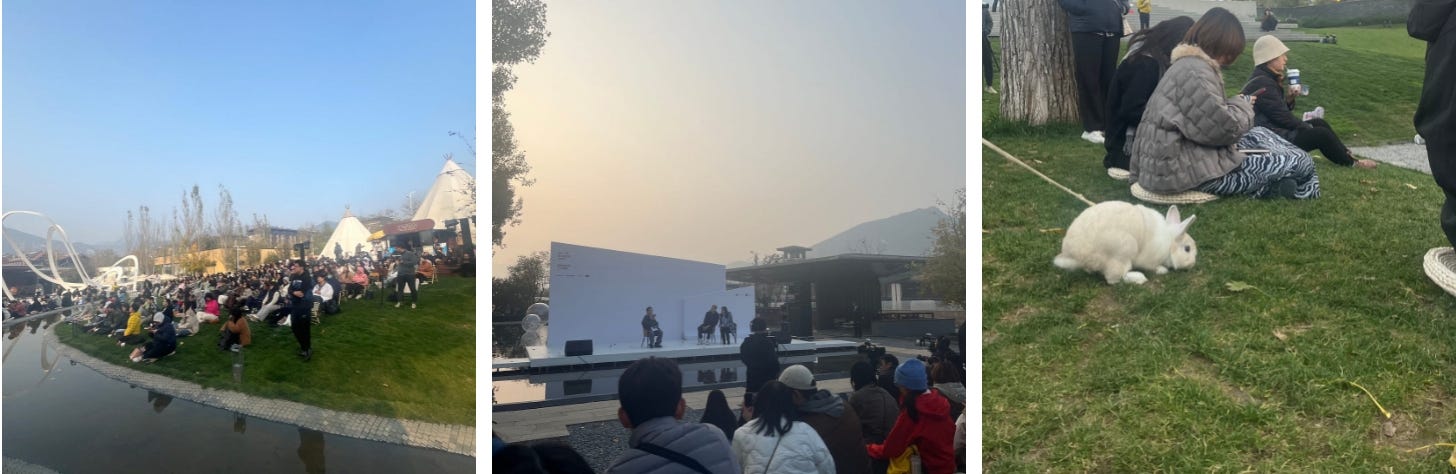
At the 单向街书店文学节 held in a Mentougou park.
随笔 // Suibi // Notes
Sharing thoughts or resources related to my work as a correspondent
1. Thirty years of feminism
Until recently, all I knew about the 1995 UN Women’s Conference in Beijing was that it was one of the first international summits China hosted, and that Hilary Clinton attended. But working on a story on the 30-year anniversary of the summit, which was officially commemorated a few weeks ago, I learnt so many interesting things. Like the fact that, in terms of its impact on Chinese society, an enormous NGO forum preceding the summit, attended by 31,000 people including over 25,000 foreign attendees from feminist NGOs worldwide, was arguably more important than the summit itself. The forum, which was moved from the Worker’s Stadium to a venue in Huairou by nervous authorities, kickstarted a period of more collaboration between the government and a new wave of women’s rights and gender NGOs, working especially in rural areas. A key achievement of this period of activism is the domestic violence law, which, as feminist Feng Yuan has put it, was “proposed, pushed through, and ultimately passed thanks to the perseverance of women’s NGOs”.
Of course, much has happened since in China’s feminist movement, which might be the most active social movement in China today, despite growing repression in the last decade. I was grateful to talk to three women activists from different generations who helped me understand these trends, from the ‘NGO generation’ to Me Too, the online movement that, as the impressive Zhou Xiaoxuan told me, in China created the foundation for the more widespread gender awareness among young women today, to a more recent diaspora generation of Chinese-speaking feminist groups.
It turned out that some of these groups are actively celebrating the anniversary of the 1995 summit, and keeping its legacy alive. Louis, a Holland-based Chinese woman in her twenties, participated in an online group commemorating it by reading the work of Chinese feminists together. “It is incredibly important to recognize that we have our own feminist genealogy,” she said. “We should not just read Judith Butler and bell hooks, but also our own people, even if for political reasons they are less visible. Like Li Xiaojiang, Lü Pin, or Feng Yuan.”
For more on this, I recommend this 歪脑 interview with Feng Yuan, which notes that we should not “带着玫瑰色滤镜打量过去,” and this excellent Substack by young journalist Wanqing Chen, who also participated in the reading group and discusses the ideas of Chinese feminists like 李小江 and 高小贤, both of whom passed away this year, in more detail in a series of articles. I am very happy to say that Wanqing has recently started working with me part-time and collaborated on this story with me.
2. Friends and foes
About two years ago, I defended my PhD dissertation on China’s immigration policymaking at Leiden University. My thesis recently became available open-access for anyone who might be interested in it. In the conclusion I try to address some broader questions like whether speaking of ‘immigration’ makes sense in the Chinese context. I have always felt a bit caught between media and academia – and would not recommend anyone to embark on a fieldwork project studying the Chinese state right now – but I am grateful I had the chance to research such a globally urgent topic, at a time when Chinese authorities are starting to realize immigration is here to stay.
Recent policy developments fit with the patterns I found in my research. Like the nationalist uproar around the recently announced K-visa for ‘talent’, which was similar to the large online response to somewhat more liberal permanent residency regulations in 2020. People familiar with the Chinese immigration authorities know that this new visa is bound to be implemented in a risk-averse, cautious manner. But without public education or much reliable information about immigration in China available, knowledge levels on the country’s migration policies are low, while state media tend to exaggerate policy impact. In addition to China’s well-known online nationalists, in my research I also identified a moderate majority, many of whom held views on issues like permanent residency for foreign nationals living in China that were more liberal than current policy.
I also recommend this new open-access handbook on migration to China, and to which I have contributed. Its range of topics – from student mobility to expatriate children and refugee migration – and authorship reflects the vibrant transnational research that has emerged on this subject over the last 15 years.
点赞 // Dianzan // Likes
Recommendations in and out of the news cycle
A good story by 食通社 on farmers in Hebei, Henan and surrounding provinces who, after a very dry summer, had to deal with the heaviest rains since 1961 and who now face a lot of trouble harvesting. See also this Sixth Tone article on the same topic, featuring a farmer called Zhen Rui who before this year had only seen floods on tv, reflecting the fact that these northern areas hardly ever experienced flooding prior to recent changes in climate. Given how many people must be affected by this year’s extreme weather, the topic seems to deserve more attention. (I did notice that “victims of natural disaster” were one of the only societal groups who received a mention in the recent Plenum communique.)
On 水瓶纪元, two impressive stories of daughters helping their fathers investigate complex labor rights violations: in the first article, Xie Jingjing finds the 黑砖厂 at which her father was forced to work for nine years, and in the second, “农村家庭的第一代大学生” Yang Mao secures compensation for her father’s work injury, helped by the recent Supreme Court interpretation of China’s social security law.
A great long-read by journalist Zhang Hanlu featuring 王姐, an impressive woman from Yunnan who is active in a union in Prato, Italy that is trying to bring the 40-hour work week to Chinese-owned textile factories there. Discussing another segment of Italy’s diverse Chinese migrant population, Zhaoyin Feng writes vividly about the Chinese baristas playing “a crucial role in keeping traditional Italian café culture alive” (nice pictures too).
Academic Shiyao talks to journalist Liu Min about the lawsuits she pursues to make companies more accountable. An entertaining listen on how to “测试法律使用的边界.”
Religion scholars Fenggang Yang and Jiayin Hu interviewed 22 Christian human rights lawyers in China, to explore what role their faith plays in their work. They also mention Zhang Zhan, whose faith does not usually feature in media coverage on her tragic case.
“当房子的「面子」开始跌落.” A worrying 人物 feature on Chinese building facades coming down due to age or the use of cheap materials.
Journalist and editor Jiang Yan on twenty years of working in cultural journalism in China. If you need some inspiration, you might also enjoy the 新京报社歌 she cites, which includes lines like: “我的纸里包着我的火/ 我的火种染出你的光/在风中在雨中在火中/在一切故事发生的时刻/在城市在原野在旅途/在任何苦难欢乐的现场.”
In The Diplomat, China sociologist Svetlana Kharchenkova writes about the subtle impact of geopolitics on the publication of books by U.S. authors in recent years. Short but packed with detail about how publishing in China works.
A quantitative analysis of over 100,000 academic publications funded by the China Scholarship Council, the state channel that funds many Chinese PhD-researchers abroad and has become more politically contentious. It finds, among other things, that the proportion of CSC-funded publications related to dual-use research is low (around 0.5%).
And I haven’t been yet, but 北京友谊商店 recently reopened after a renovation. 新京报 praises the new look as being subtle for an SOE (“国有企业在城市更新中并非只能扮演“大拆大建”的角色”),with one of the main draws a parking lot turned park.
That’s it for now. Thanks for reading :)