

Throughout the growing season I will post information on different pests or issues I am seeing in our fields in Knox County. This week, not much happening in our fields due to the cold, wet weather. Below are a some to observations to keep an eye on.
Alfalfa Weevil
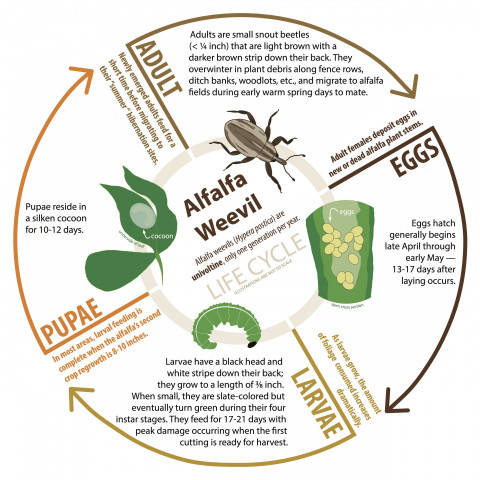
Even with the chilly weather we have experienced the last 2 weeks, we have accumulated enough growing degree days for alfalfa weevils to be active. These cold temperatures may have slowed feeding but the temperatures haven’t been cold enough to kill the weevil larvae. We are concerned that as soon as it warms they will speed up their feeding again with a vengeance. Scout your fields now, not when excessive feeding grabs your attention. Keep in mind that at a certain point, early harvest is preferable to treatment.
Click here for Alfalfa Weevil Scouting Guide
Here is a video about scouting weevils in alfalfa: https://forages.osu.edu/video
Alfalfa Weevil Update – C.O.R.N. Newsletter
Wheat

Even with chilly temps wheat is growing at a good pace. Most of our week is passing through Feekes 7 and is in (or soon will be ) in Feekes 8. As our wheat approaches Feekes 9 it is time to scout your fields and evaluate your stand/yield potential and determine if fungicide applications are warranted. 2023 Wheat Fungicide Ratings can be found in this post from earlier this week.



 lovers, campers, outdoors enthusiasts, and pet owners beware. If you thought last year’s tick season was bad, just wait. This year has the potential to be even worse.

 The USDA’s World Agricultural Supply and Demand Estimates (WASDE) report for April reveals a consistent picture of the old crop. Southern Latin American countries, such as Argentina and Uruguay, continue to suffer from drought damage, whilst other South American countries, such as Brazil and Paraguay, have a strong harvest outlook, which will likely lead to an increase in overall crop supply from South America compared to last year.

 When determining your herbicide program for spring applications, the stage of the wheat crop should be considered. The majority of wheat herbicides labeled for application at certain wheat growth stages have very short windows in which they can be applied. The popular broadleaf weed herbicides 2,4-D and MCPA are efficient and economical, but can only be applied for a short period of time between tillering and prior to jointing in the early spring. Wheat growth stages and herbicide timing restriction are outlined in a in a post last week (
