TAP Review (spring 2019)

The spring 2019 issue of the Trans Asia Photography Review is now available online at tapreview.org. (You may need to refresh your browser to view the new contents.) This issue, titled “Circulation,” features the following articles, book reviews, and interviews:

CIRCULATION

Clare Harris, “Creating a Space for Performing Tibetan Identities: A Curatorial Commentary”

Kevin Michael Smith, “Images Under Construction: Photomontage in Interwar Europe and Japan”

Yiwen Liu, “Witnessing Death: The Circulation of Lu Xun’s Postmortem Image”

Russet Lederman, “Photobooks by Women from Asia: A Conversation with Amanda Ling-Ning Lo, Miwa Susuda, and Iona Ferguson”

Chen Shuxia, Zhou Dengyan, and Shi Zhimin, “Photographic Praxis in China, 1930s-1980: A Conversation with Chen Shuxia, Shi Zhimin, and Zhou Dengyan about Shi Shaohua and the Friday Salon”

Erin Hyde Nolan, “The Gift of the Abdulhamid II Albums: The Consequences of Photographic Circulation” Continue reading TAP Review (spring 2019)

Gushi FM

Source: NYT (5/12/19)
In China, a Podcast Inspired by ‘This American Life’ Gives Voice to the Real
By Amy Qin

Kou Aizhe, creator and host of the Chinese storytelling podcast “Gushi FM,” says his goal is “to show the complexity of each person.” Credit: Yan Cong for The New York Times

BEIJING — Kou Aizhe, the creator and host of one of China’s most popular storytelling podcasts, has only one criterion for selecting stories.

“Any subject can work,” he said, “as long as it surprises me.”

What emerges is a collection of unusual stories told with an authenticity rarely heard in the country’s tightly scripted, propaganda-heavy state-run media.

A worker for a Chinese construction company describes a harrowing escape from war in Libya in an episode titled “I Shot an AK-47 at Them.” A young man recounts accompanying his ailing father to Switzerland to die by assisted suicide. A lesbian tells of her decision to enter a marriage of convenience to a gay man.

Taking inspiration from American programs like “This American Life” and WNYC’s “Snap Judgment,” Mr. Kou’s “Gushi FM” (Story FM in English) features stories told in the first person by ordinary Chinese of various backgrounds. Continue reading Gushi FM

Burying ‘Mr. Democracy’

Source: China Media Project (5/3/19)
BURYING “MR. DEMOCRACY”
By David Bandurski

Burying “Mr. Democracy”

Today, on the eve of the 100th anniversary of the May Fourth Movement, the political movement that arose out of student protests in Beijing in response to the Treaty of Versailles, “the youth” figure strongly in official propaganda. But as China’s leadership walks a tightrope, acknowledging this crucial anniversary while seeking to drain it of all hints of sanguine insurgence and youthful opposition (we are just weeks away from the anniversary of June Fourth), the story’s real protagonist is not China’s youth, but rather President Xi Jinping and the Party he leads.

The two most famous figures at the core of the “spirit” of the May Fourth Movement, Mr. Democracy and Mr. Science, are conspicuously absent. Continue reading Burying ‘Mr. Democracy’

Liao Yiwu chronicles the ‘thugs’ who survived Tiananmen

Source: Quartz (5/7/19)
A Chinese writer in exile chronicles the lives of the “thugs” who survived Tiananmen Square in 1989
By Isabella Steger

Among the ever-growing number of Chinese dissidents living in Berlin is writer Liao Yiwu, who escaped to safety in Germany in 2011.

Liao was imprisoned in 1990 for four years for publicly reciting his poem, Massacre, which was written on the morning of the Tiananmen Square crackdown on June 4, 1989, and dedicated to the victims. After he was freed, he wrote a number of books exploring the lives of the downtrodden in China, all of which are banned there. He continued to be subject to intense surveillance and travel restrictions after his release.

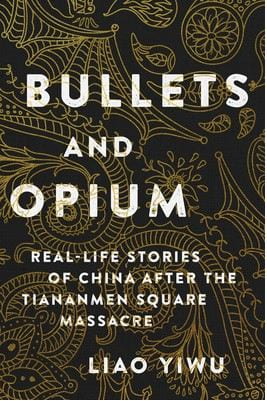
A month before the 30th anniversary of the Tiananmen Square crackdown, his book Bullets and Opium, a collection of stories of people who survived the incident, will be published in English for the first time. It was previously published in Taiwan and Germany, and will this year also be translated into Japanese and French.

The stories focus not on the student protesters whose names and experiences, Liao says, are well known, but on the lives of the ordinary, working-class citizens who bore the brunt of the army’s attacks. Liao details how these “thugs,” as they were labeled by the Communist Party, lived on the margins of society after they were released from prison, where they were subject to hard labor and torture. Liao is particularly interested in how this shaped love and sex for these men. “Many of those arrested were young men aged between 18 to 20. They never learned anything about women or relationships while they were in prison,” Liao told Quartz. “When they came out, the world had changed… And so, impotence became a common problem.” Continue reading Liao Yiwu chronicles the ‘thugs’ who survived Tiananmen

Wu Ming-yi at Pen World Voices Festival

Taiwanese writer Wu Ming-yi joins 2019 PEN World Voices Festival

The Taipei Economic and Cultural Office in New York is pleased to announce that Taiwanese writer Wu Ming-yi will join two events at the 2019 Pen America World Voices Festival in New York from May 6 to 12.

Tuesday, May 7, 6:30-8:00 pm
“Meditations on War, presented with The Guardian”
Venue: Albertine (972 5th Avenue, New York, NY 10075)

Wu joins Laurent Gaudé (Hear Our Defeats) and Sinan Antoon (The Book of Collateral Damage) for a discussion on how humanity endures the memories of war and struggles to rebuild. Moderated by Julian Borger, world affairs editor for The Guardian.

Thursday, May 9, 6:30-10:00 pm
“Literary Quest: Westbeth Edition”
Venue: Westbeth Artists Housing and Center for the Arts (55 Bethune St., New York, NY 10014)

Salon-style readings and discussions led by Festival authors at the Westbeth Center for the Arts. Wu will read selected passages from his book The Stolen Bicycle.

For more information, please visit PEN World Voices Festival.

Posted by: Yu-Kai Lin carlos.yukai.lin@gmail.com

Tiananmen anniversary picket

Tiananmen Square Massacre
30th Anniversary Picket
London, June 1

On 15th April 1989 Hu Yaobang, the General Secretary of the Communist Party of China died from a heart attack. Students, who had been preparing to commemorate the ‘May 4th Movement’ of 1919 brought forward their demonstrations in response. By 17th April students marched from their universities into Tiananmen Square in the heart of Beijing, chanting pro-democracy slogans as they went. An indefinite student strike was started in Beijing and the protest spread to over 100 cities across China. At its peak over one million people were occupying the square.

With conflicting demands and with individual students bickering for leadership roles, the students attempted to negotiate with different factions within the Party leadership. In response to the failure of these talks, some students declared a hunger strike and this action galvanised support from other sections of the population. Continue reading Tiananmen anniversary picket

Simon Leys: Navigator between Worlds review

Source: Commonweal (5/6/19)
The Generalist: Philip Paquet’s ‘Simon Ley’
Reviewed by Nicholas Haggerty

Simon Leys: Navigator between Worlds
Philippe Paquet
Translated by Julie Rose
La Trobe University Press, $59.99, 692 pp.

Mathew Lynn, Portrait of Pierre Ryckmans (Simon Leys), 2010 (Courtesy of the artist)

In the second half of the twentieth century, the definition of a public intellectual underwent a gradual but profound change, as generalists gave way to academic specialists. Sinology makes for the perfect case study of this transition. From its origins in the Jesuit missions until the mid-twentieth century, sinology favored breadth over depth; it presumed that an individual scholar could take the whole of Chinese civilization—including its language, art, and history—as his or her subject. This romantic way of approaching the study of China came to an end during the Cold War as sinology, at least in the United States, was fully assimilated into the academic field of China studies. Within this field, there were major disagreements on the proper relationship between scholarship and American foreign policy—but there was, at least, fundamental agreement about what kind of research and books counted as genuine scholarship. As the study of China was professionalized, those who did not specialize were generally looked down upon as dilettantes. Continue reading Simon Leys: Navigator between Worlds review

Indiescape HK and the Post-Handover Film World–cfp

Ex-position Feature Topic Call for Papers
(Guest Editor: Kenny Kwok Kwan Ng, Hong Kong Baptist University)
Publication Date: December 2019 (Issue No. 42)
Submission Deadline: July 1, 2019

“Independent cinema” in Hong Kong has gained much currency both in academia and in film production and reception circles since the 1997 handover. Despite the fact that the term itself is frequently invoked in critical discourse and film festival programming, the meanings and contours of independent cinema as it is practiced in Hong Kong remain a matter of debate, except for the general consensus that being “independent” in moviemaking confers a disposition of distancing from the mainstream film industry in terms of styles, genres, modes of production and exhibition, financing, or public reception. Independent filmmakers can be bona fide auteurs who have greater control over the subject matter and stylistic choices of their works compared with their mainstream counterparts. Still, creative autonomy is never absolute and always comes with a cost. Filmmakers have to play by the rules of the emerging habitus of independent cinema, while the dynamic and ambivalent exchanges between independent and mainstream cinema are constantly at play in Hong Kong when an independent filmmaker (or film) enters mainstream production and circulation. Continue reading Indiescape HK and the Post-Handover Film World–cfp

Finding a voice

Source: China File (3/28/19)
Finding a Voice
By Lü Pin(吕频)

Lü Pin is a Chinese feminist activist focusing on strategic advocacy to combat gender-based discrimination and violence. She started her work on women’s rights in the late 1990s. In 2009, she founded Feminist Voices, China’s largest new media platform on women’s issues. Since 2012, she has been devoted to supporting the activism of young feminists across China. She now resides in Albany, New York, where she continues to follow the feminist movement in China closely.

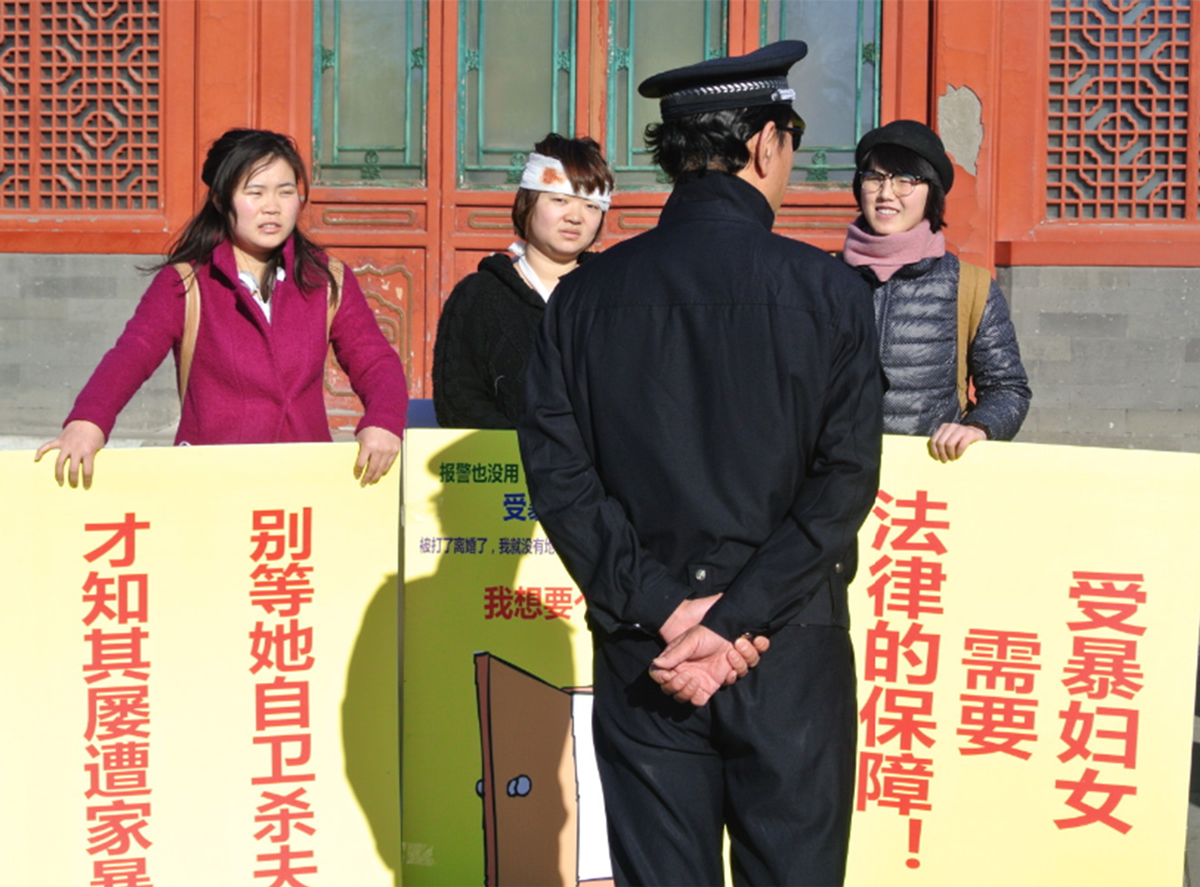
(Courtesy of Chinese Feminist Activists) A protest against domestic violence in China, 2013.

[This article was first published in the “China” issue of Logic, a magazine about technology.]

When I started writing this article, Feminist Voices had been deleted for six months and ten days. Yes, I have been keeping track of the time: ten days, fifteen days, thirty days, sixty days, three months, six months. . . The first week after it disappeared from the Internet, my heart was filled with mourning; every day I lay in bed and cried. As time went by, I seemed to see a figure drifting away, but her soul was still near me. And her name will always linger in my mind. Continue reading Finding a voice

Games and Play in China–cfp

Dear all,

A friendly reminder that the abstracts for the edited volume “Games and Play in China from the Early Modern to the Contemporary” are due by May 15, 2019. Interested authors, please submit chapter proposals of 500-750 words to Douglas Eyman <deyman@gmu.edu>, Hongmei Sun <shongmei@gmu.edu>, and Li Guo <li.guo@usu.edu>. Please see the following for details.

CFP: Games and Play in China from the Early Modern to the Contemporary
Editors: Douglas Eyman, Li Guo, and Hongmei Sun

The editors of this volume invite submission of chapters that address the ‘cultural rhetorics of gaming’ – that is, the ways in which games inhabit, represent, disrupt, or transform cultural and social practices in specific contexts. Scholarship on games and gaming has proliferated across a number of fields, including game studies, rhetoric and writing, translation studies, and education, among others. Gaming is fast becoming a nearly ubiquitous activity with global reach (particularly digital gaming – but not just limited to online activity, as increased sales of board games and role-playing games attest). The central argument in this collection is that games operate as cultural agents specific to their temporal and ecological contexts. Games are connected to the times in which they were invented, and represent the cultural functions of that time, but also continue beyond the moment of origination and connect past concerns to those in the present. Changes in the context of games – transcultural transformation – can demonstrate relationships between and among disparate cultures, as represented through game adaptations. In a similar vein, games also interact with other media, including literature and film, in ways that convey cultural value. Continue reading Games and Play in China–cfp

Founding of the Society of Sinophone Studies

Founding the Society of Sinophone Studies
May 4, 2019

Following the successful “Sinophone Studies” conference held in April of this year at the University of California, Los Angeles, we announce the formation of the Society of Sinophone Studies to promote the study of Sinitic-language communities and cultures around the world. The Society seeks to provide support for scholars with an interest in Sinophone studies and welcomes any regional, disciplinary, and topical expertise. More details about the Society will follow; please contact Howard Chiang (hhchiang@ucdavis.edu) for preliminary inquiries.

Inaugural Governing Board

Chair: Howard Chiang, University of California, Davis 
Vice Chair: E.K. Tan, Stony Brook University
Secretary-Treasurer: Rebecca Ehrenwirth, New York University Shanghai 
Program Director: Brian Bernards, University of Southern California
Communications Director: Lily Wong, American University

Posted by: E.K. Tan <EngKiong.Tan@stonybrook.edu>

Bulletin of the Institute of Modern History, no. 103

The latest issue of Bulletin of the Institute of Modern History, Academia Sinica, Vol. 103 is now available online at: http://www.mh.sinica.edu.tw/bulletins.aspx

[Articles]

Mysteries over the “Famous Thirteenth Article”: Controversies Arising from the Supplementary Treaty Signed by China and Britain in 1843
By Lawrence Wang-chi Wong

Gentry Power and Trust Crisis in Late Qing Jiangnan: A Case Study of Changshu
By Xiaoxiang Luo

Qian Mu’s Road to Academia Sinica Academician
By Chi-shing Chak

[Book Reviews]

Yu Miin-ling, Shaping the New Man: Chinese Communist Party Propaganda and the Soviet Experience, Reviewed by Mao Sheng

Posted by: Jhih-hong Jheng <bimhas60@gmail.com>

Reading and Circulation of Texts after Censorship–cfp

I am circulating this CFP on behalf of the organizers, who are eager to see proposals on China-related topics enter the conversation.–Sebastian Veg<veg@ehess.fr>

NIHIL OBSTAT: Reading and Circulation of Texts After Censorship
NYU Global Studies Center, Prague: 17-19 October 2019
www.hsozkult.de/event/id/termine-39576

Literary scholars, sociologists, and historians have long explored the processes and ideology of censorship as well as the histories of the censors themselves. Pre-publication censorship practices and the institutions of church and state that foster them have dominated the field of study. Fewer efforts have taken texts after the fact of censorship or have detailed their further intellectual, cultural, and social trajectories. But as Deleuze wrote in Negotiations (1995), “Repressive forces don’t stop people expressing themselves, but rather force them to express themselves.” While censorship takes various forms, many of them violent, it has tended toward failure, and historically the experience of censorship amongst groups as disparate as 17th century Puritans and 20th century Lithuanian poets is often deeply instructive in the means of subversion, publication, and dissemination. Censorship has informed collecting practices, as with Thomas James, who used the Catholic Index Librorum Prohibitorum to dictate the acquisitions policy of the Bodleian library from the late 16th century onward. Censorship creates new relationships between people and places because it is enforced differently from country to country, even from building to building; for example, in 1984 when the police raided Gay’s the Word bookshop in London to confiscate “obscene” imported books by Oscar Wilde, Tennessee Williams, Kate Millet, and Jean-Paul Sartre, the same titles remained available for loan at Senate House Library a few streets away, and UK publishers continued to publish the same authors unpunished. In the spirit of these examples, this conference seeks to foster an interdisciplinary conversation broaching a larger number of underexplored issues that begin only after the moment of censorship—the excess of argument, collaboration, revision, and in many cases, creative thinking, that are given shape by the experience of suppression.

We are pleased to announce that Hannah Marcus (History of Science, Harvard University) and Gisèle Sapiro (Sociology, Centre national de la recherche scientifique / École des hautes études en sciences sociales) will deliver respective keynote addresses each evening of the conference

This conference aims to be as broad as possible in its geographical, historical, and disciplinary range. The organizers welcome applications from anthropologists, bibliographers, classics scholars, comparative literature scholars, gender studies scholars, historians, philosophers, sociologists, and those within allied fields, including library and information sciences and the publishing industry. The working language of the conference will be English, but participants are naturally encouraged to present research completed in any language(s). The goal of the conference will be to publish the proceedings in a collective volume.

Applications should consist of a title, three-hundred word proposal, and one-page CV, due on May 31, 2019. Accommodations will be available for participants and some funds may be possible for travel assistance within continental Europe.

Possible topics include:

  • The reception history of expurgated, bowderlized, and censored texts
  • The social history of reading censored and samizdat editions
  • The impact of ‘market censorship’ on the rise of small, independent or clandestine publishing establishments.
  • Religious communities formed around mutual practices of censorship
  • The history of translation vis-à-vis censored texts
  • Publishing within colonized spaces
  • Canonical texts’ reception vis-à-vis censored editions
  • Strategies for circumventing censorship, i.e. scribal publication and xerography
  • Scientific and medical pedagogical traditions employing censored texts
  • Teaching censored texts: period pedagogy and teaching practices today
  • The contingencies of space and geography in censorship practices and the international circulation of censored texts
  • ‘Asymmetric’ publication or the coordination of censored and uncensored editions
  • The changing status of texts from uncensored to censors, and the inconsistent enforcement of banned items
  • Textual histories of self-censored texts and later full republication
  • Reversing censorship
  • Bibliographical challenges in book description
  • Publishing, marketing, and openly advertising censored texts
  • Hermeneutic and exegetical concerns facing censored or expurgated texts
  • Classical scholarship built upon expurgated texts and embedded polemical citations

In order to apply, please send the materials detailed above to Brooke Palmieri and John Raimo by May 31, 2019: bspalmieri@gmail.com and john.raimo@nyu.edu.

Kontakt

John Raimo, NYU Department of History, KJC Center, 53 Washington Square South 4E, New York, NY 10012
john.raimo@nyu.edu

May 4, the day that changed China

Source: NYT (5/3/19)
May Fourth, the Day That Changed China
Protests in 1919 propelled the country toward modernity. One hundred years later, the warlord spirit is back in Beijing.
By Jeffrey N. Wasserstrom
Mr. Wasserstrom is a history professor specializing in China.

A sculpture dedicated to the May Fourth Movement, in Beijing, in 2005.CreditCreditFrederic J. Brown/Agence France-Presse — Getty Images

IRVINE, Calif. — In Chinese, mentioning just two or three numbers can be enough to bring to mind a major historical event. Say “Jiuyiba” (nine-one-eight), and your listeners will know you have in mind not just any Sept. 18, but the one in 1931, when Japanese military officers in Mukden, northeastern China, faked the sabotage of a Japanese-owned railway to give Japan a pretext to invade the whole region. Or say “Wusi,” five-four, and any teenager will understand that you are talking about what happened exactly one hundred years ago this Saturday.

That day in 1919, a student protest took place in Beijing that set off what came to be known as the May Fourth Movement. Soon, similar marches were held in other Chinese cities, joined by members of other groups. The upheaval reached its apogee with a general strike in June that paralyzed Shanghai, then China’s leading industrial center and the world’s sixth-busiest harbor — and also partly under foreign control.

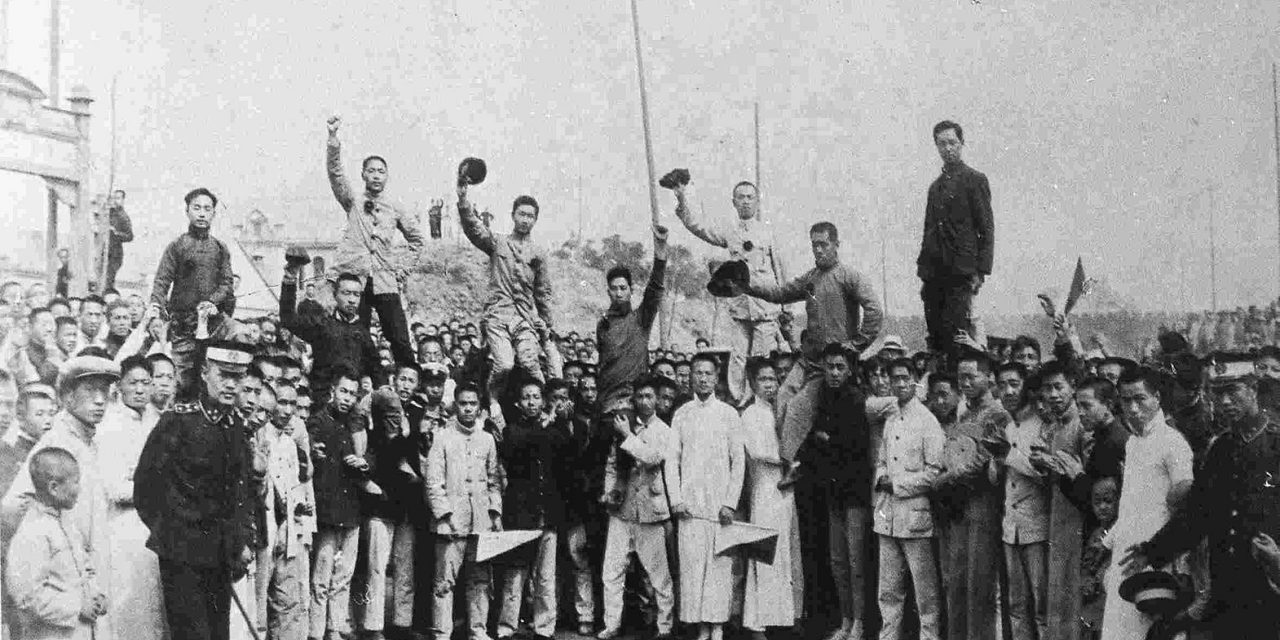
Most extant photographs of May 4, 1919, show several thousand students, men and women, in front of Tiananmen (The Gate of Heavenly Peace), a massive entryway to the Forbidden City, which had been the home of China’s imperial rulers until the 1911 Revolution toppled the Qing dynasty and the Republic of China was established. The demonstrators gathered in outrage over reports about negotiations underway in Versailles, just outside of Paris, over the terms ending World War I. Word was that the Allies planned to give former German territories in Shandong, eastern China, to Japan instead of returning them to China. Continue reading May 4, the day that changed China

Cantonese Connection workshop

Cantonese Connection: Periodical Studies in the Age of Digitalization

Periodicals played a major role in modern Chinese history: from propagating revolutionary ideas to promoting popular culture; with digitalization the studies of this otherwise too massive and ephemeral kind of literature have become more accessible than ever. “Cantonese Connection”, therefore, is a workshop bringing together local and overseas scholars to discuss various periodicals in this context, with a specific focus on the Cantonese-speaking area, including Guangzhou, Hong Kong and Macau.

The workshop is delighted to have Prof. Poshek Fu to give a keynote speech on “Chinese Student Weekly, Asia Foundation, and Hong Kong’s Cultural Cold War”.

Date :    17th -18th May 2019 (Friday – Saturday)
Venue:  Lee Ping Yuen Chamber (D801), 8/F, Lee Quo Wei Academic Building (Block D),The Hang Seng University of Hong Kong, Hong Kong
Time:    (Day 1) 09:30-17:45;  (Day 2) 09:30-12:55

Programme available at https://cgcs.hsu.edu.hk/2019-05-17-18cantonese-connection-periodical-studies-in-the-age-of-digitalization/

Posted by: Nga Li Lam <lamngali@gmail.com>