Good afternoon,
The 2019 planting season is one that will be remembered for a long time. Soils stayed wet from the April heavy rains through the month of May with persistent rainfall. Cool temperatures during these months did not aid drying of fields and kept most planters in the barn. A few small windows of opportunity existed for field work, but were short lived as constant rains returned. Fields were saturated most of the time, with several wet areas having ponding. This is a summary so far of the current planting season as described in the Extension Rainfall Report for May. For the time period of May 1-May 31, 2019 Extension rainfall reporters recorded an average of 5.12 inches of rain in Hardin County. Last year, the average rainfall for the same time period was 3.40 inches. Rainfall for May was 0.89 inches more than the ten-year average rainfall for the month. See the attached report for more information about rainfall received in Hardin County which has led to the wet June that we are experiencing now. Although the attached Ohio Crop Weather Report for June 17 has Ohio listed at 68% corn planted and 46% soybeans planted, I would suggest that Hardin County is lower than that. Some corn fields are up, although much corn is in wet, saturated soils or even ponded at the current time. I did see a field of soybeans in the first trifoliate stage in Goshen Township Friday, the first soybean field that I have noticed emerged.
June 17 Ohio Crop Weather Report
I am in the process of setting armyworm, black cutworm, European Corn Borer, and Western Bean Cutworm traps near corn fields around the county. Let me know if you would like a trap set near one of your fields to monitor these insect pest populations. The Hardin County OSU Extension Master Gardener Volunteers along with the assistance of the Men’s Garden Club are sponsoring “An Evening Garden Affair” on Monday evening, June 24 at the Friendship Gardens of Hardin County located at 960 W. Kohler Street in Kenton. The event is from 6 to 9 pm and will feature Sarah Noggle of OSU Extension-Paulding County with a program about how to grow vegetables with limited space. This event is free and open to the public, rain or shine with the program inside the HARCO workshop with seating and air conditioning. It will then move outside for a demonstration and questions. The guest speaker will begin at 7:00 pm so you will want to mark this event on your calendar if you or someone you know is interested in vegetable gardening. I have included both a news article and a flyer with more information about the event attached to this email.
An Evening Garden Affair News Release
An Evening Garden Affair Flyer
On Friday, July 12 the Ohio Forage and Grassland Council (OFGC) will offer a farm tour beginning in Jackson County and traveling through Ross and Vinton Counties to sheep farms in South Central Ohio. This tour will take place the day before Ohio Sheep and Hay Day at the Jackson Agricultural Research Station on Saturday, July 13. See the attached news release and flyer for more information about how you can register to participate in one or both of these upcoming events. Other local event in the next week or so include a Soil and Water Conservation District meeting at the SWCD office starting at 7:30 am on Thursday, June 20; and I plan to discuss the current crop situation with Dennis Beverly of WKTN at 7:30 am Saturday, June 22 on 95.3 FM as part of the “Public Eye” radio program. Until then, I have included some ag crops articles below. June 20 is the prevented planting date that is coming up for soybeans so be sure to read the information provided about this option for farmers who have crop insurance coverage.
Mark

Mid to Late June Prevented Planting Decisions – Ben Brown, Sarah Noggle, Barry Ward
Consistent rains across Ohio and the Corn Belt continue to delay planting progress as the June 17 USDA Planting Progress report showed that 68% of intended corn acres and 46% of intended soybean acres have been planted in Ohio. Nationwide, roughly 27 million acres of corn and soybeans will either be planted or filed under prevented planting insurance. Across Ohio, the Final Plant Date (FPD) for soybeans is June 20. Soybeans can be planted after the FPD, but a one percent reduction in the insurance guarantee occurs. This brief article outlines economic considerations for soybean prevented planting under three scenarios: planting soybeans on corn acres, planting soybeans late, and taking prevent plant soybeans. There are three sections to this article: a brief market update on corn and soybeans, a policy update on Market Facilitation Payments, and then finally the scenarios listed above. This article contains the best information available as of release, but conditions may change. Farmers should check with their crop insurance agents when making prevented planting decisions. OSU Extension is not an authorizing body of federal crop insurance policies. Read the rest of this article at https://agcrops.osu.edu/newsletter/corn-newsletter/201918/mid-late-june-prevented-planting-decisions.
Don’t leave your fields naked if taking the prevent plant option on corn and soybean ground – Farms underwater won’t have a choice but farmers still have options – Sarah Noggle, Alan Sundermeier
It’s been a rough spring for much of Ohio and the counties that have received the most rainfall typically have less than 20% of the county planted. Many unplanted acres remain across the Corn Belt and in Ohio. The decision to plant or not to plant still lingers in a farmer’s mind. Farmers truly want to plant but with the June 20 deadline for planting soybeans or declaring prevent plant, many farmers will be taking the prevent plant option. Additionally, on the acres not planted, weed pressure is becoming more and more of a problem. Prevent Planted fields should not be left bare/naked. Without competition for sunlight, weeds will continue to germinate and grow to create a weed seed bank for many years to come. Soil erosion on bare soil can occur even on flat fields. Therefore, make a plan to prevent planted fields: control weeds first to prevent seed set, if the soil surface is uneven, then tillage should only be done when soil is dry to avoid compaction. Cover crops can then be sown which will protect the soil until 2020 crop planting. Read more about this topic at https://agcrops.osu.edu/newsletter/corn-newsletter/201918/don%E2%80%99t-leave-your-fields-naked-if-taking-prevent-plant-option-corn.

Don’t Delay Wheat Harvest (Well…If the weather cooperates) – Laura Lindsey, Pierce Paul
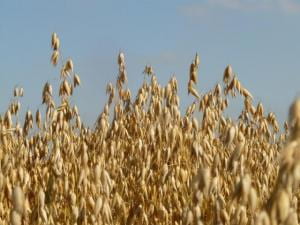
Wheat harvest date impacts both grain yield and quality. Delaying wheat harvest puts the crop at risk for increased disease, vomitoxin contamination, lodging, sprouting, and harvest loss. With funding from the Ohio Small Grains Marketing Program, we conducted wheat harvest date trials for three years. However, none of the years were similar to what we are experiencing this year. The biggest impact on wheat grain yield and quality seems to occur when the dry grain is re-wetted in the field prior to harvest. In 2016 in Clark Co., we evaluated wheat harvested on June 29 (at 12% moisture content) and July 8 (at 14% moisture content). Grain moisture increased between June 29 and July 8 due to 0.58” rain between the two dates. When the wheat harvest was delayed until July 8, yield decreased by 9 bu./acre, test weight decreased by 2.9 lb./bu., and vomitoxin level increased by 0.86 ppm. Using a grain price of $4.50/bu. and discounts from a local elevator, the difference the delayed wheat harvest resulted in a loss of $87/acre compared to the June 29 harvest. Click on https://agcrops.osu.edu/newsletter/corn-newsletter/201918/don%E2%80%99t-delay-wheat-harvest-well%E2%80%A6if-weather-cooperates to finish reading this article about harvesting wheat.
It’s All About the Weed Seedbank – Part 2: Where Has All the Waterhemp Come From? – Mark Loux
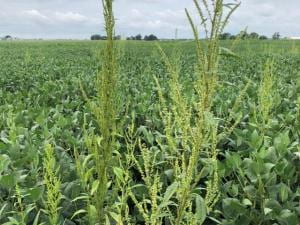
Weed populations are constantly shifting, in response to the pressure from our cultural and herbicide use practices, and how good our management of weeds is (or isn’t). Two weeks ago in CORN, we wrote about the apparent decline in marestail in parts of the state, although in subsequent communication we heard fairly clearly that not everyone’s populations had declined yet. And there is bad news – waterhemp is spreading at a rapid rate, and it’s a considerably more challenging pest than marestail for several reasons. The question really is – why has waterhemp taken off over the past several years? And not Palmer amaranth which we were more worried about? The difference may be is the initial source of the infestations as much as anything. We did not know of any Palmer in the state prior to 2011 when we became aware of an infestation near Portsmouth. We think of Palmer as still coming almost exclusively from distinctly new introductions, deriving from outside the state. Go to https://agcrops.osu.edu/newsletter/corn-newsletter/2019-12/it%E2%80%99s-all-about-weed-seedbank-%E2%80%93-part-2-where-has-all-waterhemp to read more about waterhemp.

Agronomic Field Day June 20 – Alan Sundermeier
The Northwest Ag Research Station will be hosting a field day on June 20 at 9 am emphasizing “Lake Friendly Farming Research”. Topics include Soil Drainage research, precision fertilizer placement, ultra-early corn, manure nutrient balancing, and soil health. Management of prevented planting fields will also be discussed. RSVP for lunch, no cost to attend. See the flyer or www.wood.osu.edu for information. Some topics have been changed since this writing as a result of the weather events that have happened this planting season. There will be no wagon tours as part of this special field day.
Mark A. Badertscher
Agriculture and Natural Resources Educator
OSU Extension Hardin County
1021 W. Lima Street, Suite 103, Kenton, OH 43326
419-674-2297 Office
hardin.osu.edu