Denise Ho arrested

Source: The Guardian (12/29/21)
Denise Ho: the Cantopop star and pro-democracy activist arrested in Hong Kong
The singer, who was swept up in a raid on people linked to StandNews, has been an outspoken critic of Beijing for years
By Rhoda Kwan in Taipei

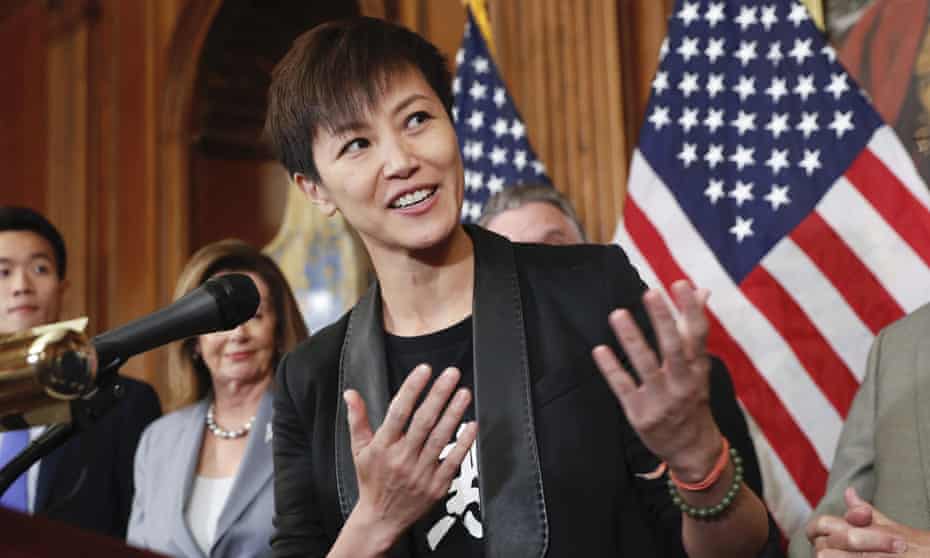
Denise Ho in Washington in 2019 where she gave evidence to Congress about human rights abuses in Hong Kong.

Denise Ho in Washington in 2019 where she gave evidence to Congress about human rights abuses in Hong Kong. Photograph: Pablo Martínez Monsiváis/AP

The arrest of Cantopop star Denise Ho in a raid on reporters and prominent figures linked to the Hong Kong media outlet StandNews has shocked her many fans in the city and around the world.

The artist, who is also a Canadian citizen, was taken from her home in Hong Kong on Wednesday for allegedly conspiring with five others to publish seditious materials in her role as a former director of the independent news provider.

Ho’s arrest marks the first time a pop star of global renown has been detained in Hong Kong for a political crime after Beijing imposed a national security law 18 months ago in response to months of pro-democracy protests in 2019. Continue reading Denise Ho arrested

HK police raid Stand News site

Source: NYT (12/28/21)
Hong Kong Police Raid Office of Pro-Democracy News Site and Arrest 7
阅读简体中文版 | 閱讀繁體中文版
Those arrested, including current and former senior staff members of Stand News, were accused of conspiring to publish seditious material. The news site announced it would shut down immediately.
By 

The acting editor in chief of the news website, Patrick Lam, was escorted from his home by police officers on Wednesday.

HONG KONG — Hundreds of Hong Kong police officers arrested seven people connected to an outspoken pro-democracy news website and raided the site’s headquarters on Wednesday, in yet another government crackdown on the city’s once-vibrant independent press.

Within hours, the site, Stand News, announced that it would shut down immediately, and its website and social media pages would be deleted within a day. All employees were dismissed.

“Stand News’s editorial policy was to be independent and committed to safeguarding Hong Kong’s core values of democracy, human rights, freedom, the rule of law and justice,” the announcement said. “Thank you, readers, for your continued support.”

The seven were arrested on suspicion of conspiring to publish seditious material, according to the police. A senior official, Steve Li, accused the publication at a news conference of publishing “inflammatory” content intended to incite hatred toward the government and the judiciary, especially through its coverage of the city’s fierce pro-democracy protests in 2019. Continue reading HK police raid Stand News site

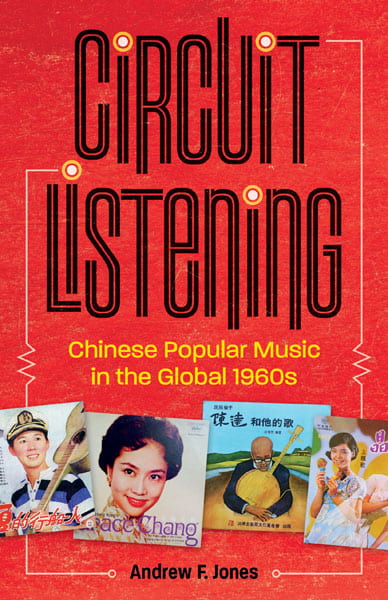
Circuit Listening review

MCLC Resource Center is pleased to announce publication of Jeroen de Kloet’s review of Circuit Listening: Chinese Popular Music in the Global 1960s, by Andrew F. Jones. The review appears below and at its online home: https://u.osu.edu/mclc/book-reviews/circuit-listening/. My thanks to media studies book review editor Jason McGrath for ushering the review to publication.

Kirk Denton, MCLC

Circuit Listening:
Chinese Popular Music in the Global 1960s

By Andrew F. Jones


Reviewed by Jeroen de Kloet

MCLC Resource Center Publication (Copyright December, 2021)


Andrew F. Jones, Circuit Listening: Chinese Popular Music in the Global 1960s Minneapolis: University of Minnesota Press, 2020.
304 pp. ISBN: 978-1517902070 (paper); ISBN 978-1517902063 (hardcover)

Allow me a rather unconventional and slightly self-indulgent opening to this book review. I read most of this book during a three-week quarantine in a hotel in Hong Kong. To keep fit, I would do some body combat exercises in the mornings. One online teacher, named Dan, would tell me that this lesson is all about connection, about connecting to the music, to your body, to others, and to the movements. That message is strikingly in-tune with the focus of Andrew Jones’s book Circuit Listening: Chinese Popular Music in the Global 1960s. And it is a powerful message, captured so well in the key concept of this book: circuit listening. The book explores musical cultures in Mainland China, Hong Kong, and Taiwan, in the 1960s and beyond, alternating rich empirical detail with lucid theorizations that hark back to globalization theory, popular music studies, and China studies. It presents an outstanding cultural history that helps to de-center the West and powerfully shows how cultural production is always already a form of cross-contamination, cross-fertilization, and creative entanglement, in the Sinophone world as elsewhere. Continue reading Circuit Listening review

Jonathan Spence dies at 85

Source: NYT (12/27/21)
Jonathan Spence, Noted China Scholar, Dies at 85
His classes at Yale and well-regarded books explored China’s vast history through details that illuminated bigger pictures and themes.
By Neil Genzlinger

Jonathan D. Spence in 2001. A historian of China, his deeply researched books probed individual lives and odd moments that were representative of larger cultural forces, wrapping it all together with vivid storytelling. Credit…Misha Erwitt for The New York Times

Jonathan D. Spence, an eminent scholar of China and its vast history who in books like “God’s Chinese Son: The Taiping Heavenly Kingdom of Hong Xiuquan” (1996) and “The Search for Modern China” (1990) excavated that country’s past and illuminated its present, died on Saturday at his home in West Haven, Conn. He was 85.

His wife, Annping Chin, said the cause was complications of Parkinson’s disease.

Professor Spence, who taught for more than 40 years at Yale University, where his lecture classes were always in great demand, found the big picture of Chinese history in small details. His books, deeply researched, probed individual lives and odd moments that were representative of larger cultural forces, wrapping it all together with vivid storytelling.

“This is a delicate spider’s web of a book, deft, fascinating and precise as Chinese calligraphy,” Diana Preston wrote in The Los Angeles Times in a review of his “Treason by the Book” (2001), about a scholar who challenged the third Manchu emperor in the early 1700s. “It is also unnerving because it conjures so much that still resonates.” Continue reading Jonathan Spence dies at 85

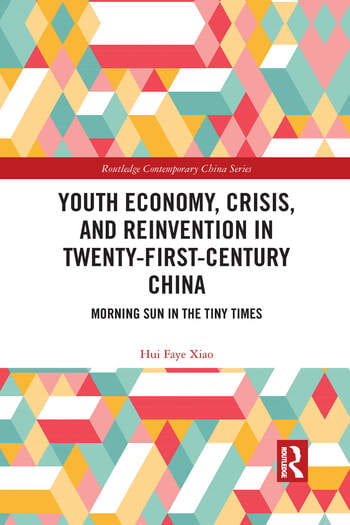
Youth Economy, Crisis, and Reinvention in Twenty-First-Century China

MCLC Resource Center is pleased to announce publication of Liang Luo’s review of Youth Economy, Crisis, and Reinvention in Twenty-First-Century China: Morning Sun in the Tiny Times, by Hui Faye Xiao. The review appears below and at its online home: https://u.osu.edu/mclc/book-reviews/youth-economy/. My thanks to media studies book review editor, Jason McGrath, for ushering the review to publication.

Kirk Denton, MCLC

Youth Economy, Crisis, and Reinvention in
Twenty-First-Century China: Morning Sun in the Tiny Times

By Hui Faye Xiao


Reviewed by Liang Luo

MCLC Resource Center Publication (Copyright December, 2021)


Hui Faye Xiao, Youth Economy, Crisis, and Reinvention in Twenty-First-Century China: Morning Sun in the Tiny Times London: Routledge, 2020. 236 pp. ISBN 9781032084695 (paperback); ISBN 9780367345518 (hardcover)

Hui Faye Xiao’s Youth Economy, Crisis, and Reinvention in Twenty-First-Century China: Morning Sun in the Tiny Times is an exciting and rewarding read. It is part of the Contemporary China series from Routledge, a series successfully bridging the social sciences and humanities. Xiao’s introduction and conclusion bind her central case studies together and offer a vision of hope amid competing trends of crisis and reinvention in what she calls the “youth economy” of twenty-first-century China.

In her introductory chapter 1, Xiao reads contemporary Chinese youth culture in the three keys of “youth economy,” “youth crisis,” and “youth reinvention.” Throughout her investigation, Xiao pays close attention to the agency, initiative, and creativity of the younger generation. She further highlights the power of the ongoing digital revolution in augmenting the self-expression and critical social engagement of Chinese youths. According to Xiao, the three keys of economy, crisis, and reinvention work together to best represent the dynamic interactions among different forces in the contemporary Chinese youth culture scene. First, “youth economy” emphasizes that Chinese youth culture, like any youth culture, is highly commercialized; situated in a roaring market economy under globalization, it also represents a departure from China’s socialist past, although historical continuities and resonances are important for Xiao’s nuanced articulations of the contemporary phenomena as well. Second, “youth crisis” refers to how the profit-driven neoliberal economy accelerates the division, differentiation, and fragmentation of Chinese youths along class, gender, ethnicity, educational, and regional lines. Third, “youth reinvention” articulates how the creative economy generates new opportunities for younger generations and may give birth to possible new youth subjects pushing forward social and cultural changes. Here the aesthetics and politics of youthful smallness, often associated with marginalized identities, emerge as central threads (23). Xiao insists on the creative potentials of the “small” identities, genres, and media studied in her book, arguing for their powers for coalition-building and reinvention among marginalized social groups. Continue reading Youth Economy, Crisis, and Reinvention in Twenty-First-Century China

Yi Sha holiday poem

A poem by Yi Sha, with two translations. More poems by different poets, please click on the link below the Chinese text. And three photos from my WeChat feed. One shows Yi Sha at the Qinghai Lake International poetry festival, I am not sure which year. I was there with him in 2015. Another picture shows Yi Sha’s desk at home, where he has just finished his historical novel on 李白.

Happy holidays!

Martin

Yi Sha
WEIHNACHTSERINNERUNG

Am Anfang der 1990er Jahre
hat die Stadt wo ich war
Weihnachten nicht gefeiert.
Die Uni wo ich unterrichtet hab,
eine Fremdsprachenhochschule, schon.
Parties in jedem Fach, jedem Jahrgang.
Studenten mit ausländischen Lehrkräften
singen in Fremdsprachen Weihnachtslieder.
Es weht aus den Fenstern des Lehrgebäudes,
klingt in Harmonie mit dem Schnee,
ob es schneit oder nicht.
Ich bleib stehen, hör zu,
spür Schönheit, Kultur,
das heilt meine frische Wunde im Herzen.

Übersetzt von MW am 24. 12. 2021

Yi Sha
CHRISTMAS MEMORY

At the beginning of the 1990s,
this town where I am
didn’t celebrate Christmas.
The college I taught at,
the foreign studies university, did.
Every class had their parties,
students and their foreign teachers.
Christmas carols in foreign languages,
wafting out from the classroom windows,
singing in harmony with the snowflakes,
whether it was snowing or not.
I stopped and listened,
feeling culture and beauty
closing the fresh wound in my heart.

Translated by MW, 12/25/21 Continue reading Yi Sha holiday poem

Growing up Uyghur in Xinjiang (1)

Fascinating and very valuable material — both Bruce Humes’ note, Sabina Knight’s article, and Patigül’s 2015 novel, Bloodline.

It would have been appropriate to add to the introductions, that soon after the novel under discussion was written and published (2015), not only has it become impossible to write and publish such novels, but mass internment camps have been set up for hundreds of thousand of Uyghurs and Kazakhs and others, who literally have the Chinese language forced down their throat in the camps — while being forbidden from speaking their native language, on pain of violent punishment.

It is even worse than what the novel and the discussion describe from before 2015. The new, draconian Chinese assault on Uyghur language and culture is part of the wide array of crimes of the ongoing Chinese genocide, which the authorities budgeted, planned and started up in 2017.  Indeed China is now a genocide country — and Chinese is the language of this genocide. It is Mr. Xi Jinping and his regime that have shamed the country this way, for generations to come, and he’s put an ugly stain on the Chinese language as such.

It’s like how my mother, after the Nazis invaded her native country in 1940, was forced to study German, until liberation in 1945. This was why even I was not able to choose German in school. I had heard her stories about how the Nazi occupier soldiers beat her and other defiant Norwegian kids, in the street. Unforgivable. And the legacy is still there. Poetry after Auschwitz?

So it is with China and Chinese now. The reason many around the world are abandoning the study of the Chinese language, is because of the mind-boggling atrocities being carried out. Just think of the camp guards beating people who could not memorize the glory to Xi Jinping fast enough, in mandarin Chinese.  Personally, I find it all profoundly revolting, to the point that it makes me regret ever learning Chinese.

I can hear the objections, that “yes but, there is still more to Chinese culture than the CCP regime” … I can only say, the stain is very deep, no amount of whitewashing will get it off. Can anyone now read Tang poetry without thinking of China’s 21st century genocide?

Only if there is an official Chinese state apology forthcoming for these atrocities and for the unfathomable arrogance, and a real Chinese reconciliation commission, I’ll find hope in that.

Magnus Fiskesjö <nf42@cornell.edu>
MLA 2022, East Asia-related panels

Jack Chen, current secretary and incoming chair of the MLA Pre-14th Century Chinese Forum, compiled a full list of Asian-related panels at the MLA 2022. Find the list below.

Best regards,

Liang Luo
Current secretary and incoming chair
MLA Modern and Contemporary Chinese Forum

MLA 2022: Sessions related to East Asia
(V) = virtual; (P) = in person

Thursday, January 6, 2022 / 12:00 PM – 1:15 PM

Decolonial and Indigenous Interventions in Japanophone Media and Literature (V)
Presider: Andrea Mendoza, U of California, San Diego

Presentations

Between Diversity and Assimilation: Revisiting Tadayoshi Himeda’s Ethnographic Documentary / Marcos Centeno-Martin, U of London, Birkbeck

Subversion and Transformation of Natural Landscapes in Medoruma Shun’s Decolonial Fiction / Andrea Boccardi, U of Leeds

Self-Discovery and Assimilation: Colonial Literary Modernity in Japanophone Taiwanese Literature / Ying Xue Liu, U of Maryland, College Park

Japanophone Literature: ‘The Question about Japaneseness’ / Paul McQuade, Cornell U Continue reading MLA 2022, East Asia-related panels

HK removes Tiananmen statue

Source: NYT (12/23/21)
Hong Kong Removes Statue That Memorialized Tiananmen Victims
The decision to take down the “Pillar of Shame,” an enduring symbol of the territory’s pro-democracy movement, was another sign of Beijing’s crackdown.
By Mike Ives

Workers removing part of the “Pillar of Shame” statue at the University of Hong Kong on Thursday. Credit…Anthony Kwan/Getty Images

The authorities in Hong Kong on Thursday removed a statue that memorialized those killed in the 1989 government massacre of pro-democracy demonstrators in Beijing, the latest crackdown on political dissent in the Chinese territory.

The 26-foot copper statue, known as the “Pillar of Shame,” was created by the Danish sculptor Jens Galschiot in 1996 and shows a pile of naked corpses arranged into what looks like a ghastly obelisk. It commemorates the June 4, 1989, massacre of pro-democracy students and workers around Tiananmen Square by the Chinese government.

The Tiananmen massacre is among the most delicate topics in Chinese politics and has been largely erased from history on the Chinese mainland. But for more than two decades, Mr. Galschiot’s statue was a symbol of the pro-democracy movement in a territory that enjoyed freedoms unimaginable in the mainland. Continue reading HK removes Tiananmen statue

Changpian 24

长篇 // Changpian // Longform

Welcome to the 24nd edition of Changpian, a selection of feature and opinion writing in Chinese. Changpian includes any nonfiction writing, from stories and investigations to interviews and blog posts, that I found worth my time — and that you might like as well. It aims to be relevant to an understanding of Chinese society today, covering topics in and outside the news cycle. The selection is put together by me, Tabitha Speelman, a Dutch researcher of Chinese politics. Feedback is very welcome (tabitha.speelman@gmail.com or @tabithaspeelman). Back issues can be found here.

Welcome to a new issue of what now seems an annual newsletter, if those still exist. Due to illness, I did not get to Changpian much this year, but I still save too many articles, and enjoy what I do read. This fall, Sixth Tone also kindly invited me to be part of their first “China writing contest” (see below for more). If you have had a look at the rest of the jury, you’ll be as surprised by that as I was, but I am grateful for the chance to reconnect to the topic – and perhaps be in your inboxes again occasionally. I hope you’ll like some of the stories in this issue. Wish you good things for 2022 (and maybe write a story!).

干货// Ganhuo // Dry Goods

In this section I highlight any (loose) themes that stood out in my recent reading.

在场

Late November, a jury of four announced the winners of the ““记者的家”新闻奖”, an interesting independent initiative held for the third time this year. In its category ‘public service reporting’, awards go to former journalist 褚朝新, whose WeChat articles on the detention of two well-known lawyers working on a case in northeast Liaoning aided their eventual release, and to the journalist who first captured with a drone the sea of flowers commemorating flooding victims at a Zhengzhou subway exit, and which authorities kept blocking from sight. (Another contender might have been the author of the impressive public spreadsheet connecting people in need with volunteers in the first 24 hours of the flooding.) Continue reading Changpian 24

Growing up Uyghur in Xinjiang

Source: Bruce-Humes.com (12/22/21)
Growing up Uyghur in Xinjiang: “Setting Sail in a Chinese-language World”
By Bruce Humes

In “China’s Minority Fiction,” Sabina Knight notes how China is pushing its ethnic minorities — particularly the Uyghur in Xinjiang — to master Mandarin:

“The question of cultural survival haunts Patigül’s Bloodline《百年血脉》(2015). The novel situates the narrator—who, like the author, is half-Uyghur and half-Hui—within the matrix of the Han majority’s aggressive promotion of Chinese:

As my father, he needed to demonstrate that he knew about Chinese, but . . . his knowledge was [just] bits and pieces he’d picked up from other Uyghurs in the village, and he still spoke Uyghur most of the time; I, on the other hand, went to a Chinese school and was setting sail into a Chinese-language world. (trans. Natascha Bruce)

The novel opens in Qochek, in the Kazakh autonomous prefecture of Xinjiang. Yet the protagonist soon leaves the city after a call from a voice claiming to be her older brother. Not sure it’s her brother, whose voice she hasn’t heard in five years, she nonetheless gives up her life in Xinjiang to go to Guangzhou. In this raw, wrenching, and at times brutal narrative, the protagonist’s search for her family members and their history encapsulates different possible futures for Uyghurs, especially assimilation, whether in Xinjiang or elsewhere in China.”

To read a short excerpt from Bloodline, visit here.

Translating Early Modern China review

MCLC Resource Center is pleased to announce publication of Lucas Klein’s review of Translating Early Modern China: Illegible Cities, by Carla Nappi. The review appears below and at its online home: https://u.osu.edu/mclc/book-reviews/translating-early-modern-china/. My thanks to our new book review editor for translations and translation studies, Michael Gibbs Hill, for ushering the review to publication.

Enjoy,

Kirk A. Denton, MCLC

Translating Early Modern China:
Illegible Cities

By Carla Nappi


Reviewed by Lucas Klein

MCLC Resource Center Publication (Copyright December, 2021)


Carla Nappi, Translating Early Modern China: Illegible Cities Oxford: Oxford University Press, 2021. 256 pp. ISBN: 978-0-19-886639-8 (Cloth)

“This is a history book” (vii), Carla Nappi writes at the beginning of Translating Early Modern China: Illegible Cities. Then: “this isn’t a history book” (viii). She’s right.

I find it a sad irony as a partisan of my discipline that historians are so often better than literary scholars at incorporating daring literary techniques into their scholarly writings—or into their conceptualizations of what it means to write scholarship. Nappi, for instance, has lectured and has a forthcoming book on the art of history as the art of the disc jockey (I think of David Bowie: “I am a DJ, I am what I play”). Even so, this history book is not only not a standard history book, it is also much more than a history book: it is a work of translation studies; it is an appeal to understand China beyond its obvious yet limiting relationship to the Chinese language; and it is a work of literature. In the medium of its mixture of these various aspects and more is its message about early modern China and translation. Continue reading Translating Early Modern China review

Struggling for historical truth

Source: China Media Project (12/20/21)
Struggling for Historical Truth
By David Bandurski
Late last week, Song Gengyi, a journalism teacher at a vocational college in Shanghai, was fired for making “erroneous remarks” on the number of victims of the 1937 Nanjing Massacre. Her firing prompted a fierce struggle online between those who saw her as a lacking patriotism and those who believed she was treated unfairly. But online censorship seems to have given the first group the upper hand.

Song Gengyi, a journalism instructor who was fired from her job at Shanghai’s Aurora College on December 16.

The firing on Thursday of a teacher at a vocational college in Shanghai who, according to state media made the “erroneous remarks” on the number of victims of the 1937 Nanjing Massacre, has prompted a fierce struggle online over the right to explore historical truths. But censorship by the authorities has effectively silenced voices in support of the teacher, sending the message that nuance about CCP orthodoxy on history will not be accepted – and that teachers should beware of student informants in the classroom.

The storm began on December 15 as a short video circulated online – apparently shared by a student “informant” – of a lecture in which Song Gengyi (宋庚一) questioned the 300,000 official number given by the Chinese government for the number of victims in the Nanjing Massacre, a tragedy that unfolded on December 13, 1937, as the Imperial Japanese Army captured the capital city of Nanjing during the Second Sino-Japanese War. Song made the remarks during her December 14 “News Interview” (新闻采访) course at Shanghai’s Aurora College, held the day after nationwide commemoration of the massacre’s anniversary.

On the afternoon of Thursday, December 16, the official Weibo account of the People’s Daily, the CCP’s flagship newspaper, weighed in on Song’s remarks. The tone of the post, which called the 300,000 number “iron-clad fact” (铁证如山), was severe. It said that Song was “errant as a teacher” (枉为人师) for “questioning historical truth,” and that she was “errant as a compatriot” (枉为国人) for “forgetting hardships and denying the evil deeds of another country.” Continue reading Struggling for historical truth

Feminisms with Chinese Characteristics

Dear colleagues,

We are excited to announce the publication of our co-edited volume, Feminisms with Chinese Characteristics.

Book Details

Ping Zhu and Hui Faye Xiao, eds. Feminisms with Chinese Characteristics.
Syracuse, NY: Syracuse University Press, 2021. (Series: Gender and Globalization)
https://press.syr.edu/supressbooks/3935/feminisms-with-chinese-characteristics/
1st edition, 408 pages | 12 B/W Illus.
Paper 9780815637257; Hardcover 9780815637394; eBook 9780815655268
SAVE 50% now through December 31st with discount code 05Snow21.

Description

The year 1995, when the Fourth World Conference on Women was held in Beijing, marks a historical milestone in the development of the Chinese feminist movement. In the decades that followed, three distinct trends emerged: first, there was a rise in feminist NGOs in mainland China and a surfacing of LGBTQ movements; second, social and economic developments nurtured new female agency, creating a vibrant, women-oriented cultural milieu in China; third, in response to ethnocentric Western feminism, some Chinese feminist scholars and activists recuperated the legacies of socialist China’s state feminism and gender policies in a new millennium. These trends have brought Chinese women unprecedented choices, resources, opportunities, pitfalls, challenges, and even crises. Continue reading Feminisms with Chinese Characteristics

Texas Asia Conference–cfp deadline extension

The Department of Asian Studies at the University of Texas at Austin is pleased to announce the Texas Asia Conference 2022: “Transitions and Transformations.” The deadline for abstract submission has been extended to January 7, 2022. The conference will take place on February 25th and 26th at the University of Texas at Austin. Please find the CFP information below.

The Texas Asia Conference (TAC) is a biennial and international graduate student conference organized by the graduate students of the Department of Asian Studies at the University of Texas at Austin. The upcoming conference will take place on February 25th and 26th, 2022, at the University of Texas at Austin’s Glickman Conference Center (the conference will move online if necessary). The conference provides a space to present and engage with graduate research work centered on Asia as a regional focus from various disciplinary perspectives. 

With this year’s conference theme, Transitions and Transformations, we invite proposals for individual papers and/or panels that explore various approaches to this topic. The last two years have made precarity a widespread condition. Faced with constant changes and conflicts, we are reaching an inflection point from which political institutions, public health, and ecosystems are taking unpredictable turns. Instead of returning to what has previously been considered the norm, it is high time for us to anticipate and adapt to the new normal. A time of crisis is also a time of opportunity, as we are witnessing new directions and conversations emerging from academia, ranging from reconsiderations of time and space to reassessments of asymmetrical geopolitical relations. Standing at this threshold moment, we propose a colloquium where important dialogues on the shared future of Asia and the world can be initiated. How do we reimagine Asia in a time of transitions and transformations? What are some possible contributions that scholarship on Asia can make to help us better cope with the challenges of the Anthropocene?  

Continue reading Texas Asia Conference–cfp deadline extension