
Alfalfa
 2nd cutting is well underway. Potato leafhoppers are very active. If you haven’t cut yet, continue to monitor, where damage is increasing, cut as soon as weather permits.
Click here for alfalfa insect scouting calendar
Click here for more information on Potato Leafhopper
Corn
 Our corn growth varies greatly throughout the county. Some fields are beginning to tassel and some field are at V8.
V12 to V13 – Six weeks after the plant emerges, V12 begins. Moisture or nutrient deficiencies may reduce the potential number of seeds, as well as the ear size, seriously. These two components of yield have key development during the period from V10 to V17. The length of time for the plant to develop through these stages affects harvestable yield.
Early maturity hybrids normally progress through these stages in less time and have smaller ears than later hybrids. Higher plant populations are needed for earlier hybrids to produce grain yield similar to normal-maturity hybrids in the adapted region. Cultivation of plants at this time will destroy some of the plant roots. Brace roots are developing from the fifth node and the first above-ground node.
V14 to V15 – Seven weeks after the plant emerges, V14 begins. The corn plant at V15 is only 12 to 15 days (around one to five V stages) away from R1 (silking). This vegetative stage is the most critical period of seed yield determination. The number of ovules that develop silks, and thus the number of kernels, is being determined. Any nutrient or moisture deficiency or injury (such as hail or insects) may seriously reduce the number of kernels that develop.
The tassel is near full size but not visible from the top of the leaf sheaths. Silks are just beginning to grow from the upper ears. Upper-ear shoot development has surpassed that of lower ear shoots. A new leaf stage can occur every one to two days.
Brace roots from the sixth leaf node are developing, and the permanent roots have continued to elongate and proliferate, eventually reaching a depth of about 5 to 8 feet and spreading several feet in all directions. In some hybrids, brace roots also will develop from the eighth and ninth leaf nodes or even higher. Some corn plants in North Dakota may only develop 16 leaves.
Critical corn growth stages
Table 5. Postemergence Herbicides in Corn – Grasses
Table 6. Postemergence Herbicides in Corn – Broadleaves
Soybeans
 Soybeans are starting to look a little bit better, however, there are still a lot of “yellow” beans throughout the county. Two possible reasons are Yellow Flash and Soybean Cyst Nematode. Other possibilities are seedling diseases and water-logged roots, more information on these topics next week.
After planting, the second biggest challenge we face is timely weed control. If you haven’t already made a postemergence application, it might be time to check your fields. Most beans (and weeds) are at stage that might warrant an application. The links below will contain OSU Herbicide rating for postemergence applications.
Soybean Postemergence Weed Control – Grasses
Soybean Postemergence Weed Control – Broadleaves
Soybean Growth & Development – R1: Beginning Bloom

- Open flower at any node on the main stem
- Flowering begins at 3rd to 6th node (V6 to V10 stage)
- Flowering period is 3 to 4 weeks
–Begins ~6 to 8 weeks after emergence
– Peaks R2 to R3; ends ~R5
- Vertical root growth rates increase rapidly
– As much as 1.3 to 3.2 in/day
Wheat
 Wheat harvest has come to an end and most of the straw is in the barn. From what I hear, wheat yields were pretty good with little to no disease issues.
If you removed the straw, remember to account for the additional fertilizer removal when planning for fertilizer needs next year. Read more here.
Double crop beans have been, or are being planted now. Click here for the Double Crop Soybean Production Guidelines from Dr. Laura Lindsey.
Misc. – Something you don’t see everyday.
I can honestly say that I have never seen one of these before! Click on the picture to see the video. If you know what it is, put your answer in the comment section. Be sure to check back next week for the answer!
… AND THE ANSWER IS – Horsehair Worm
https://entomology.ca.uky.edu/ef613

County Rainfall Update

Corn Water Requirements
Soybean Water Requirements

 Seventy-nine percent of corn was in or past dough, and 30 percent of Ohio corn was in or past dent. Ninety percent of soybeans were setting pods. Corn and soybean condition were 79 and 76 percent good to excellent, respectively. Second cuttings of other hay were 88 percent complete. Third cuttings of alfalfa hay and other dry hay were 69 and 44 percent complete, respectively. Pasture and range condition was rated 66 percent good to excellent, up from the previous week.




 Disease pressure throughout the county continues to be very low. At this stage of growth, with little to no disease pressure, and new crop corn under $5 can we justify at least $25 per acre for a fungicide application?


 It’s that time of year when weeds are beginning to show their ugly heads above the soybean canopy in many fields. During your scouting, if you find Palmer Amaranth or Waterhemp you should do whatever you can to prevent these devastating weeds from going to seed, including removing the entire plant from the field.


 Last week, warm and dry conditions dominated across the State, according to Ben Torrance, State Statistician, USDA NASS, Ohio Field Office. The most recent U.S. Drought Monitor report showed 18.5 percent of the State as abnormally dry or worse, a decrease from the previous week. Conditions matching the moderate drought rating were observed in 1.7 percent of the State. Topsoil moisture conditions were rated 2 percent very short, 23 short, 71 percent adequate, and 4 percent surplus. Statewide, the average temperature for the week ending on August 6 was 71.3 degrees, 0.7 degrees below normal. Weather stations recorded an average of 0.17 inches of precipitation, 0.65 inches below average. There were 6.1 days suitable for fieldwork during the week ending August 6.
 R1 – Silking.
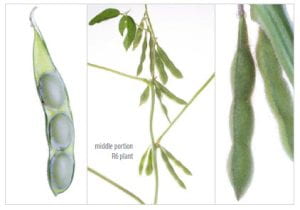
 R3 Beginning Pod


 Corn growth varies greatly throughout the county, but, more fields are beginning to tassel. As corn begins to tassel, nutrient (K > N > P) and water (0.30 inch per day) demands for the crop are close to maximum. Heat and drought will affect potential number of kernels. Scout for insects (e.g., corn leaf aphid, western bean cutworm, corn earworm, fall armyworm) and diseases (e.g., gray leaf spot, southern rust, northern leaf
 VT (Tasseling) – Stage VT occurs two to three days before silking, when the last branch of the tassel is completely visible but silks have not emerged yet from the ear shoot. The plant has reached full height and the pollen shed begins. The time between VT and R1 can vary with different hybrids and due to environmental conditions.
 Postemergence herbicide applications – Don’t forget the preharvest intervals (PHI) for grazing or harvest.

