 CFAES’s Bee Lab is co-sponsoring three upcoming Bees in Your Backyard workshops by author and bee expert Olivia Carril, and a lecture and book signing, too. Nota bee-ne: The deadline to register for the workshops is May 18; for the lecture and book signing, June 4. Continue reading Meet the bees in your own backyard
pollinators
Woods, too, are good for pollinators. Learn how
 A field full of native wildflowers is a fantastic place for pollinators. But a sun-speckled forest is too, say the organizers of an upcoming workshop on the topic.
Continue reading Woods, too, are good for pollinators. Learn how
‘Every Ohio State fan should have one’
 Spring’s a great time for Buckeye nuts to plant their own source of buckeye nuts. Dig this story on how to do it on CFAES’s Stories website. (Photo: University Communications.)
Waiter, there’s a bee on my screen
 CFAES’s 2018 Bee Lab Webinar Series kicks off when biologist-author Olivia Carril presents “Identifying Common Bees of the Great Lakes Region” from 9-10 a.m., April 18. Carril is the co-author of The Bees in Your Backyard: A Guide to North America’s Bees (Princeton University Press, 2015), which the Bookseller Buyer’s Guide calls “The ultimate bee book for bee enthusiasts and experts alike.”
Honey, we’re growing more bee-friendly plants
 CFAES researchers Reed Johnson and Sharon Treaster give you four tips for helping honey bees, and why, on Ohio State’s Insights website. (Photo: iStock.)
The case of the disappearing bee
Elizabeth Long, assistant professor in CFAES’s Department of Entomology, presents “Death by Dust? The Case of the Disappearing Bee” at 7 p.m. Thursday, April 5, in the Wooster Science Café series. Long was a co-author of a 2017 Journal of Applied Ecology study that reported that neonicotinoid insectides, when used to protect corn seeds after planting, pose risks for honey bees.
So you want to learn more about butterflies
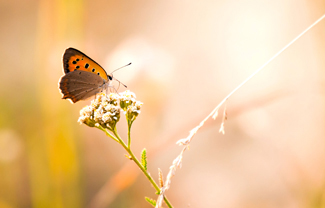 Today, March 14, is National Learn About Butterflies Day, and one way you can do just that is to bookmark TheBuzz@OSU and visit often. It’s a blog run by Denise Ellsworth, director of CFAES’s Honey Bee and Native Pollinator Education program, and it’s full of news about pollinators, both the kind that buzz and the ones with big, colorful wings.
Another way: Check out a butterfly-boosting CFAES fact sheet, written by Denise, too, that can help you make your spring planting plans. (Photo: sindlera, iStock.)
Study: Here are the world’s No. 1 pollinators
 “An unprecedented study” by a researcher now with Ohio State has shown that “honey bees are the world’s most important single species of pollinator in natural ecosystems.”
Continue reading Study: Here are the world’s No. 1 pollinators
To bee, or not to bee
‘Power of Pollinators’ open house is Sept. 12
 The Ecolab project on Ohio State’s Mansfield campus hosts its Power of Pollinators Open House from 4 to 6 p.m. Tuesday, Sept. 12, at 1760 University Drive. Admission is free and includes snacks, plants and seed packets.
Populations of pollinators — bees, butterflies and others — have seen significant drops in recent years, and the event will look at ways to help them. Talks will cover “Native Bees in Your Backyard,” “Pollinators Need Woodlands, Too!” and “Native Plant ID and Seed Collection.”
Participants should meet at the Monarch Right-of-Way demonstration plots in front of Ovalwood Hall.
For details, call CFAES wildlife program specialist Marne Titchenell, one of the event’s speakers, at 614-292-0402.