JCLC 9.1

JCLC 9.1 available via Duke University Press Journals Online

Dear friends, I am pleased to share “Critical Theory and Pre-Modern Chinese Literature”, the newest issue of the Journal of Chinese Literature and Culture (9:1), edited by Stephen Roddy and Zong-qi Cai.

Contributors to this special issue evaluate the influence of Western critical theory on the development of Chinese literary studies since the mid-twentieth century. By examining the development of hermeneutic systems such as gender studies, semiotics, cultural studies, and space theory, the authors discuss the possibility of modern critical discourse intervening in the study of ancient Chinese literature and culture.

Contributors to this issue are Alexander Des Forges, Grace S. Fong, Martin Kern, Lucas Klein, Xinda Lian, Manling Luo, Christopher M. B. Nugent, Stephen J. Roddy, Patricia Sieber, and Paula Varsano.

Browse the table of contents and read the introduction, made freely available, here:

https://read.dukeupress.edu/jclc/issue/9/1.

Purchase the journal here: https://www.dukeupress.edu/critical-theory-and-premodern-chinese-literature

This issue will be available at Project MUSE soon.  — Zong-qi Cai

Posted by: Yuefan Wang yuefanw2@illinois.edu

Penguin eco-lit collection Vintage Earth

Source: Bruce-Humes.com (7/5/22)
Last Quarter of the Moon”: Re-launching as one of 8 novels in the “Eco-fiction” Genre
By Bruce Humes

As of July 7, 2022, Penguin is launching a collection of novels “to change the way we think about — and act upon — the most urgent story of our times: the climate crisis”:

Screen Shot 2022-07-05 at 8.40.39 PM

Vintage Earth series

” VINTAGE EARTH is a collection of novels to transform our relationship with the natural world. Each one is a work of creative activism, a blast of fresh air, a seed from which change can grow.
The books in this series reconnect us to the planet we inhabit and must protect.
Discover great writing on the most urgent story of our times. “

Two of the novels are translated from the Chinese. The Man with the Compound Eyes (複眼人 吳明益 著), translated by Darryl Sterk, and Last Quarter of the Moon (额尔古纳河右岸 迟子建 著), translated by me, Bruce Humes.

It’s nice to see translated Chinese writing highlighted for its topical content, and not simply because it is “about” China, and furthermore, to see it featured along with several other world-class works of fiction. Continue reading Penguin eco-lit collection Vintage Earth

Su Tong event

List member might be interested in a hybrid event in London with both an offline and online components. Su Tong (author of Raise the Red Lantern) will be in conversation with Frances Wood from the British Library.

Open-Air Cinema: In conversation with Su Tong
Date: 16 July, 2022, 3:00 PM–4:00 PM BST
Place: China Exchange UK, 32a Gerrard Street, W1D6JA, London

TICKETS (in-person, China Exchange, London):
https://tickettailor.com/events/chinaexchange/697810/

TICKETS (join online):
https://tickettailor.com/events/chinaexchange/713348/

Daniel Yang Li
Book Marketer
Alain Charles Asia Publishing

Yan Lianke event

Dear Friends,

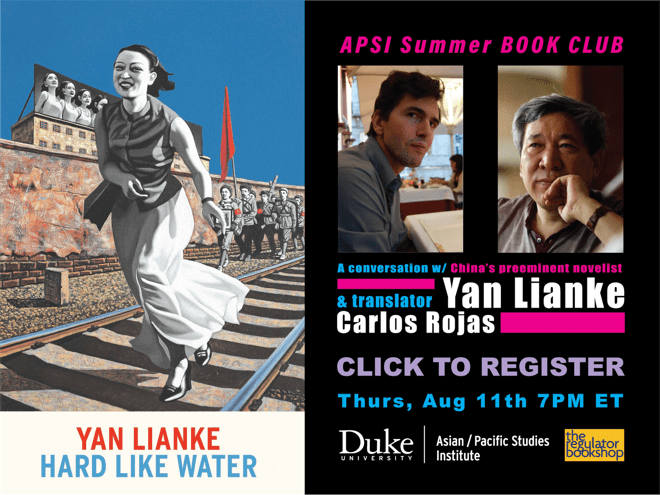
I write to invite you, and those you know who might be interested, to join us in an online book club conversation about the novel Hard Like Water 坚硬如水 with author Yan Lianke and long-term collaborator and translator Carlos Rojas.  We will hold the event both in-person and online (online registration) on August 11th from 7-9PM ET.  Please click this link or the graphic below for more details.

Best,

Alex Nickley
Interim Assistant Director
Asian/Pacific Studies Institute – asianpacific.duke.edu
Duke University, Durham, NC
email: alexander.nickley@duke.edu | office: 919-684-2783

Stuggling with the censor within

Source: Noema (6/30/22)
Struggling With The Censor Within
As the 25th anniversary of Hong Kong’s handover to China approaches, two longtime participants in the city’s cultural scene reflect on how it’s changed.
BY ANNE HENOCHOWICZ

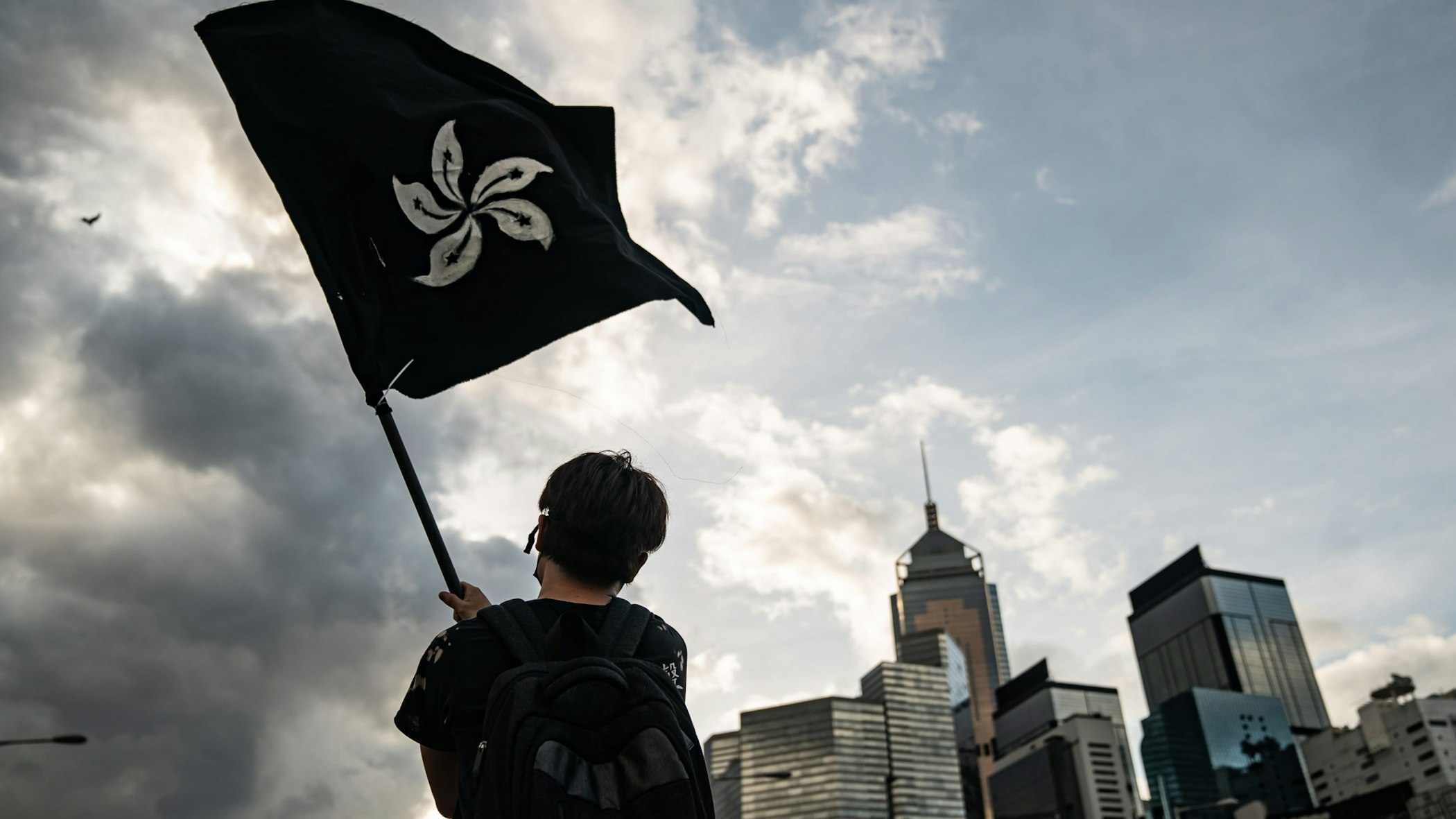
An anti-extradition protester waves a black flag outside Hong Kong’s Legislative Council Complex on July 1, 2019. (Photo by Anthony Kwan/Getty Images)

Anne Henochowicz is a writer and translator living in the Washington, D.C. area. Her work has appeared in Dissent, Mānoa, and The Washington Post. She is the former Translations Editor at China Digital Times.

July 1 has traditionally been a day of protest in Hong Kong — in past years, the anniversary of the former British colony’s handover to China has drawn hundreds of thousands onto the streets. In 2003, half a million people came out to protest proposed anti-subversion legislation. In 2012, protesters succeeded in staving off proposed “national education” in Hong Kong schools. Protesters occupied the Legislative Council floor for several hours on July 1, 2019, in demonstrations against an extradition bill that were cut short by COVID-19. Then, amid the lockdowns, the PRC passed the National Security Law on June 30, 2020, with immediate repercussions for political organizations, the media, activists and protesters. Now for many, simply deciding whether to stay in the city they call home has become a day-by-day proposition. Continue reading Stuggling with the censor within

Writer Ni Kuang dies (in Chinese)

Source: BBC News (7/4/22)
倪匡逝世:笔下小说脍炙人口、因“反共”招致两极评价的作家
By BBC NEWS

倪匡的作品

图像加注文字,倪匡的不少小说内容被视为讽刺共产党执政,虽然如此,他的作品仍然受到两岸三地读者欢迎。

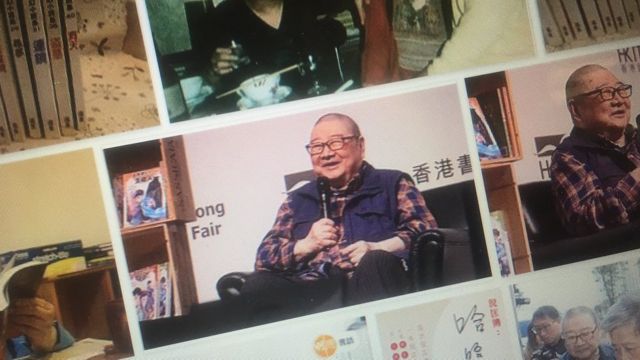
香港著名作家倪匡离世,享年87岁。他笔下作品包括《卫斯理》小说系列,广受全球华人读者欢迎,他本人更享有“香港四大才子”之一的称誉。

同为作家的沈西城周日(7月3日)在社交网站公布倪匡的死讯,但没有透露详情,倪匡早年曾经透露自己患上皮肤癌。

倪匡1935年在上海出生,曾经在中国公安部门工作,22岁逃难到香港。抵达香港后曾经做过杂工,之后在报社工作,职业生涯中创作了超过300本小说和450个电影剧本。他在1992年与妻子移居美国,2007年搬回香港。

他的不少小说内容被视为讽刺共产党,笔下小说不容易在中国大陆购买。虽然如此,他的作品仍然受到两岸三地读者欢迎。他去世的消息传出后,不少中国大陆网民到他的微博帐号留言悼念,但也有网民继续就他的反共立场批评他。 Continue reading Writer Ni Kuang dies (in Chinese)

Travel, Translation and Transmedia Aesthetics review

MCLC Resource Center is pleased to announce publication of Robert Moore’s review of Travel, Translation and Transmedia Aesthetics: Franco-Chinese Literature and Visual Arts in a Global Age, by Shuangyi Li. The review appears below and at its online home: https://u.osu.edu/mclc/book-reviews/robert-moore/. My thanks to Michael Hill, our book review editor for translations/translation studies, for ushering the review to publication.

Kirk Denton, MCLC

Travel, Translation and Transmedia Aesthetics:
Franco-Chinese Literature and Visual Arts in a Global Age

By Shuangyi Li


Reviewed by Robert Moore

MCLC Resource Center Publication (Copyright June, 2022)


Shuangyi Li, Travel, Translation and Transmedia Aesthetics: Franco-Chinese Literature and Visual Arts in a Global Age. Singapore: Palgrave Macmillan, 2021. 267 pp. ISBN 978-9811655616 (cloth).

Shuangyi Li’s Travel, Translation and Transmedia Aesthetics: Franco-Chinese Literature and Visual Arts in a Global Age is a long-form study of four Franco-Chinese writers: Gao Xingjian 高行健, Shan Sa 山颯, Dai Sijie 戴思杰, and François Cheng 程抱一. All were born and raised in China but moved to France during early adulthood and compose works in French. All are also recipients of numerous awards, and one, François Cheng, is a member of the Académie Française, the first Asian-born person to be so honored. Li’s strategy is to demonstrate that all four share a recognizable aesthetic, one that is transmedial and transnational, and only emerges when we are able to understand how the cultures and languages with which they work influence each other simultaneously.

Chapter 1 is an introduction that lays out the conceptual framework for the study. Chapter 2 leads with a short consideration of some of the principal concerns of all four writers before launching into a long analysis of François Cheng’s Le Dit de Tianyi (The River Below in English translation). Chapter 3 discusses historically-minded works by Cheng, Shan, and Dai, with a particular eye on how images and motifs from ancient China can be re-presented and re-imagined in French. Chapter 4 looks at the way calligraphy influences, and is influenced by, the fiction of the same three writers. Chapter 5 concludes the main body of the study with a consideration of how Dai Sijie’s fiction, and Gao Xingjian’s painting, interact with each writer’s respective cinematic interests. Continue reading Travel, Translation and Transmedia Aesthetics review

PRISM 19.1

PRISM 19.1 (2022)

THEMED CLUSTER CHRONOTOPIA: Urban Space and Time in Twenty-First-Century Sinophone Film and Fiction

https://read.dukeupress.edu/prism/issue/19/1

Introduction: Chronotopia: Urban Space and Time in Twenty-First-Century Sinophone Film and Fiction
By Astrid Møller-Olsen

ARTICLES

Dialogical Representation of the Global City in Chinese New Urban and Rural-Migrant Films
By Jie Lu

Ghostly Chronotopes: Spectral Cityscapes in Post-2000 Chinese Literature
by Winnie L. M. Yee

Spatiotemporal Explorations: Narrating Social Inequalities in Contemporary Chinese Science Fiction
By Frederike Schneider-Vielsäcker

Reconfiguring the Chronotope: Spatiotemporal Representations and Cultural Imaginations of Beijing in Mr. Six
By Xuesong Shao and Sheldon Lu

Take the Elevator to Tomorrow: Mobile Space and Lingering Time in Contemporary Urban Fiction
By Astrid Møller-Olsen Continue reading PRISM 19.1

China in the World review

MCLC Resource Center is pleased to announce publication of Julia Keblinska’s review of China in the World: Culture, Politics, and World Vision, by Ban Wang. The review appears below and at its online home: https://u.osu.edu/mclc/book-reviews/keblinska/. My thanks to Nicholas Kaldis, our literary studies book review editor, for ushering the review to publication.

Kirk Denton, MCLC

China in the World:
Culture, Politics, and World Vision

By Ban Wang


Reviewed by Julia Keblinska

MCLC Resource Center Publication (Copyright June, 2022)


Ban Wang, China in the World: Culture, Politics, and World Vision. Durham, NC: Duke University Press, 2022, xi + 215 pp. ISBN: 9781478010845 (paper).

Ban Wang’s China in the World: Culture, Politics, and World Vision examines how the nation of China was imagined in political discourse and cultural practice vis à vis “a broad spectrum of international outlooks”—that is, conceptions of “the world”—throughout the twentieth century (7). More than a mere history of such worldly outlooks, be they late Qing reformulations of Confucian social concepts of tiānxià 天下  and dàtóng 大同 (“all under heaven” and “great unity,” respectively) or later iterations of socialist internationalism, Wang offers a serious and urgent critique of Chinese Studies and a call to political awareness at a moment when Cold War logics threaten to flatten the nuance and complexity of our field. In accomplishing this task, China in the World is an elegantly efficient volume. Coming in under 200 pages, the text is comprised of an introduction and eight chapters, the initial six of which are devoted to focused historical case studies of literary and cinematic works, while the final two are more polemical, urging an interrogation of the state of the Chinese Studies classroom and articulating the imperative to critically “use the past to understand the present” (170). Continue reading China in the World review

The Making of Chinese-Sinophone Literatures as World Literature review

MCLC Resource Center is pleased to announce publication of Dylan Suher’s review of The Making of Chinese-Sinophone Literatures as World Literature, edited by Kuei-fen Chiu and Yingjin Zhang. The review appears below and at its online home: https://u.osu.edu/mclc/book-reviews/suher/. My thanks to Nicholas Kaldis, our literary studies book review editor, for ushering the review to publication.

Kirk Denton, MCLC

The Making of Chinese-Sinophone
Literatures as World Literature

Edited by Kuei-fen Chiu and Yingjin Zhang


Reviewed by Dylan Suher

MCLC Resource Center Publication (Copyright June, 2022)


Kuei-fen Chiu and Yingjin Zhang, eds., The Making of Chinese-Sinophone Literatures as World Literature. Hong Kong: Hong Kong University Press, 2022. xi + 249 pp. ISBN 9789888528721.

Listing just a few of the texts analyzed in the 11 chapters of Kuei-fen Chiu and Yingjin Zhang’s The Making of Chinese-Sinophone Literatures as World Literature is a good demonstration of this edited volume’s ambition:

  • A translation by Mao Dun 茅盾 of the Nicaraguan writer Rubén Dario’s story “El velo de la reina Mab” (The veil of Queen Mab);
  • a Taiwanese picturebook about a half-crocodile, half-duck creature’s identity crisis;
  • translations of pseudo-haiku by the poet Chen Li 陳黎 into subway posters, “poetry walls,” and dance pieces.

The editors and nine other contributors to this volume show an admirable lack of complacency in exploring the intersection between Chinese-Sinophone literatures and world literature. But despite the thoughtfulness of the essays collected here, I nevertheless retain some doubts about the volume’s overall framework.

Kuei-fen Chiu and Yingjin Zhang’s introduction, “Chinese-Sinophone Literatures as World Literature” is dedicated to explaining the somewhat unwieldy conceptual contraption of the title. At its core is “world literature”; Chiu and Zhang favor David Damrosch’s definition of world literature as encompassing works that are “actively present within a literary system beyond that of its original culture”[1] while acknowledging that even this effort to open up the category does not do away with the structures of publishing, scholarship, and prestige that favor a Eurocentric canon. Chiu and Zhang use the term “Chinese-Sinophone Literatures” as a way to “distance our position from a preoccupation with ‘China/center/major vs. non-China/periphery/minor debates” (8), charting a course between lumping all literature written in Chinese together and a Sinophone framework that excludes mainland literature and non-Chinese-speaking readers. Chinese-Sinophone literatures, the editors posit, are actively made into world literature as “the work travels beyond national boundaries and gains a new life in world literary space” (11, original emphasis). Chiu and Zhang emphasize a world literature defined not only by texts, but also by the translators and publishers who bring those texts across borders, by the genres used to package those texts for new audiences, and by the technologies and media used to disseminate these texts globally. Continue reading The Making of Chinese-Sinophone Literatures as World Literature review

Writing Chinese 1.1

Source: writingchinesejournal.org (6/13/22)
Writing Chinese: A Journal of Contemporary Sinophone Writing – Editorial

Writing Chinese

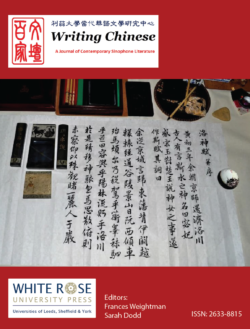
We’re very excited to share the editorial from the very first issue of our journal, Writing Chinese: A Journal of Contemporary Sinophone Writing! We hope you’ll read the whole issue online, and we’d like to thank all our contributors, and of course White Rose University Press. As the journal has a rolling deadline we’ll be using this blog to keep you up to date on new content, and please keep an eye on our social media too!

Inaugural Issue: Editors’ Note

We are delighted to launch the inaugural issue of Writing Chinese: A Journal of Contemporary Sinophone Literature. The Journal is based within The Leeds Centre for New Chinese Writing, in the University of Leeds, UK. A research hub with a strong public engagement programme, our Centre was formally established in 2018. It grew out of an AHRC-funded project entitled “Writing Chinese: Authors, Authority and Authorship” which aimed to engage practitioners (authors, translators, publishers) and academics working on, or embodying, concepts of authorship in a Chinese-language setting. Continue reading Writing Chinese 1.1

Paper Republic newsletter 14

Folks, not to brag, but I’ve all but stopped using social media for a month now (by circumstance rather than by choice) and it’s been a lovely holiday for the mind. It also means, in case you’re wondering why my boasting is relevant, this month’s newsletter is a short one.

That’s right, like many millennials, I source most of my news from the socials, and that includes Chinese-lit related news.

Here’s to a more jampacked newsletter next month, when I inevitably fall back into old habits.

In the meantime, direct your attention toward the upcoming Aberdeen Festival of Translation. By upcoming, I mean it starts on Monday 13th June with a workshop led by Nicky Harman. But there is plenty more to come.

Extracts, stories and poems:

  • Yan Lianke & Carlos Rojas on “How Contemporary Chinese Literature Made Western Modernism Its Own”
  • May Huang on “The Translator’s Guilt” and Eric Yip, who recently became the youngest-ever winner of the National Poetry Competition for “Fricatives”. Here, poet and translator, Jenny Wong chats with Eric about his win and his poetry

Continue reading Paper Republic newsletter 14

Classicism in Digital Times symposium

Harvard-Frankfurt-Lingnan Symposium
Classicism in Digital Times: Textual Production as Cultural Remembrance in the Sinophone Cyberspace
Date & Time: June 10, 2022 (15-18:00 CET; 21-24:00 Taipei; 09-12:00 Boston; 06-09:00 LA)
Online venue:

https://us02web.zoom.us/j/85429138251?pwd=M1YyeTdHckkrdTFiN3ZSenhIOEFEdz09

Meeting-ID: 854 2913 8251
Password: 380532

15:00-15:10: Greetings by Matthias Lutz-Bachmann (Frankfurt) and Zong-qi Cai (Lingnan)
15:10-15:20: David Wang (Harvard) and Zhiyi Yang (Frankfurt), Introducing the concept
15:20-15:30: Chieh-Ting Hsieh (National Chengchi U), “The Body That Counts”
15:30-15:40: Laura Vermeeren (U of Amsterdam), “Writing the Heart Sutra Online”
General Questions and Comments

16:00-16:10: Xiaofei Tian (Harvard), “The Thrill of Becoming”
16:10-16:20: Zhiyi Yang, “In the Digital Sand”
16:20-16:30: Fangdai Chen (Harvard), “Classicist Heterotopia”
16:30-16:40: Tarryn Chun (Notre Dame), “Spectacular Erudition”
General Questions and Comments

17:00-17:10: Paize Keulemans (Princeton), “Immersion without Mimesis”
17:10-17:20: Yedong Chen (Harvard), “Gaming with Chinese Characteristics”
17:20-17:30: Rossella Ferrari (U of Vienna), “Xiqu 2.0”
17:30-17:40: Michelle Yeh (UC Davis), “Classicist Television Drama in Digital Times”
General Questions and Comments

Posted by: Heidi Huang <heidihuang@ln.edu.hk>