Locating Livestreaming in Asia–cfp

Call for Contributions: Virtual Workshop ‘ASIA.LIVE: Locating Livestreaming in Asia’

While not solely concerned with China, list members may still find the following comparative workshop of interest. We are inviting audiovisual submissions, with the option for contributors to later also submit accompanying research articles for publication.

Hosts: Leiden University, the Leiden Asia Centre, and Asiascape: Digital Asia
Organisers: Florian Schneider, Dino Ge Zhang, Gabriele de Seta
Date: 13 September 2019
Abstract Deadline: 20 June 2019

The practice of broadcasting live video through the internet has recently seen a resurgence, as livestreaming platforms recuperated the format pioneered by cam sites from around the early 2000s (Senft, 2008). From Periscope and Twitch to YouTube and Facebook Live, livestreaming video is today a popular media format, especially among gaming communities, Esports audiences, and popular media commentators (Taylor, 2018). Continue reading Locating Livestreaming in Asia–cfp

Blood Letters of a Martyr

Source: LARB, China Channel (5/19/19)
Blood Letters of a Martyr
By Ting Guo
Ting Guo talks to Lian Xi about his new biography of Lin Zhao

On May 31, 1965, 33-year-old Lin Zhao was tried in Shanghai and sentenced to 20 years of imprisonment. She was charged as the lead member of a counter-revolutionary clique that had published an underground journal decrying communist misrule and Mao’s Great Leap Forward, a collectivization campaign that caused an unprecedented famine and claimed at least 36 million lives between 1959 and 1961.

“This is a shameful ruling!” Lin Zhao wrote on the back of the verdict the next day, in her own blood. Three years later, she was executed by firing squad under specific instructions from Chairman Mao himself.

Lin Zhao’s father committed suicide a month after Lin’s arrest, and her mother died a while  after her execution. In Shanghai, where I grew up and where Lin was tried, imprisoned and killed, the story (the sort told only in private) goes that Lin’s mother was asked to pay for the bullets that killed her daughter. It is also said (in private) that in the years that followed, at the Bund, the former International Settlement on the Huangpu River, one could see Lin’s mother crying and asking for Lin’s return. Continue reading Blood Letters of a Martyr

ANU Humanities Research Center–call for applications

Dear Colleagues,

Please consider applying to the 2020 Visiting Fellowship Program at the ANU Humanities Research Centre.

I had a great experience there in the summer of 2017 and would highly recommend anyone in the modern China field interested in connecting with humanities scholars worldwide to apply.

Warm regards,
Liang Luo

Call for Applications: 2020 Visiting Fellowship Program, ANU Humanities Research Centre

Greetings,

I write to you as a former or current Visiting Fellow of the HRC to ask for your help circulating the call for applications for our 2020 Visiting Fellowships to anyone you know who may be interested in the opportunity.

The theme for 2019 which will be addressed in the application is ‘Liberalism(s)’. (More information on the theme can be found here.) Continue reading ANU Humanities Research Center–call for applications

Sinophone Literature across the Strait–cfp

Call for Papers: Workshop Sinophone Literature across the Strait (China and Taiwan from the 19th Century to the Contemporary Ages)
https://acrossthestraitromatre.wordpress.com
Dates: November 7th- 8th,  2019
Venue: Roma Tre University, Department of Foreign Languages, Literatures and Cultures, Via del Valco di San Paolo 19 (Google Maps)

The workshop addresses PhD students and postdoc research fellows exploring the field of modern and contemporary Sinophone Literature, and intends to promote a positive exchange among scholars. Each participant will introduce his/her research project, which will be followed by a group discussion. By contributing to the global debate on Sinophone Studies, the workshop aims at implementing a transnational and transcultural approach. Within the field of Sinophone Literature, participants’ papers can investigate the following topics:

  • Tradition and modernity
  • Chineseness and otherness
  • Realism and related literary practices
  • Fiction, fantasy and science-fiction
  • Memory, identity and territory
  • Introduction, translation and reception of foreign literary movements and authors

Continue reading Sinophone Literature across the Strait–cfp

The cruel irony of China’s celebration of Asian cultures

I think this article, below, by Shannon Tiezzi in The Diplomat, is very important. Indeed it’s cruel irony, the height of blatant hypocrisy, for Chinese leaders to pretend to be for diversity in Asia today, all the while they conduct a veritable campaign of state terror, to cruelly force-assimilate away whole cultures in their own country, in the atrocities they are committing in Xinjiang. And yes indeed, in carrying this out, it can seem Mr Xi is grossly violating his own pronouncements on how it “It is foolish to believe that one’s race and civilization are superior to others, … It is disastrous to willfully reshape or even replace other civilizations.” But this may not be cognitive dissonance. Rather, it is founded on a theory of cultures/civilizations that regards them as separate, intrinsically organic beings, and essentially unchangeable. China for the Chinese, as it were. It’s of a family with nazism, and it is indeed “keeping pace with the times,” in the sense that this kind of crude and narrow nationalism is the new global political epidemic. It’s founded on the same kind of outdated theory of civilizations or cultures-as-organisms needing lebensraum, which propelled expansionist authoritarianisms of the past. Its converts will have no tolerance of minorities, but instead tend to abhor them, since they seem to muddy their “pure land.” The logical conclusion for this theory, as in the past versions, is to try to eradicate the minorities by way of “purification” — as we are seeing currently in China. Continue reading The cruel irony of China’s celebration of Asian cultures

How a journal censored by review of Xinjiang (5)

May I chime in as an Uyghur scholar?

I don’t think to hold a person accountable for restricting academic freedom is attacking. We should hold Brill accountable for their lack of communication and oversight but the person who is responsible for censoring the content is at fault from the beginning. Maybe it is my personal experience and feelings as an Uyghur are clouding my judgment, but at least my view comes from a desire for academic freedom, which I never had before coming to the US. If calling out Han Xiaorong for not respecting academic freedom is “attacking” him, well, count me in! I’m “attacking” Han Xiaorong for attempting to censor Dr. Grose’s review. It also is irresponsible of us if we solely put the blame on Brill, and would only perpetuate this kind of abhorrent behavior further.

Mirshad Ghalip <mieralif@iu.edu>
Department of Anthropology
Indiana University

How a journal censored my review on Xinjiang (5)

Recently a suspected case of censorship in one of Brill’s journals came to our attention, involving a book review written by Timothy Grose for our new journal China and Asia: A Journal in Historical Studies.  We have heard about the case on 7 April through Timothy Grose’s posting on social media and have acted immediately by contacting him. During the last weeks we were in a process of gathering information about the case. We have received a report from the author and copies of the correspondence between the author and editor. On 16 May we have received a report from the editor describing his perspective of the events. We will review this information to decide whether our publication ethics have been breached. As publisher we are never involved with editorial decisions and our editorial boards enjoy complete academic freedom. However, if our publication ethics have been breached, we will not hesitate to take appropriate action. Censorship or any other bias to race, gender, sexual orientation, religious belief, ethnic origin, citizenship, or political philosophy of the authors would be a clear breach of our ethical standards and are not acceptable.

Jasmin Lange <langej@brill.com>
Chief Publishing Officer, Brill

How a journal censored my review on Xinjiang (4)

I do not believe it is fruitful or correct to focus on Han Xiaorong or any one person. I do believe Brill, as a publisher and as a business that purports to work in the academic world of free inquiry, needs to take responsibility for its attempts to play all sides of a very fraught issue. It cannot be an honest broker without honesty. Brill needs to be held to account. The attacks on Han Xiaorong need to stop. In my opinion.

Rebecca Karl <karl.rebecca22@gmail.com>

I. M Pei dead at 102

Source: NYT (5/16/19)
I.M. Pei, World-Renowned Architect, Is Dead at 102
By Paul Goldberger

I.M. Pei in 1989 outside the glass pyramid he designed at the Louvre in Paris, one of his most famous commissions. “If there’s one thing I know I didn’t do wrong, it’s the Louvre,” he said. Credit Marc Riboud/Magnum Photos

I. M. Pei, who began his long career designing buildings for a New York real estate developer and ended it as one of the most revered architects in the world, died early Thursday at his home in Manhattan. He was 102.

His death was confirmed by his son Li Chung Pei, who is also an architect and known as Sandi. He said his father had recently celebrated his birthday with a family dinner.

Best known for designing the East Building of the National Gallery of Art in Washington and the glass pyramid at the entrance to the Louvre in Paris, Mr. Pei was one of the few architects who were equally attractive to real estate developers, corporate chieftains and art museum boards (the third group, of course, often made up of members of the first two). And all of his work — from his commercial skyscrapers to his art museums — represented a careful balance of the cutting edge and the conservative. Continue reading I. M Pei dead at 102

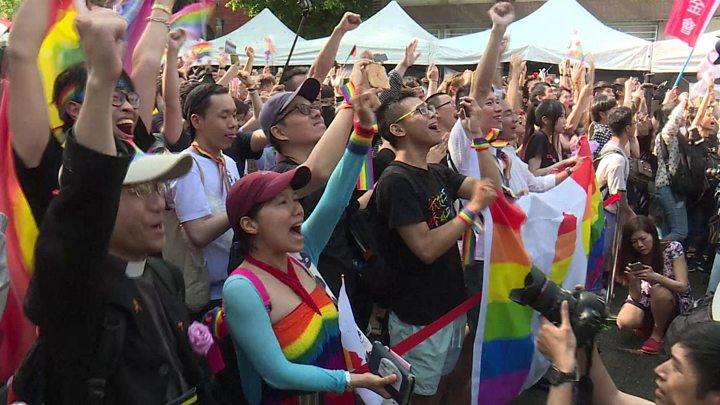
Taiwan legalizes gay marriage

Source: BBC News (5/17/19)
Taiwan gay marriage: Parliament legalises same-sex unions

Media captionCrowds celebrate as marriage law passes

Taiwan’s parliament has become the first in Asia to legalise same-sex marriage following a vote on Friday.

In 2017, the island’s constitutional court ruled that same-sex couples had the right to legally marry.

Parliament was given a two-year deadline and was required to pass the changes by 24 May.

Lawmakers debated three different bills to legalise same-sex unions and the government’s bill, the most progressive of the three, was passed. Continue reading Taiwan legalizes gay marriage

How a journal censored my review on Xinjiang (3)

No one ever openly and proudly admits that they are engaged in censorship. I get it. Even the Propaganda Department would like to be known as the Publicity Department.

And yet, like the famous quote about obscenity, when it comes to censorship, I know it when I see it. And despite Han Xiaorong’s attempts to explain away what happened at the journal China and Asia, this seems to me to be an extremely clear-cut case of censorship.

Han claims that the reference to Xinjiang’s concentration camps at the beginning of Grose’s review is “political” and thus somehow inappropriate. But as someone who writes a fair amount of book reviews, I’ve never encountered an editor who was resistant to linking a book review to pressing current affairs. This applies even to journals focused on history. Books are, after all, read in the context of the world as it is today, and I find it frankly impossible to read Cliff’s book without thinking about the ongoing tragedy in Xinjiang. Continue reading How a journal censored my review on Xinjiang (3)

Looking for a room in Shanghai

Hi, please allow me to seek your attention to my fieldwork housing, if you don’t mind.

I’m looking for a room to rent for about a year in Shanghai, beginning in mid June 2019. This is for my dissertation fieldwork in cultural anthropology. My dissertation project is about environmental NGOs of today’s Shanghai. My budget is around RMB 3,000 per month. I’d like to be within an hour-long distance from North Sichuan Road (四川北路) by subway or bus. If you are looking for a roommate in Shanghai or know someone who is, kindly consider letting me know. I don’t smoke, I have no pets. My email address is goeun.lee@uky.edu and my WeChat ID is huahai14. Thank you.

All the best,

Goeun

李高恩 Lee, Goeun, MSc Social Anthropology
PhD Candidate
Department of Anthropology
211 Lafferty Hall, University of Kentucky, USA

How a journal censored my review on Xinjiang (1)

My Response to Timothy Grose’s “How an Academic Journal Censored My Review on Xinjiang”
Han Xiaorong
Department of Chinese Culture
The Hong Kong Polytechnic University

As the editor-in-chief of China and Asia, I was solely responsible for selecting reviews for the first issue of our journal, and none of our advisers or editorial board members was involved in the selection process. In other words, Tim was on target by focusing his criticism on me.

Due to miscommunications between our book review editor and me (for this I offer my sincere apology to all parties involved), we acquired two book reviews (one was from Timothy Grose about Xinjiang, and the other reviews a book about the Chinese Communist revolution) that were not directly relevant to our journal’s central theme, which is China’s historical relations with other Asian countries. This is why I did not include these two reviews in our first issue. For the list of works published in the first issue of our journal, please click here.

Each piece in that issue deals with China’s historical interactions with other parts of Asia, specifically between China and the Indian Ocean world and between China and Korea. Continue reading How a journal censored my review on Xinjiang (1)

Poetry meets politics in photos

Source: NYT (5/15/19)
Poetry Meets Politics in Photos of China
Between violent flash points in history, Liu Heung Shing saw tenderness and subversive humor in societies saturated with propaganda.
Photographs by Liu Heung Shing
Text by Tiffany May

Musicians giving an impromptu performance in support of demonstrators during the Tiananmen Square protests. Beijing, 1989.Credit Liu Heung Shing

Liu Heung Shing looked outside the car window: an imposing portrait of Mao Zedong had disappeared from the east side of Tiananmen Square. It was 1981.

Mao loomed large that year as people gathered to watch the depositions of his political cronies, known as the Gang of Four, on state television.Earlier that autumn, before Mao’s portrait was removed from a history museum in Tiananmen Square, Mr. Liu photographed a skater gliding past a statue of Mao. The frozen faces of Communist leaders got a breath of fresh air in Mr. Liu’s photography: A Beijing resident in 2008 lined the facade of her house with the portraits of lionized figures, in plucky defiance of demolitions planned before the Summer Olympics. Continue reading Poetry meets politics in photos