World Association for Chinese Studies 2026–cfp

Call for Papers: 10th World Conference of Chinese Studies Anniversary Edition
The University of Hong Kong, School of Chinese
August 12–14, 2026
Registration deadline Jan 31, 2026

The World Association for Chinese Studies (WACS) invites proposals for panels, roundtables, and individual papers for its 10th annual conference, celebrating a decade of bridging scholarly traditions across the globe. This milestone event, hosted by the School of Chinese at The University of Hong Kong, will convene under the theme “China Studies Between Worlds — Ten Years of Bridges, New Challenges.” We welcome submissions that engage this theme across the full spectrum of Chinese Studies, including history, literature, philosophy, political science, sociology, economics, art history, religious studies, and related disciplines. For ten years, WACS has worked to foster dialogue between traditional Sinology and contemporary China Studies, encouraging exchange between Guoxue approaches and Western methodologies. Rather than imposing predetermined thematic constraints, the conference provides scholars with the opportunity to present their ongoing research and engage in open intellectual exchange. Hong Kong, with its unique position at the crossroads of East and West, offers an ideal setting for this anniversary gathering.

To ensure a balanced exchange of perspectives, participation as a speaker is limited to 100 scholars from mainland China and 100 scholars from outside mainland China. The conference language is English, though discussions may be conducted in English or Chinese. Participation as an audience member without presenting is also welcome. The program committee welcomes proposals for panels (typically comprising a chair, three to four paper presenters, and a discussant) as well as roundtable discussions and Branch Association panels. Panel proposals should be submitted as a single coordinated application. We also encourage individual paper proposals. To maintain fairness and ensure broad participation, each individual may submit only one proposal—either an individual paper or a panel contribution. Continue reading World Association for Chinese Studies 2026–cfp
American Association for Chinese Studies 2026–cfp

Call for Papers
68th Annual Conference of the American Association for Chinese Studies
University of St. Thomas
Houston, TX
October 23-25, 2026

The American Association for Chinese Studies (AACS) annual conference program committee invites proposals for panels, roundtables, and individual papers on issues concerning China,Taiwan, Hong Kong, Macao, other Chinese communities, and the Chinese diaspora for the 68th Annual Conference, hosted by the University of St. Thomas in Houston, Texas, October 23–25, 2026. The theme of the conference is “Governing Uncertainty: Institutions, Society, and Chinese Communities in a Changing World Order,” and we welcome submissions that engage this theme across multiple aspects of culture, diplomacy, economy, education, health, history, literature, politics, and society.

We welcome panels and papers from across a wide range of disciplines, including (but not limited to) economics, history, literature, political science, and sociology. The 2026 conference will feature roundtable discussions by specialists on the impact of the 2026 midterm elections in both the United States and Taiwan and their implications for international relations in the region, as well as a keynote address on the emerging world order. The organizers of the AACS meeting seek to offer a forum for interdisciplinary exchanges and policy dialogues and intend to construct a balanced program with panels on diverse issues of significance for scholarship across disciplines and for social and political policy.

The AACS is an interdisciplinary association devoted to the study of subjects related to China and Taiwan broadly construed (www.americanassociationforchinesestudies.org). Membership in AACS is required for participation in the annual conference, but non-members are welcome to submit proposals, join the Association, and participate in the annual meeting. We encourage submissions from junior and senior scholars and Ph.D. students from the United States and overseas. Please note that this conference is in-person only. Continue reading American Association for Chinese Studies 2026–cfp

The lasting legacy of the Yan’an Rectification

Source: China Unofficial Archives (1/8/26)
The Lasting Legacy of Mao’s Yan’an Rectification: The Creation of a Culture of Control
By Hai Wen

[中国民间档案馆 China Unofficial Archives is a reader-supported publication. To receive new posts and support our work, please consider becoming a free or paid subscriber. .]

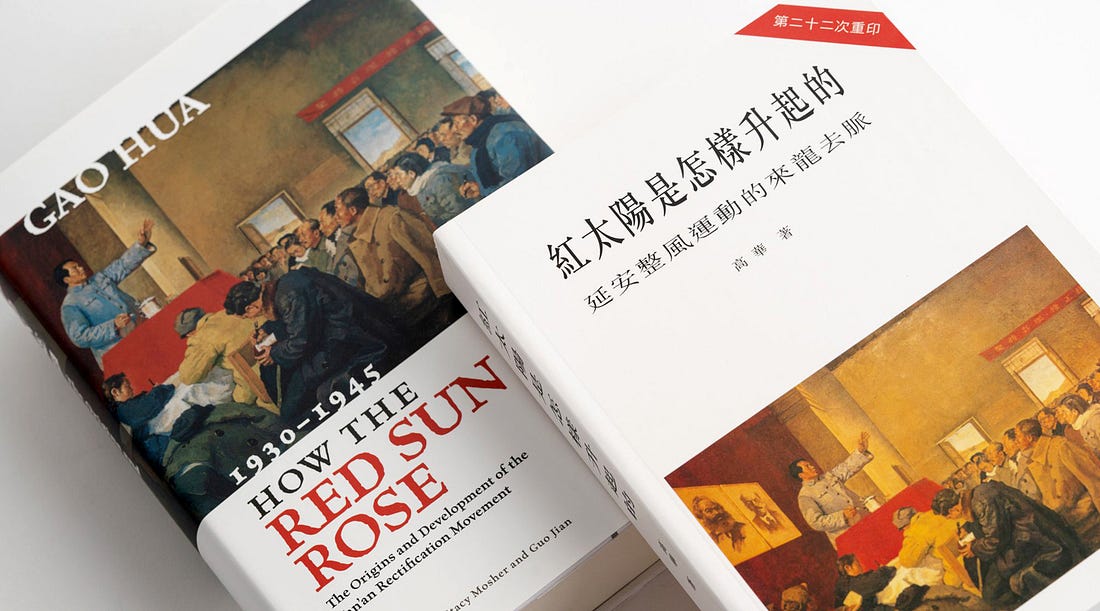
The covers of the English and the traditional Chinese versions of Gao Hua’s How the Red Sun Rose.

Looking back at China’s political trajectory over the past century, one fundamental fact is inescapable: a Party culture—not indigenous to China but transplanted from Soviet Russia—has profoundly shaped every facet of contemporary Chinese life.In China, Party culture is more than a technique of political control; it is a profound disciplining of the nation’s historical memory and spiritual landscape. Since 1949, this control and indoctrination have persisted for over seventy years. The decisive step in finalizing this Party culture was the Yan’an Rectification Movement of 1942. One could argue that the prototype of the party-state depicted in the famous 1948 dystopian novel 1984 was already forged in Yan’an; everything that followed has merely been an amplification of that original model.

In the world today, de-Sovietization has become a major global trend. Many former Soviet states, most notably Ukraine, have struggled to de-Sovietize. While the Chinese people may feel deep sympathy for Ukraine, to a large extent—particularly regarding political culture—China remains a Soviet-style state. The dead weight of the Soviet system, and specifically the drag of Bolshevik Party culture, remains a primary obstacle to China’s political and social transformation.

China’s Bolshevik Party culture encompasses, but is not limited to, elements such as extreme centralization, a cult of personality, intra-Party struggles, and ruthless purges. Together, these form a self-reinforcing, closed-loop system. From the Yan’an Rectification onward—whether through the total Sovietization of the early 1950s or the current era’s so-called “Sinicization of Marxism”—the essence has remained unchanged. Though ripples of liberalism or democratic socialism have occasionally emerged within the Chinese Communist Party, they have never managed to shake the Bolshevik foundations of the political culture.

Drawing primarily on two seminal works of Party history—He Fang’s Notes on the History of the Chinese Communist Party: From the Zun’yi Conference to the Yan’an Rectification Movement (hereafter Notes) and Gao Hua’s How the Red Sun Rose: The Origins and Development of the Yan’an Rectification Movement, 1930–1945,(hereafter Red Sun)—we will analyze how the Yan’an Rectification of the 1940s served as the foundry for the Bolshevik Party culture that continues to dominate China today. Continue reading The lasting legacy of the Yan’an Rectification

3D CGI Animation special issue–cfp

Call for Papers: 3D CGI Animation, Special Issue of the Journal of Chinese Cinemas
Guest Editor: Daisy Yan Du

Timeline:

May 1, 2026: Abstract (250 words) and author bio (250 words) due
December 1, 2026: Full article draft due
August 1, 2027: Article revisions due
Fall 2027/Spring 2028: Special issue published

We invite essays that examine 3D CGI animation in the Chinese context. Long regarded as a Western technology pioneered by films like Pixar’s Toy Story (1995), 3D CGI animation has a distinct and evolving history in China. While Chinese animators began experimenting with the technology decades ago, it was the global release of Nezha 2 (2025)—the highest-grossing animated feature film worldwide—that marked the spectacular debut for Chinese 3D CGI animation on the global stage. This special issue investigates Chinese 3D CGI animation as a technology, an industry, and an artform. We welcome contributions that explore, but are not limited to, the following topics:

  • 3D CGI as special effects in live-action cinema, especially in big-budget blockbuster films.
  • Aspects of 3D CGI animated feature films, such as the histories, aesthetics, formal style, themes, content, storytelling, technology, sound, dubbing, screening, audience reception, and fan culture, among others.
  • 3D CGI and video games.
  • 3D CGI and computer graphics.
  • 3D CGI and online platforms.
  • The histories and prehistories of the 3D CGI animation technology, industry, and artform in China.
  • Film and media theories pertinent to 3D CGI animation.

For inquires and submissions, please email Daisy Yan Du (daisyyandu@ust.hk)

Anime’s Knowledge Cultures review

MCLC Resource Center is pleased to announce publication of Tim Shao-Hung Teng’s review of Anime’s Knowledge Cultures: Geek, Otaku, Zhai, by Jinying Li. The review appears below and at its online home: https://u.osu.edu/mclc/book-reviews/tim-teng/. My thanks to Shaoling Ma, our media studies book review editor, for ushering the review to publication.

Kirk Denton, MCLC

Anime’s Knowledge Cultures:
Geek, Otaku, Zhai

By Jinying Li


Reviewed by Tim Shao-Hung Teng

MCLC Resource Center Publication (Copyright January, 2026)


Tim Shao-Hung Teng, Anime’s Knowledge Culture: Geek, Otaku, Zhai Minneapolis: University of Minnesota Press, 2024. 344 pp. ISBN: 9781517916282 (hardcover).

Over the last two and a half decades, animation studies has grown from a niche topic into a prominent subfield in film and media scholarships. Notably, the study of anime, the Japanese genre of animation, proves especially adaptable to cinema studies’ structural shift to media studies. Building on seminal works by Ōtsuka Eiji, Saitō Tamaki, and Azuma Hiroki, among others, scholars in the English-speaking world have pushed the boundaries of media studies in exhilarating ways. They have examined anime’s crossover into toy culture as symptoms of global capitalism (Anne Allison), explored the history and theory of media mix (Marc Steinberg), the technological condition of the multiplanar image (Thomas Lamarre), anime’s entangled relations with religion (Jolyon Thomas), and the media ecology of anime’s TV distribution (Lamarre). Extending this list of inspiring works is Jinying Li’s erudite Anime’s Knowledge Cultures: Geek, Otaku, Zhai, which reorients the field through careful historical tracing and subtle theorization with timely political and aesthetic observations.

Anime’s Knowledge Cultures focuses on the reception of anime culture populated by fans, dubbed variably as geeks (mainly in the US), otaku (Japan), and zhai (China). Rather than passive reception, these fans’ prolific activities constitute a productive sector of knowledge work: some cram for tests to earn the right to send danmaku (bullet curtain) messages; others pore through online forums to find out how to navigate the multiplying storylines of an anime-turned-game; still others tirelessly translate subtitles while adding stylized in-jokes for fellow fans. Li traces this collective knowledge culture on a transnational and transmedia scale, and contextualizes it within contemporary networked societies and information capitalism. As a result, the book forges connections between techno-economic developments and sociocultural practices; infrastructural and psychosomatic complexes; and political and aesthetic articulations. Using anime as a method, Li further performs with great rigor what in gaming terminology is called a double kill: on the one hand, she deftly deterritorializes the US-centric topography of global geek culture, directing attention to East Asia as a fertile ground of cultural and economic creativity; on the other, she remaps East Asia as expansive aggregates of media imaginaries in constant motion, no longer a fixed region marked by essentialized ethno-cultures. Continue reading Anime’s Knowledge Cultures review

Realism in Chinese Literature–cfp

Dear Colleagues,

We invite submissions for a special issue of the journal Humanities that delves into the evolution of realism in Chinese literature, tracing its journey from classical foundations to contemporary manifestations. This issue seeks to explore the multifaceted nature of realism across various genres, including fiction, drama, and film, highlighting its enduring significance and adaptability in Chinese literary history.

Themes of interest include, but are not limited to, the following:

  • Classical Foundations: Investigations into early realist tendencies in classical Chinese literature, examining how historical texts and traditional narratives established the groundwork for subsequent realist expressions.
  • 20th-Century Transformations: Analyses of the early 20th-century engagement with Western literary movements, such as naturalism and socialist realism, and how Chinese writers integrated these influences amidst sociopolitical changes.
  • Post-Mao Developments: Studies on post-Mao literature, focusing on contemporary authors’ navigation of modern societal complexities, incorporating elements like magical realism and neo-realism to depict China’s rapid transformation.
  • Sinophone Perspectives: Explorations of how Chinese-language writers in the diaspora reinterpret realism within transnational contexts, contributing to a broader understanding of its global resonance.

Submission Guidelines:

  • Abstract deadline: 15 May 2026
  • Full article deadline: 15 November 2026

We welcome original research articles that offer fresh insights into the dynamic and evolving nature of realism in Chinese literature. Submissions should adhere to the journal’s formatting guidelines and be submitted through the designated portal.

Please visit https://www.mdpi.com/journal/humanities/special_issues/7MHK2Z7KJW for more information on the special issue.

For inquiries and submissions, please contact the two Guest Editors or email directly at Humanities@mdpi.com.

Dr. Xueqing Xu
Dr. Yan Lu <ylu669@uwo.ca>
Guest Editors

China debates political power

Source: NYT (1/6/26)
In China, a Debate About Political Power Ignites After Maduro’s Capture
阅读简体中文版 | 閱讀繁體中文版
The reactions online revealed a Chinese society divided: Some saw what happened in Venezuela as a playbook for seizing Taiwan, while others warned about ideological rigidity.
By 

A crowd of people, many with their hand in the air gesturing the peace sign. Venezuela’s flag is waved by someone in the crowd and a framed drawing of Nicolás Maduro is held up by another.

Supporters of Nicolás Maduro gathering near the Presidential Palace to demand his release. Credit…The New York Times

When U.S. forces captured Venezuela’s president, Nicolás Maduro, Chinese social media lit up.

People with nationalist views asked: Why can’t Beijing do the same in Taiwan and arrest its president?

On the other side of the political spectrum, people cheered the downfall of a dictator. Trying to avoid censors when criticizing China’s leader, Xi Jinping, they invoked the title of a pop song, “Too bad it’s not you.”

Within hours, the discourse online became a proxy debate over China’s power, its limits and its future. For nationalist Chinese, the U.S. military operation had exposed American lawlessness and frustrations in China at what they believe is Beijing’s restraint, particularly on Taiwan. For those venturing criticism of the government, the episode underscored the vulnerability of even entrenched authoritarian leaders.

On the social media site Weibo, the hashtag related to Mr. Maduro’s seizure rose to the No. 1 position on the platform’s hot-search list. It drew over 600 million views in the first 24 hours, according to data from the platform. Continue reading China debates political power

Bi Gan’s Resurrection

Source: The New Yorker (12/18/25)
The Delirious Cinematic Artifice of Bi Gan’s “Resurrection”
In the Chinese director’s third feature, the pop idol Jackson Yee plays a shape-shifting dreamer who gets lost in a densely allusive maze of stories and genres.
By Justin Chang

Woman in all black standing in the rain.

Shu Qi, as the Big Other. Photography courtesy Janus Films.

“Resurrection,” a magnificent intoxicant of a movie from the thirty-six-year-old Chinese director Bi Gan, is no ordinary love letter to cinema. It’s more like a love labyrinth—a multi-tiered maze, full of secret passages, shadowy rooms, and winding staircases, with a giant movie theatre, sculpted from candle wax, waiting at the incandescent finish. It’s an ecstatic, extravagant work of artifice and imagination, and, from the start, Bi and his collaborators (they include the director of photography Dong Jingsong and the production designers Liu Qiang and Tu Nan) embrace their craft with a childlike sense of wonder and play. An extended early shot, set in an opium den, practically overflows with intricate visual trickery—paper-cutout characters, an outsized hand that reaches into the frame and begins manipulating the scenery—that I could have happily watched unfold for hours. More than once in “Resurrection,” the precise mechanics of a sequence can prove confounding, but the meaning is utterly clear: cinema is both a toy to be played with and a canvas of unlimited possibilities.

And that’s just the labyrinth’s foyer. Bi will soon send us hurtling into the lower depths, as he springs one trapdoor after another. My advice is to surrender and enjoy the plunge. “Resurrection,” which Bi wrote with Zhai Xiaohui, is both an expansive work of cinematic fantasy and a condensed survey of cinema’s history; it consists of a prologue, an epilogue, and four chapters in between, each one set in a different time, place, and genre. The prologue is effectively a silent film, composed in a nearly square aspect ratio, structured with elegant intertitles, and possessed of an explicit homage to “L’Arroseur Arrosé,” Louis Lumière’s comic short from 1895. The deeper we go into the labyrinth, the more elusive—and allusive—it becomes. There is a poster of Carl Theodor Dreyer’s “Day of Wrath” (1943), a terrifying hall of mirrors straight out of Orson Welles’s “The Lady from Shanghai” (1947), and a gangster’s swimming pool that would look right at home in Brian De Palma’s “Scarface” (1983). [READ THE FULL REVIEW HERE]

Backreading HK symposium 2026–cfp

Call for Papers – Backreading Hong Kong Symposium 2026: Everyday Life Reimagined
The theme of the 2026 edition of the Backreading Hong Kong: An Annual Symposium is “Everyday Life Reimagined.”

Proposal Deadline: January 16, 2026
Symposium Date: March 10 – 12, 2026
Venue: University of British Columbia

We are calling for proposals from scholars across disciplines (literature, cinema, media, translation, history, cultural studies) that engage critically with the theme “Everyday Life Reimagined” for the 2026 symposium.

The 2026 symposium aims to explore the power of imagination and the possibility of creativity in cultural texts and practices in reflecting on paradigms, boundaries, and subject-object positionings and (re-)thinking with non-human actors, precarious subjects, and historically marginalized communities.

Topics may include, but are not limited to:

  • Human and nonhuman agency and relation
  • Dealing with precarity
  • Dis-/Re-enchantment and the practice of everyday life
  • Intersections of race, gender, class, and language
  • Adaptation across media
  • Collaborative practices and productive imagination in the arts

Continue reading Backreading HK symposium 2026–cfp

Cold Window Newsletter no. 11

Welcome back to the Cold Window Newsletter. I’ve always wished that someone would write an English guide to the best Chinese writing of the year. Now, I get to be the one to do it. Since the beginning of last year, I’ve been on a quest to read every new short fiction collection published in China in 2025.¹ I’m finished, and I’m ready to share.

I maxed out my library card for this post. Didn’t even know I could do that.

Special: The year in new Chinese fiction

I like to focus on short stories not just because they’re an easy way for a non-native reader of Chinese to experience as many voices as possible, but also because reading short fiction is, pretty definitively, the best way to get your finger on the pulse of cutting-edge writing in China. Even more than in the Anglosphere, young Chinese writers nearly always stick to publishing short stories during the first phase of their career, slowly building up enough of a reputation to produce a full-length novel later on. Older authors write short fiction too, of course. But the best stuff consistently comes from the younger generation, because they’re the ones with the drive to experiment with form, prod the boundaries of what can be written about, and secure their place in the next incarnation of Chinese literature.

If you’re a reader of Chinese, or a translator or publisher interested in getting good stories in front of more readers, I hope the value of this list is self-apparent. But let me briefly make the case for why it’s worthwhile to pay attention to Chinese fiction even if you don’t usually keep up with contemporary literature. Chinese intellectual culture is driven by a vast, cosmopolitan, mostly urban, mostly young community of readers, writers, and artists. They have strong opinions about the state of Chinese society and the world, and they’ll always express those opinions, heedless of the invariably clumsy top-down efforts to rein them in. The Douban lists I covered two weeks ago are one reflection—skewed and oblique though it may be—of how Chinese intellectuals view the world. But their worldview is expressed much more directly through stories. All that’s left is for us to listen. Continue reading Cold Window Newsletter no. 11

MLA Chinese and EA Lit panels

Dear Colleagues, please find a compilation of panels related to the study of Chinese and East Asian Literatures at the MLA (Toronto, Jan. 8-11). We hope to see you there!

Warmly,

MLA Committees on Ming and Qing China & Pre-14th Century China

Thursday, 8 January 2026

16 – Natural Time and Human Narratives: Competing Temporal Orders in the Premodern World [LLC Pre-14th-Century Chinese]
Thursday, 8 January, 12:00 PM – 1:15 PM – MTCC – 601A
Presider: Natasha Heller (U of Virginia)
Presentations:
● Blowing Charis: Prophecy and Reproduction in Aeschylus’s Agamemnon, Kate Gilhuly (Wellesley C)
● Astral Immediacy in Early Empires, Heng Du (Wellesley C)
● Arboreal Temporalities in Buddhist Monasteries, Natasha Heller (U of Virginia)
● Periodizing Premodernity: Early Modern European Scholarship on the Ancient/Medieval Divide, Frederic Clark (U of Southern California)

42 – Conflicts and Kinship in Contemporary Sinophone Films
[LLC Pre-14th-Century Chinese]
Thursday, 8 January, 1:45 PM – 3:00 PM – MTCC – 713A
Presider: Jack Hang-tat Long (York U)
Respondent: Carlos Rojas (Duke U)
Presentations:
● Negotiating Linguistic and Cultural Conflicts in The Greatest Wedding on Earth, Jessica Tsui-Yan Li (York U)
● Women in the Middle: Family Ties in Ho Chao-ti’s Sock ’n Roll, Hsiu-Chuang Deppman (Oberlin C)
● Queering Kinship and Polylocality in Sinophone Cinema, Alvin K. Wong (U of Hong Kong) Continue reading MLA Chinese and EA Lit panels

Paper Republic 2025 list of translations

Paper Republic 2025 lists of published translations

We at Paper Republic are really proud of our 2025 Roll Call of Chinese writing in translation: here’s a list of published poetry collections and fiction and non-fiction. Please spread the word. And of course let us know if any have been missed off the lists (to info [at] paper-republic.org). In the next couple of days, we’ll be publishing a considerable list of children’s and YA literature. So watch our web page.

Nicky Harman <n.harmanic@gmail.com

Three new pubs from positionspolitic

Three new items on positionspolitic.org:

  1. A study of the artist, Ha Bik Chuen:

https://positionspolitics.org/zexu-guan-and-tingting-hu-are-chinese-rural-women-empowered-as-platform-labor/

3. Intro to a text on Maoism and workers in contemporary China, with a link to the full text:

Mourning Li Wenliang on the internet

Source: Annenberg School for Communications (12/17/25)
Mourning Li Wenliang, the Whistleblower of COVID-19, on the Chinese Internet
In a new paper, Professor Guobin Yang analyzes how Chinese social media users eulogized Li Wenliang through an ancient literary form.
By Hailey Reissman

A drawing of Li Wenliang that circulated online in China after Li died from COVID-19. The caption: “An Anti-Pandemic Hero, Dr. Li Wenliang.”

After Dr. Li Wenliang, the Wuhan ophthalmologist known as the whistleblower of COVID-19, died in February 2020 from COVID-19, Chinese social media was overwhelmed with tribute posts to the late doctor. Before his death, Li had been reprimanded by Wuhan police for “making false comments” and “spreading rumors” after a message he sent about the outbreak in a WeChat group was shared publicly.

Interestingly, many Chinese social media users eulogized Li in online biographies written in the style of “arrayed biographies,” a narrative form featured in one of the most famous historical texts in China: Sima Qian’s Shiji (also known as Records of the Grand Historian). The biographies in the Shiji, written in the late second century BCE, record the life stories of important figures in Chinese history by using examples of the person’s moral character.

In a new paper published in China Information, Annenberg School for Communication Professor Guobin Yang analyzed 30 of these Shiji-style biographies of Li to explore how Chinese internet users use this narrative style to share stories online under conditions of censorship. Yang argues that the Shiji-style biographies of Li are speech acts that “gave netizens the narrative structures and affordances to express sentiments which would otherwise have been hard to convey or convey in such powerful ways.”

Borrowing the Voice of History

Like Aesop’s Fables in the West, the format of Shiji biographies is instantly recognizable to Chinese audiences, says Yang, Grace Lee Boggs Professor of Communication and Sociology.

Shiji is a foundational text in early Chinese historical writing. These biographies of famous historical figures, such as generals, ministers, and scholars, are often excerpted in school textbooks and are well known and revered by the educated public,” says Yang, who also directs the Center on Digital Culture and Society. Continue reading Mourning Li Wenliang on the internet