MLA Chinese and EA Lit panels

Dear Colleagues, please find a compilation of panels related to the study of Chinese and East Asian Literatures at the MLA (Toronto, Jan. 8-11). We hope to see you there!

Warmly,

MLA Committees on Ming and Qing China & Pre-14th Century China

Thursday, 8 January 2026

16 – Natural Time and Human Narratives: Competing Temporal Orders in the Premodern World [LLC Pre-14th-Century Chinese]
Thursday, 8 January, 12:00 PM – 1:15 PM – MTCC – 601A
Presider: Natasha Heller (U of Virginia)
Presentations:
● Blowing Charis: Prophecy and Reproduction in Aeschylus’s Agamemnon, Kate Gilhuly (Wellesley C)
● Astral Immediacy in Early Empires, Heng Du (Wellesley C)
● Arboreal Temporalities in Buddhist Monasteries, Natasha Heller (U of Virginia)
● Periodizing Premodernity: Early Modern European Scholarship on the Ancient/Medieval Divide, Frederic Clark (U of Southern California)

42 – Conflicts and Kinship in Contemporary Sinophone Films
[LLC Pre-14th-Century Chinese]
Thursday, 8 January, 1:45 PM – 3:00 PM – MTCC – 713A
Presider: Jack Hang-tat Long (York U)
Respondent: Carlos Rojas (Duke U)
Presentations:
● Negotiating Linguistic and Cultural Conflicts in The Greatest Wedding on Earth, Jessica Tsui-Yan Li (York U)
● Women in the Middle: Family Ties in Ho Chao-ti’s Sock ’n Roll, Hsiu-Chuang Deppman (Oberlin C)
● Queering Kinship and Polylocality in Sinophone Cinema, Alvin K. Wong (U of Hong Kong) Continue reading MLA Chinese and EA Lit panels

Paper Republic 2025 list of translations

Paper Republic 2025 lists of published translations

We at Paper Republic are really proud of our 2025 Roll Call of Chinese writing in translation: here’s a list of published poetry collections and fiction and non-fiction. Please spread the word. And of course let us know if any have been missed off the lists (to info [at] paper-republic.org). In the next couple of days, we’ll be publishing a considerable list of children’s and YA literature. So watch our web page.

Nicky Harman <n.harmanic@gmail.com

Three new pubs from positionspolitic

Three new items on positionspolitic.org:

  1. A study of the artist, Ha Bik Chuen:

https://positionspolitics.org/zexu-guan-and-tingting-hu-are-chinese-rural-women-empowered-as-platform-labor/

3. Intro to a text on Maoism and workers in contemporary China, with a link to the full text:

Mourning Li Wenliang on the internet

Source: Annenberg School for Communications (12/17/25)
Mourning Li Wenliang, the Whistleblower of COVID-19, on the Chinese Internet
In a new paper, Professor Guobin Yang analyzes how Chinese social media users eulogized Li Wenliang through an ancient literary form.
By Hailey Reissman

A drawing of Li Wenliang that circulated online in China after Li died from COVID-19. The caption: “An Anti-Pandemic Hero, Dr. Li Wenliang.”

After Dr. Li Wenliang, the Wuhan ophthalmologist known as the whistleblower of COVID-19, died in February 2020 from COVID-19, Chinese social media was overwhelmed with tribute posts to the late doctor. Before his death, Li had been reprimanded by Wuhan police for “making false comments” and “spreading rumors” after a message he sent about the outbreak in a WeChat group was shared publicly.

Interestingly, many Chinese social media users eulogized Li in online biographies written in the style of “arrayed biographies,” a narrative form featured in one of the most famous historical texts in China: Sima Qian’s Shiji (also known as Records of the Grand Historian). The biographies in the Shiji, written in the late second century BCE, record the life stories of important figures in Chinese history by using examples of the person’s moral character.

In a new paper published in China Information, Annenberg School for Communication Professor Guobin Yang analyzed 30 of these Shiji-style biographies of Li to explore how Chinese internet users use this narrative style to share stories online under conditions of censorship. Yang argues that the Shiji-style biographies of Li are speech acts that “gave netizens the narrative structures and affordances to express sentiments which would otherwise have been hard to convey or convey in such powerful ways.”

Borrowing the Voice of History

Like Aesop’s Fables in the West, the format of Shiji biographies is instantly recognizable to Chinese audiences, says Yang, Grace Lee Boggs Professor of Communication and Sociology.

Shiji is a foundational text in early Chinese historical writing. These biographies of famous historical figures, such as generals, ministers, and scholars, are often excerpted in school textbooks and are well known and revered by the educated public,” says Yang, who also directs the Center on Digital Culture and Society. Continue reading Mourning Li Wenliang on the internet

Official media rebukes Han-Centric historical narratives

Source: Sinical China (12/20/25)
China’s Official Media Rebukes Han-Centric Historical Narratives
A viral online discouse blaming Qing Dynasty for China’s contemporary woes prompts official excoriation
By Xu Zeyu and Tian Zijun

On December 17, an article appeared on the official WeChat account of the Zhejiang Provincial Publicity Department, bearing the cautionary title “Beware of the ‘1644 Historical View’ Disrupting Our Rhythm”—a distinctively Chinese internet slang for manipulating public opinion often in biased and misleading ways. Within hours, it was republished and heavily cited across major news outlets and official accounts, indicating a coordinated push-back against a growing viral online discourse that has captivated, and increasingly alarmed, segments of China’s digital space. Here are the opening lines:

Recently, the so-called “1644 historical view” is gaining traction online. It contends that the demise of the Ming dynasty at the hands of Manchus in 1644 and the subsequent establishment of the Qing dynasty (1644-1912) represented “a fatal rupture in Chinese civilization.” In this narrative, Qing is not regarded as a legitimate successor of Chinese dynasties but a “foreign colonial power,” and the entire Qing history is open to a complete rejection because Qing’s misrule led to China’s weakness and suffering during the century of humiliation.

近来,所谓的“1644史观”在网上持续引发热议。该论调的核心主张包括,将1644年明朝灭亡、清军入关视为“华夏文明的中断”,将清朝定位为“外来殖民政权”,并衍生出对清朝历史全盘否定的评价,将近代中国积贫积弱、遭受列强欺凌的根源归咎于清朝的统治。

Continue reading Official media rebukes Han-Centric historical narratives

Cold Window Newsletter 2025 best books

Source: Cold Window Newsletter (12/18/25)
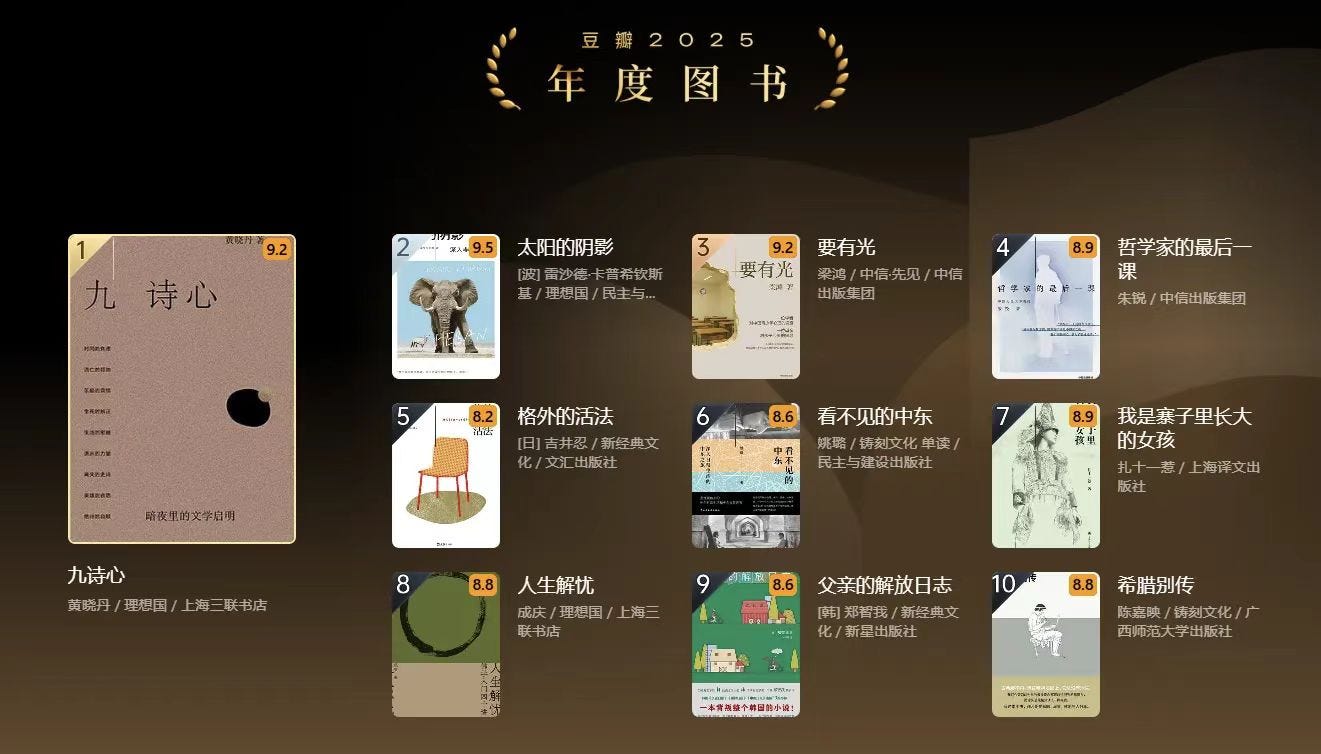
Dissecting the Douban Best Books of 2025 lists: An impromptu bonus issue
By Andrew Rule

Welcome to an unusually haphazard issue of the Cold Window Newsletter. I’m knee-deep in preparations for other literature posts I want to get out during the year-end season, but when I scrolled through the freshly-released Douban Best Books of the Year lists last night, I knew I was going to have to put everything else on hold. I have a LOT of thoughts on this year’s featured books and what they say about reading and publishing in China right now. Let’s get into it.

Douban’s top 10.

If you’re not familiar with Douban 豆瓣, it’s the rare social media platform in China that has a lot of goodwill among young people in China, myself included. (Disclosure: I was an intern at Douban for a while, but I was not involved in any year-end Best Books lists, and I’m writing this post purely as an outside user and reader.) In my experience, Douban attracts a primarily young, urban, highly-educated userbase—very artsy, very international-minded, more than a little pretentious. Until a crackdown in 2021, Douban also had a reputation as a gathering space for feminists, and it’s still a largely female space where books by authors like Elena Ferrante, Chizuko Ueno, and Lin Yi-han 林奕含 reign.

Continue reading Cold Window Newsletter 2025 best books

Inside China’s school for rebellious teens

This horror reminds me of that time I was writing about the concentration camps in Xinjiang on social media, and a Chinese person responded: “Sounds like my high school” — which may seem exaggerated given the starvation deaths in the camps, but it turns out it IS almost true — for some:

Tricked, abducted and abused: Inside China’s schools for ‘rebellious’ teens.
By Mengchen Zhang, Jack Lau and Ankur Shah. BBC Global China Unit and Eye Investigations

The BBC also made a documentary about these abusive ‘schools’ for children:

The Schools that Break Children – BBC World Service Documentaries. Dec 11, 2025.

–Sincerely,
Magnus Fiskesjö <magnus.fiskesjo@cornell.edu>

The secret trial of General Xu Qinxian

Source: NYT (12/17/25)
The Secret Trial of the General Who Refused to Attack Tiananmen Square
In 1989, Gen. Xu Qinxian defied orders to crush the pro-democracy protests in Beijing. Now, leaked video from his court-martial is on YouTube.
By , Reporting from Taipei, Taiwan

A six-hour video from the secret 1990 court-martial of Xu Qinxian, a Chinese general who refused to take part in what became a massacre in Beijing, has been leaked and posted online. CreditCredit…YouTube

When China’s rulers ordered tens of thousands of soldiers to crush pro-democracy demonstrations in Beijing in 1989, Gen. Xu Qinxian was the commander who famously said no.

He refused to lead his troops into the capital to help clear the protesters in Tiananmen Square by armed force. For decades, the story of his defiance remained murky.

Now, a leaked video of his secret court-martial has shed a rare light on General Xu, and on the tensions inside the military as Deng Xiaoping, China’s paramount leader at the time, prepared to send the soldiers into Beijing. That deployment culminated in the killing of hundreds — by some estimates, thousands — of unarmed people on June 3 and 4 as soldiers fired on protesters and bystanders.

In the trial footage, General Xu explains that he refused the order as a matter of individual conscience and professional judgment. He tells judges that sending armed troops against civilians would lead to chaos and bloodshed, saying that a commander who carried out martial law poorly would go down as “a sinner in history.”

General Xu had risen from a family of small-time vendors to command the 38th Group Army, one of the military’s most prestigious units. But by the time of his court-martial in 1990, captured in the video, he had been stripped of his command, charged with disobeying martial law orders, and brought before the judges to defend the decision that abruptly ended his career.

The six-hour video of the trial shows General Xu, in drab civilian clothes, entering a courtroom, guarded by three soldiers. Three judges gaze down from a podium. The courtroom is devoid of spectators.

Continue reading The secret trial of General Xu Qinxian

How to Read Chinese Poetry video series

Launch of English Video Series | How to Read Chinese Poetry: From the Shijing to Qing Poetry

The Advanced Institute for Global Chinese Studies (AIGCS) is pleased to announce the launch of the “How to Read Chinese Poetry: From the Shijing to Qing Poetry” video series—an adaptation of the podcast series released in 2022-2023, hosted by Professor Zong-qi Cai of Lingnan University.

Co-hosted by ten leading sinologists from North America, the series brings highlights from the acclaimed book How to Read Chinese Poetry: A Guided Anthology (Columbia University Press) to a broad general audience.

Below are the highlights of our first topic. Please join us as we journey into the ancient world of The Book of Poetry (Shijing), guided by Professor William H. Nienhauser of the University of Wisconsin–Madison.

Episodes 1-2: The Book of Poetry – Courtship Poems

https://www.youtube.com/watch?v=FBOh9nTdmFY

In the first two installments, Professor Nienhauser examines courtship poems from The Book of Poetry, the earliest anthology of Chinese poetry. The three courtship dynamics portrayed in “I Beg of you, Zhong Zi,” “The Banks of the Ru,” and “The Retiring Girl” offer contrasting perspectives on romantic pursuits in early China.

Episode 3: The Book of Poetry – A Paean to Zhou Dynastic Building

The Book of Poetry: Zhou Dynastic Building, William H. NIENHAUSER

https://www.youtube.com/watch?v=pl7O_2ahLME

The next poem examined by Professor Nienhauser is “Mian” (Woven). Like many of the Da Ya (Greater Odes), “Woven” celebrates two heroic ancestors who laid the groundwork for their descendants to overcome the Shang dynasty and establish the Zhou. The poem’s structure lends itself to memorization and recitation, suggesting it may have been used in early Zhou court rituals, much as “The Star-Spangled Banner” commemorates a pivotal event in American history.

Have fun watching and feel free to share your thoughts!

Farewell to ‘Du Fu of Huanhua Creek’

Source: China Digital Times (12/2/2025)
Translation: Farewell to a Deleted WeChat Account, “Du Fu of Huanhua Creek”
By Samuel Wade

Late last month, WeChat moderators’ axe fell on “Du Fu of Huanhua Creek,” apparently prompted by a post questioning online comments about Sino-Japanese tensions. On their other account, “History Rhymes,” author “Xu Peng1” lamented the loss of the account, the writing posted to it, and the connections it had made. The core of the post is a defense of what the authorities term “negative energy.” The great “poet-historian” after whom the account was named famously recorded the suffering of the common people during the An Lushan rebellion of the mid-eighth century, which “some argue was the end of China’s greatest Golden Age.” “Certain people around today would have called all of this ‘negative energy,’” Xu Peng writes. “But a thousand years on, what was ‘negative energy’ then is positive energy that today’s schoolchildren must learn by heart.”

Some serially banned members of Chinese social media’s “Resurrection Party” mock the process by numbering their new accounts or adopting increasingly absurd names like the recent “New New New Silence.” Xu Peng writes that instead, his next account will continue to follow the path through significant locations in Du Fu’s life. Many who have been censored express sarcastic penitence: “Yuzhilu,” for example, recently posed the rhetorical question-and-answer: “Q: What’s your opinion on public account posts getting shot down? A: I have no opinion, and feel nothing but gratitude toward the public account platform.” Similarly, Xu Peng borrows the Party exhortation to “not forget the original intention,” while making a somewhat contradictory promise of greater obedience in future: “I’ve certainly learned my lesson, and will correct my past mistakes.”

Today really was the darkest day. At noon, my younger cousin, who had been in the ICU for ten days or so, finally couldn’t hold on anymore. I hope I’ll have a chance to tell you about his story at some point.

My tears hadn’t yet dried when, in the afternoon, my WeChat public account Du Fu of Huanhua Creek (浣花溪杜甫, Huànhuāxī Dù Fǔ), was permanently banned. A sandcastle will always be swept away by the waves in the end.

I was in a daze from noon until evening, but I had to keep snapping myself out of it to look after my child.

During those distracted moments, I couldn’t stop thinking about the meaning of life, and the significance of speaking out.

Whenever I did speak out, I’d do it cautiously, aware that I was treading on thin ice, but I still inadvertently stepped on a mine and got blown up in the end.

I started posting from Du Fu of Huanhua Creek after [my previous WeChat account], Du Fu of Shihao Village, disappeared [amid the White Paper protests] at the end of 2022. Since then, the newer account has been temporarily suspended several times, and many of its posts have been deleted. Continue reading Farewell to ‘Du Fu of Huanhua Creek’

Documenting Uyghur detention camps

Source: Ethnic ChinaLit (12/16/25)
Documenting Uyghur Detention Camps in Fiction and Non-fiction
By Bruce Humes

In “He Recorded China’s Detention of Uyghurs. The U.S. Wants to Deport Him to Uganda,” the New York Times (Dec 16, 2025) reports:

In 2020, a Chinese citizen had heard reports about China’s mass detention and surveillance of Uyghurs. But he wanted to see if they were true for himself.

So the citizen, Heng Guan, 38, said that he made a hugely risky decision, driving across the country from eastern China to Xinjiang, where he tracked down and secretly shot video of hulking re-education and detention centers mostly holding Uyghurs, a Muslim ethnic group. The footage later became rare visual evidence of the scale and forcible nature of China’s clampdown, despite Beijing’s claims that they were voluntary re-education camps.

In 2021, Mr. Guan fled to the United States, where he applied for asylum. Then, this August, as he was living in New York, he was detained by Immigration and Customs Enforcement. His supporters and family members feared he might be sent back to China, where human rights activists say he would almost certainly face retribution from the government.

Perhaps it’s a good time to note how the camps have been described and documented in writing to date:

Survivor Memoirs

Continue reading Documenting Uyghur detention camps

Jimmy Lai’s conviction was years in the making

Source: NYT (12/15/25)
Hong Kong Media Tycoon’s Conviction Was Years in the Making
Jimmy Lai spent decades criticizing China’s rulers. He faces up to life in prison after a court found him guilty of national security crimes.
By Andrew Higgins and  (Andrew Higgins, a former resident of Hong Kong now working in Shanghai, has known Jimmy Lai since the 1990s and interviewed him shortly before his arrest. Alexandra Stevenson was in court for the ruling.)

Jimmy Lai stands by glass doors inside a flat decorated with ornate furnishings and screens.

Jimmy Lai at home in Hong Kong in August 2020. Credit…Lam Yik Fei for The New York Times

In a verdict long foretold by China’s Communist Party, a Hong Kong court on Monday convicted Jimmy Lai, a media mogul and rambunctious critic of the rulers in Beijing, finding him guilty of crimes endangering national security.

The conviction, swathed in the formal garb of a nominally independent judicial system left over from British rule, was never in any real doubt. Mr. Lai, 78, has been pilloried for years by China’s ruling party and its loyalists in Hong Kong as a traitor, a crook and the leader of a subversive “gang of four” who must be severely punished.

In this case, he was convicted of two counts of conspiring with foreign forces to impose sanctions against Hong Kong and another of publishing seditious material in the former British colony. He had already been convicted and imprisoned on fraud charges.

When Mr. Lai was arrested five years ago and released briefly on bail, a group of self-declared Chinese “patriots” gathered outside his home in Kowloon and waved banners warning ominously that “traitors who bring disaster to Hong Kong will not have a good end.”

Monday’s verdict delivered on that warning and brought nearer to a close a case that has crystallized the changes that have swept Hong Kong since the introduction of a harsh national security law in 2020 in response to months of antigovernment street protests that the authorities suppressed. Continue reading Jimmy Lai’s conviction was years in the making

Guan Heng fights for freedom in the US

The court date is Dec 15 for Guan Heng who is being held in Binghamton, New York, despite a pending asylum claim. I’m horrified that the US seems to have completely abandoned human rights and might actually hand this man to torture and death by the Chinese Communist authorities? Sincerely, Magnus Fiskesjö <nf42@cornell.edu>

Source: Human Rights in China (12/12/25)
Man who filmed Uyghur concentration camps now fights for his own freedom in the United States
“If he gets sent back, he’s really dead,” Guan Heng’s mother said. His fate hangs in the balance as he awaits his scheduled court appearance in New York on December 15th.
By Lu Jingwei (Atlas Luk)
Editor | Qiu Li

This post was originally written in Chinese: 中文版

Screencap of the video documenting Uyghur concentration camps released by Guan Heng.

This is a story of courage, escape, and absurd paradox.

In October 2020, Guan Heng, a young man from Henan, China, drove alone into Xinjiang, using a telephoto lens to document the concentration camp facilities hidden in the wilderness, towns, and military camps. To make these images public, he embarked on a thrilling escape: he made his way through South America and finally sailed alone in a small boat for 23 hours from the Bahamas, successfully landing in Florida. After arriving in the United States in 2021, he released the videos as planned. This footage became crucial evidence for the international community (including BuzzFeed News’ Pulitzer Prize-winning team) to confirm what China was doing in Xinjiang.

Four years later, Guan Heng, who had once thought he was safe, lost his freedom in the United States. In August 2025, during a raid by U.S. Immigration and Customs Enforcement (ICE) on Guan Heng’s roommate, Guan Heng was arrested in upstate New York for “illegal entry.” Now, he is in the Broome County Correctional Facility in New York State, facing the threat of deportation—being forced to return to the China he risked everything to escape.

On the morning of August 21, 2025, in a residential area in upstate New York, Guan Heng was awakened by a violent knocking on his door. It was ICE agents. Continue reading Guan Heng fights for freedom in the US

2026-27 An Wang postdoc

The Fairbank Center for Chinese Studies at Harvard University is pleased to announce the competition for the 2026-27 An Wang Postdoctoral Fellowship in Chinese Studies.

For academic year 2026-27 the Fairbank Center will offer up to two post-doctoral fellowships to support participants in an interdisciplinary research group to study The Social Foundations of State Power in China. Through this research theme, the group will examine how social structure, inequality, and ideology sustain state capacity and regime durability in contemporary China.

The 2026-27 An Wang research group will be led by Professor Yuhua Wang, Department of Government, and Professor Xiang Zhou, Department of Sociology.  Xiang Zhou brings expertise on social stratification, causal inference, and survey data integration. His work on China’s inequality and mobility—spanning analyses of Gini trends, returns to education, and the structure of opportunity—provides the empirical foundation. Yuhua Wang contributes complementary strengths in political institutions, state formation, and authoritarian governance. His research on the long-run trade-offs between state strength and ruler survival, the infrastructural reach of the modern state, and ideological control in academia frames the project’s political and historical dimensions.

Building on recent empirical studies, the group will seek to understand how China’s evolving social stratification, informal institutions, and value changes underpin both the endurance and adaptation of its authoritarian state. With China’s ongoing social transformation—mass education expansion, rural–urban integration, digital governance, and renewed ideological campaigns—this is an opportune moment to build cross-disciplinary frameworks linking social stratification to state durability. Continue reading 2026-27 An Wang postdoc

Sexually explicit letters about HK activists

Source: The Guardian (12/10/25)
Sexually explicit letters about exiled Hong Kong activists sent to UK and Australian addresses
Exclusive: Letters with deepfake images of Carmen Lau in UK and targeting of Ted Hui in Australia part of growing harassment
By  and 

Carmen Lau, pictured in London in February, has said she was ‘terrified’ when she learned of the letters containing deepfake images of her. Photograph: Eleventh Hour/Alamy

Sexually explicit letters and “lonely housewife” posters about high-profile pro-democracy Hong Kong exiles have been sent to people in the UK and Australia, marking a ratcheting up in the transnational harassment faced by critics of the Chinese Communist party’s rule in the former British colony.

Letters purporting to be from Carmen Lau, an exiled pro-democracy activist and former district councillor, showing digitally faked images of her as a sex worker were sent to her former neighbours in Maidenhead in the UK in recent weeks.

It is the first time that people on the Hong Kong police’s bounty list, wanted for national security offences, have been directly targeted with this kind of explicitly sexualised harassment, highlighting the heightened risks faced by female activists and their associates.

At least half a dozen of Lau’s former neighbours in Maidenhead received letters showing fake, sexualised images of her. They were posted from Macau, a semi-autonomous Chinese territory near Hong Kong. The letters have five deepfaked images of Lau, with her face superimposed on women’s bodies either naked or in underwear. One image shows the fake Lau performing a sex act, which has been pixelated.

The text on the letter states Lau’s name and supposed body measurements. It includes her former home address in full and states: “Welcome to visit me! You have the right to choose me, and I also have the right not to accept you. Just want the process to be gentle. We can become close friends in the future!”

In Australia, Ted Hui, a former Hong Kong legislator, and his wife have been targeted with a fake poster advertising his wife’s services as a sex worker. The poster shows an old photograph of Hui and his wife under the headline “Hong Kong lonely housewife”. Continue reading Sexually explicit letters about HK activists