New New New Silence

Source: China Digital Times (11/19/25)
Words of the Week: WeChat Account “New New New Silence” and China’s Online “Reincarnation Party”
By Samuel Wade

Last week’s CDT Chinese 404 Archives podcast highlighted the recent revival of the Silent Observer WeChat account. The account, which for several years has provided a platform for philosophically-inclined reflections on Chinese society and current affairs, is now on its fourth incarnation: from 默存格物 Mòcún géwù, or “Silent Observer”; to 新默存 Xīn mòcún, or “New Silence”; to 新新默存 Xīn xīn mòcún, or “New New Silence”; and now on to 新新新默存 Xīn xīn xīn mòcún, or “New New New Silence.” Its editor, writer and former journalism professor Song Shinanannounced the latest regeneration in September in a post laden with references to Hegel, Kierkegaard, and Arendt:

Silent Observer, New Silence, and New New Silence are all gone.

Today, we create New New New Silence, because we still can; because there is freedom, beauty, and love in our hearts, and Silent Observer is an island of that freedom, beauty, and love.

We build these islands because we live in a highly fragmented society. Every day, we face a flood of information, but we have no idea what’s really going on in our society, or in the minds of others. We know the thoughts of a few in our own immediate circles, and see glimmers of a few others’ through social media, but we don’t know what the people at the top are thinking, nor those at the bottom, nor those in between. We don’t know the thoughts of those who died in silence, nor those who live on in silence. We cannot freely communicate, and the anguish of that does not just affect us individually. Freedom, beauty, and love will shrivel in an age of stifled communication, unless people have a song in their hearts that they can clap and sing along to, no matter how constricted the space, or whether anyone else can hear.

[…] There are too many obstacles on the way to freedom, but I think the biggest is nihilism.

[…] To rise above nihilism, we must build islands for ourselves. Perhaps Silent Observer can be one such island—an island of freedom, beauty, and love. [Chinese] Continue reading New New New Silence

What is philosophy to me

Source: Why Philosophy? (11/3/25)
What Is Philosophy to Me?
By Haiyan Lee

How were you first introduced to philosophy? 

Many philosophers have a charming origin story about how they became a philosopher. It typically involves some sort of happy serendipity, whereupon our protagonist willy-nilly fell in love with philosophy and never looked back. My story is none-too-charming, and my stumbling into philosophy did not turn me into a professional philosopher. I still am not a philosopher—neither by training nor by professional location. Instead, I’m a literature professor holding an appointment in a foreign languages and literatures department (and a joint appointment in Comparative Literature). I would not have presumed to intrude into this space but for the insistence of Gabriel Olano. In part to explain my interloper status, I have combined the first two questions and switched the order.

I grew up in Mao’s China and received a stultifying education (1970s and 80s). My scores on the National College Entrance Examinations were just high enough to be admitted into Peking University, China’s premier institution of higher education, but not enough to earn a spot in one of the more coveted disciplines, such as English and International Finance. So I got assigned to major in Religious Studies, which was housed in the Philosophy Department. I had heard of philosophy but not religious studies, coming as I did from the hinterland and having had little exposure to anything but my textbooks. I ended up not liking either philosophy or religious studies, and I blame the university (and the entire educational system) for it.

In my first year, I had to take a number of courses in Marxism-Leninism, dialectical materialism, historical materialism, Mao Zedong Thought, and the history of the Chinese Communist Party. None of the classes assigned any readings. The instructor lectured, we took notes, and regurgitated everything back to him (yes, they were all men) on the exam. In my second year, I nearly failed the history of Western philosophy course because 1) I couldn’t follow the lectures and 2) instead of the usual final exam, the instructor required a paper and I had never written a paper up to that point and had received no instruction as to how. All this is to say that I had a terrible experience studying what passed as philosophy at Peking University. Religious studies also failed to draw me in for more or less the same reasons. After I came to the U.S. for grad school, I switched to literature, which has always been my first love. Continue reading What is philosophy to me

Dalai Lama will reinarnate

Source: NYT (7/2/25)
Dalai Lama Says He Will Reincarnate, but China Has No Say in Successor
The aging Tibetan spiritual leader is looking to prevent Beijing from taking advantage of a power vacuum that might arise after his death.
By Mujib Mashal and , Reporting from Dharamsala, India, where the Dalai Lama and other Tibetan Buddhist leaders are meeting to discuss the future of the spiritual leader’s institution

Monks in saffron robes sit as a video of the Dalai Lama speaking onscreen plays in front of them.

Tibetan Buddhist monks gathered in Dharamshala, a Himalayan hill town in India, to discuss the future of the Dalai Lama’s spiritual office, as China tries to control who will succeed him. Credit…Atul Loke for The New York Times

The Dalai Lama gathered senior Tibetan Buddhist monks on Wednesday in Dharamsala, the Himalayan town where he has lived in exile for over half a century, to chart the future of his spiritual office — and how it might survive growing pressure from China.

In a recorded video statement to the three-day conference, the 89-year-old offered few specifics on how Tibetan Buddhism’s highest office might avoid a period of uncertainty after he dies, a moment that Beijing may try to seize by installing its own choice as the next Dalai Lama.

But he made one thing clear: his own doubts about whether the institution of the Dalai Lama should continue after him have now been put to rest. He had previously been open to ending the role to avoid it being exploited by China after his death, but now affirmed that the lineage would go on.

He also made what was seen as another move at shutting China out from the future reincarnation of the Tibetan spiritual leader. He said in a statement that Gaden Phodrang Trust, which is registered in India and run by the Dalai Lama’s office, has “sole authority” to recognize such a reincarnation.

“No one else has any such authority to interfere in this matter,” he said.

The Chinese Communist Party, which has sought to erode the influence of the Dalai Lama in Tibet, asserts that only it has the authority to choose his reincarnation, despite being committed to atheism in its ranks. In Beijing, a spokeswoman for the Chinese foreign ministry said on Wednesday that the reincarnation had to be approved by the central government. Continue reading Dalai Lama will reinarnate

All under Heaven review

MCLC Resource Center is pleased to announce publication of Peter Zarrow’s review of All under Heaven: The Tianxia System for a Possible World Order, by Zhao Tingyang. The review appears below and at its online home: https://u.osu.edu/mclc/book-reviews/zarrow/. My thanks to Michael Hill, our translations/translation studies book review editor, for ushering the review to publication.

Kirk Denton, MCLC

All under Heaven:
The Tianxia System for a Possible World Order

By Zhao Tingyang

Translated by Joseph E. Harroff


Reviewed by Peter Zarrow

MCLC Resource Center Publication (Copyright June, 2025)


Zhao Tingyang, All under Heaven: The Tianxia System for a Possible World Order Tr. by Joseph E. Harroff. Berkeley: University of California Press, 2021. 332 pp. ISBN 9780520325005 (Hardback)/ ISBN 9780520325029 (Paperback)/ ISBN 9780520974210 (ebook).

Tianxia 天下 is an ancient term, found on Zhou bronzes and in early classics such as the Book of Odes (詩經), Book of Documents (書經), and the Analects (論語). The Anglosphere has found it convenient either to translate the term more or less literally as “All-under-Heaven” or, capturing its practical usage, as “kingdom” or “empire”—that is, China.[1]  In the former guise, Tianxia might be regarded as similar to ancient theocratic empires: it performs legitimacy while also providing the conceptual basis for what was politically possible. The more territorialized sense of Tianxia, in turn, might be regarded as a self-reference that various dynasties found useful. This is not the understanding presented by Zhao Tingyang 赵汀阳 in All under Heaven: The Tianxia System for a Possible World Order.  For one, both understandings of Tianxia treat it as a form of the state, whereas Zhao points to the classical distinction between Tianxia and guo 國 (state) to suggest it is something else. Namely, Tianxia refers to the world and therefore in no sense does it refer to a state (in contrast to the Greek polis, for example).  Zhao finds the concept emerging in China’s most ancient period, “too early for its own time” (xiv), while the “Tianxia system” (if not the concept) emerged with the Zhou and ended in 221 BCE.

Haroff’s fine translation captures Zhao’s style and conveys his sometimes technical philosophical terminology and his restatements of ancient texts in ways that should make sense to Western political thinkers as well as Sinologists, yet without flattening the particularities of Zhao’s ideas. In this review, I first present a summary of Zhao’s argument, and then a critique.  Use of the term Tianxia in modern scholarship took off in the early 2010s, at least according to Google’s N-gram counter, in both the original Chinese and in its romanized form. Zhao’s first major work on Tianxia, published in 2005, did much to prompt discussion. This revival of an ancient concept has sometimes been seen as a kind of ideological mask for Chinese dominance: “The tianxia system is defined as a Sino-centric hierarchical relationship among unequals, governed according to Confucian principles of benevolence,” in June Teufel’s words.[2]  Zhao Tingyang would deny he seeks any kind of Chinese dominance. For Zhao, Tianxia is a resource or a “method” to ameliorate our anarchic, violent, and oppressive world order.  In All under Heaven, he argues for the need to reinvent Tianxia in the wake of the failure of the Kantian search for world peace and the contemporary disasters of international politics. Zhao begins his interdisciplinary but mainly philosophical study of Tianxia by calling it “an ideal concerned with achieving cosmopolitical order,” but also sees it as a tool (in the realm of reality as opposed to the ideal) and “also [as] a methodology” (vii).  In Zhao’s understanding, in the Tianxia system there is no dichotomy between the inner and outer, since nothing can exist outside of the world.  Likewise, there is no distinction between friend and enemy—there are differences but no goal of annihilating the Other. Zhao would keep “national sovereignty,” but the powers of states would be limited by “world sovereignty” (22), with both sovereignties existing in the same system.  When questions affecting all humanity are at stake, those would be in the field of world sovereignty. Conflict is thus ultimately futile; “relational reasoning” (mutual aid, in a sense) ultimately works better than “individual rationality” (maximizing self-interest). In a word, Zhao believes Western political theory, centering on the nation-state, can be and should be replaced by theories that define politics as the “art of shared living” (36) on the global level. Continue reading All under Heaven review

Lu Xun and World Literature

New Publication
Ma, Xiaolu and Carlos Rojas, eds. Lu Xun and World Literature. HK: Hong Kong University Press, 2025.

Abstract: In Lu Xun and World Literature, Xiaolu Ma, Carlos Rojas, and other contributors examine various aspects of Lu Xun, who is known as the father of modern Chinese literature. Essays in this book focus on Lu Xun’s works in relation to the notions of world literature and processes of literary worlding. The contributors offer detailed analyses of Lu Xun’s own literary oeuvre and of foreign works that engage with his writings. This volume also focuses on many facets of the publication and dissemination of Lu Xun’s works, from printing and binding to the discussions and debates that followed their release in China and abroad. This book not only makes an important contribution to the field of Lu Xun studies, but also proposes a reexamination of the category of world literature.

Table of Contents:

Introduction: Lu Xun, China, and the World, by Xiaolu Ma

Lu Xun, World Poetry, and Poetic Worlding: From Mara Poetry to Revolutionary Literature, by Pu Wang

The Young Lu Xun and Weltliteratur: The Making of Anthology of Short Stories from beyond the Border, by Wendong Cui Continue reading Lu Xun and World Literature

Paper Republic newsletter no. 20

Image description

Happy Chinese New Year!

As we usher in the Year of the Snake, this vibrant and meaningful occasion is the perfect time to celebrate the richness of Chinese culture—and what better way than through the lens of its literature?

This issue brings you a feast of publications and media showcasing the brilliance of Chinese writing in translation. From fresh releases to interviews with translators and other news, we’re thrilled to spotlight stories and voices that resonate with the spirit of this festive season. Whether you’re an avid reader or simply curious about Chinese literature, there’s plenty to explore. So, grab a cup of tea, settle in, and let’s dive into the world of Chinese storytelling together!

Read online for free

  • Yan An’s poems “Territory” and “Empty Train” (translated by Chen Du and Xisheng Chen) were published online in Flyway: Journal of Writing & Environment (Iowa State University).

Events

  • Our 9th book club on modern Chinese literature with the Open University Book Club was on 17th January. Helen Wang joined us to discuss her translation of the short story “Ying Yang Alley” (鹰扬巷) by Fan Xiaoqing (范小青). If you missed it, you can check out the recording and transcript of the event here. And keep an eye on the website as we will be doing another book club in the next few months.
  • Don’t miss this masterclass and workshop by Nicky Harman and Yan Ge on 8 March 2025 at the Leeds Centre for New Chinese Writing. Writing Lives: from China in the 1930s to Britain in the 2020s. Part 1: Presentation with Nicky Harman on Ling Shuhua and Life-Writing; Part 2: Creative Writing Workshop on Characterisation, with Yan Ge. Registration link now available here.

Continue reading Paper Republic newsletter no. 20

The Anaconda in the Chandelier review

MCLC Resource Center is pleased to announce publication of Jeffrey Kinkley’s review of The Anaconda in the Chandelier: Writings on China, by Perry Link. The review appears below and at its online home: https://u.osu.edu/mclc/book-reviews/kinkley2/. My thanks to Nicholas Kaldis, our literary studies book review editor, for ushering the review to publication.

Kirk Denton, MCLC

The Anaconda in the Chandelier:
Writings on China

By Perry Link


Reviewed by Jeffrey C. Kinkley

MCLC Resource Center Publication (Copyright January, 2025)


Perry Link, The Anaconda in the Chandelier: Writings on China Perry Link. Philadelphia: Paul Dry Books, 2025. viii + 287 pp. ISBN 9781589881983 (paper)

Perry Link’s eminence as scholar and as public intellectual is well known to most MCLC readers. His pioneering scholarship on twentieth-century Chinese popular narratives and on the linguistic inventiveness of Chinese oral and written expression more generally is embodied in full-length monographs,[1] supplemented by studies of the circulation of Mao-era printed novels and unapproved hand-copied manuscripts, as well as essays on comedians’ dialogues (xiangsheng 相声) of the Mao and post-Mao years. Link’s 2007 essay on xiangsheng in the early People’s Republic of China (PRC) serves as a bang-up penultimate chapter for The Anaconda in the Chandelier.[2] The book prints in total thirty-one of Link’s 1998-2023 short and medium-length essays, book reviews, and prefaces, including a number of Link’s longer and more academic articles, together with their footnotes. Most are reprints—with revisions, says the preface, but changes are scarcely visible. Many of these contributions take on the dark task of explaining the finely tuned mechanics, psychology, and social psychology of Chinese Communist Party (CCP) control of Chinese communication through censorship, pre-censorship, and, above all, the creation of an unconscious, second-nature self-censorship among writers and the general public. Link calls the condition “fossilized fear.” That was the subject of a landmark monograph from Princeton University Press he published in 2000—on the “uses” of literature in China.[3] He updated the story in newsy and learned essays published in The New York Review of Books and various op-ed and human rights forums. (NYRB-related contributions make up about half of the essays anthologized in The Anaconda in the Chandelier.) The author’s expertise, Chinese friends and informants, and ever-critical yet always humanely empathetic social probings enabled what is probably now his best-known research: historical and biographical accounts of Chinese dissidence and protest. That focus, too, dates back to the 1980s, when he began to translate, edit, and publish short fiction and essays by freethinking PRC writers who surfaced, or, like Liu Binyan 刘宾雁, resurfaced, after the demise of Mao.[4] Consideration of the 1989 June Fourth massacre accelerated Link’s major collaborative academic projects and human rights activism, which includes documenting and explaining the before-and-after of China’s nationwide 1989 calamity, the Charter 08 movement, and the life story of the 2010 Nobel Peace Prize winner, Liu Xiaobo 刘晓波.[5] Through it all, Link has pursued yet another vocation: teaching in and administering Chinese language programs, while coproducing textbooks for them.[6] Continue reading The Anaconda in the Chandelier review

Ling Yü wins 2025 Newman Prize

NORMAN, OKLA. – An international jury has selected Taiwanese poet Ling Yü 零⾬ (Wang Meiqin 王美琴) as the winner of the 2025 Newman Prize for Chinese Literature. Sponsored by the University of Oklahoma Institute for US-China Issues in the David L. Boren College of International Studies, the Newman Prize is awarded biennially to recognize outstanding achievement in prose or poetry that best captures the human condition, based solely on literary merit. Any living author writing in Chinese is eligible.

Ling Yü will receive $10,000 and an engraved bronze medallion. She will be celebrated at an award symposium and banquet to be held on the OU Norman campus during the last week of March 2025 along with the winners of the International Newman Prizes for English Jueju.

Ling Yü was nominated for the prize by Professor Cosima Bruno (School of Oriental and African Studies, London), who praised her poetry for its “untrammeled, ingenious lyricism” and its ability to weave contemporary themes and personal experiences with the controlled elegance of classical Chinese poetry.

Bruno remarked in her nomination statement:

Ling Yü’s language is economical and concise, yet surprising and reverberating with complex meaning. Her poetry engages thoughtfully with classical and modern, Eastern and Western literary, philosophical, artistic, and esoteric sources, generating outstanding works that require attention but are also intuitively grasped. Through her works, readers encounter a prism of rich, elegantly employed references that span themes of meditation, travel, feminism, capitalism, the environment, mythology and more.

Ling Yü’s extensive body of work includes nine collections of poetry, such as Series on a City (《城的連作》1990), Names Disappearing on the Map (《消失在地圖上的名字》1992), Mudong Hymns (《⽊冬詠歌集》1999), I’m Heading for You (《我正前往你》2010), and her recent collections Skin-Coloured Time (《膚⾊的時光》2018) and Daughters (《女兒》2022). Her poetry spans topics such as cultural heritage, mythological figures, ecological concern, and autobiographical reflection. Her work has been widely recognized, translated into multiple languages, and presented at major international poetry festivals, including the Poetry International Festival in Rotterdam and the Hong Kong International Poetry Nights. Continue reading Ling Yü wins 2025 Newman Prize

I Have No Enemies review

MCLC Resource Center is pleased to announce publication of Jeffrey Kinkley’s review of I Have No Enemies: The Life and Legacy of Liu Xiaobo, by Perry Link and Wu Dazhi. The review appears below and at its online home: https://u.osu.edu/mclc/book-reviews/kinkley/. My thanks to Nicholas Kaldis, our literary studies book review editor, for ushering the review to publication.

Kirk Denton, MCLC

I Have No Enemies:
The Life and Legacy of Liu Xiaobo

By Perry Link and Wu Dazhi


Reviewed by Jeffrey C. Kinkley

MCLC Resource Center Publication (Copyright November, 2023)


Perry Link and Wu Dazhi, I Have No Enemies: The Life and Legacy of Liu Xiaobo New York: Columbia University Press, 2023. xiv + 553 pp. ISBN: 9780231216760 (Paperback); ISBN: 9780231206341 (Hardcover); ISBN: 9780231556446 (E-book).

I Have No Enemies: The Life and Legacy of Liu Xiaobo, makes a magisterial contribution to Chinese intellectual and political history. It is a comprehensive biography of an intrepid human rights promoter, leader, and thinker who won the 2010 Nobel Peace Prize during his fourth imprisonment in the People’s Republic of China, prior to his being in effect—deliberately or not—consigned to death, which arrived in 2017, during his last, eleven-year sentence. Liu Xiaobo’s 刘晓波 major opinions and the changes in them are briefly summarized, explained, and compared in the context of his life and times, speech by speech, essay by essay. One major dividend is an inside history of a major part of domestic Chinese ideological debate and political dissent in the post-Mao age, in 500 well-documented pages, so often did Liu Xiaobo’s dialogues and exploits interact with those of other freethinkers. The book also reflects on the larger social history of contemporary nonofficial protest and agitation for reform, whose content and strategies were transmuted not just by the failure of June Fourth, 1989, but also by the spread of internet communication early in the twenty-first century. Wu Dazhi and Perry Link meanwhile proffer insights into the emotional life of their main biographical subject. He was blessed with a brilliant intellect, nearly photographic memory, and the ability to deliver memorable and charismatic speeches, despite a tendency to stutter in daily life. Liu Xiaobo was both an inveterate contrarian and an eternal optimist. And yet, in his later years, he was constantly worried about causing unhappy consequences for others (already at Tiananmen in 1989, and later, in the 2008 leadup to Charter 08). He appears to have been tormented in those years by survivor guilt and what he felt was his inadequacy and irresponsibility as a family man. The biography tends to agree with him on the latter. Yet Liu Xiaobo was undaunted about what might happen to his own person, even as he incessantly questioned the logic of his own intellect and agency, and the very moral underpinnings of his personal motivation. The reader sees also the trials and tribulations of Liu’s second wife, Liu Xia 刘霞. A unique love story unfolds in chapter 20, the last chapter before the Epilogue. Continue reading I Have No Enemies review

The Political Philosophy of Ci Jiwei

New Publication
Thinking the Unthinkable: The Political Philsophy of Ci Jiwei
By Johannes Hoerning
New Left Review 143 (Sept-Oct. 2023)
[DOWNLOAD THE FULL ARTICLE HERE]

In his 1989–92 lecture series On the State Pierre Bourdieu, following Durkheim, proposed a provisional definition of the state as the basis for ‘both the logical and the moral conformity of the social world’. By ‘logical conformity’, Bourdieu meant that the agents of the social world would share the same categories of perception, the same construction of reality; by ‘moral conformity’, their agreement on certain core values. Taking his distance from classical state theory, such as that of Hobbes or Locke—in which the state, occupying a quasi- godlike viewpoint, oversees all and serves the common good—as also from Marxian traditions, from Gramsci to Althusser and beyond, which focus on the function of the state as an apparatus for maintaining public order in the interests of the ruling bloc, Bourdieu emphasized instead the need to grasp the ‘organizational magic’ of the state as a principle of consciousness—its monopoly of legitimate symbolic as well as physical violence. The social theorist therefore needed to be particularly on guard against Durkheimian ‘pre-notions’ or received ideas, against ‘thinking the state with state thinking’. A first step was to conceive the state as what Bourdieu called ‘an almost unthinkable object’.1

If there is one thinker who has met Bourdieu’s challenge to ‘think the state’ without succumbing to ‘state thinking’, it is the Chinese political philosopher Ci Jiwei. Recently retired from the philosophy department of the University of Hong Kong, Ci has devoted most of the past three decades to analysing the nature and evolution of China’s state and soci- ety since the founding of the People’s Republic in 1949. Three of his four books—Dialectic of the Chinese Revolution (1994), Moral China in the Age of Reform (2014) and Democracy in China (2019)—amount to a loose trilogy aiming to clarify the ‘logic’ of the Chinese experience and to track the evolution of the CCP regime since Mao. The collapse of Maoist utopi- anism and the liberalization of the economy after 1978 have left Chinese society in a ‘fundamentally unsettled’ condition, Ci argues.2 Each book in the trilogy addresses a different symptom of this situation: existential or social-psychological malaise in Dialectic of the Chinese Revolution, the undermining of moral subjectivity in Moral China and the looming cri- sis of political legitimacy in Democracy in China. In different ways, they are all concerned with how the Chinese party-state might accommodate itself, for its own and the nation’s good, to citizens’ need to act freely and to understand themselves as free, while at the same time preserving its own stability and that of the country at large.3 [DOWNLOAD THE FULL ARTICLE HERE]

Healing–cfp

Call for Participants/Papers for a panel “Healing in Chinese Philosophies, Literature, and Religions
In-person presentations at the AAS 2024 Annual Conference, March 14-17, 2024 in Seattle, Washington
Abstract submission deadline: July 26, 2023

We invite submissions of paper abstracts for the panel titled “Healing in Chinese Philosophies, Literatures, and Religions” to be held in-person at the AAS 2024 Annual Conference. The panel aims to explore the cultural, literary, philosophical, and religious dimensions of illness, medicine, and health in imperial China.

  • Topics of interest include, but are not limited to the following:
  • Social history of illness, medicine, and healing in Chinese contexts.
  • Therapeutic practices such as rituals, feasts, prayers, meditation, confession, and divination for healing and longevity in imperial China.
  • New perspectives and interpretations of disease, body, and health in Chinese cultural, political, religious, and gendered frameworks.

The panelists will participate in the in-person presentations at the AAS 2024 Annual Conference to be held March 14-17, 2024 in Seattle, Washington at the Seattle Convention Center and the Sheraton Grand Seattle Hotel.

Paper abstracts (300-350 words) and a short biography or CV should be sent to the panel organizer Dixuan Chen, Grinnell College, chenyuji@grinnell.edu by July 26, 2023 (Eastern Standard Time). Communication will be in English. Files should be sent as PDF or Word documents (doc or docx). Contact the panel organizer with any questions at chenyuji@grinnell.edu More information about the AAS 2024 Annual Conference 2024 in-person in Seattle, Washington: https://www.asianstudies.org/conference.

CCP smear campaign targets the Dalai Lama (2)

I expand this discussion of the Chinese propaganda against the Dalai Lama, and the stunning gullibility of the Western audiences that fell for it, in this new online interview with the new website Global Order, based out of New Delhi–Magnus Fiskesjö <nf42@cornell.edu>

Source: Global Order (5/24/23)
How the Chinese Communist Party ran a global propaganda campaign against the Dalai Lama

The Chinese Communist Party is running a global propaganda campaign to destroy the credibility of the Dalai Lama. The most recent example of this, says Magnus Fiskesjö, Associate Professor of Anthropology and Asian Studies at Cornell University, was the crude and brutal ‘suck my tongue’ controversy where an innocuous Tibetan gesture was attacked by trolling mobs, and even celebrities, around the world as sexual exploitation – all led by propaganda teams of the Chinese Communist Party. Fiskesjö talks to Hindol Sengupta about propaganda, cultural differences and misunderstandings and the redemptive power of compassion.”

CCP smear campaign targets the Dalai Lama (1)

Thanks to Magnus Fiskesjö for providing a reading for the Dalai Lama’s interaction with the child in April. I wasn’t aware of the linguistic and cultural aspects of this meeting, reductively sexualized and sensationalized in Western anglophone media. When I saw the clip, memed with a sort of gleeful meanness, the first thing I thought of is the trope of Buddhist monks and nuns in Chinese culture as lascivious, a sort of a parallel to Catholic clergy in European gothic literature (Lewis’ The Monk is the most well-known version but of course, the Catholic Church has its own historical cross to bear in this regard). The opera “The Little Nun Goes Down the Mountain,” a story of desire for the secular life, is one version of this. A fish-plank beating Buddhist monk is murdered by Shi Xiu in Outlaws of the Marsh for seducing a brother’s wife. And a similar lascivious Buddhist monk trope gets repeated when grandpa murders his mother’s Buddhist monk lover in Mo Yan’s Red Sorghum centuries later.

Maybe we need a social analysis of cancelling, which operates like a secular form of shunning in contemporary media, minus the semblance of consistent moral rationale, and with a multiplicity of actors possessing varying degrees of clout.

Sean Macdonald <smacdon2005@gmail.com>

CCP smear campaign targets the Dalai Lama

Source: The Diplomat (5/20/23)
How a CCP Propaganda Campaign Targeted the Dalai Lama
The latest smear campaign succeeded beyond China’s wildest dreams by playing into Western ignorance about Tibetan culture – and self-righteous “cancel culture” on social media.
By Magnus Fiskesjö

How a CCP Propaganda Campaign Targeted the Dalai Lama

Credit: Depositphotos

On April 8, 2023, a new global smear campaign against the Dalai Lama was unleashed on social media.

This, in itself, wasn’t news. The Dalai Lama, Tibet’s spiritual leader, has lived in exile in India since 1959, when he was forced to flee his homeland, occupied by Mao’s China. He remains deeply loved in Tibet, but the Chinese regime has made it a criminal offense even to have a photo of him. And ever since 1959, Chinese officials have been vilifying him in every medium possible.

But while this latest round is almost certainly also disinformation “Made in China,” it represents a new approach: Attempting to paint the Dalai Lama as a pedophile. The trick succeeded beyond belief, with millions of people in the United States, Europe, and beyond – due to prior prejudice coupled with the self-righteous tendency to jump to conclusions, combined with widespread ignorance about Tibet.

As the Tibetan exile activist Lhadon Tethong pointed out in a recent public conversation, the goal was very likely also to distract the world from the new dramatic oppression inside Chinese-occupied Tibet. U.N. human rights experts just issued a warning that Chinese authorities are detaining large numbers of both children and adults in Tibet, to erase their culture and turn them into Chinese-speaking laborers – modeled after the massive parallel genocide against the Uyghurs. Continue reading CCP smear campaign targets the Dalai Lama

Tombstone Histories

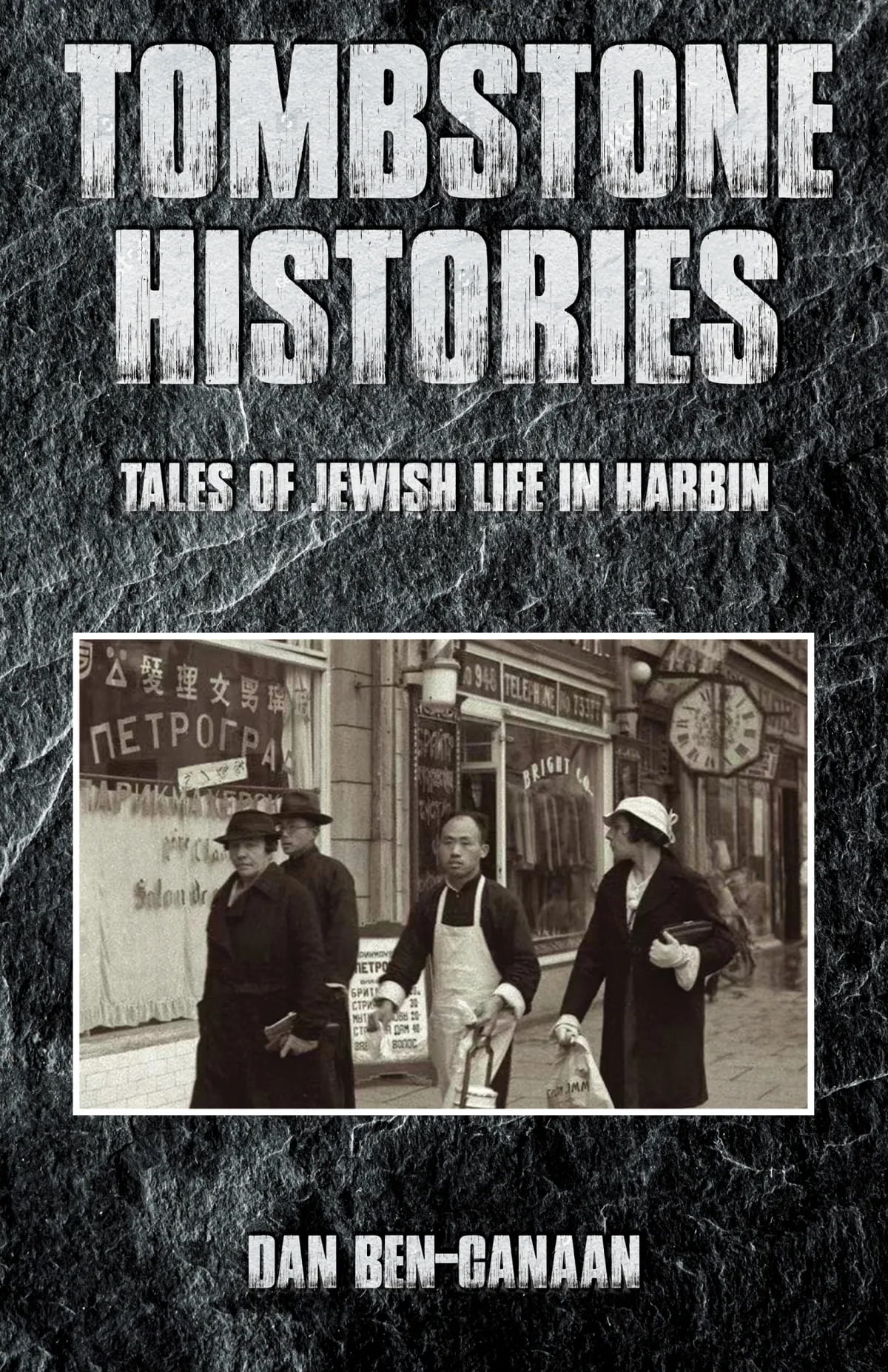
NEW PUBLICATION: “Tombstone Histories” by Dan Ben-Canaan
https://earnshawbooks.com/product/tombstone-histories/

Tombstone Histories: Tales of Jewish Life in Harbin is a venture into the strange past of a great Chinese city named Harbin that was for a time home to some 38 different national communities among them a glorious Jewish community before war and revolution destroyed their lives. Tombstone Histories presents the Jewish experience in the city in a personal and unforgettable way. It paints a revealing picture, never shown before, of Jewish daily life in this faraway and alien land.

History so often ends up as just a series of tombstones, but this book provides the other side to the story—the personal details of lives which allow readers to draw their own conclusions about the human experience, especially survival.

Professor Dan Ben-Canaan <canaan@inter.net.il>