M. Winter interview and new anthology

List members may be interested in reading Anthony Tao’s interview of me for The China Project on the occasion of World Poetry Day a few days ago.​

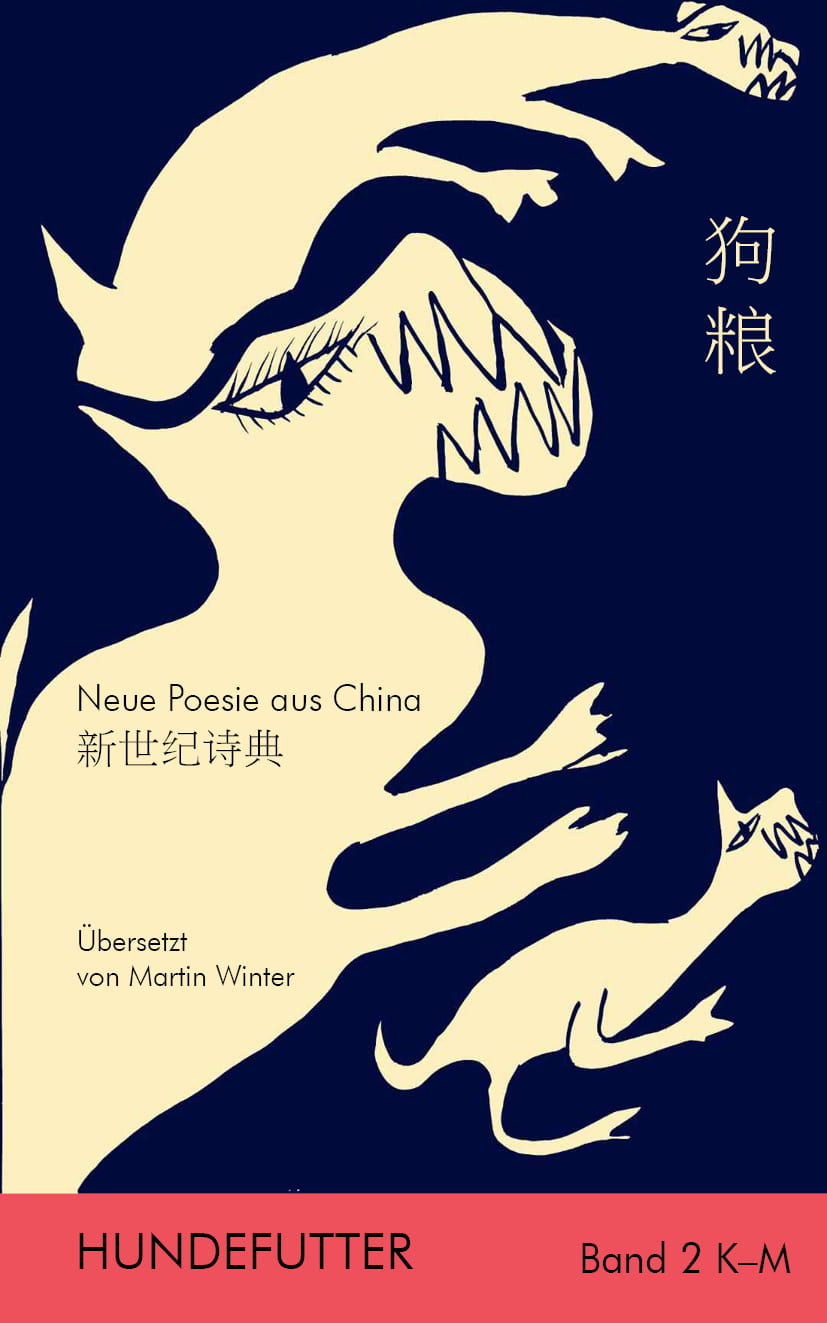
Also, the second book of our NPC (Neue Poesie aus China) anthology series ​has come out. This volume has 94 poets. For more info, please see the publisher’s page and my blog.

See also here for the first volume, with an introduction in English.

Martin Winter <dujuan99@gmail.com>

Writing Poetry on Bilibili

Source: China Daily (3/2/23)
Moving words in print
By Fang Aiqing | China Daily Global

Popular online video-sharing platform becomes a hotbed of poetic expression for young Chinese, resulting in the publication of a new book, Fang Aiqing reports.

The hustle and bustle of life’s routines, wandering back and forth from the ideal to reality, and the inner turbulence hidden behind a social mask. Some from the young generations have recorded their daily fragmentations in lines of poetry, not necessarily neat and metrical with verse, many with a hint of the burlesque, on a video-sharing platform over the last few years.

Some of these works, either displayed in user-generated videos, comment sections, or personal channels on the website, have been selected to form a collection published recently, I No Longer Work Hard to Become Someone Else: Writing Poetry on Bilibili [不再努力成为另一个人:我在B站写诗].

One of the 132 pieces reads: “There are so many things we can’t help. Sometimes I feel like I’m no different from a roll of toilet paper. Every time I finish work late and gobble a night snack, a torrent of heat splits my body in two, half-innocent and the other sentimental.”

Anthropologist Xiang Biao, director of the Max Planck Institute for Social Anthropology in Germany, comments that this piece of work conveys the writer’s earnestness toward the present moment.

He says the writer sees clearly the weariness of everyday life, the cure of a certain trifling matter, and has questions of self-doubt — Who am I? What am I doing? — that we may not get the answer to, but linger on and keep humming at the bottom of the heart. Continue reading Writing Poetry on Bilibili

New novel by A Yi

Source: China Daily (3/20/23)
Author hopes to make his own story
By Yang Yang | China Daily Global

A Yi, writer.[Photo provided to China Daily]

When I arrived at the bookstore where we agreed to meet, writer A Yi [阿乙] was snoozing in an armchair. I remember last time when we also met here, he told me his disease had damaged his lungs, so that walking fast while carrying several books would cause a shortage of breath.

That was nearly two years ago. We were here to talk about his book The Fraud Has Come to the South, a collection of hair-raising short stories published in April 2021, in which A Yi tried to set himself free as a writer, without limiting the length or topics of the stories. He also told me that he was working on his second novel, with much joy and freedom every day.

The novel is Weihunqi (Betrothed Wife), published by the People’s Literature Publishing House in December.

As one of the best novelists in China, A Yi is famous for his unique writing style, accurate diction, and rich and often bizarre imagination. At public occasions, or while meeting with friends, he always appears warm, modest, candid and humorous. In contrast, his stories are often grim, full of greedy and ruthless characters, as well as uncontrollable fates. His novella, A Perfect Crime, has been translated into French, English and other languages. Continue reading New novel by A Yi

Wang Yuewen’s ‘Home Mountain’

Source: China Daily (2/25/23)
A village finds its meaning
By Yang Yang | China Daily

The cover of the novel, Jiashan, which follows the lives of a rural family over five generations.[Photo/China Daily]

Set against the turbulent backdrop of war and upheaval, novel takes an insightful look into a community buffeted by history, Yang Yang reports.

One day in May, 1927, a wealthy man Chen Xiufu, or the Revered Youde from Shawan village in Central China’s Hunan province, went to the county seat to seek information about his son Chen Shaofu who was serving in the army. After a military coup in Changsha, Hunan’s capital, the county’s head was killed. Chen Shaofu evaded the danger by returning to the countryside, where he set up a primary school with other villagers.

Starting at the end of Northern Expedition between 1924 and 1927, the 699-page novel Jiashan 家山 (Home Mountain) by Wang Yuewen [王跃文] unfolds the undulating history of Shawan village throughout the revolutionary period, the founding of the People’s Republic of China and the construction of the country over the next two decades. In total, the story spans five generations of the Chen family.

At the book’s launch ceremony recently in Beijing, Li Jingze, literary critic and vice-president of China Writers Association, said Wang’s work provides an insight about how rural communities, with their long-existing social structure and cultural practices, created a new identity amid tremendous historical changes. Continue reading Wang Yuewen’s ‘Home Mountain’

Chinese poetry at RMMLA 2023–cfp

Call for Papers: Chinese Poetry at the 2023 RMMLA Convention
Denver, Colorado (October 11-14, 2023)

Chinese Poetry sessions at the Rocky Mountain Modern Language Association (RMMLA) 2023 convention invite paper proposals that explore any aspect of Chinese poetry and poetics. We are open to papers that examine Chinese poetry ranging from pre-modern to contemporary periods and engage with a wide range of topics that may include but are not limited to:

  • Poetry and lyricism
  • Poetry and aesthetics
  • Poetry and the self
  • Poetry and society
  • Poetry and philosophy
  • Poetry groups and movements
  • Poetry and nature/environment
  • Poetry and feminism
  • Poetry and new media
  • Poetry and translation

Please submit a proposal of no more than 250 words to Yanhong Zhu (zhuy@wlu.edu) and Giuseppa Tamburello (Giuseppa.tamburello@unipa.it) by April 1, 2023.

Chinese Poetry, Session I Giuseppa Tamburello, University of Palermo, Italy. Giuseppa.tamburello@unipa.it

Chinese Poetry, Session II Yanhong Zhu, Washington and Lee University, zhuy@wlu.edu

Posted by: Yanhong Zhu zhuy@wlu.edu

Taking China to the World review

MCLC Resource Center is pleased to announce publication of Nathaniel Isaacson’s review of Taking China to the World: The Cultural Production of Modernity, by Theodore Huters. The review appears below and at its online home: https://u.osu.edu/mclc/book-reviews/isaacson-2/. My thanks to Nicholas Kaldis, our literary studies book review editor, for ushering the review to publication.

Kirk Denton, MCLC

Taking China to the World:
The Cultural Production of Modernity

By Theodore Huters


Reviewed by Nathaniel Isaacson

MCLC Resource Center Publication (Copyright March, 2023)


Theodore Huters, Taking China to the World: The Cultural Production of Modernity. Amherst, NY: Cambria Press, 2022. ix + 288 pp. ISBN: 9781621966166 (cloth); ISBN: 9781638571346 (paper).

Rigorous attention to language is what makes literary and intellectual history a discipline, but it can also feel kind of tedious. What is Confucianism; what is China; what is a Sinograph? There are two popular approaches to this problem, the first being a diligent delineation of one’s methodology in which all such terms and concepts are carefully set forth, and even omissions are explained. The other approach is to cast most of that aside, and if your readers claim they don’t know what Confucianism is, then to hell with them anyway. Theodore Huters’ latest book, Taking China to the World: The Cultural Production of Modernity, takes a third tack, which is to dwell rather comfortably in the ambiguity of a number of such key words. The book “looks at the challenges posed by ‘modernity’” in China circa 1895-1920 (3), explaining both how knotty and how significant to the country’s history “modernity”—whatever it may be—and its pursuit have become.

One of Sinology’s grand challenges lies in understanding the vital importance and polyvalence of concepts like modernity, and how this ephemerality manifested in other intellectual spheres and organizational structures. Huters identifies a number of attendant keywords associated with the pursuit of modernity that share similar misprisions, among them a certainty about their significance that belies their polysemous nature, demonstrating how concepts like “literature,” “vernacular,” “translation,” “popular literature,” have remained persistently as elusive as they are vital to China’s project of national development. Coming to terms with this vocabulary has been and continues to be a major task confronting the fields of modern Chinese intellectual and literary history. Continue reading Taking China to the World review

Michael Berry on Hospital

Source: The Big Idea (3/1/23)
The Big Idea: Michael Berry
By Michael Berry
What is described by translator Michael Berry as a sci-fi dystopian novel may actually be somewhat of a familiar tale to you. Come along in his Big Idea to see how Hospital, by Han Song, ended up being a perfect representation of his own life.

MICHAEL BERRY:

During a recent podcast interview about Hospital, the host asked “Let’s find out if it’s even possible to summarize the plot?” It isn’t an easy question to answer, even for me, the translator of the novel. Even after spending more than a year living and breathing every word of the book, I feel like I am still figuring it out.

Hospital starts off with a fairly straightforward, plot-driven narrative: Yang Wei goes on a business trip to C City, drinks a bottle of complementary mineral water in his hotel room, is almost immediately struck down with unbearable stomach pain, and after passing out for three days, is taken to a local hospital by several members of the hotel staff. And then things gradually start to get strange…flourishes of the uncanny begin to appear and the reader is quickly transported further and further away from the book’s early realist setting into a strange, dark, and increasingly unsettling universe.

As Yang Wei descends deeper into the hospital, undergoing a seemingly never-ending series of tests, examinations, and procedures to treat a mysterious unspoken ailment, the narrative itself also gradually begins to go off the tracks, taking us down a fictional rabbit hole that is uncompromisingly experimental. Gradually, we also realize that the hospital is not what we originally thought, but rather a massive all-encompassing structure that has taken over all of C City, the nation, and the world. Continue reading Michael Berry on Hospital

Old Lady Wang and Her Piglet

Here’s my third–and, for now, final–translation of a Lu Ling short story, this one titled “Old Lady Wang and Her Piglet” (1944). It appears below and at its online home: https://u.osu.edu/mclc/online-series/old-lady-wang/.

Enjoy,

Kirk Denton, MCLC

Old Lady Wang and Her Piglet
王家老太婆和她的小豬

By Lu Ling 路翎

Translated by Kirk A. Denton [*]


MCLC Resource Center Publication (Copyright March 2023)


Cover of In Search of Love and Other Stories.

A winter’s night, and although it had only just turned nine o’clock, the village on the bank of the river was dead silent. Not a single light could be seen in the village, or along the riverbank, or in the surrounding fields. Under thick, formless gray clouds, the dark shadows of houses clustered on the slope and those of the wooden boats clustered by the shore lay heavy, forlorn, desolate. In the gray dark, giving off a faint light, the river sounded a wild cry and flowed on. A cold wind began to blow in the rain.

The streets had long been deserted. The sound of the wind and rain made the small village appear yet darker and more desolate. Off the main street, from a small lane cluttered with run-down shacks, came a clear, sharp, and emotion-filled voice, now angry, now anxious, now admonishing, now consoling; accompanying the voice was the crisp cracking sound of a bamboo stick and the coarse high-pitched squeal of a pig. In the deep still night and cold rain these sounds were so clear and anxious they could be heard far into the distance. Continue reading Old Lady Wang and Her Piglet

How We Kill a Glove

I am delighted to announce the publication of Ma Lan’s poetry collection, How We Kill a Glove, in a Chinese/English bilingual edition from Argos Books, with translations by Martine Bellen and me. The official release date is April 15, but it is already available for purchase at https://argosbooks.org/?cat=3.

Charles A. Laughlin
University of Virginia

Abstract: Ma Lan writes poems that carry us suddenly into the vast, strange worlds of myth and dream. Blurring the lines between subject and object, Ma’s poetry reveals the character, the liveliness inherent in objects, which seems hidden but never really was (“I wrap a floral tablecloth around my body/making the napkins line up naked”); her poems operate their own internal logic that aligns and then departs from the logic of shared reality (“Death never rejects a reason for ceasing to breathe”). Charles Laughlin’s sensitive, acute translation of Ma Lan’s poems bring readers into a world where “Poets are flirtatious horses”, moving with all of the might and symbolism of ancient folklore. Ma, a member of the Muslim Hui ethnic nationality in China, builds surreal spaces in these poems, embedding them with mysterious and at times menacing political undertones. “Where does it come from, this ponderous density?” she asks, using language to search the physical and metaphysical. “Like dreaming a dream beyond the universe.” Continue reading How We Kill a Glove

Xi Xi Memorial Roundtable

Made In Hong Kong: Xi Xi Memorial Roundtable Discussion
Date: Friday, March 3 2023
Time: 11:30 am-1:00 pm (EST)  (March 4 12:30 am-2:00 am HKT)

Zoom link: https://psu.zoom.us/j/91047224971?pwd=WUVrWDVENlRKaVZMYnZTM252UVpGZz09

Dear Colleagues,

You are cordially invited to participate via Zoom in our roundtable discussion to commemorate the Hong Kong writer 西西 Xi Xi who passed away in December 2022. Besides celebrating her enormous legacy in Hong Kong literature and culture and connecting the local literary community with the Anglophone academic community across the globe, the event brings together speakers from Hong Kong and the United States who will discuss topics such as pedagogy in the Anglophone classroom, researches in Hong Kong literary studies, Xi Xi’s translations and literary language, and local efforts to preserve and propagate Xi Xi’s influence via archive and community engagement.

(The roundtable is sponsored by the Department of Asian Studies of Pennsylvania State University.)

Speakers:

Shuang Shen (associate professor of comparative literature and Asian studies, Penn State)
Bangce Cheng (PhD student of comparative literature and Asian studies, Penn State)
Jennifer Feeley (translator, Yale PhD)
Louise Law Lok-man (project director of 字花 Fleurs des Lettres, Hong Kong’s acclaimed literary magazine, poet)
Maoshan Connie (illustrator, community map artist, Xi Xi’s visual arts collaborator)

Contact & Organizer: Wayne CF Yeung (Penn State) (cuy79@psu.edu)

A Novel Amusement

Find below, and at its online home, my translation of Lu Ling’s (very) short story “A Novel Amusement” (1944). Last week, we published a translation of his “Autumn Night.” Enjoy.

Kirk Denton, MCLC

A Novel Amusement 新奇的娛樂

By Lu Ling 路翎

Translated by Kirk A. Denton [*]


MCLC Resource Center Publication (Copyright February 2023)


Lu Ling, circa 1950s.

On the side of a muddy street in dark and dreary Chongqing, people began to form a single-file line at a bus stop. One by one the newly-arrived joined in, and the line got longer and longer. Most in the line were functionaries impeccably dressed in uniforms and overcoats of grey, yellow, and black; amongst this drabness were the pretty silk scarves, hairpins, and brightly colored jackets worn by young girls. Standing among them were also a few rather unsightly workers, troubled youths, and drifters.

They had been waiting for the bus for a long time and were bored, restless, and annoyed. Some among them read newspapers, some repeatedly tightened their belts to make themselves appear yet more impeccable; others—the young girls—forever under the impression that it had come undone, played continuously with their hair.

Cars and trucks rushed along the street splattering mud . . . Continue reading A Novel Amusement

The Sacred Marriage

Source: China Daily (2/20/23)
New novel explores challenges faced by urban elites in the new era
By Yang Yang

Shensheng Hunyin (The Sacred Marriage) by Xu Kun. [Photo provided to China Daily]

A new novel Shensheng Hunyin (The Sacred Marriage) by Xu Kun has been recently published by People’s Literature Publishing House.

Xu, with a broad vision and in a sharp writing style, directly addresses the dramatic and complicated changes that young people who return from overseas, outsiders coming to work in Beijing, intellectuals, and cadres who are sent on a temporary task are facing in a new era of the development of Chinese society.

Vivid personal experiences, powerful characterization, and heart-wrenching pain not only display Xu’s unique writing style of playfulness and irony, but also imparts the story with profound feelings.

“From narration to structure, from characterization to plotting, The Sacred Marriage shows the internal rhythm of the new era we are now existing in,” said Li Yan, general manager of China Publishing Group, at the book launch ceremony in Beijing.

“It displays the aesthetic characteristics of fiction in the new era, while exploring serious topics, using China’s traditional cultural value to examine the experiences and changes of urban elites, intellectuals and overseas returnees,” he said. Continue reading The Sacred Marriage

China’s Online Literature and the Problem of Preservation

Webinar: Dr. Michel Hockx – China’s Online Literature and the Problem of Preservation
Thursday, March 30, 2023
6:00-7:30p.m. CST
Virtual event held on Zoom.
Please register to attend:
https://kansas.zoom.us/meeting/register/tJIsfuuhqz4tHNMIRYEJ1dHGDkH_7fvjGM78

Abstract

Since its inception in the late 1990s, websites devoted to the production and discussion of literary work have been ubiquitous on the Chinese Web. Over the years, the study of online literature has become an established field of inquiry within the Chinese academy. General studies and textbooks have been produced, and especially for the first decade or so of online literary production, there appears to be consensus on what were the most important sites, authors, and works. This emerging canon of born-digital works, however, can rarely still be found online in its original location and context. This paper addresses the challenges of preserving early Chinese Internet literature, as well as the opportunities for literary analysis when preservation does take place.

About the speaker

Dr. Michel Hockx is professor of Chinese Literature in the Department of East Asian Languages and Cultures and director of the Liu Institute for Asia and Asian Studies at the University of Notre Dame. He has published widely, both in English and in Chinese, on topics related to modern Chinese literary culture, especially early 20th-century Chinese magazine literature and print culture and contemporary Internet literature. His monograph Internet Literature in China was listed by Choice magazine as one of the “Top 25 Outstanding Academic Titles of 2015.”

Posted by: Faye Xiao <hxiao@ku.edu>

Arise, Africa! Roar, China! review

MCLC Resource Center is pleased to announce publication of Emily Wilcox’s review of Arise, Africa! Roar China!: Black and Chinese Citizens of the World in the Twentieth Century, by Gao Yunxiang. The review appears below and at its online home: https://u.osu.edu/mclc/book-reviews/wilcox-2/. My thanks to our literary studies book review editor, Nicholas Kaldis, for ushering the review to publication.

Kirk Denton, MCLC

Arise, Africa! Roar, China!: Black and
Chinese Citizens of the World in the Twentieth Century

By Gao Yunxiang


Reviewed by Emily Wilcox

MCLC Resource Center Publication (Copyright February, 2023)


Yunxiang Gao, Arise, Africa! Roar, China!: Black and Chinese Citizens of the World in the Twentieth Century Chapel Hill, N.C.: The University of North Carolina Press, 2021. xi + 392 pp. ISBN 978-1-4696-6460-6 (cloth).

Gao Yunxiang’s new monograph Arise, Africa! Roar, China! Black and Chinese Citizens of the World in the Twentieth Century explores Sino-African American relations during the mid-twentieth century through five interconnected case studies: W.E.B. Du Bois, Paul Robeson, Liu Liangmo 劉良模, Sylvia Si-lan Chen Leyda 陳茜[錫,西]蘭, and Langston Hughes. Drawing extensively on archival sources in the United States, published sources in Chinese, English, and Russian, and writings by these individuals, their family members, and their biographers, Gao documents how Chinese and African Americans interacted and collaborated with one other in diverse ways between the 1930s and the 1970s. Moving beyond a state-to-state understanding of international engagement, Gao examines how personal relationships and opportunities for travel and translation that developed in this period enabled forms of intellectual and artistic work and political activism, producing new mutual understandings and forms of transnational belonging across the Pacific.

Departing somewhat from recent scholarship that emphasizes the limitations of Afro-Asian discourse and its imagined intimacies, as well as work that focuses on one side of the China-African American interactions during this period, Gao seeks to document historical instances of connection and engagement through an approach that places equal emphasis on both Chinese and US source materials. As Gao asserts in the final paragraph of her book: Continue reading Arise, Africa! Roar, China! review

Imagining India in Modern China review

MCLC Resource Center is pleased to announce publication of Adhira Mangalagiri’s review of Imagining India in Modern China: Literary Decolonization and the Imperial Unconscious, 1895-1962, by Gal Gvili. The review appear below and at its online home: https://u.osu.edu/mclc/book-reviews/mangalagiri/. My thanks to our translation/translation studies book review editor, Michael Hill, for ushering the review to publication.

Kirk Denton, MCLC

Imagining India in Modern China: Literary
Decolonization and the Imperial Unconscious, 1895-1962

By Gal Gvili


Reviewed by Adhira Mangalagiri

MCLC Resource Center Publication (Copyright February, 2023)


Gal Gvili, Imagining India in Modern China: Literary Decolonization and the Imperial Unconscious, 1895-1962. New York: Columbia University Press, 2022. 264 pp. ISBN 9780231205719 (paper).

Imagining India in Modern China: Literary Decolonization and the Imperial Unconscious, 1895-1962 makes a compelling case for reading Chinese writers’ imaginations of India as constitutive of the makings of both Chinese anti-imperial discourse and the project of modern Chinese literature as a whole. Gal Gvili convincingly argues that during the early decades of the twentieth century—a period marked by vigorous contestation over literature’s forms and uses—the practice of seeking imagined connections to India proved a powerful strategy for Chinese writers to “undo imperialist knowledge structures” (2). The book’s conceptual framework hinges upon the seeming contradiction between, on the one hand, Chinese writers’ interest in the idea of India as a site for anti-imperialist thought and, on the other, the markedly imperialist and Orientalist character of those texts and discourses about India accessible in China at the time. The book’s central task lies in exposing the mediating force of “Western imperialism’s truth claims and structures of knowledge” in Chinese imaginations of India (4), what Gvili terms “the imperial unconscious” (9). The book argues that attending to the workings of the imperial unconscious does not diminish “the anticolonial critique and fervor with which Chinese writers turned to India,” but instead “makes clearer the immensely complicated epistemic untangling they undertook” (19). Although the idea of the “imperial unconscious” has been explored in other contexts,[1] Imagining India importantly introduces this concept to the study of modern Chinese literature, a field in which there still remains much to uncover regarding the role of colonial networks and hierarchies in shaping the literary sphere. Continue reading Imagining India in Modern China review