 The 43rd issue (Spring 2016) of Poetry Sky has been published. The original work and translations of twenty contemporary Chinese and American poets are included. This issue was edited by Dr. Kyle David Anderson and poet Yidan Han.
Yidan Han
The 43rd issue (Spring 2016) of Poetry Sky has been published. The original work and translations of twenty contemporary Chinese and American poets are included. This issue was edited by Dr. Kyle David Anderson and poet Yidan Han.
Yidan Han
Source: New York Review of Books (4/21/16)
A Revolutionary Discovery in China
By Ian Johnson
========================================
Buried Ideas: Legends of Abdication and Ideal Government in Early Chinese Bamboo-Slip Manuscripts
by Sarah Allan
State University of New York Press, 372 pp., $95.00
========================================
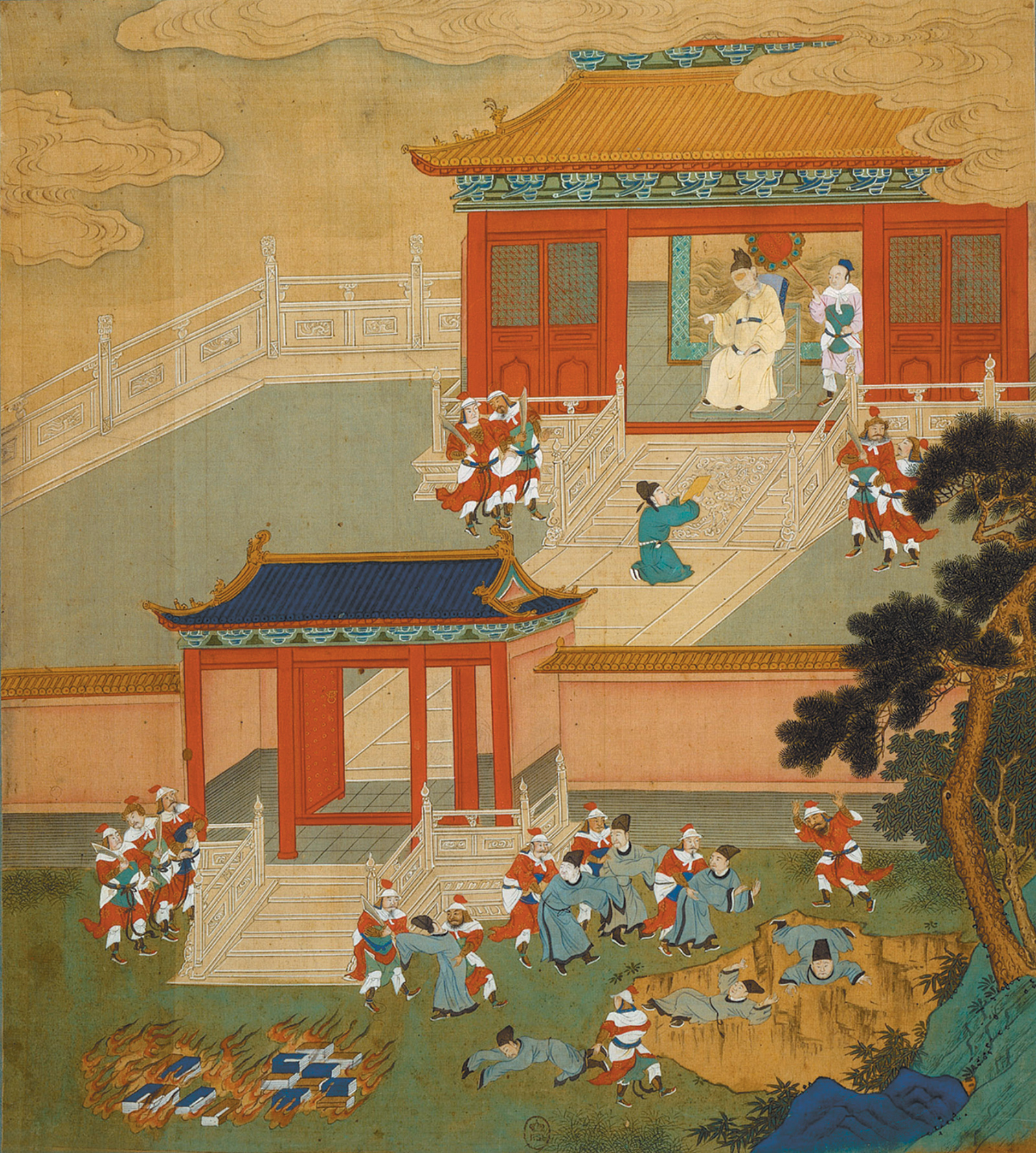
An eighteenth-century painting showing Emperor Qin Shi Huang of the Qin dynasty ‘burning all the books and throwing scholars into a ravine’ in order to stamp out ideological nonconformity after the unification of China in 221 BCE. ‘For over two millennia,’ Ian Johnson writes, ‘all our knowledge of China’s great philosophical schools was limited to texts revised after the Qin unification.’ Now a trove of recently discovered ancient documents, written on strips of bamboo, ‘is helping to reshape our understanding of China’s contentious past.’ Illustration from Henri Bertin’s album The History of the Lives of the Chinese Emperors. Bibliothèque Nationale de France/RMN-Grand Palais/Art Resource
As Beijing prepared to host the 2008 Olympics, a small drama was unfolding in Hong Kong. Two years earlier, middlemen had come into possession of a batch of waterlogged manuscripts that had been unearthed by tomb robbers in south-central China. The documents had been smuggled to Hong Kong and were lying in a vault, waiting for a buyer. Continue reading A Revolutionary Discovery
Hi everyone,
I’m happy to announce that my new film “Re-Collecting China” (7 min.) has been posted on “The Diplomat” website: http://bit.ly/1QoDqrg
The blurb:
When I lived in China in 1985-86, I became obsessed with pencil sharpeners. They came in all shapes: televisions, telephones, and cars; tigers, elephants, and giraffes; pistols, Maotai bottles, and brandy bottles; violins, pianos, and Laughing Buddhas. In one year, I collected over 200 different pencil sharpeners. Continue reading Re-Collecting China
Source: China File (4/19/16)
Fifty Years Later, How Is the Cultural Revolution Still Present in Life in China?
A ChinaFile Conversation
by Guobin Yang, Federico Pachetti, Francesco Sisci, Denise Y. Ho, Edward Friedman
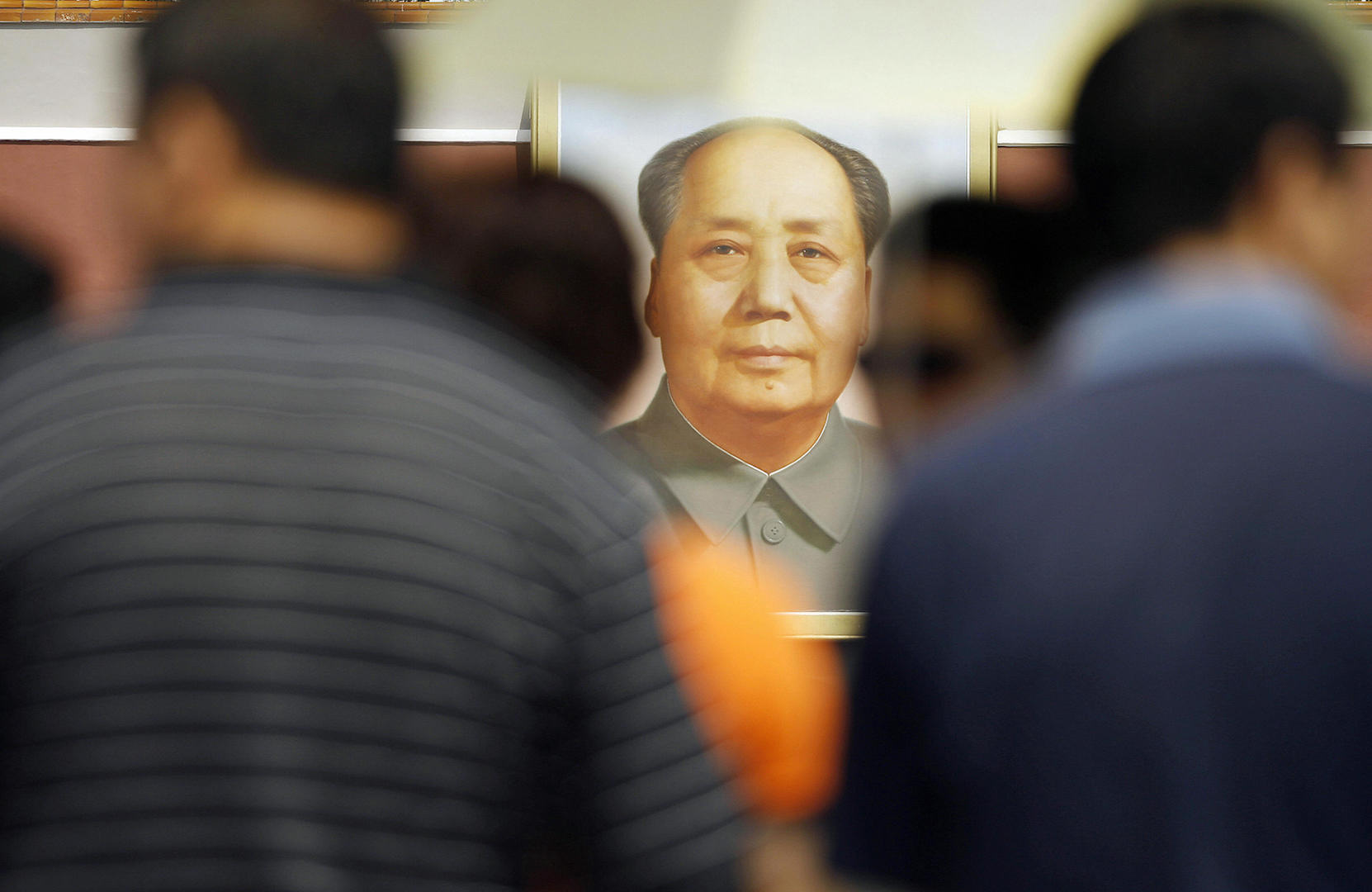
A larger-than-life portrait of the late Communist Party leader Mao Zedong overlooks the daily crowd in Tiananmen Square in the center of Beijing. Mao’s death in 1976, brought to a close the Cultural Revolution, his 10-year experiement in violent ‘class struggle’ begun 50 years ago this May, that killed millions and took China to the brink of collapse. Peter Parks—AFP/Getty Images
Fifty years ago this May 16, Chinese Communist Party leader Mao Zedong launched the Great Proletarian Cultural Revolution, a chaotic, terrifying, and often deadly decade-long campaign to “purify” C.C.P. ideology and reassert his political dominance. Despite its profound and traumatic impact on Chinese society, the legacy of the Cultural Revolution is seldom formally addressed in public. —The Editors Continue reading The CR, fifty years later
The Twitter row escalating: Chinese state authorities and state defending the US internet company’s pick for China regional chief — strange developments that tell us something new about China, but above all, something not so flattering about Twitter. See full article for copies of damning tweets from both sides. The company told Xinhua to “look forward to closer partnership in the future!” and “Let’s work together to tell great China story to the world!” to state television channel CCTV (see: https://www.hongkongfp.com/2016/04/19/twitters-new-china-head-wants-to-work-together-with-state-media/ ), the channel which is busy parading torture victims and which journalists’ organizations outside China have said are not news organizations, but state propaganda machines, and should be boycotted. Now Twitter will “work together” which everyone can guess what it means.
Magnus Fiskesjö <nf42@cornell.edu>
Source: The Guardian (4/20/16)
Twitter’s appointment of new chief in China incenses rights activists
Kathy Chen criticised by pro-democracy activists for her government and military background as she joins social media site still blocked by Beijing
By Tom Philips

Kathy Chen, the new MD of Twitter in China, faces criticism for her links to the People’s Liberation Army. Photograph: @kathychen2016/Twitter
China’s Communist party-controlled media has criticised “narrow-minded” and “prejudiced” online activists who are questioning Twitter’s decision to appoint as its first regional chief a former member of the People’s Liberation Army who once had ties to the country’s security services. Continue reading Twitter’s new head wants cooperation (1)
第七屆中國電影國際論壇: “中國舞臺電影”
征稿启事
The 7th International Forum on Chinese Cinema
Chinese Stage Films
Call for Papers
在中國國家漢辦的支持下, 美國賓漢頓大學戲曲孔子學院、密歇根大學孔子學院、南卡大學孔子學院將於2016年9月8-10日在美國南卡州哥倫比亞及查爾斯頓舉辦主題為“中國舞臺電影”的第七屆中國電影國際論壇。此次論壇的協辦單位有中國戲曲電影產業聯盟、中國電影資料館、中國戲曲學院、北京大學影視戲劇研究中心、北京電影學院国际学院、北京語言大學、山東大學文学院、武漢大學哲学院、陜西師範大學新聞傳播學院及《中國電影電視市場報》。
Under the auspices of Hanban and in collaboration with Chinese Association for Stage Film Productions; Chinese Film Archive; National Academy of Chinese Theatre Arts; Research Center for Drama, Film, and TV at Peking University; International College at Beijing Film Academy; Beijing Language and Culture University; School of Literature at Shandong University; School of Philosophy at Wuhan University; School of Journalism and Communication at Shaanxi Normal University; and Journal of Chinese Film and TV Market; the Confucius Institute of Chinese Opera at Binghamton University, the Confucius Institute at University of Michigan, and the Confucius Institute at University of South Carolina will cosponsor the 7th International Forum on Chinese Cinema in Columbia and Charleston, SC; September 8-10, 2016. The theme for this year’s forum is “Chinese Stage Films”. Continue reading 7th International Forum on Chinese Cinema–cfp
Chimerica emerging: See links in article for samplings. –Magnus Fiskesjö <nf42@cornell.edu>
Source: Hong Kong Free Press (4/19/16)
Twitter’s new China head wants to ‘work together’ with state media
By AFP

The new head of Twitter in China has called for “closer partnership” with Communist Party-backed state media, leading many of the social network’s users to question her appointment.
IT engineer Kathy Chen, who was appointed managing director for the greater China region last week, worked with the Chinese army and more recently American tech giants including Microsoft and Cisco.
Like Facebook, YouTube and other sites, Twitter is blocked in mainland China but many people and institutions — including state media — access accounts via Virtual Private Networks (VPNs).
Xinhua, China‘s official news agency, used its Twitter account to offer “congratulations” to Chen on her appointment. Continue reading Twitter’s new China head wants cooperation
Chinese Literature Today | The University of Oklahoma
 Chinese Literature Today, the biannual literary magazine featuring Chinese literature
The 10th issue of CLT features the 2015 winner of the Newman Prize for Chinese Literature, screenwriter and novelist Chu T’ien-wen, plus a sampling of novellas by Han Shaogong, Xu Zechen, and Chi Zijian from By the River: The Novella in Twenty-First-Century China, an upcoming volume in the CLT book series with the University of Oklahoma Press Edited by Charles Laughlin, Liu Hongtao and Jonathan Stalling. Featured scholar Mark Bender takes readers on a tour of his new work on epic literature from southwest China. Rounding out the issue is a selection of avant-garde prose poetry from experimental author Ya Shi. Continue reading Chinese Literature Today, no. 10
Cross-Currents: East Asian History and Culture Review
March 2016 e-journal (No. 18)
Co-editors’ Note to Readers
Articles
Against the Nihilism of Suffering and Death: Richard E. K. Kim and His Works
Jooyeon Rhee, The Hebrew University of Jerusalem
Street Theater and Subject Formation in Wartime China: Toward a New Form of Public Art
Xiaobing Tang, University of Michigan
A Russian Radical and East Asia in the Early Twentieth Century: Sudzilovsky, China, and Japan
Vladimir Tikhonov, Oslo University
Review Essays
Mad, Bad, and Dangerous to Know? The Strange Allure and Elusive Reality of North Korea
John Lie, University of California, Berkeley
Sandra Fahy, Marching Through Suffering: Loss and Survival in North Korea. New York: Columbia University Press, 2015. 272 pp. $40 (cloth/e-book).
Hazel Smith, North Korea: Markets and Military Rule. Cambridge: Cambridge University Press, 2015. 394 pp. $90 (cloth), $33 (paper), $26 (e-book). Continue reading Cross-Currents no. 18
Dear MCLC List,
We would like to announce the publication of our new edited volume, Red Legacies in China: Cultural Afterlives of the Communist Revolution, edited by Jie Li and Enhua Zhang (Harvard Asia Center Publications, 2016). See: http://www.hup.harvard.edu/catalog.php?isbn=9780674737181
Jie Li <jieli@fas.harvard.edu> and Enhua Zhang
 Description
What has contemporary China inherited from its revolutionary past? How do the realities and memories, aesthetics and practices of the Mao era still reverberate in the post-Mao cultural landscape? The essays in this volume propose “red legacies” as a new critical framework from which to examine the profusion of cultural productions and afterlives of the communist revolution in order to understand China’s continuities and transformations from socialism to
What has contemporary China inherited from its revolutionary past? How do the realities and memories, aesthetics and practices of the Mao era still reverberate in the post-Mao cultural landscape? The essays in this volume propose “red legacies” as a new critical framework from which to examine the profusion of cultural productions and afterlives of the communist revolution in order to understand China’s continuities and transformations from socialism to postsocialism. Organized into five parts—red foundations, red art, red classics, red bodies, and red shadows—the book’s interdisciplinary contributions focus on visual and performing arts, literature and film, language and thought, architecture, museums, and memorials. Mediating at once unfulfilled ideals and unmourned ghosts across generations, red cultural legacies suggest both inheritance and debt, and can be mobilized to support as well as to critique the status quo. Continue reading Red Legacies in China
The Graduate Program in Translation and Interpretation (GPTI) at National Taiwan University (NTU) announces 1 full-time Chinese-English Translation faculty position. Initial appointment will begin on February 1, 2017. For more information, please refer to the attachment or the following website:
http://gpti.ntu.edu.tw/main.php.
Graduate Program in Translation and Interpretation
National Taiwan University
No. 1, Sec. 4, Roosevelt Road, Taipei 106, Taiwan
Tel: +886-2-33661582
Fax: +886-2-33661708
E-mail: ntutiprogram@ntu.edu.tw
Source: China Real Time, WSJ (4/18/16)
China’s Movie Industry is the New Hollywood, Some Top Filmmakers Say
By Lilian Lin

ENLARGE A photo taken on April 16, 2016 shows the scene of the red carpet of the opening ceremony of the 6th Beijing International Film Festival. PHOTO: ZUMA PRESS
Is China going to replace Hollywood as the hub of global filmmaking talent? Some Chinese and Hollywood filmmakers vote yes.
“The investors in China’s film market are entrepreneurs with innovative teams, while Hollywood is producing more sequels and lacks innovation,” Yu Dong, CEO of Bona Film Group, said Sunday at a seminar on China-foreign co-productions hosted by the Beijing International Film Festival. Bona is a leading Chinese film studio and distributor. Continue reading China as the new Hollywood
Source: NYT (4/18/16)
Chinese Parents Outraged After Illnesses at School Are Tied to Pollution
By JAVIER C. HERNÁNDEZ
Source: What’s On Weibo (4/12/16)
The Early Days of Rock in China – Interview with Sinologist & Hardrocker Jeroen den Hengst China

Dutch Sinologist and musician Jeroen den Hengst was part of the Beijing rock scene when it awakened in the late 1980s. Nearly three decades later, Den Hengst looks back on the early days of rock in China – before, during and after the Tiananmen protests – and talks about the music scene in Beijing and his personal path from young Sinologist to serious hardrocker.
When I notice some glitters sparkling on Den Hengst’s face as I meet him in downtown Amsterdam in early Spring, he nonchalantly brushes them off. He was performing the night before, he tells me. Den Hengst is the host and guitar player of Amsterdam’s Hardrock Karaoke, which has become quite a phenomenon in Amsterdam and beyond. We sit down, order a beer and talk about Den Hengst’s musical journey that started in the early days of China rock. Continue reading Early days of rock in China
From: Timothy J.T. Pi <timothy.pi@gmail.com>
Source: Epoch Times (4/22/16)
There’s a BBC in China and It is Not Happy Being Called a Copycat
By Frank Fang

(L-R) Screenshots of British news network’s BBC’s China site and the China’s Business Broadcast of China (BBC). (BBC & Sina Weibo)
Until it was recently outed, China had its very own BBC News.
Business Broadcast of China, a Chinese news outlet headquartered in Hefei, Anhui Province, used to have a website with a red page header and layout that was very similar to iconic British Broadcasting Corporation’s website, according to various reports in Hong Kong and Taiwan Chinese language press.
The Chinese BBC site even featured reports on the “rise of financial technology, migrant labor in Germany, and the vagaries of the Chinese economy,” which are topics that the British BBC would carry, according to the LA Times, which first reported the news in English. Continue reading Copycat BBC in China