Novelistic treatments of the Great Leap Forward (13)

A question on a point of detail, about the film 1942 vs. the novel 1942:

In the film, there is a curious scene with Chiang. As he finally comes to realise the horrific extent of the dying that has been going on, he withdraws alone to a bench in a church. His aides keep a distance, and the scene lingers on, in silence without commentary or other clues, for what seems like a long time. I have kept wondering what the intent of including that scene could have been — and now, after your message, I wonder whether it is in the novel and if any explanation is given there. (ps. to me, Mao does not seem to have been capable of such reflection-repentance –if that is what Chiang was doing– over his own actions,  so there is a difference, potentially. ).

Magnus Fiskesjö <nf42@cornell.edu>

New biography of Liu Xiaobo

From: Anne Henochowicz <anne@chinadigitaltimes.net>
Source: LA Review of Books (8/20/15)
A New Biography of China’s Imprisoned Nobel Laureate: A Q&A; with Jean-Philippe Béja
By Jeffrey Wasserstrom
51ZxWunGmDL._SX331_BO1204203200_Rowman and Littlefield recently published Steel Gate to Freedom : The Life of Liu Xiaobo, a translation of Yu Jie’s powerful biography of a man with whom he has long been friends. Liu remains China’s best known prisoner of conscience — awarded the Nobel Peace Prize in 2010, he was unable to collect it due to his 11-year prison term for his bold call for expanded civil liberties. This new biography opens with an introduction by Jean-Philippe Béja, a leading French specialist on China, whose work often focuses on struggles for democracy. I caught up with Béja, whose recent books include The Impact of China’s 1989 Tiananmen Massacre (Routledge, 2011), to ask him some questions. (Note: as someone who has known Liu for decades and often interviewed him, Béja sometimes refers to Liu familiarly as “Xiaobo” rather than by his surname.)

JEFFREY WASSERSTROM: What are the kinds of things this book will tell Western readers about Liu Xiaobo that they would not likely have come across before, if their previous information about him had come only from pieces celebrating his win of the Nobel Peace Prize?

JEAN-PHILIPPE BEJA: Despite the fact that he was awarded the Nobel Peace Prize, Liu Xiaobo remains quite unknown to the general public. I guess the biggest surprise will come from his personal experience during the Cultural Revolution. While it is described as a catastrophe in official discourse as well as in dissidents’ writings (including Liu’s), it comes out from the book as a period of freedom which provided this typical Northeastern lively youth with a number of opportunities to get into fights, and to assert his personality. This stands in contrast with the image of the thoughtful intellectual that came across in the 1990s, but it helps explain why he was not afraid of the provocations that later so shocked the progressive intellectuals used to political correctness. Continue reading New biography of Liu Xiaobo

Sequins and censorship in Shanghai

From: Magnus Fiskesjo <magnus.fiskesjo@cornell.edu>
Source: BBC News (8/19/15)
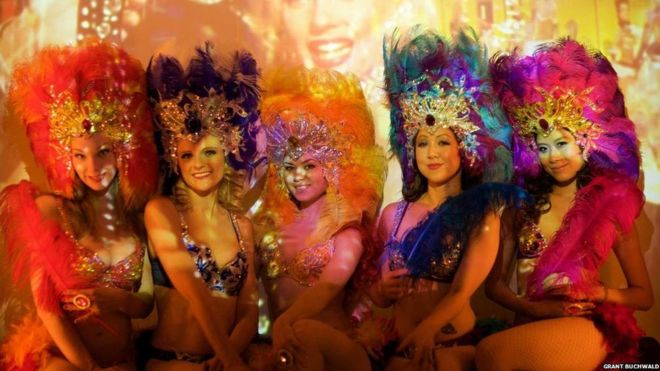
A showgirl’s story of sequins and censorship in Shanghai
By Josephine McDermott, BBC News

The chorus line at Chinatown

The club combined burlesque, Moulin Rouge and vaudeville in homage to the city’s pre-Communist past

If the strangeness of opening a burlesque club in China had not occurred to them as a Buddhist cleansing ceremony took place in their future venue, it certainly did when they found themselves submitting Frank Sinatra lyrics to be vetted by the local cultural department.

Amelia Kallman and Norman Gosney opened the first cabaret nightclub of its kind in Shanghai in 2010.

And the story of their rise and fall is now a stage show at the Edinburgh Fringe Festival.

“It’s a cautionary tale” says Kallman. “And a love story”. Continue reading Sequins and censorship in Shanghai

Drawings depict alleged torture

Source: Sinosphere, NYT (8/10/15)

Drawings Depict a Former Chinese Prisoner’s Alleged Torture by Police
By VANESSA PIAO and AUSTIN RAMZY AUGUST

SINO-TORTURE6-tmagArticle-v2

The inscription on the drawing of the police abusing Liu Renwang reads: “Many people beat and tortured me countless times.”

SINO-TORTURE7-articleInline-v2

Liu Renwang, who was twice convicted of murder before the verdict was overturned on appeal.

The hand-drawn images are bizarre and disturbing. One shows a man locked in a cage while a police officer pours boiling water on his head. Another shows him suspended from the ceiling by handcuffs as an officer jabs his side with an electric baton.

They are amateurishly drawn, with faces showing strangely neutral expressions amid scenes of severe cruelty. Yet they have captured public attention in China for their surprisingly candid depiction of abuse by the police.

Overseas human rights groups have often reported on police abuse in China, and the topic is sometimes taken up by reporters in the country, but the drawings depicting the ordeal of a man wrongly convicted of murder are one of the most graphic representations of such torture to appear in the Chinese news media in recent years.

Liu Renwang, who was twice convicted of murder in the 2008 shooting death of a village official in Shanxi Province, says the drawings depict the methods the local police used to force him to confess to a crime he did not commit. Continue reading Drawings depict alleged torture

Novelistic treatments of the Great Leap Forward (10,11)

In English translation, you can also find the following:

King, Richard, ed. Heroes of China’s Great Leap Forward: Two Stories. U Hawaii press, 2009.

With an introduction, it puts Li Zhun’s “A Brief Biography of Li Shuangshuang” (1960) and Zhang Yigong’s “The Story of the Criminal Li Tongzhong” (1980) side by side. The former also has a film version (1962).

–Chaohua Wang <sm.ca.wangchaohua@gmail.com>

————————————————

With regard to Claire Conceison’s requests for suggestions of how to translate the title 星期八, I propose “Sunderday.”

Cindy Carter <carter@paper-republic.org>

Novelistic treatments of the Great Leap Forward (9)

Two additional novels:

Zhao Xu’s 赵旭 Da ji’e 大饥饿 (作家出版社,2004) is a straightforward novel about the Great Leap famine in a few villages in rural Gansu. According to the forward, the author has also written a novel about Jiabiangou.

In Mo Bai’s 墨白 Xunzhao waijingdi 寻找外景地 (长江文艺出版社, 1999), reissued as 映在镜子里的时光 (群众出版社, 2004), a film crew in the mid ’90s visits Yinghe, Henan (the setting for much of the author’s work) to scout locations for an adaptation of an absurdist novella about a meaningless Great Leap engineering project. The novel interweaves the annotated novella with the crew’s journey, the repressed memories of a crew member who had been sent down to the region during the Cultural Revolution, and the locals’ unhealed wounds from the catastrophes of those two eras.

Joel Martinsen <jdmartinsen@gmail.com>

Novelistic treatments of the Great Leap Forward (7,8)

Yu Hua´s Huozhe (活着) also has a section devoted to the famine and the steel making craze.

Anne Wedell-Wedellsborg <annewedell@gmail.com>
———————————————————–
Not “novelistic” but in case of interest to the list, Yu Rongjun (Nick Yu), china’s most prolific playwright with more than 50 plays to his credit, wrote a play called 星期八 (best translation of this wonderful title is still under discussion, feel free to make suggestions!) in which the great famine figures prominently, which kept it from being staged in china two years ago. nick gave me the script at that time so that one of my duke students in my play translation class could translate a scene from it for her class project, and another of my former students is currently translating the full script. if anyone would like to read the chinese script, please let me know and i will get permission from nick and pass it on to you.

best, claire conceison <claire.conceison@duke.edu>

Novelistic treatments of the Great Leap Forward (4,5,6)

I remember reading Yang Xianhui’s 杨显惠 2007 book Dingxi gu’eryuan jishi 定西孤儿院纪事 (The Dingxi Orphanage Chronichles), a fictionalized memoir which also narrates the stories of a group of orphans growing up in Gansu in the years of the GLP.

Paolo Magagnin <paolo.magagnin@unive.it>

————————————————————–
I am currently reading Yan Geling’s “The Ninth Widow” (第九个寡女), about a rural woman who hides her landowner father-in-law through the campaigns of the 50’s and 60’s. Although it is not entirely about the famine, there are many pages devoted to it.

Judy Amory (jmamory@post.harvard.edu)

————————————————————–
In addition to the historical inaccuracy of the word “reformers” in Rojas’s translation that Jeremy Brown pointed out in his review, I would also like to question the word “Author” that Rojas has chosen instead of “Writer” for the character named Zuojia 作家. With the exception of the character the Child, all other characters in The Four Books are named after their previous professions — the Scholar, the Musician, etc.. “Author” is not a profession, but “Writer” is, and that is exactly the profession of the character Zuojia 作家 in his former life, before the reform-labor camp.

would also like to bring list members’ attention to another collection of short stories by Yang Xianhui 楊顯惠, Dingxi gueryuan jishi 定西孤兒院紀事. This collection is about the Great Famine, and like Jiabiangou jishi 夾邊溝紀事, the stories are also based on Yang’s investigations and interviews of survivors.

Lingchei Letty Chen <llchen@wustl.edu>

Novelistic treatments of the Great Leap Forward (3)

An important work of fiction/reportage (a dozen novellas, though not a full-fledged novel) that discusses the famine is Yang Xianhui’s 杨显惠 “Chronicles of Jiabiangou” (夹边沟记事). While the focus is on an infamous reeducation through labor camp in Gansu reserved for “rightist,” the famine plays a big role in all the stories.

Sebastian Veg <sveg@cefc.com.hk>

Novelistic treatments of the Great Leap Forward (2)

The review below refers to several books about the GLF, though they are not “novelistic.”–Kirk

Source: Public Books (8/1/15)
Famine Fiction
By Jeremy Brown

THE FOUR BOOKS. Yan Lianke, translated from the Chinese by Carlos Rojas. Grove Press, 2015

August 1, 2015 — Betraying friends. Trading sex for food. Devouring human flesh. All of these occurred during the famine that followed China’s Great Leap Forward (1958–1961), and all of them feature prominently in Yan Lianke’s The Four Books. Carlos Rojas’s translation of Yan’s novel, which was originally published in 2010 in Taiwan and Hong Kong, tells the grim story of urban intellectuals banished to a labor camp. They first experience the giddiness of the push to smelt steel and increase crop yields as the Great Leap Forward began, only to suffer through the horrors of starvation as it progressed.

The Great Leap Famine, a man-made disaster that killed more than 30 million people, remains politically sensitive in mainland China. Yan Lianke, whose previous novels also offended literary censors, knows this as well as anyone. So when he decided to write about the famine, he put censorship out of his mind. According to Yan, The Four Books “is (at least partially) an attempt to write recklessly and without any concern for the prospect of getting published.”

The result adds to what has become an impressive group of books and articles about the Great Leap Famine, its causes, the death toll, and variations among provinces as well as between cities and villages. Many such works have been written by Chinese scholars and journalists, published in Hong Kong, and then smuggled back into China by mainland visitors to the former British colony—although crossing the border with prohibited books has become increasingly difficult.1 Continue reading Novelistic treatments of the Great Leap Forward (2)

Novelistic treatments of the Great Leap Forward (1)

Dear Colleagues

An early full-length novel on the Great Leap is Zhiliang’s [王] 智量’s Hungry Mountain Village 饥饿的山村. Wang Zhiliang was a Professor at East China Normal University, and his novel was first serialized in a newspaper in Malaysia. A partial translation can be found in Renditions 68, with other fiction and poetry from the Great Leap period and later retrospectives.

Richard King <rking@uvic.ca>

Taiwan students storm education ministry

Source: Reuters (7/31/15)
Taiwan students storm education ministry compound in textbook protest

Students shout slogans during a protest at the entrance to the Ministry of Education in Taipei, Taiwan, July 31, 2015. REUTERS/PICHI CHUANG

Hundreds of Taiwan students stormed the ministry of education compound early on Friday, after one committed suicide earlier in the week, intensifying anti-China protests over textbooks they say are aimed at promoting Beijing’s “one China” policy.

About 700 students climbed barricades around the ministry and as of Friday morning about 200 students were encamped inside the ministry compound, demanding an audience with the island’s education minister, police said. Continue reading Taiwan students storm education ministry

How Li Cunxin danced to freedom

Source: The Guardian (7/30/15)
‘I would have jumped off a roof for Mao’: how Li Cunxin danced to freedom
Forced into ballet as a child in Mao’s China, Li Cunxin defected to the US and had to work as a stockbroker to support his family back home. But he never quit dancing. As he brings the Queensland Ballet to Britain, he talks about his traumas and triumphs – and shock at seeing people take their privileged lives for granted
By Judith Mackrell

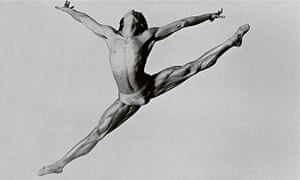
Li Cunxin dances The Rite of Spring at Houston Ballet.

Li Cunxin dances The Rite of Spring at Houston Ballet in 1986.

Li Cunxin was just 11 when Chinese officials came to his home in rural Shandong and told him he’d been selected to study at the Beijing Academy of Dance. It was 1972, the height of Mao’s cultural revolution, and an entire nation was being shoehorned into creating a new communist China. Cunxin had never danced before – his physique simply looked promising – but once in Beijing, he was plunged into a punishing physical regime, designed to make or break him as a future member of Mao’s ballet. Every day in the studio, Li’s untutored legs were yanked into stretches that tore his hamstrings. His feet – numb and cold in their alien ballet slippers – were forced into inexplicably odd positions. Homesick, sore, and 1,000 miles away from his family, Li cried himself to sleep at night. Continue reading How Li Cunxin danced to freedom

Beijing vs. Almaty

Source: The Guardian (7/30/15)
Beijing and Almaty contest Winter Olympics in human rights nightmare
The IOC is set to award either Beijing or Almaty the 2022 Games but with both bids prompting so many concerns it is time to restart the process from scratch
By Jules Boykoff

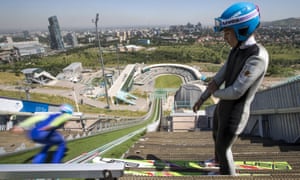
Almaty

Members of Kazakhstan’s national skiing team at a training session at the complex in Almaty that the government hopes will host the 2022 Winter Olympics. Photograph: Shamil Zhumatov/Reuters

On Friday the International Olympic Committee will decide whether Almaty in Kazakhstan or the Chinese capital Beijing will host the 2022 Winter Olympics. Both countries are human-rights nightmares. No matter which city wins, the Olympic movement loses.

Originally the IOC had numerous suitors. But bids for the Games melted away. Voters in Munich, Stockholm, Krakow, and Graubunden, Switzerland, said thanks but no thanks to the Olympics, citing high costs, low public support and security demands. Lviv was forced to pull out due to unrest in Ukraine. Oslo was a clear frontrunner, but its bid was derailed when conservatives and progressives joined forces to say no. Continue reading Beijing vs. Almaty