JCLC 12.1

TOC: Journal of Chinese Literature and Culture, Volume 12, Issue 1 (April 2025)
I am pleased to share “Key Terms of Chinese Literary Theory,” the newest issue of the Journal of Chinese Literature and Culture (12:1), edited by Zong-qi Cai.  The new issue is now available in print and online. Browse the table of contents and read the introduction, made freely available, here: https://read.dukeupress.edu/jclc/issue/12/1

Journal of Chinese Literature and Culture
Key Terms of Chinese Literary Theory

Introduction

Introduction: Toward Establishing Chinese Literary Theory as a Viable Subject of Sinological Studies
ZONG-QI CAI

Cosmology-Derived Terms

Ziran 自然 as a Term in Chinese Literary Theory and Its Conceptual Reductions
YE YE; XINDA LIAN

Literature and the Way: The Theoretical Foundation and Historical Development of Wendao 文道
LIU NING ; YUGEN WANG

A Literary Anatomy of the Binary Concept of Emptiness-Substance
LIU XIAOJUN ; BENJAMIN RIDGWAY Continue reading JCLC 12.1

Cold Window Newsletter 9.5

Source: Cold Window Newsletter 9.5
On literary community
A personal reflection, one year in
By Andrew Rule

Today, something a little different. This idea has been percolating since a conversation I had this past summer with my friend and fellow Substacker Jing Jing P. We noticed that, while each of us examines China from a non-Chinese perspective, I tend to remove myself from my own writing, as though by passing myself off as a lofty, disembodied observer I can make my book recommendations carry more weight.

To mark the one-year anniversary of this newsletter, I’m putting myself back in the narrative. What does it mean for me, as a non-native speaker of Chinese, to write about Chinese literature?

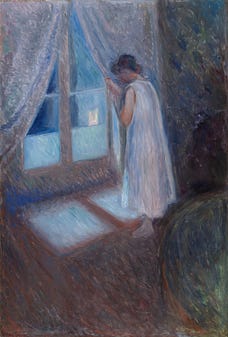
The Girl by the Window by Edvard Munch (1893). “The window functions as a symbolic barrier, separating the interior from the outside world. The sense of mystery is deepened and complicated by the fact that we cannot see the expression on the girl’s face, nor do we know what she covertly observes. She in turn appears unaware that, as she gazes from behind the curtain at something unknown outside, the artist and implied viewer are watching her.” Image is in the public domain.


Summer 2025 was an oddly appropriate time for me to be rethinking my relationship to this literature. For the first time since I became paying close attention to new literary releases in China about five years ago, young writers were making headlines in China, but it was for all the wrong reasons. In a series of viral social media posts, amateur sleuths were screenshotting recent fiction that appeared to plagiarize (mostly) classic literary worksYu Dafu, Zhang Ailing, even the Chinese edition of Madame Bovary. The screenshots were more damning in some cases than others, but even where the evidence was thin, the damage was done. At least ten young authors were thrust from the niche literary periodical circuit into the furnace of public discourse virtually overnight.¹ Continue reading Cold Window Newsletter 9.5

Cambridge MPhil in East Asian Pop Culture

Dear All,

I am pleased to announce that the Faculty of Asian and Middle Eastern Studies at the University of Cambridge is launching a new one-year MPhil (= Master’s) in East Asian Popular Culture Across Time. The full details can be found via this link:

MPhil in East Asian Popular Culture Across Time | Faculty of Asian and Middle Eastern Studies

This first-of-its-kind MPhil pioneers a new academic approach to popular culture by connecting the past, present and future. Students will develop skills in analysing key cultural products while considering how they are shaped by transmedial flows and other processes including translation, adaptation, top-down design, and grassroots creativity.

We are now accepting applications for 2026-27 and would be extremely grateful if you could help spread the word. All details about how to apply etc are available via the link above.

With thanks and best wishes,

Heather Inwood <hi208@cam.ac.uk>

The Courtesan’s Memory, Voice, and Late Ming Drama book talks

Dear all,

I am delighted to announce three invited lectures on my new book, The Courtesan’s Memory, Voice, and Late Ming Drama (University of Michigan Press, 2025), to be held later this month at Occidental College, Stanford University, and UC Berkeley.

I am grateful to share with this community that since its mid-September release, the book has drawn encouraging public interest. It situates courtesans not only as performers but also as active agents in shaping new aesthetic and literary paradigms in the late Ming. These lectures will open conversations about the book’s core methodologies and offer a glimpse into the creative journey behind its making.

[Lecture 1: Occidental College]
Date & Time: Oct. 22, 4 PM
Venue:  Choi Auditorium

[Lecture 2: Stanford University]
Date & Time: Oct. 28, 4:30 PM
Venue: Lathrop Library, 224

https://events.stanford.edu/event/book-talk-the-courtesans-memory-voice-and-late-ming-drama

[Lecture 3: University of California at Berkeley]
Date & Time: Oct. 30, 4PM
Venue: Art History Seminar Room (inside C.V. Starr East Asian Library)

https://events.berkeley.edu/ccs/event/305759-the-courtesans-memory-voice-and-late-ming-drama

All are warmly welcome to attend these events in person.

Posted by: Peng Xu 徐芃 <xupeng2@shanghaitech.edu.cn>

Gui Minhai has been detained for 10 years

Update on the situation of Gui Minhai, the poet and publisher who is a Swedish citizen only, but is illegally and incomunicado detained in China:

This October 17, it has been 10 (ten!) full years since Gui Minhai was abducted from Thailand by Chinese agents, smuggled to China, detained there, forced to perform coerced confessions on TV and then disappeared permanently. China’s government is denying his right to Sweden’s consular visits, and since several years we have no sign of life. The Chinese regime’s kidnapping, illegal detention, and deadly silencing of Gui Minhai is an outrageous atrocity, nothing less.

The European Parliament on Oct. 9 voted 546-3 (!) to demand that China’s government must free Gui Minhai — an overwhelming majority of MEPs (the three naysayers are pro-Putin extremist MEPs). See:

https://www.europarl.europa.eu/doceo/document/TA-10-2025-0225_EN.html
https://www.europarl.europa.eu/doceo/document/PV-10-2025-10-09-VOT_SV.html

On 16 October 2025, a special cultural evening will be held in Stockholm in Gui Minhai ‘s honor, arranged by Sweden’s writers’ union. More info: https://forfattarforbundet.se/kulturafton-for-gui-minhai/

On 17 October 2025, please join the Fifth Digital Appeal to Free Gui Minhai. https://internationalpublishers.org/fifth-digital-appeal-to-free-gui-minhai/ Continue reading Gui Minhai has been detained for 10 years

Hard times for the face of ‘Wolf Warrior’

Source: China Media Project (9/5/25)
Hard Times for the Face of the “Wolf Warrior”
Film star Wu Jing is well-known as the rough, tough face of China’s “Wolf Warrior” spirit. So what does it mean if Chinese netizens see his ridiculous side—especially during a week when Beijing staged a massive military parade to showcase the nation’s muscularity?
By Alex Colville

The Chinese film industry takes Wu Jing (吴京), the macho lead in some of the country’s biggest propaganda blockbusters, very seriously indeed. In the tub-thumping Battle at Lake Changjin series (co-produced by the Central Propaganda Department), he plays a commander leading his men to victory against the Americans in the Korean War, meeting his end in a fireball of patriotic glory. In the smash-hit Wolf Warrior franchise he is a gun-toting crack PLA marine, smashing his boot into the cheek of drug lords and rescuing Chinese citizens from a failed African state, treating the PRC flag as a protective talisman with his own arm as its pole.

Flag waving for box office success. A poster for the released of Wolf Warrior II in 2017.

In many ways, Wu is the face of the government’s ideal of a more assertive Chinese nation, one that is ready to stand tall in the world and fly its flag high — the same muscular nationalism on full display this week as state-of-the-art weaponry rolled through Beijing and soldiers goose-stepped to commemorate the 80th anniversary of World War II’s end. Not for nothing were the methods of a new generation of more pugnacious Chinese diplomats christened “Wolf Warrior Diplomacy.” A recurring quote from the film that spawned the label ran, “Whoever offends China will be punished, no matter how far away they are” (犯我中华者,虽远必诛). The line is well known across the country.

But last week, in the run-up to this week’s display of military might in Beijing, mocking videos of Wu that inexplicably went viral had state media pundits furiously scratching their heads. It was perhaps for some a jarring reminder that not everyone in China takes what Wu Jing represents as seriously as propagandists would like. Continue reading Hard times for the face of ‘Wolf Warrior’

Han Heroes and Yamato Warriors review

MCLC Resource Center is pleased to announce publication of Yuqian Yan’s review of Han Heroes and Yamato Warriors: Competing Masculinities in Chinese and Japanese War Cinema, by Amanda Weiss. The review appears below and at its online home: https://u.osu.edu/mclc/book-reviews/yuqian-yan/. My thanks to Shaoling Ma, our media studies book review editor, for ushering the review to publication.

Kirk Denton, MCLC

Han Heroes and Yamato Warriors: Competing
Masculinities in Chinese and Japanese War Cinema

By Amanda Weiss


Reviewed by Yuqian Yan

MCLC Resource Center Publication (Copyright October, 2025)


Amanda Weiss, Han Heroes and Yamato Warriors: Competing Masculinities in Chinese and Japanese War Cinema Hong Kong: Hong Kong University Press, 2023. pp. 184. ISBN-13 ‏ :: 978-9888805471 (cloth).

Eight decades after the end of the Second World War, the politics of war memory and historiography in East Asia remains one of the most urgent and contested terrains in contemporary culture and geopolitics—and perhaps the most persistent source of strain in China–Japan relations. The year 2025 saw the release of four Chinese films commemorating the War of Resistance, among which Evil Unbound (731, dir Zhao Linshan 趙林山) polarized audiences for its brutal portrayal of the human experiments conducted by Imperial Japan’s notorious Unit 731.[1] For China, the traumatic historical experience is tied to the persisting dilemma between remembrance and reconciliation, and between hard-won victory and unresolved historical grievances; whereas for Japan, it is entangled with the burden of responsibility, the politics of denial and apology, and the ongoing struggle to reconcile imperial legacy with postwar pacifism. Despite sustained popular and scholarly interest in war history and its legacies, quite rarely do we find in-depth studies that critically engage and contrast perspectives from both sides from media and gendered perspectives.[2]

In Han Heroes and Yamato Warriors: Competing Masculinities in Chinese and Japanese War Cinema, Amanda Weiss offers a compelling comparative study of post-1980s Chinese and Japanese war films and TV dramas, focusing on how male protagonists come to embody shifting ideals of patriotism and moral authority. Weiss’s use of “competing masculinities” highlights not only the rivalry between national discourses, but also the gendered structures through which these narratives are produced, circulated, and emotionally absorbed. In exposing the marginalization of women and the reduction of female suffering to symbolic functions within these male-centered histories, the author critiques the masculinist logic of nationalist memory-making. The book gestures toward the broader scholarly project of “rescuing history from the nation,” advocating for more humanistic and inclusive forms of remembrance that center on affective complexity and embodied individual experiences. Continue reading Han Heroes and Yamato Warriors review

Miles of solar panels on the Tibetan plateau

Source: NYT (10/10/25)
Why China Built 162 Square Miles of Solar Panels on the World’s Highest Plateau
By , Reporting from Gonghe on the Tibetan Plateau

CreditCredit…Video by The New York Times

On the Tibetan Plateau, nearly 10,000 feet high, solar panels stretch to the horizon and cover an area seven times the size of Manhattan. They soak up sunlight that is much brighter than at sea level because the air is so thin.

Wind turbines dot nearby ridgelines and stand in long rows across arid, empty plains above the occasional sheep herder with his flock. They capture night breezes, balancing the daytime power from the solar panels. Hydropower dams sit where rivers spill down long chasms at the edges of the plateau. And high-voltage power lines carry all this electricity to businesses and homes more than 1,000 miles away.

China is building an enormous network of clean energy industries on the Tibetan Plateau, the world’s highest. The intention is to harness the region’s bright sunshine, cold temperatures and sky-touching altitude to provide low-cost, renewable energy. The result is enough renewable energy to provide the plateau with nearly all of the power it needs, including for data centers used in China’s artificial intelligence development.

While China still burns as much coal as the rest of the world combined, last month President Xi Jinping made a stunning pledge. Speaking before the United Nations, he said for the first time that the country would reduce its greenhouse gas emissions across its economy and would expand renewable energy sixfold in coming years. It was a moment of global significance for the nation that is currently the world’s biggest polluter. Continue reading Miles of solar panels on the Tibetan plateau

ACLS China Studies grants 2026

Apply by November 5 for Luce/ACLS Early Career Fellowships and Travel Grants in China Studies

The American Council of Learned Societies (ACLS) invites applications for the Luce/ACLS Program in China Studies fellowships and grants now through November 5, 2025, 9:00 PM EST.

The Luce/ACLS Program in China Studies seeks to advance outstanding scholarship on China and Chinese cultures, histories, and communities, as broadly conceived. Grants and fellowships support a wide range of scholarly approaches in China studies, including multi-method research, Sinophone studies, and Global China, while encouraging dynamic and responsive scholarship that deepens public understanding of China and its evolving role in the world. The Luce/ACLS Program in China Studies aims to build a broader, more equitable field by supporting emerging scholars and strengthening scholarly networks and collective resources across the field. In 2025-26, ACLS is offering the following fellowships and grants to support research, writing, and publicly engaged scholarship:

Awards are generously supported by the Henry Luce Foundation.

Application deadline: November 5, 2025, 9:00 PM EST Continue reading ACLS China Studies grants 2026

‘Literary anarchist’ Yan Lianke interview

Source: SCMP (9/28/25)
‘Literary anarchist’ Yan Lianke on Chinese writers, the Nobel prize and censorship
Former soldier and award-winning author discusses the ‘tolerance and protection’ he has received and the state of Asian literature
By Yuanyue Dang in Beijing

Illustration: Victor Sanjinez

SCMP.

Chinese novelist Yan Lianke is considered a strong contender to win the Nobel Prize in Literature. Yan uses magical and absurd imagery to depict the realities of rural China, particularly the lives of ordinary people in the Mao Zedong era. His awards include the Franz Kafka Prize, the Lao She Literary Award and the Lu Xun Literary Prize. Yan is a professor at Renmin University of China in Beijing and a chair professor at the Hong Kong University of Science and Technology. In this interview, the former soldier considers the global status of Chinese literature and discusses the censorship of his books. This interview first appeared in SCMP Plus. For other interviews in the Open Questions series, click here.

In recent years, there has been a lot of discussion about you being in contention for the Nobel Prize in Literature. Does this put you under pressure?

I was born in 1958 and am now 67 years old. At this stage in my life, the prospect of winning any literary prize no longer exerts any pressure on me or my writing. Any pressures I face now stem from within my own existence and from literature itself rather than from outside the literature and my life.

Indeed, certain past laureates have sparked controversy among readers, and such debate is perfectly natural. Although there is broad common ground in the standards of good literature, literature is ultimately not a science – it is not mathematics, physics or chemistry. Its magic and greatness lie in its capacity for diverse interpretations: benevolent people see benevolence and wise people perceive wisdom.

Fine literary works excel precisely because they offer multiple angles for interpretation, inviting varied understandings and lively discussion.

In your writing, how do you handle sensitive events in contemporary Chinese history? For example, the Great Chinese Famine, the Cultural Revolution, the Tiananmen crackdown and the Covid-19 pandemic. Do you engage in self-censorship?

I believe in the simplest principle of literary common sense: any human experience is fair game for literature. No experience is inherently nobler or more deserving of a place in literature than another.

The distinction lies in which experiences the writer knows more intimately and can probe more deeply, and their attitude towards them. The criteria I use to decide what to write about and what to avoid are simply the life experiences that evoke a more visceral, painful resonance within me. Continue reading ‘Literary anarchist’ Yan Lianke interview

China punishes ‘excessively pessimistic’ social media (1)

This NYT article reminds me of the incident in the 1980s when one of the Communist Party propaganda bosses attacked Cui Jian 崔健 and his famous 1986 hit song ”一无所有“ [I have nothing to my name], dismissing it by saying “What does he mean, ‘he ‘has nothing.’ He has got Socialism!” (“他有社会主义!”), meaning, the man should stop complaining and praise the Party instead.

Who was that nasty old Party hack? I can’t find this memorable quote online, but I am guessing it was said by Deng Liqun 鄧力群?

Anyhow, in this article, there is certainly an echo of that attack on ungrateful young people (生在社会主义福中不知福!) like Cui Jian.

Magnus Fiskesjö <nf42@cornell.edu>

China punishes ‘excessively pessimistic’ social media

Source: NYT (10/7/25)
China Punishes ‘Excessively Pessimistic’ Social Media Users
As China struggles with economic discontent, internet censors are silencing those who voice doubts about work or marriage, or simply sigh too loudly online.
By 

Men sitting in a subway car. most of them looking at their phones.

Chinese censors are going after content that “excessively exaggerates negative and pessimistic sentiment” or promotes “defeatist narratives like ‘hard work is useless.’” Credit…Qilai Shen for The New York Times

China’s censors are moving to stamp out more than just political dissent online. Now, they are targeting the public mood itself — punishing bloggers and influencers whose weary posts are resonating widely in a country where optimism is fraying.

The authorities have punished two bloggers who advocated for a life of less work and less pressure; an influencer who said that it made financial sense not to marry and have children; and a commentator known for bluntly observing that China still lags behind Western countries in terms of quality of life.

These supposed cynics and skeptics, two of whom had tens of millions of followers, have had their accounts suspended or banned in recent weeks as China’s internet regulator conducts a new cleanup of Chinese social media. The two-month campaign, launched by the Cyberspace Administration of China in late September, is aimed at purging content that incites “excessively pessimistic sentiment” and panic or promotes defeatist ideas such as “hard work is useless,” according to a notice from the agency.

“In reality, we all experience fatigue and anxiety as a result of work and life, but these real emotions deserve respect and should not be deliberately amplified for traffic. The internet is not a dumping ground for negativity,” China’s state broadcaster CCTV said in an editorial about the campaign. Continue reading China punishes ‘excessively pessimistic’ social media

Seeing through Abstraction

Dear Colleagues,

I’m delighted to share that my book, Seeing Through Abstraction: Literary Encounters with Information in Modern China, is now out with Columbia University Press. Covering fiction, poetry, and woodcut art, the book repositions modern Chinese literature within the global history of the information age. A fuller description is available on Columbia UP’s webpage, where those interested in ordering a copy can also receive a 20% discount by using the promo code CUP20.

Anatoly Detwyler <detwyler@wisc.edu>
University of Wisconsin-Madison

Taiwan Lit–cfp

Call for Abstracts: Ling Yü and Chen Yuhong, Special Issue of Taiwan Lit
Guest Editors: Justyna Jaguścik and Wen-chi Li

In recent years, Taiwanese poetry has gained sustained international attention. Several collections have been translated into English, French, Dutch, German, Italian, and Swedish, earning translation prizes and increasing global visibility. With Ling Yü receiving the Newman Prize in 2025 and Chen Yuhong being awarded the Cicada Prize in 2022, it is timely to revisit contemporary Taiwanese poetry and recognize its depth, strength, and vitality, qualities that not only resist being overshadowed by the prominence of contemporary Chinese poetry but also affirm Taiwan’s rightful place on the world stage in its own name, without mediation through China. This special issue on Ling Yü and Chen Yuhong seeks to further consolidate their visibility through the platform of Taiwan Lit and the Global Sinosphere and to examine the processes through which their works may be canonized within broader literary frameworks.

Pairing Ling Yü and Chen Yuhong provides a unique lens for exploring Taiwanese poetry across generational and stylistic lines. Ling Yü’s work is often associated with lyrical density, philosophical reflection, and explorations of interiority. As Cosima Bruno remarked in her Newman Prize rationale: “Ling Yü’s language is economical and concise, yet surprising and reverberating with complex meaning. Her poetry engages thoughtfully with classical and modern, Eastern and Western literary, philosophical, artistic, and esoteric sources, generating outstanding works that require attention but are also intuitively grasped.”

Chen Yuhong, by contrast, presents a distinct poetic aesthetic. Her work foregrounds feminist critique and musicality, while her practice as a translator has introduced the works of Louise Glück, Carol Ann Duffy, Anne Carson, and Margaret Atwood into Mandarin. Taiwanese scholar Chen I-chih observes that Chen Yuhong “poured her lifelong sensitivity and passion into her work,” and that “her achievement lies primarily in the subtle prosody forged through the fusion of Chinese and Western poetics, as well as in the multilayered system of imagery she developed,” which earned her the United Daily News Literary Grand Prize in 2017. Continue reading Taiwan Lit–cfp

Mirror: Selected Poems by Zhang Zao

New Publication:
Mirror: Selected Poems by Zhang Zao, Translated by Fiona Sze-Lorrain
Zephyr Press, 2025
Bilingual, with an introduction by Fiona Sze-Lorrain and an afterword by Bei Dao

To purchase: Zephyr Press or Amazon

This bilingual posthumous collection is a detailed, retrospective look at Zhang Zao, one of the more brilliant poetic minds from China of the late 20th and early 21st centuries. He left China in 1986 and lived in Germany until his death at 47 in 2010.

The poems in this collection span Zhang Zao’s short career, beginning with “Mirror,” one of his earliest and best known works, and ending with “Lantern Town,” written less than two months before his death. As Bei Dao writes in his afterword, Zhang Zao “possessed both a thorough grasp of European literature and culture and an introspective understanding of the broad, profound Asian aesthetics: between the two philosophies, he sought a new tension and melting point.” Translated by Fiona Sze-LorrainMirror is Zhang Zao’s first book to be translated into English and will be bilingual in Chinese and English on facing pages.

Mirror is the twelfth and final volume in Zephyr Press’s Jintian Series of Contemporary Chinese Poetry, which was launched in 2011 and has been curated by Bei Dao, Lydia H. Liu, and Christopher Mattison. It is also Fiona Sze-Lorrain’s fourth translation title (after Wind Says by Bai Hua, I Can Almost See the Clouds of Dust by Yu Xiang, and Canyon in the Body by Lan Lan) in the series. Continue reading Mirror: Selected Poems by Zhang Zao