Literary inquisition

Source: China Media Project (11/17/25)
THE CMP DICTIONARY: Literary Inquisition 文字狱
By David Bandurski

“Literary inquisition” is a practice rooted in imperial China whereby authorities persecute scholars, writers, and officials for content deemed subversive or disloyal to the ruling power. While officially condemned by the Chinese Communist Party as a relic of feudalism, the spirit of literary inquisition persists in the CCP’s own suppression of dissent. The term has gained new relevance as Beijing deploys it rhetorically against Taiwan’s government.

Zhang Yang’s (张杨) first draft of The Second Handshake, originally titled “Waves” in 1963, was just one of many versions he would write, rewrite, and circulate as a sent-down youth in Changsha. Little did he know at the time, it would become one of the most popular works of Cultural Revolution-era samizdat literature known as shouchaoben (手抄本), named for their hand-reproduction method.

Based on an amalgamation of true stories about love and science in a changing China, The Second Handshake became so big that, by 1975, it had seriously alarmed China’s leaders. Yao Wenyuan (姚文元), a member of the radical faction known as the Gang of Four, banned the reproduction of the novel and had Zhang arrested.

For the crimes of “promoting idealistic theories of human nature and genius” and “glorifying bourgeois and revisionist educational lines,” Zhang was imprisoned and sentenced to death.

Zhang’s case became one of the most well-known cases of literary inquisition (文字狱) of the Cultural Revolution era. The term itself, though, is a gesture to China’s past — to its long history of legal persecution of scholar-officials for writings deemed subversive or defamatory of the court. Continue reading Literary inquisition

Tibetan Sky

NEW PUBLICATION: Tibetan Sky, by Ning Ken; translated by Thomas Moran (Sinoist Books, 2025)

Wang Mojie’s dreams wilted in the Beijing heat. Leaving behind its constricting avenues at the end of the millennium,¹ the disillusioned academic seeks meaning in Lhasa. Instead, he finds Ukyi Lhamo. The soul of every party, her studied Parisian charms hide an inner rootlessness. Raised by a mother who stifled her beliefs to protect all she held dear, she searches for her grandmother,² the key to her lost heritage.

Crossing paths among a gathering of self-exiled intellectuals living among the cool mountains, the two bond on the sidelines of a fierce philosophical debate. However, as Wang Mojie’s masochistic fantasies resurface, can they cling to what they mutually lack? Or was it never possible to make peace with zero?

¹ After a divorce sparked by his unusual perversions

² A Tibetan Buddhist nun with a severed aristocratic lineage

Surrealism in the PRC

New Book : Surrealism and the People’s Republic of China: From Mao to Now
By Lauren Walden

This study investigates cultural exchange between the Surrealist movement and the People’s Republic of China (1949-present). This book asserts Surrealism resolutely chimed with traditional Chinese thought whilst reflecting and refracting contemporaneous socio-political issues from Mao to now. A ‘historico-intrinsic’ relationship coalesces archival and primary sources consulted in Chinese, French and English, artist interviews as well as cosmopolitan political theory. The purported originality of European modernism is questioned, ascertaining traditional Chinese concepts of spontaneity were cited by Surrealists as redolent of automatism, the notion of creating without forethought. Surrealist art was officially prohibited under Mao’s rule (1949-1976). However, the book interrogates potent tensions in suppressed surrealist artworks by Zhao Shou and Sha Qi, who discovered the movement while studying abroad. Furthermore, Walden explores how several European Surrealists aligned Chinese calligraphy with automatism as well as Michel Leiris and Marcel Mariën’s travels to Maoist China and their diametrically opposed visions of the nation. Amidst post-socialism, the book posits that the ’85 New Wave consciously employed Surrealism to process the traumatic Cultural Revolution (1966-1976) and react to newfound societal freedoms. Subsequently, the volume considers why a new artistic tendency of ‘surrealist pop’ emerged in the 1990s. At present, Lauren Walden reveals how Surrealism has become officialised and even promoted by Chinese authorities owing to revolutionary resonances between traditional Chinese art and the western avant-garde.

The book will be of interest to scholars working in art history, Chinese studies, and Surrealism. Chapter 4 is available open access here as well as the introduction via a preview PDF. An online book launch will take place on the 30th November 7pm UK time. Sign up here. Continue reading Surrealism in the PRC

Poverty in Modern Chinese Realism

I would like to share a free chapter from my new book, Poverty in Modern Chinese Realism: From Russia, with Squalor (Oxford UP, 2025), available till December 15th.

The Preface, which precedes this free introductory chapter, summarises the book’s main interventions.

A discount is available for the entire book here: Discount Code: AUFLY30

Best wishes,

Keru Cai <keru.cai@unsw.edu.au>
The University of New South Wales

On Youtuber Li Ziqi

Source: Public Books (11/12/25)
China’s Imagined Pasts and Futures: On YouTuber Li Ziqi
By Thomas Chen

Li Ziqi.

One year ago today—on November 12, 2024, after a three-year and four-month hiatus—China’s most popular YouTuber resurfaced. A woman in her mid-30s from the Sichuan countryside, Li Ziqi (李子柒) posted three new videos to her channel, which has over 28 million subscribers worldwide. In the first video, in order to lacquer her grandmother’s old wardrobe, she climbs up scaffolded lacquer trees to tap their sap. In the second video, she builds a large bamboo-themed hut for the display of her clothes. In the third video, with silk from silkworms she has cultivated herself, she makes a flower that she then wears, while playing the piano and singing a pop song. Each of these videos quickly garnered millions of views, as a global audience cheered her return, following the resolution of a legal and financial dispute with her former management company.

In Li’s videos, labor is not degraded but creative. Critics may argue that it is presented almost entirely as DIY: an individualistic rather than communal endeavor, even when traditionally communal activities like planting and harvesting are involved. What Li performs cannot be scaled up into a plan to mobilize the masses. But the vision she offers is, at the same time, emancipatory. In The German Ideology, Marx famously sketches this one day in the life of the man of the future:

In communist society, where nobody has one exclusive sphere of activity but each can become accomplished in any branch he wishes, society regulates the general production and thus makes it possible for me to do one thing today and another tomorrow, to hunt in the morning, fish in the afternoon, rear cattle in the evening, criticise after dinner, just as I have a mind, without ever becoming hunter, fisherman, herdsman or critic.

Except for post-dinner debate, we could say that Li Ziqi realizes this passage in visual form (if not in reality). She may not hunt in the morning, fish in the afternoon, or herd cattle in the evening; still, her over 130 videos testify to the mind-blowing breadth of her abilities. She does not restrict herself to one sphere of activity; indeed, she is masterful in numerous spheres, from making shoes, paper, and furniture from scratch to practicing woodblock printing and sericulture. Continue reading On Youtuber Li Ziqi

UK university censorship scandal (1)

Dramatic revelations, from inside the recently revealed Chinese state intervention against Sheffield Hallam University, in the words of Laura Murphy, the scholar whose research was targeted, but fought back. –Magnus Fiskesjö, magnus.fiskesjo@cornell.edu

Source: The Economist (11/11/25)
A human-rights researcher on why she pushed back when China bullied her university
By Laura Murphy, professor at the Helena Kennedy Centre for International Justice at Sheffield Hallam University, and a fellow at the Harvard Kennedy School’s Carr-Ryan Centre for Human Rights.

Illustration: Dan Williams

In august last year a senior colleague informed me that the university where I work, Sheffield Hallam University (SHU), would not publish my team’s research exposing Uyghur forced labour in the critical-minerals sector in China. I was also told that, if necessary, SHU was prepared to take the highly unusual step of voluntarily returning hundreds of thousands of pounds in grant funding rather than have future projects bear the imprimatur of the Helena Kennedy Centre (HKC), the university’s human-rights research institute for which I had been working since 2019.

What could possibly induce a university to make such a surprising decision, especially one that had spent years standing up to harassment from Chinese authorities for its research on Uyghur forced labour, and whose own chancellor had been hit with sanctions by the Chinese government for her criticism of rights abuses in China?

It took a freedom-of-information request for me to find out. Last month I learned that only weeks before I received that call, Chinese security-service agents had visited the university’s student-recruitment office in Beijing and “confirmed that access to shu.ac.uk [the university website] is restricted [within China] due to the HKC research papers being available through the website”. The agents had told the university’s student-recruitment officer that they wanted her to share with them the details of upcoming conversations with SHU colleagues in Britain. This was, an administrator noted, “an instruction, not a request”.

There had also been a similar visit in April 2024. A SHU internal document reported: “The tone was threatening and the message to cease the research activity was clear.” Continue reading UK university censorship scandal (1)

You Xing Bookstore gets reprieve

Source: China Digital Times (11/10/25)
Translations: As Tributes Pour In, Chengdu’s You Xing Bookstore Gets a Reprieve From Feared Closure
By Cindy Carter

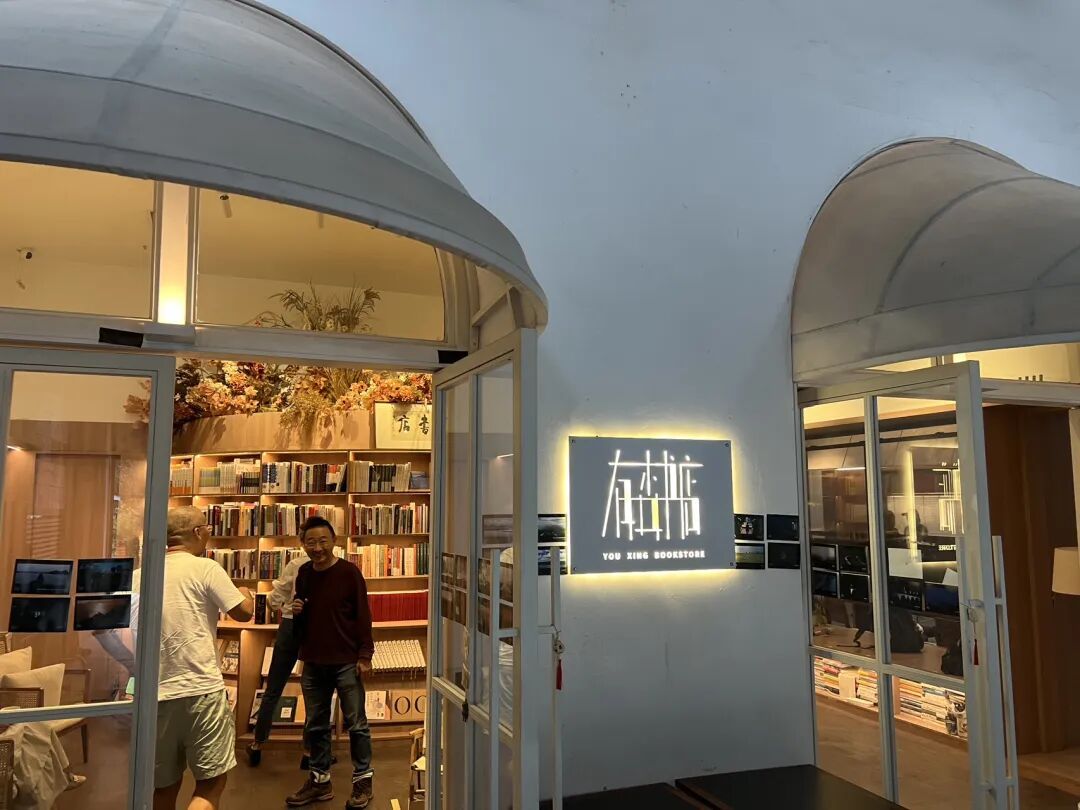
The entrance to You Xing Bookstore is welcoming and well-lit. The exterior walls are painted white, and there are two broad double-doors with large inset panes of clear glass, and rounded canopy-style awnings above them. Between the doors, on the exterior wall, is an illuminated grey and white sign with the store’s name in both English and in highly stylized Chinese characters. Inside the entrance, at left, are some comfortable looking wooden chairs with white cushions, and a band of curved, blonde-wood bookshelves filled with various books. Two men stand between the shelves and the door, talking and smiling. One of the men—dressed in boots, rolled-up blue jeans, a black sweater, and glasses—smiles directly at the camera.

The entrance to You Xing Bookstore: a clean, well-lighted place (source: WeChat account 麦客自留地)

Following more than a week of speculation that Chengdu’s You Xing Bookstore (有杏书店Yǒu Xìng Shūdiàn) would soon close, amid an outpouring of tributes from customers and supporters, it appears that the beloved bookstore and events space has been granted a reprieve and will remain in business. Started in August 2023 by former financial reporter and prolific blogger Zhang Feng and a group of friends, You Xing Bookstore has become a vibrant public space, providing books, coffee, free public events, and a much-needed sense of community following three years of “zero-COVID” policy-induced isolation.

On October 29, the bookstore’s founder Zhang Feng published a WeChat post announcing that due to “force majeure” (unspecified reasons beyond his control, likely referring to official pressure), the bookstore would be closing its doors on November 28. When an online commenter asked, “Why? The bookstore has always had such good events,” Zhang Feng replied, “That’s exactly the reason.” Zhang’s initial announcement, which he quickly deleted, has been archived by CDT Chinese editors, and a portion is translated below:

I had imagined many ways that the bookstore might end. The most likely scenario was force majeure—and now, this has come to pass.

You Xing Bookstore will close on November 28.

I nearly smiled when I heard the news. I always knew this day would come, I just wasn’t sure when it would happen.

My attitude towards managing a bookstore has always been: If you only had one day, how would you run that bookstore? You should live every day as if it might be your last. Continue reading You Xing Bookstore gets reprieve

The dream of outrunning time

Source: NYT (11/8/25)
In China, the Dream of Outrunning Time
阅读简体中文版 | 閱讀繁體中文版 | Leer en español
Longevity labs, “immortality islands” and grapeseed pills are part of China’s national project to conquer aging, despite sometimes shaky science and extravagant claims.
By ,

Attendees trying out a cryogenic therapy room at a longevity and anti-aging conference in Shanghai, in September.

When a Chinese state television microphone recently caught China’s top leader, Xi Jinping, and President Vladimir V. Putin of Russia musing about the possibility of living to 150 and perhaps even forever, many reacted with anxious consternation.

But there has been no tut-tutting in the laboratory of Lonvi Biosciences, a longevity medicine start-up in the southern Chinese city of Shenzhen. “Living to 150 is definitely realistic,” said Lyu Qinghua, the chief technology officer of the company, which has developed anti-aging pills based on a compound found in grapeseed extract. “In a few years, this will be the reality.”

He is skeptical about modern medicine defeating death entirely — something Mr. Putin said was possible with organ transplants — but he thinks that longevity science is advancing so fast even the seemingly impossible might come to pass.

“In five to 10 years, nobody will get cancer,” he predicted.

The search for the elixir of life, embraced with gusto in recent years by American tech billionaires like Peter Thiel, has been underway in China for more than two millenniums. It started with the first emperor, Qin Shi Huang, who ordered a nationwide hunt for death-defying potions. Just in case that did not work, he also ordered the creation of thousands of terra-cotta warriors to protect him in his grave should he die. The emperor died at 49, possibly from mercury poisoning caused by an anti-aging treatment. Continue reading The dream of outrunning time

Seeing China’s autistic community in film docs

Source: China Unofficial Archives (11/11/25)
Lonely Island and We Will Have Everything: Seeing China’s Autistic Community in Independent Documentaries
By Bao Mian

[中国民间档案馆 China Unofficial Archives is a reader-supported publication. To receive new posts and support our work, please consider becoming a free or paid subscriber. ]

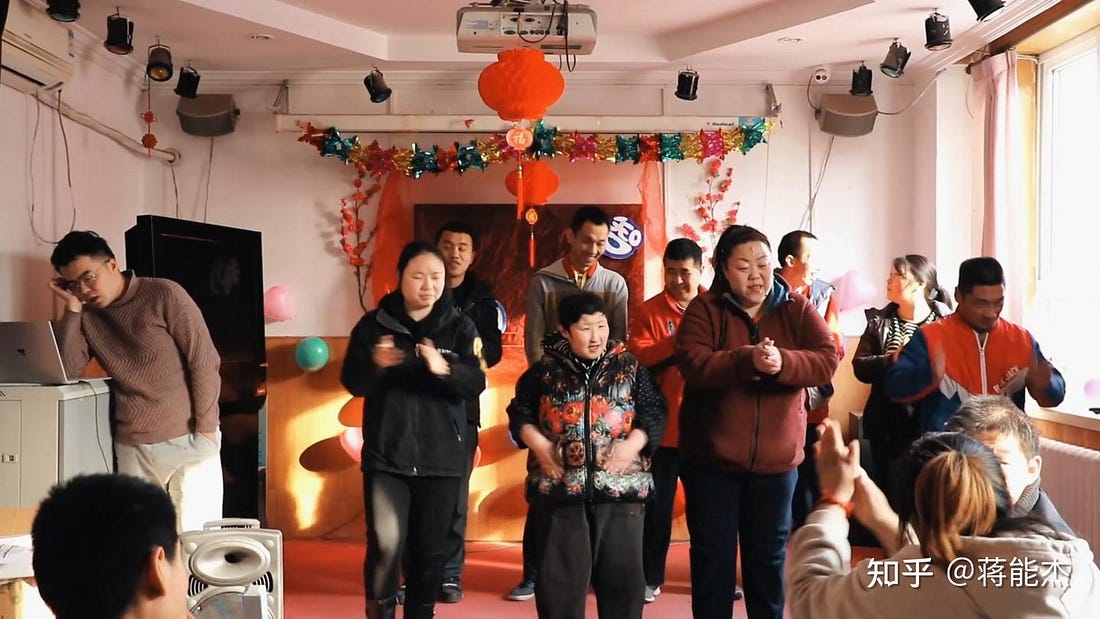
Film still from We Will Have Everything. Photo source: Director Jiang Nengjie’s Zhihu account.

In 2022, the China Disabled Persons’ Federation standardized the terminology for autism. In an official document, it released ten standardized terms for use concerning people with disabilities. Specifically, Article 7 of the notice pointed out that the official, standardized term for Autism Spectrum Disorder (ASD) is “loneliness disorder” (gūdúzhèng).

Loneliness is a term that more easily evokes public sympathy, even though the more accurate term is zìbì (“self-enclosed”, coming from the Greek root of autism, autós, which means “self”). Although well-meaning, the terminological differences highlight the problems that people with autism have in Chinese society—pitied but also with their problems inadvertently downplayed and turned into merely a kind of loneliness.

The overall effect in Chinese society is that the autistic community and other neurodivergent individuals (including those with intellectual disabilities, cerebral palsy, Down syndrome, etc.) are often treated as a distinct species from “normal people.” Consequently, the general public maintains a distance from them, avoiding interactions and engagement. We do not see them in China’s primary and secondary schools—the adoption and introduction of the concept of inclusive education are still in the early stages in China—and it is even less likely for adults to encounter them in the workplace.

This erasure extends to statistics as well. According to 2022 statistics from China’s National Health Commission, the prevalence of “childhood autism” among children aged zero to six in China is approximately 0.7%. However, due to differences in diagnostic systems, public awareness, and regional medical resources, the actual prevalence may be much higher than 0.7%. In other East Asian countries, such as South Korea and Japan, for example, the rate is several times higher. Continue reading Seeing China’s autistic community in film docs

(In)visibility: seeing, making visible, keeping hidden — cfp

Interdisciplinary Doctoral Symposium: ‘(In)visibility: seeing, making visible, keeping hidden’
Venice, 14-15-16 April 2026
Organized by PhD students of the 40th doctoral programme in Asian and African Studies, Ca’ Foscari University of Venice.

Accessing and producing knowledge is never neutral. From the erasure of certain voices in historical narratives to the strategic visibility of bodies, choices are constantly made about what can be seen and believed — and, consequently, what must remain hidden and invisible. Two main forces reflecting underlying hierarchies of power are at play: on the one hand, the partial and ideologically inflected nature of the sources; on the other hand, the situated position of the scholar. Crucially, they can result in the exclusion, marginalisation, misunderstanding or invisibilisation of voices endowed with less power, socially and/or historically.

This symposium questions how presence and absence are constructed, how certain topics or agents are rendered peripheral, and how historiographical, disciplinary, ethical, methodological, but also institutional choices reinforce (or challenge) patterns of invisibilisation. How do our ways of seeing and not seeing shape the contours of knowledge?

Harnessing (in)visibility as a lens on knowledge, this symposium explores three interrelated dynamics: seeing, making visible, keeping hidden. Continue reading (In)visibility: seeing, making visible, keeping hidden — cfp

IndieChina Film Festival cancelled

Another new milestone in the Chinese Communist party’s intimidation and interference on foreign soil: Inaugural IndieChina Film festival in New York cancelled after China puts pressure on directors. Was due to have opened today Nov. 8, 2025. –As usual, the tactic appears to have been to threaten filmmaker’s families at home in China. So that they can’t talk about it. Effective.

Not too much in the media about this yet — which is weird. Why? A few news reports so far:

Film festival in New York cancelled after China puts pressure on directors (The Guardian)

Transnational repression at the IndieChina Film Festival (Donald Clarke)

Authorities shut down film festival in New York (Human Rights Watch)

BTW — wasn’t this a big chance for NY politicians and leaders to step up and condemn the Chinese regime’s censorship actions right under their noses? But, some have been co-opted by the longstanding CCP efforts to influence New York politics. We know they infiltrated the NY governor’s office (a spy was expelled), and they have been using the CCP “United Front” scheme to take over “community” organizations, as they do around the world, to silence Chinese dissent and then use these fake fronts to gain a foothold in local politics in the name of “representing the Chinese community.”

And it seems that this time, these tactics have scored a big victory against free speech on US soil — brazenly shuttering a film festival. Continue reading IndieChina Film Festival cancelled

Chen Wanli’s museum career

New Publication: Feng Schöneweiß. “Precarity, Resilience, and Chen Wanli’s Museum Career in Twentieth-Century China,” Museum Worlds 13, 1 (2025): 82-93.

This article explores precarity and resilience in Chen Wanli’s 陳萬里 pursuit of a museum career. Through a critical biography approach, the article examines Chen’s professional development in three stages through his work as a physician at Peking University (1917–1927), his tenure as a provincial head of public health (1928–1949), and his career at the Palace Museum (1949–1969). It details how Chen negotiated various professions to become a museum archaeologist, how he acquired the competences necessary for a museum career, and how his critical biography reveals the sociopolitical conditions of the museum profession in twentieth-century China. Investigating his transnational networks, the article also demonstrates how Chen became a powerhouse of ceramic archaeology and knowledge dissemination, contributing to the training of generations of Chinese museum professionals.

DOI:
https://doi.org/10.3167/armw.2025.130108

Keywords:
archaeology; China; Cultural Revolution; fieldwork; Fogg expedition; museum professionalization; Palace Museum; transnational networks

Posted by: Feng Schöneweiß <feng.schoeneweiss@khi.fi.it>

Pigsy Eats a Watermelon

The Chinese Film Classics Project is pleased to announce the publication of Christopher Rea’s translation of the animated short film Pigsy Eats a Watermelon 豬八戒吃西瓜 (Wan Guchan 萬古蟾, dir., 1958). Subtitles were created by Yao Jiaqi.

https://chinesefilmclassics.org/pigsy-eats-a-watermelon-1958/

https://www.youtube.com/watch?v=316XRGq_yQE

ABOUT THE FILM:

Pigsy Eats a Watermelon (Zhu Bajie chi xigua 豬八戒吃西瓜)
Directed by Wan Guchan 萬古蟾
Written by Bao Lei 包蕾
Assistant Director and Cinematographer: Chen Zhenghong 陳正鴻
Music composed by Wu Yingju 吳應炬
Art direction by Zhan Tongxuan 詹同渲 and Xie Yougen 謝友根
Animation design by Hu Jinqing 胡進慶, Qian Jiaxing 錢家騂, Shen Zuwei 沈祖慰, Ju Hui 車慧
Studio: Shanghai Art Film Studio 上海美朮电影制片厂
21 minutes, sound
Year of release: 1958
English subtitles translated by Christopher Rea
Subtitles created by Yao Jiaqi

Who can resist a delicious watermelon on a hot summer day? One day in June, Tripitaka and his companions Monkey King, Sandy, and Pigsy pause their journey to the west to take shelter at an abandoned temple. Monkey King offers to go find some food and drink for the parched travelers, and Pigsy tags along, but Pigsy soon decides that his friend can do the work while he takes “a nap beneath a giant tree / Just how lovely would that be?” While Monkey is foraging in the South Seas Melon Patch and Peach Orchard, Pigsy awakens to discover before his eyes a GIANT watermelon. What will our ever-famished friend do next?

This short film brings together Chinese paper cutting and stop-motion animation to tell a story featuring the main characters of the Journey to the West. Pigsy is perhaps the most famous comical character in Chinese literature and folklore, the personification of animalistic gluttony and other corporeal desires. Hs self-restraint is sorely put to the test in this episode, which does not occur in the original Ming dynasty novel. Director Wan Guchan, the most prominent of the pioneering animation trio, the Wan Brothers, had earlier been a driving force behind other animated films inspired Journey to the West, notably the landmark full-length animated film Princess Iron Fan (1941). Notably, Pigsy Eats a Watermelon, a film about hunger and thirst, was released just as China was entering the Great Famine caused by the Great Leap Forward (1958-1962).

Asian crime films — cfp

Call for Papers: Special Issue of Asian Cinema, “Moving Violations: Asian Crime Films”
Special Issue Editors: Victor Fan, Kristof Van den Troost, and Earl Jackson

Crime films are about as old as the cinema itself. Eliciting strong emotions and affective intensities through the depiction of violence and the posing of often deadly ethical dilemmas, they also offer spectators opportunities to negotiate their conflicting sociopolitical values and address their blissful and traumatic memories. This special issue aims to explore the ‘moving violations’ of Asian crime films.

The term ‘moving violations’ can be interpreted broadly as a reference to crime films’ relationship with cinematic movement, action, and affection; the way many of these films address questions of social and personal mobility, migration, and border-crossing; gender and sexual queerness; as well as the relationship between political power and criminality (including questions of censorship and governmentality). Crime films produced in Asia often address the inter-cultural, inter-racial, and inter-regional flows, whose unruliness can challenge and violate the Euro-American-centric notion of generic conventions and understanding of social and ethical normativity.

Crime seen from the perspectives of both law enforcement and the perpetrators cover not only advances in critical analysis but also contradictions in the social order as well as variations in resistance and desperation from the side of the criminal. One can study how a genre functions within a single culture, or how it changes according to the cultures that adapt it. By using the frame of the crime film, we aim to be as inclusive as possible for all its variations and subcategories.

Essays on Hong Kong and Japanese crime films are welcome, but we are also interested in analyses of less familiar and more recent crime film phenomena, whether it is Taiwanese ‘black films’ (hei dianying), recent South Korean successes, mainland China’s ‘Dongbei’ noir, or the brutal poetics of Indian directors Ram Gopal Varma and Anurag Kashyap’s crime films. We welcome single-region foci as well as Inter-Asian studies. We look forward to approaches from across the disciplines as well as experiments in interdisciplinary inquiry, including, but not limited to, approaches rooted in cinematic genre studies, cultural criminology, and law-and-film studies. In addition, we are open to methodologies including theoretical and philosophical investigation, close reading, history/historiography and media archaeology.

Submission: https://submission.pubkit.co/publisher/29/journal/290/login
Choose ‘Moving Violations: Asian Crime Films’ from the special issue menu.
Deadline: 31 December 2026

Inquiries: Professor Victor Fan (ho_lok_victor.fan@kcl.ac.uk)

Posted by: Kristof Van den Troost k.vandentroost@cuhk.edu.hk

New publication on Chinese contemporary cinema

We are pleased to announce the release of Chinese Contemporary Cinema. Genres, Storytelling, and Heroes (Il cinema cinese contemporaneo: Generi, narrazioni, eroi) by Chiara Lepri. The volume, published by Carocci (Rome), offers an in-depth exploration of contemporary Chinese cinema, tracing its evolution from the post-reform era to today. Through an analysis of genres, narratives, and heroic figures, it sheds light on the cultural and social dynamics shaping modern China.

Date of publication: November 7, 2025.

Chiara Lepri holds a Ph.D. in Asian and African Civilizations from Sapienza University of Rome. Her research interests focus on Chinese cinema, as well as on the relations between Italy and China in the field of cinema. She has conducted academic training and research in Beijing, Shanghai, Tokyo, and Osaka, as well as at the Italian Cultural Institute in New York. She is an Adjunct Researcher in the project Biographical Database of Italians in China (BDIC) at Sapienza University of Rome.

Chiara Lepri <chiara.lepri@uniroma1.it>