Poison Hemlock and Wild Parsnip are Blooming in Southern Ohio


Originally posted on Buckeye Yard and Garden Online

By Joe Boggs- June 3, 2020

Poison hemlock (Conium maculatum) and wild parsnip (Pastinaca sativa) are two of our nastiest non-native weeds found in Ohio.  Poison hemlock is one of the deadliest plants in North America.  Wild parsnip can produce severe, painful blistering.  Both are commonly found growing together.

Poison hemlock and wild parsnip are members of the carrot family, Apiaceae.  The old name for the family was Umbelliferae which refers to the umbel flowers.  They are a key family feature with short flower stalks rising from a common point like the ribs on an umbrella.

Continue reading Poison Hemlock and Wild Parsnip are Blooming in Southern Ohio

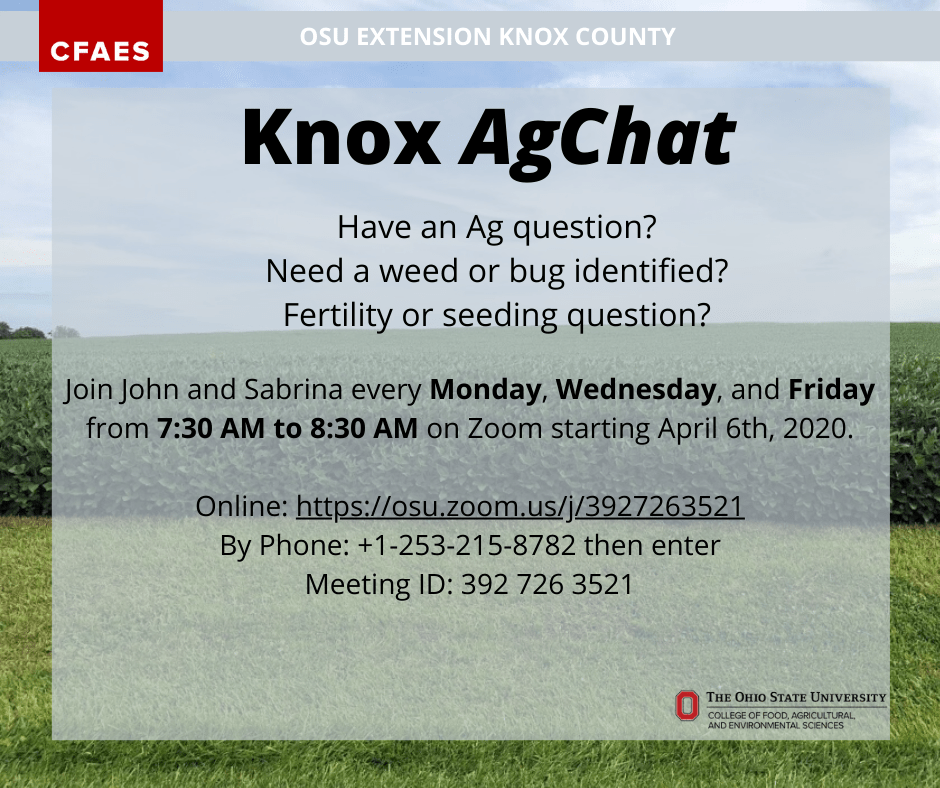
Virtual Office Hours – Knox AgChat

As you know The Ohio State University has closed all Campuses and Extension offices.  While our office is closed, we are working from home and will continue to do so until we are able to return.   You can reach us by phone (740-397-0401) Monday through Friday from 8 – 5.  You can also reach us anytime by email:

        John – barker.41@osu.edu              Sabrina – schirtzinger.55@osu.edu

In the meantime we are working diligently to create new options to stay in contact with everyone.  With this in mind, beginning Monday April 6 we will begin VIRTUAL OFFICE HOURS – Knox AgChat

Knox AgChat will provide us the opportunity to utilize video and/or audio conferencing on your computer or cell phone.  You can join us online here: https://osu.zoom.us/j/3927263521  or join by phone 1-253-215-8782 and enter Meeting ID: 392 726 3521.

We will focus on Ag questions from 7:30 – 8 and Horticulture questions from 8 – 8:30.

Additionally, we plan to periodically invite guest speakers to our chat.  We will post that schedule each week.


Is It A Pine, Spruce, or Fir?

Originally posted on the Buckeye Yard and Garden OnLine

By: Amy Stone and Curtis Young

White Fir, Photo Credit: Curtis Young

Everyone has probably struggled with plant identification at some point in their life. While some of us may still be learning – it can be on ongoing process, others may have mastered the skills involved in identifying plants in the landscape, woodlots or streetscapes.

Continue reading Is It A Pine, Spruce, or Fir?

5 Reasons Why Soil Biology Matters on the Farm

Jeff Goodwin, Conservation Stewardship Leader and Pasture and Range Consultant
(Previously published with Noble Research Institute; March 13, 2019)

Success and long-term viability for most agricultural enterprises ultimately hinges on the health of their soil. This is true for beef operations in the Southern Great Plains to row crop farms in the Midwest.

For decades, the agriculture industry has focused, studied, and ultimately understood the physical and chemical characteristics of our soil resource (e.g., soil texture, soil pH, etc.). However, until the past few years, little emphasis has been placed on the biological constituents and their importance in a healthy, functional soil.


Continue reading 5 Reasons Why Soil Biology Matters on the Farm

What to Plant in the Fall Season

The nights are cooler. The days are shorter. Vegetables in the garden are looking peaked, and summer flowers are turning brown.

 It’s prime time for some planting.

“A typical consumer looks at it as, ‘Oh, winter is coming, let’s give up gardening.’ That’s not necessarily so,” said Daniel Struve, an Ohio State horticulturalist emeritus. In fact, he recommends fall for planting many trees, shrubs, grass and flower bulbs and even fall flowers for some late color.

Sean Barnes, a horticulturist at Ohio State’s Chadwick Arboretum & Learning Gardens, agrees — noting that trees and shrubs benefit from a chance to get their roots established before the stress of a hot, dry summer.

They shared their tips for making the most of fall planting.

Are you planting trees and shrubs?

Warm fall soils promote root growth. “They really are active; you just can’t see it,” Struve said.

There are exceptions.

Continue reading What to Plant in the Fall Season

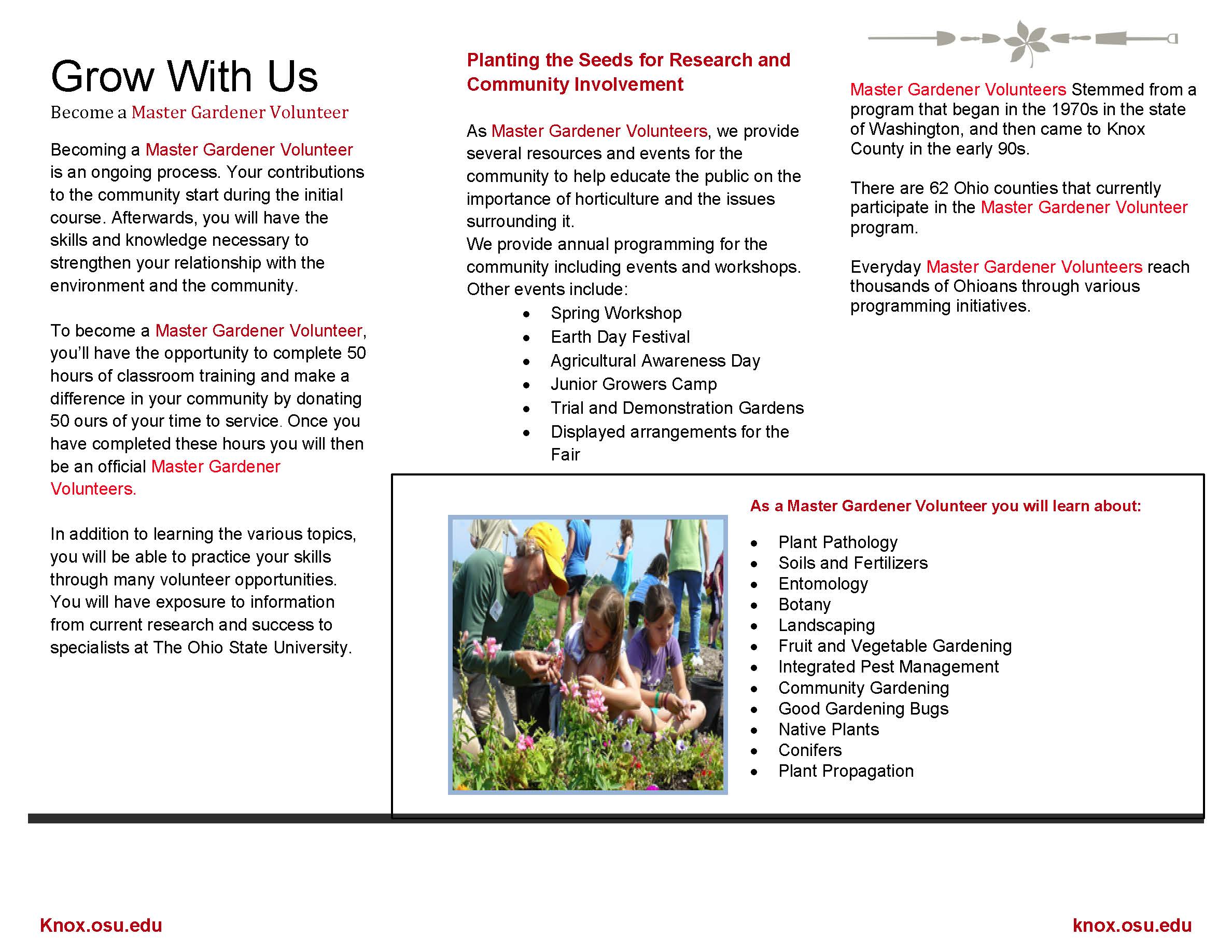
Knox County Master Gardener Volunteers WANTED

Share your love of gardening while giving back to the community! 

Learn: Master Gardener trainees receive University level training in horticulture from The Ohio State University Extension in the areas of botany, soils, trees, flowers, lawns, fruits and vegetables, entomology, pest management, and diagnostic skills. Trainees complete a minimum of 40 hours of training.

Give: After training, new volunteers will work with each other in various activities in Knox County to complete 50 hours of service in the first year. Opportunities include: answering horticultural questions, educating local gardeners on plant selection and care, helping community members within the community gardens and more. There are numerous ways to be involved in the community and you can be a part of it!

Grow: Master Gardeners enjoy the social aspect of learning together, volunteering together, and helping other in out county.

Join: If you are interested in gardening, want to help your community grow, and want to learn more, the Ohio State University Master Gardener is for you!

For more information or to obtain an application contact Sabrina Schirtzinger at 740-397-0401 or schirtzinger.55@osu.edu. 

Spring Vegetable Climate Predictions for Planting 2018

Originally posted in the VegNet Newsletter

By: Tim McDermott, Extension Educator Franklin County

When I am planning when to start seeds in order to get ready for an upcoming spring or fall planting season.  I take the frost date into account, but then I adjust that date according to the weather projections as that gives me insight into how I can maximize production by using weather data plus season extension.

For example,  the fall frost date in central Ohio is around mid-October.   The fall climate prediction data was for a delayed frost date and a warmer fall.  Once I read about this I planted my fall vegetables using this data in anticipation of a longer fall growing season for summer vegetables.

I planted green beans and zucchini in the first week of August 2017.  Both are about 50-60 day vegetables so they would mature long after the frost date normally, and both do not like frost.

Germination was about a week or so later

Because of the delayed frost date, I was able to enjoy a harvest late into fall and ate green beans and zucchini fresh for Thanksgiving dinner.


Picture taken Mid-October. Notice due to delayed planting their are no cucumber beetles or stink bugs infesting the plants.

This year the climate prediction center states that we will continue to have a February with temperature swings and periods of heavy precipitation.

For the growing season the prediction is for a gradual warm up from March through May with a wetter than normal spring.  Summer is looking like the warm up continues with a drier than normal precipitation forecast.

BIG THANKS TO THE C.O.R.N. Agronomic Newsletter for data assist. 

CLICK HERE FOR THE LINK FOR THE CLIMATE DATA FROM NWS/NOAA


Make sure you check the prediction models when you are making your plans.  It might save you some time and trouble and might  get you some extra production.