Illham Tohti wins Martin Ennals award

Two years into his arbitrary life sentence, Uyghur scholar Ilham Tohti has been awarded the Martin Ennals Award for human rights defenders.–Kevin Carrico <kjc83@cornell.edu>

Source: The Guardian (10/11/16)
Ilham Tohti, Uighur imprisoned for life by China, wins major human rights prize
The man known as ‘China’s Mandela’ announced as the winner of the annual Martin Ennals award for human rights defenders
By Tom Phillips

tohti

A moderate Uighur intellectual, who was jailed for life after opposing China’s draconian policies in its violence-stricken west, has been named the winner of a prestigious award known as the “human rights Nobel” in a move likely to infuriate Beijing. Continue reading Illham Tohti wins Martin Ennals award

Tighter grip in wake of religious revival

Source: NYT (10/7/16)
China Seeks Tighter Grip in Wake of a Religious Revival
By IAN JOHNSON

BEIJING — The finances of religious groups will come under greater scrutiny. Theology students who go overseas could be monitored more closely. And people who rent or provide space to illegal churches may face heavy fines.

These are among the measures expected to be adopted when the Chinese government enacts regulations tightening its oversight of religion in the coming days, the latest move by President Xi Jinping to strengthen the Communist Party’s control over society and combat foreign influences it considers subversive. Continue reading Tighter grip in wake of religious revival

Yang Zhanqing, a life in detention

Source: NY Review of Books (10/6/16)
China: A Life in Detention
By Yang Zhanqing

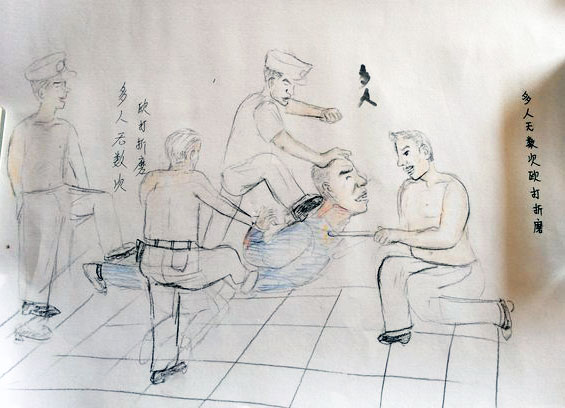
A sketch by truck driver Liu Renwang showing abuse he received in an extralegal detention center, 2014-2015

A sketch by truck driver Liu Renwang showing abuse he received in an extralegal detention center, 2014-2015

Every year in China, thousands of people suffer what the United Nations calls “arbitrary detention”: confinement in extra-legal facilities—including former government buildings, hotels, or mental hospitals—which are sometimes known as “black jails.” There is no formal arrest or presentation of charges, and access to lawyers is denied. Many of those detained in this way have criticized the government, complained about abuse, petitioned for remedies, or assisted others in seeking justice (rights lawyers have been especially vulnerable). Others are simply people whom authorities regard as “troublemakers” who might “disturb order” at politically sensitive times such as meetings of the National People’s Congress, anniversaries of the Tiananmen massacre, or last month’s G20 summit in Hangzhou. Until now, there have been few records of what goes on inside these facilities, but one first-hand account has recently come to light. Continue reading Yang Zhanqing, a life in detention

Fate catches up to Shantou CR museum (1)

I happened on this museum six years ago and wrote a short piece about it in a Sydney Chinese newspaper. Since then, reading various reports about the authority’ s refusal to let people remember the CR, I have often wondered how long this remote museum – the only one I know of – will be able to survive. Now I have my answer.

From this report, it seems that the museum has not been destroyed but covered up. I wonder if there may come a time when it may open again?

Lily Lee <l.lee@sydney.edu.au>

The end of Consensus

Source: China Media Project (10/3/16)
The End of Consensus
By David Bandurski

21ccomIN CHINA, it looks like the end of Consensus. No, I’m not talking about Xi Jinping fashioning himself as “the core,” or as the country’s COE, or “chairman of everything.” I’m talking about the sudden and complete eradication over the weekend of the website Consensus, 21ccom.cn, which long served as a respected platform bringing together writers and academics of various backgrounds to discuss more sensitive issues of social and political development in China.

An order for the closure of Consensus reportedly came from Beijing authorities on October 1, China’s National Day. According to the Chinese-language service of Radio France International (RFI), the site’s CEO said on the social media platform WeChat that Consensus had been shut down for “transmitting incorrect ideas” (传递错误思想). Continue reading The end of Consensus

CR in Tibet

Source: NYT (10/3/16)
The Cultural Revolution in Tibet: A Photographic Record
By LUO SILING

Tsering Woeser’s father, an officer in the People’s Liberation Army in Lhasa when the Cultural Revolution broke out in 1966, photographed many public attacks on Tibet’s old ruling class and religious leaders. Here, a Buddhist nun wears a sign labeling her as a counterrevolutionary. CreditTsering Dorje

In 1999, the Tibetan writer Tsering Woeser came across Wang Lixiong’s book “Sky Burial: The Fate of Tibet.” On finishing it, she sent Mr. Wang photographs taken by her father, who was with the People’s Liberation Army when it entered Tibet in the 1950s and documented the early years of the Cultural Revolution in Lhasa in the 1960s. Mr. Wang wrote back, saying, “It’s not for me, as a non-Tibetan, to use these photos to reveal history. That task can only be yours.” Continue reading CR in Tibet

Fate catches up to Shantou CR museum

Source: NYT (10/2/16)
Fate Catches Up to a Cultural Revolution Museum in China
By DIDI KIRSTEN TATLOW

Tiananmen Exiles review

Source: Human Rights Quarterly 38, 2 (May 2016): 516-519.

The Lonely Few: Human Rights and the Dreams of the Tiananmen Generation
By Vera Schwarcz

images[Review of Rowena Xiaoqing He, Tiananmen Exiles: Voices of the Struggle for Democracy in China (Palgrave Mcmillan, 2014), ISBN 978-1-137- 43831-7, 212 pages.]

You will have to run the last lap deaf. You will have to run the last lap by yourself. Primo Levi, “Voices” 10 February 1981

Is dreaming of a better world a human right? It certainly does not appear explicitly in the Universal Declaration of Human Rights put forth by the UN to which China has nodded a most reluctant assent (with a loud proviso that countries still in lower stages of development cannot afford the “luxury” of fully implementing universal rights just yet).[1] Many scholars have already documented China’s horrific abuse of prisoners, the lack of free speech, free movement, and free association. Rowena Xiaoqing He’s book offers a different opportunity: To expand the lexicon of “rights” to include a more vague yet compelling spiritual longing for an improvement of the human condition, especially as experienced under totalitarian regimes. Continue reading Tiananmen Exiles review

An era in HK is ending

Source: WSJ (9/23/16)
An Era in Hong Kong Is Ending, Thanks to China’s Tight Embrace
Beijing is pressing the territory to mold itself in the mainland’s image, quickening the demise of its prized autonomy and openness
By Ned Levin and Chester Yung

bn-py332_0921ho_d_20160922144920

HONG KONG—The integration of Hong Kong with mainland China was preordained in handover talks the U.K. held with Beijing in the 1980s. The year 2047 was the due date.

It is coming ahead of schedule.

Hong Kong, long an outpost of free trade and reliable courts beside Communist China, is coming under increasing pressure from Beijing and local leaders to mold itself in the mainland’s image. That is despite Beijing’s pledges to keep the city largely autonomous for half a century after the handover in 1997. Continue reading An era in HK is ending

Murong Xuecun on personal freedoms

Source: NYT (9/23/16)
Beijing’s Disturbing Turn Against Personal Freedoms
By Murong Xuecun

24murong-inyt-master768

Outside the Second Intermediate People’s Court in Tianjin, China, where four men were convicted of “subversion of state power” based on details from a dinner conversation. Credit: Rolex Dela Pena/European Pressphoto Agency

HUANGSHAN, China — In February 2015, a group of about 15 people met at a restaurant in the Chaoyang District of Beijing. This past August, four of the attendees were convicted by the Tianjin Second Intermediate People’s Court of “subversion of state power,” and details from their conversation were used as evidence against them.

In the last three decades, China has made the world marvel at an economic miracle that has brought hundreds of thousands of people out of poverty. The quality of life for millions of Chinese people has skyrocketed in just a generation. Continue reading Murong Xuecun on personal freedoms

Cantopop queen on a crusade

Source: SCMP (9/18/16)
Denise Ho: the Cantopop Queen on a crusade against China’s Communist party
She has been labelled ‘Hong Kong poison’ by Beijing, which has also called for her to be boycotted, but the singer is determined to spread her message
By Tom Phillips in Hong Kong

Cantonese pop singer and activist Denise Ho speaks during an interview in Hong Kong.

Cantonese pop singer and activist Denise Ho speaks during an interview in Hong Kong. Photograph: Vincent Yu/AP

Denise Ho’s struggle against the Communist party of China began at 5.58pm on a Sunday afternoon. It was as the Hong Kong Cantopop queen watched aghast as live television images showed police fire the first of 87 canisters of teargas into a sea of pro-democracy demonstrators, in a botched bid to quell their protest.

“I couldn’t stand by and just watch everyone fight,” the 39-year-old pop star recalls of the clashes in September 2014 that sparked the former colony’s umbrella movement street occupation, two years ago next week. “I just had to stand up and to say something.” Continue reading Cantopop queen on a crusade

Violence against reporters in Wukan

Source: Voice of America (9/15/16)
Hong Kong Journalists Condemn Violence Against Reporters in Wukan
By Hai Yan

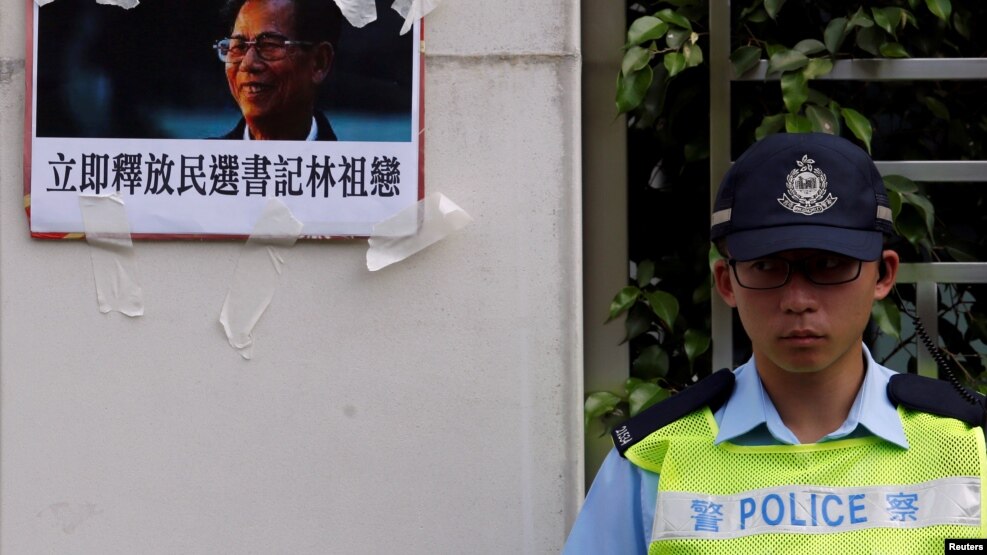
A portrait of jailed Wukan village chief Lin Zuluan is displayed by protesters demanding the release of Lin outside China Liaison Office in Hong Kong, China, Sept. 14, 2016.

A portrait of jailed Wukan village chief Lin Zuluan is displayed by protesters demanding the release of Lin outside China Liaison Office in Hong Kong, China, Sept. 14, 2016.

The Hong Kong Journalists Association on Thursday strongly condemned Chinese security officials for the violent treatment of journalists reporting on confrontations between police and Wukan villagers in Guangdong province.

Journalists from Hong Kong said they were beaten and detained by Chinese police while attempting to cover the violent crackdown on protesters in the small fishing village Wednesday.

Continue reading Violence against reporters in Wukan

Silencing the echoes of Tiananmen (1)

Thanks very much to Magnus Fiskesjö and to Louisa Lim, who wrote this very informative and revealing article. 1989 is an important reminder to a reality behind a day-to-day day dream, for people in China and in many other places. When I read about conscious efforts by LinkedIn and other media to censor voices from China and elsewhere talking about 1989, I thought of how the June 4th massacre in Beijing had been remembered or not remembered in Austria this year. The national channel ORF brought a film about the difficulties of making and selling Carinthian and Viennese cooked beef in China. On June 4th. Nothing else about China on the radio or on TV. We have a small email list that grew out of Vienna University’s Chinese Studies department. It has been rather dormant for a while, except for Confucius Institute announcements. There were heated discussions after Liu Xiaobo was awarded the Nobel Peace prize in 2010. On June 4th, 2016, there was an announcement for the TV program on Austrian boiled beef in China. I reacted saying that perhaps such an announcement, as well as the boiled beef documentary, was inappropriate. Especially if there was nothing else on the list or on TV etc. from China on that day and indeed for a while. The person who made the announcement said I was right. But there were several people who got very angry about my suggestion. Politics invading, disturbing the peace. Oh my. Continue reading Silencing the echoes of Tiananmen (1)