Pushing the Boundaries lecture

The University of Sydney China Studies Centre
Pushing the Boundaries: Assessing the Potential of Intersections between China’s Current National Self-image, Tianxia (‘all under heaven’) and the Traces of Confucian Morality and Aesthetics
Date: Wednesday, 8 September 2021
Time: 1:00PM-2:00PM AEST
Location: Online
This seminar is free and open to the public!

REGISTRATION IS ESSENTIAL 

In recent years, the People’s Republic of China has become increasingly assertive in the upholding of its national territorial limits. The reasons for this assertiveness are not far to seek. Exponential domestic economic growth over the last four decades has greatly enhanced the PRC’s confidence on the world stage in addition to strengthening the country’s military reach, regionally and internationally. Alongside a desire to re-establish Greater China’s former geographical integrity following the divisions wrought by civil conflict as well as Euro-American and Japanese colonialism/imperialism there is also a necessity to secure vital trading routes and access to resources. Less materially to the fore, but also important, are intersections between the PRC’s current national territorial assertiveness and the recent revisiting by Chinese academics of an uncertainly bounded governmental authority signified by the term tianxia (‘all under heaven’)—and by association cognate Confucian conceptions of morality and aesthetics—during China’s dynastic-imperial past as the basis for a new harmonious, non-interfering “post-West” world order. It will be argued that while those intersections are open to interpretation as tracing a durable Chinese civilization-specific cultural habitus in support of the PRC’s contemporary national self-image they have by turns a potential to shape China as a renascent world power deconstructively/reciprocally—as a matter of parallaxic discursive positioning—somewhere (and nowhere) between the dual imaginaries of empire and the nation-state. Continue reading Pushing the Boundaries lecture

Discussion with Xi Chuan / Reading by Mang Ke and Xi Chuan

Hi, MCLC–

As the last event of this year’s International Poetry Nights in Hong Kong “Break Out: Reading & Dialogue” Series, Chinese poets Mang Ke 芒克 and Xi Chuan 西川 gave readings, followed by a discussion between Xi Chuan and me, covering topics from the Chinese classics to world literature to poetry and art and the creative process. The readings were in Mandarin, with Chinese and English text (translations by Jonathan Stalling and Huang Yibing and by me), and the discussion was in Mandarin. The hour-and-a-half-long event can be viewed on youtube, here:
https://www.youtube.com/watch?v=cYnDT7r5THs

Lucas Klein Lucas.Klein@asu.edu

Chinese Heritage in the Indian Ocean

The University of Sydney China Studies Centre
Chinese Heritage in the Indian Ocean : A Cultural Anthropological Perspective
Date: Friday 13 August 2021
Time: 12:00 pm–1:00 pm AEST

Location: Online
REGISTRATION ESSENTIAL

About this event

Organised by the Department of Chinese Studies in collaboration with the China Studies Centre ‘Language, Literature, Culture and Education’ cluster, The Australian Society for Asian Humanities and the Faculty of Art, Design & Architecture at UNSW.

Early overseas Chinese communities and their legacies are often disconnected from and overshadowed by grand historiographic narratives that attempt to legitimise China’s footprint in the world today. Drawing on the strength of a museological project commissioned by the Foshan municipal government, Guangdong, on the Cantonese societies in the Southwest Indian Ocean, this talk will unveil with anthropological evidence how during the late 19th and early 20th centuries Chinese migrants established themselves along the western coast of the Indian Ocean (i.e. the Mascarene Islands, Madagascar, Tanzania and Mozambique) and how varieties of Chinese heritage in this particular region are being rediscovered and re-evaluated for the present-day political and economic needs. It offers an alternative and bottom-up view of the role culture plays in China’s global strategy, distinct from the official tones of cultural diplomacy and people-to-people exchange.

About the speaker: Xuefei Shi is a postdoctoral researcher in the ERC-project TransOcean at Chr. Michelsen Institute (CMI), Norway, and currently an affiliated researcher at the Department of Chinese Studies, USYD. His research looks into the mobilities of Chinese fishermen and fishing communities in the Indian Ocean, in particular Madagascar. With a Ph.D. in development studies from Radboud University, the Netherlands, he has extensive fieldwork experience in East Africa in the past decade. Continue reading Chinese Heritage in the Indian Ocean

No regrets for telling the truth

Listen to “No Regrets for Telling the Truth.”
Free to Think Podcast with Dr. Jo Smith Finley, July 25, 2021.
Also available at Scholars at Risk.

Episode Description

Free to Think talks with Dr. Jo Smith Finley, a reader in Chinese studies at Newcastle University, UK. In March 2021, Dr. Smith Finley, among others, was sanctioned by the government of the People’s Republic of China, including a ban on traveling to China, a freeze on assets, and a ban on collaborating with Chinese counterparts, whether in China or abroad.

The sanctions were in retaliation for Dr. Smith Finley’s research about reported human rights violations in the Xinjiang Uighur Autonomous Region. These include the forced internment of over one million Uighurs, a largely Muslim ethnic minority, in what some have labeled an ongoing attempted genocide. By targeting the careers of scholars outside of China, the sanctions represent a dramatic escalation in the Party-state’s campaign to censor information that is contrary to the official national narrative, and a threat to academic freedom everywhere.

yrs. sincerely,

Magnus Fiskesjö

Street Angels talk

Christopher Rea will be speaking about the history and artistry of the film “Street Angels” (1937) at an online event hosted by the China Institute NYC

Street Angels (1937): Tragedy meets comedy in a time of war”
July 28, 2021, 4:30pm Pacific Time / 7:30pm Eastern Time
Registration: https://www.chinainstitute.org/event/street-angels-tragedy-meets-comedy-in-a-time-of-war/

Street Angels, the most celebrated Chinese musical of the 1930s, was released in Shanghai in July 1937 just as full-scale war broke out with Japan in northern China. Its themes—sexual and economic exploitation offset by fun and camaraderie—were at once shocking and entertaining. Set in the slums of Shanghai in 1935, the film presents the precarious lives of the urban lower classes in a tragicomic mode. War looms in the background of this story of a refugee singer. The Japanese army was soon to invade Shanghai, but, to accommodate China’s censors, the film never mentions the enemy by name.

Synopsis: Teenaged songstress Zhou Xuan sings two hit songs in director Yuan Muzhi’s masterpiece. At the center of these “street angels” is a young woman who has fled fighting in the Northeast only to find herself threatened again in Shanghai. She seeks refuge from her abusers with her lover across the alley, played by heartthrob Zhao Dan, and other downtrodden friends. But will Xiao Hong and her sister, who has been forced into prostitution, be able to escape?

The film showcases the popularity of film musicals, the charm and charisma of its “golden voice” star, the multiple influences of Hollywood on the Chinese talkies, and the violent realities of 1930s China. In Mandarin, with English subtitles.

Translating the Occupation book launch

Translating the Occupation: Online Book Launch
Vancouver: 5pm (5 Aug)
Toronto: 8pm (5 Aug)
Taipei/Beijing: 8am (6 Aug)
Melbourne 10am (6 Aug)

We are proud to launch Translating the Occupation: The Japanese Invasion of China, 1931-1945. Coedited by Jonathan Henshaw, Craig A Smith, and Norman Smith and published with UBC Press, this volume brings together two dozen academics from Canada, China, Korea, Japan, Taiwan, the United States, and Australia in a novel approach that combines translation with the study of East Asian history. Join us for a discussion with the three coeditors and Professor Emerita Diana Lary.

Hosted by: Professor Emerita Diana Lary (UBC)

Speakers:

Norman Smith (University of Guelph)
Jonathan Henshaw (Academia Sinica)
Craig A Smith (University of Melbourne)

Register for this book launch: Eventbrite registration for Zoom event

From 1931 to 1945, as Japanese imperialism developed and spread throughout China, three regions experienced life under occupation: the puppet state of Manchukuo, East China, and North China. Each did so in a distinct manner, but making sense of experiences and decisions made during this crucial period has been an elusive goal for historians. Continue reading Translating the Occupation book launch

Multidisciplinary Work in a Time of Hate

The annual Asian Theatre Journal Lecture (co-hosted by the Association for Theatre in Higher Education and Association for Asian Performance) offers a unique opportunity to hear from one of the leading scholars in the field. This year we are excited to welcome Alexa Alice Joubin.

Lecture Title: “To unpathed waters”: Multidisciplinary Work in a Time of Hate
Association for Theatre in Higher Education Annual Conference
Sunday, August 8, 2021 at 1 pm EDT
Sign up through the ATHE conference

Force of Forging Words: A Translation Conversation

Source: Notes on the Mosquito (7/7/21)
Force of Forging Words: A Translation Conversation
An online launch for Words as Grain: New and Selected Poems by Duo Duo 多多, translated by Lucas Klein, from The Margellos World Republic of Letters by Yale University Press.
Lucas Klein in discussion with Nick Admussen, Chris Song, and Jami Proctor Xu, moderated by Tammy Lai-Ming Ho

In “The Force of Forging Words,” a poem in Words as Grain: New and Selected Poems by premier Chinese poet Duo Duo 多多 (Yale University Press, The Cecile and Theodore Margellos World Republic of Letters series), translated by Lucas Klein, Duo Duo writes: “outside force, continuing on / from enough, is insufficient hallucination // … // this is rationale’s wasteland / but the ethics of poetry.”

What are the ethics of poetry? Is poetry the wasteland of the rationale, or of the rational? Is translation a kind of hallucination, and is it sufficient? What care needs to be taken to translate such poetry? Our speakers will discuss these questions with the translator to celebrate the publication of Words as Grain. Continue reading Force of Forging Words: A Translation Conversation

Unpacking ‘Propaganda’ in Revolutionary China talk

Unpacking ‘Propaganda’ in Revolutionary China: How Opened Archives Transformed Cultural and Social Histories of the Mao Era, by Matthew D. Johnson
This seminar is co-hosted with the Department of Chinese Studies at the University of Sydney.
The University of Sydney China Studies Centre
Registration

The term “propaganda” is frequently used in the pejorative, to indicate untruth in politics or media. In pragmatic terms, however, its meanings have changed over time. This talk will focus on what propaganda was in a historical sense, using the concrete example of the Chinese Communist Party in the 1950s and 1960s. What did propaganda mean? What were its institutions and functions? What were its main techniques and themes? What can we learn about popular consciousness as a result? In answering these questions, this talk will draw on research carried out by the speaker during a “golden era” of archival openness in the People’s Republic of China, when researchers were allowed access to documents that allowed them to reconstruct the local details of what had been previously assumed to be a monolithic Party-state. What these records tell us is that experience during the “Mao years” was far from monolithic but, like understanding propaganda itself, determined by more fine-grained distinctions in position and vantage point. This more locally nuanced understanding of China, in turn, is constructive for understanding events both in the past and today. Continue reading Unpacking ‘Propaganda’ in Revolutionary China talk

Memory and Forgetting in China and Taiwan

Memory and Forgetting in China and Taiwan
A Conversation around Three New Books
Young China Watchers
Thursday, July 1, 2021 | 2:00 PM – 3:00 PM EDT

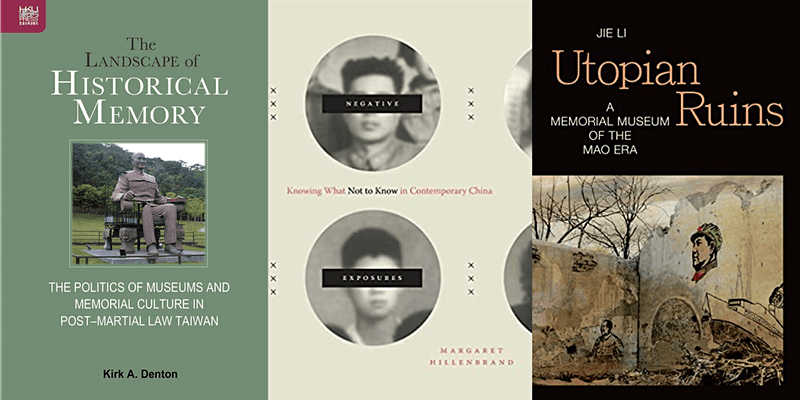
As the Chinese Communist Party plans to celebrate the 100th anniversary of its founding, Young China Watchers–Washington, DC invites you to join three experts on the preservation, creation and manipulation of popular historical memory in China and Taiwan. This timely discussion will examine how states and societies shape the understanding of their pasts–through invention, erasure and memorialization–and the contests over the narratives that define contemporary politics.

The virtual book talk will include Professor Kirk Denton from The Ohio State University, Associate Professor Margaret Hillenbrand from Oxford University and Associate Professor Jie Li from Harvard University. Each has recently published a book from which they will share their key findings and takeaways.

RSVP Here Continue reading Memory and Forgetting in China and Taiwan

Cultural History of Heritage in China

The University of Sydney China Studies Centre
Cultural History of Heritage in China
Time: 1:00PM-2:00PM AEST
Date: Wednesday 7 July 2021
Registration

Organised by the Department of Chinese Studies in collaboration with the China Studies Centre ‘Language, Literature, Culture and Education’ cluster and The Australian Society for Asian Humanities (formerly OSA).

This talk discusses how the Chinese understanding and treatment of the past has changed over time, depicting the development from imperial times to Mao-era China. In doing so, the talk pays particular attention to the cultural history of “heritage” over the last century, especially the practices of imperial collections, knowledge transmission and antiquarianism. Chinese treatment of the past has been and continues to be characterised by cycles of destruction and creation in which new dynasties or governments use the past to legitimize their rules. Moreover, members of Chinese society have gone through cycles of antiquarianism – attempts of conserving and collecting the past – to foster a sense of identity during times of uncertainty. Studying the history of heritage ideas and practices in both imperial and modern China, the talk argues that today’s “heritage fever” can be seen as a part of this tradition.

About the speaker

Yujie Zhu is a Senior Lecturer at the Research School of Humanities and the Arts, the Australian National University, Australia. His research focuses on the politics of cultural heritage and memories in modern China. His recent books include Heritage Tourism (Cambridge 2021); Heritage Politics in China (Routledge 2020, with C. Maags) and Heritage and Romantic Consumption in China (Amsterdam 2018). Continue reading Cultural History of Heritage in China

Feng Jicai event

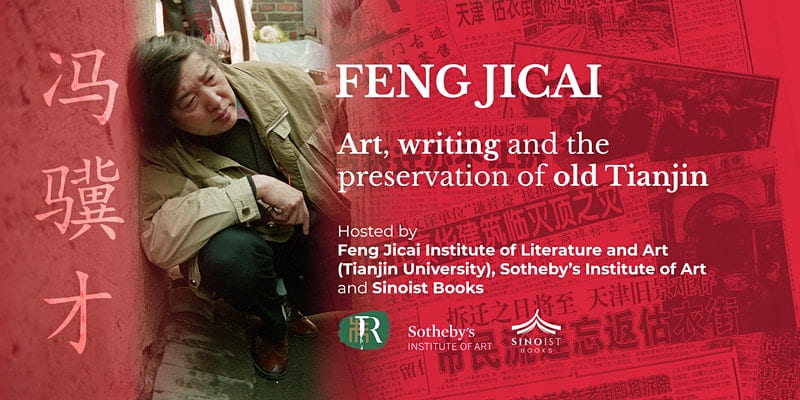
Feng Jicai: Art, Writing, and the Preservation of Old Tianjin
A guided tour of Feng Jicai’s work & Tianjin’s broader artistic legacy, led by world-class experts from Sotheby’s Institute of Art.
Fri, 25 June 2021; 05:00 – 06:00 EDT; 10am British Summer Time / 5pm China Standard Time
Online event: click the link above to register

Sinoist Books, Sotheby’s Institute of Art, and the Feng Jicai Institute are thrilled to bring you Feng Jicai: Art, Writing, and the Preservation of the Old Tianjin. In this seminar, we’ll be exploring the artistic, literary, and cultural history of Tianjin, looking to Feng Jicai as one of its most prominent authors and artists operating in the 20th-21st century.

We’ll be hearing from the author himself, hearing about the significance of his work in Tianjin and beyond, as well as unpacking the intimate connections between his art and his other work.

What’s more, we’ll be looking at Tianjin’s wider artistic culture with Dr Katie Hill, one of Sotheby’s Institute of Art experts, as she shares her knowledge on the Tianjin Yangliuqing woodblock new year pictures.

We’re looking forward to welcoming people from around the globe – this event will be bilingual in Chinese to English sequential translations provided, we’re excited to say!

This event will be recorded for later social media broadcast. Continue reading Feng Jicai event

Chinese Film Classics

Colleagues,

I am delighted to announce the publication of my book Chinese Film Classics, 1922-1949 (Columbia University Press):

https://cup.columbia.edu/book/chinese-film-classics-19221949/9780231188135

For fun, I made two short trailers for the book–something I think more of us should do:

1-min trailer: https://youtu.be/mMwK7_h052s
2-min trailer: https://youtu.be/mMwK7_h052s

People interested in early Chinese cinema might also take a look at the updates to the Chinese Film Classics website: https://chinesefilmclassics.org/

The website features over 20 English-subtitled films from the Republican era, as well as a full online course. I will post about the website on the listserv separately later this month.

For now, please join me tomorrow at my first public talk since the book’s release, hosted by the U.C. Berkeley Department of History: “Chinese Film Classics and Hollywood Resonances”

https://events.berkeley.edu/index.php/calendar/sn/history/?event_ID=139398

The event begins at 5pm Pacific Standard Time, Thursday, May 20, 2021.

Professor Wen-hsin Yeh will be the chair and Professor Weihong Bao will be the discussant.

Best,

Christopher Rea

What is South China Sea Buddhism

Lecture: What is South China Sea Buddhism?

Organised by the Department of Chinese Studies in collaboration with the China Studies Centre ‘Language, Literature, Culture and Education’ cluster and The Australian Society for Asian Humanities (formerly OSA).

Chinese Buddhists have never remained stationary. They have always been on the move. Why did Buddhist monks migrate from China to Southeast Asia? How did they participate in transregional Buddhist networks across the South China Sea? In this talk, I will tell the story of “South China Sea Buddhism,” referring to a Buddhism that emerged from a swirl of correspondence networks, forced exiles, voluntary visits, evangelizing missions, institution-building campaigns, and organizational efforts of countless Chinese and Chinese diasporic Buddhist monks. Drawing on multilingual research conducted in Indonesia, Malaysia, Singapore, China, Hong Kong and Taiwan, I challenge the conventional categories of “Chinese Buddhism” and “Southeast Asian Buddhism” by focusing on the lesser-known—yet no less significant—Chinese Buddhist communities of maritime Southeast Asia. By crossing the artificial spatial frontier between China and Southeast Asia, this talk brings Southeast Asia into the study of Chinese Buddhism and Chinese Buddhism into the study of Southeast Asian Buddhism. Continue reading What is South China Sea Buddhism