Don’t think I posted this already. Cao Fei’s “Same Old, Brand New” lightshow commissioned by Art Basel and ICC. To view the video, click the title above.–Kirk
Posted on Youtube here: https://www.youtube.com/watch?v=nG13oONJAYI
posts related to Chinese art
Don’t think I posted this already. Cao Fei’s “Same Old, Brand New” lightshow commissioned by Art Basel and ICC. To view the video, click the title above.–Kirk
Posted on Youtube here: https://www.youtube.com/watch?v=nG13oONJAYI
DEAR MCLC LIST MEMBERS:
I am delighted to announce the publication of my new book, Gendered Bodies: Toward A Women’s Visual Art in Contemporary China (University of Hawaii Press, 2015).
You may visit the press webpage specified for the book at
http://www.uhpress.hawaii.edu/p-9515-9780824840037.aspx
DESCRIPTION
 Gendered Bodies introduces readers to women’s visual art in contemporary China by examining how the visual process of gendering reshapes understandings of historiography, sexuality, pain, and space. When artists take the body as the subject of female experience and the medium of aesthetic experiment, they reveal a wealth of noncanonical approaches to art. The insertion of women’s narratives into Chinese art history rewrites a historiography that has denied legitimacy to the woman artist. The gendering of sexuality reveals that the female body incites pleasure in women themselves, reversing the dynamic from woman as desired object to woman as desiring subject. The gendering of pain demonstrates that for those haunted by the sociopolitical past, the body can articulate traumatic memories and psychological torment. The gendering of space transforms the female body into an emblem of landscape devastation, remaps ruin aesthetics, and extends the politics of gender identity into cyberspace and virtual reality. Continue reading Gendered Bodies
Source: The Guardian (11/26/15)
Beijing Shuts Down Art Exhibition on Violence Against Women
Gallery planning to exhibit feminist works celebrating attempts to combat violence against women forced to close down hours before opening
Tom Phillips in Beijing
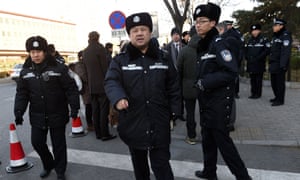
China’s nascent feminist movement has been on the receiving end of a harsh crackdown. Photograph: Greg Baker/AFP/Getty Images
Beijing authorities have shut down an art exhibition celebrating attempts to combat violence against women, organisers said on Thursday.
The exposition, timed to coincide with the UN’s International Day for the Elimination of Violence Against Women, was to open at Beijing’s Jinge Art Gallery on Wednesday. But when artists arrived hours before its planned opening, they found the doors bolted shut.
“The reason our exhibition was called off is pressure from higher authorities,” said Cui Guangxia, the Beijing-based artist curating the event. Continue reading Beijing shuts down feminist art exhibit
Source: China Real Time, WSJ (11/19/15
Come Together: Yoko Ono Says China and Japan Should Make Love, Not War
By Olivia Geng

Yoko Ono performs a shout during a press conference before the opening ceremony of her exhibition held at the 798 art district in Beijing, China, Saturday, Nov. 14, 2015. Associated Press
From World War II history to maritime disputes, the list of conflicts between China and its neighbor Japan is long and at times vexing – but to hear Yoko Ono tell it, there’s no need for such bad blood between the two Asian rivals.
“Japanese and Chinese are both very intelligent people; instead of using their intelligence to fight with each other, it’s better to get together,” the 82-year-old artist and musician said last weekend at the opening of her first solo exhibition in Beijing.
“I don’t think the world wants that,” she added. “The world wants us to always be fighting, so we are weak. But we have to know that they are trying to trick us.” Continue reading Yoko Ono exhibit in Beijing
Source: NYT (11/5/15)
An Arts Explosion Takes Shanghai
By Justin Bergman

The Long Museum West Bund, which incorporates a preserved coal-unloading bridge from an old industrial site. Credit Qilai Shen for The New York Times
In Shanghai, the historic Bund grabs much of the spotlight — the stretch of former banks and trading houses along the Huangpu River, built a century ago in a kaleidoscope of architectural styles, is a monument to the grandeur of another era. It can also be downright suffocating on weekends, with tourists jostling for selfie positions.
For congestion-weary residents, another part of the riverfront now known as the West Bund has become a far more appealing place to spend the weekend. Here, a once-forlorn industrial area known for aircraft manufacturing has been transformed into a lush green corridor where Shanghainese come to ride bikes and skateboards, scale outdoor rock-climbing walls and, a rarity in this city, enjoy picnics on the grassy riverbank.
And in the last two years, museums and galleries have also started popping up as part of the city’s plan to turn the West Bund into a world-class arts and culture hub, Shanghai’s answer to Museum Mile in New York or South Bank in London. Continue reading Art explosion in Shanghai
Source: NYT (11/10/15)
Chinese Taxi Driver Turned Billionaire Bought Modigliani Painting
By AMY QIN

BEIJING — Liu Yiqian, a former taxi driver turned billionaire art collector, confirmed on Tuesday that he was the buyer of the painting of a nude woman by Amedeo Modigliani that sold for $170.4 million at Christie’s New York on Monday night.
Speaking by telephone from Shanghai, the Chinese collector said he planned to bring the work back to the city, where he and his wife have two private museums.
“We are planning to exhibit it for the museum’s fifth anniversary,” he said. “It will be an opportunity for Chinese art lovers to see good artworks without having to leave the country, which is one of the main reasons why we founded the museums.” Continue reading Chinese billionaire buys Modigliani painting
Dear Colleagues,
I am writing to announce the publication of the facsimile and translation of the Chinese editor, curator, and activist Ou Ning’s notebook Bishan Commune: How to Start Your Own Utopia.
Best regards,
Mai Corlin <maicorlin@gmail.com>
ABOUT THE BOOK
 The Bishan Commune: How to Start Your Own Utopia is a graphic montage piece, where comments, thoughts and short accounts from Ou Ning’s travels to Bishan are intertwined with drawings, clippings, color-coded text, handwritten notes, pictures and quotes. The forefathers of the utopian community, pictured side by side in a pantheón, are the Russian anarchist Peter Kropotkin (1842-1921) and one of the Chinese leaders of the historical Rural Reconstruction Movement, James Yen (1890-1990).
Ou Ning’s goal with the Bishan Commune utopia is to realize the idea of an autonomous zone, where experiments with co-living, sharing, anarchism, community, self-organization, architecture, art practices, and rural traditions can take place, however difficult this might prove in present-day China. Continue reading Bishan Commune: How to Start Your Own Utopia
Source: NYT (10/14/15)
Mao and Other Cultural Inspirations
By RANDY KENNEDY

“A Complete Set of Chinese Zodiac Figures In Tang Dynasty Three Colors Glaze Ceramic Style” (2002), by Zhang Hongtu. Credit Zhang Hongtu, via Queens Museum
Zhang Hongtu, who left his native China for New York in 1982 seeking more creative freedom, could never be accused of dull-wittedness, especially when it comes to iconography of the Chairman. He has painted Mao shirtless, Mao with pigtails, Mao as a Quaker (on a cereal container) and Mao with one eye and two mouths. He has even built an unplayable Ping-Pong table with Mao-shaped cutouts.
Mr. Zhang’s career of almost half a century, which plays subtly and at times deviously with Chinese traditions and East versus West stereotypes, is the subject of a first-ever American survey at the Queens Museum, opening Sunday, Oct. 18. It brings together more than 50 works, including sketches from his days in China and series like “Soy Sauce Calligraphy” and “Remade Landscapes,” paintings that mash up Western modernist and classical Chinese styles. (Through Feb. 28, http:://www.queensmuseum.org.) Continue reading Zhang Hongtu exhibit in NYC
Booking is now open to attend Dislocations: Remapping Art Histories; a conference organised by Tate Research Centre: Asia-Pacific.
Dislocations: Remapping Art Histories
A conference organised by Tate Research Centre: Asia-Pacific
Tate Modern, Starr Auditorium
Thursday 3 December 2015 – Friday 4 December 2015, 18.00
A drinks reception takes place from 18.15 on Thursday 3 December in the Starr Foyer

Do Ho Suh Staircase-III 2010 Polyester and stainless steel Overall display dimensions variablePurchased with funds provided by the Asia Pacific Acquisitions Committee 2011© Do Ho Suh, courtesy Lehmann Maupin Gallery, New York
The histories of modern and contemporary art in Asia are inseparable from the cultural, social and political realities of the region and its continuously changing position in the world at large. What we regard as the canonical reading of art and its histories have been the subject of rigorous critique and revision in the past decades, and the conventional perception of art history as a singular narrative has yielded to a more complicated, discursive understanding of multiple art histories.
The conference raises a number of questions on performance, socially engaged practice and the methodological rethinking of the Western-centrism of 20th century art histories. Topics include environmental art and performance in Japan in the 1960s, performance and its relationship to installation art in the Philippines in the 1970s, transnational and multivalent character of Modernism’s centres such as Paris and Mumbai, the effect of the internet and social networking technologies in contemporary Chinese art and the ‘social’ legacy of the socialist era in contemporary practice in China.
Keynote: Do Ho Suh
Convenors: Marko Daniel, Joan Kee, Sook-Kyung Lee, Ming Tiampo and Zheng Bo
Speakers: Ignacio Adriasola, Lee Ambrozy, Pamela N. Corey, Sonal Khullar, Tina Le, Lu PeiYi, Su Wei, Ming Tiampo and Zheng Bo
If you would like to learn more about the conference, please email trc.asiapacific@tate.org.uk
Funded PhD Position in Chinese Art History at the University of Melbourne
Applications close 31st October, 2015.
Applications are invited for a PhD scholarship associated with an Australian Research Council (ARC) funded Future Fellowship study into the international context of modern and contemporary Chinese art. The study, led by ARC Future Fellow Dr Claire Roberts (Associate Professor of Art History), is based at the University of Melbourne. The student will be full time. S/he will pursue an independent PhD research project, and also contribute to the larger ARC project, which involves collaborative research, international workshops, and the development of exhibitions.
We are seeking a highly motivated student with demonstrable research skills, writing experience, and expertise in one or more of the following fields: Chinese studies, art history & theory, visual cultures, critical & curatorial studies, and intercultural communication. The student will be expected to engage deeply with issues related to Chinese art; proficiency in Chinese is strongly recommended. Continue reading Melbourne art history position
Source: NY Review of Books (9/12/15)
I Try to Talk Less’: A Conversation with Ai Weiwei and Liao Yiwu
By Ian Johnson

Ai Weiwei And Liao Yiwu Discuss Culture And The Individual In Modern China. Getty Images.
In late July, Chinese authorities renewed travel privileges for conceptual artist and political activist Ai Weiwei, ending a five-year prohibition following his arrest in 2011. He promptly flew to Munich and then Berlin, where he has accepted a three-year guest professorship at the city’s University of the Arts.
After arriving in Germany, Ai gave two interviews that aroused some controversy, telling the Süddeutsche Zeitung and Die Zeit that repression in China is bad but not as bad as in the past—defensible positions, especially if comparing today’s China to the Cultural Revolution or the period immediately after the 1989 Tiananmen massacre, but still surprising to some who had come to expect extremely pointed and uncompromising statements from Ai. Continue reading A conversation with Ai Weiwei and Liao Yiwu
From: maghiel van crevel <M.van.Crevel@hum.leidenuniv.nl>
Source: The Guardian (9/12/15)
Ai Weiwei – from criminal to art-world superstar
The Chinese artist talks about how his incarceration helped his career, and why he’s embarrassed about his early work – ahead of his first major UK exhibition
By Michael Prodger

Ai Weiwei: ‘I don’t go to church. I work seven days a week, I’m always the first one in the office.’ Photograph: Andy Wong/AP Photo
For a man who in 2011 spent 81 days incarcerated without charge at the pleasure of the government of the People’s Republic of China, Ai Weiwei’s choice of Berlin studio is a curious one. Rather than an airy white room full of light, he has gone for the opposite: an extraordinary maze of underground cellars that were once the cooling warehouses for the Pfefferberg brewery. This cavernous labyrinth of huge, bare, brick-vaulted spaces serves as studio, store rooms, refectory and creative hub for Ai and his team, and in its Carthusian calm resembles a subterranean monastery. The place exudes a feeling of security but not necessarily of freedom. Continue reading Ai Weiwei–from criminal to art superstar
Here’s a video report from The Guardian about Ai Weiwei and his views on Beijing as urban space.
Joseph Allen <jrallen@umn.edu>
Source: http://www.theguardian.com/cities/video/2015/sep/08/ai-weiwei-beijing-prison-freedom-of-speech
After a quick glance, just wanted to say, fantastic! A wonderful addition to this project and to making this incredibly important magazine available. Congratulations.
Sean Macdonald <smacdon2005@gmail.com>
Rebecca Nedostup and I created a multi-part unit on Dianshizhai for the MIT Visualizing Cultures site, which I think MCLC list members may be interested in. Here’s the url:
http://ocw.mit.edu/ans7870/21f/21f.027/dianshizhai/index.html
Best wishes,
Jeff Wasserstrom <wasserstromjeff@gmail.com>