Tuesday, December 1 – Green Zone opens

Now that the Opening Ceremonies and Leaders Event for COP 21 are over, the facility has opened for the rest of us.  There are two main parts to the conference headquarters. First is the Blue Zone, where the actual negotiations take place.  You have to have a badge to get into the Blue Zone, which I do not have. In the past, I am told, the United Nations has been pretty generous in issuing badges to observer organizations such as Sierra Club, but this year they were not.  Sierra Club had about 70 members coming to Paris, but they got only 10 badges.  This meant that only certain staff members and the highest-level volunteers could get in.  Citizens Climate Lobby had badges only for Joe Robertson and the global strategies advisor Sarabeth Brockley, who works for the United Nations.  Climate Reality had no badges for anyone but Al Gore and president Ken Berlin.
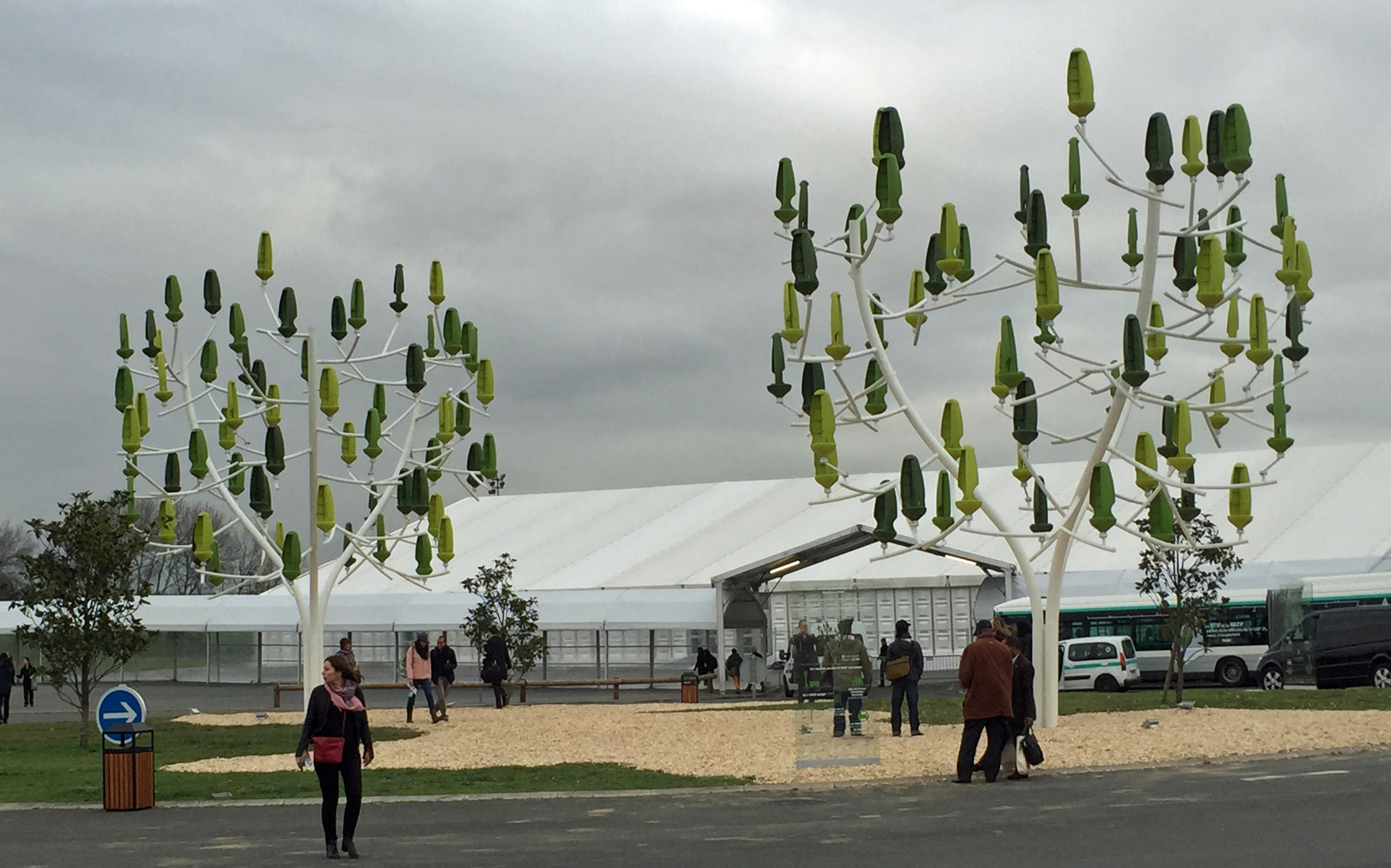
Wind trees create power from wind near COP 21.

Wind trees create power from wind near COP 21.

I knew going into the conference that getting into the Blue Zone was unlikely barring a last-minute miracle. For example, a couple of times someone posted on the CAN listserv that their group had an extra badge, but invariably it was snatched up within minutes.  Even knowing this, I decided to go anyway. I was on the fence until the Sustainability conference in October at Ohio State. Among the speakers was Andrew Light, staff climate adviser in the Office of Policy Planning for the U.S. Department of State.  Light had acted as a negotiator at several COPs, so he knew first-hand what it was like.  He told me that watching the actual negotiations was incredibly boring, and that most of the action was in the civil society section of the conference.  He described the hope he felt walking through the enormous civil society section which housed organization after organization working on some aspect of addressing climate change.  That made me decide that even without a badge to the Blue Zone, I could get a lot out of attending.
Entrance to Climate Generations.

Entrance to Climate Generations.

The civil society section of COP 21 was called Climate Generations, also known as the Green Zone.  That is where the Sierra Club had a booth set up, so today I set out to see the Green Zone and meet the people at the Sierra Club booth.  Getting to COP 21 from my hostel was pretty involved, but there were people in green jackets at the Gare du Nord train station to provide directions.  First I had to buy tickets for Line B of the regional train, known as RER, which were more expensive than regular metro tickets.  I had to take that train to the Le Bourget stop, then catch a free shuttle to the COP 21 headquarters.  Once I got off the shuttle, I had to walk over to the Green Zone.

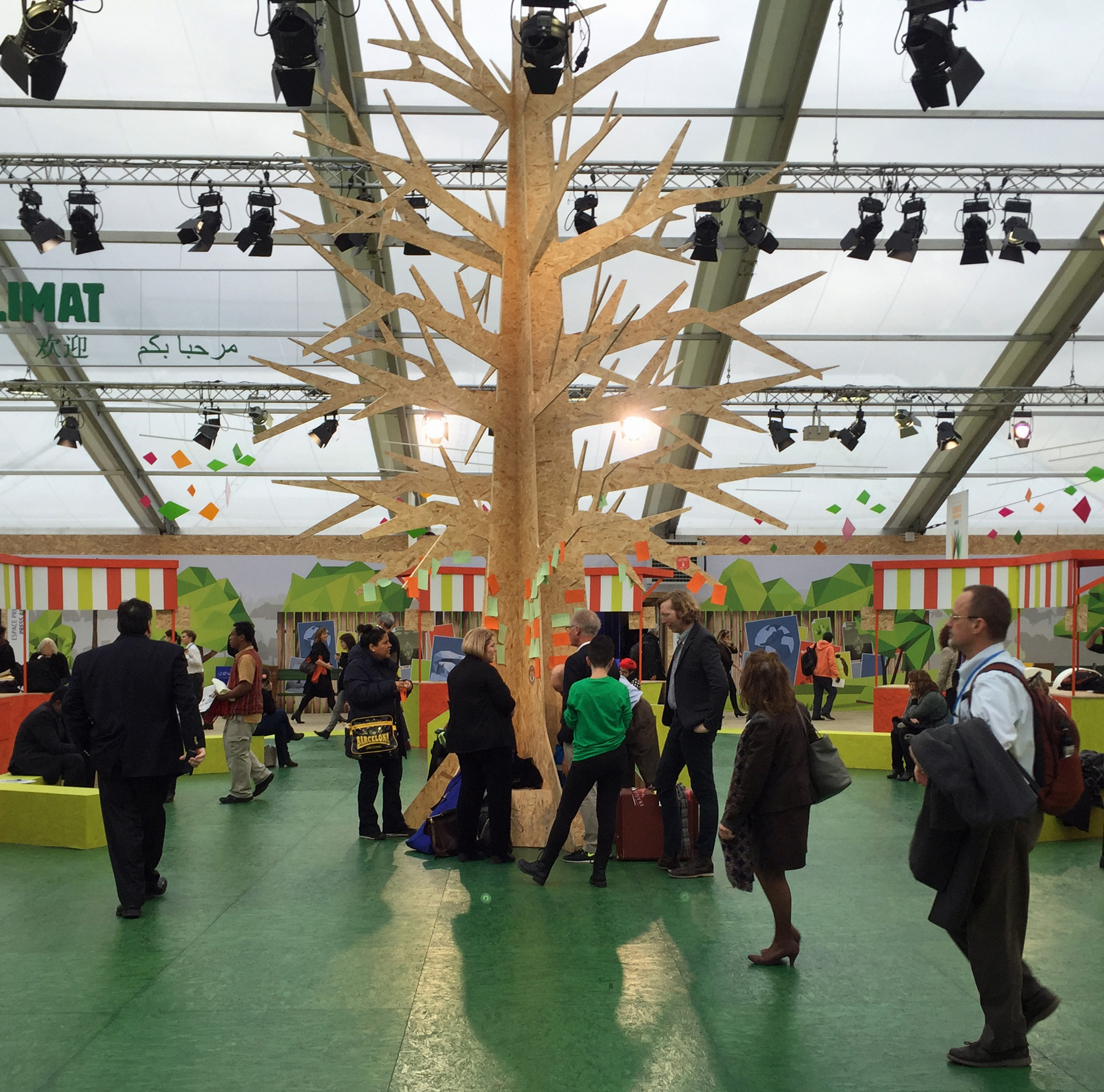
Once arriving at the Climate Generations space, I had to go through airport-like security screening. They had about a dozen lines, and I didn’t get there until the afternoon, so lines were short.  Finally I was in the Green Zone.  It was a huge building, the size of an airline hangar, with all the facilities set up just for this conference.  Coming in there was a coat check, a station to recharge electronics, and an area of tables to meet at.  Down most of one side was a large auditorium and a series of seven meeting rooms.  These would be filled every day with panels, discussions, and other events.  Then there were various performance spaces and three different areas for civil society booths.

Sierra Club booth

Sierra Club booth in the Climate Generations space. From left to right are President Obama (in cardboard anyway); Glen Besa, Virginia chapter; Jim Dougherty, national board; and Tyla Matteson, Virginia Chapter.

I was wondering how to find the Sierra Club booth when I happened across area C, which housed about 50 booths, and saw that its map included the Sierra Club.  So I went in to say hi, and met several of the people who I would become friends with during the course of the trip.  These included Glen Besa and his wife Tyla Matteson from the Virginia chapter, Jim Dougherty who is on the national board, and Steven Sondheim from Tennessee who was in charge of staffing the booth.  These four were the mainstays of the Sierra Club booth and ended up doing the lion’s share of work staffing it.  Beside the booth was a life-size cutout figure of Obama, which people kept wanting to get their pictures with.

I had not had lunch, but lines at the restaurants were so long that I decided to skip it. My Sierra Club colleagues told me that this is how it always works the first day — the vendors just don’t seem to be able to handle the crowds.  Lines for food were at least an hour and sometimes two hours long. Tyla shared some of her croissant with me, and we all decided in the future to pick up food at the train station and bring it with us to the Green Zone.  I did walk around and get some photos around the building, and I located the all important bathrooms and water filling stations.  As a souvenir each booth got COP 21 water bottles to hand out, and I accepted mine gratefully.

James Hansen surrounded by media after his talk at Place to B.

James Hansen surrounded by media after his talk at Place to B.

Tonight was an important event at Place to B.  Each night from 6 to 8 p.m. the hostel has programmed special guest panels for a feature called Place to Brief, and tonight’s panel included Naomi Klein, author of This Changes Everything, and former NASA scientist James Hansen, known for testifying about climate change before Congress in 1988.  I knew the CCL people would be there to see Hansen as he is on the CCL board.  I wanted to see both, as did others from the Sierra Club.  Steven and I left the Green Zone a little after 5 p.m., but transportation took so long that we didn’t get to Place to B until right at 6 — and the downstairs area where Place to Brief happens was completely full.

James Hansen and Sustaina Claus at Place to B.

James Hansen and Sustaina Claus at Place to B.

Fortunately the hostel was live streaming the proceedings on TVs in the workspace upstairs.  Unfortunately a lot of people in the workspace would not stop talking, even though others were trying to watch the event.  I set up my GoPro video camera and taped the panel from upstairs, which meant that I was basically taping a TV show, but it was better than not taping anything at all.  The sound quality was poor at times, but we were able to catch most of it.  Later I discovered that a Facebook friend, Paul Beckwith, had also gotten into this event, taped Hansen’s entire presentation, and posted the video on his blog.
Monday, November 30 – Opening Day of COP 21

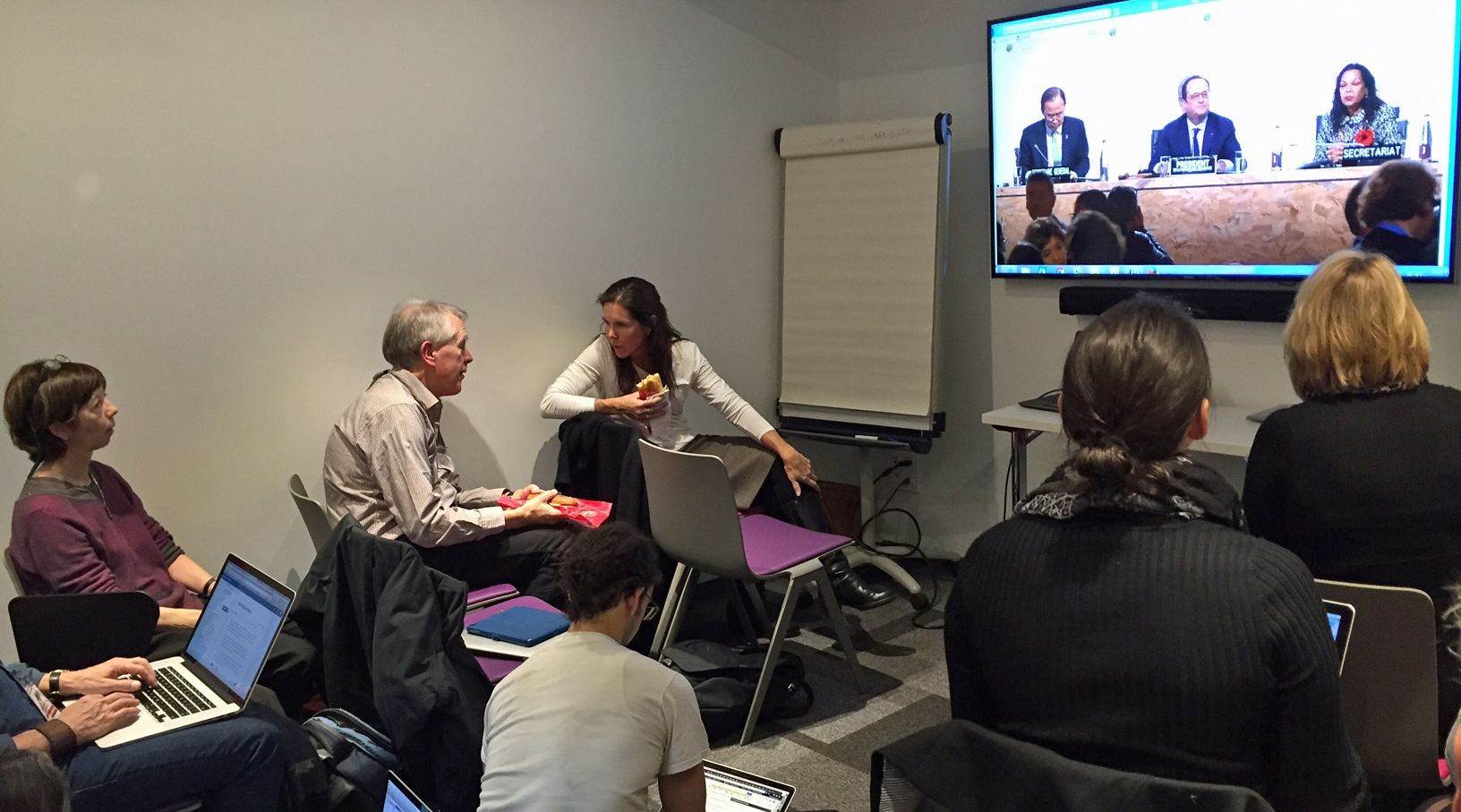
Members of Climate Action Network watch the opening of COP 21.

Members of Climate Action Network watch the opening of COP 21.

Today was a lot calmer than yesterday but no less busy.  It was the opening day of the 21st Conference of the Parties to the United Nations Framework Convention on Climate Change, known for short as COP21.  Because of all the security measures, Le Bourget, the converted airport north of the Paris city center where COP21 is taking place, was closed to the public.  So I went with several members of the Citizens Climate Lobby delegation to the hub for the Climate Action Network, or CAN, a network of organizations from around the world working on climate change.  The CAN hub is about a 10-minute walk from my hostel at Place to B, but my phone got confused at an intersection where several streets came together.  Eventually I found it, and several of us congregated in two rooms to watch the ceremonies, which were being livestreamed on the Internet.

After the so-called “family photo” of all the visiting world leaders, more than 150 country presidents, prime ministers, and other heads of state were scheduled to speak at the Leaders Event starting at noon.  Even though each leader was only given three minutes to speak, there were so many of them that speeches ran in two rooms simultaneously and still went on into the evening.

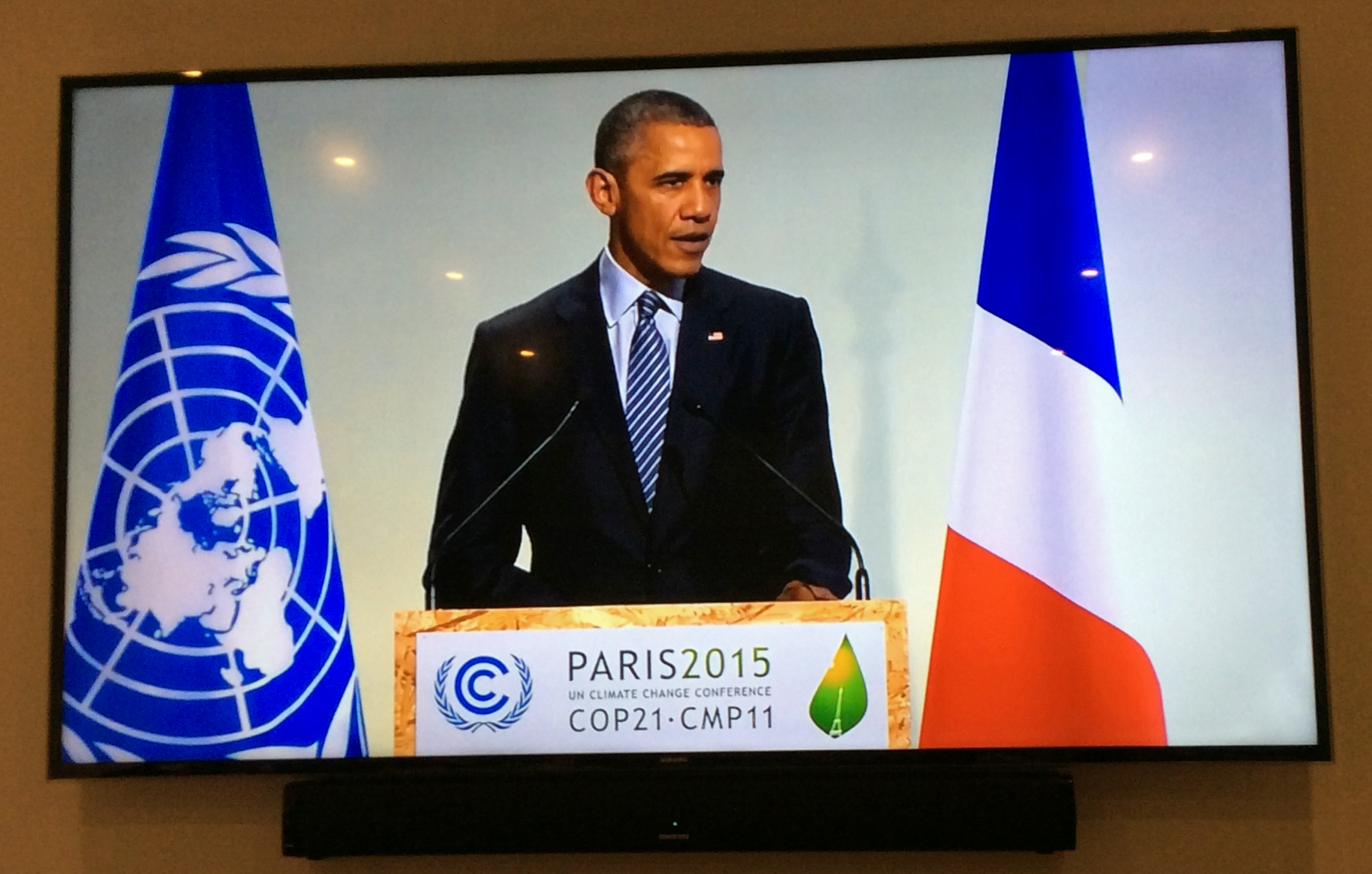
President Obama speaks at COP 21.

President Obama speaks at COP 21.

President Obama spoke about 12:45 and gave what I thought was an excellent speech.  He called the Paris climate conference a “turning point … the moment we finally determined we would save our planet.” “I’ve come here personally, as the leader of the world’s largest economy and the second-largest emitter, to say that the United States of America not only recognizes our role in creating this problem, we embrace our responsibility to do something about it,” Obama said.  He talked about his recent trip to Alaska and called for an ambitious and transparent agreement.  He talked about how this is life or death for island nations and said he was meeting with their leaders tomorrow. He also mentioned the multibillion-dollar investment fund in clean energy research and development to be launched by Bill Gates and others today.

You can see video of Obama’s speech here and read statements by all the world leaders here.

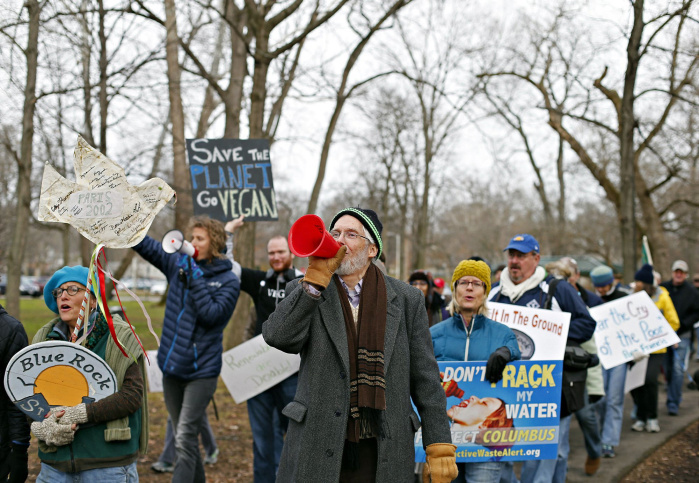
My CCL colleague Chuck Lynd leads the Global Climate March in Columbus.

My CCL colleague Chuck Lynd leads the Global Climate March in Columbus.

While I was listening to the various leaders speak, I was also paging through my social media accounts and saw that my CCL colleague Chuck Lynd had pulled off quite a march for climate in Columbus. As I was trying to avoid arrest at Place de la Republique in Paris, Chuck and others had gotten over 100 people to come out as part of the Global Climate March organized by 350.org.  I was amazed because before I had left, only a handful of people were signed up.  In less than a week, Chuck got the word out to environmental advocates across Central Ohio, and they turned out in droves, resulting in a great photo in the Columbus Dispatch.  That made my heart sing.

See video of the Columbus march from Carolyn Harding and photos from David Roseman via the Sierra Club Central Ohio Group.

On the frustrating side, the keys on my iPad stopped working.  I had planned to live tweet the Leaders Event, and even posted that I would on my Facebook page. but was unable to.  This was a cause for some panic, as I had not brought a laptop to Paris but was relying on the iPad to do the heavy lifting.  I was worried it had crashed even though it was only six months old.  Perhaps the blog posts and photos from yesterday had worked it too hard.  I wasn’t sure what to do, so I sent out a query through the CAN-talk listserv asking if anyone had a laptop I could borrow.  Most people recommended that I take the iPad to an Apple store in Paris, which I finally decided to do.  One was about a mile away, which gave me my first chance to truly walk around the city.  Once I got to the Apple store, it took awhile to figure out the system for getting some help, but when I finally did, the technician simply told me to call Apple support.  Well, I could have done that from the CAN hub!  But unfortunately I did not buy international minutes from Verizon.

Then I noticed that the operating system for the iPad needed to be updated.  I prayed that would solve the problem and pressed the button.  It was an entire new install of the IOS operating system and took a long time to work. After that, I sat at the store playing with the keys again for awhile.  Eventually I decided the iPad was indeed fixed, though I considered buying a new laptop in France anyway. Posting blogs and processing photos is so much easier from a laptop, and I will not travel to an event like this again without one.  But not only is the electrical outlet on French laptops different, the keyboard is different — it is not a QWERTY keyboard but AZERTY.  So I decided not to.

Members of the Citizens Climate Lobby delegation meet in Paris.

Members of the Citizens Climate Lobby delegation meet in Paris.

Finally tonight I ended up at the dinner and meeting for Citizens Climate Lobby.  Both took place at apartments that CCL members had rented out for the conference through Air B&B.  I’ve never used Air B&B, but after seeing their apartments, I decided to try it next time I am traveling internationally.  Their setup looked much more comfortable than the hostel, which is basically a dormitory, and they have access to full kitchens so they can cook their own food.  This is cheaper than buying every meal out as I have to do.

The highlight of the CCL meeting was hearing from Joe Robertson, the global strategy director, about the launch today of the Carbon Pricing Leadership Coalition.  CCL’s entire platform is carbon pricing, specifically a proposal called carbon fee and dividend that would tax carbon at the source of extraction and return all proceeds to American households.  There is a lot of talk nationally about a carbon tax, but a formal discussion of pricing carbon was taken off the agenda for COP 21 in October.  Christiana Figueres, executive secretary of the UNFCCC, said at the time that countries had too many different carbon pricing schemes for them to be reconciled into one document.

Even so, the launch of the CPLC on the first day of COP 21 put carbon pricing front and center in the conference. Consisting of 15 national governments (including Canada, Germany, and France), five subnational governments (Quebec, British Columbia, Alberta, Ontario and California), and more than 60 businesses (including BP, Enel, and Shell), the CPLC has a goal of adding carbon pricing to all national strategies by 2020 — only five years away!  And they just may be able to do it.  At the launch was a powerhouse of leaders: World Bank President Jim Kim, German Chancellor Angela Merkel, Canadian Prime Minister Justin Trudeau, Chilean President Michelle Bachelet, Ethiopian Prime Minister Hailemariam Desalegn, Philippines President Benigno Aquino III, and Mexican President Enrique Peña Nieto. Joe saw the entire thing inside the Blue Zone.

CCL has two blog posts about the launch of the Carbon Pricing Leadership Forum, one by Peter Joseph, leader of the Marin County Chapter, and one by Jessica Langerman, a volunteer from Massachusetts.

Sunday, November 29 – Nearly caught up in a crackdown

Today has been an adventure, much more than I bargained for. First I got seven glorious hours of sleep which really helped after two days of travel. I woke up with hopes my luggage had arrived overnight, but no such luck. No clothing shops would open before 10 a.m. when the Sierra Club’s orientation for all members at COP21 was set to take place. So either I had to miss the orientation hope a shop would be open and have my my size, or wear the same old sweats to the orientation. I elected to do the latter thinking I could sit in the back. I was glad I did because the information shared there was crucial to understanding the negotiations.  I’ll post a series of “State of Play” updates by Fred Heutte, lead volunteer with the Sierra Club Federal and Climate Campaign, to cover this.

Mini-march at Place de Republique

Mini-march at Place de Republique

Orientation got out about noon, so several people headed over to Place de Republique to see if we could find the shoes exhibit. Earlier in the day, Sierra Club volunteers and others had put out thousands of pairs of shoes to symbolize those who could not march. However by the time we got there, we couldn’t find them and figured they had been removed, as they were only going to be on display for a few hours. Lots of people were in the plaza, and they would have stumbled all over a large exhibit.

Media interviewed demonstrators.

Media interviewed demonstrators.

We looked for a few minutes at the huge memorial to the terrorist victims – two large rows of flowers, cards, and items left all around the huge bronze statue of Marianne, the symbol of the French republic holding an olive branch in her right hand and resting her left on a tablet engraved with the Rights of Man. Then we went to lunch. See video of the memorial to the Paris terrorism victims

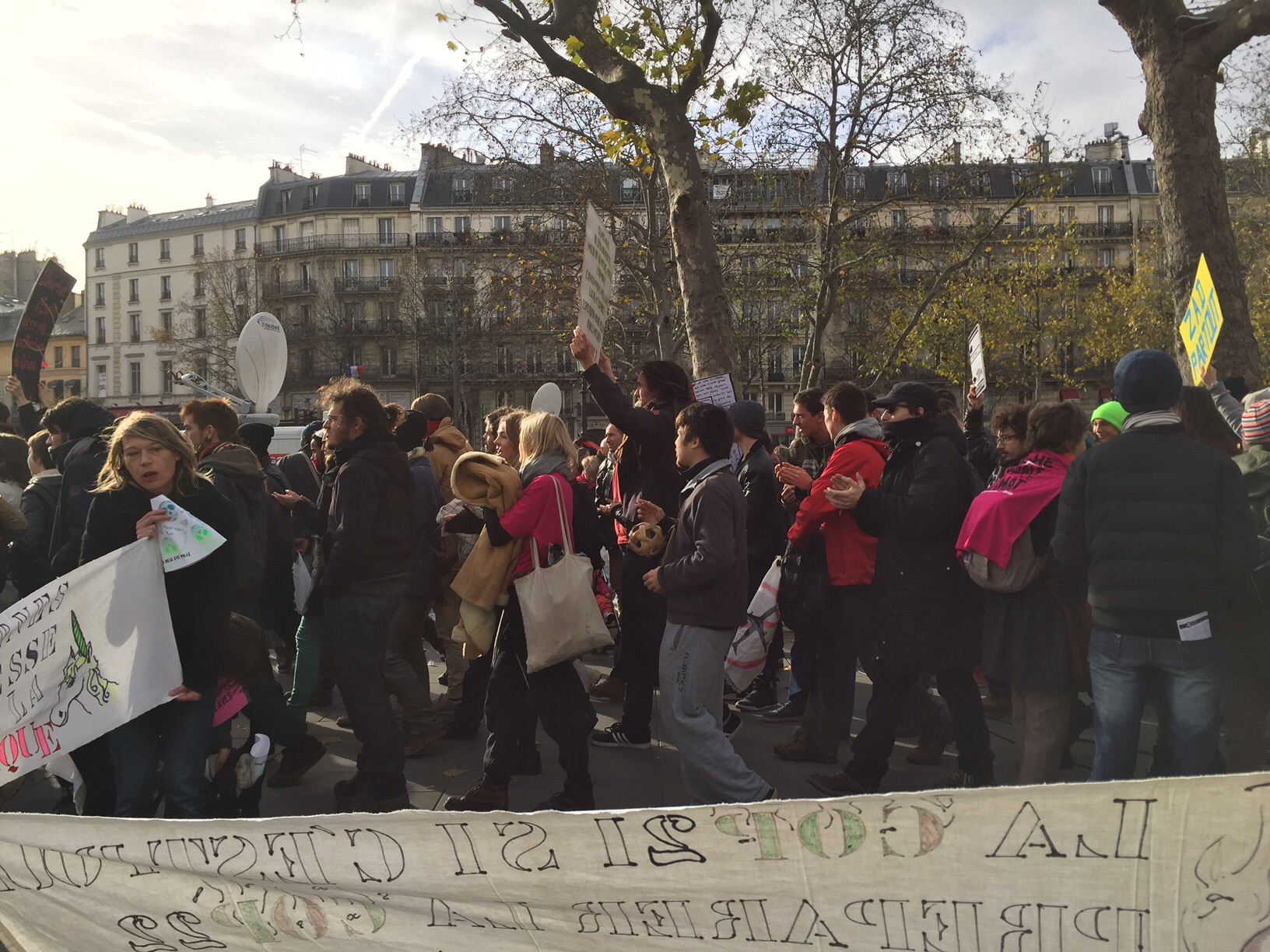
After lunch, the others headed to Musee D’Orsay, but I decided to go back to the hostel to check on my luggage. My metro train changed at Place de Republique, so I decided to go up to see if I could get photos of the terrorism memorial and look again for the shoes. There were again a lot of people, some groups doing “mini marches” around the plaza, and other people just hanging out. I decided to also get pics of some of the activists, their activities and signs. I also found a small shoe exhibit, which people were just then adding to.

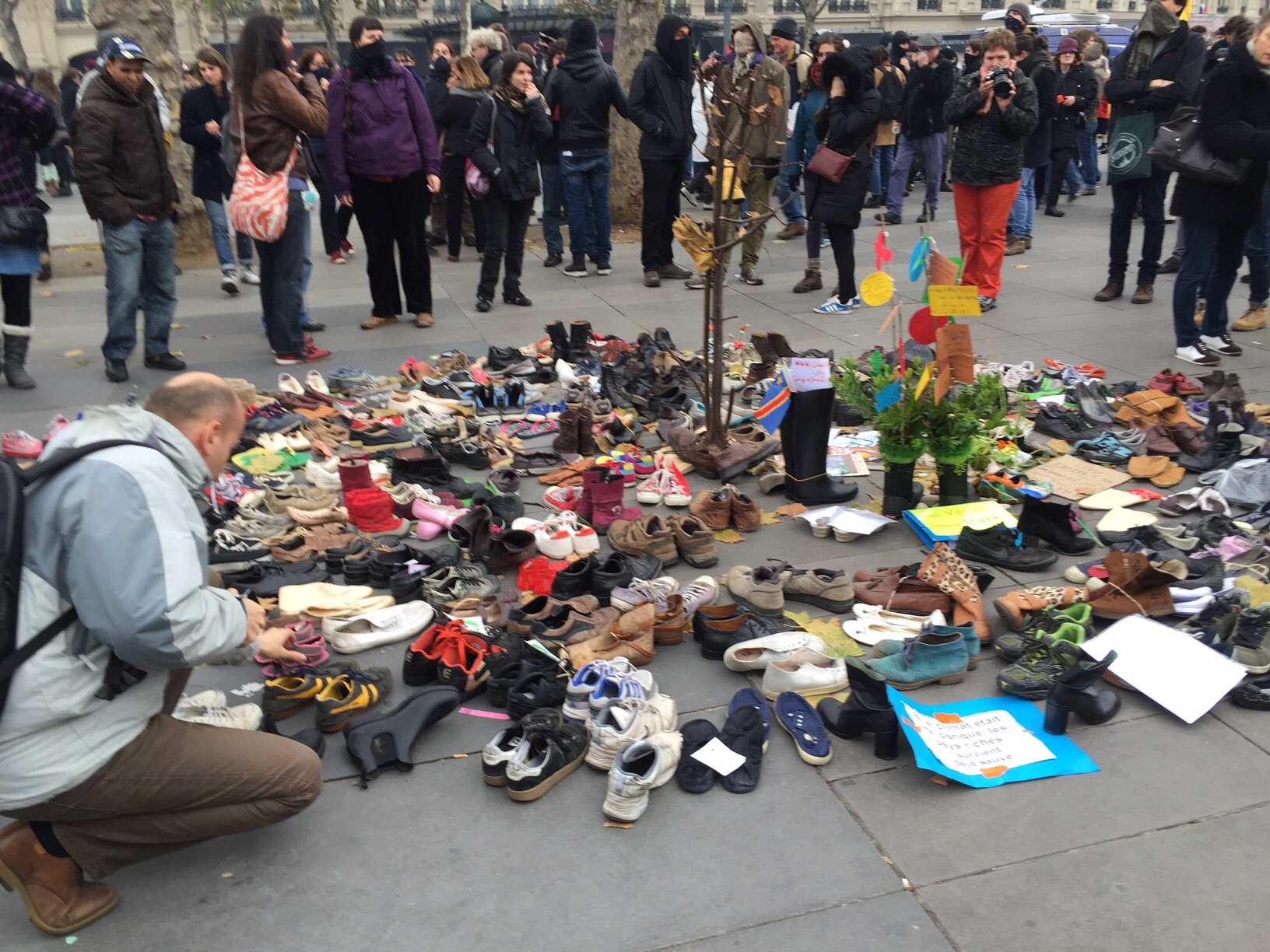
A second shoe exhibit, smaller than the morning exhibit, appeared at the plaza.

A second shoe exhibit, smaller than the morning exhibit, appeared at the plaza.

While I was doing that, the police arrived and stood in phalanxes along the streets leading into the square. They stood on the sides of the square for a long time. I asked people if the police would come into the square and make arrests. People who I talked to said no, they didn’t think so. But that was wrong. They started with tear gas around the edge of the plaza and not near me, but it pushed people my direction. Then was a series of loud booms. I wasn’t affected because it was all across the plaza, but I could smell it. If you’ve ever lit those old firework snakes on July 4, it smells like that.

tear gas at the other end of the plaza

Tear gas at the other end of the plaza

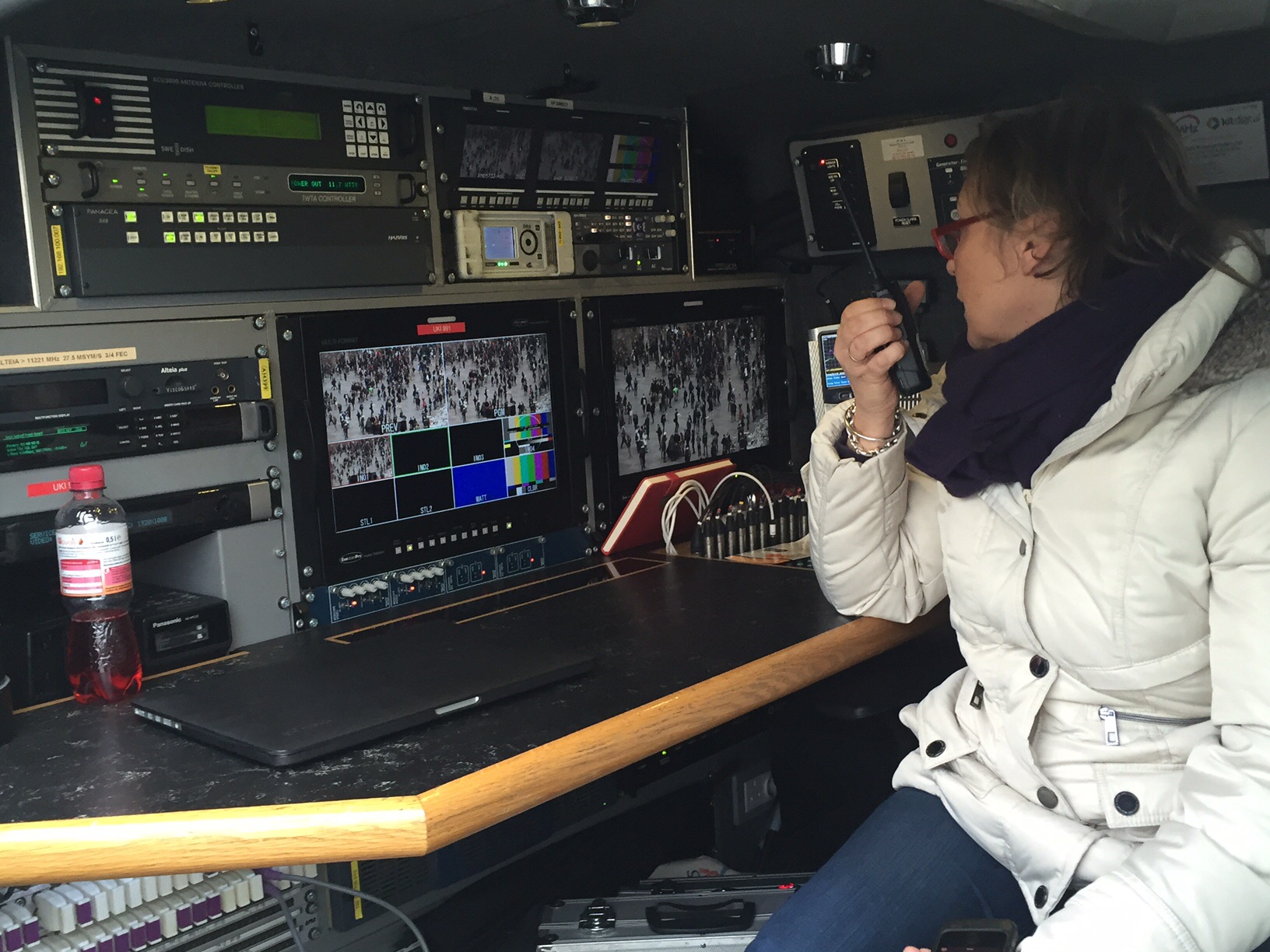
As this was going on, I found an AP van and talked to their staff member. She was inside the van watching video their camera people were getting from above and sending them instructions over a walker talkie as to what to close in on. I wasn’t sure if things would escalate, but the AP person told me the police would not bother them, so stood near their van in hopes of looking like media just in case. I also pinpointed where the metro entrance was so I could get out quickly if needed.

Row of police move closer

Row of police move closer

Then the police started to move in. That’s when I decided it was time to leave. I started down the stairs to the metro only to find the police had closed the metro stops. Another nearby metro stop was also gated shut, with police behind the gate. So I could not leave. Then police started to cordon off the streets. Fortunately some well-dressed people with luggage showed up to get into the Crowne Plaza, whose doors were also closed. But the bellhop opened the doors for them and I took advantage. See video of police moving in on protesters

View from the hotel: Police vans move in

View from the hotel: Police vans move in

From the hotel window I watched dozens of police vans move in, presumably to start arrests. There was a crowd demonstrating a few hundred feet down from the hotel, so that’s probably where the police were going to start. I have no desire to get arrested, so I hung out in the hotel bar for a couple of hours with a soup and tea. Finally by 5:45 I was ready to leave, but the metro stop was still closed and the police were still making arrests. The hotel staff pointed me to the next metro stop down away from the arrests, and I found a train and got back to the hostel. It was eerie riding through the Place de Republique stop, which is normally extremely busy but tonight was totally empty.

Vegan demonstrators

Vegan demonstrators

So what are my feelings about all this? On the one hand, I did not see anything different in Paris as at the countless demonstrations in the US. People were simply expressing themselves and their feelings of urgency about the climate, which I understand and share. On the other hand, Paris has just suffered one of the worst terrorist attacks since 9/11, which took place not far from today’s events. The government is understandably concerned about another attack, and it would be easy for bad people to hide in the crowd. So while I wish the government hadn’t felt the need to cancel the climate march, I can see why they did, and I wanted to respect that.

An AP staffer directs camera angles from the van.

An AP staffer directs camera angles from the van.

Then there’s a third hand, which is that with a previous career as a journalist, I also wanted to document events, and here I had a front row seat. I could have left the moment police showed up, but I wasn’t sure they were going to make arrests. I thought maybe they were just trying to contain the crowds in one area or making sure it didn’t get above a certain size. So I decided to see what happened. Part of why I’m here is to witness history, and this was the history of a cancelled climate march.

Men in black moved past just as police moved in.

Men in black moved past just as police moved in.

One more thing happened just as I was walking toward the metro stop to leave. A group of men all in black pants and jackets came running toward me. As I took a picture, one of them slapped down my arm and yelled at me “No photo!” I was afraid he would take my phone, so I just said “Okay” and tried to look harmless. They moved on, and I was left wondering who they were. They could have been civil demonstrators, anarchists, rabble rousers, or genuine terrorists, but clearly they didn’t want their picture taken, and you couldn’t see their faces anyway because they were covered in black too. So while I feel like the police did not need to crack down on civil demonstrators as harshly as they did, I am also not convinced that everyone in the crowd was a climate activist. Some may have very well not had good intentions.

P.S. My luggage finally arrived! 11:30 pm after three more calls to the airline.


Here are some more pictures from the day’s events:

Another mini-march around the plaza

Another mini-march around the plaza


Idle No More France was present

Idle No More France was present


Activists let their frustration with the cancelled march be known.

Activists let their frustration with the cancelled march be known.

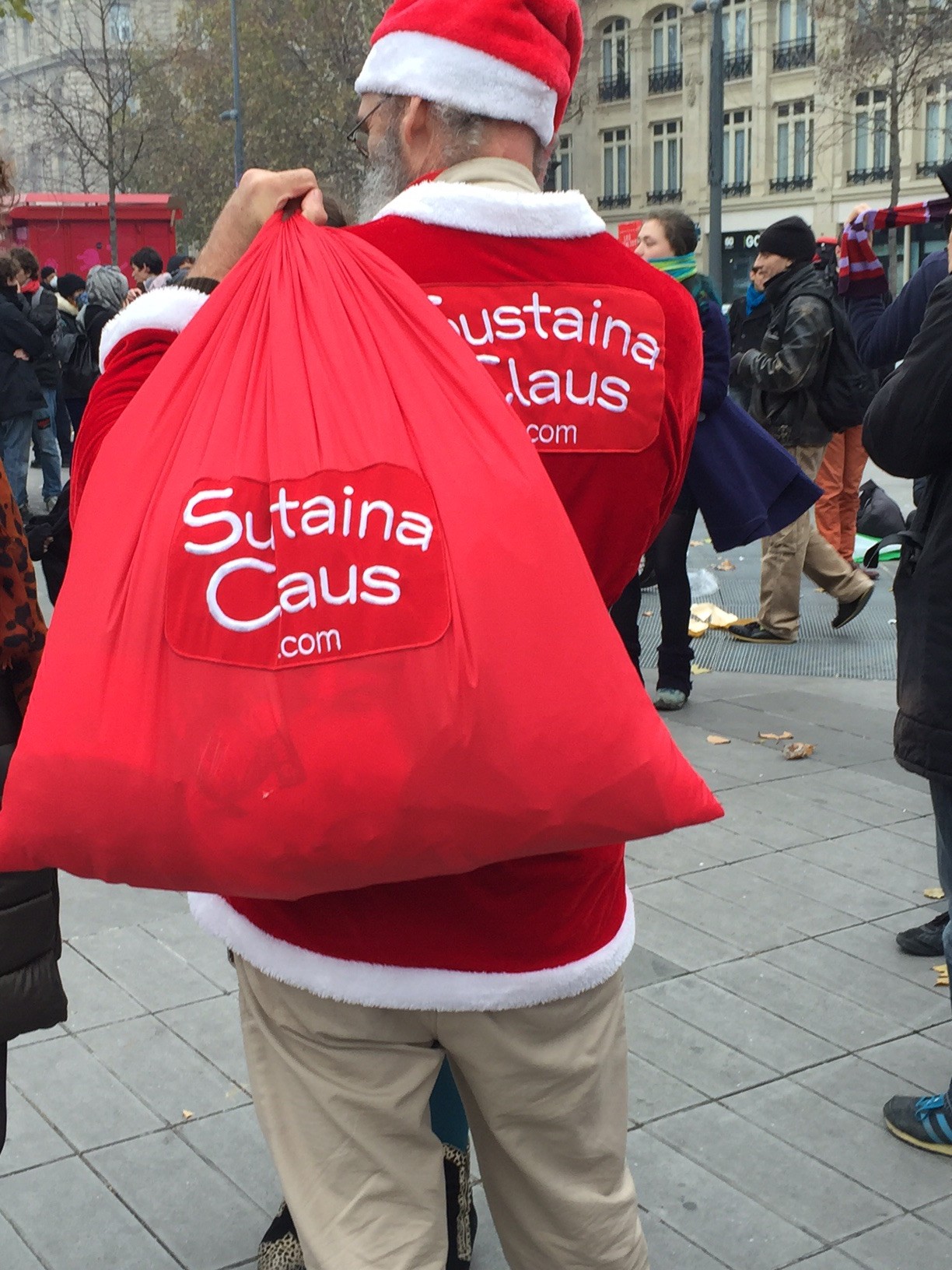
Sustaina Claus - I'm not sure what was in the bag!

Sustaina Claus – I’m not sure what was in the bag!

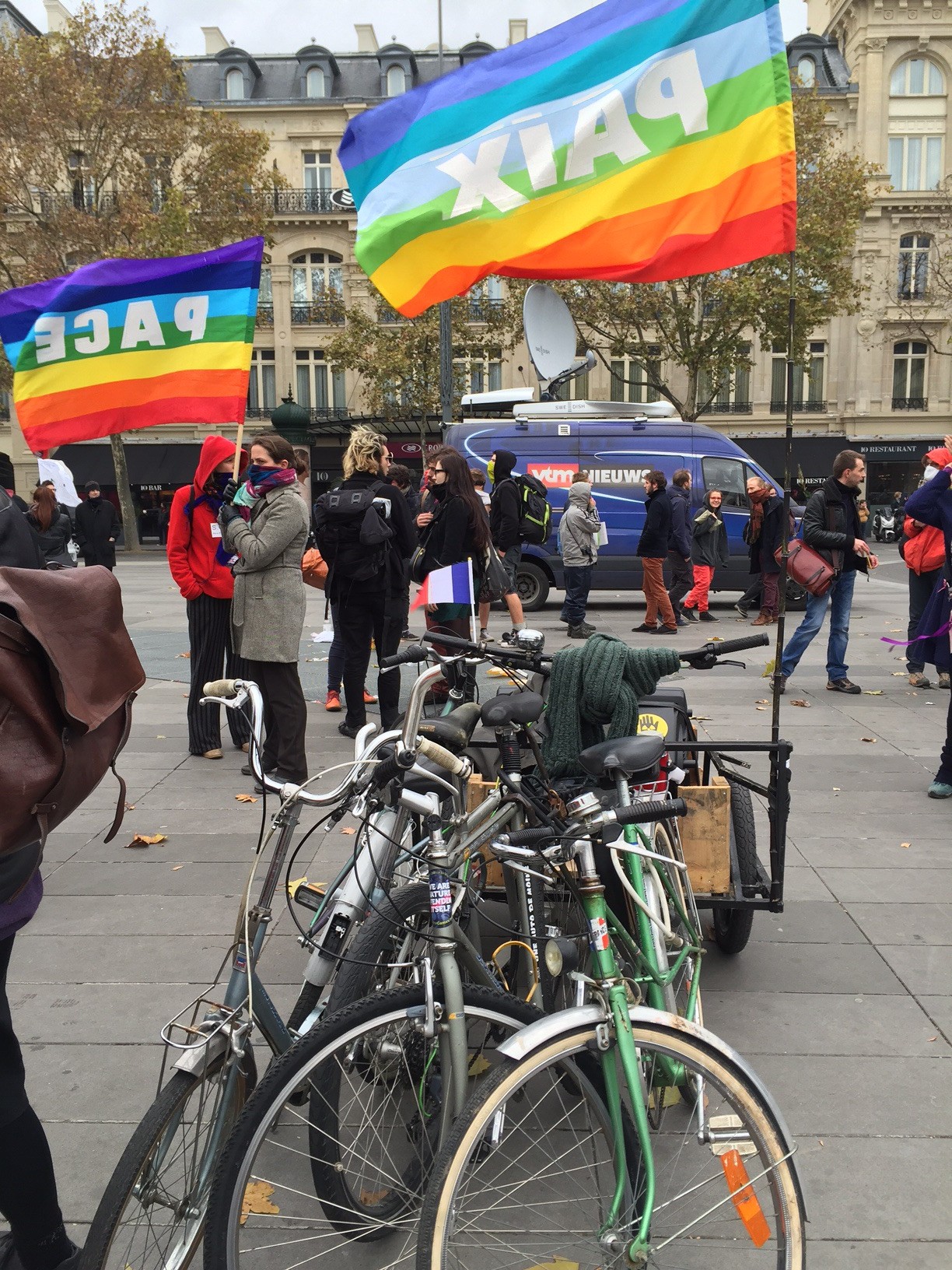
more bike signs

more bike signs

detail of shoe exhibit.

detail of shoe exhibit.

Signs left behind

Signs left behind

Demonstrators start to get louder

Demonstrators start to get louder

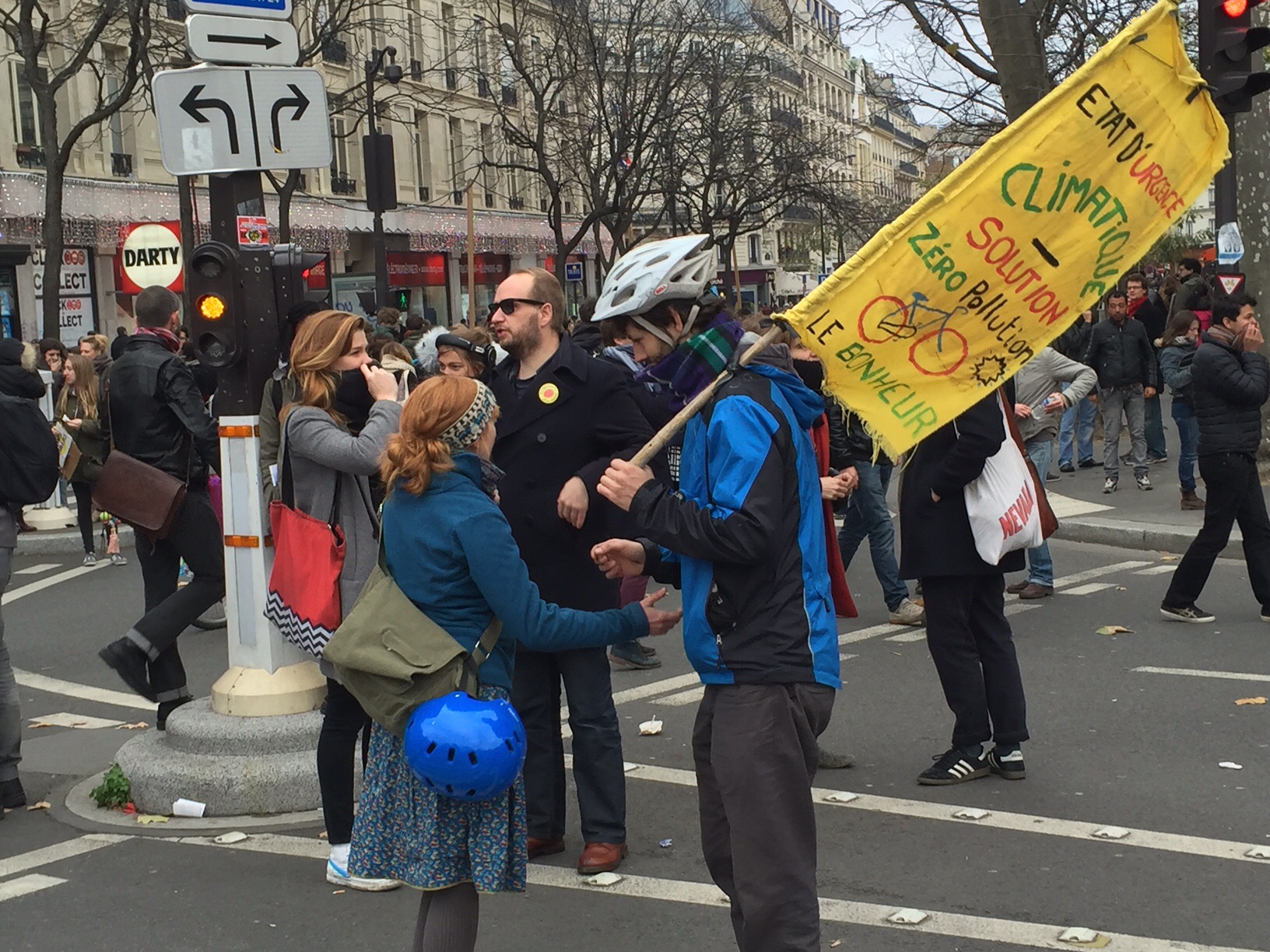
Bicyclist with sign

Bicyclist with sign

Police gathered outside the plaza.

Police gathered outside the plaza.

Tear gas at the edge of the plaza

Tear gas at the edge of the plaza

The hotel TV showed events just outside the doors.

The hotel TV showed events just outside the doors.

Saturday, November 28 – I made it to Paris!

I made it. The flight was incredibly long, though British Airways keeps you well fed and the food is good. However, I didn’t sleep at all on the flight – I never do on flights – so I am exhausted. And worse, they lost my luggage. As much as I like Ohio State sweats, I don’t want to wear them for days on end, and I’d really like a change of underwear.

place to BI arrived at my hostel – St Christopher’s Inn, or for COP21, Place to B. They don’t officially start the COP21 event until 3pm, so I couldn’t get into the room until then. It is a typical hostel. I’m in the room with the least number of beds – four – but they are bunk beds and I am on top! I have to climb a tall ladder to get up there. This will be interesting – haven’t done that since age 12.

A world map made from moss adorns the inside of Place to B.

A world map made from moss adorns the inside of Place to B.

Inside P2B was a hub of activity this afternoon with staff trying to get ready for the conference, so I decide to go elsewhere for lunch. Just around the corner was a place billing itself as “The world’s best vegetarian Indian restaurant,” so I decided to stop there. That’s when I realized I’m not in Ohio anymore. The menu was in a mix of French and English but at least the dishes had names I recognized. I ordered mutter paneer only to find you had to order rice separately. You also have to ask for silverware and water separately. The wait people probably got tired of hearing from me.

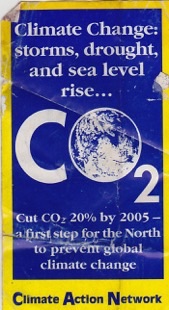
COP1 badge 1995I did sneak in a short nap after lunch and am hoping to get to a meeting with the Citizens Voice team. Meanwhile I’ve been catching up on email. I got signed up on several email lists from Climate Action Network, an umbrella organization for climate groups all over the world. The past few days people with CAN have been sending a constant stream of emails with information about events, briefings, badges, security, and who knows what. One of them even dug up an old sticker from the very first COP in 1995!

A reception at Place to B starts at 6 p.m., but I may have to go buy some toiletries and go back to bed instead. Between my last term paper and an overnight flight, I can barely keep my eyes open. Paris is 6 hours ahead of New York – and Ohio – so it will be like going to bed at noon the next day. The Bose noise canceling headphones we got may turn out to be a crucial investment, especially for people sensitive to noise as I am.

———————————————————————————————

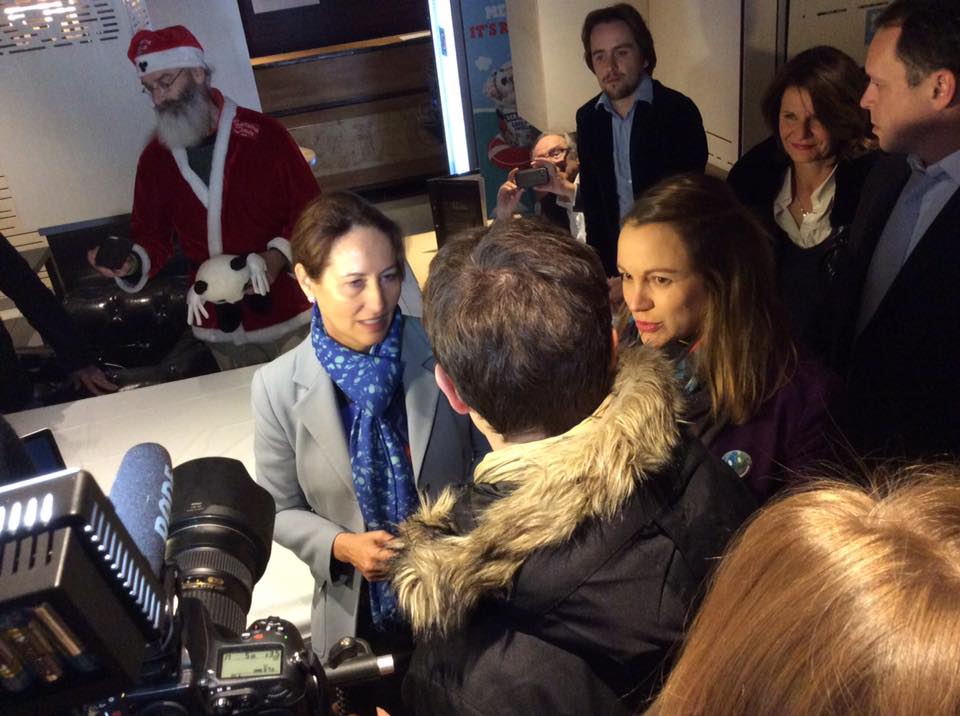
Ségolène Royal, French Minister of Ecology, Energy and Sustainable Development, and Axelle Lemaire, French Deputy Minister for Digital Affairs visited Place to B.

Ségolène Royal, French Minister of Ecology, Energy and Sustainable Development, and Axelle Lemaire, French Deputy Minister for Digital Affairs, visited Place to B.

I did get to the reception.  First was mixing and mingling, where I met the other Citizens Voice contributors.  Things were very crowded so it was hard to do much beside say hi.  Then the event started.  First was a a visit by Ségolène Royal, French Minister of Ecology, Energy and Sustainable Development, and Axelle Lemaire, French Deputy Minister for Digital Affairs.  Then we spoke with two artists behind a project called the Bureau of Linguistical Reality.  The idea was to coin new words to capture the concepts behind climate change, which is something humans have never faced before.  Besides the fairly well-known “anthropocene” were words like “ennuipocalypse” and “gwilt.” Citizens Voice team member Jeremy Lent did interviews with both artists, now up on Youtube.


Why I’m going to the climate conference in Paris

Note: I submitted this column to the Columbus Dispatch a week before my trip to the COP21 climate conference in Paris.  They asked me for a photo to go with it, but never published it.  I include it here because it is a good explanation of why I decided to go.

Headlines about climate change greet us daily. Just last week in the Columbus Dispatch, we learned that a melting glacier in Greenland could boost sea levels almost two feet (“Sliding glacier could raise sea levels by 20 inches,” 11/14); last month was the hottest October on record (“Absurdly hot October as Earth sets 8th heat record this year,” 11/18); and ocean temperatures have reached a new high (“Ocean warming tops previous El Nino record,” 11/19).

In Ohio, former state climatologist Jeffrey Rogers tells us that climate change has increased instances of extreme weather, leading to more rain coupled with more periods of drought, higher temperatures, and greater windstorms (“Map shows weather is worsening, group says,” 11/13).

COP21 logoThe ongoing urgency of climate change is why next week I will travel to Paris to participate in events surrounding the United Nations climate talks. As a volunteer for Ohio Sierra Club, Citizens Climate Lobby, and Climate Reality Project, I will be staffing booths in the civil society section of the conference; attending debates, workshops, screenings and presentations on climate change risks and solutions; and reporting on events through blogs, social media and online video. And yes, I will offset the carbon emitted by my flight through a purchase at NativeEnergy Travel Offsets.

As this one week of headlines shows, climate change is one of the most pressing problems of our time. Climate scientists agree that if left unaddressed, climate change would destabilize the Earth’s environment, making parts of the planet virtually uninhabitable for humans and many other species by the end of the century. Nor can the solutions to climate change wait. Physics doesn’t care about politics, which puts addressing climate change on a non-negotiable timeline.

The good news is that most observers expect the Paris climate conference to rise to the challenge. Throughout the year, nations have held a series of meetings leading up to the Paris talks, and so far 168 countries have made “intended nationally determined contributions,” or pledges to reduce their carbon emissions. If all nations come to an agreement on lowering carbon emissions in Paris, it will be a historic first, as past UN climate conferences have covered only developed countries.  This year the agreement is expected to cover developing countries too.

The momentum for the Paris climate talks began a year ago when President Obama announced a historic deal on lowering carbon emissions with China. The United States, relying largely on the EPA Clean Power Plan, agreed to lower emissions 26-28 percent below 2005 levels by 2025. China agreed to peak emissions and get 20 percent of its energy from renewables by 2030. China is closing coal plants, building solar plants, and will launch a cap-and-trade program next year.

One mark of momentum going into the Paris climate talks is that this year for the first time, 100 world leaders will arrive on the opening day of the conference, rather than waiting until the last minute to swoop in and try to hammer out an agreement. Everyone wants to avoid the failure of the Copenhagen climate summit in 2009 when leaders could not agree and the talks fell apart.

Scientists and policymakers have set 2 degrees Celsius as the maximum we can warm the planet without destabilizing the environment, and some think the limit is 1.5 degrees C. Will the expected agreement at the Paris climate conference bring emissions down far enough? Most observers think probably not. The Earth has already warmed almost a degree since the Industrial Revolution, with about a half-degree more locked in due to the long half-life of carbon.

But what a climate agreement among all nations would do is provide a baseline to start, so that negotiators can then continue to move the ball forward. One proposal being discussed is a requirement for nations to revisit their pledges every five years, which would provide a platform for pushing them to continue doing more until we are within a safe threshold for climate.

By going to Paris, I hope to help make a difference in this process. As one person, I can vote, contact my legislators, and organize local meetings and events – all of which I do. But by banding together with thousands of others from around the world, I can contribute to making a strong statement to world leaders that their citizens want them to take action on this crisis.

Cathy Cowan Becker is on the executive committee of Sierra Club Central Ohio Group, co-leader of Citizens Climate Lobby Columbus Chapter, and a member of the Climate Reality Leadership Corps.

CCL National Conference

Last month I traveled to Washington, DC, for the 2015 meeting of Citizens Climate Lobby, for which I am a co-leader of the Columbus chapter.  The conference was absolutely inspiring.  The plenary speakers included:

  • Katharine Hayhoe, climate scientist at Texas Tech and CCL board member
  • James Hansen, former director of Goddard Institute for Space Studies and CCL board member
  • Bob Perkowitz of ecoAmerica, a climate opinion survey and communications group

I met several people in person who I have become friends with through the Global Warming Fact of the Day group on Facebook.  I got to know several of the other leaders of CCL chapters in Ohio.  And most empowering, I got to meet with four different Ohio representatives, all Republicans, to talk about CCL’s proposal for carbon fee and dividend.

Although I have lobbied my state and federal legislators before with other groups, CCL has probably the most effective lobbying strategy I’ve experienced.  People are assigned to groups of five or six for each legislator meeting, and each person in the group gets a role.  I led the group meeting with my representative, Steve Stivers, OH-15, while for other meetings I did time keeping, told a personal story, explained the basics of the proposal, made the ask, or did follow-up.  Assigning each person in the group a role and knowing what your role was allowed you to concentrate on doing that one thing well while not stepping on the toes of others as they did their part.

After I got back, I sent a letter about the meeting to the Dispatch, which I was happy to see given prominent space in a Saturday paper.  Here is the text:

Carbon fee, dividend good for air, economy

Recently I joined a group of Ohioans who, along with 800 volunteers from Citizens Climate Lobby, traveled to Washington, D.C. to meet with more than 500 members of Congress. Our 13 volunteers from Columbus, Delaware, Springfield and Cincinnati met with aides for 16 of Ohio’s 18-member Senate and House delegation.

We were there to ask our members of Congress to consider a new proposal for addressing climate change: carbon fee and dividend. The proposal has three parts: first, place a steadily rising fee on the carbon content of fossil fuels, collected at the point of extraction and entry into the economy; second, return 100 percent of the fee equally to American households in the form of a monthly dividend check; and third, enact a border adjustment on goods coming in from countries that do not have a similar carbon fee to discourage U.S. companies from relocating jobs.

A study by the nonpartisan Regional Economic Modeling Inc. finds that by 2035, a carbon fee and dividend would provide $396 a month to a family of four, add 2.8 million jobs, increase gross domestic product by almost $1.4 trillion, lower carbon emissions by 52 percent and prevent 227,000 premature deaths. REMI also found that the Great Lakes region, which includes Ohio, would benefit more than any other in job creation, economic stimulus and cleaner air.

Most congressional offices we met with were Republican, and most of the aides we spoke with had not heard of carbon fee and dividend. Most started off cool to the proposal, but gradually warmed up as we explained its benefits. Everyone knows that something must be done to address climate change. The debate isn’t about the science but about finding a solution acceptable to everyone.

To find out more about carbon fee and dividend, visit citizensclimatelobby.org.

CATHY COWAN BECKER

Co-leader

Columbus chapter

Citizens Climate Lobby

Letter to the editor

I rarely agree with anything George Will says in print, though in the 90s I used to like to read some of his columns about baseball.  But lately his opinion pieces have become almost offensive, especially when he writes about anything having to do with women or climate change.  Last week he wrote an especially heinous column about colleges and universities working to become more sustainable.  Without stopping to think, I dashed off a letter in response, then decided to send it in to the Dispatch.  To my surprise, they published it, on the Saturday page no less which allows letters to run a little longer.  Here is the text:

Concern for climate is rational

I respond to the April 18 Op-ed column “Colleges now worship at the shrine of ‘sustainability,’ ” by George F. Will.

Will needs to check in with his fellow conservatives, as well as the business community, and get the facts.

He could start with Calpers, the largest American public pension fund, which with 60 other institutional investors has asked the Securities and Exchange Commission to require oil and gas companies to publish detailed analyses of the risks posed by climate change to their business models.

He could then contact the 43 CEOs of international corporations who wrote urging world leaders to reach an ambitious agreement to fight climate change.

The heads of Dow Chemical, Unilever, Philips and Ericsson are among those who signed.

Next, he could call the Risky Business Project, which studies the economic risks of climate change in the United States. It is co-chaired by Hank Paulson, treasury secretary under President George W. Bush, and includes as board members the CEO of Cargill and former CEO of Goldman Sachs.

Will should look up carbon fee and dividend, a revenue-neutral, market-based proposal to address climate change supported by conservatives such as George Shultz, secretary of state under President Ronald Reagan.

A study by the forecasting group Regional Economic Models, Inc. found it would create 2.3 million jobs.

Finally, Will needs to understand that the science of climate change is in fact settled, as 97 percent of climate scientists say it is real and caused by humans.

There is nothing wrong with colleges acting to preserve the environment for students that pay their tuition.

This is not a religious cult. It is common sense.

CATHY COWAN BECKER

Grove City

Costa Rica – Day 8 – Mountain towns

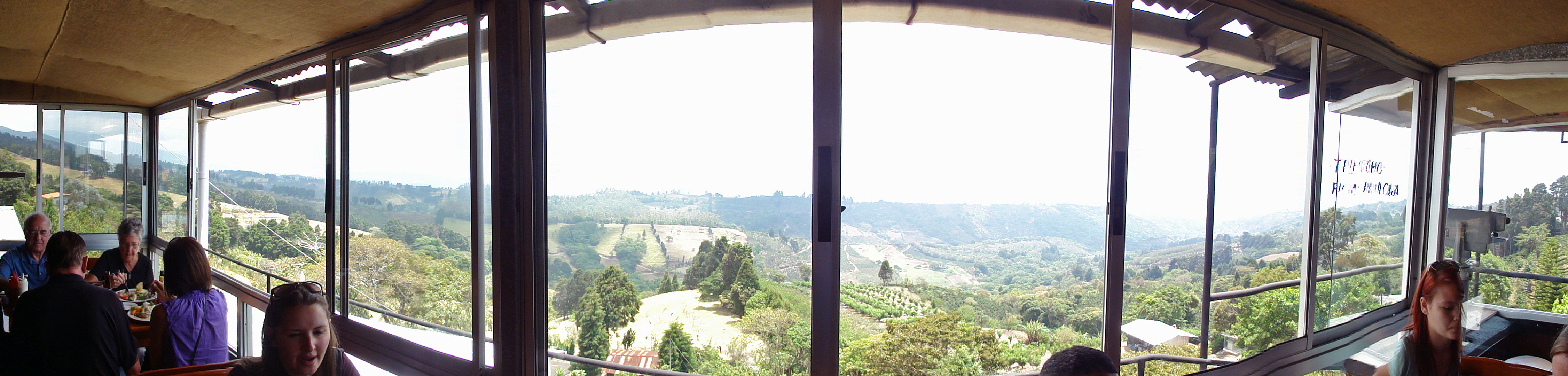
Panorama view from the mountaintop restaurant where we ate lunch overlooking the Central Valley

Panorama view from the mountaintop restaurant where we ate lunch overlooking the Central Valley. Click to enlarge.

Today was spent driving through the mountains and seeing a couple of small communities on the way to the airport hotel. We really gave the gears of the van a good workout. The road was windy, with traffic coming to a full stop several times, including one long stop due to a traffic accident. But the air was cool enough to turn off the van’s AC and open the windows. This was maybe the first day in Costa Rica when I wasn’t covered in sweat from the moment of walking out the door – even at midday I was pretty comfortable.

Gardens outside church in village of Zarcero.

Gardens outside church in village of Zarcero.

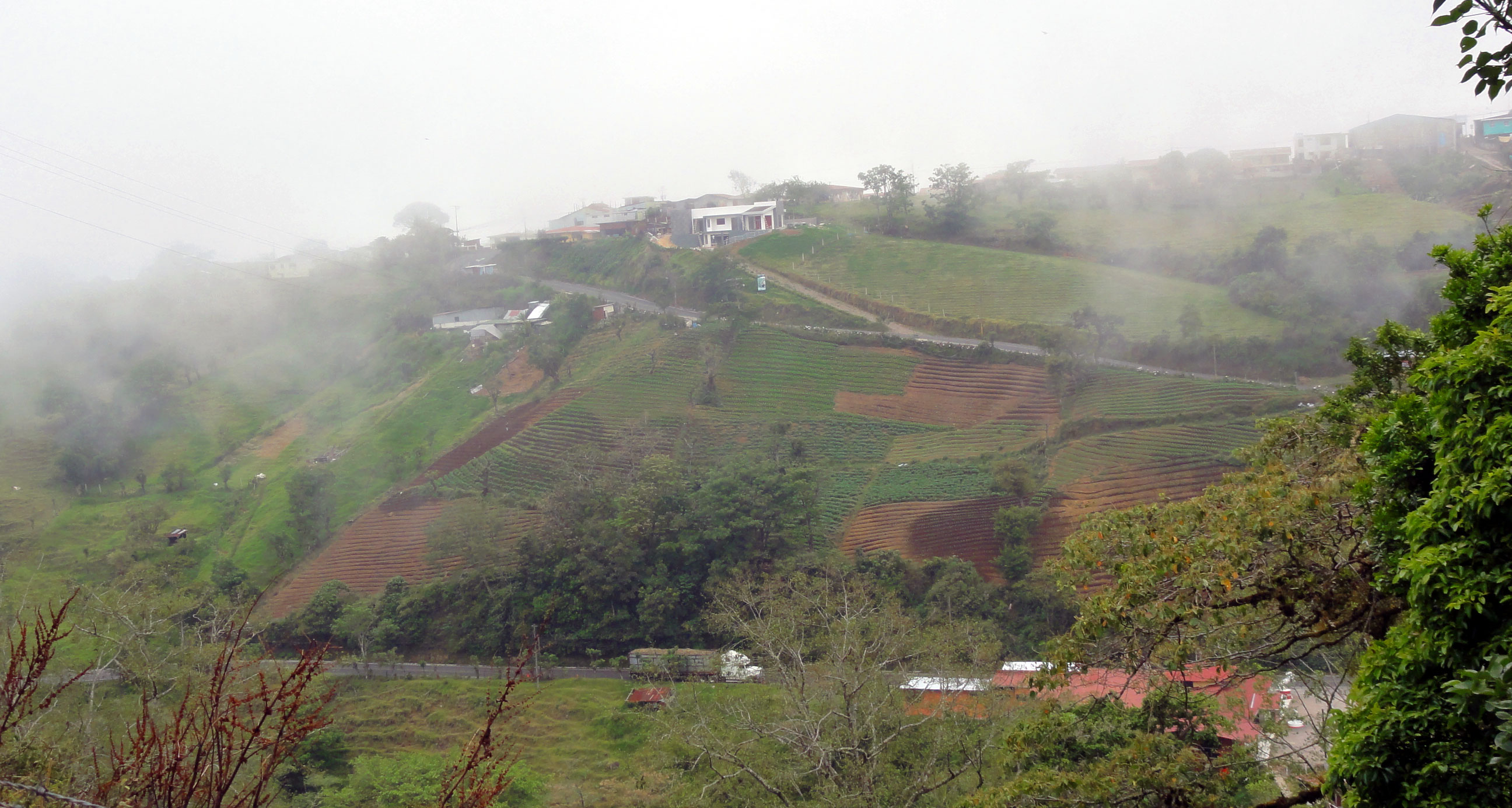
The view was gorgeous the entire trip. We saw several hills covered with coffee plants or terraced with cabbage. We also passed lots of trucks loaded with sugar cane, as well as a former sugar cane factory that is now a milk factory. This made me wonder if they pasteurize the milk in Costa Rica.  Obviously they didn’t at Laureles Farm – they drink it straight from the cow.  But probably the milk sold in stores is pasteurized. It also makes me wonder if Costa Rica has large dairy farms with industrial practices as in the U.S. or if most of the milk is sold to the factory from small or organic farms. In fact this whole trip has made me wonder how the representative the animal welfare practices I saw at Earth and the home stay farms are of the rest of the country. Our guide Mario discussed this a lot when it came to organic vs nonorganic crops such as bananas but we didn’t really touch on this regarding animal husbandry or welfare practices. It’s also telling that the students on the trip had never seen the word husbandry applied to animal care because in the U.S. it’s all about animal science.

Wedding in progress in Zarcero

Wedding in progress in Zarcero

While we were driving through the mountains, the resident director Paul told us that back in the 70s, McDonald’s had deforested thousands and thousands of hectares in the area to create room for beef cattle to graze. This is an area where trees grow very slowly, and it has still not recovered. We did see lots of small groups of cattle grazing – some of them balanced in very precarious spots on the side of mountains. It made me wonder if many of the lose their footing and go tumbling down. They are such large animals with such small legs to support their weight, and clearly were not designed to graze on the sides of mountains the way, say, mountain goats are. I also tried to imagine what the area must have looked like covered in virgin forest.  Some of it probably would have been cut down to make way for towns and such, but not nearly as much as to graze cattle.  This damage to the mountain forests in Costa Rica a generation ago may be part of why the country has such a strong environmental mindset now.

Deforestation and other land use changes are a major contributor to climate change – not as much as fossil fuels but definitely a major factor that also needs to be addressed. I feel like industrial farming as it has been practiced in my lifetime has been part of the problem, but farming could also be part of the solution if it is done with an eye toward keeping carbon in the ground. The kinds of farming practices we are seeing in Costa Rica definitely help contribute to the solution. I feel like research in this area is just beginning, but it can’t be done fast enough.

View from the mountains.  Note the terraced agriculture and full sugar cane truck in the road below us.

View from the mountains. Note the terraced agriculture and full sugar cane truck in the road below us. Click to enlarge.

The earth evolved with certain areas to be used in certain ways – whether grazing millions of hooved animals such as in the great plains of North America or boasting loads of biodiversity in jungles and forest as in Costa Rica. If humans are to become caretakers of the earth and not destroyers, we will have to learn to live in harmony with what the earth itself has evolved to do, even if it is somewhat turned toward our own purposes. That means while we might be grazing cattle in Nebraska where millions of wild bison used to roam, we need to keep forest to act as the lungs of the planet and host the biodiversity that strengthens the web of life — and not coincidentally provides many of our healing products. What is good for the planet is in the end good for us, and vice versa. We can either accept this and live within the planetary boundaries, or we can go extinct and take a bunch of other life forms with us.

Unfortunately after McDonalds and the other large corporations were done with Costa Rica, they moved on deforesting the Amazon rainforest in Brazil. For many years the problem has been acute, with many football fields of forest disappearing daily.  After 2004 rate of deforestation had been declining, but recently it has gone back up. It can be dangerous for environmental activists to try to stop this. A nun from Dayton named Dorothy Stang was murdered in 2005 for just this kind of work in Brazil because there is a lot of money to be made in selling off the rainforest for cattle ranches. Hundreds of environmental activists are killed each year in various places around the world. We must find a way to make preserving the planet as it was meant to be more profitable than liquidating it like a going out of business sale.

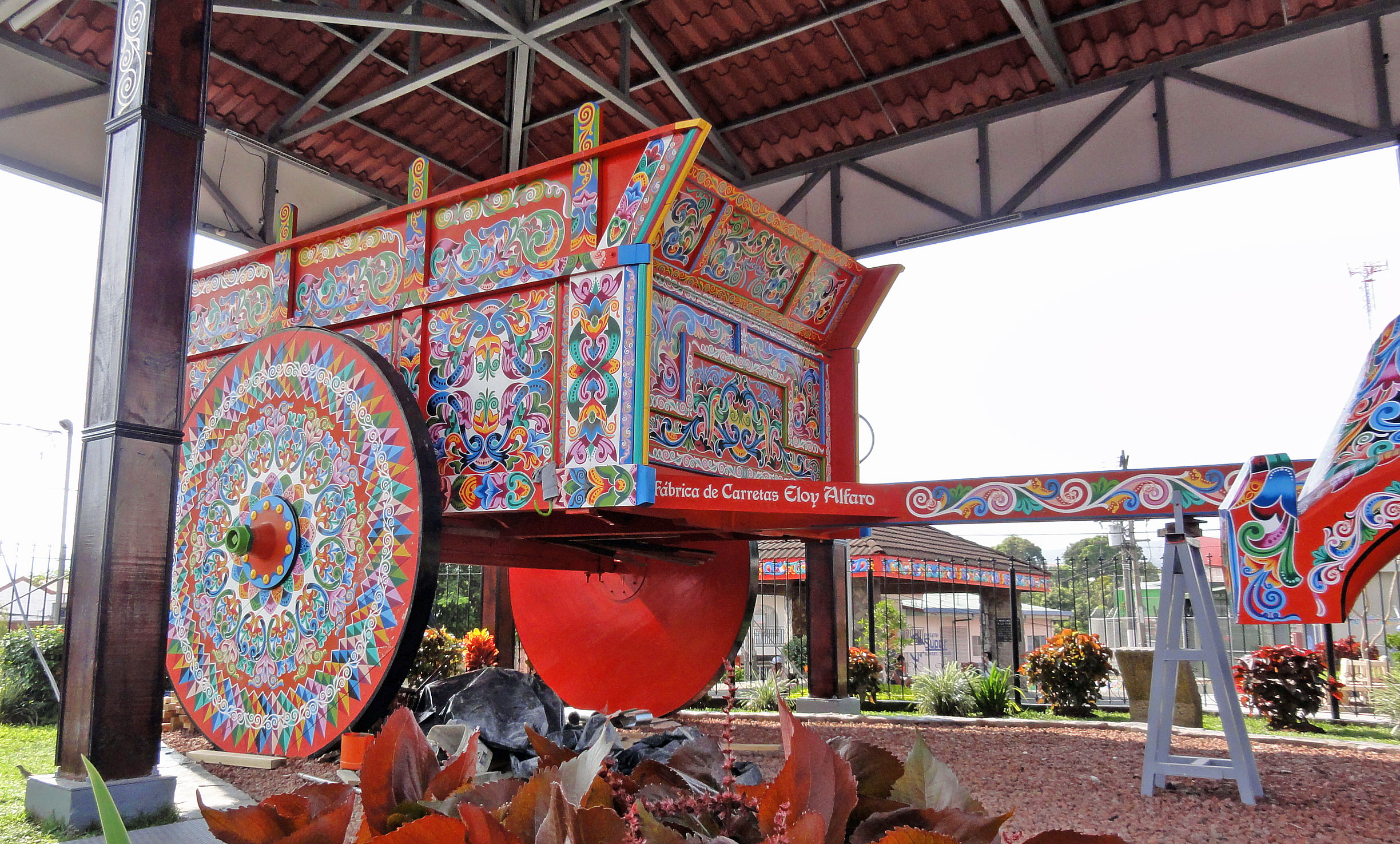
Biggest ox cart in the world in Sarchi.

Biggest ox cart in the world in Sarchi.

The two communities we saw were very relaxing. At Zarcero we stumbled on a wedding in progress at the town church which was really neat. The gardens at that church are famous and tended to by hand by a longtime volunteer.  In exploring the town I wandered into what looked like a small business version on PetSmart or Tractor Supply – the store was full of animal feed, boots, bird houses, medicines, saddle gear, and pretty much any animal paraphernalia you might need.  In Sarchi we took a group picture at the largest ox cart in the world, which took four years to build, then visited shops owned by the guy who made the cart. We saw where the workers hand paint the wood items sold in the store. I got a great inchworm puzzle with the alphabet on it for my nephew in Scotland, and a 3D cat puzzle and CD of Costa Rican music for my husband.


Group photo near the ox cart.

Group photo near the ox cart.

Costa Rica – Day 7 – End of home stay, ecolodge, hot springs

Our group with the Laureles farm family.  From left to right: Becca, Leesha, Fernando, Lidia, Carla, me, and the Laureles grandson in sunglasses in front.

Our group with the Laureles farm family. From left to right: Becca, Leesha, Fernando, Lidia, Carla, me, and the Laureles grandson in sunglasses in front.

My preparations the night before paid off, as I slept really soundly and not worrying about bugs. The whole thing with the dogs must have bothered me more than I thought because I dreamed that I was walking by a busy street in back of the UNC campus (where I did my undergrad) and found two dogs in different places who had been hit by cars and were lying by the road with broken legs. In the dream I scooped them up and was taking them to get medical care when I woke up.

A howler monkey brought her baby out to see us.

A howler monkey brought her baby out to see us.

I got up before dawn, and three of us (Carla, Leesha, and me) went to watch the sun rise over the farm. Just as at the beach at Tortuguero, the sun didn’t come up in a ball like we are used to seeing at home. It just got light. Fernando’s cattle were mostly sitting down (which cattle here seem to do a lot) or grazing peacefully. Leesha tried to make friends with one of their horses in the pasture, but he was shy and didn’t want to get too close. On the way back we stopped by the howler monkey trees again. The monkeys had been very active just before dawn howling to greet it. They were still active getting their breakfast when we stopped by the trees. We probably watched them for a half hour. At first they hid, but after a bit a few came out where we could see them, including a mom with a baby on her back. She sat watching us for a long time, and I got a ton of pics.

Fernando showed Carla how to milk a cow.

Fernando showed Carla how to milk a cow.

Then we went back to the farm where we got to help Fernando milk the cow. That was fun – Leesha was a natural, and I got the hang of it but am glad I don’t have to do it every morning. Fernando put the calf into a separate enclosure while we got a bucket full of milk. When we were done, he let out the calf, who made a beeline for his mom. I’m glad they let the calf stay with the mom.  The mother-offspring bond is the strongest in nature, and to talk the calf away so that we can take the milk does not seem right. It was enough to make me switch mainly to almond milk, though it’s hard to avoid dairy entirely. While we were milking the cow with Fernando, Lidia came out with a glass that we filled up straight from the cow. She then used that to make some of the very best pancakes I have ever eaten, which we had along with eggs, juice, and of course rice and beans.

<Optional thoughts about the book I was reading>

While the rest of the group walked for a swim at a river spot with difficult access, I got some reading done in This Changes Everything. Naomi Klein makes the case that climate change will require us to abandon unregulated free market capitalism to enact the collective solutions needed to address carbon emissions. She thinks it is a great opportunity to reshape human relations to be more just, equitable and fair, to enact protections for workers and poor people around the world.

It’s a compelling argument, but I’ve also read some interesting critiques. Basically the critiques say Klein was anti-capitalism before she started writing about climate change – she wrote about clothing factory workers in South America and about disaster opportunism, in which big companies use the opportunity of a disaster to make a windfall profit. The critiques think her current book is more of the same vein, and that she doesn’t give enough credit to some of the market solutions being proposed such as a price on carbon.

Klein says we need a mass social movement to force governments to take the steps needed to address climate change. I agree with that, but I think we need market solutions too. A carbon tax, preferably with the proceeds being returned equitably to everyone in the form of dividend checks or tax cuts as proposed by Citizens Climate Lobby, is a must. Klein thinks this idea is okay but not nearly enough. I think it’s just a start too, but it’s a vital one. We have to disincentivize fossil fuels and incentivize renewables if we want people to make the switch.

Klein seems to talk mostly about mass movements but decentralized control with communities taking charge of their own energy, transit and food systems. I would love to see that, and mass movements are important. That’s what stopped the Keystone pipeline, which is of huge symbolic value, and having participated with the Sierra Club in the People’s Climate March in New York City, I feel like the march helped provide immediacy and momentum to the UN talks that week.  It was shortly after that when Obama announced the first-ever agreement with China to lower emissions. Of course none of this is enough and the work is not done, but you have to start somewhere.

This year will be huge for climate agreements leading up to the talks in Paris in December where everyone is hoping for the first time to get a binding agreement across all nations. That will be a tall order. Klein is right that social movements will make a huge difference in the climate debates, and she is right that control needs to come down to the local level.

I’m pleased to live in Columbus, which has a very ambitious green plan.  But this leads to my critique of Klein’s focus on social movements.  As important as they are, in the end it is governments, whether local state or national, that will decide if, when, and how we address climate change.  This is why I’m studying public policy. I’m not exactly sure where this course of study will lead, but climate change is the most important issue not just in my lifetime but maybe in of all human civilization, and I want to be in a place where I can help address it.

<End of thoughts about the book and back to the trip>

Becca made friends with a rescued deer fawn.

Becca made friends with a rescued deer fawn.

So most of Friday afternoon was spent on the bus driving to the Villa Finca Tina ecolodge in the mountains, then to the Baldi hot springs. I’m pretty sure this will get changed up next year, since we didn’t make it to the hot springs until after 9 p.m. so had less than an hour. They were absolutely amazing though, as was the lodge which had several rescued orphan deer and even planted special grasses for the deer to eat.

In Ohio it is against the law to rescue orphan deer. I understand about wildlife rehabilitation needing to be licensed, but we should allow people who care – and most people do – to help animals that need help. Even if those orphans go to a sanctuary to live out their lives, that’s better than being killed just because they were unlucky enough to lose their mother. In one case, a police officer and his wife rescued an orphan deer whose mother had been hit by a car.  When the authorities came and take it, the couple claimed the deer had escaped the day before and showed their torn screen door. In reality I’m thinking they probably found a sanctuary out of state to take the deer.

It’s a ways until retirement, but it liked the ecolodge area and hot springs so much, I would give serious consideration to retiring there. The community seemed to have a lot of natural healing practitioners, and as of now it’s affordable. I’ll have to come back with my husband and investigate this idea more thoroughly before making any decisions, but this is now a possibility on the list.

Reacting to Zhao et al

This is a reaction to readings in ENR 8150 Advanced Environment, Risk, and Decision Making. The reading was Zhao, X., Rolfe-Redding, J., and Kotcher, J. E., Partisan differences in the relationship between newspaper coverage and concern over global warming (Public Understanding of Science, 2014).

This week’s readings fall directly into my area of interest for this class and research on climate change communication more generally. I’ve written two term papers on topics related to motivated reasoning about climate change, and still find the topic fascinating. I also can’t seem to stay out of a climate change debate group on Facebook where you can see it in action. It’s a living laboratory for these concepts if there ever was one.

Criticisms

First, a few criticisms / observations about the Zhao study. Zhao mentions this at the end, but by limiting the media analysis to four mainstream newspapers, that misses a lot. Part of his thesis is that people are selective in the media they seek out so that it reinforces opinions they already hold. I have absolutely found this to be the case with climate change.

Last semester in Eric Toman’s class, one assignment was to interview three people on their opinions about climate change, much as if we were researchers doing a study like this. I interviewed three people at a cafeteria where I often go to eat. One woman was an absolute denier who thinks climate change is a hoax, and I talked with her for over an hour. She ended up showing me all the sources where she gets her news. She said that if you weren’t online, then you were missing everything, and all her sources were highly partisan news sites. Forget Fox News or WSJ – I hadn’t even heard of most of the sites she showed me, but they were clearly very popular among climate deniers. I’ve found similar results in the climate change debate group. The deniers won’t accept certain news sources at all — for example, that hate hate hate Skeptical Science, but they love Breitbart, Watts Up With That, and other partisan outlets.

The point is that there is a whole world of partisan news sources on the denier side, and maybe equally as many on the climate side, though it is hard for me to treat the two sides as equal, since one has the weight of science behind it and the other does not. However, there are lots of pro-climate science sites such as Climate Progress, Climate Reality, Skeptical Science, etc. I wouldn’t know how to do a study that took all these various outlets into account unless you picked a few to represent each side, or you simply asked people what they read online. However, online news is certainly worth looking at regarding an issue that has become as politically polarized as climate change, as both sides tend to seek out more detailed news online than they will ever get from mainstream media.

Another observation I had about the Zhao study is that it was of news coverage and public opinion on climate change in 2006, which is almost 10 years ago now, and a LOT has happened since then. For one thing, the countermovement of front groups and foundations didn’t really kick into full gear until 2009 when the cap and trade proposal was in front of the U.S. Congress — and since then they have been spending $1 billion a year in climate change denial, most of it in untraceable dark money (Brulle, 2013). If things were partisan back in 2006, imagine how partisan they are now!

A third point has to do with how the study measured concern about climage change. All the questions in the GSS survey were about what is happening in the Arctic region to polar bears and such. But as this class has repeatedly demonstrated, the distance affect is very real, and it’s hard for peole to get excited about something so far away. That alone could skew results about how concerned people are about climate change.

More news, less concern

Now, regarding Zhao’s findings. One thing he finds is that as news coverage increases, concern with climate change increases among Democrats but decreases among Republicans. That is very interesting and goes along with Kahan’s cultural cognition findings that deniers and dismissives actually know as much or more about climate change as people who are concerned. It’s counterintuitive, but these findings are pretty consistent.

The question is, what do we do about it? News outlets can’t exactly stop covering climate change in the hopes that the deniers will come around. They won’t. On the contrary, mainstream news outlets do not cover climate change enough. If we want to talk about agenda setting, the lack of coverage of climate change as opposed to issues like ISIS, immigration, and Obamacare may be part of why most middle Americans don’t see it as important.

This finding can help people who want to communicate the importance of climate change to a broad audience in one way, however. Several times in this class we have talked about how people can couch climate change in other issues such as public health, jobs creation, or national security. This finding reinforces that point. Climate change is multi-dimensional and affects everything, so we can talk about those specific affects more than whether climate change is happening and if it is caused by humans.

I’ve come to several points of agreement with members of the opposition in the debate group in this manner, even if we have different reasons for agreeing. For example, one guy and I agreed that it’s useful for the military to employ solar power, even if I said they are doing it because they take the threat of climate change seriously while he said they are doing it to become less vulnerable to attacks on oil caravans in conflict zones. There is no reason both of these statements can’t be true.

Another very interesting finding in the Zhao study is that people on both sides became more concerned when presented with stories that discussed scientific uncertainty and did not refute it. How can this be? My guess is, people like certainty, but for different reasons. Some people like to be told what to think, while others like to rebel against accepted opinion. Being told scientific opinion is uncertain makes people want to pin it down, which causes them to get engaged in the issue.

Responding to opposition

A third finding that I thought was interesting was about when partisans swung into action to get their side across. Zhao et al found this happened when they thought opposition news sources were publishing too many stories about climate change. The content of those stories didn’t matter — it was the fact that a news outlet on the other side had published them at all, and partisans felt this meant the stories had to be countered.

I am sure this effect is real because I’ve been in groups where this happened and people were asked to go make comments on the story or social media post in question. The point wasn’t so much what the story said, though it usually actually is slanted in the way people think it will be from simple heuristics. However, this pheonomen is another reason for looking at outlets beyond mainstream media that are truly partisan about climate change.

One reason I think debate groups like the climate change one I’ve been participating in and other such groups are popular is that people feel the need to get their points of view out. They don’t expect to convince the other side of anything, but they do think if someone who is undecided or less partisan is reading, then the “correct” point of view needs to be visible. This is also why some vested interests actually hire people to make comments on news stories and social media posts. They want to steer the conversation in a certain way, and they are willing to pay for it. The phenomenon is so prevalent that it has its own vocabulary: astroturfing by sockpuppets. (More here, here and here.)

I would love to see an update of the Zhao study that takes internet news sources into account, as well as the conversation among people who engage in comments on news stories and social media. We are beyond passive intake of newspapers and into an era where just as much if not more of the action happens online. In the climate change debate group, someone makes a post, usually a news story or blog entry that showcases their own opinion, probably once every 10 minutes, and most posts get dozens if not hundreds of comments. We can dismiss all of this as so much noise, but it’s also indicative of the conversation, a living laboratory. Why not take advantage of it?