‘The Audible Annals of Abudan’

Source: Ethnic ChinaLit (5/25/25)
Synopsis: “The Audible Annals of Abudan” (梗概:《凿空)
By Bruce Humes

A colleague and I have just completed translation of a novel set in turn-of-the-century Xinjiang. Given that precious little writing is coming out of the region these days — and that this is a moving novel that captures the poverty and impact of state-driven modernization on a village there populated by Turkic Muslims and their uppity donkeys — readers might enjoy our synopsis of the novel below.–Bruce Humes

Synopsis: The Audible Annals of Abudan
(Based on the Chinese novel by Liu Liangcheng)

Within your lifetime,
many things will disappear before your eyes.
Only those you yearn for wont arrive. — Imam Ghupur

At high noon, a harsh burning sun hangs above Qiuci’s Old Town Bazaar in southern Xinjiang. On the congested bridge, a driver honks his horn furiously at an oncoming donkey cart. As if on cue, what seems like ten thousand donkeys commence braying in unison. The riverbed is instantly engulfed by deafening hee-haws.

Sirens blaring, the People’s Armed Police swoop down and order the cart owners to silence their beasts, or else. But as the chorus of furry vocalists converges in the sky and then plummets back to earth, no owner dares rein in his donkey.

What led to this ear-shattering mob action? Has the foreigner’s Mad Donkey Disease gone viral on Chinese soil? Could the donkeys have learned of their doomsday? Was it a toxic combination of the scorching sun, overcrowding and the piercing sirens? Or was it instigated by Elqem, the Donkey Master of Abudan?

The Party Secretary wants to get to the bottom of this “mass incident” — any leading cadre’s nightmare — and quick.

The investigators zero in on Abudan, where the Turkic villagers are accustomed to their hardscrabble lifestyle on the fringes of the vast Taklamakan Desert, once the ancient Buddhist kingdom of Qiuci before Islam arrived one thousand years ago. Continue reading ‘The Audible Annals of Abudan’

Translating Yu Hua’s ‘City of Fiction’

Source: World Literature Today (May 15, 2025)
Answering New Questions: Translating Yu Hua’s City of Fiction
By Todd Foley

Here form is content, content is form.
—Samuel Beckett on Finnegan’s Wake

On April 8, 2025, Europa Editions published City of Fiction, the English translation of Yu Hua’s complex novel containing elements of epic adventure, romance, and family saga, set against the backdrop of the intense social and cultural development of China’s early twentieth-century history. In this essay, translator Todd Foley discusses his choices, some of which resist conforming to more standard editorial expectations.

The vast distance between English and Chinese makes the question of translating voice and style especially fraught. When a Chinese text is dismantled and rebuilt in English, how should it sound? What are the rules for its reconstruction? For all that has been written on the theory of translation, there is no clear answer, as the gold standard of “faithfulness” proves to always be relative: “faithful” to what? Every translation, as it takes shape from the idiosyncratic relationship between the original text and the translator’s feeling of it (which is, of course, always socially and historically contingent), poses these questions anew.

City of Fiction presented me with some new questions of style and voice I did not expect from Yu Hua. Following his impeccably executed avant-garde modernism of the 1980s, Yu Hua’s novels of the past three decades have all been characterized by brisk, rollicking narratives that critically examine recent Chinese history up through his contemporary moment. His energetic style is typically full of fecal matter, blood, guts, and misogynistic sexuality, which all paradoxically coheres around an incisive and tear-jerking social allegory—which itself is merely the first step toward the more serious philosophical tensions his works explore. Continue reading Translating Yu Hua’s ‘City of Fiction’

5th Int’l Conference on Chinese Translation History–cfp

The International Conference on Chinese Translation History series, organized by the Research Centre for Translation (RCT), The Chinese University of Hong Kong, explores Chinese translation history within the bigger framework of world civilization and human thought. It aims to lay groundwork for new models, methods, and perspectives in this innovative interdisciplinary branch of learning through detailed case studies. Since 2015, the conference series have been held every two years, with a different central theme for every conference. The fifth conference focuses on the broad spectrum of issues pertaining to the concept of text and context in Chinese translation history.

Since the Cultural Turn in the 1980s, Translation Studies has shifted from a traditional prescriptive paradigm to one that examines the social, historical, and cultural factors influencing translation activities. As Susan Bassnett and Andre Lefevere pointed out in Translation, History and Culture (1990), translation is not merely a linguistic matter; instead, there is always a context in which the translation takes place, always a history from which a text emerges and into which a text is transposed. This international conference invites scholars to explore the theme of “Text and Context”, focusing on various case studies to investigate the internal elements of translated texts and the contexts in which they are generated, circulated, and received. It aims to examine the influence of ideologies, poetics, and politics on translated texts and contexts, thereby showcasing the complexity and diversity of translation history.

Participants may attend the conference as individuals or members of a panel up to three.

Submission procedures: Please email the completed application form (click here) with an abstract of your paper/panel (no more than 250 words) to RCT (translationhistory@cuhk.edu.hk) on or before 15 August 2025. For panels, please also submit one abstract for each individual paper. All abstracts will be reviewed by the Conference Academic Committee. Notifications of acceptance will be sent out before 31 August 2025. Continue reading 5th Int’l Conference on Chinese Translation History–cfp

Cold Window Newsletter no. 6

Source:  The Cold Window Newsletter 6 (2025)
By Andrew Rule

Welcome back to the Cold Window Newsletter! In this issue: a first foray into the world of Chinese internet literature, kicking off a column that will be running through several issues of this newsletter throughout 2025; and short fiction from the margins of Southern China.

A note on numbering: this is the third issue of the newsletter published on Paper Republic, but it is the sixth full-length issue overall. I’ve also begun writing shorter features between main issues that will not be cross-posted here, so if you want to receive the interim feature that will be coming out later this month, make sure to visit the newsletter’s main page on Substack.

Guide: Thirteen ways of looking at Chinese internet literature (1-2)

When we write about Chinese fiction in English, we have a tendency to draw a clear line between translated literary fiction (serious, challenging, widely acclaimed but little read) and translated popular fiction (addictive, commercial, devoured in private by millions but rarely acknowledged by the literary establishment). Despite the warmth and open-mindedness of readers on the literary fiction side, and despite the explosive growth of translation websites and fan communities on the popular fiction side, this divide has persisted. But, in my view, as long as you’re only reading work from one side of the divide, you’re missing out on a huge swath of the creativity, diversity, and insight that Chinese fiction can offer. Continue reading Cold Window Newsletter no. 6

City of Fiction

City of Fiction, by Yu Hua
Europa Editions
2025, pp. 432, Hardcover
ISBN: 9798889660934
Translated by Todd Foley

A story of love, blood and dreams, set in early 20th century China

In the early 20th century, China is a land undergoing a momentous social and cultural shift, with a thousand-year-old empire crumbling and the nation on the brink of modernity. Against this backdrop, a quiet man from the North embarks on a perilous journey to a Southern city in the grip of a savage snowstorm. He carries with him a newborn baby: he is looking for the child’s mother and a city that isn’t there.

This is a story of two people: a man who finds unexpected success after having journeyed to the hometown of the woman who abandoned him; and the woman he is searching for, who mysteriously disappeared to embark on her own eventful journey. This is a story about vanished crafts and ancient customs, about violence, love, and friendship. Above all, it’s a story about change and about storytelling itself, full of vivid characters, ranging from bandits to vengeful potentates, from prostitutes to deceitful soothsayers, and surprising twists—an epic tale, as inexorable as time itself and as gripping as a classic adventure story.

Yu Hua
Now one of China’s most beloved novelists, Yu Hua was born in Haiyan, Zhejiang province, in 1960, and grew up in and around a hospital where his parents were both doctors. His book include the best-selling To Live (Knopf, 2003) and China in Ten Words (Anchor, 2011). He is the recipient of numerous international awards and honors, including the Italian Premio Grinzane Cavour and Giuseppe Acerbi prizes, and the French Prix Courrier International. In 2004 he was made a Chevalier de l’Ordre des Arts et des Lettres by the French government. His Paris Review Art of Fiction interview was published in 2023.

Posted by: Todd Foley <twf218@nyu.edu>

Cold Window Newsletter #5

Welcome back to the Cold Window Newsletter! In this issue: the Beijing literary collective introducing dozens of Chinese writers to the world, and two novelists from Liaoning who deserve to be translated.

A note on numbering: this issue will be the second to be posted on Paper Republic, but the fifth overall. Remember to subscribe for updates, including a shorter Substack-only issue that will be coming out in a week or two to wrap up my coverage of the Dongbei Renaissance (for now!).

Recommendation: Entering the Spittoon universe

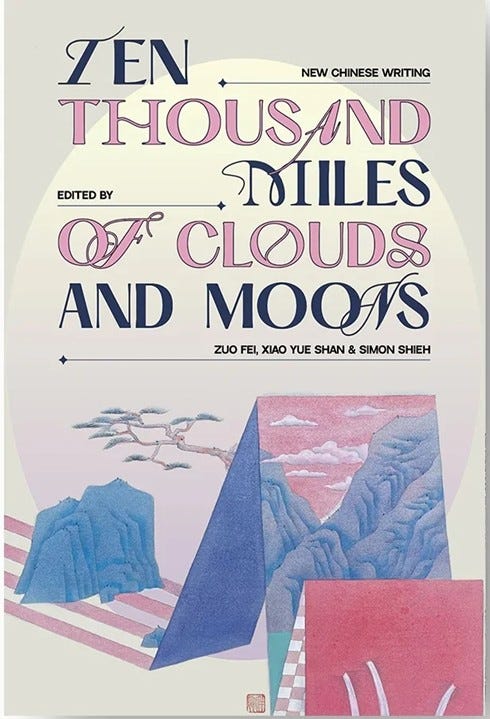
Ten Thousand Miles of Clouds and Moons: New Chinese Writing (2025)

What is Spittoon? When I first came across its website in 2022, I thought it was just a literary magazine devoted to new translations of Chinese literature. We’ve had those before—pour one out for Pathlight and Peregrine, two beloved Chinese translation magazines from the 2010s—but rarely ones that boasted the same panache and gleeful oddness of Spittoon’s biannual offerings. Later I also found that Spittoon has also hosted regular poetry and fiction nights in Beijing for over eight years; has operated at least two separate literature podcasts; and, as of this winter, has published a gorgeous new anthology of translated Chinese fiction, nonfiction, and prose called Ten Thousand Miles of Clouds and Moons: New Chinese Writing. I’ve emerged from my journey down the Spittoon rabbit hole dazed and bedazzled. Continue reading Cold Window Newsletter #5

Cold Window Newsletter 1

Paper Republic: The Cold Window Newsletter 1 (2025)
By Andrew Rule

Welcome to the first issue of the Cold Window Newsletter to be published on Paper Republic! This is the (extra-long) first installment of a new monthly collaboration that will be appearing in the Paper Republic feed each month. Read on for an introduction to the newsletter; a round-up of 2024’s most acclaimed Chinese short fiction; and profiles of two of China’s best literary suspense novelists.

Introduction: What is the Cold Window Newsletter?

I started this newsletter last fall because I wished that there were more spaces on the English-language internet dedicated to talking about Chinese-language writing that hasn’t been translated yet. For those of us who are interested in Chinese literature but do most of our reading in English, it’s hard to get a sense for what the Chinese literary world is buzzing about at any given time. And while excellent projects like Spittoon, the Leeds Center for New Chinese Writing Book Club, and Paper Republic itself can give you a snapshot of fiction from China that has already been translated into English, where can you go to hear about Chinese fiction that is still too new to be translated, or that may already have been waiting for years for the right translator to come along?

Thus was the Cold Window Newsletter born. Continue reading Cold Window Newsletter 1

Summer Translation Collaborative III

Summer Translation Collaborative III
with Julia Keblinska and Patricia Sieber
May 12-16, 2025 (May 11 arrival, May 17 departure)
The Ohio State University (Columbus, OH, U.S.A., in person)

Developing modules for the “Chinese Theater Collaborative”

Fig.1 Excerpt from “Khubilai Khan Hunting” 元世祖出獵圖 (1280, by  Liu Guandao 劉貫道, painting); Courtesy of the open-source database of the National Palace Museum, Taipei

In this week-long workshop to be held on the OSU campus, CTC co-editors Julia Keblinska and Patricia Sieber will guide a small group of participants in authoring new modules for the Chinese Theater Collaborative (CTC) digital resource center. The program will feature presentations on how to handle different texts and diverse media, hands-on module development, and spirited peer review. This year’s workshop will focus on the modern afterlives of plays featuring Eurasian peoples, diasporic communities, ethnic minorities and foreigners (e.g., Jurchen, Mongols, Manchus, tribute delegations from around Eurasia, etc.) in any media (e.g., different traditional theatrical/operatic styles, spoken drama of any tradition, films, animation, TV drama, graphic renditions, prints, etc.). The goal is to create workable draft modules that can eventually be published on CTC.

We would like to recruit a lively cohort of advanced undergraduate and graduate students as well as recent MAs and PhDs. Required qualifications: Advanced command of modern Chinese, professional fluency in spoken and written English. Experience with translation, theater or other media is desirable, but not required. We welcome participants who are interested in developing either individually authored or collaboratively written modules. CTC modules are backed by scholarly research but presented in an accessible and visually appealing style to cater to a broad range of audiences. Continue reading Summer Translation Collaborative III

Window to America

The Chinese Film Classics Project is delighted to announce the publication of Yuqian Chen and Christopher Rea’s translation of the film Window to America (Meiguo zhi chuang 美國之窗, 1952).
https://chinesefilmclassics.org/window-to-america-1952/

https://www.youtube.com/watch?v=2gtQlxBQeQo

ABOUT THE FILM:

Are current conditions in the United States of America making you want to jump out the window? Not so fast—there’s money to be made…on your death! Window-washer Charlie Kent has just finished cleaning the last window of a Wall Street skyscraper, and, now facing indefinite unemployment, plans to jump to his death from that very window on the 42nd floor. Mr. Butler, the capitalist from whose office he plans to jump, persuades Kent to stop—stop long enough to let Butler & Co. turn his suicide into a live radio spectacle and sell advertisements, ostensibly so that Kent can leave his family a legacy. Advertisers come calling, including H-Bomb Cigarettes, Maclini’s Suits, Harriman Unbreakable Glasses (“When a man jumps from the 42nd floor wearing Harriman glasses, his body may break, but the glasses won’t!”), Green Horse Whisky, Atomic Hair-growth Ointment…even the Spiritualist Society, which signs an exclusive contract for post-mortem ownership over Charlie’s soul. All the deal-making builds suspense about the do-or-die moment at which we will find out: Will he jump? And, more importantly, will we get rich? Continue reading Window to America

Paper Republic newsletter no. 20

Image description

Happy Chinese New Year!

As we usher in the Year of the Snake, this vibrant and meaningful occasion is the perfect time to celebrate the richness of Chinese culture—and what better way than through the lens of its literature?

This issue brings you a feast of publications and media showcasing the brilliance of Chinese writing in translation. From fresh releases to interviews with translators and other news, we’re thrilled to spotlight stories and voices that resonate with the spirit of this festive season. Whether you’re an avid reader or simply curious about Chinese literature, there’s plenty to explore. So, grab a cup of tea, settle in, and let’s dive into the world of Chinese storytelling together!

Read online for free

  • Yan An’s poems “Territory” and “Empty Train” (translated by Chen Du and Xisheng Chen) were published online in Flyway: Journal of Writing & Environment (Iowa State University).

Events

  • Our 9th book club on modern Chinese literature with the Open University Book Club was on 17th January. Helen Wang joined us to discuss her translation of the short story “Ying Yang Alley” (鹰扬巷) by Fan Xiaoqing (范小青). If you missed it, you can check out the recording and transcript of the event here. And keep an eye on the website as we will be doing another book club in the next few months.
  • Don’t miss this masterclass and workshop by Nicky Harman and Yan Ge on 8 March 2025 at the Leeds Centre for New Chinese Writing. Writing Lives: from China in the 1930s to Britain in the 2020s. Part 1: Presentation with Nicky Harman on Ling Shuhua and Life-Writing; Part 2: Creative Writing Workshop on Characterisation, with Yan Ge. Registration link now available here.

Continue reading Paper Republic newsletter no. 20

Soong Translation Studies award–call for entries

CALL FOR ENTRIES
The 27th Stephen C. Soong Translation Studies Memorial Awards (2024–2025)

Introduction

Stephen C. Soong (1919–1996) was a prolific writer and translator as well as an active figure in the promotion of translation education and research. To commemorate his contributions in this field, the Stephen C. Soong Translation Studies Memorial Awards were set up in 1997 by the Research Centre for Translation, The Chinese University of Hong Kong, with a donation from the Soong family. They give recognition to academics who have made contributions to original research in Chinese Translation Studies, particularly in the use of first-hand materials for historical and cultural investigations.

Entry and Nomination

RCT invites Chinese scholars or research students in mainland China, Hong Kong, Macau, Taiwan or overseas regions to participate in the 27th Stephen C. Soong Translation Studies Memorial Awards (2024–2025). General regulations are as follows:

  1. All Chinese scholars or research students affiliated to higher education/research institutes in mainland China, Hong Kong, Macau, Taiwan or overseas regions are eligible to apply.
  2. Submitted articles must be written in either Chinese or English and published in a refereed journal within the calendar year 2024. Each candidate can enter up to two articles for the Awards. The publication date, title and volume/number of the journal in which the article(s) appeared must be provided.
  3. Up to three articles are selected as winners each year. A certificate and a cheque of HK$3,000 will be awarded to each winning entry.
  4. The adjudication committee, which consists of renowned scholars in Translation Studies from Greater China, will meet in June 2025. The results will be announced in July 2025 and winners will be notified individually.
  5. Articles submitted will not be returned to the candidates.

Continue reading Soong Translation Studies award–call for entries

Paper Republic 2024 Roll Call

2024 Roll-Call of Chinese Literature in English Translation
By Jack Hargreaves, published 

‘Tis the end of 2024 (Where it’s gone? Don’t ask me.) and that means it’s time for the annual roll-call of Chinese-language literature published in English translation.

It has been a mixed year, with, on the plus side, there being more women authors published than in 2023, and just more works of fiction in general — more prizewinning works of fiction, too.

But there does seem to be less poetry. And when I say there are more works by women than there has been, the increase isn’t dramatic. In fact, you might say that this year is, on the whole, a return to business as usual after the post-Covid years — those weren’t fallow years, but they were lower yield.

Still, it’s a really exciting list of titles which includes some of my favourite reads from 2024, full-stop. I’m also confident that we’ve missed some works out, especially when it comes to poetry, so please do drop any absent titles in the comments below and we’ll make sure to add them. The same goes for any particularly glowing reviews you’ve come across, or prize announcements (we’ve mostly included winners, but please also share any shortlisted or longlisted works).

Special mentions go to translators Jennifer Feeley and Lin King for bringing us five showstoppers between them, with Mourning a Breast and Tongueless, and Taiwan TravelogueCloud Labour and book two of The Boy From Clearwater, respectively. Continue reading Paper Republic 2024 Roll Call

Six Poems by Mu Cao

MCLC Resource Center is pleased to announce publication of “Six Poems by Mu Cao,” translated by Hongwei Bao. The translations, along with the original Chinese poems, appear below and at their online home: https://u.osu.edu/mclc/online-series/mu-cao/. As previously announced on the blog, Mu Cao is a recent winner of the Prince Claus Impact Award.

Kirk Denton, MCLC
Six Poems by Mu Cao

By Mu Cao 墓草

Translated by Hongwei Bao


MCLC Resource Center Publication (Copyright December 2024)


Photo credit: Fan Popo.

[Translator’s note: The following poems are presented with Chinese version first, followed by its English translation. The dates at the end of the poems indicate when the poems were first written. The author’s and translator’s bios can be found at the end. I have opted to present all the translated lines in lower case.] 

蚂蚁

为了停留在人世间
我强暴地压抑自己
为了感觉生命的存在
我把自身和一只蚂蚁比较

我看到蚂蚁用强忍的牙齿
向野兽说话
我看到另一只冷漠的蚂蚁
带着他的技术
去远方流浪

(2006年9月11日)

ants

to survive in this world
i forcefully suppress myself
to feel the existence of my being
i imagine myself to be ants

i see an ant challenge a beast
clenching its unyielding teeth
i see another ant
take his craft
and leave, drifting in an unknown world

(September 11, 2006) Continue reading Six Poems by Mu Cao

Sino Queer Translation–cfp

Call for Papers
Sino Queer Translation: Sexualities across Languages, Cultures, and Media
Edited by Hongwei Bao and Yahia Ma

In recent years, there has been a proliferation of scholarly works examining the relationship between queerness and translation, including the translation of queer texts in different languages and the development of non-normative strategies in translation. Much of the existing work primarily focuses on translations of/between English and Indo-European languages, literatures, and cultures, including Queer Theory and Translation Studies (Brian James Baer, 2021), Queering Translation, Translating the Queer: Theory, Practice, Activism (edited by Brian James Baer and Klaus Kaindl, 2018), and Queer in Translation (edited by B. J. Epstein and Robert Gillett, 2017), Queering Modernist Translation: The Poetics of Race, Gender and Queerness (Christian Bancroft, 2021).

Despite the dominance of scholarship on translations between Indo-European languages in the field, there are some scholarly works looking at queer aspects of Chinese literature in English translation and queer translation in the context of the Sinosphere. For example, James St. Andre’s book Translating China as Cross-Identity Performance (2018) looks at the translation of Chinese texts into English and French from the eighteenth to the twentieth centuries from the perspective of cross-identity performance, using queer metaphors such as drag; Ting Guo and Jonathan Evans’ work focuses on translational and transnational queer fandom in China and queer female teen dramas in translation (Guo and Evans, 2020, 2024). Other examples include the discussion of how the concept of queer has been translated, circulated, and received in Chinese and Sinophone contexts (Song Hwee Lim 2008, 2018; Andrea Bachner 2017; Hongwei Bao 2020, 2024; Wangtaolue Guo 2021), Leo Tak-Hung Chan’s (2018) study of parodic Japanese manga versions of the Chinese classic Xiyouji 西遊記 (The Journey to the West), and Yahia Ma and Tets Kimura’s (2024) analysis of Li Kotomi’s queer novel Hitorimai /獨舞 (Solo Dance) in three languages from the perspective of self-translation, rewriting, and translingual address. Continue reading Sino Queer Translation–cfp

An Afternoon with Howard Goldblatt

Dear MCLC Community,

A few weeks ago, we held a wonderful event at San Francisco State to honor our alum, former faculty member, and pre-eminent translator of Chinese literature, Professor Howard Goldblatt. The event was entitled “Farewells and Homecomings: An Afternoon with Celebrated Translator Howard Goldblatt.” Professor Goldblatt shared stories about his time at SF State, his first trip to China in the 1980s, and his friendships with Chinese writers. The event culminated with Professor Goldblatt presenting SF State with a priceless gift. The recording of the event, along with a slideshow and more information, can now be found on our website. You can also view the recording and slideshow below.

https://mll.sfsu.edu/news/afternoon-celebrated-translator-howard-goldblatt

Happy Thanksgiving,

Frederik Green