The Post-Truth World review

Source: Taipei Times (11/4/22)
Movie review: The Post-Truth World
This glossy murder-mystery thriller offers a sharp critique of today’s sensationalist media and raises questions about the pursuit of truth
By Han Cheung / Staff reporter
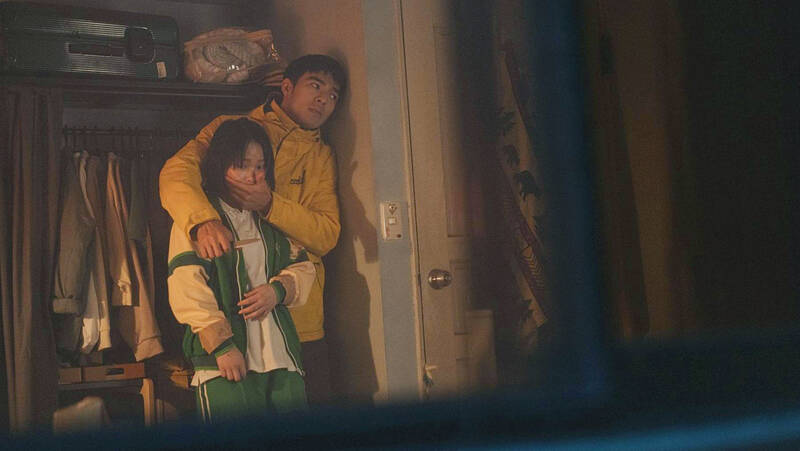
Edward Chen and Caitlin Fang star in The Post-Truth World. Photos courtesy of Vie Vision Pictures

This is the type of movie that makes people hate journalists. Not only does Chang Hsiao-chuan (張孝全) effortlessly play the stereotypical dogged, slimy reporter who discards any ethical boundaries to get a story, he habitually manipulates facts to boost online views for his floundering news program.

But the grim truth for the industry, as shown in an exaggerated manner in The Post-Truth World (罪後真相) is that clicks rule the news these days, and viewers should not entirely trust the information being presented. Neither should the journalists themselves.

This biting critique of Taiwan’s increasingly sensationalist media landscape is smartly packaged as a glossy murder-mystery thriller, boosted with celebrity cameos. It’s slick and entertaining enough, but it’s the understated complexity of the main characters that makes the film thought-provoking.

Despite his flaws and questionable behavior, Chang’s character, Brother Li-min, somehow still manages to come off as a sympathetic hero. He seems to want to do the right thing, especially at the behest of his late wife, who was an award-winning investigative journalist, but also faces immense pressure from his boss (who at the same time makes righteous comments about delivering fair and balanced news) to get views. Continue reading The Post-Truth World review

On the Video Game Genshin Impact

Source: Association for Chinese Animations Studies (9/29/22)
What is Lost Moving from “Shanzhai” to Global: On the Video Game Genshin Impact (2020)
By Yasheng She

Fig 1: Yujin performing Chinese opera on a stage

What does it take to transcend a national border to be globally recognized, and what are the responsibilities of being on the global stage? I will attempt to answer these two questions in my analysis of three incidents surrounding the open-world roleplaying game Genshin Impact (2020). While video game is distinct from animation, it relies on animation to visualize and communicate the system to the player. Beyond the technical aspects of animation, video games can leverage animation as a cultural currency to reach a broader audience. Genshin takes advantage of the Japanese animation style, or the anime-esque style, to create its global identity and elevate Chinese cultural elements to the global stage. While successfully representing Chinese culture and redefining the label “made-in-China,” Genshin fails in some aspects of embodying non-Chinese cultures. This essay argues that this failure is not only a result of the complicated entanglement between representation and appropriation but also the reality of depending on the anime-esque style to achieve global recognition. Precisely, the anime-esque style elevates any culture if it is recognizably faithful to the anime-esque conventions. Yet, it limits the extent of self-expression, especially those perceived as too alien, confusing, or too racially aware to the assumed global audience.

In 2019, Chinese developer miHoYo announced its open-world roleplaying game Genshin Impact (Genshin) and quickly attracted international attention. The game’s similarity to The Legend of Zelda – Breath of the Wild (BotW), developed and published by Japanese media conglomerate Nintendo, instigated this attention. Outcries of plagiarism and “shanzhai” were so prominent that there were recorded incidents of passionate Chinese fans destroying their game consoles in protest of the game.[1] Intriguingly, the outcries of bad faith mimicry mainly came from China, not Japan, where BotW is published. One word soon took hold of the entire discourse: “shanzhai,” a Chinese neologism for “copycat” or “fake,” that can be translated as “mountain fortress/village.”[2] Continue reading On the Video Game Genshin Impact

Lhapal Gyal on the State of Tibetan Cinema

Source: Radii (9/21/22)
Award-Winning Filmmaker Lhapal Gyal on the State of Tibetan Cinema
By Runjie Wang

A vanguard of Tibetan new wave cinema, filmmaker Pema Tseden is internationally renowned for exploring subjectivity and modernity in Tibetan culture. His oeuvre has sparked considerable interest in Tibetan cinema while paving the path for a handful of disciples, among whom tricenarian Lhapal Gyal is gaining significant recognition.

Hailing from Hainan Tibetan autonomous prefecture in Northwest China’s Qinghai province, Gyal was motivated to study film after watching Tseden’s directorial debut, The Silent Holy Stones (2005), in high school. The two eventually connected, and Tseden encouraged Gyal to immerse himself in literature, the backbone of filmmaking.

The aspiring filmmaker then gained the opportunity to cut his teeth by working as an assistant director while Tseden was filming Tharlo (2015).

Then, in 2018, Gyal made waves with his debut feature film, Wangdrak’s Rain Boots, which was selected for the Berlin International Film Festival’s Generation section (films touching on youth culture). The film also earned him the title of ‘Best Director’ at the 12th edition of the FIRST International Film Festival in 2018.

The hour-and-a-half-long film sketches out the inner world of an introverted child living in a Tibetan village and his deep desire for rain after receiving a pair of rain boots. However, the child’s yearning for rain runs in opposition to the desire of other villagers, who want clear skies for the harvest.

Wangdrak’s Rain Boots’ minimalist aesthetics and narrative, marked by a childlike innocence, are reminiscent of Iranian classics such as Abbas Kiarostami’s Where Is the Friend’s House? (1987) and Majid Majidi’s Children of Heaven (1997).

More on: https://radii.co/article/lhapal-gyal-tibetan-cinema

Posted by: Roderic Wang <rodericwang@gmail.com>

Diversifying Tibetan Cinema

Source: The China Project (11/4/22)
Diversifying Tibetan cinema: Q&A with Jigme Trinley, director of ‘One and Four’
Jigme Trinley is an up-and-coming director and the son of the pioneering auteur of Tibetan cinema, Pema Tseden. We discussed what makes Tibetan films Tibetan, the creative process of making his award-winning feature debut, and his experience of “attending” international film festivals in the time of COVID.
By Amarsanaa Battulga

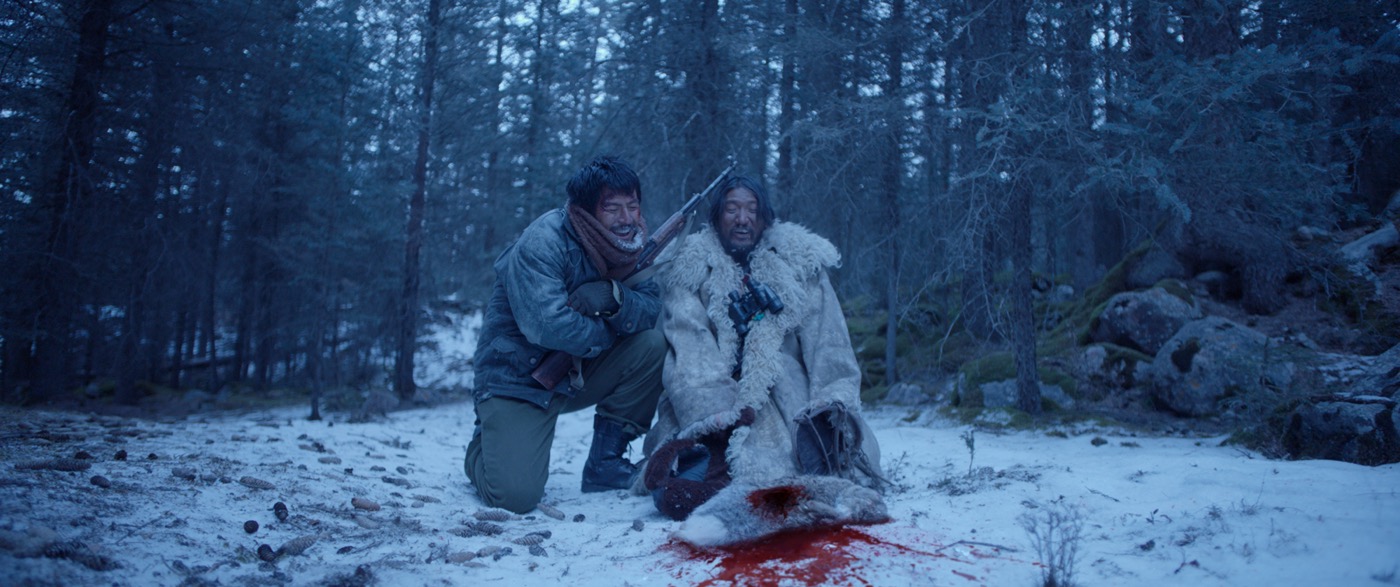
A still from “One and Four”

Jigme Trinley (久美成列 Jiǔměi Chéngliè), a 25-year-old Beijing Film Academy graduate, first appeared on the radar of Sinophone cinema when his feature debut One and Four (一个和四个 Yīgè hé sìgè) premiered at the Tokyo International Film Festival last November.

This stylish thriller defies what audiences have come to associate with Tibetan films. There are no mystical rites, no spiritual contemplation, no existential reflection — at least not explicitly. Instead, Trinley treats viewers to guns, poachers, police, and a car chase, all set on a snowy mountain and in a wooden cabin where a forest ranger is visited by strangers one after another.

Continue reading Diversifying Tibetan Cinema

The Pearl Necklace (1926)

NEW FILM TRANSLATION
The Chinese Film Classics Project is pleased to announce the publication of Christopher Rea’s translation of the silent film “The Pearl Necklace” 一串珍珠 (1926). Watch the film on the Chinese Film Classics website:

https://chinesefilmclassics.org/the-pearl-necklace-1926/ or directly on Youtube:

ABOUT THE FILM

Bling’s the thing! But, in this silent film, a wife’s ostentation gets her family into serious trouble. The Pearl Necklace (1926), also known as A String of Pearls, is famous today less for its conservative morality tale about female vanity than for two sequences of animation, in the opening credits commissioned by the Great Wall Film Company, and at minute 68, when the titular string of pearls rearrange themselves into the word 患禍 MISFORTUNE. Continue reading The Pearl Necklace (1926)

Young short-film directors win awards

Source: SCMP (11/1/22)
China’s young short-film directors are winning awards at international festivals – could this new generation of auteurs revive Chinese cinema?
Driven by freedom and ‘a sense of mission’, Chinese short-film makers are gaining international recognition with wins at film festivals from Cannes to London. This comes as Chinese feature films are flagging internationally. Does the success of these young filmmakers herald another golden era for Chinese cinema?
By

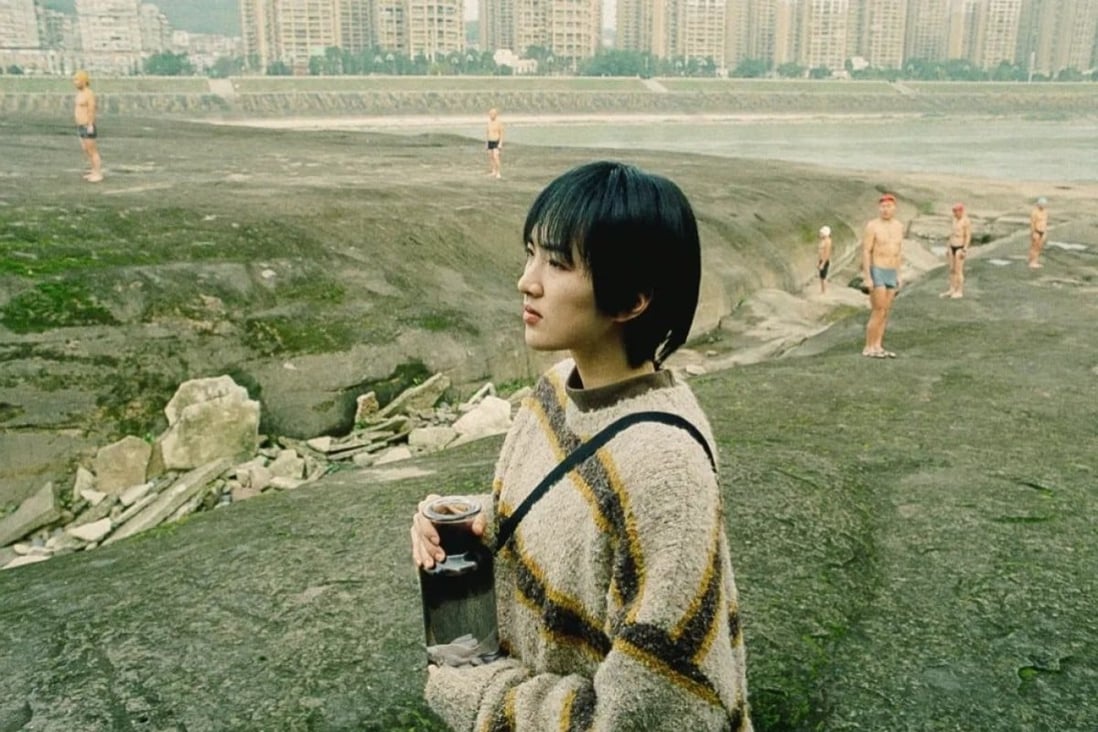
A still from The Water Murmurs, a short film directed by Chen Jianying. Chinese short films have enjoyed a recent wave of success at international festivals from Cannes to London.

A still from The Water Murmurs, a short film directed by Chen Jianying. Chinese short films have enjoyed a recent wave of success at international festivals from Cannes to London.

When Southern Afternoon, a short film directed by Chinese filmmaker Lan Tian, was awarded the Sonje Award at the Busan International Film Festival in South Korea on October 14, many thought China’s short-film industry had already had a good finish to the year.

And then three days later, another Chinese short film, I Have No Legs, And I Must Run, by Li Yue, won the Short Film Award at the London Film Festival.

It would appear that short films from China have been rushing to be crowned in recent times. The prizes for Lan and Li’s works follow several others that have made a name for themselves.

The highlight came earlier this year at the Cannes Film Festival, where three Chinese short films were recognised.

The Water Murmurs, directed by Chen Jianying, won the Short Film Palme d’Or – the festival’s highest prize for short films. Will You Look At Me, by Huang Shuli, received the first Queer Palm – awarded for brilliance in LGBT+-relevant films – given to China. Somewhere, by Li Jiahe, took second prize in La Cinef, a category for short films from film schools around the world. Continue reading Young short-film directors win awards

‘Stonewalling’ shows independent film is still kicking

Source: The China Project (10/28/22)
‘Stonewalling’ shows independent Chinese filmmaking is still kicking
“Stonewalling,” a movie about sexuality and reproduction, was filmed within China, but funded solely from outside sources. It has sidestepped domestic censors and secured international premieres. Could this be a way forward for China’s independent filmmakers?
By Maja Korbecka

Stonewalling, which just had its U.S. premiere at the New York Film Festival, is the third full-length feature directed by Huáng Jì 黄骥 and Ryuji Otsuka. The duo continues to reflect on young women’s sexuality and reproduction in contemporary China, which were also the focus of their two previous films, Egg & Stone (2012) and Foolish Bird (2017).

Huang and Otsuka began their film career in the 2000s, when an independent documentary movement swept across China thanks to the rising availability of DV cameras. Born and raised in Hunan, Huang graduated from the scriptwriting department of Beijing Film Academy in 2007. Tokyo-born Otsuka made documentaries for Japanese television before moving to China in 2005, where he joined a booming independent documentary scene. Huang Ji and Ryuji Otsuka became partners privately and professionally, their films being the cinematic offspring of their relationship. Continue reading ‘Stonewalling’ shows independent film is still kicking

Tsai Ming-liang NYC retrospective

Source: SCMP (10/26/22)
How Taiwan’s art-house film icon Tsai Ming-liang has evolved over 30 years, as New York retrospective takes deep dive into his work
One of Taiwan’s foremost directors, Tsai explains how empathy has become more important in his work and how film students need to find their own voice. He says he doesn’t want to manipulate viewers into ‘manufactured feelings’ like mainstream films do, but use a purely cinematic language that doesn’t distract.
By Daniel Eagan

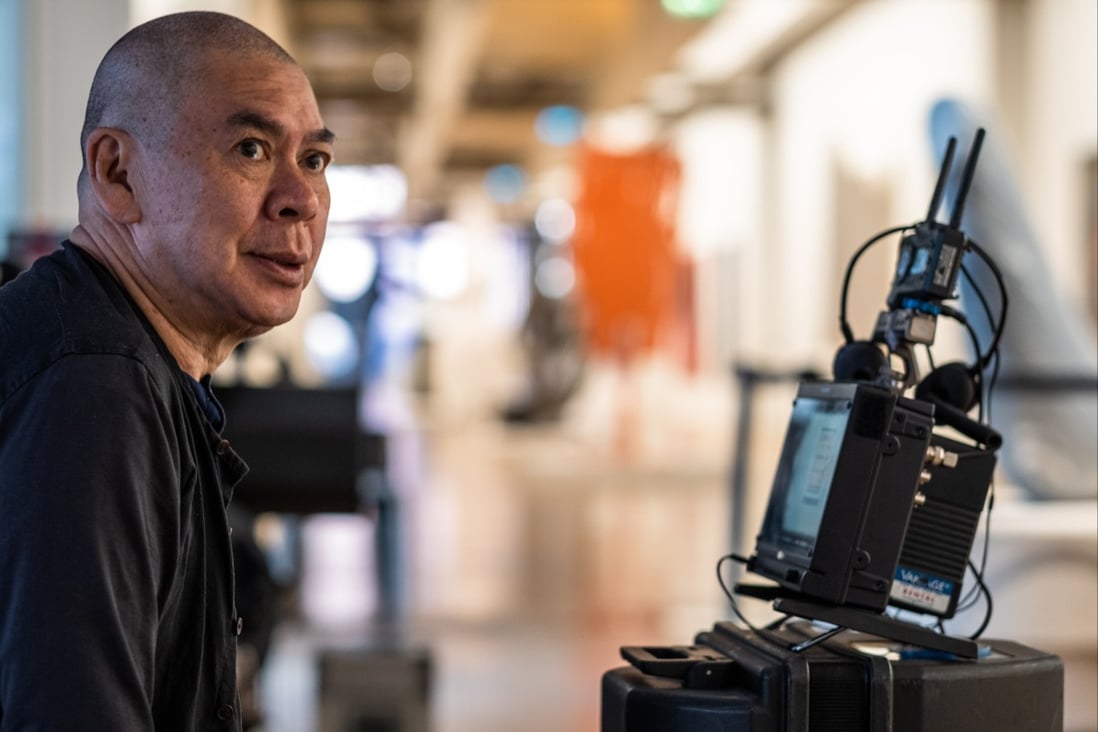
Malaysian-Taiwanese filmmaker Tsai Ming-liang moved to Taiwan in 1977 to study theatre. Photo: Claude Wang

Malaysian-Taiwanese filmmaker Tsai Ming-liang moved to Taiwan in 1977 to study theatre. Photo: Claude Wang

Thirteen years after Malaysian-Taiwanese filmmaker Tsai Ming-liang last visited the United States, a retrospective of his work kicked off at New York’s Museum of Modern Art (MoMA) – and Tsai was there to greet the audience.

Titled “Tsai Ming-Liang: In Dialogue with Time, Memory and Self”, the retrospective began on October 20 and includes 14 of Tsai’s feature films and four short films, as well as examples of his art.

It’s an opportunity to “take a big, deep dive into his body of work that lets viewers see how he has evolved over 30 years”, says La Frances Hui, curator of film at MoMA.

Tsai has been recognised as one of Taiwan’s foremost directors since his earliest films, but he playfully dismisses his influence on other filmmakers.

“Do I have that kind of impact?” he says with a laugh, via a translator. “What I tell my film students is just be yourself. Even if you have writer’s block, find your own voice. The process of creating is developing and exploring and finding yourself.” Continue reading Tsai Ming-liang NYC retrospective

The Cinema of Ann Hui–cfp

CFP: The Cinema of Ann Hui: Aesthetics, Politics, and Philosophy
Editors: Zhaoyu Zhu (University of Nottingham, Ningbo, China); Weiting Fan (Chongqing University Meishi Film Academy)

Ann Hui Oh-Wah has been one of the most important figures in Hong Kong film production since the Hong Kong New Wave. In 2020, she was awarded with the Golden Lion for Lifetime Achievement at the 77th Venice Film Festival. Except for Andrey Yue’s Ann Hui’s Song of the Exile (1990), there is rarely any book-length project dedicated to studying Hui’s cinema in the English-language academia. However, her prolific career spanning all over 40 years provides scholars with valuable resources to probe into the relationship between a filmmaker’s creativity and the vicissitudes of the Hong Kong cinema, especially in terms of the cinematic representation of Hong Kong’s diasporic communities’ experience of displacement under Hong Kong’s specific socio-political context. Indeed, as a female director, her works also inspire us to rethink the position of female filmmakers within the Chinese-language film industries and the representation of female subjectivity in Asian cinema. Besides, we also expect to invite scholars to read Hui’s works from innovative aesthetic perspectives, especially by re-appropriating non-western-centric philosophical concepts. We hope this edited collection can be a handbook for exploring Ann Hui’s oeuvre as a multifaceted entity, which further contributes to understanding Hui’s historical importance in Chinese cinemas and women’s filmmaking on the global screen. Continue reading The Cinema of Ann Hui–cfp

Hero, pandemic portmanteau film

Source: The China Project (10/14/22)
‘Hero’: China’s pandemic seen through three COVID-stricken cities
Directed by three Golden Bear-nominated Sinophone filmmakers, this anthology film proves a disappointingly tawdry fare, full of conservative messages.
By Amarsanaa Battulga

Still from Hero

Earlier this year, when the release of the pandemic-themed film Ode to the Spring, about “spring and hope,” was postponed from April to July due to stringent lockdowns across China, the irony was a bit too on the nose. But the recent release of yet another pandemic film proves that irony will never die. Hero, which celebrates “ordinary people’s extraordinary persistence in life,” was recently released amid a fresh round of lockdowns, and was followed by Beijing doubling down on its COVID-zero policy. Persistence, indeed.

For this pandemic-themed omnibus, three of the most acclaimed female directors of Sinophone cinema – Lǐ Shǎohóng 李少红 (BlushStolen Life), Joan Chen (陈冲 Chén Chōng, Xiu Xiu: The Sent-Down Girl), and Sylvia Chang (张艾嘉 Zhāng Àijiā, Love Education) — team up to make the worst film of their career. According to Douban, a popular Chinese review website similar to IMDb, Hero is the lowest-rated film for all three helmers, save for Li’s 2007 pseudo-ghost thriller The Door.

Hero opens with Li Shaohong’s Wuhan story, set in January 2020. When Shen Yue (周迅 Zhōu Xùn, Suzhou River) contracts the virus and ends up quarantining in her bedroom due to a shortage of hospital beds, the atmosphere at home gets tense. Her bad-tempered mother-in-law (许娣 Xǔ Dì) wants her as far as possible from her son and grandson, but Shen Yue’s unwary young son has no concept of social distancing and her husband (白客 Bái Kè) is sadly incapable of taking care of the boy. Continue reading Hero, pandemic portmanteau film

Untold Herstory

Source: No Man Is an Island (10/11/22)
Taiwan’s Founding Mothers?: Untold Herstory
by Jennifer Ruth

Poster for Untold Herstory.

GIVE US ART forms that tell an honest history not a whitewashed one of so-called founding fathers. If America, for example, needs more 1619 stories than it does 1776 ones, then Taiwan needs more stories about 228 and the White Terror.

thuànn Taiwan, founded by Yao Wenzhi, and director Zhou Meiling (Zero Chou) deliver with Untold Herstory 流麻溝十五號), the film that opens the Kaohsiung Film Festival on October 14th and begins its theatrical run in Taipei on October 28th. The film is based on true events and the lives of real women, as documented by Cao Qinrong in the 2012 book Liumagou No. 15: Green Island Girls Team and others. Through oral interviews with those who survived (one of the five women, Shi Shuehan, was executed), official documents from the files, and letters they sent while imprisoned, the book details the experiences of five female prisoners on Green Island in the early 1950s.

Photo credit: 湠臺灣電影 thuànn TAIWAN/Facebook

Out of this material, Untold Herstory‘s screenwriters have crafted a story about three female prisoners representative of the women targeted for “ideological reeducation” during the White Terror. Two are clearly depicted as heroes but heroes whose strategic choices are diametrically opposed: Yan Shuixia, played by Herb Hsu (徐麗雯), refuses to compromise, holding to her principles with a strength she derives from her Christian faith. Hers is a fairly uncomplicated portrait of courage. The other, Chen Ping, played by Cindy Lien (連俞涵), is the stereotype of the “collaborator,” a person willing to do anything to survive. She, too, though, is a hero, having landed in prison by offering herself up as the ringleader of a Marxist book club so as to save others and, at the “New Life Correction Center” on Green Island, continuing to use the advantages she gains by “selling out” to save lives. These two characters both protect the third main character, Kyoko (played by Yu Pei-Jen [余佩真]), a wide-eyed innocent swept up in the terror for one or another of the nonsense reasons the KMT gave at the time. Continue reading Untold Herstory

East Asian War Films–cfp

ACLA 2023 Seminar East Asian War Films–CFP
(Aaron) Feng Lan (flan@fsu.edu), Florida State University
Lily Li (lily.li47405@gmail.com), Eastern Kentucky University

East Asian War Films

The most unforgettable events marking the modern histories of East Asian countries such as China, Korea, and Japan are perhaps the series of military conflicts, ranging from civil wars to regional and world wars. These wars have profoundly affected these countries in each of their own nation-building struggles, their relations with one another, and their positions in the world. Memories of such wars, which are deeply and disturbingly entrenched in the national consciousness of these countries, have been invoked over and over again in their cultural articulations, especially films in recent decades. This seminar invites paper proposals that explore any aspects of war films produced in China, South Korea, Japan, and other East Asian regions. The term “war film” here can be construed in its broad sense: war drama, war anime, and war documentary. We particularly encourage analyses and evaluation of cinematic representations of war in transnational and comparative contexts. Possible topics may include, but are not limited to:

  • War films and history
  • War films and nationalism
  • War, memory, and trauma
  • War films and gender politics
  • War blockbusters and capital
  • War films and East Asian ethics of war
  • Aesthetics/cinematics of violence
  • Teaching East Asian war films

Deadline: October 31, 2022.
https://www.acla.org/node/add/paper

A Life in Six Chapters

My film on the writer Xiao Jun, A Life in Six Chapters, has been completed, and we are ready to take some institutional orders. Below is the trailer:

You can find an introduction and blurbs at the following: https://www.eaglewindvision.com/a-life-in-six-chapters

A Life in Six Chapters presents a visual portrait of Xiao Jun (1907-1988), a left-wing Chinese writer who befriended the literary figure Lu Xun and the political giant Mao Zedong. The film spans more than 60 years from the 1920s to the 1980s, taking a tour of China’s literary scene, and introducing renowned writers like Lu Xun, Xiao Hong, Hu Feng, Ding Ling, Nie Gannu, Ai Qing, Lao She, and more. Xiao Jun’s romances and struggles are set against the backdrop of twentieth century China, including the 14-year Sino-Japanese War, the Communist rectification campaigns, post-1949 political movements, the chaotic years of the Cultural Revolution, and, finally, the early years of the country’s opening-up. A disciple of Lu Xun, Xiao Jun tried throughout his life to hold on to his mentor’s spirit of intellectual autonomy free from political influence. Although he befriended some of the CCP’s top leaders, from Mao Zedong and Zhou Enlai to Chen Yun and Peng Zhen, he never joined the party. Even a campaign of criticism against him could not persuade him and he is remembered as one of a few Chinese writers who survived without bending to politics.

The “Educational Package” (USD$350) for the university library includes a DVD, a downloadable link to the film (with a watermark of the ordering university’s logo), and an unlimited campus screening license. Inquiry can be sent to:

eaglewindvision@gmail.com

Best,

S. Louisa Wei

‘Return to Dust’ gone from streaming sites

Source: The China Project (9/28/22)
‘Return to Dust,’ homegrown arthouse hit depicting rural life, gone from Chinese streaming sites
“Return to Dust” built buzz among Chinese moviegoers over the summer mainly through word of mouth, eventually becoming the top film at the local box office earlier this month. Now, it’s nowhere to be found on streaming services.
By Zhao Yuanyuan

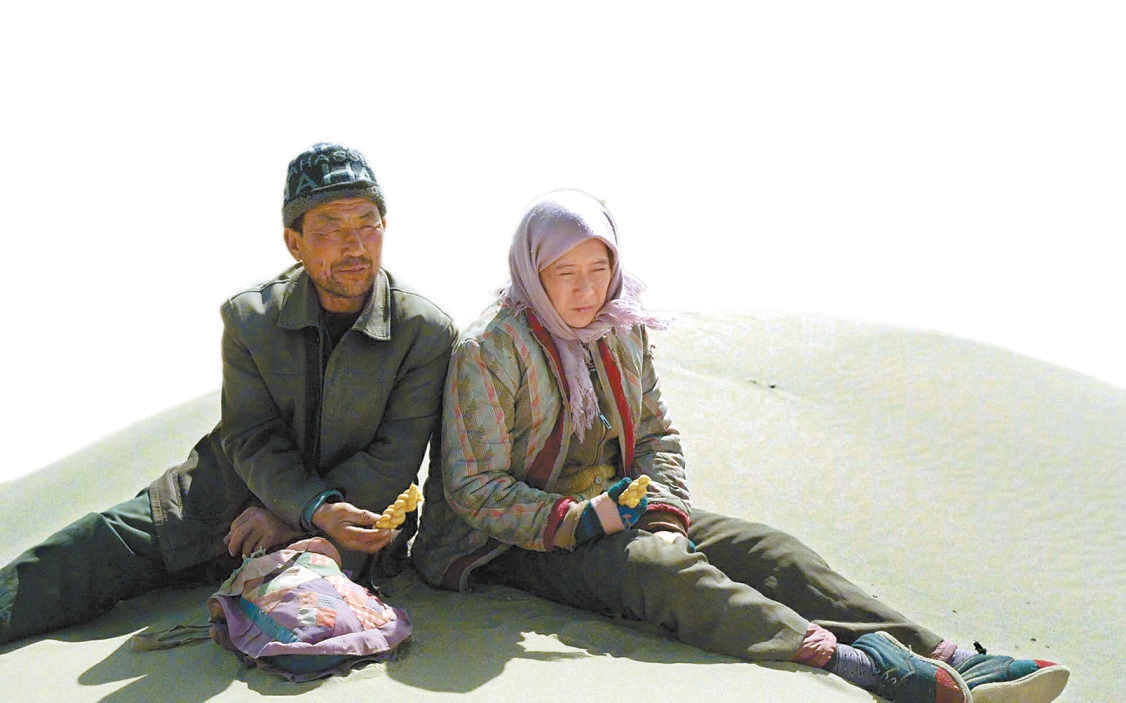
Return to Dust

Return to Dust (隐入尘烟 yǐnrùchényān), a domestically produced arthouse title that has been a surprise box-office hit in China for its realistic deception of rural life in the country, has disappeared from all Chinese streaming services, likely a result of censorship.

The issue was brought to people’s attention on Monday, when a slew of complaints surfaced on Weibo about the movie’s sudden removal from virtually all streaming sites in China, including major outlets like iQiyi, Tencent Video, and Youku. On Douban, a popular Chinese forum similar to Reddit and IMDb, short reviews seem to have been disabled, with the most recent comment time-stamped at around noon yesterday. (Although the official page of the film is still available.)

On Weibo, the hashtag #隐入尘烟# (Return to Dust) was unsearchable for a short period of time on Monday due to what the site cited as “relevant laws, regulations and policies,” which is the default explanation given for censorship of phrases on the platform. (As of the time of writing, the hashtag is viewable again.) Continue reading ‘Return to Dust’ gone from streaming sites

The Hotel

Source: The China Project (9/30/22)
‘The Hotel’: Wang Xiaoshuai returns to his roots in pandemic film
“The Hotel” was created when director Wang Xiaoshuai and his friends found themselves stuck in a Chiang Mai hotel during the onset of COVID-19. Unfortunately, the characters’ experiences will fail to resonate with the many in China who have lived through lockdown.
By Maja Korbecka

The Hotel

After 30 years of filmmaking, Wáng Xiǎoshuài 王小帅 has adapted to the changing conditions of the Chinese film industry with the same entrepreneurial energy as in the 1990s, when international film festivals recognized him as one of the most prominent young Chinese directors. He — along with his “Sixth Generation” contemporaries — was among the first to venture into independently financed film production. His latest, The Hotel, feels like a return to his roots, because once again the director worked independently of big studios, with a very low budget and in a limited timeframe.

The Hotel is a direct reflection of pandemic realities both on and off screen. It would not exist if two filmmaking families — Wang and his wife, the film producer Liú Xuán 刘璇; and producer Zhāng Yuán 张元 and his wife, the scriptwriter Níng Dài 宁岱, and their actress-director daughter Níng Yuányuán 宁元元 — had not decided to spend Chinese New Year together in Chiang Mai with a group of their friends: poet and novelist Yě Fū 野夫, model and actress Qú Yǐng 瞿颖, actress and TV host Huáng Xiǎolěi 黄小蕾, and actor and TV host Dài Jūn 戴军 — all of whom agreed to star in the film. Wang explains that shooting took only 14 days, preceded by 10 days of looking for film equipment eventually obtained from a Thai film crew that finished shooting a commercial just as Chiang Mai was going into lockdown. Continue reading The Hotel