Farmer’s execution

Source: NYT (11/15/16)
A Chinese Farmer’s Execution Shows the Pitfalls of Rapid Urbanization
By OWEN GUO

A construction site on the outskirts of Shijiazhuang in Hebei Province last month.CreditNomaan Merchant/Associated Press

BEIJING — The Chinese authorities said on Tuesday that they had executed a farmer convicted of killing a village official after the demolition of the farmer’s home, despite months of public outcry in sympathy with the farmer.

The execution of Jia Jinglong, 30, took place in Shijiazhuang, the capital of the northern province of Hebei. He was sentenced to death last November. On Tuesday, he was allowed a brief visit with his family, the state news agency Xinhua reported. Continue reading Farmer’s execution
The C-Word (1,2)

The standard Japanese pronunciation of 支那 is “Shina,” and in Cantonese it should be “Ji-naa”. I’m not sure where the pronunciation “Chee-na” is coming from.

Terry Russell <Terry.Russell@umanitoba.ca>

====================================

I wish to thank Chow Chung-yan for providing such a rational and lucid explanation to this issue.

Lily Lee <l.lee@sydney.edu.au>

====================================

The C-Word

Source: SCMP (10/30/16)
THE C-WORD: WHY HONG KONG LOCALISTS HAVE OFFENDED ALL CHINESE
Through much of its history ‘Chee-na’ was a neutral expression, but its association with Japanese aggression turned it into a taboo
By CHOW CHUNG-YAN

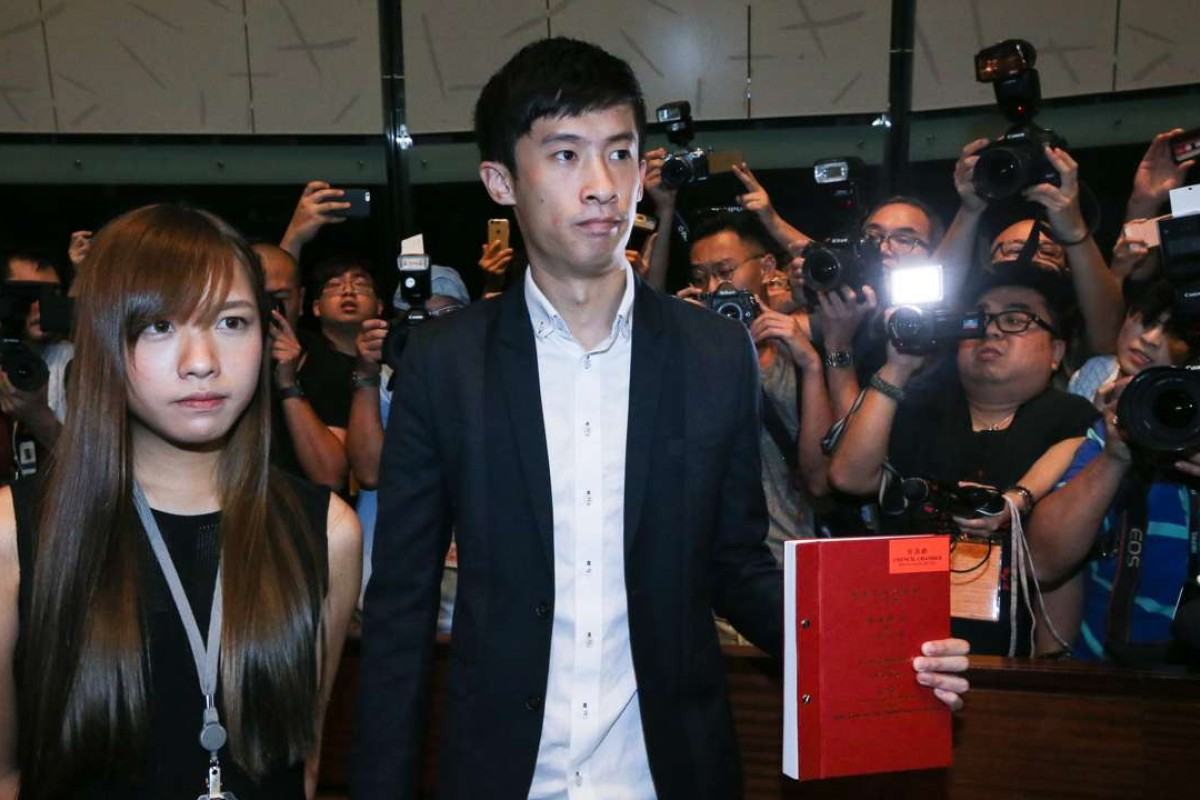
A few days after Hong Kong localists Sixtus “Baggio” Leung Chung-hang and Yau Wai-ching called China “Chee-na” during their swearing-in ceremony as the city’s newly elected legislators, Leung went on radio to defend himself.

First, he tried to pin it to his “accent”. When the radio host pointed out that he seemed to have no problem pronouncing China properly on other occasions, Leung admitted that he did use the word “Chee-na”. But he shrugged it off as nothing important or offensive. Continue reading The C-Word

HK venue cancels screening of ‘Raise the Umbrellas’

Source: Sinosphere, NYT (11/10/16)
Hong Kong Venue Cancels Screening of Protest Film, Citing Political Concerns
By DIDI KIRSTEN TATLOW

A pro-democracy demonstrator shrouded in tear gas near Hong Kong’s government headquarters in September 2014. An educational group in the city has called off a screening of a film about the protests.CreditXaume Olleros/Agence France-Presse — Getty Images

BEIJING — The filmmaker Evans Chan was delighted when an educational center in Hong Kong agreed to screen his new documentary about the Umbrella Movement, the pro-democracy demonstrations that convulsed the city in 2014.

But then, two weeks before the event, scheduled for Tuesday, the Hong Kong Center of the Asia Society canceled the screening of the film, “Raise the Umbrellas,” citing political concerns. Mr. Chan, who is from Hong Kong, said he was disappointed but not entirely surprised. Continue reading HK venue cancels screening of ‘Raise the Umbrellas’

China moves to bar HK legislators

Source: NYT (11/6/16)
In a First, China Moves to Bar 2 Hong Kong Legislators From Office
By MICHAEL FORSYTHE and ALAN WONG

HONG KONG — The Chinese government effectively barred two young, pro-independence politicians in Hong Kong from taking seats in the territory’s legislature on Monday, an extraordinary intervention in the affairs of this semiautonomous former British colony that could prompt a constitutional crisis and incite more street protests. Continue reading China moves to bar HK legislators

Grassroots elections have made no progress

Source: China Change (11/1/16)
For Over 36 Years, Grassroots Elections in China Have Made No Progress – An Interview With Hu Ping

%e5%8c%97%e5%a4%a7%e7%ab%9e%e9%80%89

ELECTION DEBATE AT PEKING UNIVERSITY IN 1980.

Yaxue Cao: This year is also an election year in China, with county- and district-level elections of People’s Representatives on November 15. Independent candidates have sprung up everywhere, and China Change recently ran an article about the independent candidates from Beijing, including the group of 18 organized by Beijing resident Ye Jinghuan (野靖环). Over the months leading up to the vote, they’ve held training sessions on election law and the electoral process — some of which was presented by lawyers. But since their announcement of candidacy, they’ve been harassed by police. On the first day (October 24) of their neighborhood campaign, police came and stopped some of them from leaving home, and blocked interviews with foreign media. Some candidates elsewhere in China have been subject to criminal or administrative detention.

Hu Ping: Right, that’s what happened. I’ve also been following this news. Continue reading Grassroots elections have made no progress

Tianxia, imperial ambition or cosmopolitanism (3)

67370

Dear List members,

My book, Imperial-Time-Order: Literature, Intellectual History, and China’s Road to Empire (Brill, 2016) also touches upon the concept of tianxia in the twentieth century, formulating an imperial way of thinking centered on time:

http://www.brill.com/products/book/imperial-time-order

“Imperial-Time-Order is an engagingly written critical study on a persistent historical way of thinking in modern China. Defined as normalization of unification and moralization of time, Qian suggests, the imperial-time-order signifies a temporal structure of empire that has continued to shape the way modern China developed itself conceptually. Weaving together intellectual debates with literary and media representations of imperial history since the late Qing period, ranging from novels, stage plays, films, to television series, Qian traces the different temporalities of each period and takes “time” as the analytical node by which issues of empire, nation, family, morality, individual and collective subjectivity are constructed and contested.”

Kun Qian <kqian516@gmail.com>
University of Pittsburgh

Tianxia, imperial ambition or cosmopolitanism (2)

68003Here’s a new publication, by list member Marc Matten, on the tianxia ideology in twentieth-century China.–Kirk

Imagining a Postnational World: Hegemony and Space in Modern China (Leiden: Brill, 2016)
Marc Andre Matten, Friedrich-Alexander University Erlangen-Nuremberg

This book analyzes the historical significance of rivaling concepts of world order in 20th century East Asia. Since the arrival of European imperialism in 19th century – coupled with its different schools of political philosophy and international law – China has struggled to combine ideas on national sovereignty, spatiality and hegemony in its quest of either imitating or replacing European norms of world order. By analyzing Chinese visions of regional and international order and comparing them with Japanese proposals of that era, this book discusses in detail the relationship of territoriality and political rule, discourses of amity and enmity, and finally the role of hegemoniality in the process of imagining a possible postnational world in 21st century East Asia and beyond.

Social credit system relies on big data

Source: Washington Post (10/21/16)
China’s plan to organize its society relies on ‘big data’ to rate everyone
BEHIND THE FIREWALL: How China tamed the Internet |This is part of a series examining the impact of China’s Great Firewall, a mechanism of Internet censorship and surveillance that affects nearly 700 million users.
By Simon Denyer

Rachel Orr/The Washington Post; iStock

BEIJING — Imagine a world where an authoritarian government monitors everything you do, amasses huge amounts of data on almost every interaction you make, and awards you a single score that measures how “trustworthy” you are. In this world, anything from defaulting on a loan to criticizing the ruling party, from running a red light to failing to care for your parents properly, could cause you to lose points. And in this world, your score becomes the ultimate truth of who you are — determining whether you can borrow money, get your children into the best schools or travel abroad; whether you get a room in a fancy hotel, a seat in a top restaurant — or even just get a date. Continue reading Social credit system relies on big data

Tianxia, imperial ambition or cosmopolitanism (1)

This is an interesting, informative, and thought-provoking analysis.

I find the tianxia culture/normative appeal versus the realpolitik dimension to be persuasive semantically, but where intellectual history and politics are concerned, how do we substantiate that, because ancient China at certain moments manifested specific types of world views (i.e., Tianxia), such views thoroughly inform and are inextricable from contemporary Chinese political philosophy and praxis? One argument holds that political behavior is biological and racial: “In Chinese blood, there is no DNA for aggression” (Xi Jinping. South China Morning Post  Sunday, 18 May, 2014. http://www.scmp.com/news/china/article/1514570/president-xi-jinping-vows-peace-pla-top-brass-talks-tough-and-vietnam). Wang Ban compels us to historicize and dissect such claims, which can only help us in refuting them.

Nick Kaldis <nkaldis@gmail.com>

Tianxia, imperial ambition or cosmopolitanism

Source: China Policy Institute: Analysis
Tianxia: Imperial Ambition or Cosmopolitanism?
Written by Ban Wang

The rise of China has provoked thinkers to debate the classical worldview crystalized in Tianxia. Literally meaning “all under heaven”, “tianxia” refers to a system of governance, held together by a regime of value and culture, which transcends racial and geographical boundaries. The interest in this hoary concept, however, is not new. When Qing China encountered the Western powers in the 19th century, Chinese thinkers, such as Kang Youwei, proposed the idea of datong (great world community) and tianxia to heal the world riven by interstate conflict and colonialism. Continue reading Tianxia, imperial ambition or cosmopolitanism

Gui Minhai, 365 days in detention

Today it has been 365 days since Gui Minhai, Swedish citizen, scholar, and a Hong Kong-based bookseller and publisher, was abducted from his Thailand vacation apartment and disappeared, to China, where he later, like many others, was forced to deliver staged confessions on TV. It is not publicly known where he is held in China, and no trial has been staged for any of his forcibly confessed actions. Chinese authorities have placed intolerable restrictions on consular access by Swedish representatives. Meanwhile, we have learned much about the details of the extralegal coercive methods used to extract these sorts of confessions, from the brave colleague of Gui’s, Lam Wing-kee, who managed to return to Hong Kong and held press conferences and published his account of his own detention (see: https://www.hongkongfp.com/missing-booksellers/ ). Continue reading Gui Minhai, 365 days in detention

HK Legco swearing-in

Source: NYT (11/12/16)
At Hong Kong Swearing-In, Some Lawmakers Pepper Their Oath With Jabs
点击查看本文中文版 Read in Chinese
By ALAN WONG

HONG KONG — The streets of Hong Kong have been the site of numerous protests over the years against the Chinese government’s policies toward the semiautonomous territory, whether over national security legislation or election procedures. On Wednesday, the protests moved into Hong Kong’s legislature, as newly elected lawmakers gathered to take the oath of office. The acts of defiance directed at Beijing, with some people calling for outright independence for Hong Kong, seemed to augur an especially stormy legislative term. Continue reading HK Legco swearing-in

Red Star Over China (1)

In a high school 語文 textbook published by 人民教育出版社, in a volume with the theme of “Selections from Biographies, Chinese and Western,” the third excerpted biography (after those of Du Fu and Lu Xun) is Mao Zedong’s by Edgar Snow. I wondered a bit when I came across that. But it seems that things don’t happen in singletons. First a textbook joins the two men, now a tv series does. We know why Snow was widely read (in English) back then. What are the reasons now (in Chinese)?

Best regards,

Eva Shan Chou <choues@gmail.com>

Rethinking the Princess Wencheng story

Source: Washington Post (10/11/16)
In Tibet, History bows down before propaganda in the tale of a royal romance
By Simon Denyer

It is an epic tale of love between a teenage princess and a noble emperor, of the first bonds of friendship between China and Tibet that sprung up more than 15 centuries ago. It is a tale of how China brought civilization to its barbarous west, rendered in lavish operatic form.

But this is more than an operatic romanticization of ancient history, it is a deliberate attempt, experts say, to rewrite history in the service of propaganda. Continue reading Rethinking the Princess Wencheng story

Log in