Chinese taming of Australian media, academia

Some excellent, alarming podcasts are coming out from the Asia Institute, Melbourne, on Chinese interventions there to control Australian media and academia. In the first one, not least John Fitzgerald is astute as an observer and he’s actually not just talking about Chinese-language media but also Chinese interventions in English-language media:  

Control and Capture: Taming Overseas Chinese Media
The Little Red Podcast, Asia Institute, Melbourne, Australia, Dec. 2016.

https://soundcloud.com/user-340830825/control-and-capture-taming-overseas-chinese-media

“China’s not trying to influence, it’s trying to change Australia.” Continue reading Chinese taming of Australian media, academia

Macao gambling firms visit Jinggangshan

Curiouser and curiouser. I wish I could have put this in the chapter on red tourism in my museum book!–Kirk

Source: Global Times (12/14/16)
Macao gambling firms’ trip to red site met with amusement, anger online
By Zhang Yu

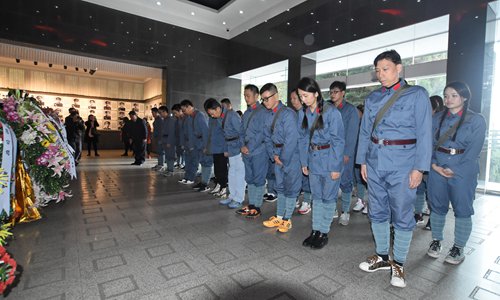
A group of some 60 staff members from Macao’s casino industry recently visited red site Jinggangshan for a one-week patriotic course, sparking discussions from mainland netizens over its significance.

Staff members of Macao casino companies pay tribute to revolutionary martyrs in Jinggangshan, East China's Jiangxi Province. Photo: Courtesy of Sociedade de Jogos de Macau Holdings

Staff members of Macao casino companies pay tribute to revolutionary martyrs in Jinggangshan, East China’s Jiangxi Province. Photo: Courtesy of Sociedade de Jogos de Macau Holdings

Every year, millions of visitors flock to China’s red sites to pay tribute to deceased communist leaders and learn about the Communist Party of China’s (CPC) revolutionary past. Continue reading Macao gambling firms visit Jinggangshan

Forced confessions in China

MCLC members:

A video of my recent talk on the forced confessions in China has been uploaded online: https://vimeo.com/194054432

The reference (I am also working on an article so criticisms and suggestions welcome):

Fiskesjö, Magnus. “TV Tears Made of Fear: Anatomy of the Spectacle of Power in China’s Forced Confessions.” Cornell Contemporary China Initiative lecture series. Cornell University, November 14, 2016. https://vimeo.com/194054432

(will also be linked to here: http://www.cornell.edu/video/series/ccci-contemporary-china-lectures) Continue reading Forced confessions in China

Universities as CCP ‘strongholds’

Source: The Guardian (12/9/16)
China universities must become Communist party ‘strongholds’, says Xi Jinping
By Tom Phillips in Beijing
All teachers must be ‘staunch supporters’ of party governance, says president in what experts called an effort to reassert control

large

Chinese authorities must intensify ideological controls on academia and turn universities into Communist party “strongholds”, President Xi Jinping has declared in a major address.

“Higher education … must adhere to correct political orientation,” Xi said in a high-profile speech to top party leaders and university chiefs that was delivered at a two-day congress on “ideological and political work” in Beijing.

Continue reading Universities as CCP ‘strongholds’

Trump speaks with Tsai Ing-wen (6)

Another good piece below. My own comment to the whole affair is that many on the so-called left in the US as well as in other Western countries often seem to still live in the cold war era — they never got the memo about Taiwan’s democracy, which came about at the end of the cold war. Maybe this affair will make them get that memo. — Magnus Fiskesjö <nf42@cornell.edu

Source: Washington Post (12/7/16)
Americans should stop using Taiwan to score points against China
By Lin Fei-fan, Chen Wei-ting and June Lin

imrs

Keep Taiwan Free rally on July 2 2014 in New York City, Photo by Alysa Chiu.

[Lin Fei-fan is a co-founder of Taiwan March, a pro-Taiwan advocacy group, and Network of Young Democratic Asians, an alliance with regional activists. Chen Wei-ting is a co-founder of Taiwan March. June Lin is a co-founder of Democracy Tautin, a social justice group, and is currently based in Washington, D.C. The three of them were student leaders during the 2014 Taiwan Sunflower Movement.]

Like many Americans who stand for progressive ideals, few young Taiwanese see someone like Donald Trump as a decent leader. However, the anxious reaction of the American media and foreign policy establishment to the Dec. 2 phone call between Taiwan’s President Tsai Ing-wen and President-elect Trump is also at odds with American values of human rights, freedom and democracy. Continue reading Trump speaks with Tsai Ing-wen (6)

Trump speaks with Tsai Ing-wen (5)

From: Martin Winter <dujuan99@gmail.com>
Source: Quartz (12/6/16)
Liberal Americans should be celebrating Trump’s Taiwan call, not condemning it
By Kevin Hsu, Lecturer in urban studies, Stanford University

A ten-minute phone call between US president-elect Donald Trump and president Tsai Ing-wen of Taiwan has generated much hullaballoo. Or to be more precise, the histrionic reporting in its aftermath by the American media certainly seems to have done so.

A glance at the comical transcripts of Trump’s earlier conversation with the Pakistani prime minister reveals how seriously to weigh these phone sessions. (Hint: not very). But let’s allow that this could be a deliberate act on the part of the incoming leader, with some measure of symbolic value. Continue reading Trump speaks with Tsai Ing-wen (5)

Trump speaks with Tsai Ing-wen (4)

The Osnos piece was not just somewhat less than even-handed, it was also wrong on a crucial detail. To quote: “Some background: Taiwan broke away from mainland China in 1949.” Even the most basic understanding of East Asian history in the post-war period is enough to tell you that Taiwan did no such thing. The ROC government re-located to Taiwan and continued to claim sovereignty over the whole of China, supported and protected by the US. It seems that we are well and truly in a post-factual era if such statements can appear in The New Yorker.

David Holm <dvdholm37@gmail.com>

Trump speaks with Tsai Ing-wen (2,3)

Thanks for posting the Osnos piece; Walter Russell Mead has published a more measured, and I think more judicious, reaction:

http://www.the-american-interest.com/2016/12/04/what-the-taiwan-call-means/

A. E. Clark <aec@raggedbanner.com>

===========================================

So many commentaries on the Trump-Tsai Ing-wen phone call. This one by Andrew Browne seems a little more even-handed than the previously posted Osnos piece.

Terry Russell <Terry.Russell@umanitoba.ca>

Source: WSJ (12/4/16)
Dispensing With Tip-Toeing, Trump Puts Taiwan in Play
The future of U.S.-China relations depends on Trump’s intentions with Tsai phone call
By Andrew Browne

unknown

Trump’s phone conversation on Friday with Taiwan’s Tsai Ing-wen broke decades of diplomatic protocol. Photo: Associated Press

TAIPEI—Donald Trump took the call. The voice on the other end of the line was Taiwan’s president congratulating him. They chatted for a few minutes about economic matters and security—the normal business of politics. Why all the fuss? Continue reading Trump speaks with Tsai Ing-wen (2,3)

Trump speaks with Tsai Ing-wen (1)

Source: The New Yorker (12/3/16)
THE REAL RISK BEHIND TRUMP’S TAIWAN CALL
By Evan Osnos

osnos-trump-taiwan-1-1200

The Taiwan call is the latest indicator that Trump the President will be largely indistinguishable from Trump the candidate.PHOTOGRAPH BY EVAN VUCCI / AP

If you work in foreign affairs, you learn that a highly unexpected event is often the result of intent or incompetence. (You also learn that what looks, at first, like intent often turns out to be incompetence.) In the Donald Trump era, we may need a third category—exploitation—which has elements of both.

In his first semiofficial act of foreign policy, President-elect Trump, on Friday, lobbed a firework into the delicate diplomacy of Asia by taking a phone call from Taiwan’s President, breaking thirty-seven years of American practice in a way that is sure to upset relations with China. It wasn’t clear how much he intended to abruptly alter geopolitics, and how much he was incompetently improvising. There is evidence of each; in either case, the way he did it is very dangerous. Continue reading Trump speaks with Tsai Ing-wen (1)

Trump speaks with Tsai Ing-wen

Source: NYT (12/2/16)
Trump Speaks With Taiwan’s Leader, an Affront to China
By MARK LANDLER and DAVID E. SANGER

President Tsai Ing-wen of Taiwan.CreditRitchie B. Tongo/European Pressphoto Agency

WASHINGTON — President-elect Donald J. Trump spoke by telephone with Taiwan’s president on Friday, a striking break with nearly four decades of diplomatic practice that could precipitate a major rift with China even before Mr. Trump takes office.

Mr. Trump’s office said he had spoken with the Taiwanese president, Tsai Ing-wen, “who offered her congratulations.” He is believed to be the first president or president-elect who has spoken to a Taiwanese leader since at least 1979, when the United States severed diplomatic ties with Taiwan as part of its recognition of the People’s Republic of China. Continue reading Trump speaks with Tsai Ing-wen

Guokao

Source: BBC News (12/1/16)
The people who can’t quite get a government job
By Ruhua Xianyu

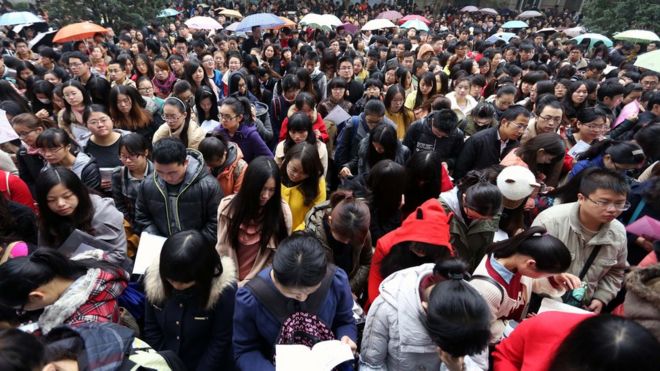
Applicants get ready for China's National Civil Service Exam, which attracts a million candidates each year

GETTY IMAGES :Applicants get ready for China’s National Civil Service Exam, which attracts a million candidates each year

It’s a fiendishly difficult “brain burning” exam that promises those who pass a job for life. And that prize is so coveted that some come back again and again for more test punishment.

China’s National Civil Service Exam or “Guokao” took place this week. Every year around a million people take the test in an attempt to get one of about 27,000 government jobs dubbed “iron rice bowls“, with guaranteed job security, steady income and benefits. Chances of success are 36 to one this year. Continue reading Guokao

Hu Fayun, inside and outside the system

Source: NY Review of Books (11/28/16)
Inside and Outside the System: Chinese Writer Hu Fayun
By Ian Johnson

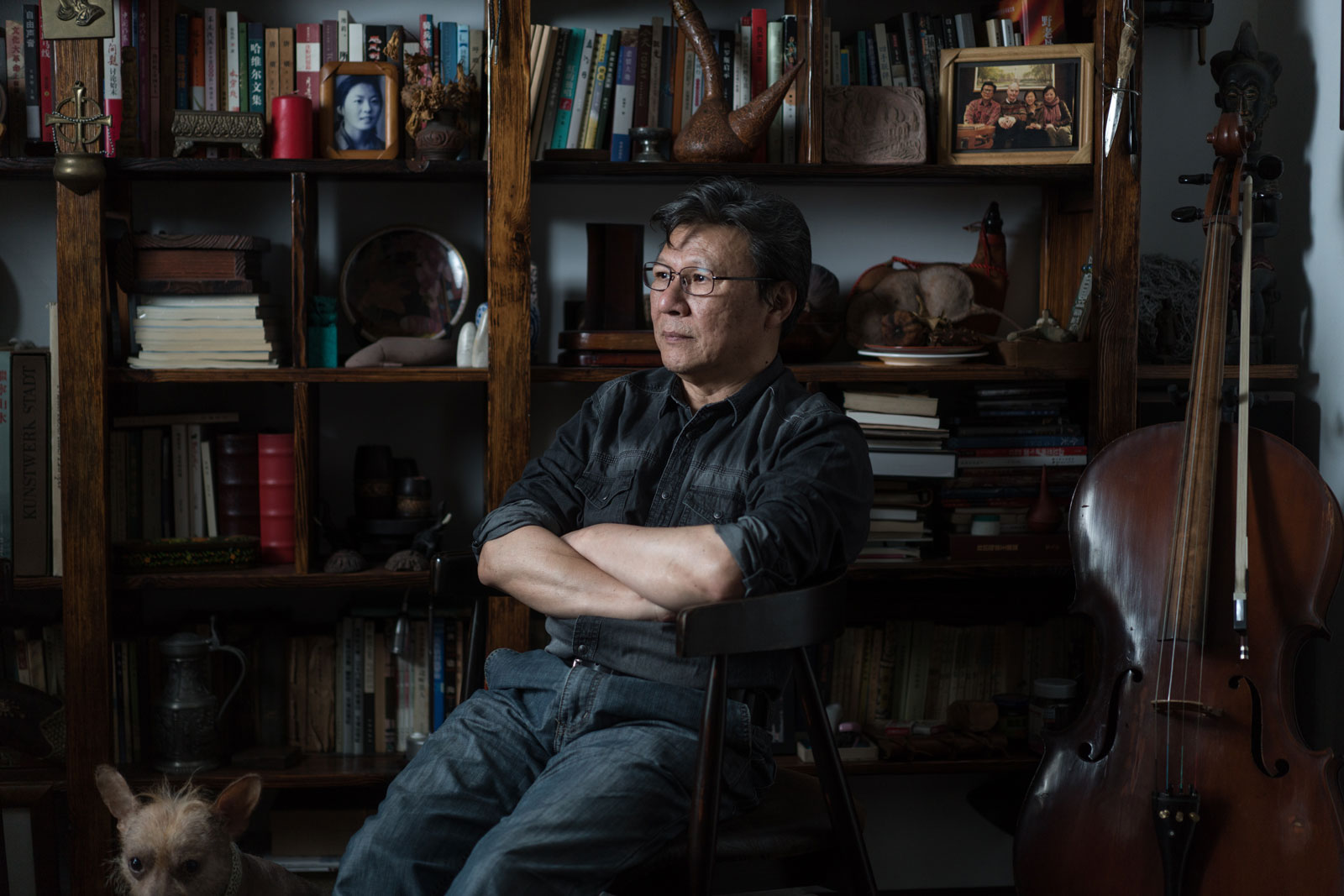
Hu Fayun in Wuhan, 2016

Sim Chi Yin/VII. Hu Fayun in Wuhan, 2016

Over the summer I traveled to Wuhan to continue my series of talks with people about the challenges facing China. Coming here was part of an effort to break out of the black hole of Beijing politics and explore the view from China’s vast hinterland. Continue reading Hu Fayun, inside and outside the system

‘Kim Fatty the Third’

Source: The Guardian (11/16/16)
Chinese websites censor ‘fatty’ nickname that mocks Kim Jong-un
Ban on ‘Kim Fatty the Third’ comes after North Korean officials formally ask China to stop such insults appearing in media
By Associated Press in Beijing
Kim Jong-un

North Korean leader Kim Jong-un is ridiculed by some in China as ‘Kim Fatty the Third’. Photograph: Wong Maye-E/AP

Chinese websites are censoring a phrase meaning “Kim Fatty the Third”, a nickname widely used to disparage the North Korean leader, after officials from his country reportedly conveyed their displeasure in a meeting with Chinese counterparts.

Searches for the Chinese words “Jin San Pang” on the search engine Baidu and microblogging platform Weibo returned no results this week.

The nickname pokes fun at Kim Jong-un’s girth and his status as the third generation of the Kim family to rule the world’s only hereditary communist dynasty. It’s especially popular among young, irreverent Chinese who tend to look down on their country’s would-be ally.

Relations between China and North Korea have been strained by Pyongyang’s nuclear weapons programme, which China has condemned along with South Korea, Japan, the United States and Russia. But Beijing continues to support the Kim regime with limited trade and diplomatic backing.

North Korean officials, fearing that Kim would find out about the nickname, lodged a formal request with China recently to prohibit names disparaging Kim from appearing in the media, according to Hong Kong newspaper reports.

The Chinese foreign ministry spokesman, Geng Shuang, said on Wednesday that reports of the banning of Jin San Pang did not “comply with facts”.

“The Chinese government stays committed to building a healthy and civilised environment of opinions,” he added. “We disapprove of referring to the leader of any country with insulting and mocking remarks.”

Kim Fatty the Third is such a widely used term in China that it is sometimes suggested by auto-complete algorithms on web portals such as Baidu, China’s leading search engine. While searches for Jin San Pang returned no results this week, Baidu left untouched results for other versions of the nickname, such as Kim Fat Fat Fat.

A Baidu spokeswoman, Tracy Hu, declined to comment.

The Beijing-based company has typically said that its policy is to provide accurate search results while also complying with Chinese regulations.
Confucianist outside, confused inside

Source: SCMP (11/18/16)
China in the 21st century: Confucianist outside, confused inside
Kerry Brown and Sheng Keyi explore what Chinese people believe as their lives grow more materially rich and their country pursues its dream of national rejuvenation
By Kerry Brown and Sheng Keyi

It’s a simple question: “What do Chinese people believe?” But answering it has never been easy. Does the ringing affirmation by the ruling Communist Party at its plenum this year that the People’s Republic is on track to finally become a middle-income country in the next five years, which will be rejuvenated and powerful, finally answer this vexed question? Is this faith in the “Chinese Dream” of national destiny what, in the end, unites all Chinese people? Continue reading Confucianist outside, confused inside