Professor’s death in Taiwan

Source: The Guardian (10/28/16)
Professor’s death could see Taiwan become first Asian country to allow same-sex marriage
Campaigners believe a ‘breakthrough’ is near after draft bill tabled by ruling party to amend family law in favour of LGBT rights
By Nicola Smith in Taipei
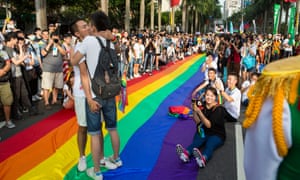
Two gay men kiss standing on the rainbow banner during the annual gay pride march through Taipei’s city streets.

Two gay men kiss standing on the rainbow banner during the annual gay pride march through Taipei’s city streets. Photograph: Craig Ferguson/LightRocket via Getty Images

The death of a gay professor could propel Taiwan into becoming the first Asian country to legalise same-sex marriage by the end of next year.

More than 80,000 LGBT activists and supporters are expected to take to the streets of the Taiwanese capital, Taipei, on Saturday for what is expected to be Asia’s largest ever gay pride parade. Continue reading Professor’s death in Taiwan
Living in China’s expanding deserts

Source: NYT (10/24/16)
Living in China’s Expanding Deserts
People on the edges of the country’s vast seas of sand are being displaced by climate change.
By JOSH HANER, EDWARD WONG, DEREK WATKINS and JEREMY WHITE
點擊查看繁體版

deserts

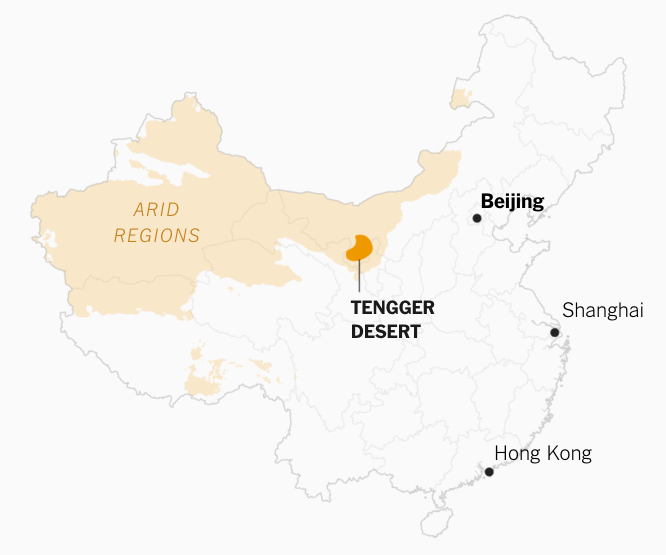
Map of Chinese deserts.

IN THE TENGGER DESERT, CHINA — This desert, called the Tengger, lies on the southern edge of the massive Gobi Desert, not far from major cities like Beijing. The Tengger is growing.

For years, China’s deserts spread at an annual rate of more than 1,300 square miles. Many villages have been lost. Climate change and human activities have accelerated desertification. China says government efforts to relocate residents, plant trees and limit herding have slowed or reversed desert growth in some areas. But the usefulness of those policies is debated by scientists, and deserts are expanding in critical regions.

Continue reading Living in China’s expanding deserts

Social credit system relies on big data

Source: Washington Post (10/21/16)
China’s plan to organize its society relies on ‘big data’ to rate everyone
BEHIND THE FIREWALL: How China tamed the Internet |This is part of a series examining the impact of China’s Great Firewall, a mechanism of Internet censorship and surveillance that affects nearly 700 million users.
By Simon Denyer

Rachel Orr/The Washington Post; iStock

BEIJING — Imagine a world where an authoritarian government monitors everything you do, amasses huge amounts of data on almost every interaction you make, and awards you a single score that measures how “trustworthy” you are. In this world, anything from defaulting on a loan to criticizing the ruling party, from running a red light to failing to care for your parents properly, could cause you to lose points. And in this world, your score becomes the ultimate truth of who you are — determining whether you can borrow money, get your children into the best schools or travel abroad; whether you get a room in a fancy hotel, a seat in a top restaurant — or even just get a date. Continue reading Social credit system relies on big data

Book lovers flock to 117-year-old store

Source: China Daily (10/7/16)
Book lovers flock to 117-year-old store run by elderly man
By Wu Yan and Wang Jianfen (China Daily)

Book lovers flock to 117-year-old store run by elderly man

Jiang Chengbo at his bookstore in Suzhou, Jiangsu province. [Photo by Xu Lijuan/China Daily]

Jiang Chengbo is 90. He is running a 117-year-old antique bookstore inherited from his grandfather, and that has made him an internet celebrity. Jiang, the third-generation owner of the store, said that after visitors began talking about it on the internet, book lovers from across the country have come to look for books and take photos with him.

Located in the Gusu district of Suzhou, in East China’s Jiangsu province, the store covers about 20 square meters and is filled with shelves on three sides with books categorized as literature, history and philosophy. Continue reading Book lovers flock to 117-year-old store

Why Chinese women can’t get a break

Source: NYT (10/13/16)
Why Chinese Women Still Can’t Get a Break
点击查看本文中文版 Read in Chinese
By HELEN GAO

16gao-blog427

Credit: Lisk Feng

BEIJING — On a Saturday afternoon in late September, I sat in the brand-new auditorium of my former high school in Beijing, watching the gala for my 10-year reunion. Near the end, teachers stepped onto the stage to deliver speeches.

“Girls, I hope you will focus on finding your life partners,” said the Chinese-language teacher, with the same stern air as when she urged us to succeed on the college entrance exam. “Marriage cannot be delayed,” the biology teacher said. The physical education teacher offered to set up single alumnae with eligible bachelors at her husband’s company. Continue reading Why Chinese women can’t get a break

A Taiwan museum featuring all of Asia

Source: NYT (10/6/16)
A Taiwan Museum Featuring All of Asia
点击查看本文中文版 Read in Chinese
By CHRIS HORTON

06iht-rarttaiwana-master768

Visitors viewing the wall display introducing different Buddhas at the National Palace Museum’s Southern Branch in Chiayi County, Taiwan. The museum, which opened in September, celebrates the interconnectedness of Asian cultures. Credit Billy H.C. Kwok for The New York Times

CHIAYI COUNTY, TAIWAN — Taiwan has a new National Palace Museum. This time around, it is not just about China.

Reflecting 16 years of political changes and concomitant rising Taiwan identity, the Southern Branch of the National Palace Museum opened its doors to the public in September as Taiwan’s new government looks to play down its connections to China while moving toward greater engagement with the rest of Asia. Continue reading A Taiwan museum featuring all of Asia

Shengnü (leftover women) in Chinese literature (2,3)

This is indeed a niche point to occupy but I cannot think of any influential fiction that centers on the leftover woman yet; but in popular online fiction and “low-end” film there are: “閃婚生女」「剩女的全盛時代」,POPULAR FILM 2015 舒淇 彭于晏 「剩者為王」

Flair Donglai SHI <183967472@qq.com>

===============================

You can find a couple of stories  from the early 1980s in translation in One Half of the Sky  Heinemann, London, 1978.  The collection includes Zhang Xinxin’s “How Did I Miss You?” (我在那儿错过了你? Originally published in Shouhuo 收获, 1980, No 5) and “Because I’m Thirty and Unmarried” by Xu Naijian (not sure of the original Chinese title or publication details but probably also 1980). These covered young women who were sent to the countryside during the CR, did not marry there, because they would have had to give up their city residence rights if they did, and then returned to the cities after the CR, but found the men of their age who returned with them then married younger women, thus creating the group of “leftover women.”

Cheers,
Rosemary Roberts <rosemary.roberts@uq.edu.au>
School of Languages and Cultures
University of Queensland

Shengnü (leftover women) in Chinese literature (1)

Wang Anyi, Fang Fang, Chi Li and Chi Zijian often write stories about divorced women or women of a certain age who are not yet married. Wang Anyi and Fang Fang’s stories in the forthcoming anthology By The River: Seven Contemporary Chinese Novellas address this theme. But pretty much all women writers who have emerged since the 1980s, including Zhang Jie (The Ark), Lin Bai, Chen Ran, and Hong Ying address questions of “why should I be so anxious to get married?” although many of their characters are married women who are having doubts about their lives.

Charles Laughlin <cal5m@eservices.virginia.edu>

Shengnü (leftover women) in Chinese literature?

Dear all,

Writing on the behalf of a MA student who is working on the shengnü 剩女 (leftover women) phenomenon. Wondering if any of you had a literary text dealing with this issue (novels, short stories…) in mind? I can’t really think of any. We did find several blogs and short videos, but not fiction.

Many thanks in advance!

Vanessa Frangville <vanessafrangville@gmail.com>

Gaokao, world’s toughest school exam

Source: The Guardian (10/12/16)
Is China’s gaokao the world’s toughest school exam?
By Alec Ash
Chinese children must endure years of stress and impossible expectations preparing for their final school exam. The students who do best can look forward to glittering careers and even good marriage prospects. But for the less successful, the system is brutal.

gaokao

For two days in early June every year, China comes to a standstill as high school students who are about to graduate take their college entrance exams. Literally the “higher examination”, the gaokao is a national event on a par with a public holiday, but much less fun. Construction work is halted near examination halls, so as not to disturb the students, and traffic is diverted. Ambulances are on call outside in case of nervous collapses, and police cars patrol to keep the streets quiet. Radio talkshow hosts discuss the format and questions in painstaking detail, and when the results come out, the top scorers are feted nationally. A high or low mark determines life opportunities and earning potential. That score is the most important number of any Chinese child’s life, the culmination of years of schooling, memorisation and constant stress. Continue reading Gaokao, world’s toughest school exam

Tighter grip in wake of religious revival

Source: NYT (10/7/16)
China Seeks Tighter Grip in Wake of a Religious Revival
By IAN JOHNSON

BEIJING — The finances of religious groups will come under greater scrutiny. Theology students who go overseas could be monitored more closely. And people who rent or provide space to illegal churches may face heavy fines.

These are among the measures expected to be adopted when the Chinese government enacts regulations tightening its oversight of religion in the coming days, the latest move by President Xi Jinping to strengthen the Communist Party’s control over society and combat foreign influences it considers subversive. Continue reading Tighter grip in wake of religious revival

Boarding school’s psychic toll

Source: Sinosphere, NYT (10/5/16)
Recognizing Boarding Schools’ Psychic Toll in China
By DIDI KIRSTEN TATLOW

BEIJING — The emotional disintegration of a 17-month-old boy named John as he sought and failed to find comfort from caregivers in a British boarding nursery, captured in a 1969 documentary film, deeply distressed the Chinese women at a seminar last week on early childhood separation.

It showed in hard-to-watch detail the damage that can be inflicted when young children lose their primary caregivers. John’s anguish was extreme. He cried for days, refused food and withdrew. Continue reading Boarding school’s psychic toll

Quest for scientific glory and aliens

The first stage in Liu Cixin’s Three-Body Problem has come true. Next up: the aliens. To view the WSJ video report, click the link below –Kirk

Source: China Real Time (9/27/16)
China’s Quest for Scientific Glory and Aliens

bn-pz751_crttel_e_20160927044904

China’s new radio telescope, the largest in the world—and the latest marker of Beijing’s ambition to become a global player in science—began its search for signals from distant galaxies on Sunday. Photo: Zuma Press

More on Ning Ken’s ultra-unreal

Source: Quartz (9/20/16)
A new literary genre critiques the scariest, most unbelievable part of life in China—reality
BY Adrienne Matei

China's literature doesn't need wizards, dragons, or ghosts—everyday life is surreal enough as it is.

China’s literature doesn’t need wizards or dragons—everyday life is surreal enough already. (Courtesy of Monte Clark Gallery and Greg Girard)

Traditional literary tropes have struggled to describe China’s day-to-day corruption, warp-speed modernization, supersonic development, and political oppression. Mystery, satire, horror—none feel quite expansive enough to begin encompassing the stories of the world’s most simultaneously populous yet secretive country.

To help bridge this gap, Beijing-based novelist Ning Ken has created a new literary genre to properly convey the absurdity of modern life in China: chaohuan. Meaning “ultra-unreal,” this contemporary mode of literary expression is intended to reflect the modern Chinese zeitgeist in all its dark oddity. Continue reading More on Ning Ken’s ultra-unreal