National Urban Issues Identification Survey

The National Urban Extension Leaders (NUEL) is leading a national urban issues identification and prioritization process for Extension. As part of this process you are invited to take a few minutes to complete a survey to prioritize a set of urban issues that Extension is, could or should be working on in the North Central states. The survey should take no more than 10 minutes to complete. The information collected will be used to set regional and national urban issues, develop national urban issue teams, and focus content for future regional and national urban conferences and staff professional development. Follow this link to the Survey.

Sourced from: NUEL

Learn How This City Increased Access to Entrepreneurship Support

Mayor Deana Holiday Ingraham of East Point, Georgia, knows firsthand entrepreneurship is the key to a thriving community. Understanding entrepreneurship’s impact on people is something she learned from growing up watching the positive influence of her father’s small business, a family construction company, on their community. “He created jobs. He provided job training by literally teaching people skills on the job. He helped people during times of need and helped them support their families,” Ingraham explained. Follow this link to read more.

Sourced from: Cities Speak

Registration is Now Open for Leadership in the City

Are you interested in Extension in urban areas and ready to improve your knowledge, skills, and results?

The Leadership in the City course will help you learn about leadership, networks, innovation, and management. The 5-month online program will prepare you, as an Extension professional, to be relevant locally, responsive statewide, and recognized nationally.

The goal of this comprehensive professional development program is to improve the knowledge, skills, and results of university Extension professionals working in large cities. You will connect with peers from around the country to engage in critical thinking and creative problem solving to become better prepared to be relevant locally, responsive statewide, and recognized nationally.

The program was developed based on a foundation of entrepreneurial theory and urban Extension practice and will build upon existing leadership experiences, management training, and Extension professional development.

You will learn from experienced leaders; apply what you learn in your city, region, or state; engage in critical thinking and creative problem solving; and participate in online collaborative learning. Each competency-based module incorporates interactive digital delivery and the flipped classroom model for active learning and engagement.

Upon completion of the course, you will be better prepared to:

  • Evaluate, illustrate, and build upon their four dimensions as an entrepreneurial leader (traits and drivers; competencies and experiences).
  • Navigate as a leader working in the urban and university contexts.
  • Implement elements of entrepreneurial organizations.

The investment in the program is $500 plus a commitment to work hard and have fun investing 8-14 hours per month. The 5-month online course begins in January 2021. If you have multiple participants from the same institute, you are each entitled to a $100 discount (Promotion code: LITC21-MULT).

This course is led by Dr. Julie Fox from the Ohio State University Extension.

Complete details and registration information can be found at https://cityextension.osu.edu/leadership. The deadline for registration is November 30.
Leading Edge Dialogue Series: Fulfilling the Land Grant University Mission

The Western Center for Metropolitan Extension and Research has released the next white paper in their Leading Edge Dialogue series: Fulfilling the Land Grant University Mission: Extension and Community-Based Applied Research, co-authored by Lou Swanson (Colorado State University). Major themes of the discussion included: recognizing Extension’s emerging role-shift into inter- and multi-disciplinary work across the university system; establishing Extension as a co-creative partner with other public institutions in the work of community development and applied research; and exploring methodologies to advance workforce development and urban-rural interdependencies through programming. Follow this link to learn more.

Sourced from: The Western Center for Metropolitan Extension and Research

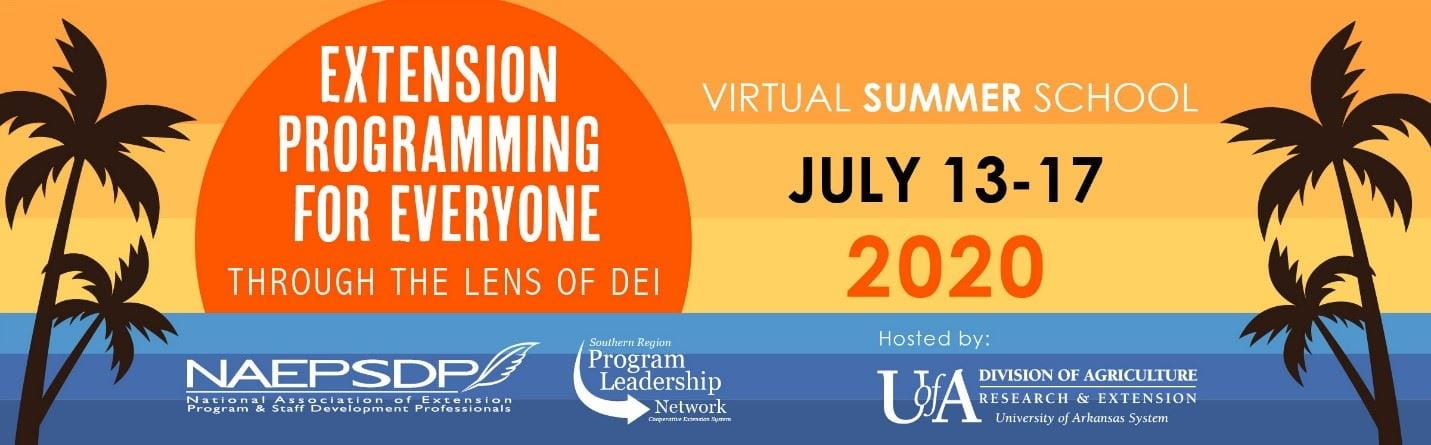
NAEPSDP Presents: Virtual Summer School


All Extension professionals are invited to join this informative webinar series on incorporating Diversity, Equity, and Inclusion into Extension programs from planning to evaluation. The webinar series will begin Monday, July 13, 2020 at 3 p.m. EDT. Follow this link to learn more.

Sourced from: NAEPSDP


Supporting Each Other and Our Communities – NUEL Inequities Dialogue

National Urban Extension Leaders (NUEL), in collaboration with the Southern Rural Development Center and Michigan State University, are excited to host a listening dialogue to inform decision makers next steps in addressing inequities internal to urban Extension and supporting urban Extension professionals to meet the needs of the communities served.

This supportive dialogue space was designed with all urban Extension professionals in mind, regardless of position or tenure. Everyone living and working in urban areas has ideas on how Extension can better support the community. The report will be reviewed by NUEL to map a strategy complementing current and historical contributions. Feedback will also be shared with state Extension administrators to help inform their next steps. The dialogue will be held on Monday, July 20, 2020, 2-3:30 p.m. EDT.  Follow this link to register.

Sourced from: NUEL

Letting Data Lead the Way: Addressing Food and Internet Access in Syracuse

Even a few months into lockdown, we are still figuring out new ways to live, learn, work, and play. In every major facet of society, we are watching as the systems that once kept us going are breaking down. One particular area of focus has been on public education as schools close their doors and scramble to move classes online. The headlines highlight students and teachers struggling to adapt to this new mode of learning, and parents struggling to manage their kids, work, and household responsibilities simultaneously. Some school districts are choosing to shut down for the year, unable to make the transition to remote learning; some parents have flat out given up on homeschooling, unable to deal with the demands of work and their kids’ classes. Follow this link to read more.

Sourced from: Data-Smart City Solutions

Addressing Power Inequity in Research to Create Change

Research cannot be excluded from conversations about systemic racism. We rely on the research process to expose systemic issues and guide us toward solutions. But deeply rooted in this process is a power dynamic, an aspect of research that dims its idealism when examined up close. It is our responsibility, then, to put in the work—examining our methods for harmful and disempowering practices, acknowledging them, and committing to a new approach. Research, even in pursuit of equity, isn’t exempt from racial and ethnic discrimination. Since the Urban Institute’s founding 50 years ago by then-president Lyndon B. Johnson, we’ve had to reckon with the behavior and the environment that shaped our founding principles. But beyond good intentions, the solution requires critical evaluation, explicit action, and accountability measures, often disruptive and uncomfortable, to effectively dismantle racist structures. Follow this link to learn more.

Sourced from: Urban Institute