Ohio CAUV Values Projected to Decline Through 2020

The Current Agricultural Use Valuation (CAUV) program allows farmland devoted exclusively to commercial agriculture to be taxed based on their value in agriculture, rather than the full market value, resulting in a substantially lower tax bill for the farmer.

The formula for CAUV values incorporates agricultural factors (soil types, yields, prices, and non-land costs for corn, soybeans, and wheat) to calculate the capitalized net returns to farming land based on the previous 5 to 10 years. CAUV underwent large-scale changes to its calculation in 2017 that was targeted to reduce the property tax burden of farmland.

A new report, Ohio CAUV Values Projected to Decline Through 2020, shows the projection of CAUV values though 2020. According to the study authors, OSU agricultural economists Robert Dinterman and Ani Katchova forecast a decrease in the assessed value of agricultural land to an average CAUV value of approximately $600 in 2020.

Access this report at:

https://aede.osu.edu/sites/aede/files/publication_files/CAUVProjectionsFall2019.pdf

Ohio Agricultural Loan Delinquencies Have Stabilized in 2019

Financial stress, expressed as the ability of farmers to repay loans, is important to follow during times of low farm income. A new report “Ohio Agricultural Lending Outlook: Fall 2019,” published by Kevin Kim, Robert Dinterman, and Ani Katchova with the OSU AEDE’s Farm Income Enhancement Program, points to good news for Ohio farmers. The report provides information on agricultural loan volumes and delinquencies for Ohio farmers.

Agricultural loans issued by FDIC insured banks have increased in volume both nationally and in Ohio. For Ohio, the total number of agricultural loans reached $3.8 billion in 2018. There has been a slight uptick in delinquency rates, but they remain under 2%, which is a significant benchmark as delinquency rates remained above 2% for several years following the 2008 Farm Financial Crisis. The average delinquency rate for Ohio farm production loans for the recent 12 months was 1.06%, while for real estate loans it was 1.83%, seeing declines from last year’s rates.

Access this report at:

https://aede.osu.edu/sites/aede/files/publication_files/AgLendingOutlook2019.pdf


Ohio’s Proposed Hemp Rules Are Out

By Peggy Kirk Hall and Ellen Essman

OSU Agricultural & Resource Law Program

Ohio’s newly created hemp program is one step further toward getting off the ground.   On October 9, the Ohio Department of Agriculture (ODA) released its anxiously awaited proposal of the rules that will regulate hemp production in Ohio.   ODA seeks public comments on the proposed regulations until October 30, 2019.

There are two parts to the rules package:  one rule for hemp cultivation and another for hemp processing.   Here’s an overview of the components of each rule:

  1. Hemp cultivation

The first rule addresses the “cultivation” of hemp, which means “to plant, water, grow, fertilize, till or havest a plant or crop.”  Cultivating also includes “possessing or storing a plant or cop on a premises whre the plant was cultivated until transported to the first point of sale.”  The proposal lays out the rfollowing egulatory process for those who wish to cultivate hemp in Ohio.

Cultivation licenses.  Anyone who wants to grow hemp must receive a hemp cultivation license from the ODA.  Licenses are valid for three years.  To obtain a license, the would-be hemp cultivator must submit an application during the application window, which will be between November 1 and March 31.  The application requires the applicant to provide personal information about the applicant, and if the applicant is a business, information about who is authorized to sign on behalf of the business, who will be primarily responsible for hemp operations and the identity of those having a financial interest greater than ten percent in the entity.    The cultivation license application will also seek information about each location where hemp will be grown, including the GPS coordinates, physical address, number of outdoor acres or indoor square footage, and maps of each field, greenhouse, building or storage facility where hemp will grow or be stored.  Cultivators must pay a license application fee of $100, and once licensed, an additional license fee of $500 for each growing location, which is defined as a contiguous land area or single building in which hemp is grown or planned to be grown.  All applicants and anyone with a controlling interest ithe hemp cultivation business must also submit to a criminal records check by the bureau of criminal identification and investigation.

Land use restrictions.  The proposed rules state that a licensed hemp cultivator shall not:

  • Plant or grow cannabis that is not hemp.
  • Plant or grow hemp on any site not approved by the ODA.
  • Plant, grow, handle or store hemp in or within 100 feet of a residential structure or 500 feet of a school or public park, unless for approved research.
  • Comingle hemp with other crops without prior approval from ODA.
  • Plant or grow hemp outdoors on less than one-quarter acre, indoors on less than 1,000 square feet, or in a quantity of less than 1,000 plants without prior approval from ODA.
  • Plant or grow hemp within half a mile of a parcel licensed for medical marijuana cultivation.
  • Plant or grow hemp on property that the license holder does not own or lease.

Hemp harvesting.  Licensed growers would be required to submit a report to ODA at least 15 days before their intended harvest date and pay a pre-harvest sample fee of $150.  ODA then has to sample the hemp for THC content, and only if approved can a cultivator harvest the crop, which in most cases must occur within 15 days after the sample is taken.  Failing to harvest within the 15-day window might require a secondary sampling and sampling fee.  A cultivator would be required to have a hemp release form from ODA before moving any harvested materials beyond the storage facility.

Random sampling.  The proposed rules also allow for random sampling of hemp by ODA and provide details on how ODA will conduct the sampling and charge sampling fees.  Any cultivator is subject to random sampling in each location where hemp has been cultivated. ODA will report testing results that exceed 0.3 THC to the cultivator, who may request a second sample.  A cultivator must follow procedures for destroying any leaf, seed, or floral material from plants that exceed 0.3 THC and any material that was co-mingled with the 0.3 THC materials, but may harvest bare hemp stalks for fiber.

Destruction of hemp.   Under the proposed regulations, a license holder must submit a destruction report before destroying hemp and ODA must be present to witness the destruction.  The proposed rules also authorize ODA to destroy a crop that was ordered destroyed, abandoned, or otherwise not harvested and assess the costs against the licensee.

Reporting and recordkeeping are also important in the proposed rules.  Licensed cultivators must submit a planting report on an ODA form for each growing location by July 1 or within 15 days of planting or replanting, which shall include the crop’s location, number of acres or square footage, variety name, and primary intended use.  The rule would also require licensees to submit a completed production report by December 31 of each year.    A licensee that fails to submit the required reports would be subject to penalties and fines. Cultivators must maintain planting, harvest, destruction and production reports for three years.

Control of volunteer plants.  A licensee must scout and monitor unused fields for volunteer hemp plants and destroy the plants for a period of three years past the last date of reported planting.  Failing to do so can result in enforcement action or destruction of the plants by ODA with costs assessed to the licensee.

Pesticide and fertilizer use.  The laws and rules that apply to other crops will also apply to hemp, except that when using a pesticide on a site where hemp will be planted, the cultivator must comply with the longest of any planting restriction interval on the product label.   ODA may perform pesticide testing randomly, and any hemp seeds, plants and materials that exceed federal pesticide residue tolerances will be subject to forfeiture or destruction without compensation.

Prohibited varieties.  The proposed rule states that licensed cultivators cannot use any part of a hemp plant that ODA has listed as a prohibited variety of hemp on its website.

Clone and seed production.  Special rules apply to hemp cultivators who plan to produce clones, cuttings, propagules, and seed for propagation purposes.  The cultivator can only sell the seeds or plants to other licensed cultivators and must maintain records on the variety, strain and certificate of analysis for the “mother plants.”  The licensee need not submit a harvest report, but must keep sales records for three years of the purchaser, date of sale, and variety and number of plants or seeds purchased.

Cultivation research.  Universities may research hemp cultivation without a license but private and non-profit entities that want to conduct research must have a cultivation license.  Cultivation research licensees would be exempt from many parts of the proposed rules, but must not sell or transfer any part of the plants and must destroy the plants when the research ends.

Enforcement.  The proposed rule grants authority to the ODA to deny, suspend or revoke cultivation licenses for those who’ve provide false or misleading information, haven’t completed a background check, plead guilty to a felony relating to controlled substances within the past 10 years, or violated the hemp laws and rules three or more times in a five-year period.

  1. Hemp processing

The proposed rules package by ODA also addresses processing, which the rule defines as “converting hemp into a hemp product” but does not include on-farm drying or dehydrating of raw hemp materials by a licensed hemp cultivator for sale directly to a licensed hemp processor.    Because of this definition, many farmers who want only to grow and dry hemp would need only a cultivation license.  Growers who want to process their licensed hemp into CBD oil or other products, however, must also obtain a processing license.  The processing rules follow a similar pattern to their cultivation counterpart, as follows.

Processing licensesIn addition to submitting the same personal, business and location information as a cultivation license requires, a hemp processing license application must list the types of hemp products that the processor plans to produce.   An “extraction operational plan” including safety measures and guidelines is required for processors who want to extract CBD from hemp to produce their product, and an applicant must indicate compliance with all building, fire, safety and zoning requirements.  The amount of the license fee depends on what part of the hemp plant the processor plans to process.  Processing raw hemp fiber, for example, requires a $500 license fee for each processing site, whereas processing the raw floral component of hemp requires a $3000 fee for each site.  Like the cultivation license, a processing license is valid for three years.  Applicants and those with a controlling interest in the business must submit to a background check.

Land use restrictions.  The proposed regulations would prevent a licensed processor from:

  • Processing or storing any cannabis that is not hemp.
  • Processing or storing hemp or hemp products on any site not approved by ODA.
  • Processing, handling, or storing hemp or hemp products in or adjacent to a personal residence or in any structure used for residential use or on land zoned for residential use.
  • Processing hemp within 500 feet of a school or public park, except for approved research.

Financial responsibility.    A licensed processor must meet standards of financial responsibility, which require having current assets at least $10,000 or five percent of the total purchase of raw hemp materials in the previous calendar year, whichever is greater, and possessing a surety bond.

Inspection and sampling.  As with cultivation licensees, hemp processing licensees would be subject to inspection and sampling by ODA under the proposed rule.

Food safety regulations.  The proposed rule requires hemp processes to comply with federal and state food safety regulations.

Sources and extraction of cannabinoids (CBD). A processor who wants to extract or sell CBD products must obtain the materials from a licensed or approved cultivator or processor in Ohio or another state with hemp cultivation licenses.  The regulation outlines components of the extraction operational plan that a processor must submit with the processing application, as well as acceptable extraction methods and required training.

Product testing.  A hemp processor must test hemp products at an accredited testing laboratory before selling the products.   The proposed rule describes the testing procedures, which address microbial contaminants, cannabinoid potency, mycotoxins, heavy metals, pesticide and fertilizer residue and residual solvents.  There are testing exemptions, however, for hemp used exclusively for fiber, derived exclusively from hemp seed and hemp extracts.  The testing laboratory must create a certificate of analysis for each batch or lot of the tested hemp product.

Processor waste disposal.  Under the proposed rule, a licensed processor must follow procedures for proper disposal of hemp byproducts and waste and must maintain disposal records.

Product labeling requirements are also proposed in the rule.  A processor must label all hemp products except for those made exclusively from hemp fiber as outlined in the rule and in compliance with federal law and other existing Ohio regulations for standards of identify and food coloring.

Recordkeeping.  As we’d expect, the proposal states that hemp processors must maintain records for five years that relate to the purchase of raw, unprocessed plant materials, the purchase or use of extracted cannabinoids, and the extraction process.

Prohibited products.  Finally, the proposed rules include a list of hemp products that cannot be offered for sale, which includes hemp products with over 0.3 percent THC by dry weight basis, hemp products which laboratory testing determines do not meet standards of identity or that exceed the amount of mytoxins, heavy metals, or pesticides allowed, and any hemp products produced illegally.

What’s next for the hemp rules?

Keep in mind that these rules are not yet set in stone; they are a simply a proposal for hemp licensing rules in Ohio.  Those interested in cultivating or processing hemp in the future should read the draft rules carefully.  The proposed rule for hemp cultivation is here and the proposal for hemp processing is here.  Anyone can submit comments on the proposed rules here.  Your comments could affect what the final hemp rules require for hemp cultivators and processors.  After ODA reviews all comments, it will issue its final hemp licensing regulations.

Federal law requires that after Ohio finalizes its rules, ODA must submit them to the USDA for approval.  That approval won’t occur, however, until USDA completes its own hemp regulations, which are due out in proposal form any day now.  Ohio’s rules will become effective once USDA approves them, hopefully in time for the 2020 planting season.  Stay tuned to the Ag Law Blog to see what happens next with hemp production in Ohio.


Agricultural & Natural Resources Income Tax Issues Webinar

by: Barry Ward, Director, OSU Income Tax Schools

Tax practitioners, farmers and farmland owners are encouraged to connect to the Agricultural and Natural Resources Income Tax Issues Webinar on Dec. 16 from 9 a.m. to 3 p.m. The event is sponsored by Ohio State University Extension and participants can attend the webinar at host locations throughout Ohio or connect at home or office.

The webinar focuses on issues specific to farm tax returns related to agriculture and natural resources, and will highlight timely topics and key regulations of the Tax Cuts and Jobs Act.

The program is an intermediate-level course for tax preparers whose clients include farmers and rural landowners. Farmers who prepare and file their own taxes will also benefit from the webinar.

Topics in the Ag Tax Issues Workbook that is provided to all participants include:

Tax planning for farmers

Proposed §199A Cooperative Regulations

199A and farm rentals

Form 4797 issues

Form 4562 depreciation and expensing issues

Disaster-related tax issues

Farming C corporations electing S corporation status

Getting out of the farming business

Allocating purchase price to depreciable items

Discounted sales and leases

Current H2A labor issues

Taxation of contract feeding arrangements

Industrial hemp considerations

Timber tax issues

Conservation easements

Case study and forms update

The cost for the one-day school is $150, and applications have been made for the following continuing education credits:

  • Accountancy Board of Ohio, CPAs (6 hours)
  • Office of Professional Responsibility, IRS (6 hours)
  • Supreme Court of Ohio, Attorneys (5 hours)

Registration includes the Agricultural Tax Issues Workbook. The deadline to register is Dec. 6 to ensure participants will receive the workbook in the mail before the workshop. The live webinar, which will also feature a real-time Q-and-A, can be viewed at several host locations statewide and will include lunch. Participants also have the option to view the webinar from home if unable to attend a host location. For those who choose not to attend at a host location, a web address for the webinar will be sent in advance of the Dec. 16 presentation.

Host locations include:

Auglaize County, OSU Extension Office, 208 S. Blackhoof St., Wapakoneta

Clermont County, OSU Extension Office, 1000 Locust St., Owensville

Putnam County, OSU Extension Office, 1206 E. Second St., Ottawa

Wayne County, Wayne County Administration Building, 428 West Liberty St., Wooster

Wyandot County, Elks Lodge, 320 E. Wyandot Ave., Upper Sandusky

More information on the workshop, including how to register, can be found at go.osu.edu/agissuesreg

Contact Barry Ward at 614-688-3959, ward.8@osu.edu or Julie Strawser at 614-292-2433, strawser.35@osu.edu with questions.


OSU Extension Announces Two-Day Tax Schools for Tax Practitioners & Agricultural & Natural Resources Income Tax Issues Webinar

by: Barry Ward & Julie Strawser, OSU Income Tax Schools

How to deal with the new tax law (Tax Cuts and Jobs Act) for both individuals and businesses are among the topics to be discussed during the upcoming Tax School workshop series offered throughout Ohio in late October, November and December.

The annual series is designed to help tax preparers learn about federal tax law changes and updates for this year as well as learn more about issues they may encounter when filing individual and small business 2019 tax returns.

The tax schools are intermediate-level courses that focus on interpreting tax regulations and changes in tax laws to help tax preparers, accountants, financial planners and attorneys advise their clients. The schools offer continuing education credit for certified public accountants, enrolled agents, attorneys, annual filing season preparers and certified financial planners.

This is another important year for tax education as the new tax law continues to create some challenges for tax practitioners to prepare tax returns. We have an excellent set of instructors with a great deal of experience and training along with a top reference workbook to prepare tax practitioners to best serve their clients during this ongoing process of incorporating recent tax law changes in completing tax returns.

The workbook alone is an extremely valuable reference as it offers over 700 pages of material including helpful tables and examples that will be valuable to practitioners. Sample chapters of the reference workbook can be found at: https://go.osu.edu/WorkbookChapters.

In addition to the tax schools, the program offers a separate, two-hour ethics webinar that will broadcast Dec. 11 at 1 p.m. and again on Dec. 13 at 10 a.m. The webinar is $25 for school attendees and $50 for non-attendees and is approved by the IRS and the Ohio Accountancy Board for continuing education credit

Register two weeks prior to the school date and receive the two-day tax school early-bird registration fee of $375. This includes all materials, lunches and refreshments. The deadline to enroll is 10 business days prior to the date of each school. After the school deadline, the fee increases to $425.

Participants can also choose to attend just day one of the workshop for $250. Additionally, the 2019 RIA Federal Tax Handbook is available to purchase by participants for a discounted fee of $40 each. Registration information and the online registration portal can be found online at:
http://go.osu.edu/taxschools
The schools run from 8 a.m. to 4:30 p.m. on the following dates and locations:

• Oct. 30-31 — Ole Zim’s Wagonshed, 1387 State Route 590, Gibsonburg.
• Nov. 4-5 – Sheraton Suites, 1989 Front St., Cuyahoga Falls.
• Nov. 6-7 — Ashland University Convocation Center, 820 Claremont Ave., Ashland
• Nov. 12-13 — Presidential Banquet Center, 4548 Presidential Way, Kettering.
• Nov. 14-15 — Old Barn Out Back, 3175 W. Elm St., Lima.
• Nov. 19-20 — Der Dutchman Restaurant, 445 S. Jefferson Rt. 42, Plain City.
• Nov. 21-22 – Christopher Conference Center, 20 N. Plaza Dr., Chillicothe.
• Dec. 2-3 — Ohio University, Zanesville Branch Campus Center, 1425 Newark Road, Zanesville.
• Dec. 5-6 — The Ohio State University, Nationwide & Ohio Farm Bureau 4-H Center, 2201 Fred Taylor Dr, Columbus.

A daylong webinar on Ag Tax Issues will be broadcast Dec. 16 from 9 a.m. to 3 p.m.  If you are a tax practitioner that represents farmers or rural landowners or are a farmer or farmland owner that prepares your own taxes, this five-hour webinar is for you. It will focus on key topics and regulations of the Tax Cuts and Jobs Act related specifically to those income tax returns.

You can choose to attend a host location or participate at home or in the office. Host locations will provide a facilitator, refreshments and lunch. You are encouraged to bring your computer as there will be real-time Q&A. If you choose not to attend a host location, a web address will be e-mailed to you prior to the webinar.

Registration, which includes the Ag Tax Issues workbook, is $150. Register by mail or on-line at http://go.osu.edu/AgIssuesReg

More information on the workshops, including how to register, can be found at go.osu.edu/2019taxschools. Participants may contact Ward at 614-688-3959, ward.8@osu.edu or Julie Strawser 614-292-2433, strawser.35@osu.edu for more information.

Fun in the Fall: Minimizing Liability at Your Agritourism Operation

By: Evin Bachelor, Wednesday, September 04th, 2019
Source: https://farmoffice.osu.edu/blog/wed-09042019-206pm/ohio-ag-law-blog-fun-fall-minimizing-liability-your-agritourism-operation
Whether we’re ready or not, Labor Day traditionally marks a transition from summer to fall.  Pumpkin flavored everything will soon be available at a coffee shop and restaurant near you, and Ohio’s agritourism farms will surely be busy.

Whether you are just getting your agritourism farm up and running, or a seasoned agritourism veteran, it never hurts to take a moment to think about your liability risks.  The OSU Extension Agricultural & Resource Law Program has developed a number of resources, available on our publications webpage, that can help you think about ways to minimize the legal risks to you and your farm.  These resources include:

  • Ohio’s Agritourism Law – Ohio law grants liability protection for personal injuries suffered while participating in an agritourism activity.  It also provides for special taxation and zoning of lands where agritourism activities occur.  This law bulletin explains what your farm needs to do to be covered by the immunity, and how much protection it provides.  Click HERE to read the law bulletin.
  • Farm Animals and People: Liability Issues for Agritourism – Farm animals can be a valuable attraction for an agritourism operation, but having people and animals interact on the farm creates liability risks.  This factsheet explains a range of animal liability risks and provides a checklist to think about what you can do to reduce the risk of injury to your visitors, as well as reduce the risk of a lawsuit.  Click HERE to read the factsheet.
  • Agritourism and Insurance – Even with immunity laws in place, a farmer must carefully consider the farm’s insurance needs and ensure that it has adequate coverage.  This factsheet explains agritourism insurance, why it may be needed, and more.  It also provides a checklist that may help an agritourism farmer make sure that certain important insurance questions are addressed before an accident occurs.  Click HERE to read the factsheet.
  • Agritourism Immunity Laws in the United States – Many states, including Ohio, have taken steps to encourage agritourism by providing agritourism farms with some degree of immunity to liability.  We explain Ohio’s law more in depth in our law bulletin titled “Ohio’s Agritourism Law,” but this factsheet compares approaches taken in other states and provides a checklist that helps an agritourism farm think about how much protection it has under these laws.  Click HERE to read the factsheet.
  • Agritourism Activities and Zoning – Zoning is a force to be reckoned with in many states, but many states, including Ohio, have taken steps to encourage agritourism through zoning regulations.  This factsheet explains how zoning and agritourism interact across the country, including an explanation of Ohio’s current approach.  Click HERE to read the factsheet.
  • Youth Labor on the Farm: Laws Farmers Need to Know – Many Ohio agritourism farms provide employment to youth, who are able to learn about agriculture, business, and customer service through working at the farm.  Those hiring youth under the age of 18 want to make sure that they are following federal and Ohio labor laws.  Our latest law bulletin explains the youth labor laws that are unique to agriculture.  Click HERE to read the factsheet.

Food sales present some special issues that you will want to think about if you wish to sell food at your farm.  Depending upon the foods you sell, you may have to obtain a retail food establishment license for food safety purposes.  The following resources can help you think through the steps you must take to sell food at your agritourism farm:

  • Food Sales at Agritourism Operations: Legal Issues – Whether you sell fresh produce, cottage foods or baked goods, or prepare and serve food on-site, there are legal risks and requirements that may come into play.  This factsheet explains some of the legal issues you should consider before selling food at your farm, and provides a checklist of things to consider before you begin selling food.  Click HERE to read the factsheet.
  • Selling Foods at the Farm: When Do You Need a License? – This Ohio-specific factsheet explores farmers, including those operating an agritourism farm, need to register or obtain a license in order to sell food at the farm.  Click HERE to read the law bulletin.

Beyond our website, many of our peers at OSU Extension have developed a number of helpful resources for agritourism farms.  OSU Extension’s Agritourism Ready webpage, which you can access at u.osu.edu/agritourismready/, is designed to be a one stop shop for preparing an emergency management plan.  You can also read factsheets on Ohioline related to agritourism ranging from “Creating Signage for Direct Food and Agricultural Sales” to “Grants and Low-Interest Loans for Ohio Small Farms,” and “Maps, Apps and Mobile Media Marketing” to “Selling Eggs in Ohio: Marketing and Regulations.”

As new legal issues arise, we will continue to create resources that help farmers understand and mitigate their risk.  In the meantime, we wish everyone a fun and safe fall at Ohio’s agritourism farms.

“Ask the Expert” Area Seeks to Help Farmers at this year’s Farm Science Review

Each year, faculty and staff of The Ohio State University address some of the top farm management and veterinarian medicine challenges which Ohio farmers are facing during the “Ask the Expert” sessions held each day at the Farm Science Review at the Molly Caren Agricultural Center near London, Ohio.

The 20 minute “Ask the Expert” presentations at Farm Science Review are one segment of the College of Food, Agricultural, and Environmental Sciences (CFAES) and the College of Veterinary Medicine comprehensive extension education efforts during the three days of the Farm Science Review which will be held September 17-19 in London, Ohio.

Our experts will share science-based recommendations and solutions to the issues growers are facing regarding weather impacts, tariffs, veterinarian medicine, and low commodity prices. Producers are encouraged to attend one or more of the sessions throughout the day.

The sessions will take place in the Ohio State Area in the center of the main Farm Science Review exhibit area located at 426 Friday Avenue. This year’s featured sessions are:

Tuesday, September 17, 2019
“Tax Strategies Under the New Tax Law” presented by Barry Ward
10:00 – 10:20 a.m.

“Climate Smart- Weather, Climate & Extremes-Oh My!” presented by Aaron Wilson
10:20 – 10:40 a.m.

“Before the Pearly Gates- Getting Your Farm Affairs in Order” presented by David Marrison
10:40 – 11:00 a.m.

“Crop Inputs & Cash Rent Outlook for 2020” presented by Barry Ward
11:00 – 11:20 a.m.

“Farm Stress-We Got Your Back” presented by Dee Jepsen
11:20 – 11:40 a.m.

“The Legal Buzz on Hemp” presented by Peggy Hall
11:40 – 12:00 noon

“Current Status of African Swine Fever” presented by Scott Kenney
Noon to 12:20 p.m.

“Farm Income Forecasts: Are Farmers Experiencing Financial Stress?” presented by Ani Katchova
12:20 – 12:40 p.m.

“How Much Money Stayed on the Farm? 2018 Ohio Corn & Soybean Production Costs” presented by Dianne Shoemaker
12:40 – 1:00 p.m.

“Where Are We on U.S. Trade Policy” presented by Ian Sheldon
1:00 – 1:20 p.m.

“Farm Accounting: Quicken or Quickbooks” presented by Wm. Bruce Clevenger
1:20 – 1:40 p.m.

“Commodity Markets – Finding Silence in the Noise” by Ben Brown
1:40 – 2:00 p.m.

“GMOs, Food Animals, and Consumers” presented by Dr. Gustavo Schuenemann
2:00 – 2:20 p.m.

“Solar Leasing Options” presented by Peggy Hall & Eric Romich
2:20 – 2:40 p.m.

“Poultry Backyard Disease Management” presented by Dr. Geoffrey Lossie
2:40 – 3:00 p.m.

Wednesday, September 18, 2019
“Climate Smart- Weather, Climate & Extremes-Oh My!” presented by Aaron Wilson
10:00 – 10:20 a.m.

“The Legal Buzz on Hemp” presented by Peggy Hall
10:20 – 10:40 a.m.

“Zoonotic Diseases: Can I really get sick from my 4-H Project?” presented by Dr Jacqueline Nolting
10:40 – 11:00 a.m.

“Solar Leasing Options” presented by Peggy Hall & Eric Romich
11:00 – 11:20 a.m.

“Where Are We on U.S. Trade Policy” presented by Ben Brown
11:20 – 11:40 a.m.

“Impact of Peak Electrical Demand Charges in Agriculture” presented by Eric Romich
11:40 – 12:00 noon

“Crop Inputs & Cash Rent Outlook for 2020” presented by Barry Ward
12:00 – 12:20 p.m.

“Commodity Markets – Finding Silence in the Noise” by Ben Brown
12:20 – 12:40 p.m.

Public Perception Risk: Building Trust in Modern Agriculture by Eric Richer
12:40 – 1:00 p.m.

“Farm Stress-We Got Your Back” presented by Dee Jepsen
1:00 – 1:20 p.m.

“How Much Money Stayed on the Farm? 2018 Ohio Corn & Soybean Production Costs” presented by Dianne Shoemaker
1:20 – 1:40 p.m.

“Poultry Backyard Disease Management” presented by Dr. Geoffrey Lossie
1:40 – 2:00 p.m.

“Tax Strategies Under the New Tax Law” presented by Barry Ward
2:00 – 2:20 p.m.

“CRISPR gene editing: Are super animals within our reach?” presented by Dr. Scott Kenney
2:20 – 2:40 p.m.

“Using On-Farm Research to Make Agronomic and Return on Investment Decisions” presented by Sam Custer
2:40 – 3:00 p.m.

Thursday, September 19, 2019
“Horse Health Care and How to Feed a Horse” presented by Dr. Eric Schroeder
10:00 – 10:20 a.m.

“Farm Stress-We Got Your Back” presented by Dee Jepsen
10:20 – 10:40 a.m.

“Tax Strategies Under the New Tax Law” presented by Barry Ward
10:40 – 11:00 a.m.

“The Legal Buzz on Hemp” presented by Peggy Hall
11:00 – 11:20 a.m.

“Solar Leasing Options” presented by Peggy Hall & Eric Romich
11:20 – 11:40 a.m.

“Commodity Markets – Finding Silence in the Noise” by Ben Brown
11:40 – Noon

“Crop Inputs & Cash Rent Outlook for 2020” presented by Barry Ward
12:00 – 12:20 p.m.

“Antibiotic Use in Animals-Does it Impact for Human Health” presented by Dr. Greg Habing
12:20 to 12:40 p.m.

“Where Are We on U.S. Trade Policy” presented by Ben Brown
12:40 – 1:00 p.m.

“Swine Biosecurity” presented by Dr. Carlos Trincado
1:00 – 1:20 p.m.

“Nutritional Support for Ruminants in Winter” presented by Dr. Jeff Lakritz
1:20 – 1:40 p.m.

“How Much Money Stayed on the Farm? 2018 Ohio Corn & Soybean Production Costs” presented by Dianne Shoemaker
1:40 – 2:00 p.m.

The complete schedule for the Ask the Expert sessions and other events at the 2019 Farm Science Review can be found at: https://fsr.osu.edu/

Additional farm management information from OSU Extension can be found at ohioagmanager.osu.edu or farmoffice.osu.edu

Source:
David Marrison, OSU Extension
740-622-2265
Marrison.2@osu.edu

#leanonyourlandgrant

Back-to-school means different laws apply to youth farm workers

by: Peggy Kirk Hall, Associate Professor, Agricultural & Resource Law

Originally published at: https://farmoffice.osu.edu/blog/mon-08262019-909am/ohio-ag-law-blog%E2%80%94back-school-means-different-laws-apply-youth-farm-workers

When kids head back-to-school, it’s time for farmers to do some homework and recall the rules that apply to youth working on farms during the school year.   Once school is in session, Ohio labor laws place restrictions on the times of day and number of hours that youth under the age of 18 can work on a farm.  The laws don’t apply to parents, grandparents, or legal guardians, however.  For other farm employers, be aware that the laws vary according to the age of the minor and some require written parental consent.  Here’s a quick refresher:

16 and 17 year olds

  • Cannot work before 7:00 a.m. on school days, with the exception that they can work starting at 6:00 a.m. if they were not working past 8:00 p.m. the night before.
  • Cannot work after 11:00 p.m. on a school night, which means a night when the minor has school the next day.
  • No daily or weekly limits on the number of hours the youth can work.

14 and 15 year olds

  • Cannot work during school hours while school is in session.
  • Cannot work before 7:00 a.m. or after 7:00 p.m., but can work until 9:00 p.m. from June 1 to September 1 or during any school holiday or break lasting more than 5 weekdays.
  • Cannot work more than 3 hours during a school day or more than 8 hours during a non-school day.
  • Cannot work more than 18 hours in a week while school is in session, unless the job is part of a work education program such as vocational training or work study.

12 and 13 year olds

  • The same time restrictions and daily and weekly hour limits for 14 and 15 year olds (above) apply to 12 and 13 year olds, but there is no exception to the 18 hour weekly limit for vocational training or work study programs.
  • Employer must obtain written parental consent for the youth to be working, unless the youth’s parent or legal guardian also works on the same farm.

Under 12 years old

  • Can only work on a farm where employees are exempt from the federal minimum wage, which includes a farms of an immediate family member or a “small farm” that used fewer than 500 “man days” of agricultural labor in any calendar quarter the preceding year.  A “man day” is a day during which an employee performs agricultural work for at least one hour.
  • Exception to the above:  local youths 10 and 11 may hand harvest short-season crops outside school hours for no more than 8 weeks between June 1 and October 15 if their employers have obtained special waivers from the U.S. Secretary of Labor.
  • The same daily time restrictions and daily and weekly hour limits for 14 and 15 year olds (above) apply to youth under 12 years old, but there is no exception to the 18 hour weekly limit for vocational training or work study programs.
  • Employer must obtain written parental consent for the youth to be working.

The other labor laws that typically apply to youth doing agricultural work on a farm continue to apply throughout the school year. For example, employers must maintain records for youth employees, provide a written agreement of compensation and a statement of earnings on payday, and a 30-minute rest period if the youth works more than five consecutive hours. An employer can’t assign any youth under the age of 16 with a “hazardous” job or task unless the youth is 14 or 15 and has a certificate of completion for tractor or machine operation. Further information about these and other laws that apply to youth under 18 working on a farm is in our new Law Bulletin, Youth Labor on the Farm: Laws Farmers Need to Know, available here.

https://farmoffice.osu.edu/sites/aglaw/files/site-library/YouthLabor.pdf

Changes on the Horizon for H-2A Temporary Agricultural Labor Rules

Written by Evin Bachelor, Law Fellow, OSU Extension Agricultural & Resource Law Program

Originally published at: https://farmoffice.osu.edu/blog/thu-08292019-1114am/ohio-ag-law-blog-changes-horizon-h-2a-temporary-agricultural-labor-rules

The U.S. Department of Labor (DOL) says that it has found a number of inefficiencies in the H-2A temporary agricultural labor visa program, and the department has a solution: change the program’s rules. The DOL has proposed a number of administrative rule changes that it believes will make the approval process move along quicker, relieve burdens on U.S. farms, and create a more level playing field with regards to pay. Before we talk about the rule changes, let’s recap what the H-2A program is.

H-2A is a visa program for seasonal agricultural laborers from other countries.

Labor shortages have plagued farms across the United States for decades. Congress first created a visa program for non-immigrant labor in the early 1950s, but it wasn’t until 1986 that Congress established the H-2A visa program for temporary agricultural workers. Under this program, farmers may apply to employ H-2A workers on their farm on a temporary or seasonal basis for up to a year, but may apply to renew the worker’s visa for up to three total years.

In order to hire H-2A workers, an employer must certify in an application to the DOL that there are not enough qualified domestic workers willing and able to perform temporary and seasonal agricultural labor. In order to prove that there is not enough domestic labor, the farmer must demonstrate an effort to advertise the available work in the local area.

Further, the farmer must demonstrate to the DOL that employing foreign workers will not negatively affect the wages and working conditions of similarly employed U.S. workers. In other words, a farmer can’t hire foreign labor because it’s cheaper. A farmer is expected to pay the foreign workers the same as the farmer would pay domestic workers, based upon the higher of the DOL’s Adverse Effect Wage Rate, minimum wage, or prevailing wage.

What does the Department of Labor seek to change?

The DOL proposes to make several changes to the H-2A program’s administrative rules. Some of these changes update the rules to reflect what is already happening, while some make slight changes to the program’s overall scope.

  • Mandate e-filing. The DOL currently allows farmers to submit their applications online or in hard copy, but reports that 4/5 of applications are completed online. A review by the DOL has found that online applications get completed more quickly, have fewer errors, and reduce costs relative to hard copy submissions. Under the new rule, the DOL would require all applications to be completed online, unless the farmer has a disability or does not have internet access.
  • Allow e-signatures. The DOL currently requires farmers to sign a hard copy of their applications and either scan the document into the application or mail it. Under the new rule, the DOL would accept e-signatures as equal to handwritten signatures.
  • Subdivide the adverse effect wage rate based upon specific agricultural occupations. In the previous section, we noted that the farmer must pay the foreign workers the same as he or she would pay domestic workers. One way to determine that wage is to use the DOL’s Adverse Effect Wage Rate. Currently, the DOL has one rate for a state or region based upon the combined numbers for field and livestock workers. Under the new rule, the DOL would use Farm Labor Survey data to subdivide agricultural occupations in order to ensure that higher paying occupations, such as supervisors of farmworkers and construction laborers on farms, use an Adverse Effect Wage Rate that properly reflects the wages of those higher paying occupations, rather than one general rate for all agricultural workers.
  • Update the methodology for calculating prevailing wage standards. Another way to calculate the minimum wages of H-2A laborers is to base their pay off of the prevailing wage. The current method of calculating the prevailing wage, which has not been updated since 1981, requires in-person interviews of employers. Under the new rule, the DOL would eliminate the in-person requirement and allow states to collect data using more modern methods.
  • Incorporate guidance letters regarding animal shearing, commercial beekeeping, custom combining, and reforestation occupations into formal rules. When asked for an interpretation of its rules and policies, a federal agency may issue a guidance letter to the person seeking an interpretation. These guidance letters are not necessarily binding, and have no general application beyond the person seeking the interpretation. By incorporating the guidance into a formal rule, the interpretation holds the force of law. The DOL identified these occupations as unique relative to other agricultural occupations, and created a special set of procedures to obtain H-2A laborers to work these types of jobs.
  • Expand the definition of “agriculture” to include reforestation and pine straw activities. Currently, reforestation and pine straw occupations are only available for H-2B applications, which are for non-agricultural occupations. Under the new rule, these activities would be eligible for the agricultural based visa.
  • Reduce the time an employer must allow a domestic worker to apply for a job to 30 days. Currently, the DOL requires a farmer to hire all eligible, willing, and qualified U.S. workers who make themselves available to work until the half way point in the H2-A contract period. This means that if a farmer has H-2A laborers working under a six-month contract, then the farmer must hire any eligible, willing, and qualified domestic worker during the first three months of the contract. Under the new rule, the farmer would only have to leave such opportunity open to domestic workers for 30 days.
  • Allow an employer to stagger the entry of H-2A labor. Sometimes a farmer does not need all of the H-2A labor to arrive at once, but rather needs some to start on one date and then others to start on a different date. Currently, this would require the farmer to submit an application for each date on which the farmer needs H-2A labor. Under the new rule, the farmer would be able to submit one application but stagger the start dates of his or her workers over the course of 120 days. This 120-day clock begins on the day the first H-2A workers enter the U.S.

For more information about the proposed changes, visit the proposed rule’s entry on the Federal Register HERE.

https://www.federalregister.gov/documents/2019/07/26/2019-15307/temporary-agricultural-employment-of-h-2a-nonimmigrants-in-the-united-states

The public may submit comments until September 24, 2019.

As part of the public rulemaking process, the DOL is seeking public input on the proposed rule changes. Members of the public may submit written comments to the DOL until Tuesday, September 24, 2019.

You may submit a comment online (visit https://www.regulations.gov/) or by mail (send to Adele Gagliardi, Administrator, Office of Policy Development and Research, Employment and Training Administration, U.S. Department of Labor, 200 Constitution Avenue NW, Room N-5641, Washington, DC 20210). When mailing comments, be sure to include the rule’s Regulatory Information Number (RIN): 1205-AB89.

Corn Market Considerations

By: Clint Schroeder OSU Extension

Originally Published on

The United States Department of Agriculture (USDA) released their World Agriculture Supply and Demand Estimates (WASDE) report earlier this week and it has certainly taken the market by surprise. The debate continues to rage over how acres are classified by USDA and if the information contained in the report is accurate. The WASDE reported that corn acres nationally are at 90 million with another 11.2 million classified as Prevented Plant. The USDA also increased their national yield forecast to an average of 169.5 bushels per acre. This came as a major shock to the market and sent corn futures sharply lower. The December ’19 corn futures have traded 61 cents lower in the days following the report.

This report is especially problematic for producers in Ohio that have not forward contracted any bushels based on uncertainty of yields associated with delayed plantings.  There are also producers that are holding old crop corn in hopes that the cash price would reach levels over $5. This has lead to a very strong regional basis through the summer. It has also begun the process of demand rationing.  One of the major end users in Ohio is obviously the ethanol industry.  Unfortunately, September ethanol futures on the Chicago Board of Trade are trading at their lowest levels since October of 2014. One of the reasons for this is increased stocks. The industry closed the month of July with a new record of 24.5 million barrels stockpiled.  That represents an increase of 11% from the previous year. Needless to say these cumbersome stocks combined with a low futures price and a higher cash corn price, due to the strong basis, have had a negative impact on ethanol margins. It is important for producers to be aware of this situation as any significant rally in the futures or strengthening of the basis will ratchet up the pressure on ethanol plant managers. This could lead to the temporary shutdowns at plants throughout Ohio as managers wait for margins to improve.

Provided by Stephanie Karhoff – OSU Extension

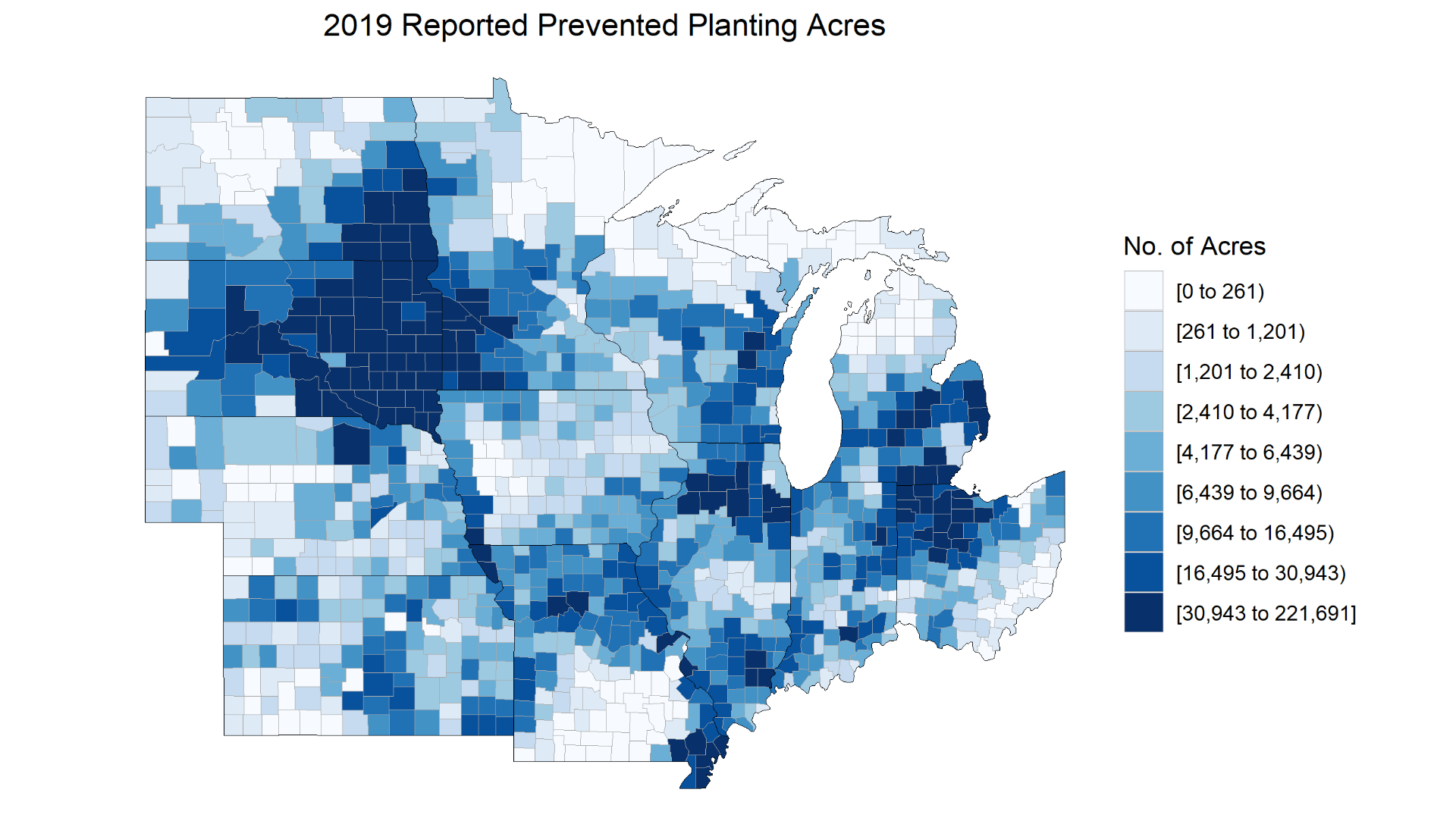
The USDA will release the next WASDE on September 12th and it is unlikely that it will have as great of an impact as the August report. Many of the questions that farmers and traders have been left with will not be answered fully until after harvest data comes in. Given the unprecedented number of unplanted or delayed acres there are many questions on how many acres will actually end up harvested for grain. Ohio had reported over 880,000 of prevent plant corn acres to the USDA as of August 1st.  This will continue to be reflected in a stronger than normal basis in those areas that were most impacted. There also remains plentiful speculation on the possibilities of meeting the yield numbers that USDA has forecasted.