COVID-19 Impact on Ohio’s Beef Industry

by: Garth Ruff, OSU Extension Henry County.

COVID-19 has had profound impacts on our food and livestock production systems here in the U.S. With regards to the beef industry the impact has been felt locally and throughout the country. Locally here in Ohio, with the JBS plant in Souderton closed, and reduced packing capacity in other regional packing plants, the local cash market for fed cattle has been greatly diminished. For the past two weeks, auction markets in the state have asked cattle feeders to hold off on bringing fed cattle to market due to packing plant closures and overall lack of packer demand.

Like most of agriculture, timing is critical for the livestock production supply chain to flow as it is designed. What is the impact of holding market ready cattle in local feedlots? Economically, cash flow concerns for small to medium size cattle feeders may arise as packing capacity remains limited. Immediate impacts for cattle feeders include increasing days on feed, selling heavier and potentially higher yield grade cattle once the market returns. Most packing plants have discount schedules of Yield Grade 4 and 5 cattle in addition to carcass weight specifications.

There have been discussions regarding slowing the rate of gain or transitioning livestock to a maintenance diet. As fed cattle sales are delayed, the cost of gain increases, more feed is required, and cattle are less efficient as they reach or pass optimal harvest condition.

In a study commissioned by the National Cattlemen’s Beef Association and led by Derrell Peel, Breedlove Professor of Agribusiness and Extension Livestock Marketing Specialist at Oklahoma State University the total losses to the US beef industry were estimated at $3.7 billion or the equivalent of $111.91 per head for each mature breeding animal. The losses for the cattle feeding segment of the industry was projected to be at $3.0 billion or $205.96 per head.

Worth noting, one bright spot with regards to fed cattle is that demand at the local level has greatly increased. Local meat processors have reported record retail beef sales, however large increases in local demand are often tempered by the lack of cooler space available in small plants that are already working at capacity. The cattle supply is available, however logistics remain a challenge.

While local stocker prices have been relatively stable, especially for calves going to grass; the NCBA study estimates that stocker/backgrounder losses averaged $159.98 per head, or $2.5 billion country wide.

Prior to COVID-19 cull cow and bull processors were operating at or near capacity, given the current status in the dairy industry, that trend is likely to continue. Beef cow-calf operators have an opportunity to add some condition to cows currently on the cull sheet if it can be done at an economic cost of gain.

The beef industry and all of agriculture is currently navigating uncharted territory with the disruption to the supply chain caused by COVID-19. If you have questions reach out as additional information is available from state-level Extension, and the Ohio Cattlemen’s Association are available to assist producers in these difficult times.


COVID-19 – Impacts on Ohio’s Swine Industry

by: Steve Moeller, Department of Animal Sciences, State Swine Extension Specialist

Like many livestock sectors, the impact of COVID-19 on Ohio’s and the Nation’s swine industry have been multi-factorial and ever-changing.  In response, the National Pork Board has maintained an on-line COVID-19 information center at https://www.pork.org/ which is updated multiple times per day based on new findings.  The impact is now being felt as the number of ‘short-term’ packing plant closures seem to increase daily. Plant closures will impact the industry as a whole in a number of ways, namely: 1) U.S. production is matching packing plant capacity and both are at record levels, thus a regional lack of shackle space will likely occur, 2) Swine production is now nearly constant, centered around weekly flow and optimization of space utilization, thus pig spaces are full and need to be continually emptied to make room for incoming production, 3) Distribution channels from packing plants to consumers are not as efficient, leading to challenges in managing product movement from the packer to the consumer. Additional plant closures, particularly if they occur from Indiana eastward will place a significant burden directly on the producer; 4) The bright spot:  Export markets have helped offset some of the supply, particularly trade with traditional partners in Japan and Mexico, but with added sales to China.

Economic challenges have also followed the shut-downs due to COVID-19.  A few points to consider: 1) Bellies, the long-standing staple for adding value to pork; price January, 2019 – $1.72/lb.; price January, 2020 – $1.19/lb.; price April 10, 2020 – $0.46/lb.  Demand for bellies has dropped due to restaurant and food service closures, compounded by a supply of bacon in packages too large and in locations not amendable to retail trade at the grocer.  Take home: EAT MORE BACON!!!!! (for more information on pork prices see: https://www.pork.org/blog/category/weekly-pork-price-summary/ ; 2) Carcass prices received have dropped considerably from early January, 2020 (~$0.563/lb. carcass) to April 14, 2020 (~$0.36/lb. carcass) reducing revenue per head by over $40.00 per pig produced (https://www.ams.usda.gov/); 3) Weaned pig (~21 days of age) cash prices reported between $2.00 and $16.00 per head, on a breakeven production cost near $35 to $40.00 per weaned pig; 4) Ethanol production facilities have been shuttered, reducing access to distillers dried grains with solubles (DDGS) which offered lower cost energy and protein options for producers.  Shift back to traditional corn-soybean meal diets as being most cost effective; 5) Concern regarding sourcing of key amino acids and vitamins via import from global stocks.

Producer responses have been mixed and guarded as one would expect in times of challenge.  Considerable interest in slowing growth rates in finisher swine if market access is restricted.  Dietary changes to add fiber, tightening feeder adjustments to slightly restrict feed flow, and many other options have been proposed; yet, this is a short term solution when pig flow is dictated by births and space needs from the sow units (for more information consult: https://www.porkbusiness.com/article/pulling-lever-should-you-slow-down-pig-growth).  Sow harvest numbers have trended higher in the past few weeks, an indication that some producers may be cutting herd size back. Likely these numbers represent the poorest performing animals first, but with continued pressure indications are that some producers may consider liquidating.  There are also groups looking to reduce numbers of piglets through planned euthanasia or abortion, as last resorts, to relieve numbers in already full production systems. Significant challenges in each of the identified areas as the caregivers, managers, owners maintain a very vested interest in welfare friendly production of high quality, safe food.

In summary, COVID-19 has had a multitude of negative effects on Ohio’s swine sector, many of which have ripple effects on individuals and their communities.  Outreach education and information from state-level Extension, the Ohio Pork Council, and the National Pork Board are available to assist producers in these difficult times.
Meat vs COVID-19; The good, the bad and the ugly of supply and demand

by: Stan Smith, OSU Extension, Fairfield County

To suggest that supply in local meat cases has been disrupted since schools closed and ‘stay-at-home’ orders were issued last month might be an understatement.

The good is simply this. We have more than adequate supplies of market ready livestock on the farm to accommodate the consumer’s demand for meat.

The bad is that COVID-19 caused disruption to the meat supply chain that created short term shortages in the meat case, and fluctuations of price in both the meat case and especially livestock at the farm.

The ugly is these concerns are likely to affect both the farmer and the consumer for weeks, and perhaps even months to come. The solution to the chain of events that have caused the problems in the supply chain all revolve around how quickly COVID-19 is arrested and the lives of consumers and all the members of the meat supply chain can return to normal.

First, to understand the solution one must have an understanding of the inter-related actions and reactions that caused the meat case shortages and livestock price fluctuations experienced in recent weeks, and perhaps into the foreseeable future.

The story begins early in 2020 when the livestock markets were reacting negatively to the concerns of the potential impact COVID-19 could have on exports when it hit the U.S.

In mid-March when it became obvious COVID-19 had arrived in the U.S., markets shifted their attention to domestic meat supplies. On March 16 when Ohio’s schools closed, they were no longer offering lunch to 1.7 million schoolchildren. Families were suddenly needing to shop for food – including meat – to prepare at home. A week later Ohio’s stay-at-home order was issued. That resulted in restaurants closing or only offering drive through service and families were once again headed back to the grocery to stock up as they prepared to create even more meals at home. As Americans were now suddenly no longer spending more than a third of their food budget on meals prepared away from home, the markets reacted with a short-lived spike in livestock prices as supply scrambled to keep up with demand in local meat cases.

It’s now April and the markets have shifted their focus away from the demands of simply feeding the consumer, but are now concerned about packing plants operating below capacity or temporarily closing down due to the impact the virus is having on the labor force in those plants. While demands for meat in the retail case remains strong, and livestock inventory is more than adequate to supply that demand, the loss of U.S. harvest capacity is now causing a backlog of market ready livestock at the farm. The net result is strong prices in the meat case at a time when farm gate livestock prices are depressed simply due to the lack of a market outlet.

Today, consumers are again facing the potential for temporary disruptions to the meat supply chain until packing plants can get back to full production. At first glance this may seem to be a short-term problem the consumer can simply manage around. Unfortunately, the same is not necessarily true for the livestock owner.

If a consumer must prepare a meal without meat because of an empty meat case, it’s a meat sale that is lost forever. At the same time, along with lost packing house capacity and resulting delayed animal sales comes market ready livestock that continue to grow – and create more meat – every day they are held off the market. Even when restaurants are allowed to reopen, the question remains, “How quickly will consumers return to restaurants, and can the supply chain quickly shift again and provide the meat they will demand in timely fashion?”

Until COVID-19 subsides and enough healthy work force is available to restore the U.S. packing house capacity and entire supply chain structure, we will continue to deal with the good, the bad and the ugly of a disrupted supply and demand. Consumers may experience temporary meat case shortages while livestock producers will be faced with marketing challenges, depressed prices, and the need to remain flexible in their livestock feeding and marketing plans moving forward.

The three articles that follow focus more closely on the impact COVID-19 is having on beef, swine and lamb producers and their individual markets.


Join OSU Extension for Farm Office Live on April 20

OSU Extension is pleased to be offering the third session of “Farm Office Live” session on Monday evening, April 20, 2020 from 8:00 to 9:30 p.m.  Farmers, educators, and ag industry professionals are invited to log-on for the latest updates on the issues impact our farm economy.

The session will begin with the Farm Office Team answering questions asked over the past week.  Topics to be highlighted include:

  • Update on the CARES Paycheck Protection Program (It is out of money!)
  • WHIP+
  • Update on commodity prices
  • Update on Dairy Margin Coverage program
  • Update on Unemployment compensation
  • Other legal and economic issues

Plenty of time has been allotted for questions and answers from attendees. Each office session is limited to 500 people and if you miss the on-line office hours, the session recording can be accessed at farmoffice.osu.edu the following day.  Participants can pre-register or join in on Monday evening at  https://go.osu.edu/farmofficelive 

The March 2020 Soybean Crush Report is One for the Record Books

Click here for a PDF version of this article

By Ben Brown, Department of Agricultural, Environmental and Development Economics, The Ohio State University – 4/17/2020

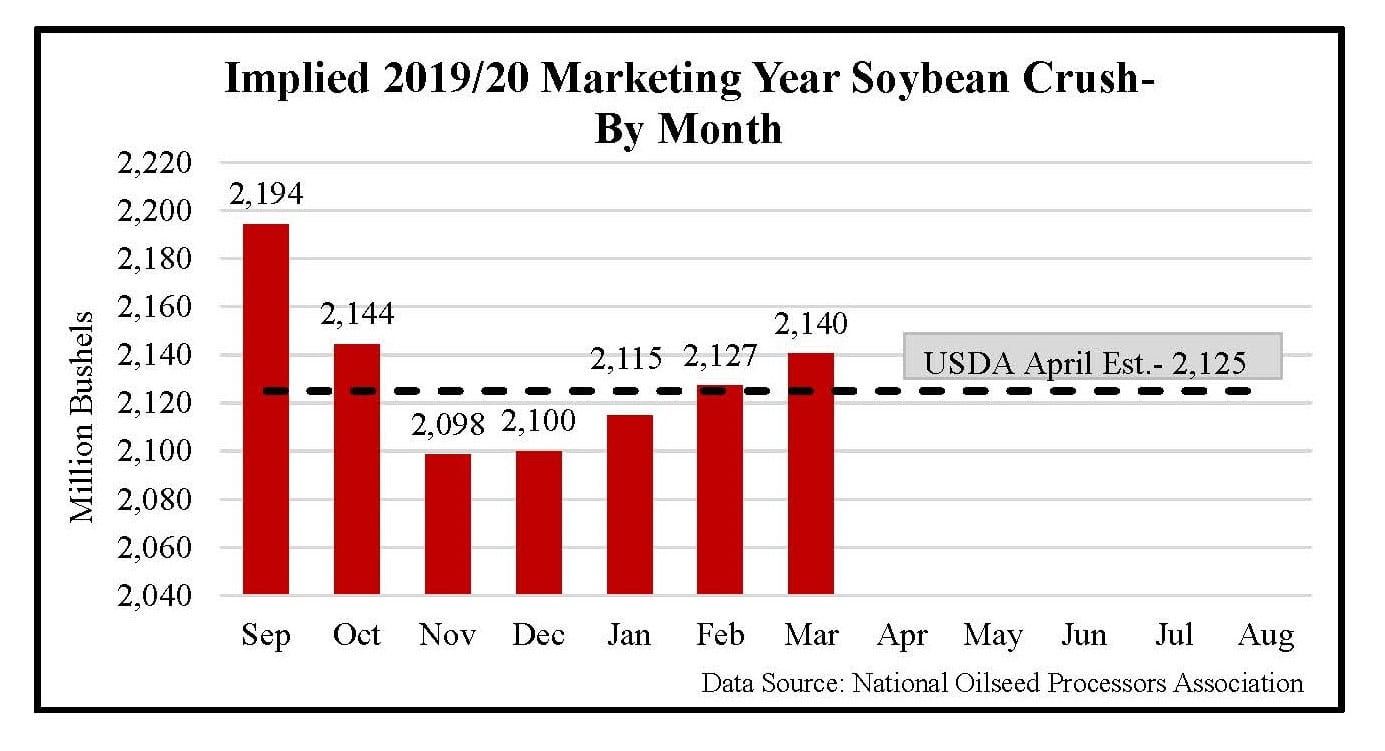
The National Oilseed Processors Association (NOPA) released their March 2020 soybean estimates on Wednesday April 15- a day that usually is not held in high regard due to US tax collections. That is until this year, when federal income tax filings could be deferred to the middle of July and NOPA released a report further solidifying one of the few bright spots in the agricultural marketplace amid COVID-19 disruptions. The report indicated that monthly soybean crushing by the organization’s 13 members who account for approximately 95% of all crushed soybeans in the US reached a new monthly crush record of 181.374 million bushels.  This far exceeds any previous month and the market analyst expectation for the month of 175.163 million bushels. The March total is the first month above 180 million bushels and bested the previous record set just two months earlier by 6.211 million bushels. Soybean crush during the 2019/20 marketing year has been supported by strong domestic and international demand for soybean meal and healthy crush margins with new records being broken in four out of seven reported months- October 2019, December 2019, January 2020 and March 2020.


The USDA World Agricultural Supply and Demand Estimate (WASDE) report released April 9th increased 2019/20 marketing year crush by 20 million bushels from the February estimate to 2.125 billion bushels. This forecast would also be a record and 1.6% higher than last year’s total. Only September and November have failed to exceed the monthly values from the prior marketing year. At 181.374 million bushels reported by NOPA and a consistent rate with recent monthly USDA crush reports, the March crush report is estimated at 192.5 million bushels. That puts the seven-month cumulative total for the current marketing year at 1.265 billion bushels, roughly 60% of the April WASDE forecast. US soybean crush needs 859.5 million bushels over the remainder of the marketing year or 172 million bushels each month to meet estimates. Monthly crushing has exceeded this value every month besides September, justifying the April USDA increase.  The US crushed 851 million bushels between April and August a year ago. Cumulative soybean crush is currently 9 million bushels ahead of the seasonal pace needed to reach USDA’s estimate of 2.125 billion bushels. The less than one percent advantage over seasonal adjustments implies 2.140 billion bushels. At this implied value, 2019/20 would be a 2.3% increase over 2018/19. This is not out of the question, but infrastructure capacity will be tested. US soybean crushing increased year over year by 8% in 2014/15 and 2017/18 when new infrastructure was built- the increase averaged 1.2% in other years. Current market conditions support USDA meeting and possibly exceeding the April WASDE Estimate if demand holds for the remainder of the marketing year.

Soybean meal prices have fallen in recent weeks with the rest of the agricultural commodities back to levels seen in early February on the futures market. Some cash markets have remained elevated as soybean meal demand replaces the lack of dried distillers grains in feed rations where appropriate. The May soybean meal contract closed at $291.8/ton on April 16, 2020 roughly $45 less than three weeks prior. The April WASDE report increased domestic soybean meal use 300,000 tons to 37.1 million tons, 2.7% above last years disappearance. With a national hog herd 4% larger than last March and a near record cattle on feed number elevated soybean meal for feed use seems likely to continue. One caution would be the announcement of pork and beef packing facilities either closing or slowing output as a result of COVID-19. Packing slowdowns decrease the demand for live animals and producers are forced to slow the rate of gain in animal growth and thus feed usage. However, if packing plants start reopening and moving toward full speed soon and ethanol production remains suppressed, putting a limit on DDG availability, it is possible to see increased feed use for both soybean meal and corn.

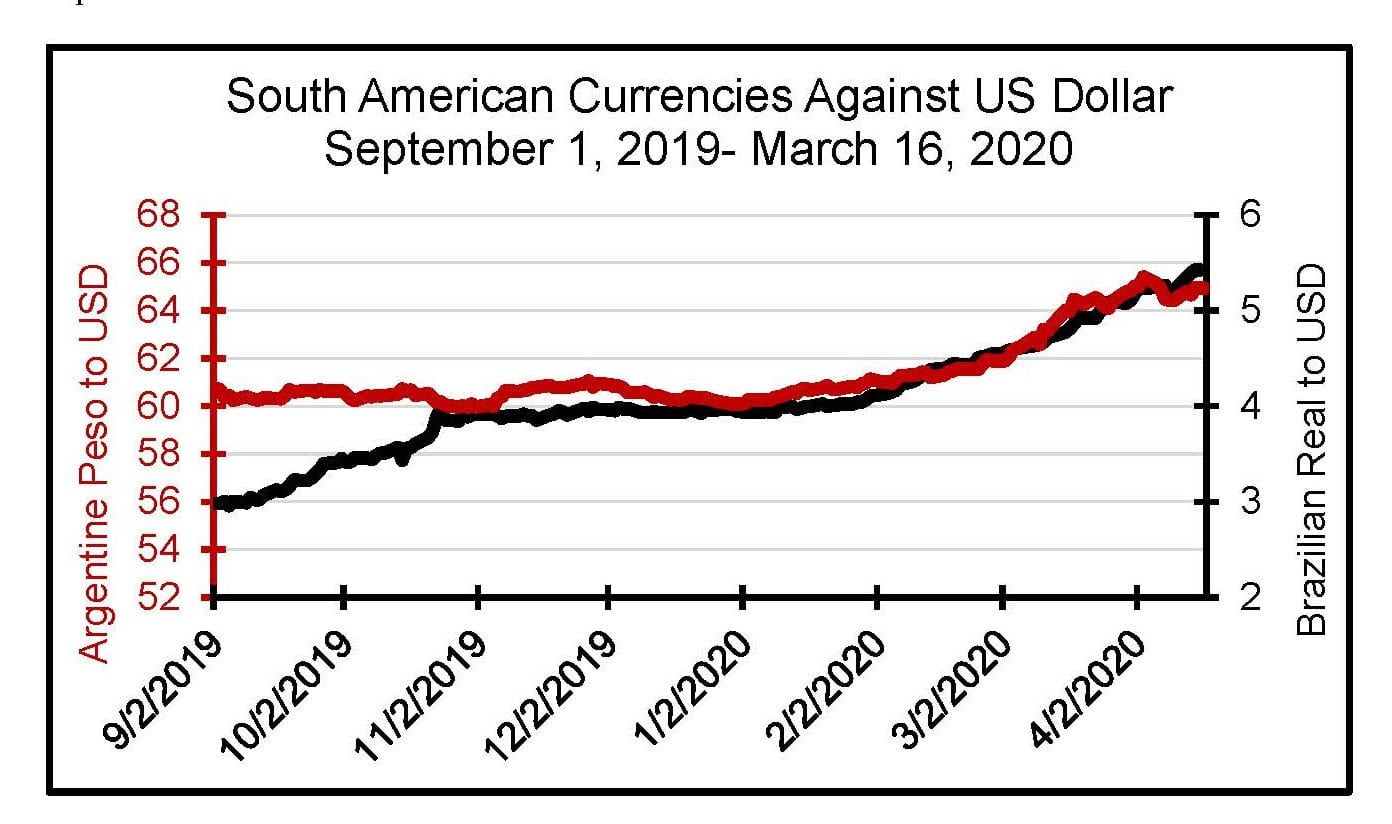
Strong soybean meal exports are also supporting increased crushing. The April WASDE report increased the forecasted value for exports during the marketing year to 250,000 tons. At 13.45 million tons the current marketing year will be 104,000 tons below the 2018/19 total after exports lagged heading into the start of the marketing year primary on strength of South American crushing and currency exchanges. The Peso has depreciated 32% against the Dollar since August 1, 2019 with a similar drop to the Real. Through the first seven months of the marketing year, soybean meal exports sit 4% below the same period last year and total commitments are 3% below the three-year average. However, this has improved from the weak sales and exports in November and December. Outstanding sales for the remainder of the marketing year are just over 2.7 million metric tons but remain 12% below the outstanding sales reported at this time last year. Increased exports to Canada and Central American are only partially making up for decreased sales to Vietnam (-63%), the European Union (-40%) and Japan (-56%). Unless COVID-19 continues to cause logistical challenges in Argentina it is difficult to see how the US maintains the strong export sales experienced in March. It is possible to see a reduction to 13.35 million tons of soybean meal exports.


Soybean oil prices have found a little strength on technical support in the last couple weeks after being on a steady decline since the start of the calendar year. Soybean prices started the year at just over 35 cents per pound before bottoming out mid-March at 25 cents per pound. This was the lowest value for soybean oil since October 16, 2006. Soybean oil import forecasts have been reduced for China, India and Venezuela on weaker economic activity and reduced competitiveness for biodiesel to gasoline. However, reduced production in Argentina due to COVID-19 did allow the US to pick up some soybean oil sales. Price competitive palm oil prices out of Indonesia are putting pressure on soybean oil exports. World stocks to use of oils at 6.3% is 1.3% less than a year ago on increased palm, soybean and sunflower use. Accumulative export sales through the first seven months of the year sit 40% above the same period a year ago, but sales also started out the year very strong. Total commitments for the year sit 28% above the three-year average with outstanding sales of roughly 309,000 metric tons which is 64% above a year ago with large sales to South Korea in March. Even with a reduction of 200 million pounds in the April WASDE, exports in 2019/20 are estimated to be almost 24% above last years oil exports. Given the strong export sales already this year it is likely that the US will exceed last years value, but lingering COVID-19 impacts on biodiesel and economic activity globally make maintaining the rapid export pace unlikely.

COVID-19 has put a damper on strong domestic use of soybean oil. Current estimates are for a 474 million pound reduction in domestic disappearance of soybean oil to 22.4 billion pounds. Lack of motor fuel use continues to put downward pressure on biofuels eroding the forecast as people stay home.

Summary: The March NOPA crush values shattered monthly crushing records on increased demand for both meal, strong oil exports and healthy crush margins for processors. Historical pace would imply 2019/20 soybean crush at 2.140 billion bushels, but infrastructure constraints and declining demand for soybean oil compared to March could dampen soybean crush through the remaining six months. USDA raised soybean crush 20 million bushels in the April WASDE to 2.125 billion. At this time that adjustment is justified, but we might not see a crush report like March for a while.


For Farmers Markets without a Facility due to the COVID-19 Crisis, What are the Rules on Access to Restrooms?

by: Amanda Douridas, Christie Welch, Peggy Kirk Hall

With the closing of many public places and government buildings, some farmers’ markets may be left without their usual access to restrooms. What are the requirements for market managers to provide restroom facilities?

The Ohio Revised Code states that restrooms must “be readily accessible to farmers’ market personnel when the farmers’ market is open for more than four consecutive hours.” Note that this requirement applies to “personnel” or employees of the market. There is not a restroom requirement in the regulation that applies to vendors or customers of the farmers’ market.

One option for easily complying with this rule is to limit farmers’ market hours to four hours or less, since the obligation applies only if the market is open for more than four consecutive hours. For markets that are open for more than four hours, the other option is to rent a portable toilet for personnel if permanent facilities are not available.  And while there is no requirement for restrooms to be available to the public, some markets like to offer this as a courtesy to their vendors and shoppers.  In light of the social distancing orders, use by customers may be very limited or non-existent. But what about your market personnel?

We know during normal operations, many markets have restroom access, especially for vendors.  But during the COVID-19 pandemic and the fact that many of the facilities that markets had access to are now closed; portable toilet rental might be the best option. Markets may be able to get a reduced rate if the toilet is only being used for a few hours a week. Locking the toilet with a padlock when the market is closed will ensure no one accesses it outside market hours. The code also state “[a]ll equipment and facilities used in a farm market, farmers’ market, and a farm product auction shall be maintained and clean.” So, it will need to be maintained and cleaned. A temporary hand washing station can be setup using a 5 gallon thermal container with warm water and a 5 gallon bucket to catch the water. Add soap and paper towels on the table, along with a trash can for a complete station (see graphic for example).

If restrooms had been available, but now will not be, let vendors know so they can be prepared for the change. This would be a nice courtesy to them since vendors are unable to leave during market hours.

Also make sure your vendors and customers understand this is NOT business as usual.  While we love farmers’ markets for their social atmosphere, those activities need to be stopped to help maintain everyone’s safety and health. The goal at this time should be to allow customers to access locally produced food from farmers with as little interaction as possible. Signage to remind your customers to maintain social distance, to not touch the produce, and to get their items and exit the market quickly are also good practices at this time.

For more information about operating farmers’ markets during the COVID-19 pandemic, you may want to check out the Ohio Farmers Market Network resource page: https://go.osu.edu/covid19ofm.


From the University of Kentucky Best Practices for Sampling At Farmers Markets

http://www2.ca.uky.edu/cmspubsclass/files/extensionpubs/2012-19.pdf

April 10 AG Law Harvest

By: Peggy Kirk Hall, Friday, April 10th, 2020

Source: https://farmoffice.osu.edu/blog/fri-04102020-532pm/ag-law-harvest

Although many of us are quarantined at home these days, the gears of the legal world are still turning.  Here’s our gathering of recent notable news and legal developments:

Our Farm Office is open Monday Night! Join us for the Farm Office’s live online office hours this Monday night from 8—9:30 p.m.  Our team of experts will provide updates on the Paycheck Protection Program and the dairy economy and discuss COVID-19 macro-economic and export impacts, BWC dividends, property tax concerns, potential legal issues arising from COVID-19, and other issues you want to discuss.  Register at https://go.osu.edu/farmofficelive.

What’s the deal with dicamba? Our partner, the National Agricultural Law Center, is hosting a free webinar on dicamba litigation on Wednesday, April 15 at noon EST.  “The Deal with Dicamba:  An Overview of Dicamba Related Litigation,” will feature attorney Brigit Rollins, who will review each of the dicamba lawsuits, the claims made by the plaintiffs, and what the outcome of each suit could mean for dicamba use in the United States.  Go to https://nationalaglawcenter.org/webinars/dicamba/ to learn more.

Walmart sued for employee’s COVID-19 death.  We’ve been wondering when we’d start seeing COVID-19 lawsuits, and the answer is now.  On Monday, the estate of a Walmart employee in Illinois who died from COVID-19 sued the company for negligence and wrongful death.  The complaint alleges that Walmart failed to properly clean the store or provide employees with masks, gloves, antibacterial wipes and other protective equipment, knew that employees were exhibiting COVID-19 signs and symptoms, and did not screen new employees for COVID-19.  A second employee at the same store has also died of the virus.  Read the complaint at https://farmoffice.osu.edu/sites/aglaw/files/site-library/COVID%20Walmart%20lawsuit.pdf

Shell eggs go to market.  The FDA issued guidance that eases up packaging and labeling requirements during the COVID-19 pandemic for shell eggs sold directly to consumers in retail food establishments.  The agency explained that it made the change because plenty of shell eggs are available to meet increased consumer demands, but properly labeled retail packaging for the eggs is not.  See the guidance at: https://www.fda.gov/media/136671/download

EPA’s glyphosate approval is challenged.  Glyphosate, used in the weed killer Roundup, is in the news again.  This time, the controversy surrounds the EPA’s decision in January 2020 to allow glyphosate to continue being used in the interim while the agency conducts its mandatory 15-year re-approval review.  Although EPA has yet to make its re-approval decision, two groups of plaintiffs have petitioned the Ninth Circuit Court of Appeals for an invalidation of the EPA’s decision allowing continued use in the interim.  Plaintiffs argue that the decision violates both the Federal Insecticide, Fungicide, and Rodenticide Act and the Endangered Species Act because the EPA has not gathered enough information to prove that glyphosate is safe for humans, the environment, and endangered species.  You can read the petitions at: https://www.nrdc.org/sites/default/files/glyphosate-petition-for-review-20200320.pdf and http://www.centerforfoodsafety.org/files/01-petition-for-review–final_35405.pdf and EPA’s interim decision at https://www.epa.gov/sites/production/files/2020-01/documents/glyphosate-interim-reg-review-decision-case-num-0178.pdf

No rehearing for RFS litigation.  We reported previously that the Tenth Circuit Court of Appeals held the EPA in violation of the Renewable Fuel Standard (RFS) when it granted RFS blending waivers to three small refineries.  While the Trump administration did not appeal the court’s decision, two of the oil refiners requested a rehearing before the full panel of Tenth Circuit judges.  This week, those requests were rejected by the Tenth Circuit, starting a 90-day period during which the refiners may petition for a hearing before the U.S. Supreme Court.

ODNR suspends hunting and fishing license sales for non-residents.  The Ohio Department of Natural Resources announced this week that it is “temporarily suspending the sale of non-resident hunting and fishing licenses until further notice” to further discourage travel into the state.  ODNR has no set date to lift the suspension; it will be in place as long as state COVID-19 orders dictate.  Read ODNR’s press release at: http://ohiodnr.gov/news/post/odnr-to-temporarily-suspend-sale-of-non-resident-hunting-and-fishing-licenses

BWC gives dividends and deferrals.  The Ohio Bureau of Workers’ Compensation board decided yesterday to pay dividends to employers for BWC premiums to the tune of up to $1.6 billion.  Checks will go out to employers later in April, and will equal approximately 100% of the BWC premiums paid in their 2018 policy years.   The agency is also allowing employers to delay unpaid premium installments due for March through May until June 1, 2020 and will not lapse coverage or assess penalties for amounts not paid due to the COVID-19 pandemic.  See the Frequently Asked Questions at: https://www.bwc.ohio.gov/downloads/blankpdf/COVID-19-BWCFAQs.pdf

Pasture Rental Rates and the Price of Hay

by: Clifton Martin, OSU Extension Educator, Muskingum County

Originally posted to Ohio Beef Team Newsletter:

Source: https://u.osu.edu/beef/2020/04/08/pasture-rental-rates-and-the-price-of-hay/#more-8597

Rental rates and hay prices are two questions quickly asked with potential lengthy answers.  Many factors will affect market prices both over time and regionally. This is a quick discussion to look at some ballpark ranges on how pasture rental rates can be determined.

Published in 1998, OSU Bulletin 872, Maximizing Fall and Winter Grazing of Beef Cows and Stocker Cattle, presents calculations using the rent per unit of livestock on a monthly basis using the formula animal weight per 1,000 lbs x hay price per ton x pasture quality factor.

Where Pasture Quality Factors are as follows:

0.12 = 0.12 unimproved condition
0.15 = 0.15 fair to good permanent pasture
0.18 = 0.18 very good permanent pasture
0.20 = excellent meadow (grass/legume)
0.22 = lush legume pasture

The example in Bulletin 872 uses a 1,000 lb cow with 200 lb calf (1.2 animal unit months), hay price of $40/T, and pasture quality of 0.15.

Example: 1.2  X  $40  X  0.15 = $7.20 rent/head/month

This is a fairly standard calculation which attempts to adjust for forage quality and time on pasture but not the only method producers or landowners may need. It is also easy to adjust and customize based on individual conditions. More systems of calculating rental rates can be found in OSU Extension Fact Sheet FR-8, Establishing a Fair Pasture Rental Rate.

Calculating the price of hay can be moving target and it can be tough to provide a direct answer if asked. This is especially true when supply and quality appear to be low and markets are active. Rent conversations can go the same direction, but there are tools to help move everyone into the ballpark for effective conversations and help frame expectations. Ultimately, producers must know their own cost of production for profitably and landowners must know their own cost of ownership before the conversation starts.

For our purposes here, the ballpark boundaries are the above calculation and statistics from the USDA National Agricultural Statistics Service. Consider the following:

Pasture Rental rates per acre in the state of Ohio ranged from $12.50 to $66.50 across 34 reporting counties in the state of Ohio in 2019 (USDA NASS).  For the sake of discussion, if we throw out the high and low, the range is then $12.50 to $56.50 (more than one county reports $12.50).

In a ten-year time span from 2008 to 2019, the average pasture rental rate per acre in the state of Ohio varied from $25-$47. (USDA NASS)

With an animal unit of 1.2 and fair pasture quality of 0.15, rent per head per month ranges from $7.20 (hay price $40/T) to $36.00 (hay price $200/T).

The annual average price of hay for the state of Ohio from 2008 to 2019 ranged from $112 to $193 (USDA NASS).

Table 1 Presents an adaptation of the rent/head/month calculation presented in Bulletin 872 to quickly demonstrate the impact of the price of hay. Table 2 presents price ranges based on changes in the quality of the pasture. Table 3 provides examples of calculations on cow/calf, dairy, and ewe/lamb livestock. Any claims of high pasture quality and high hay quality should have supporting records to support the claim.

Table 1.

Table 2.

Table 3.

As always, there are a whole host of reasons that some of these numbers may not make sense in every situation. I often get asked what the “going rate” is for both rent or hay, and the reality is the best I can do is drop a few numbers to show what some of the boundaries are to frame a discussion. The numbers presented here are part of one approach among many and should be evaluated against other methods and opportunities.

Resources:

Maximizing Fall and Winter Grazing of Beef Cows and Stocker Cattle, Bulletin 872.  1998.  Ohio State University Extension

OSU Extension Fact Sheet FR-8, Establishing a Fair Pasture Rental Rate, 2006 ohioline.osu.edu/factsheet/FR-8

USDA NASS Statistics
Ohio Hay Price Received Historical: https://quickstats.nass.usda.gov/results/4EDA186C-D249-3292-80A3-DFF413E435F7

Ohio County Cash Rents Pastureland 2019: https://quickstats.nass.usda.gov/results/2D242713-B0F1-3ACE-91C3-79FD5A70B258

Ohio Cash Rent Pastureland 2008-2019: https://quickstats.nass.usda.gov/results/FB2CC371-EC35-317B-8302-5ECD19C0A34D

“Farm Office Live” returns Monday, April 13 at 8:00 p.m.

OSU Extension is pleased to be offering a second “Farm Office Live” session on Monday evening, April 13, 2020 from 8:00 to 9:30 p.m.  Farmers, educators, and ag industry professionals are invited to log-on for the latest updates on the issues impact our farm economy.

The session will begin with the Farm Office Team answering questions asked over the past week.  Topics to be highlighted include:

  • Update on the CARES Paycheck Protection Program
  • Update on the Dairy Economy
  • Examination of how COVID-19 is impacting agricultural exports
  • Bureau of Workers Compensation’s announcement  of dividend returns
  • A look at the long term macro economic impact of COVID-19
  • Will property taxes be delayed?
  • Potential Legal Impacts of COVID-19

Plenty of time has been allotted for questions and answers from attendees. Each office session is limited to 500 people and if you miss the on-line office hours, the session recording can be accessed at farmoffice.osu.edu the following day.  Please register at  https://go.osu.edu/farmofficelive 

The OSU Farm Office is Open! COVID-19 and Other Hot Topics on Monday, April 6 at 8:00 p.m.

As you may know, Ohio State’s campuses and offices are closed.  But we are all working away at home, and our virtual offices are still open for business.  Starting Monday April 6th, the OSU Farm Office Team  will open our offices online and offer weekly live office hours from 8:00 to 9:30 p.m.  We’ll provide you with short updates on emerging topics and help answer your questions about the farm economy.   Each evening will start off with a quick 10-15-minute summary of select farm management topics from our experts and then we’ll open it up for questions and answers from attendees on other topics of interest.

Who’s on the Farm Office Team?  Our team features OSU experts ready to help you run your farm office:

  • Peggy Kirk Hall — agricultural law
  • Dianne Shoemaker — farm business analysis and dairy production
  • Ben Brown — agricultural economics
  • David Marrison — farm management
  • Barry Ward  — agricultural economics and tax

Each office session is limited to 500 people and if you miss our office hours, we’ll post recordings on farmoffice.osu.edu the following day.  Register at  https://go.osu.edu/farmofficelive.  We look forward to seeing you there!