Latest COVID-19 Legislation to Provide Funds for Farm Businesses

By: Peggy Kirk Hall, Associate Professor, Agricultural & Resource Law Program

Economic relief measures in the CARES Act have proven difficult for farms, first due to confusion over which and how farmers qualify and also by soaring demand and depleted funding.   But the recently enacted Paycheck Protection Program and Health Care Enhancement Act (HR 266) should help.  The legislation injects more funds into both the Paycheck Protection Program (PPP) and Economic Injury Disaster Loans Program (EIDL) and clarifies that farmers can qualify for EIDL loans.  The bill also came with a bonus:  additional guidance from the USDA and SBA for farmers seeking to access the programs.  Both programs are first-come, first-served, so farm businesses who haven’t applied for the funds should decide whether to do so right away.

Here’s how the new legislation affects agricultural businesses:

  • Allocates another $310 billion for the PPP to provide payroll funding for eligible employers, which includes $60 billion in funding for smaller lending institutions working with PPP loan applicants.
  • Doubles the EIDL program, adding another $10 billion to the SBA disaster loan program for eligible businesses.
  • Clarifies that agricultural enterprises are eligible for EIDL loans.

Using the PPP:  a few quick tips

The SBA will resume accepting applications for the PPP today.  Information about the program is on SBA’s website, here.  Generally, PPP gives loans of up to $10 million at 1% interest to keep employees employed, with a loan maturity of two years and generous forgiveness provisions.

Farm businesses, including cooperatives, with fewer than 500 employees or who fit within the definition of a “small business concern” may apply for a PPP loan through an approved lender.  Lenders include local banks as well as agricultural lenders in the Farm Credit System.  Farmers should talk first to the lenders with whom they ordinarily do business to see if the lenders are participating in the PPP.  If not, SBA provides a lender locating tool here.

The PPP application is here.  Employers may use the loan for payroll costs or owner compensation replacement, as well as for mortgage interest, rent, and utility payments and interest payment on other debts, but 75% of the expenditures must be for payroll costs.  To determine the maximum loan amount, an employer must document and calculate aggregate payroll costs from the previous 12 months, from calendar year 2019, or from February to June of 2019 if a seasonal employer.   The SBA provides assistance on how to calculate payroll costs, and finally addresses the requirements for self-employed farms who report income on Schedule F.  Read the guidance here, and see question 3 if you’re reporting income on Schedule F.

Upon receiving a PPP loan, a lender will set up a separate account for the funds.  Borrowers should carefully document loan expenditures.  This is not only for compliance purposes, but also because the PPP loan program includes a forgiveness component that forgives an amount equal to the sum of eligible costs and payments made during the eight weeks following disbursement of loan funds.  At least 75% of the amount forgiven has to be for payroll costs, and the amount may be reduced by reductions in total salary or wages.  Borrowers will have to apply for forgiveness, and documentation of all expenditures will prove necessary to the forgiveness process.  We’re awaiting additional guidance on the forgiveness provisions, so keep an eye out for more information on this important topic.

The EIDL program

Farm businesses and agricultural cooperatives with no more than 500 employees may also now apply for EIDL, which gives loans up to $2 million for businesses that suffer economic injuries due to COVID-19.  Because the program ran out of funds, there is a backlog in EIDL applications and the SBA is not reopening the loan portal until it catches up with the backlog.  If SBA does reopen the program, businesses apply directly through the SBA here.

Businesses may use an EIDL loan for fixed debt, payroll, accounts payable, and other operating expenses due to the pandemic, but can’t use the funds for the same purposes as the borrower’s PPP loan.  The interest rate for EIDL is higher at 3.75% (2.75% for non-profits), but the term can be up to 30 years.

Important to note:  EIDL also includes an “emergency advance” component that provides a $10,000 advance within a few days of submitting an application.  A borrower doesn’t have to repay the advance, even if the borrower doesn’t ultimately qualify for a loan.  But if the borrower also has a PPP loan, the PPP forgiveness is reduced by the $10,000 EIDL advance.  The emergency advance can go towards paying sick leave, payroll, increased materials costs, rental or mortgage payments, or other obligations due to revenue losses, as long as the borrower hasn’t used PPP funds for those costs.

There’s still more for farms to digest from the CARES Act.  The Farm Office team is ready to help!  Join us for “The Farm Office is Open” tonight at 8 p.m., when we’ll discuss the CARES Act programs and other economic developments for agriculture.  Register for the  live webinar and access past webinar recordings here.

Annie’s Virtual Reunion Slated for May 6, 2020

by Amanda Douridas, Extension Educator

Those who have participated in an Annie’s Project understand the camaraderie and friendships that are developed during the course. They also understand the value of education to improve the farm operation. Keeping those two points in mind, the Ohio Women in Ag team is hosting a virtual Annie’s Reunion on May 6 from 9-11 a.m.

The reunion will allow past participants to catch up with each other through virtual breakout rooms and further expand their education through 3 different tracts: Farm Management, Livestock, and Food. The opening session will provide resources and inspiration for the unique challenges farms are facing right now. Breakout sessions include grain and livestock market updates, backyard poultry, food prep and preservation and more. Those who have not participated in an Annie’s Project are also invited to attend to learn more!

If interested, please save the date and look for registration information next week. For questions, please contact Amanda Douridas at Douridas.9@osu.edu.


Farm Office Live on Monday April 27

OSU Extension is pleased to be offering the third session of “Farm Office Live” session on Monday evening, April 27, 2020 from 8:00 to 9:30 p.m.  Farmers, educators, and ag industry professionals are invited to log-on for the latest updates on the issues impact our farm economy.

The session will begin with the Farm Office Team answering questions asked over the past week.  Topics to be highlighted include:

  • Update on the CARES Paycheck Protection Program
  • Economic Injury Disaster Loan (EIDL)
  • Coronavirus Food Assistance Program (CFAP) Update
  • Ethanol and biofuel update
  • ARC and PLC Forecasts
  • Other legal and economic issues

Plenty of time has been allotted for questions and answers from attendees. Each office session is limited to 500 people and if you miss the on-line office hours, the session recording can be accessed at farmoffice.osu.edu the following day.  Participants can pre-register or join in on Monday evening at  https://go.osu.edu/farmofficelive 

Examining 2020 Corn and Soybean Acreage

By Ben Brown, Department of Agricultural, Environmental and Development Economics – The Ohio State University – 4/24/2020

Click Here for a PDF Version of this Article

Spring acreage decisions are of interest to analysts and producers across the country, as COVID-19 disrupts supply chains and raises questions of longer-term demand shifts. Analyst have interest on the supply for the 2020/21 marketing year, while producers weigh profitability and agronomic considerations. The challenging part of the whole picture is that most alternative options are not any better than the first. Corn and soybeans compete for acres through most of the Corn-belt with cotton competing in the southern and southeastern portions, grain sorghum competing in the lower plains and small grains like spring wheat competing in the upper plains. Ohio does not have many large-scale alternatives outside of corn and soybeans due to growing conditions, access to end markets and specialized equipment limitations. Therefore, for most Ohio crop producers the options in randomized order are plant corn, plant soybeans, convert to forage or pasture, utilize prevented planting, Conservation Reserve Program (CRP) or to idle the ground to do capital improvements and prepare for winter wheat or barley. This article examines acreage intentions, local profitability, and the estimated national supply of corn and soybeans.

Planting Intentions

The National Agricultural Statistics Service (NASS) released the summary of the Prospective Plantings Survey conducted annually the first two weeks of March on March 31, 2020. The survey of the planting intentions of 80,000 farmers is reviewed for reasonableness at both the regional field office and at the national level for accuracy.  The Prospective Plantings Report provides a summary of planting intentions at that point in time and because market and weather conditions change between early March and planting, the March report should not be used as actual producer intentions at planting, but a starting point. Principal acres of major crops were estimated at slightly over 319 million acres, a 16.5 million acre increase from the challenging 2019 growing season, but slightly down from 319.3 million acres in 2018.  The increase in principal crop acres largely came from coarse grain crops: corn, grain sorghum, barley and oats all up from 2019, 8%, 11%, 7%, and 7% respectively. The growth in feed grain acres outside of corn increases competition for feed use at a time when the livestock sector is adjusting to COVID-19 disruptions.

Crop producers indicated they intended to plant 96.99 million acres of corn and 83.5 million acres of soybeans. Figures 1 and 2 illustrate corn and soybean acreage intentions with percentage change from 2019 by state. States experiencing a greater than 20% increase in corn acres were states affected most by persistent rainfall in 2019 and large quantities of prevented planting acres. Almost all Corn-belt states indicated a 2020 soybean acre increase with Indiana being the exception matching their total from the prior year. Demand prospects for both crops are bearish for the upcoming marketing year.  Ethanol is estimated to be down roughly 55 million bushels/week and soft international exports of soybeans are also trending down due to relatively cheap Brazilian soybeans. As mentioned in last weeks update, soybean crush had a historic March 2020, but the prospects of strong crush continuing depend on logistical issues in competing countries as a result of COVID-19. The price impact for both commodities in evident in the ratio of new crop soybeans (November 2020) to corn (December 2020) currently at 2.5:1 up from 2.4:1 when the survey was taken. The higher ratio encourages more soybean acres, but timing is crucial. Given producers likely applied pre-planting nutrients and purchased seed, a larger ratio is needed to move significant national acres from corn to soybeans. Analysts have suggested 95 million corn acres. Over the last 20 years, corn acres declined more than 2 million acres from the March Prospective Planting Report to the  Final Acreage Report only once- 2019 when acres fell 3.1 million. Acres increased 3.1 million in 2007. However, there may be changes regionally due to local basis. In Ohio, when adjusting for changes in harvest basis the new crop ratio increased for soybeans to 2.68:1 on April 22 from 2.46:1 March 2. This strong increase would indicate there is potential for acres not already prepared for corn planting to shift to soybeans in Ohio.

Figure 1

Figure 2

Estimated National Supply of Corn and Soybean

Under the above planting intentions and the current outlook for corn demand, a large US ending corn supply appears imminent. With a historical relationship of harvested corn acreage to planted acres and a trend line yield of 178.5 bushel/acre this implies national production at 15.887 billion bushels- a new record. To match the record in 2016 at 15.148 billion with the same trend line yield, planted acreage would need to fall over 4 million acres. A reduction this large would require 0.3 million additional grain sorghum acres in Kansas, Oklahoma and Texas, increased spring wheat acres in the Upper Plains by about 1.2 million and close to 2.5 million acres switched to soybeans in the Eastern Corn-belt. While possible, this would still leave the US with a 17.4-billion-bushel supply which includes an expected increase in 2019/20 marketing year carryout. Under a scenario where the Safrinha crop in Brazil and the Black Sea region both have production declines due to drought, China increases purchases of US corn to meet its Phase 1 trade commitments and ethanol production returns to full capacity there is still roughly 2.3 billion bushels in 2020/21 carryout. This appears to be the best-case scenario for corn price with an average yield. A dry summer in the US reducing yields is an undesirable way to increase corn price. Under any scenario, the likelihood of a large US corn crop is likely with prices remaining below cost of production for many producers.

Any substantial reduction in corn acres is expected to increase soybean acres above the 83.510 million reported in the Prospective Planting Report. After a year of record soybean carryout built on decreased soybean exports in 2018/19 the drastically smaller than expected 2019 soybean crop of 76.1 million acres reduced estimated 2019/20 soybean stocks to a manageable level. Increasing the soybean acres above the Prospective Planting Report by 2 million aces with a national trend line yield of 50.5 bushel/acre implies a 4.278-billion-bushel crop, the fourth largest on record. While domestic soybean crush has continued to set new monthly records and will likely increase year over year, US soybean exports continue to fall below the seasonal pace needed to reach the current USDA estimate of 1.775 billion bushels by 260 million bushels or 15%. Support for US exports in the current marketing year will likely need to come from China buying large quantities of US soybeans August through December. When looking at demand for the 2020/21 soybean crop one concern is the market signals Brazilian producers are receiving to expand soybean production and therefore exports. In last week’s market outlook, it was discussed how currencies in Brazil and Argentina have fallen roughly 30% compared to the US dollar. This decreases the incentive to buy US products in the short-term, but since commodities in South America are based off the Chicago Board of Trade, the decreased currency rate also encourages Brazilian producers to lock in high prices and expand production in the long-term. Without stronger international demand, the US soybean crop at 83.5 million acres and supplies at 4.7 billion bushels appear adequate to reach $8.50 cash soybean prices for 2020/21.

Figure 3.

Production Cost Considerations

Examining relative prices is one part of estimating Ohio acreage adjustment from the Prospective Planting Report, with the second part being consideration of production costs for each commodity given expected prices at planting. Historically, when both corn and soybeans have had market prices in the early spring below estimated costs, preference has been given to soybeans due to lower variable costs. Corn is given preference when both crops show anticipated positive returns. Illustrated in Figure 4 is the difference in contribution margins between the two crops for west central Ohio cropland. The contribution margin is the difference between expected market revenue and total variable costs. To get expected market revenue the regional harvest basis bid was subtracted from the harvest futures price during the 3rd week of April for both commodities each year and multiplied by a 40-year trend yield. The variable costs are sourced from annual OSU Production Budgets produced by Barry Ward. This calculation represents what was known to producers directly before planting each year. Since 2014, soybeans have been favored to corn acres at planting. Crop insurance and government payments coupled to production have changed this relationship in final returns per acre in years of adversity, but that income support was unknown to producers at planting. Similarly, Agricultural Risk Coverage (ARC) and Price Loss Coverage (PLC) payments are not tied to production and therefore are not included. The difference in 2020 contribution margins is the strongest since corn was favored before the 2011 growing season at $102/acre.

Figure 4

Anticipating Acreage 4.24.2020

Based on the March 1st Grain Stocks Report released by NASS on March 31, 2020 Ohio had roughly 44% of the 2019 corn production in on-farm storage and roughly 35% of the 2019 soybean production held on-farm. At these levels there was a significant decline in farm level working capital as Ohio cash prices declined due to COVID-19. It is estimated that $19.90/ acre in 2019 crop revenue has been lost since the beginning of March when adjusted for the percentage already sold. For a farm of 1,100 acres split 50/50 corn and soybeans this would result in a working capital decline of $21,890. This working capital would have likely been used to pay input costs related to the 2020 crop. Selling old crop corn and soybeans on the cash market currently is undesirable for most farms. Finding alternative ways to generate short-term working capital is anticipated. Interest costs have declined for operating loans and additional cost savings can come from switching to soybean acres. However, even for soybeans the market conditions at this point in April are worse than the same point in recent years including 2018 when trade disputes negatively impacted soybean prices before planting. Farmers may want to consider the potential of switching to soybeans and look to make new crop marketing sales.

Summary

The planting intentions reported by US producers during the first of March coupled with current demand prospects make a corn supply near 18 billion bushels likely during the 2020/21 marketing year. A large soybean increase near 5 billion bushels is also possible. Market conditions always change between the March Planting Intentions Report and when planting starts, with 2020 futures prices already accounting for lost demand and the potential of large supplies. A reduction in planted corn acres with increases to grain sorghum, spring wheat and soybeans is expected. The reduction is likely not going to be more than 2 million acres making the 2020 corn crop with expected yields a new record. Marketing conditions and financial considerations would support a sift to soybean acres in the Eastern Corn-belt and looking for opportunities to market new crop soybeans at current harvest prices. Little new crop corn marketing is happening, with the hope of short crops globally. As farmers know, a lot can happen between now and harvest, but market conditions suggest a continued deterioration of farm financial positions in 2020.

References

Brown, B. “The March 2020 Soybean Crush Report is One for the Record Books.” Ohio Ag Manager. The Ohio State University. April 24, 2020.

https://u.osu.edu/ohioagmanager/2020/04/17/the-march-2020-soybean-crush-report-is-one-for-the-record-books/

Cash Prices. ProphetX. DTN. April 23, 2020.

“Grain Stocks Report.” National Agricultural Statistics Service. United States Department of Agriculture. March 31, 2020.

https://downloads.usda.library.cornell.edu/usda-esmis/files/xg94hp534/d217r7014/k643bk61s/grst0320.pdf

 Prospective Planting Report.” National Agricultural Statistics Service. United States Department of Agriculture. March 31, 2020.

https://downloads.usda.library.cornell.edu/usda-esmis/files/x633f100h/zp38wx43m/bk128w44q/pspl0320.pdf

Ward, B. “OSU Farm Budgets.” Farm Office. The Ohio State University Farm Office. April 23, 2020.

https://farmoffice.osu.edu/farm-mgt-tools/farm-budgets

We are In This Together

bySarah Noggle, Extension Educator, ANR, Paulding County & Chris Zoller, Extension Educator, ANR, Tuscarawas County

Daily, farmers are taxed with challenges. We think of farmers as superheroes.  Superheroes have some sort of extraordinary power, but at times their shield is not enough to deal with what is coming their way. The weakness Superman had was kryptonite, and like Superman, farmers usually can only fight off so many scenarios being thrown at them.  The day-to-day tasks of managing a farm can cause stress and frustrations.  Add to this the impact of COVID-19 on farm commodities, and it’s obvious the strain takes its toll on everyone.

Sean Brotherson, North Dakota State University Extension, shares stress and mental health, management tips.

Why is it that some farmers can handle lots of stress and others very little? Researchers who have examined differences between successful and unsuccessful stress managers have identified three key factors. First, individuals vary in their capacity to tolerate stress. For example, prolonged exertion and fatigue that would be only mildly stressful to a young farmer but may prove very difficult for an older farmer or someone with a heart defect.  Emergencies on the farm, delays, and other problems that a confident farmer takes in stride may be a stumbling block for one who feels inadequate. While part of an individual’s stress tolerance is inborn, a crucial part depends on the quality of coping skills practiced. Learning to cope successfully with a stressor once makes it easier the next time.

A second factor is feeling in control. Successful stress managers know how to accept those stressors out of their control – the weather, their height, stock market fluctuations – and how to effectively manage those stresses within their control – such as neck tension, temper flare-ups, or record keeping.

Finally, the attitudes, perceptions, and meanings that people assign to events determine a large part of their stress levels. A person has to perceive a situation as stressful or threatening to experience stress. If you think your dog is barking in the middle of the night because of a vandal, you will experience more stress than if you suspect a skunk has wandered into your yard.

Stress can be defined as energy in a blocked or chaotic state. Individuals should seek to develop calm, free-flowing energy that promotes harmony and balance in a person’s body, psyche, and soul. To relax and manage stresses well during peak farm/ranch stress seasons – planting and harvesting – takes discipline and daily practice at controlling events, attitudes, and responses.

Following are some techniques individuals may adopt to gain control.

Control Events

Plan ahead. Don’t procrastinate.

  • Before planting and harvest, discuss who can be available to run for parts, care for livestock, etc.
  • Set priorities about what has to be done today and what can wait until tomorrow. Plan your time.
  • Say no to extra commitments that you do not have time to do.

Control Attitudes

  • See the big picture: “I’m glad that tire blew out here rather than on that next hill.”
  • List all the stresses you now have. Identify those you can change; accept the ones you cannot change.
  • Shift your focus from worrying to problem-solving.
  • Think about how to turn your challenges into opportunities.
  • Notice what you have accomplished rather than what you failed to do.
  • Set realistic goals and expectations daily. Give up trying to be perfect.

Control Responses

  • Focus on relaxing your body and mind. Keep only that muscle tension necessary to accomplish the task.
  • Tune in to your body. Notice any early signs of stress and let them go.
  • Take care of your body. Exercise regularly and eat well-balanced meals.
  • Avoid smoking cigarettes, using alcohol or other drugs, or using tranquilizers or sleeping pills.
  • If your health allows, tense and then relax each part of your body from toes to head, one section at a time.
  • Take a break. Climb down from your tractor and do a favorite exercise.
  • Take three deep breaths – slowly, easily. Let go of unnecessary stress.
  • Stop to reflect or daydream for 10 minutes. Close your eyes, and take a short mental vacation to a place you enjoy. See the sights; hear the sounds; smell the smells. Enjoy. Then go back to work feeling refreshed.
  • Think positive thoughts: “I can and will succeed.”
  • Look for the humor in things that you do.
  • Find someone with whom you can talk about your worries and frustrations.
  • Seek help when you need it. There are times when all of us can benefit from professional advice or support.

Seeking Help

Depending upon your situation, having a friend or relative to share your concerns may suffice.  Other times, you may benefit most from a trained professional.  The following are resources we hope you find useful.

So remember, like Superman, farmers can’t always hold up their shield to fight off all the scenarios being thrown at them. It’s okay to don your cape and reach out. Mental health challenges affect one in four adults according to a survey conducted by the World Health Organization in 2017. Even in our rural communities, there are sources of help. Additionally, reach out to OSU Extension in any of the 88 counties and we can point you in the right direction.


Navigating COVID-19 on the Farm – Best practices for Daily Management of Sanitation, Deliveries, Equipment Repairs, and People

by:  Lisa Pfeifer, Educational Program Manager, Agricultural Safety & Health & Dee Jepsen, PhD, Associate Professor and State Safety Program Leader, Agricultural Safety & Health

Click here for a PDF version of this article

Practices for limiting exposure and risks related to coronavirus.

While agriculture has been a part of the essential work that continues to hum with a focus on keeping our food supply chains open amid stay at home orders, it is important not to lose sight of the fact business as usual will demand course correction and new plans to keep family and employees safe, and farms operable and secure. Information changes quickly in the face of the unknowns of this pandemic, but one prediction that has remained stable is the timeline for a vaccine. It will be 12 to 18 months before a vaccine is available, necessitating plans to see farms through spring planting, summer, harvest, winter, and spring a second time. To delve into some ideas on how to navigate a normal workday on the farm in the face of a public health emergency and an economic crisis it will take thinking outside of the box and a commitment to change some rote behavior and practice.

Where do can an individual farm or operation start?

Start by examining and planning for four areas of concern.

  • Contingency
  • Keeping Family and Employees Safe
  • Equipment Use and Sanitation
  • Deliveries and On-Site Custom Services

Contingency plans or continuity of business plans keep operations running smoothly in case of any disruption. According to a current online poll conducted by DTN and data analytics company Farm Market iD, more than 69% of farmers polled don’t have a prepared backup plan should they become sick with the virus themselves. Farms need a plan for the foreseeable future, until a vaccine is widely available. Farmers plan for herd management, crop rotation, inputs, cash flow, and equipment repair. Contingency planning will just become another part of the arsenal of best management practices, otherwise a cascade of failures may result, including:

  • Insufficient operational resources
  • Loss of workforce
  • Workers who might not be adequately trained for tasks
  • Lack of someone with operational knowledge
  • Crop or product waste

Contingency Planning

Prepare written documentation of your business operations in case of illness. Communicate the plan to family or another person who can step in during a time of need. Identify the critical functions of all sectors of your business.

  • Agronomic
  • Livestock
  • Marketing
  • Finance
  • Human Resources

Make sure you walk through different scenarios for the farm. Include contacts for veterinary care, equipment service, feed and seed supply. Map out the farm property, including all rented ground and buildings. Note whether or not you have any tenants in housing and what the agreements are for payment.

A small farm the owner may be the sole operator, or alternatively the sole caregivers should a spouse or family member fall ill, putting that operation at greater risk if a disruption occurs.

Do the employees or neighbors identified to help have the necessary understanding of the operation and the appropriate training to do the job? Do they have access to the all needed information? Like passwords to important accounts. Can bills be paid? Gates unlocked? Are keys needed for any equipment?

Keeping Family and Employees Safe

Start with the basics, all of the CDC guidelines — thorough hand washing, covering coughs and sneezes, and staying home when sick. Then build from there.

  • Make sure to provide a place where employees can wash hands and have disposable towels available.
  • Provide alcohol-based hand sanitizer containing at least 60% alcohol for remote locations.
  • Discourage workers from using other workers’ phones, desks, offices, or other work tools and equipment, when possible.
  • Discourage sharing of any food or beverages.
  • Maintain regular housekeeping practices, including routine cleaning and disinfecting of surfaces, equipment, and other elements of the work environment.

Post easy to follow guidelines for your employees in commonly utilized spaces. The CDC has printable resources online. Talk with employees about coronavirus to gauge their understanding and concerns. Keeping communications lines open will help each operation refine and make changes to new procedures.

Establish plans of work for employees built around health and safety considerations.

  • Assign jobs/tasks that can be done without the presence of another, if possible.
  • Instruct employees to physically distance six feet if a shared worksite is necessary.
  • Remember workers may be asymptomatic and physically difficult work activity can cause spread of droplets outside the recommended six feet of distancing. Take special precautions when assigning heavy labor tasks.
  • Utilize separate transportation.
  • Consider grouping employees to work in teams, to limit individual exposure.

Levels of risk associated with various jobs workers perform can differ and consideration must be given to where, how, and to what sources of coronavirus might workers be exposed. This will allow for appropriate plans to be made and protective mechanisms to be put in place in advance of those exposures. Will an employee come into contact with the general public, customers, elevator or ag business employees, on-site service providers, or coworkers? What about off of the farm in non-work environments? Do some of your employees face high exposure risks at home because of a spouse’s work setting?

Keeping family and employees safe will require the establishment of protocols for sanitizing common gathering places like the shop, lunch areas, and offices spaces on the farm property. Cleaning and disinfecting high touch areas like — door handles, phones, keyboards, light switches, monitors/touchpads, faucets/sinks, and restroom areas.

Equipment Use and Sanitation Plans

Knowing an optimal equipment use plan would allow for a single operator to reduce virus spread, what protocols can you put in place on your farm?

The goal should be to put steps in place to:

  • Eliminate ride sharing in all vehicles if possible
  • Sanitize each operator cabin upon entry and departure
  • Provide cleaning supplies for each tractor/employee

On all tractors and equipment, touch points should be sanitized. Include exterior handrails or grab bars, doorknobs or handles, the steering wheel, controls, handles to open windows, the key or start button, and the seat. Consider exterior equipment points with high touches as well, like hydraulic connections, hitch pins, 3-point hitch connection points, and the PTO.

For soft or porous surfaces such as tractor seats remove visible dirt and clean with appropriate cleaners, allowing for dry times between users. If dry times will put equipment out of rotation for too long, consider covering operator seats with a trash bag and changing between each operator. Get creative in how you can engineer protections around the farm.

Deliveries and On-Site Custom Services

Identify and coordinate a drop-off location for supplier deliveries, away from on-farm high traffic areas and housing. Create specific instructions for drop-off deliveries.

  • Provide the location and all procedures needed at the drop-off point.
  • Create signage to easily identify drop-off points.
  • List all point of contacts with contact information to assist with questions leading up to delivery and upon arrival.
  • Practice distancing with delivery drivers. Avoiding personal interaction is best.

When an outside source will be providing on-site services make a plan before their arrival. Instruct technicians, mechanics, and applicators to utilize their own transportation to and from the field if the work or service is to be performed off site.

Reference Materials

Guidance on Preparing Workplaces for COVID-19, https://www.osha.gov/Publications/OSHA3990.pdf

Steps on the Farm to Manage COVID-19, https://www.ncga.com/stay-informed/media/in-the-news/article/2020/03/steps-on-the-farm-to-manage-covid-19

On Farm Biosecurity to Keep Us and Employees Safe, https://agcrops.osu.edu/newsletter/corn-newsletter/2020-08/farm-biosecurity-keep-us-and-employees-safe#.XpSH-39bwpI.twitter

COVID-19 Guidance for farm employers, https://farms.extension.wisc.edu/covid-19-guidance-for-farm-employers/?fbclid=IwAR0eWUgzsqbqEkYP4hWt2gVE8QRH5ca-Jzdwpd5NA6icCrM0uXCfYZzxTj4

Six possible impacts of COVID-19 on farming, https://www.morningagclips.com/six-possible-impacts-of-covid-19-on-farming/?fbclid=IwAR01wkTg6AKfxikpQs-PKsaIcVMKsybNFYRq2ERMzzlV1YBNnL6XQiomubQ

Planning for a Pandemic, https://www.ocj.com/2020/04/planning-for-a-pandemic/

A “primary” education: Ohio Supreme Court rules on wedding barn dispute

by Peggy Kirk Hall, Associate Professor and Director of OSU Ag & Resource Law Program

Who knew wedding barns could lead us to the Ohio Supreme Court?  Such is the case for a longstanding controversy over a wedding barn in Medina County.  Litchfield Township opposed the use of the barn for weddings enough to file a lawsuit and appeal its case to Ohio’s highest court.  In a unanimous decision issued today, the court ruled that the weddings could go on.

The case revolves around Forever Blueberry Barn, LLC (“Blueberry Barn”), whose owners built a barn in 2015 in Litchfield Township. The owners’ plans were to host weddings and other social events in the barn.  The owners believed their use qualified the barn as agriculture under Ohio’s broad “agricultural exemption” from zoning authority.  The township thought differently, and claimed that the use was not agriculture and instead violated the township’s residential district zoning regulations.  The township sought an injunction to prevent weddings and events from taking place in the barn.

The Medina County Court of Common Pleas issued the injunction against Blueberry Barn, agreeing that the barn did not qualify for the agricultural exemption.   But the court later withdrew the injunction upon receiving evidence that Blueberry Barn had planted grape vines on the property.  Doing so constituted “viticulture” and fit the land use within the definition of “agriculture” for purposes of the agricultural exemption, the court determined.

On appeal, however, the Ninth District Court of Appeals concluded that the trial court should have examined whether the barn itself was being “used primarily for the purpose of vinting and selling wine.”  Ohio’s agricultural exemption prevents townships from using zoning authority to prohibit the use of land for “agriculture,” which includes viticulture, and also states that townships can’t prohibit the use of buildings or structures “used primarily for vinting and selling wine and that are located on land any part of which is used for viticulture.…”  The appellate court said that a determination must be made at the trial level whether the wedding barn structure was “used primarily” for wine vinting and sales.

At its second trial court hearing, Blueberry Barn brought forth evidence that it produced and stored wine in the barn along with storing winemaking equipment.  Blueberry Barn also explained to the court that persons could only rent the wedding barn if they purchased wine from Blueberry Barn.  Based on this evidence, the trial court concluded that the primary use of the barn was for vinting and selling wine.  On a second appeal by the township, the Ninth District Court of Appeals agreed with the trial court’s judgment.  The township appealed yet again, this time to Ohio’s Supreme Court.

The issue before the Court focused on one word in the agricultural exemption:  primarily.  In order for the agricultural exemption to apply, the wedding barn must be used primarily for vinting and selling wine.  The agricultural exemption does not define the word primarily, so the Court looked to the ordinary dictionary meaning of the word “primary,” which is “of first rank, importance, or value.”  The Court reminded that whether a use is primary is a question of fact to be determined by the trial court.

The township argued that the trial court’s conclusion that vinting and selling wine was the primary use of the barn was incorrect, because only 4% of the barn’s physical space involved vinting and selling wine.  The Supreme Court disagreed with such a conclusion, and clarified that “primary” does not mean “majority.” The Court stated that the amount of space or time devoted to vinting and selling wine would not determine whether the use is “primary.”  It would not be unreasonable for a new winery producing limited quantities of wine in its early stages of production to use its barn space for other purposes, reasoned the Court.

One never knows when the Buckeyes will pop up in a conversation or even a court case, and it happened in this one.  In a teaching moment, the Supreme Court used Ohio Stadium to illustrate its interpretation of the word “primary.” It would be hard to argue that football is not the primary use of Ohio Stadium even if the stadium holds 20 events a year and only 7 of those events are for Buckeye football, the Court explained.  Additionally, the Court pointed to the fact that only those who purchased wine from Blueberry Barn could use the facility for weddings or events as further support for the trial court’s factual determination that wedding rentals contributed to the barn’s primary use of vinting and selling wine.  The Court affirmed the ruling in favor of Blueberry Barn, bringing an end to the six-year wedding barn controversy.

I’ve taught zoning law and Ohio’s agricultural exemption for many years.  One question I’ve received hundreds of times is this:  how do we know which use of a structure is “primary”?  The Court’s decision today sheds light on this seemingly minor but highly relevant question.  The answer is one that helps us interpret not only the “used primarily for vinting and selling wine” language in the agricultural exemption, but also relates to additional provisions that apply to “agritourism” structures.  Several references in the agricultural exemption prohibit zoning regulation over buildings “used primarily” for agritourism.  When next asked what “primary” means, I can now happily refer to the new “primary-use test” created today by the Supreme Court:  primary does not mean majority, but does mean of first rank, importance, or value.  That’s a primary contribution to Ohio’s agricultural zoning law.

Read the Ohio Supreme Court’s decision in Litchfield Twp. Bd. Of Trustees v. Forever Blueberry Barn, L.L.C. at https://farmoffice.osu.edu/sites/aglaw/files/site-library/2020Ohio508_BlueberryBarn.pdf

WHIP Not Only Applies to Baseball- Enrollment at FSA Now Open!

By: Ben Brown & David Marrison, The Ohio State University

Click Here for PDF Version of Article

Historically, Midwest producers have seen the acronym WHIP and associated it with the baseball statistic (Walks plus Hits per Inning Pitched), a statistic used to cross evaluate pitchers. However, Midwest producers might find it beneficial to participate in a federal aid program through the United States Department of Agriculture (USDA) with the same acronym, Wildfires and Hurricane Indemnity Program Plus (WHIP+).

Ohio producers have rarely qualified for WHIP+ because the weather eligibility requirements could not be met. However, when President Trump signed the Additional Supplemental Appropriations for Disaster Relief Act in June 2019 it provided more than $3 billion to the USDA for WHIP+ to help US producers who were affected by natural disasters in 2018 and 2019. WHIP+ builds on its predecessor program the 2017 Wildfire and Hurricane Indemnity Program (2017 WHIP) that was authorized by the Bipartisan Budget Act of 2018.

Ohio producers may recall the “Top-Up” payments in 2019 which supplemented prevented planting payments on eligible crops with a maximum of a 15% bonus payment (15% for Revenue Protection, Yield Protection and 10% for Revenue Protection with Harvest Price Exclusion).

The Further Consolidated Appropriations Act of 2020, passed and signed in December 2019, provided an additional $1.5 billion for continued assistance through WHIP+ and expanded qualifying losses due to excessive moisture and D3 and D4 drought. Drought severity rankings range from D0 (Abnormally Dry) to D4 (Exceptional Drought). Producers of crops, trees, bushes, and vines who experienced losses in 2018 and 2019 due to natural disasters are eligible to apply for funding through the Farm Service Agency (FSA). Livestock losses are covered by other disaster programs through FSA and are not eligible for WHIP+.

It is estimated that producers who experienced yield losses in 2019 or were not covered by an insurance product either under the Federal Crop Insurance Corporation (FCIC) or the Noninsured Crop Disaster Assistance Program (NAP) will be the primary beneficiaries of WHIP+.

Eligibility and Application Process

Eligible producers are those from a primary Presidential or Secretarial disaster county or producers who can provide documentation that a loss occurred because of a qualifying disaster. In Ohio, all counties except for Cuyahoga County were declared eligible in 2019 with counties primarily along the Ohio River also eligible in 2018. The map below shows county eligibility by year (red-2019 only and purple- 2018 & 2019). A full county list can be found at: https://www.farmers.gov/recover/whip-plus/eligible-counties


Sign-up for WHIP+ through the Farm Service Agency began March 23, 2020 A deadline has not been set; however, it is recommended that producers either express intent or file and application with their local FSA office as soon as possible. The application is straightforward and can be found at: https://www.farmers.gov/sites/default/files/documents/Form-FSA-894-WHIP-Plus-Application.pdf.

The information required in the application process includes verifiable and reliable production records by crop, type, practice, intended use and acres if not already on file. Crop insurance records are a form of verifiable and reliable production records.  Recipients of WHIP+ benefits are required to purchase either FCIC or NAP insurance for the next two eligible years at the 60% or greater coverage level. Producers who did not purchase insurance in 2020, but would like to participate in the 2019 WHIP+ program, are eligible but would need to buy coverage in 2021 and 2022.

Payments

Payments are intended to provide assistance for producers who experienced a crop, tree, bush or vine loss due to a natural disaster in excess of FCIC or NAP net indemnities and the value of the harvested crop. For the 2019 and 2020 crop years, the USDA has indicated an initial 50% of the calculated payment will be issued after the application is processed with the remaining payment paid after January 1, 2020. It is unclear if 100% will be paid upon approval, since January 1st has passed.

Formula

WHIP+ Payment = Expected Value of Crop x WHIP Factor – Actual Value of Crop Harvested x Payment Factor– NAP Payment or crop insurance indemnity received by producer

The WHIP Factor-       ranges from 70 to 95% and is connected to the producer’s coverage level of FCIC and NAP. Producers with no coverage have a WHIP+ Factor of 70% and producers who elected the highest coverage levels receive a 95% factor.


            Coverage Level WHIP+ Factor
Uninsured 70%
CAT (FCIC) or NAP BASIC 75%
50%-55% 77.5%
55%-60% 80%
60%-65 82.5%
65%-70% 85%
70%-75% 87.5%
75%-80% 92.5%
80% or above 95%
Supplemental Coverage Option 95%


The Payment Factor   varies by state and commodity and is set to reflect the damages lost when the crop is not harvested or prevented from being planted. This value is unknown to the public at the current time.

How USDA plans to calculate Actual value of the Crop Harvested is also unknown at the current time.  Without this value and the payment factor it is difficult to estimate expected payments from the program. The FSA has indicated  payments will be calculated on a Farm basis, but it is unclear if that means FSA Farm Number, Crop Insurance Farm or Operational Farm.

Summary

Produces who suffered losses to crops, bushes, vines or trees in 2018 and 2019 due to excess moisture or D3-D4 drought are eligible for WHIP+. All counties minus Cuyahoga County in Ohio are eligible in 2019 or if producers can provide documentation of losses from qualified natural disasters. There are still many unanswered questions about how the payments will be calculated or an estimate of classification of producers most likely to receive benefits. It is believed by the authors, producers who experienced large production losses on a whole farm basis, producers not covered under the Federal Crop Insurance Program or Noninsured Crop Disaster Program or prevent plant producers who experienced a loss greater than their insurance indemnity are likely to see the largest benefit. The application is rather straightforward, and producers are encouraged to call their FSA office and express intent to apply and start the process. Procedures from there may vary from county to county. Follow your county FSA Office guidelines for WHIP+. An informational sheet about the program can be found at: https://www.fsa.usda.gov/Assets/USDA-FSA-Public/usdafiles/FactSheets/2019/wildfire-and-hurricane-indemnity-program-plus_whip.pdf


References

 U.S. Department of Agriculture. “USDA Opens Wildfires and Hurricane Indemnity Program Plus (WHIP+).” Press Release No. 0170.20. February 28, 2020. https://www.usda.gov/media/press-releases/2020/02/28/usda-opens-wildfires-and-hurricane-indemnity-program-plus-whip

U.S. Department of Agriculture. Farmers.gov Wildfire and Hurricane Indemnity Program Plus. https://www.farmers.gov/recover/whip-plus

USDA Announces Coronavirus Food Assistance Program (CFAP)

By: Ben Brown Assistant Professor of Professional Practice- Agricultural Risk Management, Department of Agricultural, Environmental, and Development Economics  & David Marrison, Associate Professor & Extension Educator in Coshocton County

On April 17, the preliminary details about the Coronavirus Food Assistance Program (CFAP) were released by the U.S. Department of Agriculture (USDA) program aimed to assist farmers, ranchers, and consumers in response to the COVID-19 pandemic. The CFAP provides $19 billion in funds authorized through the Coronavirus Aid, Relief, and Economic Security Act (CARES).

The $19 billion program includes two major elements. The first element is for Direct Support to Farmers and Ranchers. This program will provide $16 billion in direct support to farmers based on actual losses where prices and market supply chains have been impacted by COVID-19. The program will also assist producers with additional adjustment and marketing costs resulting from lost demand and short-term oversupply for the 2020 marketing year caused by COVID-19.

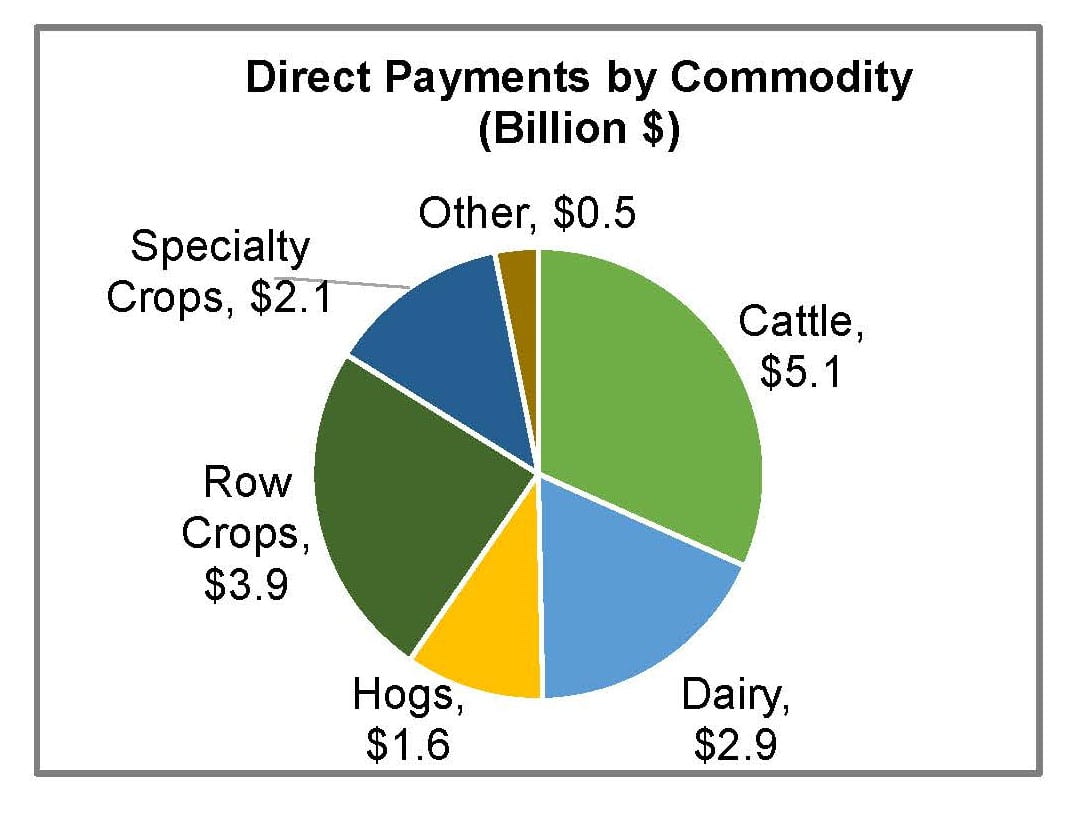
It has been reported, although not confirmed by the USDA, that in the direct support program, $5.1 billion will be allocated to support cattle producers, $3.9 billion for row crop producers, $2.9 billion for dairy, $2.1 for specialty crops, $1.6 billion for hog producers and $500 million for other commodities.

The Chairman of the Senate Agricultural Appropriations sub-committee has indicated the direct assistance to producers will be one payment comprised of the sum of two parts. The first part is 85% of the losses incurred between January 1 and April 15, 2020 per commodity. The second part will be 30% of the loss in market prices due to COVID-19 between April and the next two quarters. Secretary Perdue has expressed that payments are intended to be made by end of May or early June. To qualify for a payment, a commodity must have declined in price by at least 5% between January and April 15, 2020. While there are several entities illustrating price declines including The Ohio State University, the price series USDA will use to determine eligibility is uncertain. Federal payment limits apply, set at $125,000 per commodity with an overall limit of $250,000 per individual or entity. USDA has indicated that CFAP may take into consideration other farm program benefits regarding payment limitations, which could limit CFAP payments in the case a producer is receiving payments in other federal safety net programs. The exact program limitations and qualifying support are unknown at the present time. The direct payment program will be administered by the Farm Service Agency.  More details will be forthcoming by the Farm Service Agency in the upcoming weeks. Access more information at: https://www.fsa.usda.gov/

The remaining $3 billion dollars of the CFAP allocation will be used for a USDA Purchase and Distribution program.  In this program, the USDA will partner with regional and local distributors to purchase $3 billion in fresh produce, dairy, and meat. The USDA will purchase an estimated $100 million per month in fresh fruits and vegetables, $100 million per month in a variety of dairy products, and $100 million per month in meat products. The distributors and wholesalers will then provide a pre-approved box of fresh produce, dairy, and meat products to food banks, community and faith-based organizations, and other non-profits to distribute. Monthly purchases totaling $300 million will continue until the funds are exhausted.

In addition to the Coronavirus Food Assistance Program, the USDA will utilize other available funding sources to purchase and distribute food to those in need. This includes an additional $873.3 million available in Section 32 funding to purchase a variety of agricultural products for distribution to food banks. The use of these funds will be determined by industry requests, USDA agricultural market analysis, and food bank needs.

Additionally, the FFCRA and CARES Act provided at least $850 million for food bank administrative costs and USDA food purchases, of which a minimum of $600 million will be designated for food purchases. The use of these funds will be determined by food bank need and product availability.

For all the information on USDA’s work during the COVID-19 pandemic and resources available,  visit https://www.usda.gov/coronavirus.


COVID-19 Impact on Ohio Sheep Producers

By Tim Barnes OSU Extension, Marion County

Lambs are just one of the many agricultural commodities that have been disrupted by the COVID-19 pandemic. There is never a good time for a pandemic to strike, but COVID-19 hit the sheep industry at the traditional best market price.  Spring lambs are a family favorite for traditional Easter meals (April 12), Orthodox Easter (April 23), the Muslin feasts of Ramadan (April 23 to May23), some Jewish sects for Passover (April 8-16), and the secular May 10 Mother’s Day celebration.

America’s biggest market for fresh lamb is in the area from Baltimore to Boston.  Major East Coast packers relay on the close location of Ohio producers (Ohio has the 5th most producers in the US) to provide a steady source of fresh lamb.  The “white tablecloth restaurants” and the other segments of the food service industry account for over 50% of the United State lamb consumption.  As demand builds back to pre-pandemic levels, Ohio lambs will continue to be a large part of the East coast supply chain.                                                                                                                                                                                                                                Ohio Sheep Facts:

-Lamb Price from United Producers Mt. Vernon collection point (weekly, low & high prices are recorded, and the average number is used for these calculations.) The dollar price represented is lost value in market decline from March 13 to April 10 sales.   The gross revenue for each lamb has dropped 25% from the lamb market value in early March.

  1. Lambs 131# -$61 = (.47 cwt X 131)
  2. Roaster 60# -$27 = (.45 cwt X 60)
  3. Hair lambs -$24 = (.30 cwt X 80)
  4. Aged sheep -$45 = (.30 cwt X 150)

-Producers questions have generally been directed to the decision to sell Easter lambs at this time or add additional weight and sell them later in the fall.  Each case will need to be evaluated on an individual basis and will depend on resources and financial stability.

-Club Lamb & Breeding Stock Producers are selling their sheep privately or through online sales.  Quality animals are being sold at expected values.

-Ohio Lamb feeders have been able to move their contracted lambs but noncontracted market lambs are not able to be sold.

Sheep industry facts:

  1. Second largest lamb packer in United States declared bankruptcy
  2. Currently, packers in West Virginia and New York City have suspended operations.
  3. New Holland, Pennsylvania Lamb Market (largest lamb market in the Eastern United States) sold 5500 head of lambs on April 3rd and 2000 head on April 10th.
  4. National weekly slaughter is down 15%, national production is down 22%, & live weight is steady at 138 pounds.
  5. Strong US Dollar continues to support imports from Australia & New Zealand (260 million pounds of lamb which represents 66% of lamb consumed in the US on an annual basis).
  6. National cold storage is steady with past 5-year averages.
  7. Wool has lost 88% of value and pelts have lost 75% of their value due to closed exports to China.

In closing, this pandemic is another call from Mother Nature that no matter how hard we try to redirect her work, she produces chemical resistant weeds, mutant viruses, and extreme weather.  Change is upon us, so embrace the new normal!