– Christine Gelley, Agriculture and Natural Resources Educator, Noble County OSU Extension
Poison hemlock has already emerged in a vegetative state around Noble County and beyond. Soon it will be bolting and blooming on stalks 6-10 feet tall. All parts of the plant are toxic to all classes of livestock if consumed and is prevalent along roadsides, ditches, and crop field borders. It is a biennial weed that does not flower in the first year of growth but flowers in the second year. The earlier you can address poison hemlock with mowing and/or herbicide application, the better your control methods will be.

Poison hemlock is a concern in public right of ways, on the farm, and in the landscape!
Poison hemlock is related to Queen Anne’s lace, but is much larger and taller, emerges earlier, and has purple spots on the stems. Another relative that is poisonous is wild parsnip, which looks similar to poison hemlock, but has yellow flowers. Giant hogweed is another relative of poison hemlock that is also toxic. All of these plants have umbel shaped clusters of flowers.
 Many health challenges on the farm can be avoided with proper herd health management, including vaccinations, treatment, and biosecurity. On Monday, March 21st Dr. Justin Kieffer, Clinical Veterinarian for the Department of Animal Sciences at OSU will be providing a Beef Herd Health Management update. Starting at 6:00 p.m. Dr. Kieffer will discuss vaccination protocols for both cows and calves, and how to best implement a vaccination program. Also, some emerging herd health issues including pink eye, anaplasmosis, and antimicrobial use will also be covered. If you have questions regarding cattle health, bring them with you to ask Dr. Kieffer after his presentation.
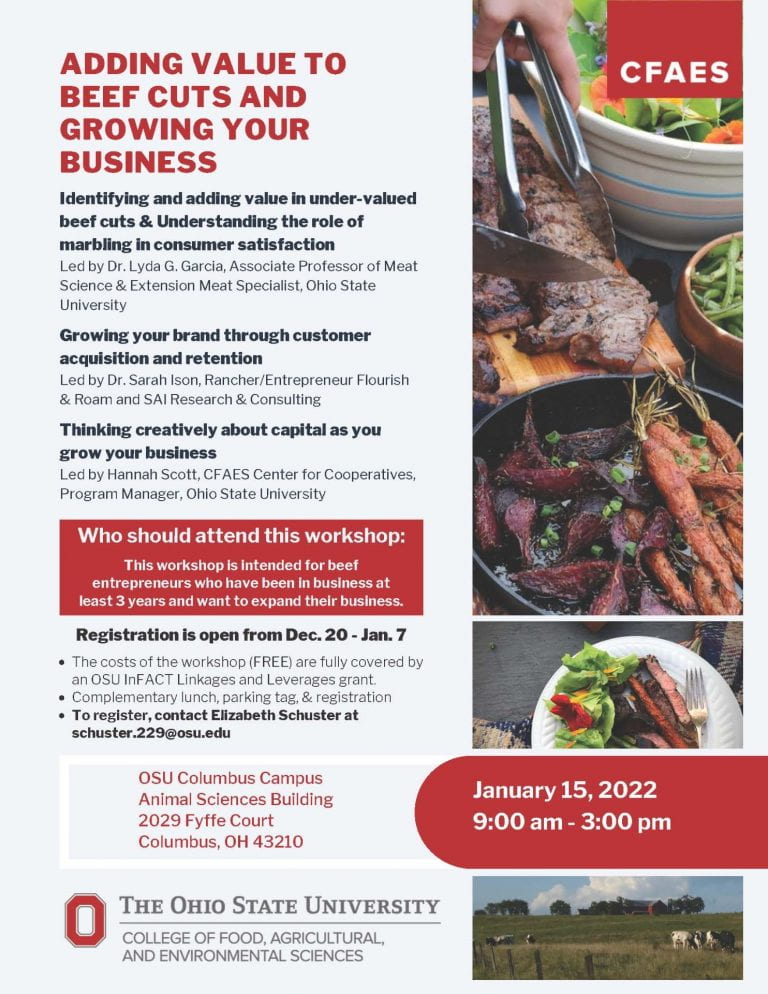 This 1-day workshop, being held on January 15 in the Animal Sciences Building on the OSU Campus, is designed for beef producers and culinary businesses who are looking to grow their business. This training was inspired by findings from the Catalyzing Food Entrepreneurship research project, partially funded by the Ohio State University’s Initiative for Food and AgriCultural Transformation. The research found that there is a gap in entrepreneurial trainings for small-scale food producers who want to scale up and access new markets. This training was designed as a pilot to fill that gap in Ohio.