A Museum’s Role in De-Extinction

When you think of bringing back a species that is extinct, you may picture a huge Woolly Mammoth or a giant Tyrannosaurus rex. But have you ever pictured bringing back a plump, dove-like bird, the Passenger Pigeon? It seems a highly unlikely candidate for the de-extinct research being conducted by Long Now Foundation’s Revive & Restore. This group of geneticists are working on what they call genetic rescue, to both save highly endangered species and bring back extinct species. But what role do museums play in the de-extinction of a species that died out in 1914?

Cream colored passenger pigeon egg

Passenger Pigeon egg from the Tetrapod Collection © Hothem, 2016

Why Bring Back the Passenger Pigeon?

Imagine a sky darkened for hours because a cloud of birds are passing through a town on the way to their roosting spot. Though an amazing sight to behold these birds were actually quite damaging to the forests they used as a roost. Branches would break under the weight of nests and birds. Feces would cover the trees and ground and cause a rise in acidity in the soil. Scientists Ellsworth and McComb (2003) suggested that about 8% of the forests within the pigeons’ breeding area were damaged annually.

While all this sounds terrible for the forest, the birds were also aiding in the creation of a healthier forest. How? The damage they caused to the forest canopy, allowed more light to enter the forest. The feces they produced would actually add some nutrients to the forest floor creating nutrient rich soil. In addition, their main food source, various nuts from oaks and beeches, were able to spread throughout the Passenger Pigeon’s breeding range creating some of the various forest we walk through today.

Revive & Restore’s overall goal in de-extinction of the Passenger Pigeon is to fill the lost forest disturbance niche that the pigeon’s extinction caused. Researchers debate that by bringing back the pigeons the need for human managed forest fires or disruptions will be decreased. They hope to create more natural forest regeneration via the pigeon’s destructive behavior.

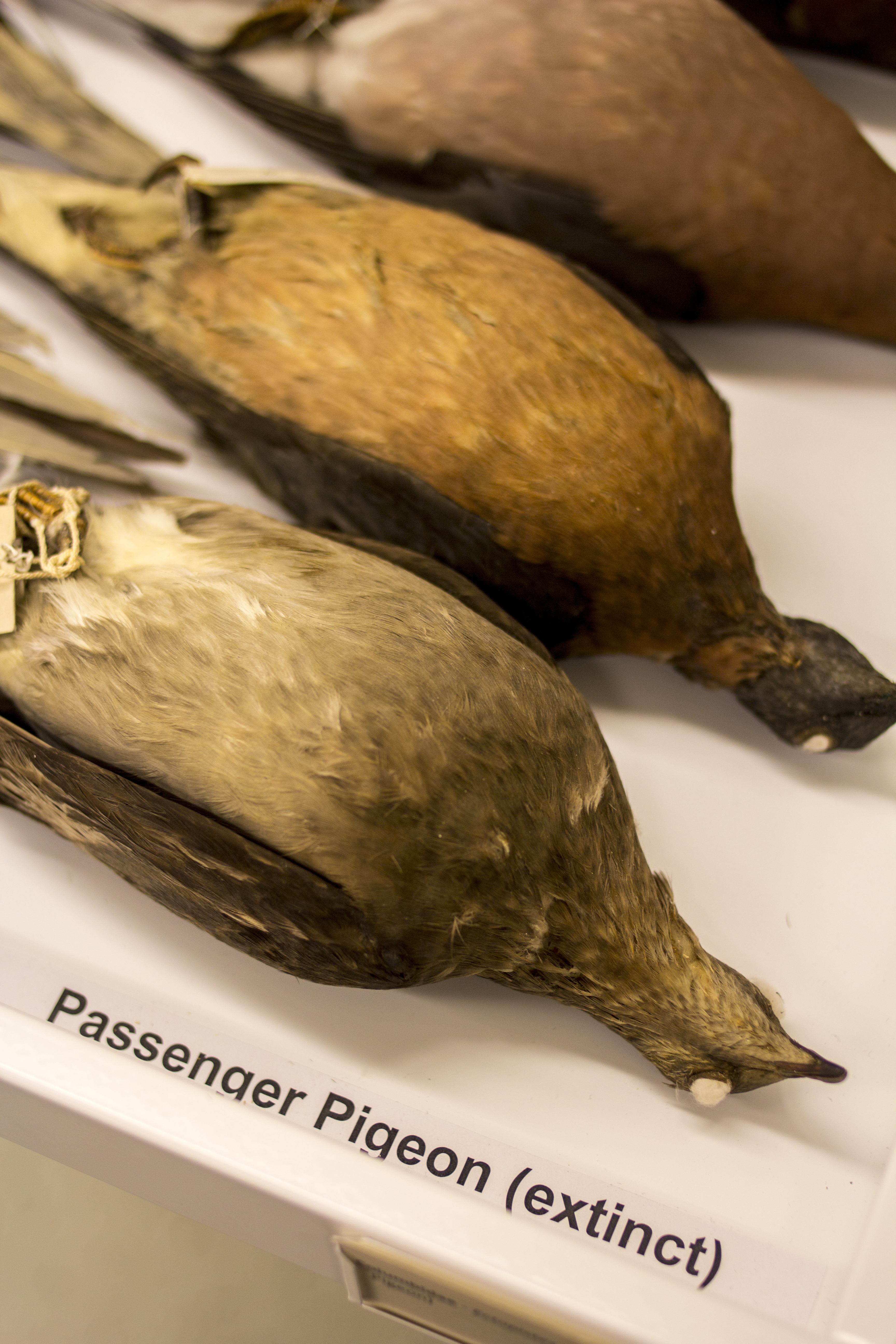
Drawer filled with passenger pigeon study skins

Tray with Passenger Pigeons ©Hothem, 2016

A Museum’s Role in De-Extinction

Museums, like vast libraries of natural history, hold the key for groups like Revive & Restore. Museum collections, such as the Tetrapod Collection here at OSU, are the final resting places for extinct species. Study skins hold the genetic material that researchers need to understand what genetic components are necessary to bring back or understand the evolution of a species. It is part of our mission to make sure that these species are understood not just in terms of location and date but also in terms of their genetic makeup or DNA. Using museum specimens for DNA sequencing of extinct species is not a new topic, in fact, it became popular in 1984 with examining dried quagga muscle tissue. Researchers then used this technique to confirm that the quagga, an extinct member of the horse family, really was as closely related to today’s horse as fossils suggested. Now researchers are looking at using Passenger Pigeon study skins to create a full genome of the species to better understand both its evolution and how to bring it back to today’s skies.

Be sure to check out the Tetrapod Collection’s campaign and help us purchase a new mobile cabinet for the extinct species in our collection. Our goal is to raise $5,500 and to educate people, about tetrapods throughout the month of October. Be sure to check out our videos, social media, blog and campaign page!

Passenger Pigeon profiles

Passenger Pigeons ©Hothem, 2016


About the Author: Stephanie Malinich is collection manager of the OSU tetrapods at the Museum of Biological Diversity.


Literature cited:

ELLSWORTH, J. W. and McCOMB, B. C. (2003), Potential Effects of Passenger Pigeon Flocks on the Structure and Composition of Presettlement Forests of Eastern North America. Conservation Biology, 17: 1548–1558. doi:10.1111/j.1523-1739.2003.00230.x

What it takes to be a successful Invader

Invasive species have received a lot of bad press, but let’s face it, some of these alien species really have what it takes to make it!  One example of a highly successful invasive species is the Round Goby, a native to central Eurasia including the Black Sea and the Caspian Sea.

Male Round Goby in black spawning coloration

Male Round Goby in black spawning coloration

Identifying an alien

Recently a graduate student in Michigan sent a request for identification of a fish skull.  When I saw the skull on a photo that the student attached to the inquiry my first thought was that this is a species I haven’t seen before.  I was thinking to myself, “in my mind I’ve got a fairly good catalog of all the native species that are found in the Great Lakes, so this one is probably exotic”.  Furthermore, I examined the teeth and the rest of the skull picture, and found features that are similar to the marine blennies and gobies that I’m familiar with; quite possibly a Round Goby.

OSUM 104701, Neogobius melanostomus skull

OSUM 104701, Neogobius melanostomus skull

When one observes the teeth of a Round Goby skull, it becomes readily apparent that they are eminently suited to catching prey: numerous, closely packed and somewhat curved teeth. Once the fangs are sunk into the prey’s body it would be difficult to wriggle out of the goby’s maw.  Speaking of the “maw”, the width of the Round Goby’s head and mouth are somewhat disproportionately large in comparison to the size of the body.  This aspect of the anatomy amplifies the capacity of the fish to suck in its prey.  By opening the mouth quickly a vacuum is created, which when combined with the sudden forward lunge that the goby employs toward the prey, improves the likelihood of successful capture.

Neogobius melanostomus are extremely aggressive and will challenge fishes larger than themselves, outcompeting native fish for preferred habitat as well as preying on other fish’s eggs and young.

What makes the Round Goby so successful?

Round Gobies are found primarily in the benthic zone of the water body, from the bottom of shallow areas down to 70 feet in depth.  They prefer areas where there is plenty of cover such as around rocks, sticks and logs.  The species has been found to tolerate polluted conditions, which enables it to occupy areas that less tolerant species cannot live in. This increases their opportunities to grow into a large population that aids in overcoming the other species in less polluted areas.  Another aspect of their biology that enhances their prowess is a highly developed lateralis system, a fishes’ sensory system conveying environmental information to the brain and making them an effective competitor and predator in dark, murky conditions as well as in clear daylight.

High productivity is a hallmark of an effective invader.  A mature Round Goby female is able to produce over 3,000 eggs, the older the female the more eggs they produce.  The male uses posturing and coloration (see the photo above) to attract females to its nest, often mating with more than one female.  The females spawn up to six times in a season, which lasts all summer long from April through September. Let’s do the math: a female could produce 18,000 young in just one year, that’s a lot of Round Gobies!

Although the deleterious effects of this intruder are considerable in scope, as some research here at OSU has shown, one must nonetheless admire their capabilities.  But we should keep in mind that without our assistance it is doubtful that Round Gobies would have spread so far and certainly not so quickly.  Their ability to tolerate euryhaline conditions, a wide range of salinities, facilitates their natural spread under normal conditions over a much longer time. It has allowed them to survive in the ballast waters of vessels and occupy new areas when the ballast is flushed.

Although they are best known from the Great Lakes they are now found in the lower reaches of larger rivers and have been captured in the Illinois River drainage, presaging their invasion of other Mississippi River tributaries.

map of Round Goby invasion in Great lakes regionBut thus far the most dramatic spread of the Round Goby has occurred in the Great Lakes of North America where a lack of effective competitors facilitated their occupation of new territories.

Northern Europe, too, has suffered from a Round Goby Invasion as shown in these maps and the potential for their spread in Europe is estimated to be much greater. You can follow them on AquaMaps, enter genus “Neogobius” and species “melanostomus” to obtain a map showing their predicted spread.

map of Round Goby invasion in Europe


Because they are not tasty to humans it is hard to truly appreciate this fish from any perspective other than that of their successes as invaders. But to a larger, piscine predator they must indeed be tasty as they have become a substantial part of native gamefishes’ diet.  And for Lake Erie water snakes, as well as aquatic birds like gulls and cormorants, Round Gobies are a major new item on the menu.  Indeed, Round Gobies are so abundant in Lake Erie that frustrated anglers often complain that the pesky little perciforms are the only thing they can catch.

The Round Goby is here to stay, and changes wrought by their incursion will reverberate for decades across the Great Lakes at least. Have you caught one yet?


About the Author: Marc Kibbey is Associate Curator of the Fish Division at the Museum of Biological Diversity.

Strange things to do with ticks

When most of us think of natural history collections we see well-labeled, nicely arranged rows of jars, sets of herbarium sheets, or pinned insects, and this is certainly a curator’s ideal. But this does not acknowledge the occasional outburst of mis-applied creativity leading to a novel approach to preserving specimens. Every collection probably has a few examples, and I thought I should share some from the acarology collection. The collection includes some ticks processed in ways that are simultaneously novel, creative, and useless.

The standard way to preserve ticks is in fluid, mostly 70-95% ethanol. Ideally in good vials with complete labels, and a barcode linked to a properly functioning database.

vial of ticks (Ixodes lemuris) with proper labeling

vial of ticks (Ixodes lemuris) with proper labeling

One less than great alternative is diluted formalin, at least for a brief period of time. This mixture does not evaporate as fast as ethanol (good in warm regions and in the absence of good containers) but it diminishes the value of the specimens because it destroys DNA. Still, this is not very odd. “Weird” would be one word for the option of pinning ticks.

pinned and slightly shriveled ticks

pinned and slightly shriveled ticks


We have a few of these in the OSU Acarology Collection. These specimens are essentially useless. Insects, with their hard cuticles, do quite well on pins, but generally soft-bodied organisms like ticks just shrink and shrivel, in the process destroying many valuable characters.


While tick adults and (usually) nymphs are fluid preserved, tick larvae are small enough that they can also be put on slides. A well-prepared slide of an unengorged tick larva can be a thing of beauty.

slide of larval Haemaphysalis lemuris

slide of larval Haemaphysalis lemuris

Under a microscope you can observe very fine detail of the cuticle structure, leg hairs, mouthparts, etc. Of course not everybody is as narrow-minded as the above lines suggest. For example, one specimen of an engorged adult dog tick (Dermacentor variabilis) in our collection shows a reckless disregard of the rule that slide mounting is only for larvae. The specimen is encased in a 2mm high wooden “box” placed on a slide, filled with mounting medium and topped with a glass cover slip.

side view of slide with female Dermacentor variabilis

side view of slide with female Dermacentor variabilis

The overall resulting structure is far too thick and too opaque to be usable, but the craftsmanship exhibited in making this “box” can only be described as exquisite.


I would like to close with a salute to those among us that are not bound by conventions and that bravely go where nobody has gone before. Just don’t do it again.


About the Author: Dr. Hans Klompen is professor in the department of Evolution, Ecology and Organismal Biology and director of the Ohio State University Acarology Collection.

Internship, Volunteering or Job?


We at the Triplehorn Insect Collection frequently receive inquiries from students and even professionals seeking opportunities to learn about insects and insect collections. Some people are looking for training in a specific area, others have a more general interest. We also receive many inquiries regarding volunteering and research opportunities in the collection. We try to accommodate as many requests as our staff and resources allow.

In recent years we have had many undergraduate student interns in the collection. Most of them were Entomology majors at Ohio State, some were majoring in Biology, Zoology, and event in Art. We also had student interns from other colleges and universities. Some of these students spent a summer with us, others took internships during the semester for school credit. Some stayed for several semesters, others only a couple of weeks.

Because of the growing interest, we decided that it was time to make the internship offers a bit more structured. A few weeks ago we announced two internship opportunities for the fall semester, one for insect imaging and one for insect curation. As the email inquiries started arriving, it quickly became clear that there was interest (we received 25 inquiries in 10 days), but there was also some confusion on what an internship is versus an undergrad research experience, an undergrad job, or volunteering.

So what is an internship? How does that differ from volunteering? Is internship the same as research experience? What’s the deal with internship for school credit?

Here is our take:

Internship – Our understanding of internship is that it is a ‘mentored, practical learning experience in a professional environment’. Mentored, because it’s important that the experience be structured and directed. An intern, in our opinion, should not be given a task and left to fend for themselves. Our interns come in during regular hours only and are always monitored by a trained staff or experience student worker. Practical emphasizes that the intern will take what they have learned, both previously and as part of the internship experience, and put it to good use. The word experience has popped up several times: this is meant to emphasize (as does practical) that we want to do more than just talk about the work we do, we want the interns to actually do it. Finally, we mean professional environment not in terms of funds, but in terms of being serious and implementing whatever the best practices are.

There is something that is deliberately missing in that definition, though, and that is any mention of financial compensation. Some places offer paid internships. We do not. First, we simply cannot afford it. Second, what we provide is an educational opportunity in a university environment and we take the responsibility to make it a structured, mentored experience.

Beyond the practical learning experience, students can get school credit for their efforts by enrolling in formal internship course (in our department this is EEOB 3191, 1-3 credit hours; other departments offer some form of internship courses as well). And whether one enrolls for credit or not, at the end of the day the intern – we hope – has made the kind of personal connection with their mentor that makes for a substantive and useful letter of recommendation later on when they apply for a real job, grad school, med school, etc.

Note that research internships involve actively working in a research project under supervision of a faculty or research scientist. That is not the kind of internships we are currently offering. The broad goal of our insect curation internship is to familiarize students with the work involved in maintaining and enhancing a research quality insect collection. Specific objectives involve learning the basics of insect specimen preparation (sort, dry, mount, and label insect specimens). In addition, student interns are offered opportunities to learn other techniques and protocols, depending on their progress, their (and our) time availability, and their interest.


Volunteering – The core of volunteering is that the person donates their time and effort in support of an organization, projects, etc. As such, it can overlap a lot with our concept of intern. But it differs, basically, in that we’re not necessarily promising a well-rounded, holistic and mentored experience. Volunteers come to us willing to help in whatever capacity because they think our work is valuable in some way. We try to match the tasks with the experience that volunteers already have: one person might be particularly good with organizational skills, another with the fine motor skills needed to mount and label specimens. And while interns are typically young persons looking to gain skills and experience, our volunteers run the gamut in ages, from teenagers to retirees. Right now we have two amazing volunteers: Lauralee Thompson, who has just completed one year of volunteering with us on Sept 8, and Jan Nishimura.


Student Job – When we advertise a ‘undergraduate curatorial assistant’ job, it means 1) we can only hire undergraduate students (that’s what our money is earmarked for), 2) we have a particular set of goals to accomplish in a particular time and we offer training on the specific tasks related to the job, and 3) it is just the nature of an insect collection, in particular, the large number of specimens, that the tasks are likely to be repetitive and tedious.

In the end, though, students who are hired, say, to do specimen data entry, end up learning a lot about the various aspects of the curation as they will have the need to perform some of them, they also learn about geography, computers, and, no surprise, about insects. For young persons, jobs like the ones we offer are also great opportunities to learn good work habits and to foster and demonstrate attributes like reliability, honesty, diligence, perseverance, ability to learn and to work with others in a collaborative way. Then, this too can translate into the kind of reference letter that really makes a difference to a potential new employer.

We currently have two specimen digitization projects funded by the National Science Foundation, one for beetles, and another, that just started, for butterflies and moths. Neither of these projects would be feasible without the work of our undergrad curatorial assistants.


One thing is common between interns, volunteers, and student workers: they are all learning and they all need care and attention from the collection staff. It is important for us, staff, supervisors, faculty, to engage with them and to nurture their interest in the work we do. That not only helps to keep them motivated, but it also fosters good interactions between everyone in the collection, and provides them with a positive experience that they will hopefully remember and cherish for the rest of their lives.


Current Digitization Projects:

Digitization PEN: Integration of data from the Triplehorn Insect Collection with the Southwestern Collections of Arthropods Network. Award #1503659. Start Date: July 1, 2015, Estimated End: June 30, 2018. Investigator(s): Norman Johnson & Luciana Musetti.

Digitization TCN: Collaborative Research: Lepidoptera of North America Network: Documenting Diversity in the Largest Clade of Herbivores (LepNet). Award #1602081. Start Date: July 1, 2016, Estimated End: June 30, 2020. Subcontract from the University of Northern Arizona to Norman Johnson & Luciana Musetti.


If you would like to know more about our internship program, about the digitization projects underway in the collection, or about possible collection-based undergraduate research experience, please contact us at osuc-curator@osu.edu.


About the Authors: Luciana Musetti is an Entomologist and Curator of the Triplehorn Insect Collection. Norman Johnson is a Professor in the Department of EEOB and Director of the Triplehorn Insect Collection.


Freshwater Mussels Vs. The World

Did learning the difference between the lifestyle of the freshwater vs. saltwater mussels whet your appetite? Are you curious whose cousin you are consuming when slurping scallops or opening oysters?  Do you catch yourself wondering at night if sea slugs are really related to land slugs? Is your superpower talking to octopuses and you want to know what other animals you may be able to communicate with? We have got you covered.

This time, we are going to discuss the relationships between all these molluscs, so you can learn just how distinct these organisms really are.  You will finally be able to join the club* of polite pedantic people standing with on the borderlines between clades reminding anyone who will listen that these organisms are distinct! Among our allies are those who pipe up whenever someone calls a spider monkey an ape and folks who visibly wince whenever anyone implies that a spider is a bug. This is the kind of knowledge you can brag about. You’ll never need something to talk about on a date again. Those long thanksgiving dinners with extended family will be a breeze! Shells are easy to carry around as props so you can always be prepared!

*there is no club

ARE YOU READY TO READ?!

(Those of you who already know the difference are also invited to read on but are given explicit permission to feel slightly smug while doing it. It’s a win either way.)

Continue reading Freshwater Mussels Vs. The World

Views from a student intern in the tetrapods collection

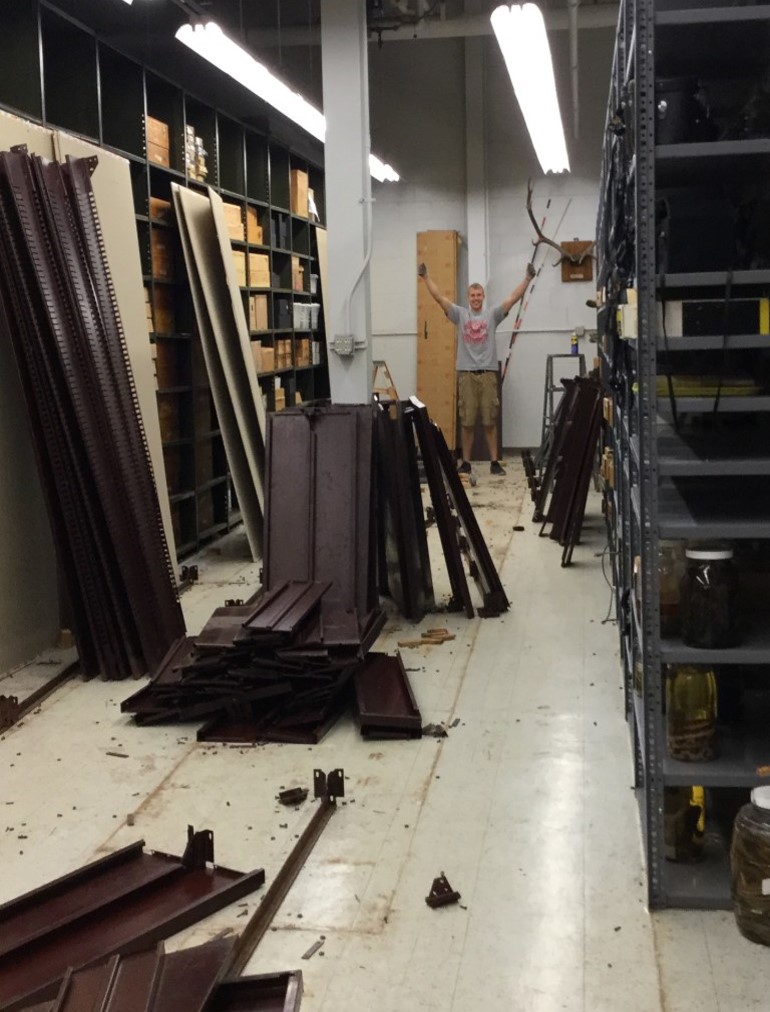
Intern Josh after taking down some old shelving units – all as planned

Interning this summer at The Ohio State University’s Museum of Biological Diversity has been an eye-opening experience that allowed me to take part in the day-to-day tasks that keep the museum up and running. I was lucky enough to work in the tetrapod division which contains some of my favorite animals such as birds and amphibians.

catalog scan

Sample of a Catalog Scan

My first project of the summer was scanning our entire specimen catalog so that we can access the information electronically. Although it was a little tedious to scan hundreds of pages, I was able to make all of that information easily accessible on the computer. This should help the collection be more efficient as well as help researchers who are using the museum’s specimens.

A sparrow being examined before becoming a study skin ©Malinich, 2016

A sparrow being examined before becoming a study skin © Malinich, 2016

I also prepared multiple bird specimens during my internship including a couple of House Sparrows, American Robins, and an American Tree Sparrow. Prior to the internship I had only prepared one specimen, so I was able to learn some useful techniques that helped me improve my skills. It was a privilege to learn hands-on from an expert in the art of skinning.


Another one of my duties this summer was georeferencing. I was responsible for determining the latitude and longitude of each specimen for a specific state. I did this by using the locality description that was provided by the collector of the specimen and a map program on the computer. Having a specific location for each specimen will be more helpful for researchers.

The final task of the summer was taking down the old shelving units that were rusting. This involved a lot of physically moving specimens around and trips to the loading dock.


Getting rid of the rusty old shelving units cleared space for the new ones that match the rest of our collection. This job made the collection much cleaner and more ascetically pleasing.

intern_close-up

Overall I had a great experience here this summer, I learned a lot about all the ins and outs that keep a research museum functioning. I look forward to returning for an open house in the future.


About the Author: Josh Elger was a Summer 2016 Intern for the Tetrapod Division. He is currently working on a B. S. from Ohio Dominican University.

Field ornithology

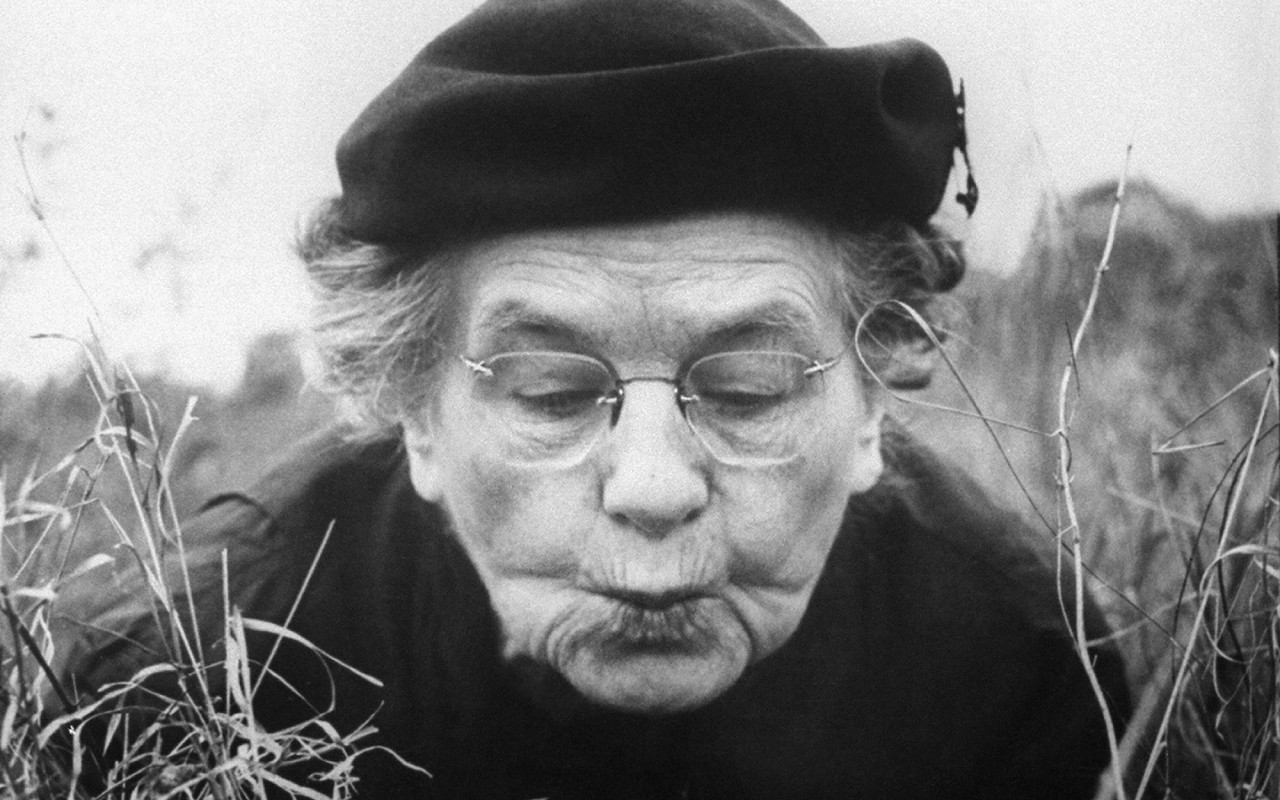
A recent post on Cool Green Science about Margaret Morse Nice “How a Scientific Outsider Changed How We Study Birds” inspired me to think more generally about how researchers study bird behavior in the field and how acoustic recordings can help us understand bird behavior. By the way, here “field” does not refer to a type of habitat rather it encompasses any natural habitat (rivers, lakes, meadows, forests etc.) in which animals live.

Margaret Morse Nice portrait

Margaret Morse Nice looking into a nest of baby sparrows, 1956 (Wikipedia)

Margaret Morse Nice’s most important contributions to ornithological research were probably in the advancement of techniques in studying birds. She was one of the few American women ornithologists in the 1930s and the first to make detailed observations of individual birds. She followed Song Sparrows through their lives, took notes on their life history and published her observations in over 200 papers and books. Most of her publications are listed in her autobiography “Research is a passion with me“.

cover of Margaret Morse Nice's book Research is a passion with me

Book by Margaret Morse Nice “Research is a passion with me”

Interestingly, Nice who was born in Massachusetts in 1883 studied Song Sparrows in Columbus, OH where she and her family lived in 1927-1936. During these eight years she closely followed birds on their property off Patterson Ave, a floodplain on the east-side of the Olentangy river just north of Lane Ave, what is today Tuttle park. Even though the habitat has changed from the shrubs, weeds and gardens in Nice’s time you can still find open areas especially along the river which Song Sparrows to this day use to build their nests and raise their young.

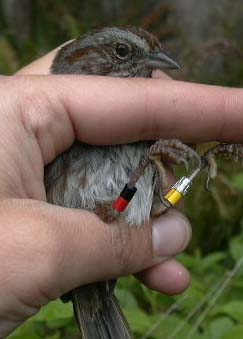
To follow individual birds closely, identify them repeatedly and note their behavior and interactions with each other, it was clear to Nice that she needed to mark the birds. Over the years she trapped some 870 Song Sparrows which she marked with unique combinations of plastic color bands on their legs. We still use the same technique today.

color-banded Song Sparrow

“Red-black / yellow-metal” banded Song Sparrow (c) K. Whittaker

Bird banding actually started in Europe as an aid to follow migrating birds and still is used for this purpose: Researchers put a metal band with an engraved unique number on a bird’s leg – just like your social security number. They report this number as well as where and when the bird was caught and banded to a central lab, here in the USA the central bird banding lab in Maryland. When somebody then recaptures or finds a banded bird, they can access this information through the bird banding lab and relate it to data they collect about the bird.

Colored leg bands help researchers to follow individual birds. Sounds easy? It can be once you have the colored leg bands on the bird. First you have to catch the bird and that can prove tricky. We primarily use two established bird trapping techniques: walk-in traps and mist-nets.

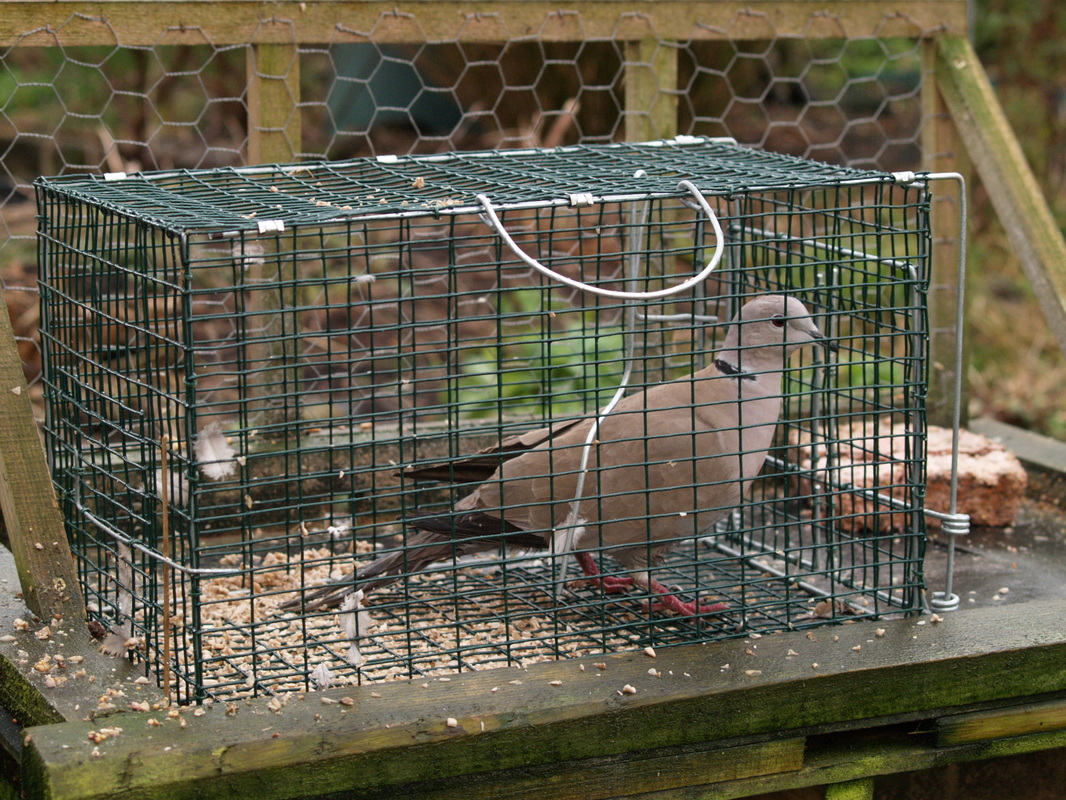
Just as the name implies, wire-mesh traps are placed on the ground, seeded with some tasty morsels and when the bird in search of food walks into the trap a door closes behind it and traps it within.

Collared Dove in a Potter Trap

Collared Dove in a Potter Trap (c) Third Wheel Ringing Supplies

For a mist-net imagine a volleyball net strapped between two poles but with finer mesh and all the way to the ground. These nets work best in foggy weather conditions when they are nearly invisible and when placed strategically in a bird’s flight path, the subject will fly into the mesh, bounce and fall into a fold at the bottom of the net and get entangled. We then “extract” the bird from the net and band it. – By the way not everybody can trap and band birds because they are highly protected under the Migratory Bird Treaty Act dating back to 1918. Through training with a master bird bander researchers can obtain a U. S. Federal Bird Banding and Marking Permit.

So what role does sound play in this? Sometimes we lure birds to the mist-net by playing calls or songs of its species. Why does this attract a bird? Most songbirds are territorial, i.e. they defend an area that they use exclusively for feeding or breeding and song keeps every other bird of the same species out of this territory. Some researchers have actually done clever experiments to prove this keep-out function of birdsong, but that is a story for another post.

Doug Nelson holding up a loudspeaker playing bird song in front of a mist net

Doug Nelson holding up a loudspeaker playing bird song in front of a mist-net in Oregon (c) Angelika Nelson

So, birds do not produce their most beautiful songs to please us, rather one function is to repel a male contender. If the opponent does not take this warning, a bird will switch to physical attack. Exactly this behavior can get them trapped in a mist-net as they search intently for the invisible opponent, aka loudspeaker, and eventually dive at in attack.

This brings me back to Nice’s contributions to field ornithology: Nice studied closely the territorial behavior of “her” birds. Once all males were banded she made close observations of where they sang, how they interacted with neighbors and whether they were able to attract a mate. She described patterns of invaders and defenders during territorial encounters and described the role that song played in these. To this day this is a prominent research topic in our lab where we have studied territorial singing behavior in the White-crowned Sparrow and other species over the last decades.

Following in the footsteps of Margaret Morse Nice, Dr. Chris Tonra, Assistant Professor in the School of Environmental and Natural Resources at Ohio State, has started a project to continue work on behavior of the Song Sparrow. He and his students regularly band today’s local Song Sparrow population at Ohio State’s Wilma H. Schiermeier Olentangy River Wetland Research Park, less than one km upstream from Nice’s former home, and follow them throughout the year. He uses some of the techniques from Nice’s days, others have advanced – read more about the project here!


About the author: Angelika Nelson is the curator of the Borror Laboratory of Bioacoustics. Her recent research has focused on song and behavioral ecology of the White-crowned Sparrow in Oregon; each spring Angelika teaches the OSU course “Ohio Birds” where students learn about the life of birds and how to identify them in the field – by sight and sound.


References:

“Nice, Margaret Morse.” Complete Dictionary of Scientific Biography. 2008. Encyclopedia.com. (August 17, 2016).

Finding No-No

In our Muskingum River Survey we’re searching for a couple (invasive) fish species that we hope we do not find: The Silver and Bighead Carp.  Environmental DNA has been detected in the Muskingum River for Bighead Carp and also for Northern Snakehead, another invasive species from Asia.


And just as importantly, we’re taking names, numbers, weights and lengths of everything else we catch, documenting Muskingum River’s fish fauna before the Asian carp invade.  Just a few of the native species we’re catching or may catch soon that are found in the Muskingum:


About the Author: Marc Kibbey is Associate Curator of the Fish Division at the Museum of Biological Diversity.

Pre-Asian Carp Invasion: Muskingum River Survey

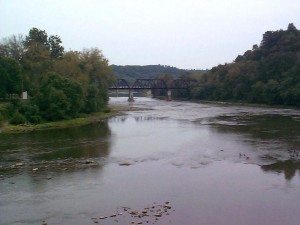
zano1_dsfrmybrdg

Photo of the Muskingum River from the National Weather Service

A little over two years ago a test of the Muskingum River using eDNA techniques showed positive results for Bighead Carp, one of several Asian carp species, and Northern Snakehead.  Although the Ohio Division of Natural Resources (ODNR) and U.S. Fish and Wildlife Service sampled the Muskingum River extensively neither of these invasive species was actually caught.  It may be that the highly sensitive eDNA technique picked up genetic material from bird feet or boat bottoms that traveled from areas where the invasive species were well established, but that has yet to be proven conclusively.

The OSUM Fish Division is currently carrying out a project to survey the Muskingum River watershed from top to bottom under the supervision of project leader Brian Zimmerman, with a grant from the Ohio DNR Division of Fish and Wildlife, overseen by Associate Professor and MBD director Meg Daly. Fifty-five sites above, below and in each of the nine pools between the locks and dams of the mainstem, and 5 each along the two major tributaries of the Muskingum River, Muskingum River lock and dam Photo from the Ohio Canal Society, the Walhonding and the Tuscarawas Rivers, will be sampled.

Muskingum River lock and dam, Photo from the Ohio Canal Society

Muskingum River lock and dam, Photo from the Ohio Canal Society

The sampling techniques will include

  1. Electroshocking: as the name implies, this technique involves the application of electrical current to stun fish, causing them to remain immobile for crew members with pole nets to retrieve them and place them in a large tub in the boat.
  2. Seining: The use of 6’ tall x 8’ wide seine nets by two or three people in this project to sample shallow areas.
  3. Benthic Trawling: We take an 18’ flat bottomed John boat with two 25 horsepower outboard motors and drag a small “otter” trawl net along the bottom of the river.
  4. Hoop Netting: This method uses 3 sets of large mesh nets supported by iron hoops. The hoop nets are left out for two days after which we return and remove the fish from the nets. Read more about this technique on our fish blog.

With all of the methods the catch is identified, counted, measured and weighed, and returned except for any invasive species we may catch (fortunately no Silver or Bighead Carp have been caught!…yet…). We see a very high rate of survival of the captured fish and these are returned to the river.

The project will extend over two years, from July to September of 2016 and 2017, and will culminate in a final report providing an assessment of the Muskingum River fish community.  This information will provide a baseline for use in potential remediation efforts should the silver and/or bighead carp become established above the Devola Dam.

Technically all carp (Silver, Bighead, Grass, Common, Black, and Prussian carp, and Goldfish are the species currently established in the United States but there are at least four more – Crucian, Catlan, Mrigal and Mud Carp- are recognized as valid species) are Asian in origin.  Common Carp, by the way, are believed to have originally come from the Caspian Sea.  Back in the 1880’s the U.S. Commission of Fish and Fisheries intentionally distributed Common Carp in rail cars across much of the United States to serve as a food fish, but the idea never caught on as extensively as hoped due to the habit of wild carp to scavenge the bottom of water bodies.

Common Carp are invasive, but are considered naturalized.  They can be deleterious to stream and lake bottoms, and do impact other fish, bird, and mollusk species as well as plants, but at this point the damage has been done, so to speak.  After nearly 140 years native fish and other animals have adapted to Common Carp.  Some fishermen and environmental agents prefer to kill Common Carp whenever they are caught, in many cases simply throwing them on the stream bank to suffocate, but in truth this has little if any effect on the population since their recruitment rate is extremely high.

Silver and Bighead Carp were brought to the United States during the 1970’s and 1980’s, and escaped into the Mississippi River watershed from their state, federal and privately run facilities following extensive rains that overflowed the hatcheries.  In the Mississippi River and many tributaries they are securely established in abundances that impact native fish species and interfere with local trawling concerns.

Adult fish species that are known to be adversely affected by Silver and Bighead Carp are Gizzard Shad and Bigmouth Buffalo.  The dietary overlap of the carp with these native fishes has been shown to reduce the adults’ size and health.  In addition the high volume planktonic grazing employed by these carp is likely to compete for that food source with larvae and young-of-the-year of most other native fishes, ultimately causing a reduction in native populations.

Grass Carp are established in lakes and rivers across the State of Ohio.  Deleterious effects from this invader include removal of macrophytes (large aquatic plants) from stream bottoms with concurrent increases in turbidity.  The macrophytes provide cover and spawning habitat for many native organisms.  The carp only digest about 1/2 of the plants they eat, so the large amounts of fecal matter cause algal blooms.  The OSUM crew has caught several Grass Carp already, euthanizing and saving samples from them.

It is not known at this point what the remediation would consist of if Bighead or Silver Carp do invade the Muskingum River.  Similar to many other invasive species it would be extremely difficult if not impossible to completely eradicate them from waterways like the Muskingum River that have connections to other rivers that contain the species.  Short of completely damming the river (which carries its own set of ecological problems), or installing an electric barrier as has been done between the Illinois River and Lake Michigan, eradication would be short-lived.  It may be that the best approach would be to simply utilize the pests as a food source as has been done in Kentucky and other states, since their flesh is much more palatable than that of common carp.  If we catch any Bighead or Silver Carp (electroshocking works well for larger Silver Carp, while hoop netting is one of the best methods for Bigheads) they will be euthanized with samples taken for DNA analysis, but we really do hope that is not the case.


About the Author: Marc Kibbey is Associate Curator of the Fish Division at the Museum of Biological Diversity.