More than 17-year cicadas


To complement Norman’s post on the 17-year cicadas, I thought today we would look at some other species of cicada that are part of the holdings of the Triplehorn Insect Collection.

Some of our cicada specimens are pretty old, dating back to the 1890’s, but the majority were collected and preserved by Joe and Dorothy Knull between the early 1930s and 1960s.

Drawer with specimens recently returned to the collection

Drawer with specimens recently returned to the collection

There are over 190 different kinds of cicadas (that includes species and subspecies) in North America alone (Sanford, 2012) and more than 3,000 around the world.

In the collection we have species of around 200 of those, but that number is likely to increase thanks to a recent loan return which added another 800 cicada specimens to the collection.  That material had been borrowed for study in 1969 and only now was returned to us. The specimens in this batch date to 1950s and 1960s.


We don’t have an exact count of the number of cicadas in the Triplehorn Insect Collection yet, but we estimate between 8,000 and 10,000 specimens. Once we finish curating and databasing our cicadas, the data for all the specimens will be available online via the collection database interface.

Here are a few of my preferred. Notice that most were collected out west. That is a reflection of the collection’s history and the research interests of the people who helped build the collection over the past 80+ years.

Some species of the genus Okanagana:


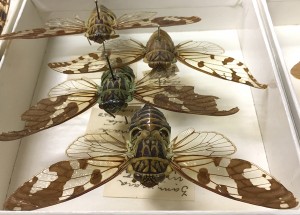
More interesting and attractive specimens:


Some exotic beauties:

Finally, a few yet to be determined show stoppers:


As we curate the collection I’ll post more photos of interesting cicada specimens from our collection.


Literature reference: Sanborn, Allen F., and Maxine S. Heath. 2012. The Cicadas (Hemiptera, Cicadoidea, Cicadidae) of North America North of Mexico. Entomological Society of America.

About the Author: Dr. Luciana Musetti is an Entomologist and Curator of the C. A. Triplehorn Insect Collection. All photos by the author.

The call of the wild

Even though it’s the middle of the political crazy season, the call I’m referring is not a primal scream from a lectern, but a chorus of insects with only one thing on their mind. The 17-year cicadas have returned!

Here at the Triplehorn collection we’ve been fielding questions and visits for weeks now about the scheduled simultaneous emergence of the three species of Brood V. Finally, we couldn’t resist any longer, and we decided to go to see them. Actually, I guess they’ve been here all along, but it is the mass emergence of adults that attract all the attention. The rest of their lives, the cicadas live as nymphs in the soil, slowly and steadily feeding on the roots of trees. But then, every 17 years, for our local species, the nymphs crawl out of the soil and climb up trees to molt into the adult stage.

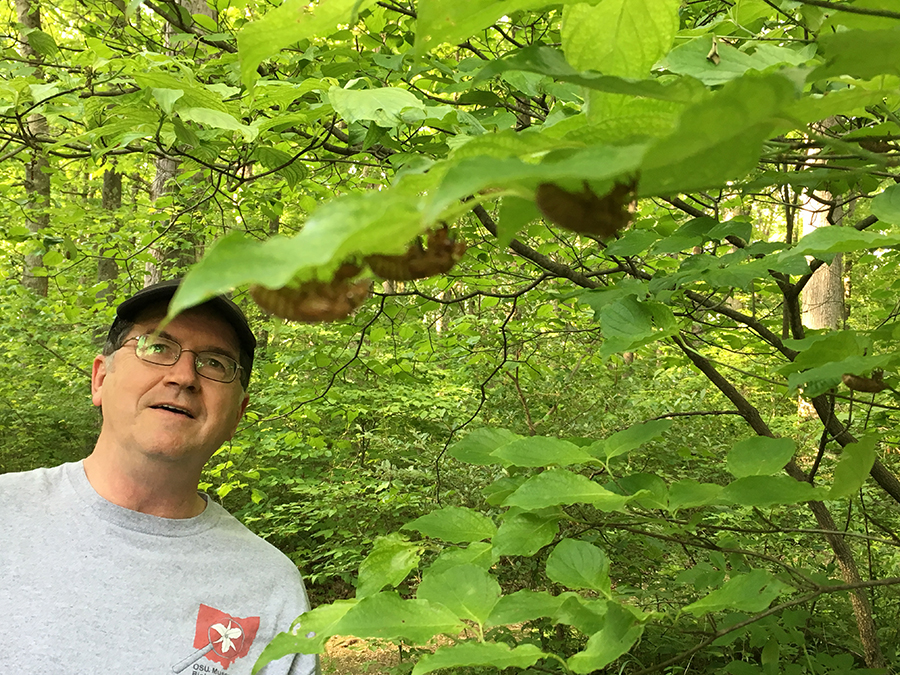
Norman Johnson at Clear Creek Metro Park

Norman Johnson at Clear Creek Metro Park

My reference to the brood hints at some of the intriguing complexity that surrounds these humble creatures. First, there are two types of periodical cicadas: those with 17-year life cycles and those with 13-year life cycles. Both are unique to eastern North America. (How cool is that!)  The 13-year variety is more southern, and the 17-year variety is more northern in distribution. Within cicadas with those two life-cycles there are multiple species: four of the 13-years, and three of the 17-years. Even more, there are 15 different “broods” in different areas, and each brood times their emergence for different years. So this year (2016) Brood V is emerging in eastern and southern Ohio (and beyond); Brood VIII will emerge in the easternmost counties of Ohio in 2019; and the big and widespread emergence right here in my own back yard will be Brood X in 2021. In each 17-year brood there are the three different species: with a little training they’re easy to distinguish both by eye and by their song.

Brood V consists of all three species of 17-year cicadas: Magicicada cassinii, Magicicada septendecim, and Magicicada septendecula

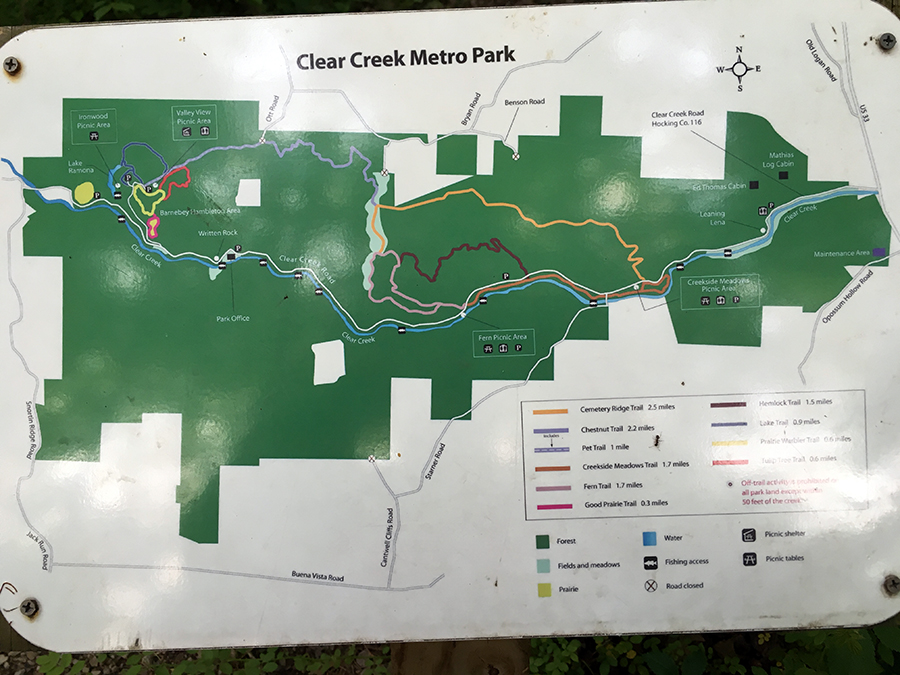
Map of Clear Creek Metro Park

Map of Clear Creek Metro Park

Last week we drove from Columbus southeast to Clear Creek Metro Park. We’d heard the cicadas there were out in good numbers. It wasn’t until we got past Lancaster that we began to be able to hear the cicadas singing, even though we were tooling down the highway at the posted speed limit. As we drove along the main road through the park, following the valley carved out by Clear Creek, we could clearly hear them singing. Instead of being surrounded by a steady drone, though, the cicadas seemed to be clustered in smaller patches. They were more up the sides of the hills than in the floor of the valley, so we headed uphill. Part of this park used to be owned by Ohio State where there were teaching and research labs at a place called Barneby, an area is situated on the hills above little Lake Ramona.


One of the few adult specimens we saw that evening

One of the few adult specimens of Magicicada we saw that evening. Photo by NF Johnson

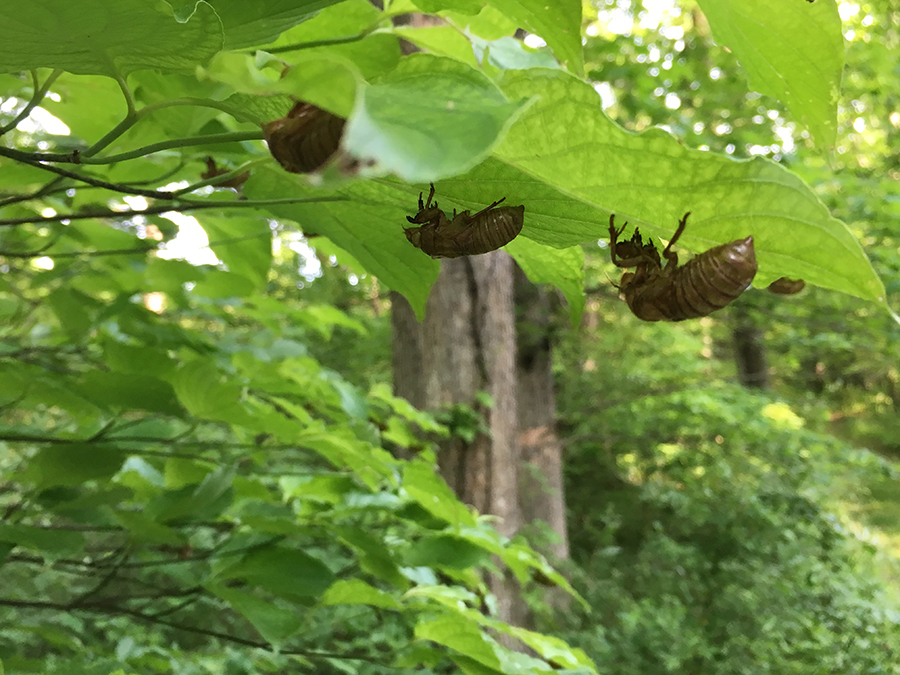
At six in the evening the cicadas were still actively singing, but we actually saw very few adults. At this time of day they seemed to all be up in the tree canopy. The nymphs usually come out at night, crawl up the vegetation, and molt into the adult stage. The plants in the area had lots of evidence of this because the skins that were shed remain attached to the plants. They truly do look like little aliens and maybe just a little bit dangerous, with their enlarged front legs that look like they could grab hold of you. In fact, though, they’re harmless.

Exuviae: remains of cicada exoskeleton after they molted to adult stage

Exuviae: remains of cicada exoskeleton after they molted to adult stage

Many have probably seen these cast skins (exuviae) that are left behind by the common dog-day cicadas, the ones that are present every year, emerging usually in the second half of the summer. The 17-year cicadas are smaller. Also, I’ve usually seen dog-day cicada exuviae on the trunks of trees.  In contrast, the ones we saw this week were much more common on leaves and even on grasses. It looks like the cicadas crawl up as far as they possibly can, and when they get on a leaf their weight makes the leaf droop downwards. At that point the nymph’s head would be pointed toward the ground. They then turn around 180 degrees, and it’s in this position that they molt.

I must say that the flurry of reports in the newspapers and on television have been a real mixed bag of fact and fiction. Amidst the facts there are little nuggets that make me scratch my head and sigh. Some headlines have reported the emergence of a “plague.”(!) Now it is true that cicadas are also called “locusts,” but locust plagues are actually huge swarms of grasshoppers, not cicadas. These real plagues are particularly damaging because the grasshoppers are ravenous feeders and consume almost every plant in sight. Adult periodical cicadas, on the other hand, don’t feed at all. The only thing they do is mate and lay eggs to produce the next generation. If there’s any damage that the cicadas do, it’s with their egg-laying activity.

One newspaper article I saw claimed that the eggs were laid in the soil, but to that I say “Nay, nay.” At the tail end of a female cicada she has a needle-like appendage that she uses to insert her eggs into tree twigs. When there are high densities of cicadas, then, the incisions made in the twigs can be so abundant that they damage that year’s growth of the tips of the trees.

To learn more about periodical cicadas, there are lots of resources.  There are websites devoted to them. A couple of the more prominent are www.magicada.com (Magicicada is the scientific name of these animals) and www.cicadamania.com. Both of these also have Facebook pages and Twitter feeds. You can contribute data from sightings that will help us understand the finer details of the distribution of the different broods.

There’s a Facebook public group dedicated to the Ohio Brood V. There are lots of videos available online where you can both see and hear these fascinating beasts. I particularity enjoyed Return of the Cicadas, a short film by Samuel Orr, who’s been working an a documentary on cicadas since 2007.  Also, yesterday the Columbus Dispatch has a nice spread with pictures of various species of cicadas deposited here at our very own Triplehorn Insect Collection (see the online version here.)

There are more than 3,300 species of cicadas in the world (over 190 found in the USA), and we still have a lot to learn about them.

Walking the trails

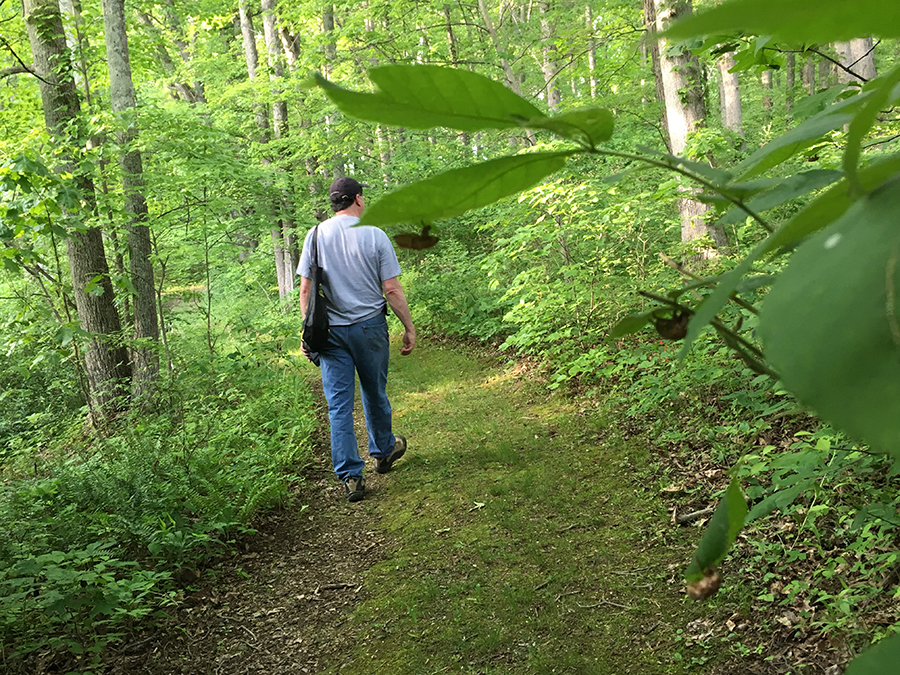
Walking the trails and listening to the cicadas call

As a biologist, I learned that there are many truly fascinating environments in which we find the most amazing plants and animals. Most of these, though, are far away: tropical rain forests, deserts, cloud forests, karoo, etc. But here, literally in our own back yard, we have some of the most fascinating animals in all the world. Don’t miss out on the periodical cicacdas, because if you do, they won’t be back for a long time!


About the Author: Dr. Norman Johnson is an Entomologist, Professor and Director of the C.A. Triplehorn Insect Collection at Ohio State University. Photos by L. Musetti, except when indicated otherwise.

Mimicking Mussels


A little known fact about freshwater mussels is that they live part of their life as a parasite. The glochidia or larval stage of a mussel will attach to a host and grow for a few weeks before releasing and falling to the substrate below. The host that the glochidia parasitize is almost always a fish (there is one species of mussel that can parasitize salamanders). Each species of freshwater mussel has just a few species of fish on which its larva can attach. Because of this special and very specific mussel-host fish relationship, mussels have evolved ways to “trick” their particular fish into becoming infested with glochidia. Some mussel species lure fish in close with a modified section of their mantle tissue that resembles a tasty meal, such as minnows or tadpoles. When the fish strikes it is bombarded with thousands of glochidia, which will encyst onto the gills or other parts of the fish. The fish swims away, un-phased by the whole ordeal. The glochidia grow for 30 days or more on the fish. Another method a mom mussel uses to infest a host fish is by releasing a snot-like string containing their glochidia into the water. A fish swims through the strands and the larvae attach. Below are some examples of different mussel species using unique lures to attract their fish host.

Click the video below to view some examples of mussel lures.

Videos 1&2: Pocketbook (Lampsilis cardium) flapping its mantle tissue resembling a minnow or darter. This lure is used to attract fish such as smallmouth bass or bluegill on which the Pocketbook’s glochidia can attach.

Video 3: Ridged Pocketbook (Lampsilis ovata) displaying a similar lure as the Pocketbook mussel.

Video 4: Black Sand Shell (Ligumia recta) with its unique lure that to a fish looks and moves very much like a crayfish or crawdad. This lure could be used to attract fish such as largemouth bass. Interestingly, she usually displays the lure at night.

Video 5: Lilliput (Toxoplasma parvum) using undulating mantle flaps to lure in unsuspecting fish.


About the Author: Caitlin Byrne is Collection Manager of the Division of Molluscs.


STRIKE: Creating Awareness for Bird Window Strike Fatalities

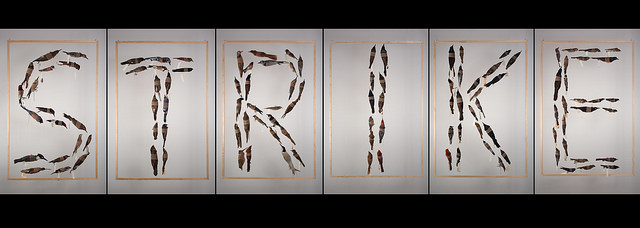
The word "strike" is spelled out of bird study skins

“STRIKE”-An art installation created to represent building fatalities in birds. ©Amy Youngs, 2015

December 2015, OSU Associate Professor and local artist Amy Youngs borrowed specimens from the Tetrapod Collection for her art installation for a BioPresence exhibition at OSU. The word “STRIKE” was spelled out with 116 bird specimens from our collection to commemorate the bird deaths resulting from collisions with human-made structures that occur every year.

Amy describes her motivation for the project:

“The project comes from my desire to see the world from the perspectives of other animals. As a human animal, I can never fully understand the experience of a bird, but as an artist I try to translate that effort in ways that speak to other humans and perhaps have some positive effect for birds. I began thinking about the window strike issue when I saw Angelika Nelson collecting a dead bird that had hit a window at the Heffner Building at the Olentangy Wetlands Research Park. I began asking questions about what birds see and don’t see and what is known about preventing the problem of building collisions. I thought about how many of the dead birds in the collection of the Museum of Biological Diversity could attest to the tragedy of human-built structures. What if the birds went on strike? What if we saw our buildings like birds did? Perhaps we would learn to build in ways that would allow us to become better citizens of the ecosystem.”

Collaborations between Art and Science like this one are an innovative way to raise awareness of environmental issues. In this case we focused attention on bird strikes. Artists and scientists can work towards creating unique ways to both increase building visibility for migrating birds and public awareness of the problem. Check out this project at Temple University in Philadelphia, PA for some inspiration. For now, we will keep using the bird collision study skins as outreach tools in education events on this pressing matter.


About the Author: Stephanie Malinich is Collection Manager of the OSU Tetrapod Collection.

Striking Out: Building Strike Collections

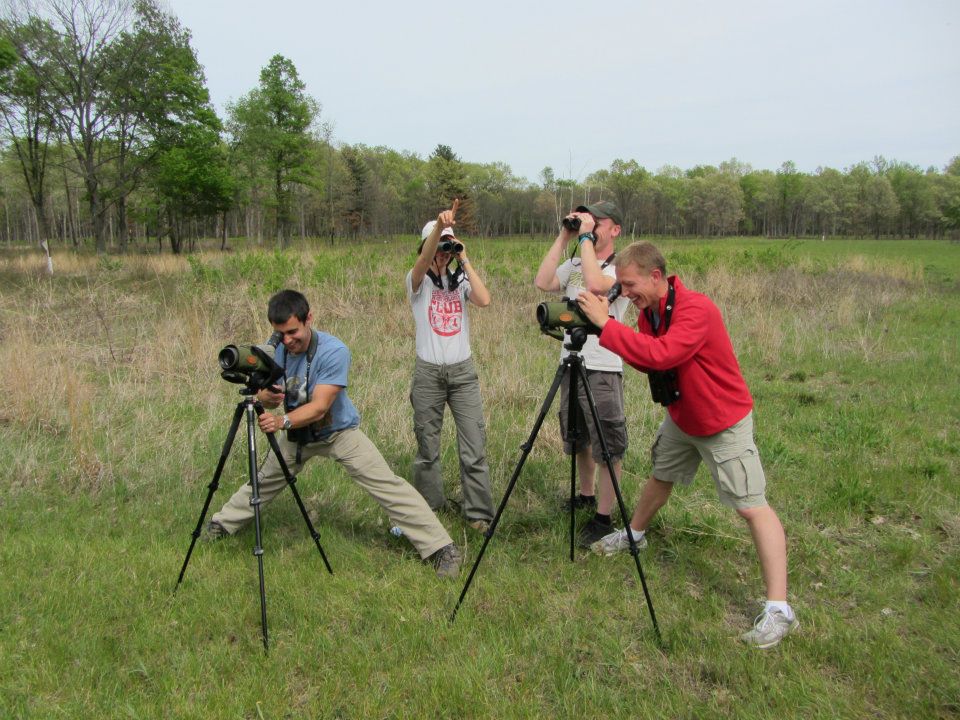
Students and staff posing with birding binoculars and scopes

OSU students and staff participating in Biggest Week in American Birding in Northern Ohio. ©Stephanie Malinich, 2012

As a bird-watcher, spring is my favorite time of the year. Every spring millions of birds start to migrate from their wintering grounds to their summer breeding grounds. Surprising to most people, many birds migrate at night and typically you will not see large flocks of small birds traveling throughout the day. Spring migration can be a great time to see new species of birds that may not live in your state year round and this is a time for celebrating birds. But this joyous time for birders can also be an incredibly fatal time for birds that have traveled thousands of miles on their migratory pathway to their nesting grounds.

An estimated 500,000,000 bird fatalities occur in North America each year due to anthropogenic sources including collisions with building (Erickson et al 2005). Yes, this is correct, 500 million birds! This number is especially heightened by the peak migration times of spring and fall, when birds migrating at night are most likely to die: Night migrating birds have always used light to orient themselves and usually the moon and stars are the only light sources in the night sky. However nowadays brightly-lit buildings disorient these birds causing them to collide with windows in buildings. Typically, birds are trying to closely approach the light source (similar to insects around a street lamp) or circle the light source (in this case the building) until a point of complete exhaustion.

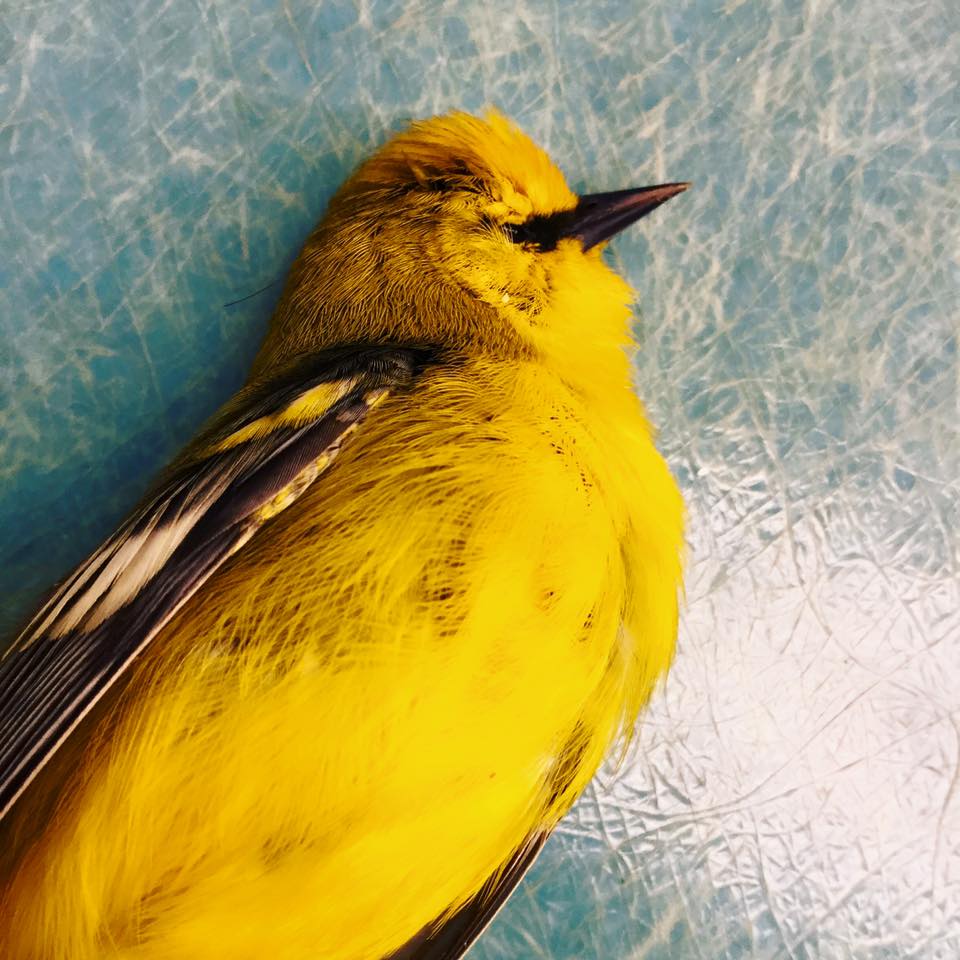
Yellow colored warbler with black bill

A Blue-winged Warbler collided with a downtown Columbus building. © Stephanie Malinich, 2016

This makes building collisions a top fatality to birds on their migratory pathway. Actions since this discovery have been taken to lower the numbers of building fatalities, e.g. through the national effort of  Lights Out programs by the Audubon society. The overall goal of the Lights Out programs are to work with building managers in major cities to reduce the amount of light at night during peak migration season. Not only will this help reduce fatalities for nocturnally migrating birds but reduce energy costs for building owners – a win-win situation.

Many of Ohio’s major cities such as Columbus, Cleveland, Dayton, and Toledo have participated in Light’s Out Programs. Active in Ohio since 2012, researchers have worked with managers of some familiar buildings such as the AEP corporate headquarters, Columbia Gas, Columbus City Hall, Grange Insurance Audubon Center, and more on reducing lights at nights during peak migration seasons. Are you curious about Columbus’s impact on bird building collisions? Columbus Lights Out monitoring report from 2012-2013 gives insights into how lights on buildings in Columbus are affecting the amount of collision death and injury in birds.

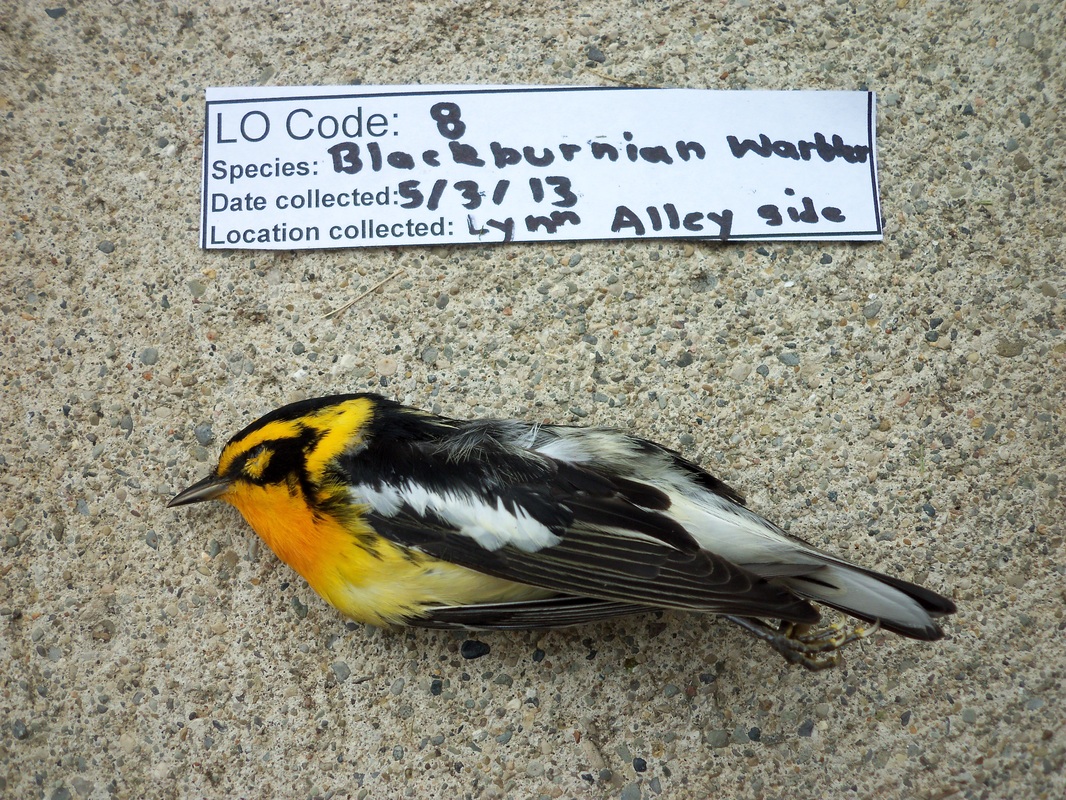
Dead bird on sidewalk

Blackburnian Warbler collected by Lights Out Columbus volunteers for a study of building collisions. ©Lights Out Columbus, 2013

What do programs such as Lights Out, which survey injured and dead birds, mean for museum collections around these major cities? For Columbus it meant that birds found dead were submitted to the Museum of Biological Diversity’s Tetrapod Collection, where they are now used as tools in teaching students and making them aware of the impact buildings can have on bird populations. In the two years when we collaborated with the Columbus Lights Out program we received over 200 bird specimens which had died from building collisions in downtown. These now remain as vouchered specimens in our collection, as physical proof, as well as scientific tool, on the impact that building collections have during migration season.

Overall as collection manager, I see a huge increase in our bird salvage intake during spring. This is primarily due to citizen scientists who find birds that have struck windows on their house, work buildings, etc., and want to make sure the birds death was not in vain. On average the Tetrapod collection receives close to 100 bird specimens with suspected death from building collision each year. This April and May alone, I have already received 15 bird species that have died from impacts with windows or buildings and spring migration is not yet close to completion. If you find a dead bird and do not  know what do with it, please visit the museum’s Contribute Specimens webpage to learn about how to donate a specimen to the Tetrapod Collection. Are you worried that your home may be adding to building fatalities among birds? The Lights Out program has suggestions on how you can stop bird collisions at your home or feel free to contact us for some suggestions.
Are you curious to find out more about what can be done to make others aware of window or building collisions by birds during spring migration? See pictures of what Ohio State University’s BioPresence project has done to raise awareness in their art exhibition last fall.


About the Author: Stephanie Malinich is Collection Manager of the OSU Tetrapod Collection.


Reference: Erickson, Wallace P.; Johnson, Gregory D.; Young, David P. Jr. (2005). “A summary and comparison of bird mortality from anthropogenic causes with an emphasis on collisions.” In: Ralph, C. John; Rich, Terrell D., editors 2005. Bird Conservation Implementation and Integration in the Americas: Proceedings of the Third International Partners in Flight Conference. 2002 March 20-24; Asilomar, California, Volume 2 Gen. Tech. Rep. PSW-GTR-191. Albany, CA: U.S. Dept. of Agriculture, Forest Service, Pacific Southwest Research Station: p. 1029-1042

Amazing Diversity in Fish Dentition

Since the ray finned fishes are the most speciose group of vertebrates it is not surprising they exhibit such a wide range of feeding structures and functions.  Here are just a few examples of their dental arrays.

Lampreys – Lack true jaws.  Lampreys start out their life cycle with a toothless mouth suited to filter feeding, and in the parasitic forms develop several circular rows of sharp teeth used for latching onto and a radula (center of oral disk) for rasping a hole in their prey.

OSUM 104832 downsized

Sharks– teeth are triangular and razor sharp, those on the lower jaw have small serrated lateral cusps at the bases for enhanced cutting and tearing that is facilitated with strong jaw musculature and shaking motion of the head or chewing.  Sharks, unlike many of the more advanced fish species shown here, do not have pharyngeal jaws associated with their gill baskets.

Lungfish – have a tooth structure unique among the vertebrates: sturdy tooth plates called “Odontodes” that are used for grasping and crushing prey

Lungfish dentary plate (image from Nature)

Gar – rows of small villiform teeth for capturing and holding fishes in their elongated jaws while they manipulate the fish to a headfirst position for swallowing

OSUM 36915 longnose gar downsized

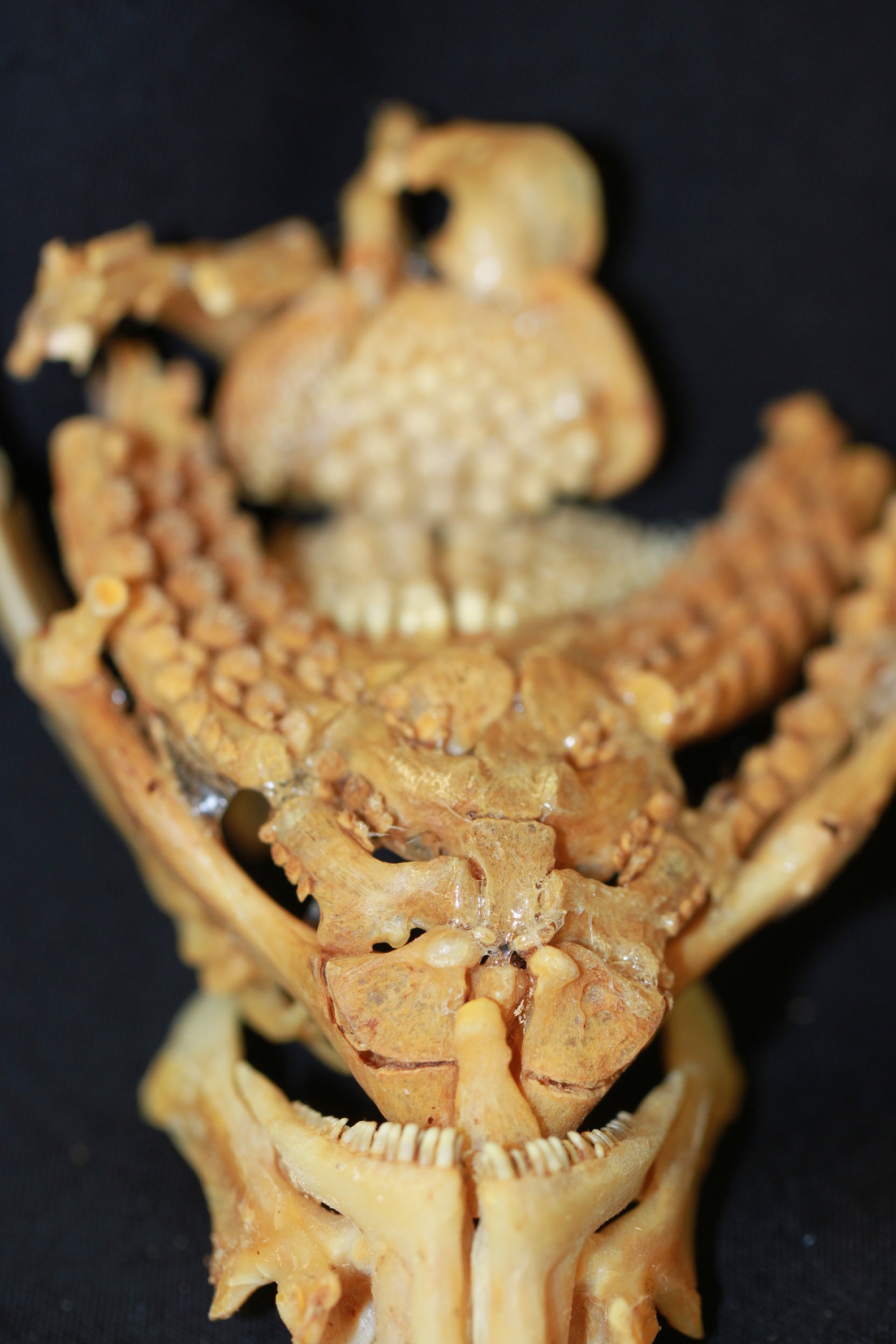
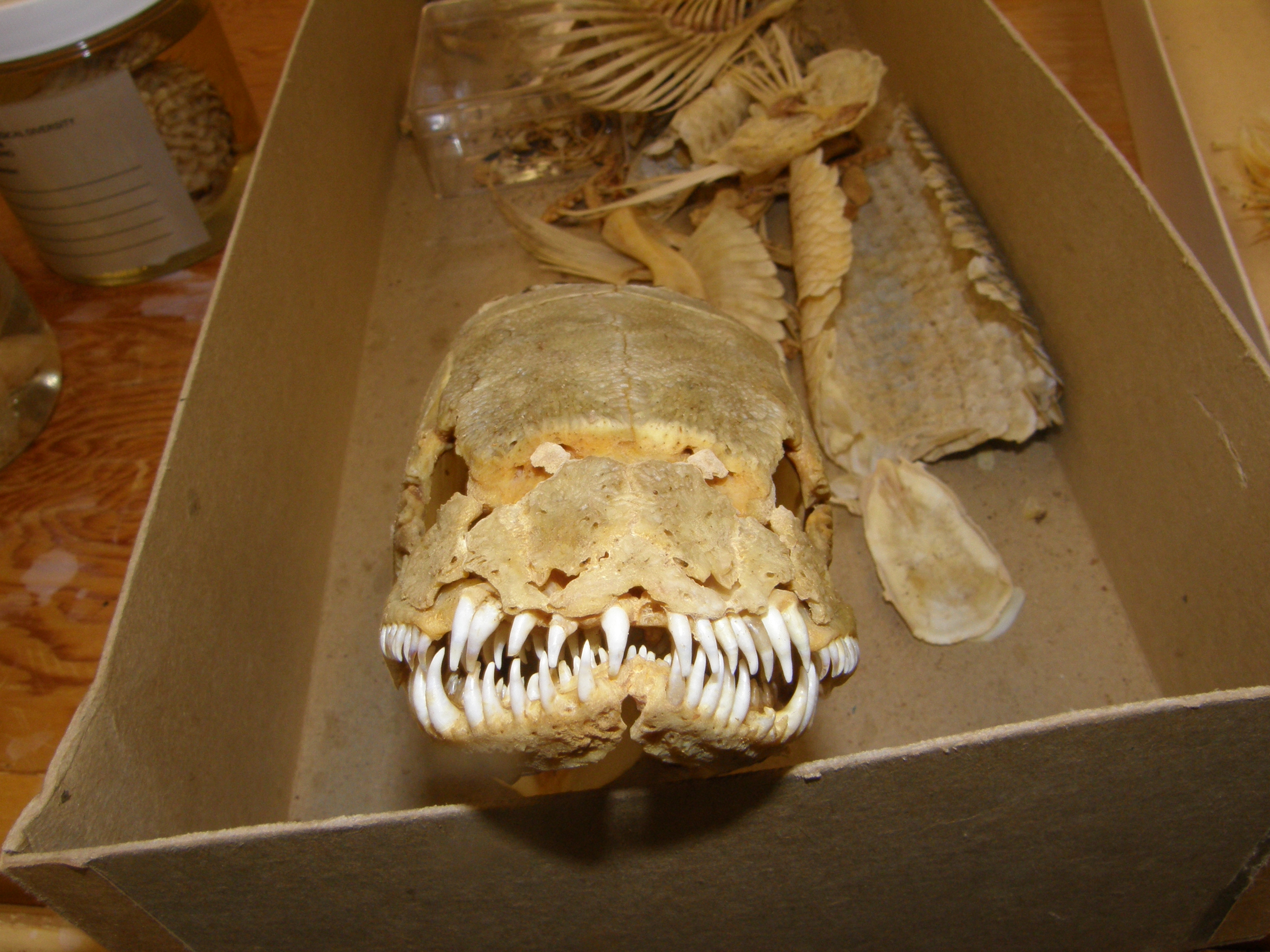
Bowfin – many sharp caniform, inward pointing teeth on the premaxilla, dentary and maxilla jaw bones for grasping and holding the prey (an extreme example of canine teeth in fish is shown in the African Goliath Tigerfish)

Bowfin teeth downsized

Pike – (image in previous post) the long, sharply curved caniform teeth on the dentary are a prelude to a villainous array of cardiform teeth  on the premaxillary, basibranchials, last two pharygobranchials, vomer, palatines, and glossohyal bones

Grass Carp – the heavy pharyngeal teeth of these herbivores are used for shredding algae

grass carp pharyngeal teeth

Piranha  – teeth are triangular, razor sharp, with small lateral cusps at the bases like sharks

OSUM Study Specimen Piranha Iouitos Peru downsized

River Redhorse – feed on sand-dwelling mollusks with sturdy teeth on lower pharyngeal jaws (characteristic of all ostariophysans whereas higher teleosts have pharyngeal teeth on lower and upper arches like the redear sunfish) used for crushing molluscs found in the bottom substrates

OLYMPUS DIGITAL CAMERA

Moxostoma carinatum pharyngeal arch

Flathead Catfish – gulp prey with large, non-protrusible mouth and hold with cardiform teeth, the largest patches of which are shown in this picture of a partial, disarticulated jaw, on the premaxillary (top of image) and anterior dentary (larger, semicircular structure at bottom of image) bones.  Gill arches show pharyngeal teeth, with pharyngeal tooth plates at the anterior, ventral symphysis of gill arches

flathead teeth downsized

Largemouth Bass – have limited cardiform teeth on the medial jaw bones, but these are complimented by a large, protrusible mouth for engulfing prey

largemouth2 downsized

Freshwater Drum – All other drum species are marine, but this one is native to larger waters in the Great Lakes and Mississippi River drainages.  (1st image focused on the anterior aspect of the jaw) Note the incisor-like anterior teeth on the anterior dentary for nipping prey off substrates, the molariform teeth on the heavy glossohyal bones, (2nd image focused on the posterior aspect of the jaw) the sturdy pharyngeal teeth on the gill arches for capturing and shredding prey, and the molar-like teeth on the pharyngeal tooth plate for crushing mollusk shells

drum jaw downsizeddrum pharyngeals downsized

Ocean Pout – like many molluscivores have strong conical dentition on the anterior portion of their jaws for plucking mollusks from surfaces, and flattened, molariform teeth in marginal or pharyngeal jaws

IDL TIFF file

X-ray from Canadian Museum of Nature

Triggerfish (incisor-like dentition), Pufferfishes (teeth fused into parrotlike beak) – have powerful jaws to remove invertebrate prey (sponges, ascidians, coelenterates and chitons) from surfaces

puffer mouth downsized


About the Author: Marc Kibbey is Assistant Curator of the OSUM Fish Division.

Toothy Customers

OLYMPUS DIGITAL CAMERA

A frequent subject of our writings, the Bowfin

Only vertebrates have true teeth, and the type of teeth they have is indicative of the feeding niche they occupy.  Fishes portray an amazing picture of diversity in teeth and correspondent feeding niches.  Some fish species have no teeth at all and thus rely on their mouths to either crush their prey as in the sturgeon, or simply suck in their prey as in the seahorse and pipefish.  Some have very few teeth, such as the non-parasitic lampreys in adult form, and some have an absolutely terrifying array of teeth such as the pikes and the sharks.

IMG_1866[1]

Ventral, exterior view of a Northern Pike jaw

The placement (marginal, medial and pharyngeal) of teeth within a fishes’ mouth is one of the many characters that are used to differentiate fish species.  But a Northern Pike seems to have almost all the surfaces covered:

Esox masquinongy teeth

Disarticulated Northern Pike jaw.  As you might imagine, once the prey fish is caught with the canine teeth and moved into the mouth there is little chance for escape.

Piscivorous fish typically have long, sharp teeth, but some piscivores rely on strategies alternative to their dentition to capture their prey.  The billfishes (marlins, sailfishes and swordfishes) stab and stun their prey with their elongated rostrums, sawfishes slash with a many-toothed rostrum to “collect” their prey.  Electric eels stun prey fishes, while toadfishes, anglerfishes and batfishes use a lure on their snouts or at the end of an extension to attract small fishes and may include a pheromonal attractant.  Such species typically have numerous smaller rows of teeth to grasp and hold their victims.

Fishes also exhibit diversity in the attachment of the teeth in their jaws:  The “Type I” arrangement has a strong mineralized connection between the tooth and and the jaw in bichirs, gars, bowfin, lower teleosts and some higher fishes (or the tooth and the pharyngeal bone in paddlefishes).  The “Type II” arrangement is seen in many teleosts with mineralization incomplete and the tooth connected to the jaw by collagen.  Stomiiformes (the order in which such bizarre, deep sea creatures as dragonfish, marine hatchetfish and viperfish are placed) have the Type III attachment with teeth hinged and depressible for moving prey to the esophagus and then erectible to prevent prey from escaping.  The Type IV attachment has collagen at the posterior part of the tooth base and acts as the hinge with the anterior edge lifting off the base (exposing the pulp cavity) to trap prey, this arrangement is found in pikes, some stomiiforms and higher teleosts.

Some fish groups such as sharks, wrasses, filefishes and triggerfishes exhibit polyphyodontia, the lifelong replacement of teeth.  A new tooth develops in the dental lamina under or behind the existing teeth.  In the sharks, for example, only the front 1 or 2 rows are used for feeding, while teeth develop posteriorly and move anteriorly to replace teeth individually as needed and on a regular basis.  In some shark species this occurs as frequently as every 9-12 days in the sandbar sharks or as infrequently as two to four times a year in the blue shark; with the old teeth drop to the ocean floor.  Exceptions include some like the cookie cutter sharks where the entire upper and lower sets are replaced as units and swallowed.  Piranhas replace one entire side of the teeth on their jaws at one time.  Polyphyodontia is a character that is not unique to fish however; a few mammals (kangaroos, elephants and manatees) and several reptiles replace their teeth too.  Many bony fish are monophydontic and develop only one set of teeth, while most mammals are diphydontic, replacing their teeth only once.

Below are several examples of fish groups or individual species that exemplify the variety in fish dentition and coincident feeding niches.  Forthcoming at the end of the week I’ll post images of these species and their teeth.

Lampreys – start out their life cycle with a toothless mouth suited to filter feeding, and in the parasitic forms develop several circular rows of sharp teeth used for latching onto and rasping a hole in their prey.

Sharks– teeth are triangular and razor sharp, those on the lower jaw have small serrated lateral cusps at the bases for enhanced cutting and tearing that is facilitated with strong jaw musculature and shaking motion of the head or chewing.  Sharks, unlike the higher fishes, do not have pharyngeal jaws associated with their gill baskets.

Lungfish – have a tooth structure unique among the vertebrates: sturdy tooth plates called “Odontodes” that are used for grasping and crushing prey

Gar – rows of small villiform teeth for capturing and holding fishes in their elongated jaws while they manipulate the fish to a headfirst position for swallowing

Bowfin – many sharp caniform, inward pointing teeth on the premaxilla, dentary and maxilla jaw bones for grasping and holding the prey (an extreme example of canine teeth is shown in the African Tigerfish)

Pike – the long, sharply curved caniform teeth on the dentary are a prelude to a villainous array of cardiform teeth  on the premaxillary, basibranchials, last two pharygobranchials, vomer, palatines, and glossohyal bones.

Grass Carp – the heavy pharyngeal teeth of these herbivores are used for shredding algae

Piranha  – teeth are triangular, razor sharp, with small lateral cusps at the bases like sharks

River Redhorse – feed on sand-dwelling mollusks with sturdy teeth on lower pharyngeal jaws (characteristic of all ostariophysans whereas higher teleosts have pharyngeal teeth on lower and upper arches like the redear sunfish) used for crushing molluscs found in the bottom substrates

Flathead Catfish – gulp prey with large, non-protrusible mouth and hold with cardiform teeth, the largest patches of which are on the premaxillary and anteior dentary bones

Largemouth Bass – have limited cardiform teeth on the medial jaw bones, but these are complimented by a large, protrusible mouth for engulfing prey

Ocean Pout – like many molluscivores have strong conical dentition on the anterior portion of their jaws for plucking mollusks from surfaces, and flattened, molariform teeth in marginal or pharyngeal jaws

Triggerfish (incisor-like dentition), Pufferfishes (teeth fused into parrotlike beak) – have powerful oral jaws to remove invertebrate prey (sponges, ascidians, coelenterates and chitons) from surfaces


About the Author: Marc Kibbey is Assistant Curator of the OSU Fish Division at the Museum of Biological Diversity.


You went there to do what? Collecting mites in the Philippines


Collecting mites has its own rules. It is often very easy to collect a great diversity very close to home. For example, the Buckeye dragon mite, Osperalycus tenerphagus, was collected in (and described from) an old-field just across from the museum, and one of the most reliable sources of Terpnacarus is under a conifer in my front yard. Still, some groups do require a bit more travel, and this year has been particularly busy on that front, with trips to the Philippines and Brazil. The goal for both trips was the same: collect a diversity of Uropodina.

Uropodid mite from Australia

Male uropodid mite from Queensland, Australia

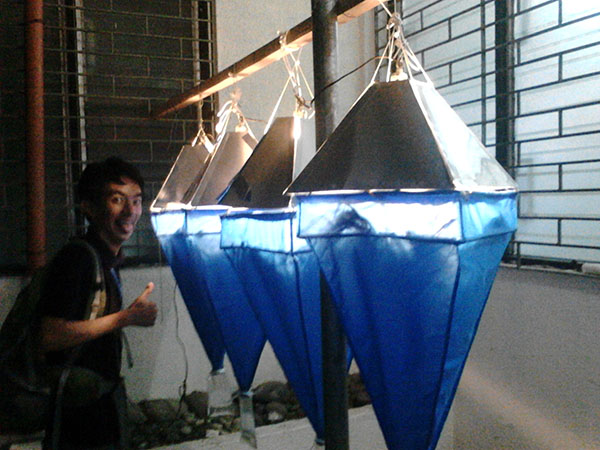
Berlese funnels

Berlese funnels at UPLB (photobombed)

The group is the current focus of my research. They occur in all temperate and tropical areas of the world (there is a good diversity in Ohio), but some genera and families are restricted in distribution, usually to specific parts of the tropics. So off I went to collect in faraway places.
Mite collecting trips do differ a bit from classical big game collecting trips in Africa or India: 1) nothing is being shot, and 2) there is a noticeable lack of caravans of porters, elephants, etc. Most mite collecting involves either collecting directly from hosts (insects, vertebrates, etc), or from the habitat. For me habitat was the main target, given that most uropodines live in soil, litter, or rotting wood. Collecting mites is also not very glamorous and definitely lacks instant gratification: you go to a habitat, collect possible sources of mites (e.g. bags of soil & litter), and bring them back for processing. Processing usually means Berlese funnel extraction, using heat to drive the mites out of the substrate until they fall down the funnel and into preserving fluid (95% ethanol in most cases). Bottom line, you spend 30 minutes collecting, have to wait 2-3 days to see results, and many more weeks to figure out what exactly you got.  Patience is a virtue.  On the bright side, a single sample may yield hundreds of mites.

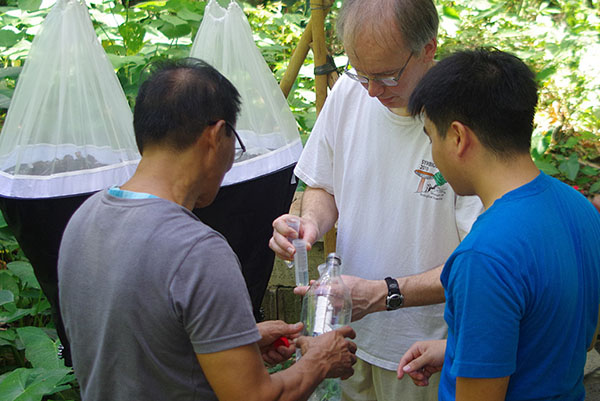
Mite collecting

From left to right: Phin Garcia, author, Jeremy Naredo

The Philippines trip was standard in many ways, but exceptional in terms of scale. I usually come back from a trip with 2-8 samples, here we were running 20 funnels almost continually. It helped a lot to have good collaborators, and for this trip I was fortunate to be able to work with folks at the University of the Philippines Los Baños, the agricultural campus of the University of the Philippines. The help of Drs. Juan Carlos Gonzalez, UPLB Museum of Natural History director, and Jun Lit, director of the Arthropod collection, is greatly appreciated. I specifically worked with Jeremy (Jebboy) Naredo, a MSc student, and Rufino (Phin) Garcia, a staff member with an uncanny ability to find mites.

Our base of operations was the museum. The building is relatively small, but quite nice, and with small but extremely popular exhibit spaces. One day there were 8-10 buses of school kids parked in front.
The Museum is set in a remnant of tropical forest. To test the funnel assemblies we put up on the day I arrived, we grabbed some litter from around the building, and ended up with some of the richest samples of the entire trip. One more of the oddities of sampling for mites. The campus proved to provide some very good sampling opportunities, both around the museum and in the Hortorium, a much larger forest remnant along a creek running through campus.

Creek in Hortorium, UPLB campus

Creek running through UPLB campus

There are potential problems working in the Philippines. Collecting, even of litter samples, is strictly regulated, so we could only work in certain areas using permits issued to the museum. And as usual, not everything worked. A long anticipated trip to Sibuyan Island, the “Galapagos of the Philippines”, had to be cancelled because of rough weather. The only way to get to that island is by ferry, and with rough seas all ferry rides were cancelled. Disappointing, but there is a limit on how much risk to take to collect mites, and this was clearly too much.
The main trip was to the Laguna – Quezon Landgrant area, an area that has both decent forest and is the focus of additional reforestation efforts.

Laguna Quezon Landgrant area

Laguna Quezon Landgrant area

The trip there was interesting. Initially the standard fare, using a rented jeepney to get to the headquarters. After that it got more fun, when we climbed on a wagon towed by a tractor. I have strong suspicions that the folks at the station wanted to see how long we could last on a trip worthy of any amusement park ride. To say that the ride was “bumpy” is an understatement. We regularly went airborne, getting seriously worried about being flipped out of the wagon. Eventually we decided to walk the final part to save ourselves and the dissecting microscope I was bringing. On the way back we walked all the way with a horse carrying our supplies, much better. The camp we stayed at was basic, but by using a stream coming out of the mountains, there was running water and even nice (but cold) showers. And excellent yields of mites. Phin and Jeremy braved a colony of army ants to get some of the (temporary) nest material. The ants did not appreciate it, and later on tried very hard to leave the funnel through the top, instead of falling down in the alcohol. We had to tape up all access points to avoid having a colony in the museum.  The rangers in the area were great, although it was slightly disconcerting that they all carried shotguns (to protect against log poachers).

Mahogany plantation

Mahogany plantation

I never left the island of Luzon, but we did travel to the Northeastern corner of the island, a roughly 12 hr car ride. We went to visit Dr. Leonila Raros, the pre-eminent Philippine acarologist , who has retired there. The area is 95% rice paddy, but we sampled her bamboo plots, and a few other sites on the way. Samples included a mahogany (Swietenia macrophylla) plantation. This species of mahogany is native to Central America and increasingly rare in its native range. In contrast, it has become a pest plant in the Philippines, invading forest remnants and displacing native vegetation. Very little will grow under these trees in the Philippines

Cave at Pangasinan

Crew after sampling Pangasinan caves

Our final collecting trip was by far the dirtiest: caves at Pangasinan. The cave systems here are enormous, with a very active group of cavers constantly working on mapping the caves. I was interested because bat guano may house some very specific uropodines. 30 years ago I worked in the Philippines on a mammal survey, spending a lot of time in bat caves. All of those were dry, these were not. These cavers view of a “dry” cave was wading into water up to your knees, “wet” caves would require scuba gear (I only figured this out AFTER we visited). An interesting experience.

Overall we ended up with almost 400 vials of specimens, mostly uropodids. That may easily represent several thousand specimens. Does such level of collecting endanger species or destroy habitats? Almost certainly no. Each sample may represent about 2l (0.5gal) of soil and litter. Any road or housing construction will destroy far larger areas and mite numbers. Second, while most people think plants or vertebrates or butterflies when thinking about conservation, mites are parts of ecosystems, and to figure out what role they play it would be good to at least know what we have.

Thanks to Jeremy Naredo who provided most of the pictures.

About the Author: Dr. Hans Klompen is professor in the department of Evolution, Ecology and Organismal Biology and director of the Ohio State University Acarology Collection.

Open House 2016


Last Saturday (April 23) started out cool and cloudy, but the enthusiasm of visitors and volunteers at the 12th Annual Museum Open House made it turn into an exhilarating day.  By our best reckoning, we had 2,641 guests join us to celebrate the day. Our 186 volunteers were there to welcome them and share their passion for biodiversity.
This was a year of innovation: a springtime date, outdoor activities under a massive 20′ x 90′ tent, a 2,200 gallon aquarium stocked with a variety of fish from the Scioto River, the t-shirt design contest, and a number of new hands-on activities. The support and positive feedback from the community was absolutely tremendous and thoroughly invigorating. Thanks to all who came, to all who helped to put the event together, to all our amazing volunteers, to the generous donations from visitors, and to the College of Arts & Sciences, Department of Evolution, Ecology & Organismal Biology, and to the Department of Entomology for financial support.

We’re wrapping up this year’s event (look for a more complete report at later blog post) and already thinking and planning for our lucky 13th Open House: all ideas on how to make this a better event are welcome. See you next year!


Open House-130

This year we expanded to the outside of the Museum, with kids’ activities under the tent.

Open House-134

Another new feature was the portable aquarium, stocked with fish from the Scioto River; they were returned to the river at the end of the day.

Open House-31

One of our young visitors gets a closer look at the fish.


Open House-8

A chameleon being painted on the cheek of one of our guests.

Open House-Christina

OSU undergraduate student Christina Daragan volunteered in face painting and acquired a painting of her own.

Open House-68

EEOB department chair Dr. Libby Marschall cuts chameleons out of paper plates for a kid’s activity.


Open House-32

A young visitor engaged in fish-printing.

Open House-81

Graduate students from the Aquatic Ecology Laboratory help with the plankton races.

Open House-73

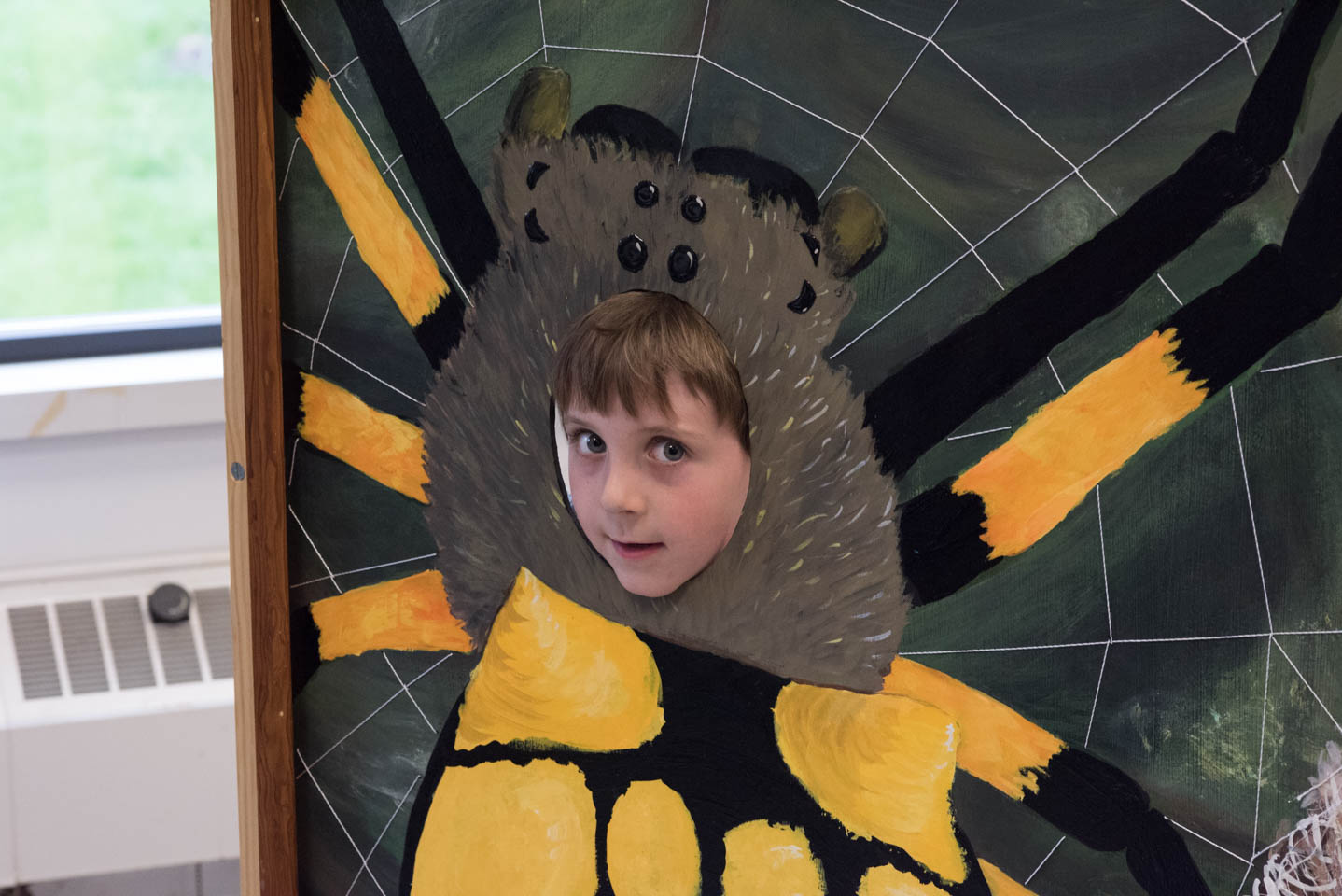
One of many young visitors who were photographed looking through a very different organism!


Open House-51

George Keeney, “zookeeper” of the Insect Zoo, which is always a big attraction.

Open House-60

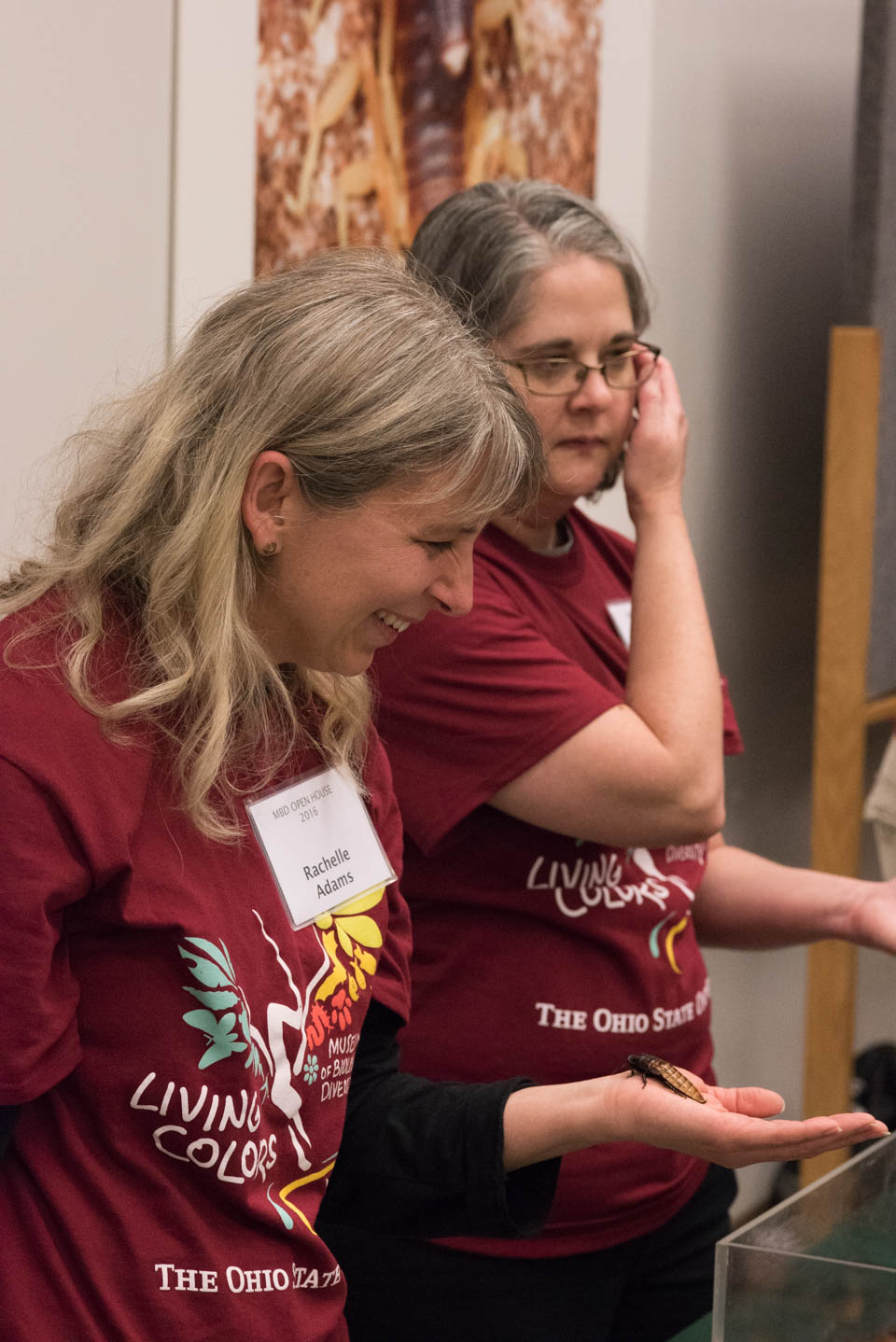
Dr. Rachelle Adams shows roaches to visitors.

Open House-39

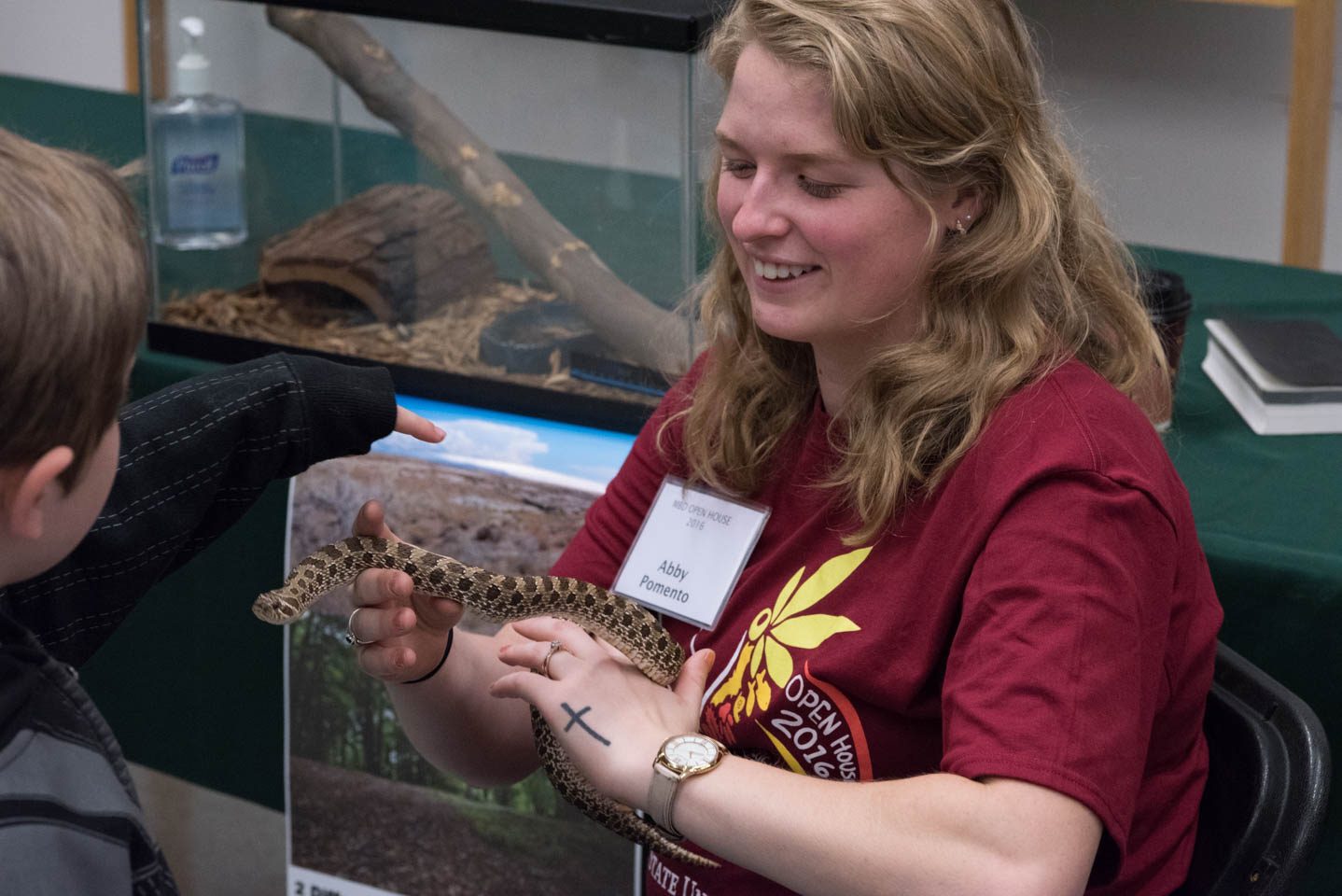
Abby Pomento shows a Hognose Snake to a young visitor.


Open House-44

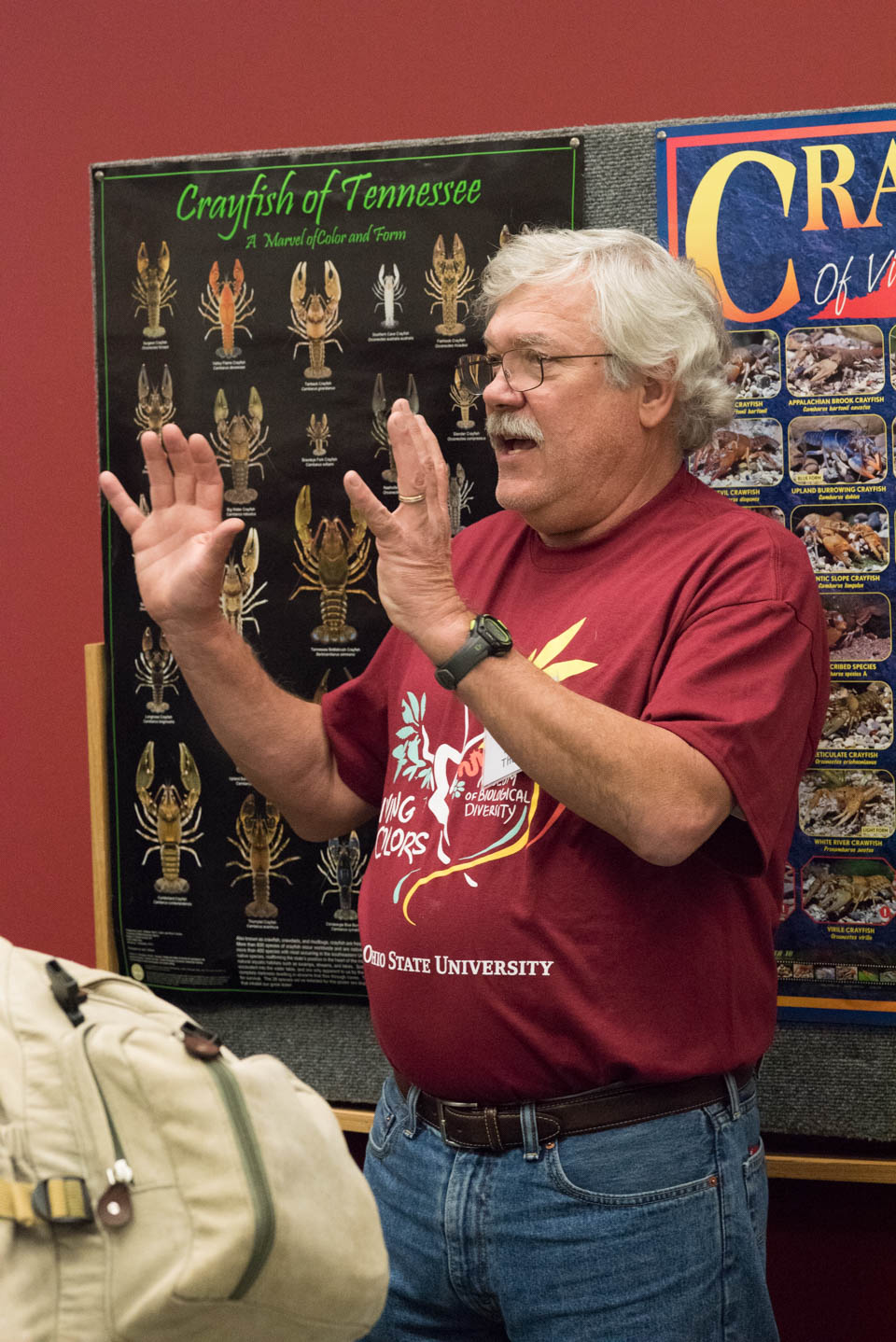
Roger Thoma explains crayfish biology to visitors.

Open House-77

Former graduate student Dr. Paul Larson explains DNA analysis.

Open House-46

Members of the limnology lab talk about aquatic systems with visitors.


Open House Bird Lady

Stephanie Malinich, Manager of the Tetrapod Collection, with her avian headdress.

Open House-128

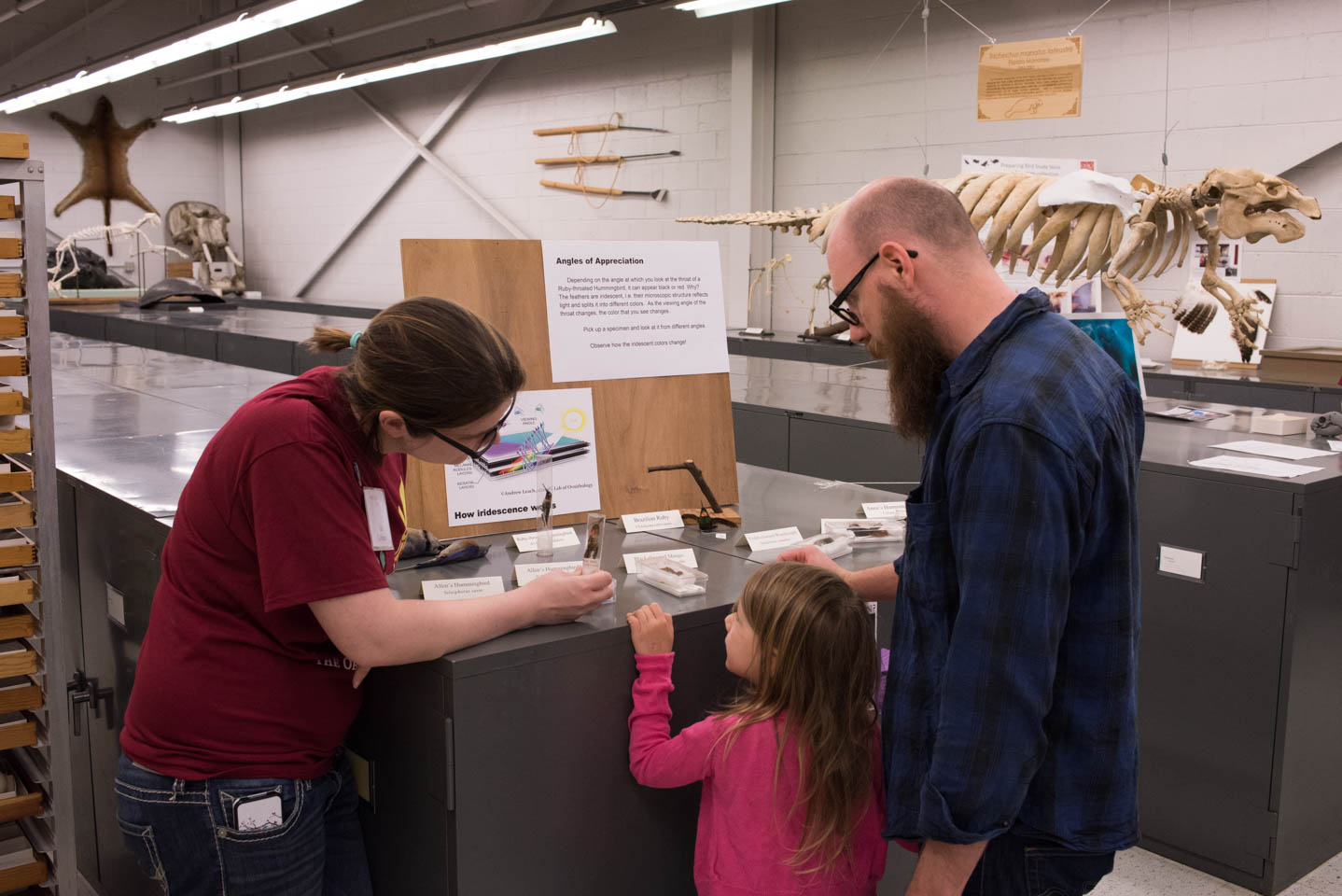
Graduate student Liz Calhoon explains the colors of birds.

Open House-124

Activities and exhibits in the Insect Collection.


Open House-41

The adult phase (you can tell by the wings) of a volunteer in the Insect Collection.

Open House-64

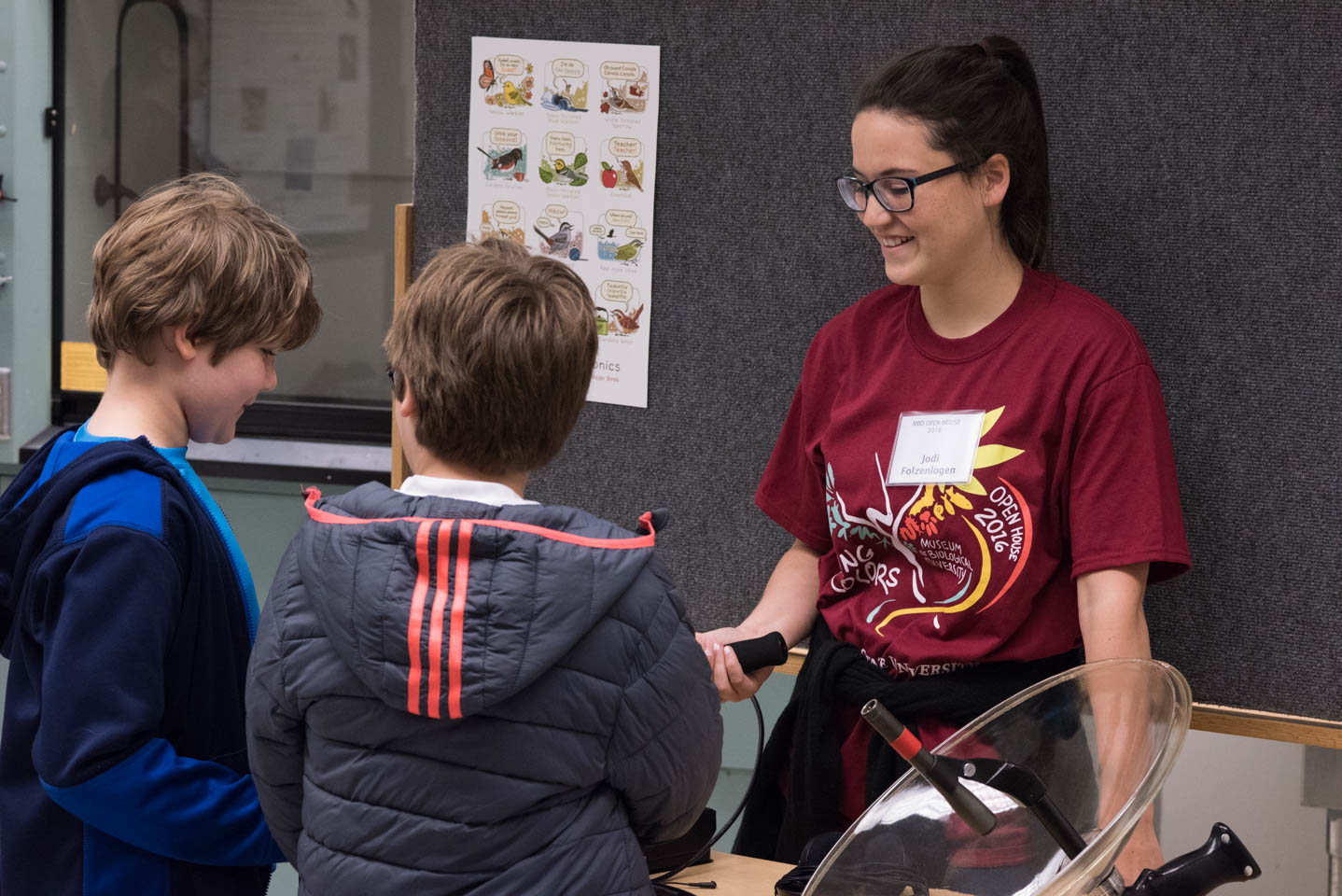
Jodi Folzenlogen explains the collection of sounds in the Bioaccoustics exhibit.

Open House-111

Dr. Tom Watters, Curator of the Mollusc Collection, explains the world of mussels and clams.


Open House-115

Dr. Hans Klompen, Director of the Tick & Mite Collection, shows the world of these tiny organisms to our guests.

Open House-113

OSU undergraduate student Miriam Gibbs explains fish biology.

Open House-106a

Drs. Bill Ausich, William Schenck and Dale Gnidovec talk about fossils with our visitors.


Open House-122

Exhibits in the Herbarium.

Open House-117

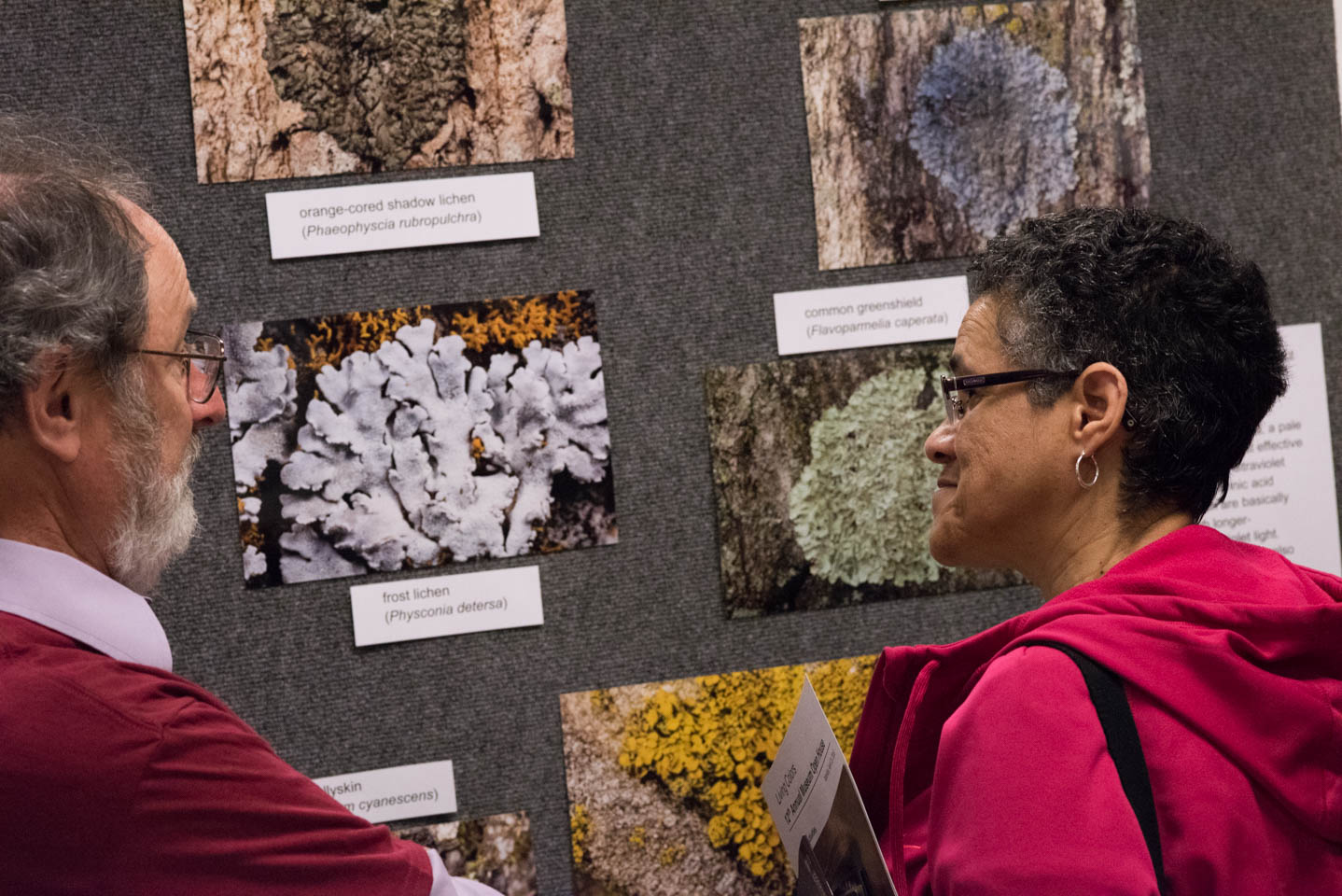
Dr. Bob Klips explains lichen biology to a guest.

Open House-129

Dr. Meg Daly, Director of the Fish Collection, and Dr. Norm Johnson, Director of the Insect Collection (and lead event organizer), enjoy a moment in the beautiful weather.


Open House-67

Dr. Luciana Musetti, Curator of the Triplehorn Insect Collection, with Zach Hurley, former Curatorial Assistant at the insect collection.

Open House-72

Dr. Carol Anelli, Associate Chair of Entomology, and Dr. Johnson help orient visitors.

Open House-137

Kevin Lumney, Instructor in EEOB, takes a well-deserved break near the end of the event.


About the Authors: Dr. Norman Johnson is Director of the Triplehorn Insect Collection and led the organization of the Museum Open House 2016. Dr. John Freudenstein is Director of the OSU Herbarium. Norman wrote the text above and John produced the photo gallery. All photos and captions by John Freudenstein.

Open House on my mind


For the past three months I have done little else other than plan and prepare for the Annual Museum of Biological Diversity Open House, coming up Saturday, April 23, 10AM-4PM. As one of the lead organizers, my mind is full of the big items and the small details that need to be taken care of so all the many parts of the event can work well.  No wonder when it comes to my turn again to write a post for the #OSUBioMuseum blog, I can only think of one thing: Open House.


Earlier in the year I wrote about the changes we are implementing in order to handle the expected number of visitors.

Museum Open House 2.0

If all of you come to visit this Saturday — which we hope you do, and the trend (see graph below) continues, we will probably have another record-breaking number of visitors.

Graph showing visitor attendance at the Annual Museum Open House

Graph showing visitor attendance at the Annual Museum Open House

Besides changing the date (from February to April), we are moving most of the hands-on activities outside of the Museum and under a big tent. With more space available, we added a number of new activities, and expanded a few others.  Some of the all-time favorites, like the Arthropod Zoo, were given more space. The full list of activities and the collections that will be open to the public, may be seen below.

Guide to the collections, displays areas and activities of the 2016 Museum Open House.

Guide to the collections, displays areas and activities of the 2016 Museum Open House.

If you are following us on social media, we have been instagramming, tweeting and posting updates on Facebook about the upcoming event. Several of us, faculty, staff and students in the Museum, are posting on one or more of these outlets so the best way to follow is to search for the hashtag #MBDOH2016.

Now, with only a few days to go and with most of the big items taken care of, I’m having a little time to contemplate the overwhelming size of the event ahead of us. Wow!

Back in 2005 we never imagined that our Open House would become this big and successful. We only thought we would share the work we do and the amazing animals and plants we study.

But after eleven annual open houses, and knowing that so many of our neighbors here in central Ohio have the same passion and enthusiasm for the natural world as we do, we can only be thankful and try to hold the best event we can.

All the collections are working on colorful theme-related displays and we will also have new hands-on activities. We hope you can join us as we explore the role of colors in Nature during our 2016 Museum Open House.

For more information about the event please visit our Visitor Information page. Note that we have much more visitor parking space available this year.  

Before I forget, I especially want to acknowledge the work and support of my colleague Steve Smith. In 2014, when I first worked on the organization of a museum Open House, Steve had just started as the Museum’s part-time office manager. We both had to learn a great deal, and banged our heads around more than a few times. And here we are again! Thanks, Steve!


About the Author: Dr. Luciana Musetti is an Entomologist and the Curator of the Triplehorn Insect Collection.