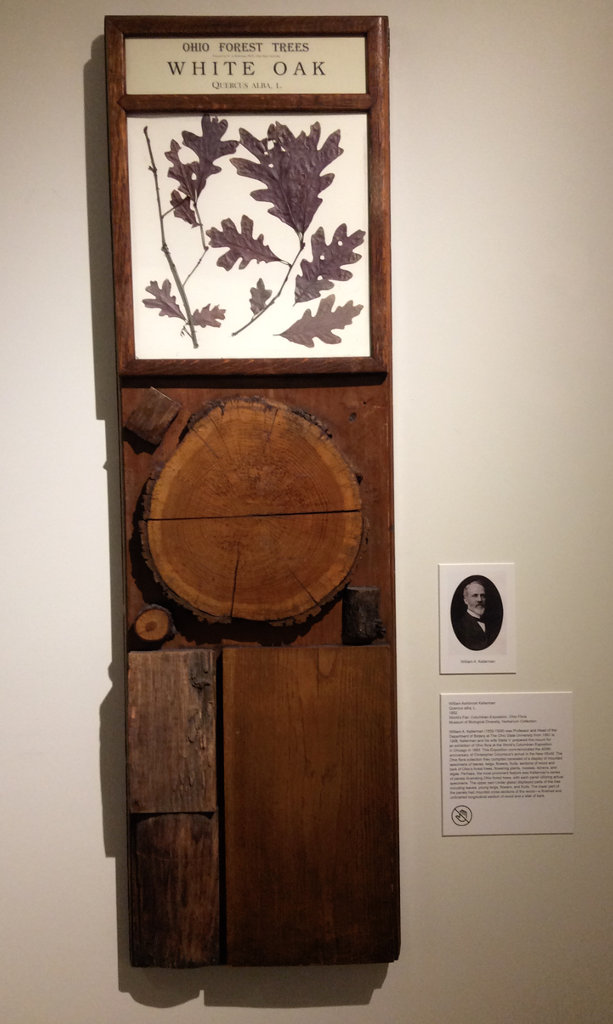
An 1892 Framed Plant Mount on display at the Thompson Library

The first director of The Ohio State University Herbarium and his wife, Dr. and Mrs. William Ashbrook Kellerman, prepared quite a large number of framed mounts of Ohio plants in 1892. According to the previous curator of the herbarium, Dr. Ronald L. Stuckey, these were “part of an exhibit of the Ohio flora displayed in the Ohio State Building … at the Columbian World’s Fair in Chicago in 1893. The total collection consisted of a display of mounted specimens of leaves, twigs, flowers, fruits, section of wood and bark of Ohio’s forest trees, and flowering plants, mosses, lichens, and algae.”

One of these framed mounts, twigs and wood section of the white oak tree, Quercus alba L., is currently on display at the Thompson Library until May 14, 2017. Dr. Florian Diekmann, head of the Food, Agricultural, and Environmental Sciences Library and Student Success Center, was in contact with the staff of the OSU herbarium early June last year seeking help in displaying specimens of white oak as many of the wooden structures of the main library were obtained from that plant.

Since the original twigs and leaves were not in good condition and the glass was chipped in a corner, Dr. Diekmann agreed to have it restored and refurbished. This is just one of the many framed, mounted but not displayed items in the Herbarium hitherto. The idea behind the gallery is to show the “unique connections and history shared between The Ohio State University and Ohio’s forests.” The Ohio State University Herbarium was glad to share its resources with the general public and has also made other items available for display at the gallery.

Mesfin Tadesse, curator OSU herbariumAbout the Author: Mesfin Tadesse is curator of vascular plants at The Ohio State University Herbarium.

*** We would like to hear from you, please leave a comment ***

Flight of the Butterfly

What does re-animated life in the Triplehorn insect collection look like? What if a butterfly took flight from its drawer? Watch for yourself: Flight of the Butterfly by Tamara Sabbagh

THANK YOU Luciana Musetti, curator of the OSU Triplehorn Insect collection for facilitating the students’ visit.

About the Author: Angelika Nelson is the outreach and multi-media coordinator at the Museum of Biological Diversity and facilitates visits of school classes and students.

*** Which of the animations is your favorite? ***

Samsara – Cyclicality of life

Another video of re-animated life produced by a student in the Moving Image Art class organized by Amy Youngs, Associate Professor of Art:

Samsara – Cyclicality of life by Yuntian Zang: Inspired by the antlers on the wall, a deer goes wandering …

THANK YOU Stephanie Malinich, collection manager of Tetrapods, for facilitating the students’ visit.

About the Author: Angelika Nelson is the outreach and multi-media coordinator at the Museum of Biological Diversity and facilitates visits of school classes and students.

*** Which of these animals is your favorite? ***

re-animated Life I

We scientists look at our natural history collections as a great resource for our studies. Specimens tell us about life in the past (where species lived, what they looked like, how many individuals existed etc.) and let us hypothesize about the future. This is one way of looking at these dead “things” that we so meticulously curate. Artists may have a quite different view. This was greatly illustrated by a Moving Image Art class organized by Amy Youngs, Associate Professor of Art, last semester. Students visited our collections of dead things and were asked to find ways to re-animate these animals. We were amazed by the imagination of these young artists-to-be. Over the next days we will share some of the best pieces with you. Here is the first animation, Re-Animated Life by Alina Maddex: Birds and one turtle moving in their natural environment

THANK YOU Stephanie Malinich, collection manager of Tetrapods, Marc Kibbey, Associate Curator of the Fish Division, Caitlin Byrne, Collections Manager of the Division of Molluscs, and Luciana Musetti, curator of the OSU Triplehorn Insect collection for facilitating the students’ visit.

About the Author: Angelika Nelson is the outreach and multi-media coordinator at the Museum of Biological Diversity and facilitates visits of school classes and students.

*** Which of these animals is your favorite? ***

Ain’t No Mountain High Enough .. To Stop Tree Squirrels From Hybridizing

The Chavez Lab will be going to the North Cascades of Washington this summer to do field work in the Tamiasciurus tree squirrel hybrid zone. We have been studying hybrid zone dynamics between Douglas squirrels (T. douglasii) and red squirrels (T. hudsonicus) for 10 years using mostly genetic and phenotypic data. Now is the time to start some observational field research to better document hybrid dysfunction and behavioral interactions between species and their hybrids.

This study contains a richness in questions as to the role that ecological divergence has in the maintenance of isolating barriers and ultimately speciation between these two species. These parapatric species, separated by an extreme change in habitat, meet each other in the different mountain ranges in the Pacific Northwest. Both species live primarily in coniferous forests and have diets and lifestyles that are specialized for feeding on seeds from conifer cones. In the North Cascades region, Douglas squirrels are mostly found on the west side of the Cascade Mountains in a mesic forest environment with a moderate coastal climate. Red squirrels on the other hand are mostly found in the rain-shadow of the Cascade Mountains on the eastside and live in a drier forest with a more seasonally variable climate. Due to the higher fire frequencies in the eastside forest communities, some of the conifer species that red squirrels depend on produce cones with very hard scales or are serotinous (only open during extreme heat from fires). As a result, red squirrels in this region have very strong jaw muscles and bite force in comparison with Douglas squirrels that only feed from trees that produce softer cones. There are many other environmental differences between the westside and eastside environments and thus strong potential for adaptive divergence between these species.

So, you may ask, what does all this ecology have to do with hybridization and speciation? Well, these species may be producing hybrids that have phenotypes that are not well adapted to either type of forest and thus are at a selective disadvantage. Our goal for this study is to examine more directly whether hybrids have lower fitness and dysfunctional traits that decrease their chances of surviving and reproducing. We plan to do this by live-trapping squirrels in a hybrid zone location where I know from previous genetic research that both parental species and hybrids occur. We expect all squirrel types to be living in close proximity with each other and thus we should have good opportunities to study behavioral interactions, as well as document differences in various performance behaviors, such as feeding, mating, vocalization, territorial defense, anti-predator defense, etc…

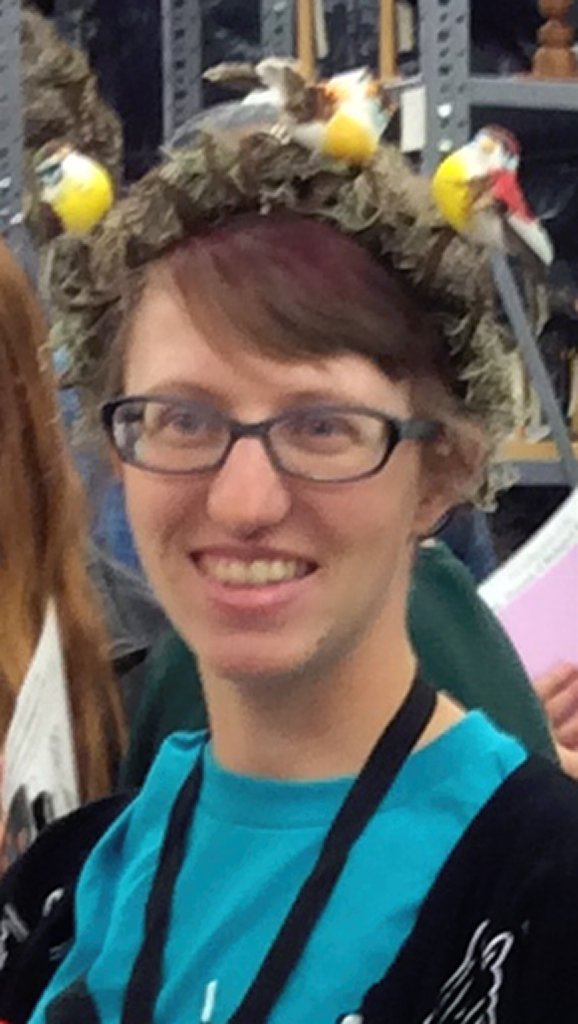
Stephanie Malinich with bird crownStephanie Malinich is going to be the lead field technician and she will supervise a crew of eager field assistants. Since this is our first field season, we expect a lot of surprises, hopefully more pleasant than difficult ones. This is an exciting time for our lab and we will update you on our findings on this blog later in the year.


Andreas ChavezAbout the Author: Andreas Chavez is Assistant Professor in EEOB as of Fall 2016. He is also Director of Mammals in the Tetrapod Collection at the Museum of Biological Diversity. This is his first blog post for the Chavez Lab on the MBD website.

*** Leave a comment to welcome Andreas Chavez ***

Museum Open House 2017

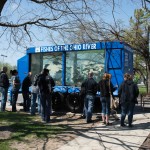
We hope you all enjoyed our Open House last Saturday. We started the morning in the dark due to a power outage in the Upper Arlington area. Just as we moved specimens and displays outside, the power came back on at 10:30 am and we were able to invite visitors inside.

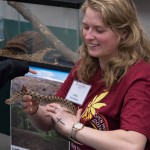
The auditorium was creeping and crawling with all kinds of arthropods including everyone’s favorite stick insects and scorpions.

Lots of activities awaited all kids and young-at-heart; among others you could plant a seedling, build your own bird feeder, preserve bugs in goo and get your face painted – some artists were at work here.

Herbarium, insects, tetrapods, fishes and mollusc collections had their doors open to give you insights into research in natural history collection and simply show you some of the cool specimens we have.

You could listen to sounds of frogs, cicada, racoons and other animals in the Borror lab of Bioacoustics.

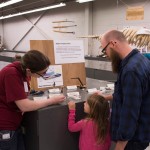
Drawing natural history specimens was a hit, and produced some very nice drawings.

We would like to thank our numerous volunteers without whom this event would not have taken place. They help with set-up, explain displays to visitors and take displays down at the end of the day. THANK YOU.

Let us know what your favorite activity or display was. We hope to see you all again next year!

About the Author: Angelika Nelson is curator of the Borror Laboratory of Bioacoustics and coordinates social media and outreach at the museum.

*** We would like to hear from you – Please leave a comment ****

Our big day is tomorrow

Tomorrow, Saturday April 22, from 10 AM – 4 PM we will open our doors and welcome all of you to visit our hidden treasures in the natural history collections of The Ohio State University. Stop by and talk to the curators who meticulously keep these specimens and make them available to students and researchers for study throughout the year. This is your chance each year to see what we do and to support our efforts.

The event is FREE and so is parking. We will have many activities for children including face painting, the very popular bugs-in-goo, a live arthropod zoo … and this year new, for anyone over 15 years, guided sessions on scientific illustration, drawing natural history specimens.

Enjoy some photos from last year events

The set-up for tomorrow is in full swing, here is what I have seen so far


About the Author: Angelika Nelson is curator of the Borror Laboratory of Bioacoustics and coordinates social media and outreach at the museum.

*** We hope to see you tomorrow ***

Songsters on the move

I have been teaching a class on Ohio Birds since January during which we visit various field sites around Columbus to look for birds. One main goal is for students to be able to identify birds visually and acoustically by the end of the semester. As you may imagine the birds we have been seeing over this time period have  changed quite a bit.

Not only the species have changed but also overall diversity. Venture out in January and you can call it a good day when you see 15-20 bird species. You want to choose your birding location carefully, a variety of habitats (lake, woodlot, open field, and bird feeder) will increase your numbers. These days however 30 species are the norm, it is migration season! While most of our winter guests such as Dark-eyed Junco and American Tree Sparrow have left us and gone north to their breeding grounds in Canada, many other species that spent the winter south, some as far as Argentina, are on their way to our temperate region.

Blue-gray Gnatcatcher. Photo by Christopher Collins, 2017

Blue-gray Gnatcatcher. Photo by Christopher Collins, 2017, via www.fb.com/roguebirders

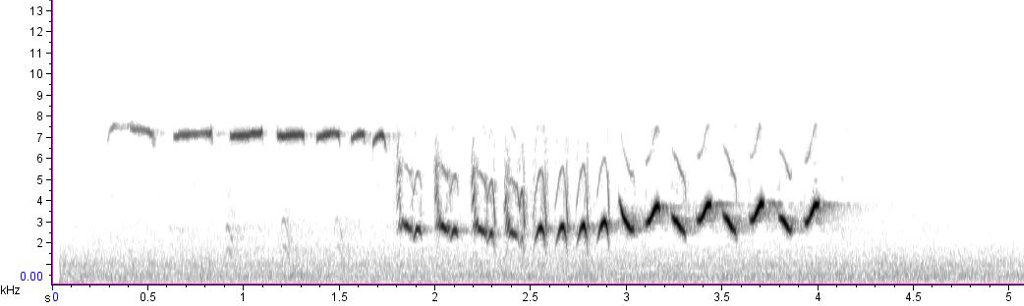
Have you seen a Blue-gray Gnatcatcher yet? Guess what this bird feeds on! Listen for their begging-like calls high in the tree tops. Their long tail and light-gray appearance are a good give-away.

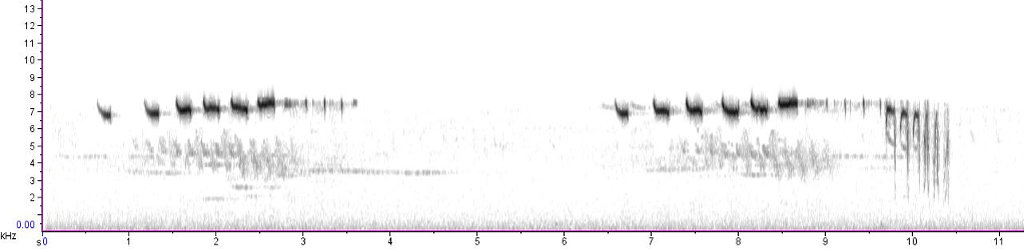
Spectrogram of calls of Blue-gray Gnatcatcher

Spectrogram of calls of Blue-gray Gnatcatcher, BLB28872


Similarly flitting around in the tree tops are kinglets (family Regulidae). These tiny birds (even smaller than chickadees! they weigh only 10g or 2 nickels) seem to be constantly on the move. One of the two species that can be added to your Ohio list, the Golden-crowned Kinglet, even spends the winter with us. Truly an amazing feat in temperatures that can drop to zero Fahrenheit and below on occasions. A good photo of this species shows off their flashy bright yellow crest bordered by a black eyebrow stripe on each side.

My favorite though is the Ruby-crowned Kinglet, in particular because of its song. It starts out like its close-relative the Golden-crowned with some very high-pitched tsee notes, but then truly distinguishes itself through a jumble of notes, a musical twitter, that seems incredibly loud given the small size of this songster.

Spectrogram of song of Golden-crowned Kinglet

Spectrogram of song of Golden-crowned Kinglet, BLB17541

Spectrogram of song of Ruby-crowned Kinglet

Spectrogram of song of Ruby-crowned Kinglet, BLB11487


But do not underestimate the small! My all-time favorite, the Winter Wren, delivers the loudest song (per unit body weight) of all birds, a beautiful cascade of bubbly notes.

Winter Wren. Photo by Christopher Collins, 2016

Winter Wren. Photo by Christopher Collins, 2016, via www.fb.com/roguebirders

While you may get lucky to hear this song in Ohio on occasion from one of the male Winter Wrens passing through, their song is commonly heard in the deciduous and evergreen forests of the north. By the way, did you know that the male hormone testosterone greatly influences bird song? As these males migrate and get ready for the breeding season, their testosterone levels increase and they start practicing their song – even though they are not setting up territories here or trying to attract females.

Spectrogram of song of Winter Wren

Spectrogram of song of Winter Wren, BLB44620


There are many ways to appreciate our songbirds. Since I am fascinated by their song I like to record their vocalizations and take these recordings back to our sound lab and look at them. We humans are just so visually oriented that even the song of a Winter Wren may look more beautiful to us than listening to its sound (This is of course not true if you have a musical ear or train yourself to listen carefully and pick out intricate details).

If you are interested in learning how to record bird songs, look at them at home and compare them to each other join me for a Sound Analysis workshop at the nature center at Battelle Darby Creek metro park on Saturday April 29 from 10:30-11:30 am. If you are an early riser, join us on a Bird Walk at 8 am that same day and listen to the bounty of birds singing at this time of the year.

Credits:
Sound descriptions based on the ones given by the Cornell Lab of Ornithology, All about Birds.

Thank you Christopher Collins and Jim McCormac for the bird photos.

All recordings are archived in the Borror Laboratory of Bioacoustics. More detailed information for each can be accessed online; just click on each species’ name:
Blue-gray GnatcatcherGolden-crowned KingletRuby-crowned KingletWinter Wren

About the Author: Angelika Nelson is curator of the Borror Laboratory of Bioacoustics and instructor of Ohio Birds each spring.

*** Which birds are your favorites? ***


Ticks in pictures

Some more about ticks.  No, not The Tick comic or the movie Ticks … both may be entertaining, but they feature completely inaccurate depictions of ticks.

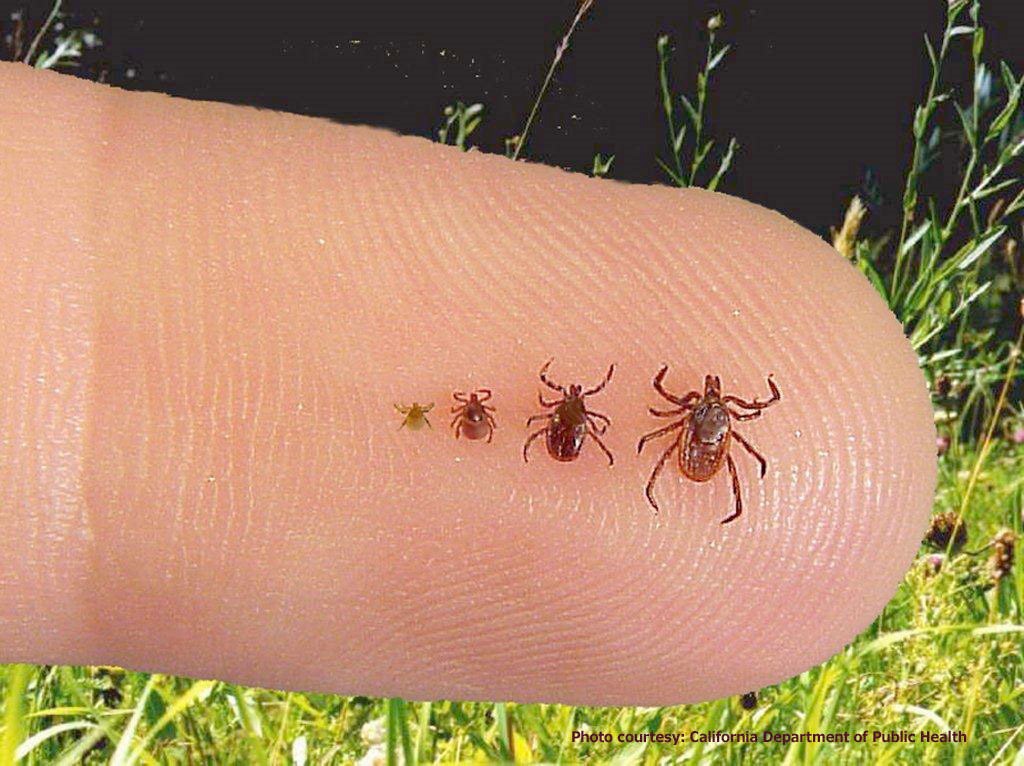
Let’s talk about real ticks:  Ticks are rather large mites. To demonstrate this, here is a family portrait:

family portrait of Ixodes pacificus, California Dept. of Public Health

Family portrait of Ixodes pacificus, California Dept. of Public Health [public domain]

From left to right, larva (6 legs), nymph (8 legs), male and female of Ixodes pacificus, the Western black-legged tick, from the west coast (you can see them with the naked eye, therefore they are big).

All members of the family feed on host blood using highly modified mouthparts, but only larvae, nymphs, and females engorge (feed to the point where their body truly swells up).

close-up of mouth parts of Amblyomma extraoculatum, U.S. National Tick Collection (USNMENT00956315)

Close-up of mouth parts of Amblyomma extraoculatum, U.S. National Tick Collection (USNMENT00956315)

Here are some nice examples of engorged females.  Keep in mind that while engorged ticks are easy to find, they are often difficult to identify.

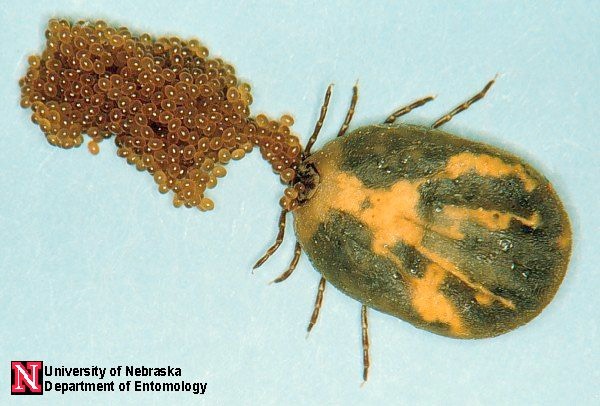
Most of the ticks we encounter in Ohio have females that feed only once.  They engorge, convert all that host blood into a single mass of hundreds to thousands of eggs, and die.

tick with eggs (c) Univ. Nebraska, Dept. Entomology

Tick with eggs, Univ. Nebraska, Dept. Entomology

Ticks in general get really bad press.  Kind of sad, because ticks are very good at quite a few things, like surviving (some can survive hours under water or years without food), or manipulating your immune system (using a dizzying array of chemicals often found only in ticks). On second thought, that may not strike most people as positive, so let me end with a few pictures of beautiful creatures. I already introduced Amblyomma americanum, which occurs in Ohio, the others are African, A. chabaudi on tortoises in Madagascar, A. variegatum usually on cattle. Amblyomma variegatum is the main vector of heartwater, a disease making cattle herding impossible in parts of Africa, but still, very pretty.

See some more of these specimens close-up, but at a safe distance through microscopes at our Annual Open House, April 22, 2017.


Dr. Hans Klompen, Professor EEOBiology at OSUAbout the Author: Dr. Hans Klompen is professor in the department of Evolution, Ecology and Organismal Biology and director of the Ohio State University Acarology Collection.

*** Which of these ticks is your “favorite”? Let us know on Facebook ***


Know your ticks: Ohio

Daffodils are in bloom, students walk around in shorts and T-shirts, so it must be the beginning of tick season.  And indeed, the first ticks are out and questing (= searching for a host). This might be a good time to talk about ticks in Ohio.  Ohio is not a major center for tick diversity, but it has some diversity.  Most people only know the three main people biters, Dermacentor variabilis (American dog tick), Amblyomma americanum (lone star tick), and Ixodes scapularis (deer tick), so let’s start with these:

Dermacentor variabilis is perhaps the most widespread and common tick in Ohio.  Immatures feed on rodents and other small animals, but adults feed on medium (opossums, raccoons, dogs) to large (humans) mammals.  Of the “big three” this species is the most tolerant of drying out, and the most likely to be encountered in open areas.  The main activity period for adults is mid-April – mid-July.  D. variabilis is the vector of, among others, Rocky Mountain Spotted Fever (RMSF) and tularemia.  Columbus used to be a focal area for RMSF, but the disease is less common now.  D. variabilis may also cause tick paralysis, although less frequently than the related D. andersoni from the Rocky Mountains region.

American dog tick

Dermacentor variabilis American dog tick

Amblyomma americanum used to be uncommon in southern Ohio, but has increased in numbers and range over the last decades.  This is part of a general trend.  In the eastern U.S., this species is rapidly expanding its range northwards.  All instars, larva, nymph, and adult feed on mid-size to large animals, incl. humans.  Like D. variabilis, females can deposit very large clutches of eggs, but in this case the resulting larvae often stay together.  If you are unlucky and step close to a mass of these “seed ticks”, you may be attacked by hundreds of ticks simultaneously.  These ticks are active in all warm months of the year.  Unlike D. variabilis, “Lone stars” are not common in open areas, preferring more shady and humid sites.  For a long time A. americanum was listed as vectoring few human diseases, but it has now been identified as vector of human monocytic ehrlichiosis and STARI, and possibly tularemia and Q-fever.

lone star tick

Amblyoma americanum lone star tick

Ixodes scapularis appears to be an even more recent resident.  This species was rare or absent in Ohio before 2010, but has now been found in a majority of Ohio counties.  The reason for this sudden expansion is unclear.  This is a relatively small species.  Larvae can be found in summer, nymphs late summer, and adults in fall and early spring.  Immatures tend to feed on smaller sized hosts, e.g. rodents, small birds, while adults prefer larger hosts, such as deer.  However, all instars may attach to humans.  Nymphs are considered the most problematic: they are small (thus often undetected), and can be infected with e.g. Lyme disease (unlike the even smaller larvae).  Like A. americanum, this species prefers shady, humid environments.  New subdivisions build in forests, resulting in large amounts of forest edges with lots of deer, have been a very good habitat for this tick in New England.  Ixodes scapularis has become famous as the vector for, among others, Lyme disease, human granulocytic anaplasmosis, and babesiosis.  Co-infection is common in New England and appears to result in increased pathology.

deer tick

Ixodes scapularis deer tick

So much for the common people biters.  It is important to note that most species of tick rarely if ever bite people.  They prefer different, usually smaller, hosts.  For example, Rhipicephalus sanguineus, the brown dog tick prefers feeding on dogs.  It is one of the few species that may occur indoors in dog kennels etc.  Haemaphylis leporispalustris appears to be specialized on hares and rabbits.  Several Ixodes species, I. cookei, I. dentatus, I. kingi, I. marxi, can be found on small to medium sized mammals, often associated with nests or burrows.  Finally, the so-called soft ticks, family Argasidae, are represented by only a single species in Ohio, Carios kelleyi, primarily found in bat colonies.

Find out more about the ticks’ life cycles and their diseases.

Dr. Hans Klompen, Professor EEOBiology at OSUAbout the Author: Dr. Hans Klompen is professor in the department of Evolution, Ecology and Organismal Biology and director of the Ohio State University Acarology Collection.


*** Have you found a tick yet this spring? send us a photo of your specimen on Facebook! ***