One of my favorite courses at Ohio State University (OSU) is the mammalogy course offered in the School of Environment and Natural Resources, which is instructed by Dr. Stan Gehrt. A big part of this course is a field study, where students use different sampling techniques to survey wildlife around Columbus. Our group chose to survey mammals in Chadwick Arboretum, which is located on OSU’s west campus. In addition to daytime in-person surveys, our group set up camera traps in an effort to capture the area’s nightlife. We were mostly expecting to capture images of deer, and maybe raccoons, so you can imagine our surprise when a coyote showed up in our photos (Figure 1)!
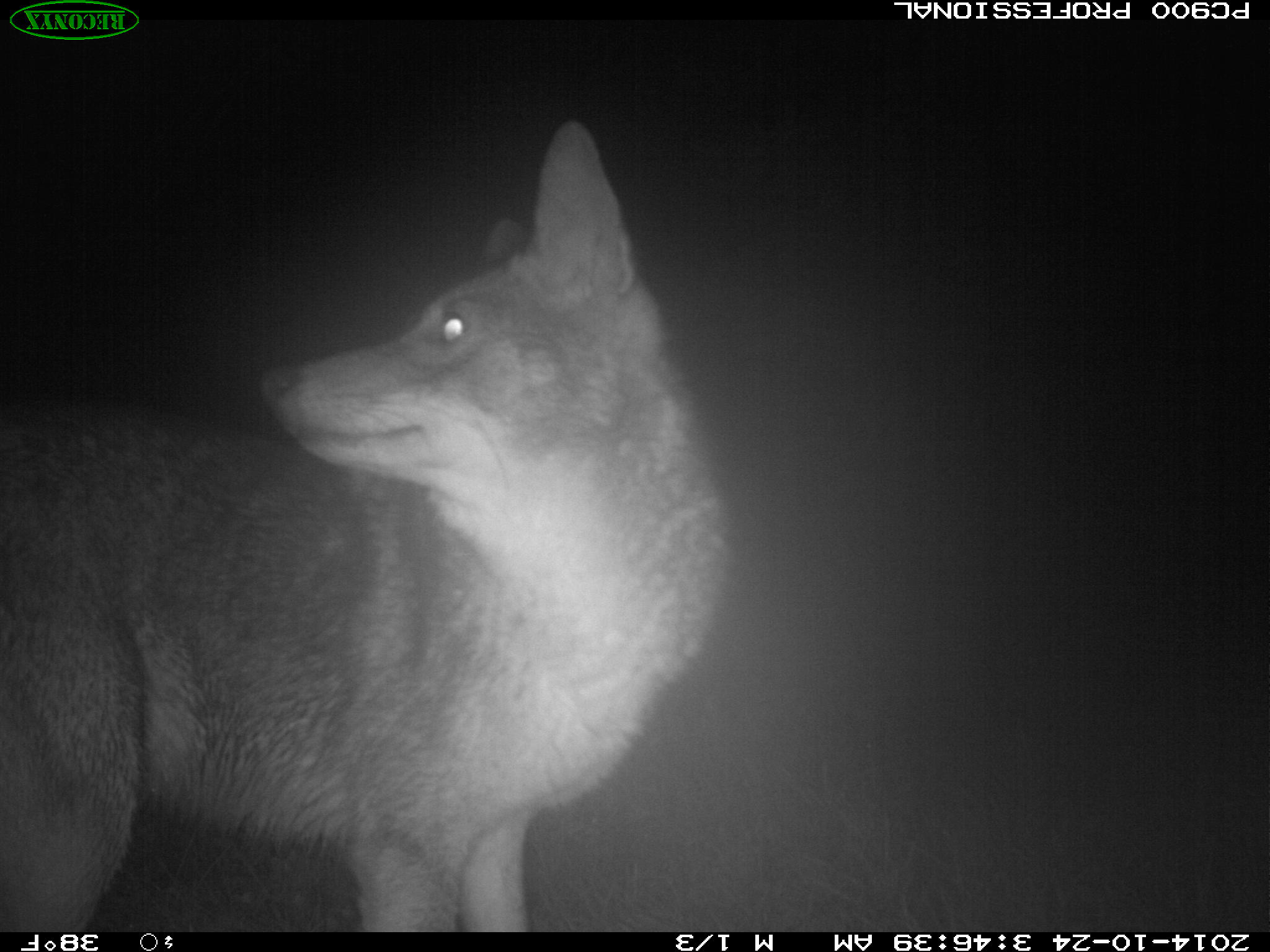
Figure 1. Camera trap photo of a coyote in Chadwick Arboretum (my own)
Urban coyotes are far more common than some people realize, and research groups in urban centers around the country have studied this phenomenon. For example, Dr. Gehrt’s lab studies urban coyotes in Chicago, Illinois. Additional research efforts include the Urban Coyote Initiative and the Denver Urban Coyote Project (See the links below for more information on these projects!).
Not surprisingly, not all animals can thrive in the urban landscape. Urban environments can cause stress in animals (Schell et al., 2013; Birnie-Gauvin et al., 2016). When an animal becomes stressed, stored energy in its body is mobilized (Randall et al., 2001). This energy fuels the animal’s “fight or flight” response. This stress response allows the animal to deal with the stressor, which is beneficial in the short term. However, long-term stress can have negative health impacts, such as decreased functioning of the immune system, that result in decreased fitness (Randall et al., 2001).
When faced with anthropogenic disturbance, coyotes do present a stress response (Schell et al., 2013). However, research has shown that coyotes thrive in urban environments (Morey et al., 2007; Gehrt et al., 2011). This success in urban environments may be due, in part, to increased survival (Gehrt et al., 2011; Rodewald & Gehrt, 2014). Although adult coyotes have similar survival rates in urban and rural environments, research has shown that juvenile coyotes have higher survival rates in urban environments (Gehrt et al., 2011).
In addition to changes in reproduction and survival, urban species often behave differently than their rural counterparts (Ditchkoff et al., 2006; George & Crooks, 2006). For example, research has shown that coyotes have lower activity levels in areas where human activity is high (George & Crooks, 2006). Other species, such as bobcats, may become more nocturnal in urban areas in order to avoid high human activity during the day (George & Crooks, 2006). Urban species may also change their diets and foraging strategies in order to take advantage of food sources such as garbage or garden fruits and vegetables (Ditchkoff et al., 2006). These behavioral modifications help urban species to take advantage of new resources and avoid human-induced stress, which ultimately enables them to survive, and sometimes even thrive, in urban environments.
Check out the following links for more information:
- OSU Professor Dr. Stan Gehrt: https://senr.osu.edu/our-people/stanley-d-gehrt
- Terrestrial Wildlife Ecology Lab: https://senr.osu.edu/programs/terrestrial-wildlife-ecology-lab
- Chicago research: https://urbancoyoteresearch.com/
- The Denver Urban Coyote Project: http://www.therealwileecoyote.com/
- The Urban Coyote Initiative: http://urbancoyoteinitiative.com/
References
Birnie-Gauvin K, Peiman KS, Gallagher AJ, de Bruijn R, Cooke SJ (2016) Sublethal consequences of urban life for wild vertebrates. Environ Rev 24: 416 – 425.
Gehrt SD, Brown JL, Anchor C (2011) Is the urban coyote a misanthropic synanthrope? The case from Chicago. Cities Environ 4.
Morey PS, Gese EM, Gehrt SD (2007) Spatial and temporal variation in the diet of coyotes in the Chicago metropolitan area. Am Midl Nat 158: 147 – 161.
Randall D, Burggren W, French K (2001) Eckert Animal Physiology: Mechanisms and Adaptations. W. H. Freeman and Company, New York.
Rodewald AD, Gehrt SD (2014) Wildlife Population Dynamics in Urban Landscapes. In: McCleery RA, Moorman CE, Peterson MN, eds. Urban Wildlife Conservation. Springer US, pp 117 – 147.
Schell CJ, Young JK, Lonsdorf EV, Santymire RM (2013) Anthropogenic and physiologically induced stress responses in captive coyotes. J Mammal 94: 1131 – 1140.