We sorted one kit last week, which was collected by S. Nelson in Wood county. I got Eleanor trained to sort out specimens from kits in addition to helping with pinning. As always, lots of fun things to see in the kit.
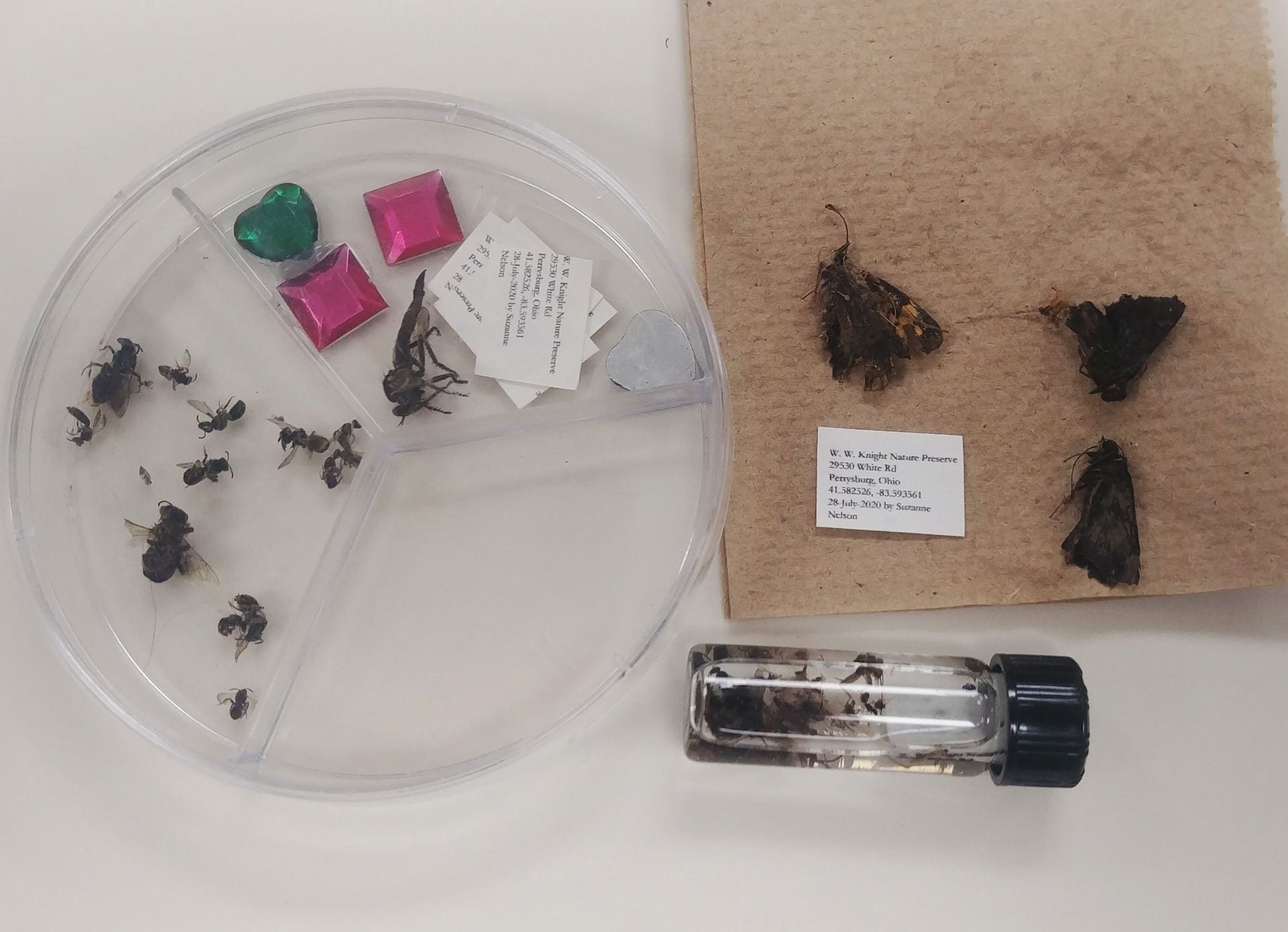
Here is an example week of sorting from this kit. Reasonable numbers for most groups, plus a few more robberflies! We also had a lot of spiders in this kit for some reason, with what seems like 3-4 spiders a week (compared to one spider every other week in the kits).
Here are several weeks of sorted bees and hoverflies from the same kit. Some weeks there were only a few bees and then some weeks there were over 50. Still nowhere near our 450 bees per week, which is fine with me. Notably absent from this kit was Calliopsis. This is the first kit to not have several Calliopsis.
Melitoma was a lovely find for this part of the state!
I was particularly excited to see a Morning Glory Turret Bee (Melitoma taurea), which is now the northernmost record of the species on iNaturalist. This beautiful gray bee likes morning glory flowers, and has an extra long tongue to reach down in there. It also has a cool black pattern on its thorax, which is best shown in a photograph of a different specimen by Laura Hughes here: https://www.inaturalist.org/observations/56588305
Check out how long that tongue is on Melitoma! It reaches to the hindlegs! That long tongue helps it get down deep into the morning glory flowers.
Cool bycatch of the week: This longlegged fly (family Dolichopodidae) is bright green, has the characteristic long legs, and has modified forelegs for some reason. Check out those tarsi!
If you are looking for even more bee content, check out the website of Dr. Jamie Strange here: https://u.osu.edu/strange.54/
Covid and Pinning Training:
I am still keeping the pinning training sessions small to reduce the risk of covid. I have not added new slots yet. We are experiencing our highest rate of Covid infections in Ohio so far (5,500 new cases on Saturday), so everything is subject to change. Feel no pressure to still show up if you are worried about spreading or getting covid at the lab. Masks are still required regardless.
The only people I am around are those who come to the lab and those I encounter while grocery shopping (my partner now works from home, so he is not encountering anyone). So fingers crossed I don’t come down with it either. I have signed up for OSU’s weekly asymptomatic testing, but there is normally a few days delay between the test and results. As an OSU employee, I am also required to take my temperature each morning before I go on campus, so if I do get sick, I will hopefully notice sooner.
If it comes to a point where I think our risks in the lab have increased significantly, I may end up cancelling all pinning training sessions. I have already acknowledged that our specimen processing is going to take significantly longer than we originally anticipated, so we might not finish pinning specimens till late next year, not even counting the identification side of things. So pre-emptive thank you for your patience as we try to slowly and safely get through the results.
That is all I have for this week since it was a short week for us in the lab.
Thanks to everyone who signed up to help pin specimens! I know the slots filled up quickly and a lot of people did not get a space. Have no worries! We will be adding more slots in a few weeks, so you still get a chance to help out and learn to pin. I’m still trying to figure out a way to show pinning over video, but the microscope camera can only view as wide as the head of a carpenter bee, so that is out (unless you just want to watch my magnified fingers try to pin something under a microscope, but I am pretty sure you don’t)
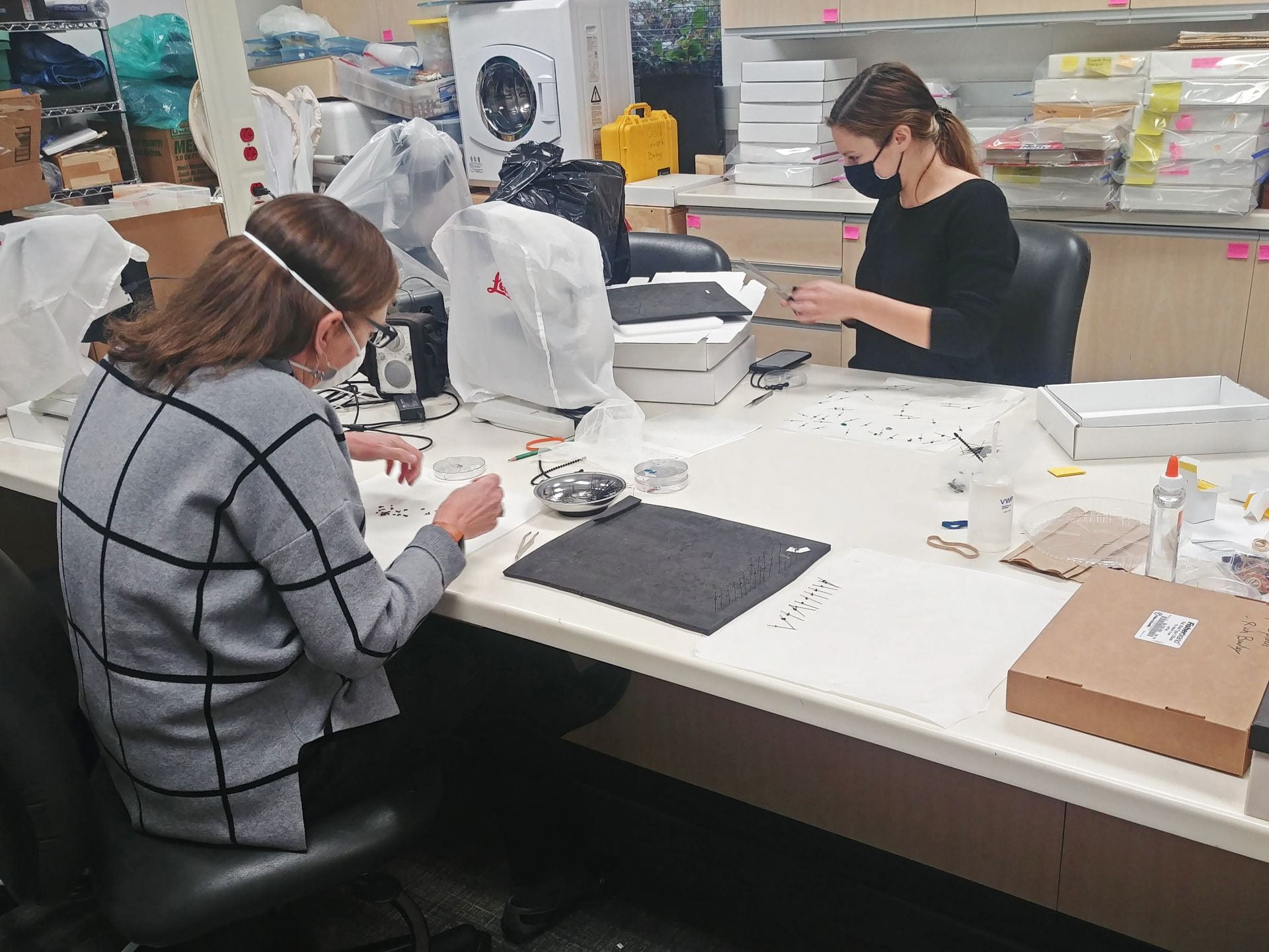
Eleanor and Elizabeth were hard at work helping to pin and glue specimens last week.
We made much better progress this week, almost fully pinning 2 kits worth of bees. Thankfully, none of the samples has 400+ bees per week, so that definitely helped. We finished pinning Cameron’s specimens and moved on to specimens from Beth S. in Putnam County.
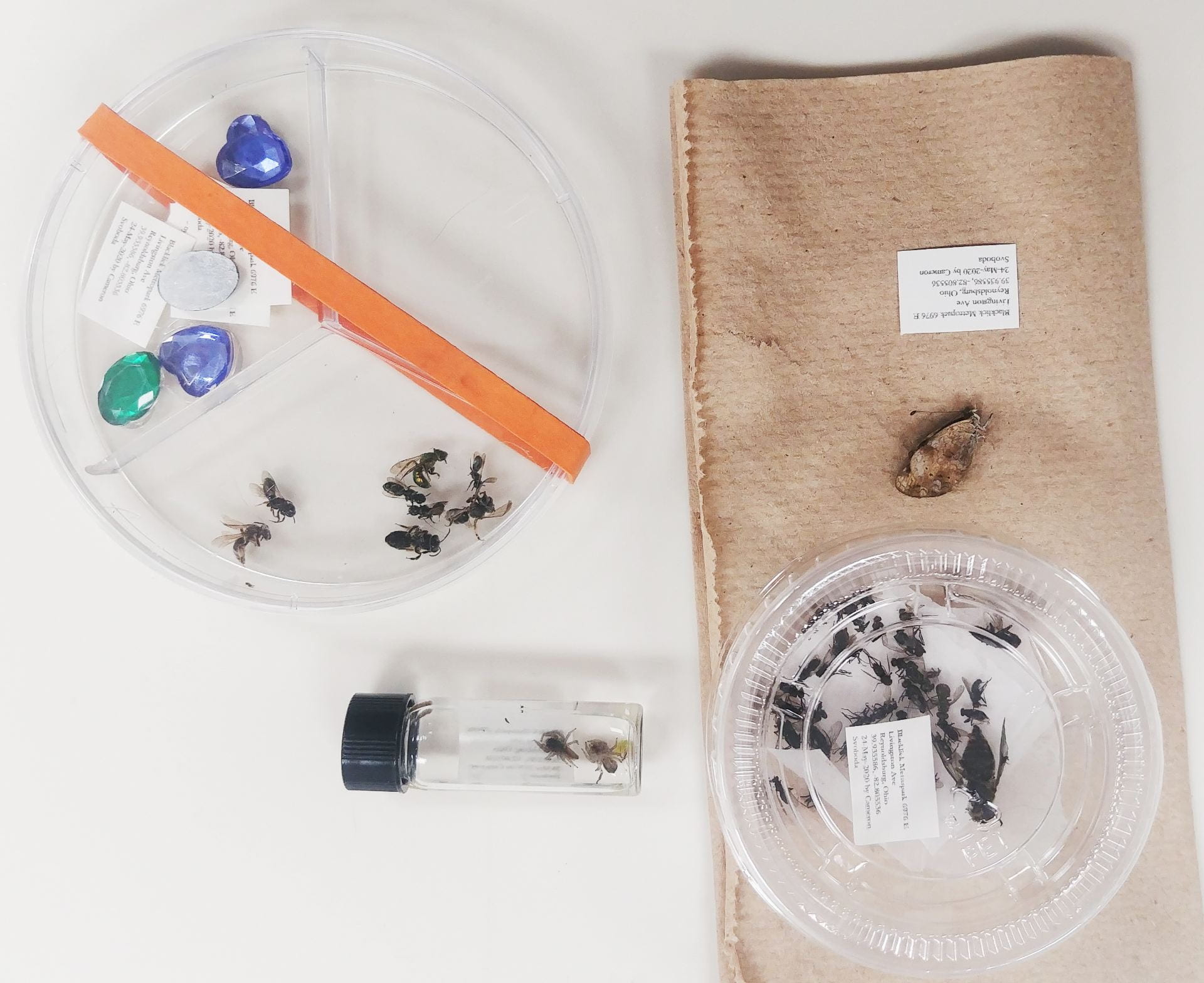
An example of a week of sorted specimens from the kit by Cameron S. Such a reasonable number of bees (in the petri dish) and several different species!
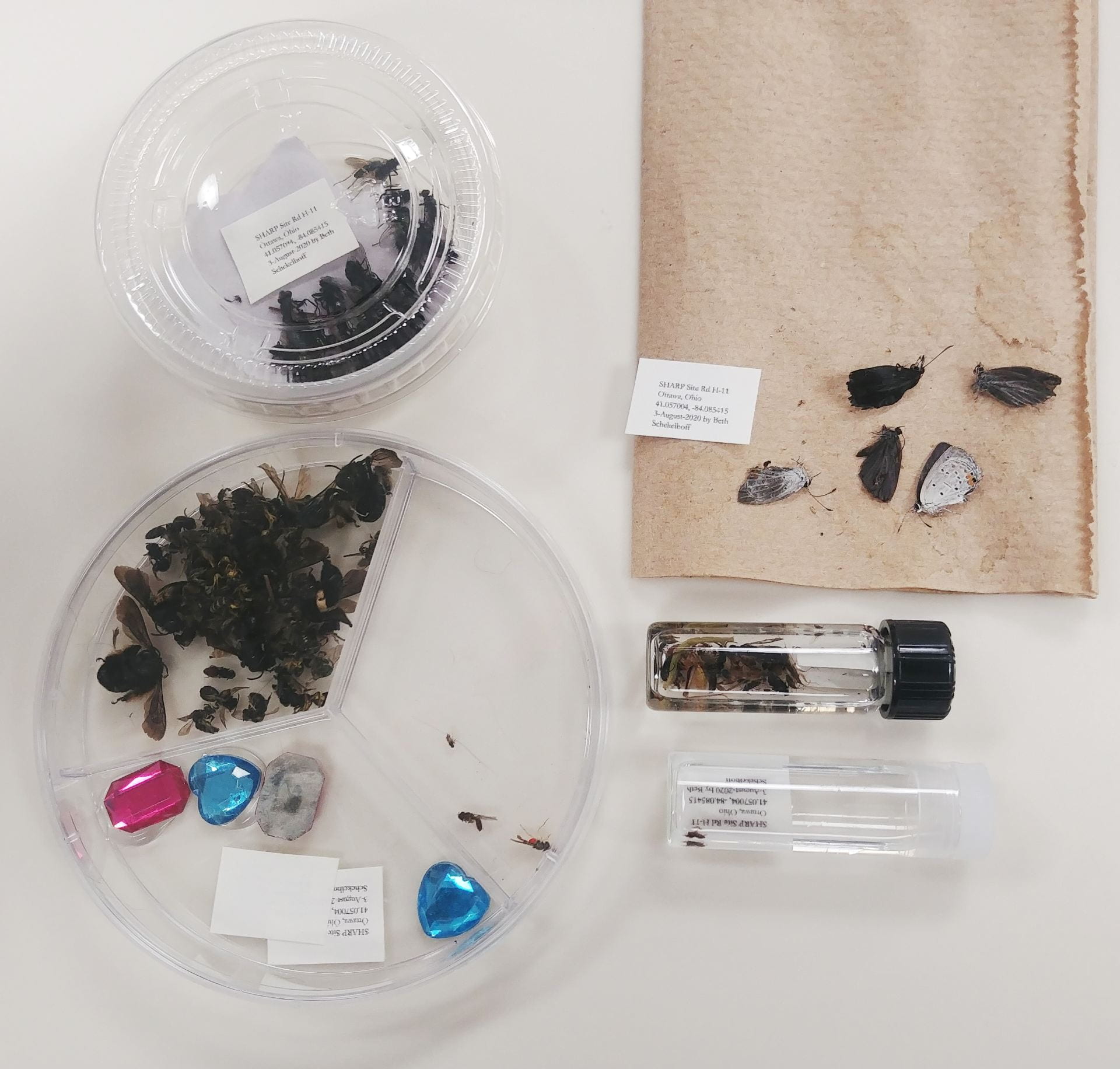
Oddly, Beth S. had very few small bees and many medium (Halictus + Calliopsis) and large bees (Melissodes sp). So that made pinning a bit easier.
Cameron helped on Wednesday to process and pin specimens. Here he is showing off some of the progress.
We also had Roxanne L. and Kiersten M. on Thursday help with pinning specimens (no photos, so just imagine some cheery people staring at lots of bees).
So, did we see anything cool this week? Well, lots of Calliopsis in the kits so far, which has been interesting given how rarely people observe them out flying. I wonder if they fly at a different time of day when most photographers are active. If you judge just based on the 3 kits, you would think they were the most common bee at every site, yet they have not been photographed alive at either Cedar Bog or Blacklick Metro Park. I wonder why?
Cameron also had an abundance of Shore flies on his first sample date. They look like generic black flies, until you look at their front legs. These legs are greatly expanded (you can bet they never forget leg day) and have spines, which allows them to catch prey, similar to preying mantis front legs!
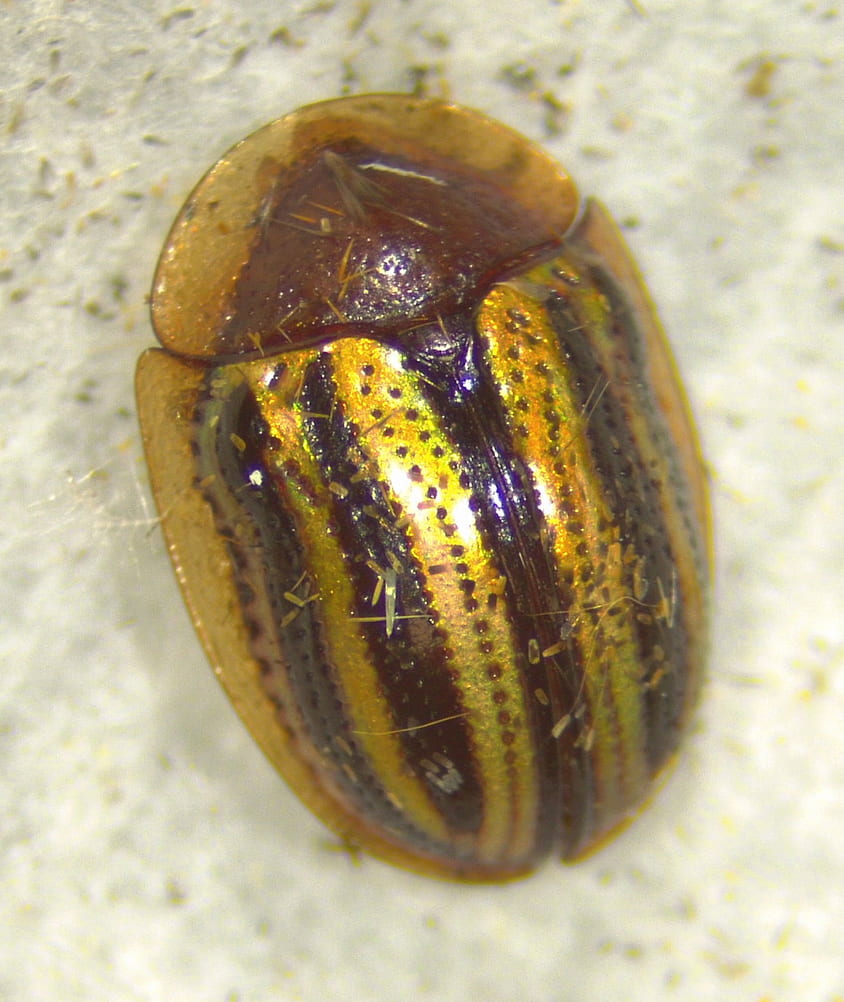
There are many species of tortoise beetles in Ohio, but I didn’t recognize this one. So I photographed it and submitted it to iNaturalist where a tortoise beetle enthusiast (rob-westerduijn) identified it as Agroiconota bivittata
I initially thought this was one of the stem sawflies, but a rather small one. I was quickly corrected that this was one of the parasitic wasps, with iNaturalist user jeongyoo identifying it as the genus Macroteleia.
Lastly, don’t forget to vote on Tuesday if you haven’t already! I already voted and got my flu shot, so I’m ready to go for the rest of 2020 (fingers crossed).
Insect University this week! The (Virtual) Insect University is this week. It is a free, daily pollinator-focused webinar from October 26th through 30th at 10 AM. Our speakers include Jamie Strange, Heather Holm, Olivia Carril, Jennifer Thieme and Doug Tallamy. Find details and the registration link here. Consider the InsectU program a small thank you for your work to conserve our insect diversity. The webinars will also be recorded, so if you can’t make the 10AM time slot, no worries!
New Student Worker:
We officially hired a part time student worker for our project! Eleanor started helping us pin specimens this week and will be in the lab with me for the foreseeable future.
Signing up to help pin bees:
Many people have asked when they can come down to the lab to help pin bees. I have created this sign up page where people can pick dates to stop by the lab and help. Arrive no earlier than 10 AM so I have time to get things ready to go. I plan to be in the lab till about 5 pm on those days. Please plan to commit at least an hour, ideally more as I will only be having a maximum of 2 people per day (plus me) in the lab out of concern for Covid. Masks will also be required. More information is on the sign up website below.
Freezer updates:
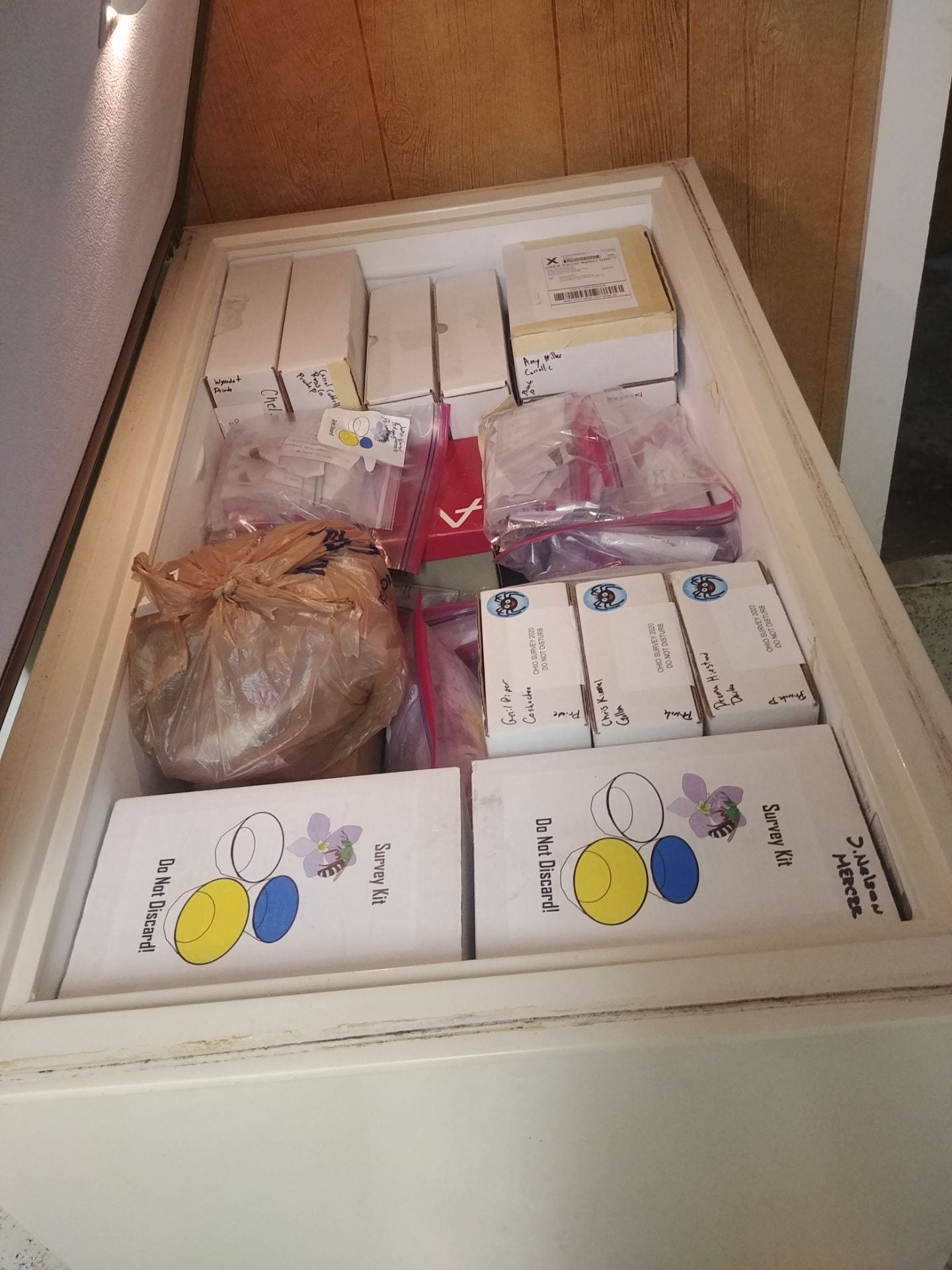
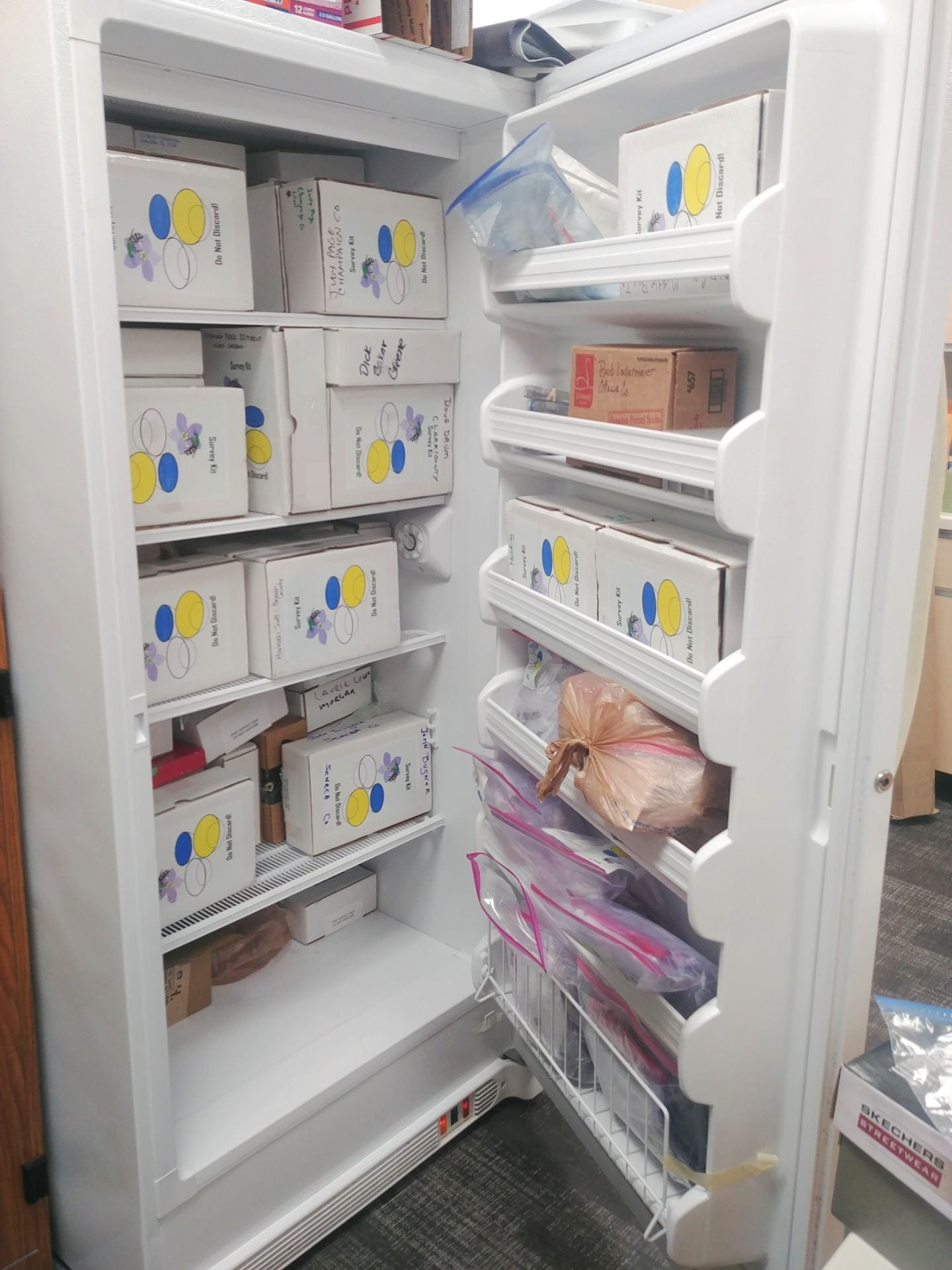
We have completely filled our lab freezer AND and chest freezer at Dawes with these kits. So there is plenty of work ahead of us. We should have a better idea of how long it will take to sort specimens in the coming weeks.
The Dawes Chest Freezer is now completely full! It was quite the game of tetris to try to get as many boxes in their chest freezer.
Meanwhile, the lab freezer is also really full. We have a little space to accept a few more kits, but hope to get through the current kits quickly so we can move on to bringing some of the kits at Dawes back to the lab.
Specimen progress:
We have fully sorted one kit! Granted, I think this is an abnormally abundant kit and sorting took place between the sampling pick up week and MaLisa spending a lot of time sending reminder emails about drop off days. So the rate of kit sorting should be much faster than once every 3 weeks. We will finish pinning this kit this week and then move on to our next kit.
If you recall this petri dish of bees from last week, this showed the highest number of bees per week that we have sorted so far. How many bees do you think were in the petri dish?
August 5th was definitely their most abundant week of bees for this kit. See image above. How many bees do you think were in the kit? Well, we finally got those pinned, so you can see just how many bees were in the petri dish!
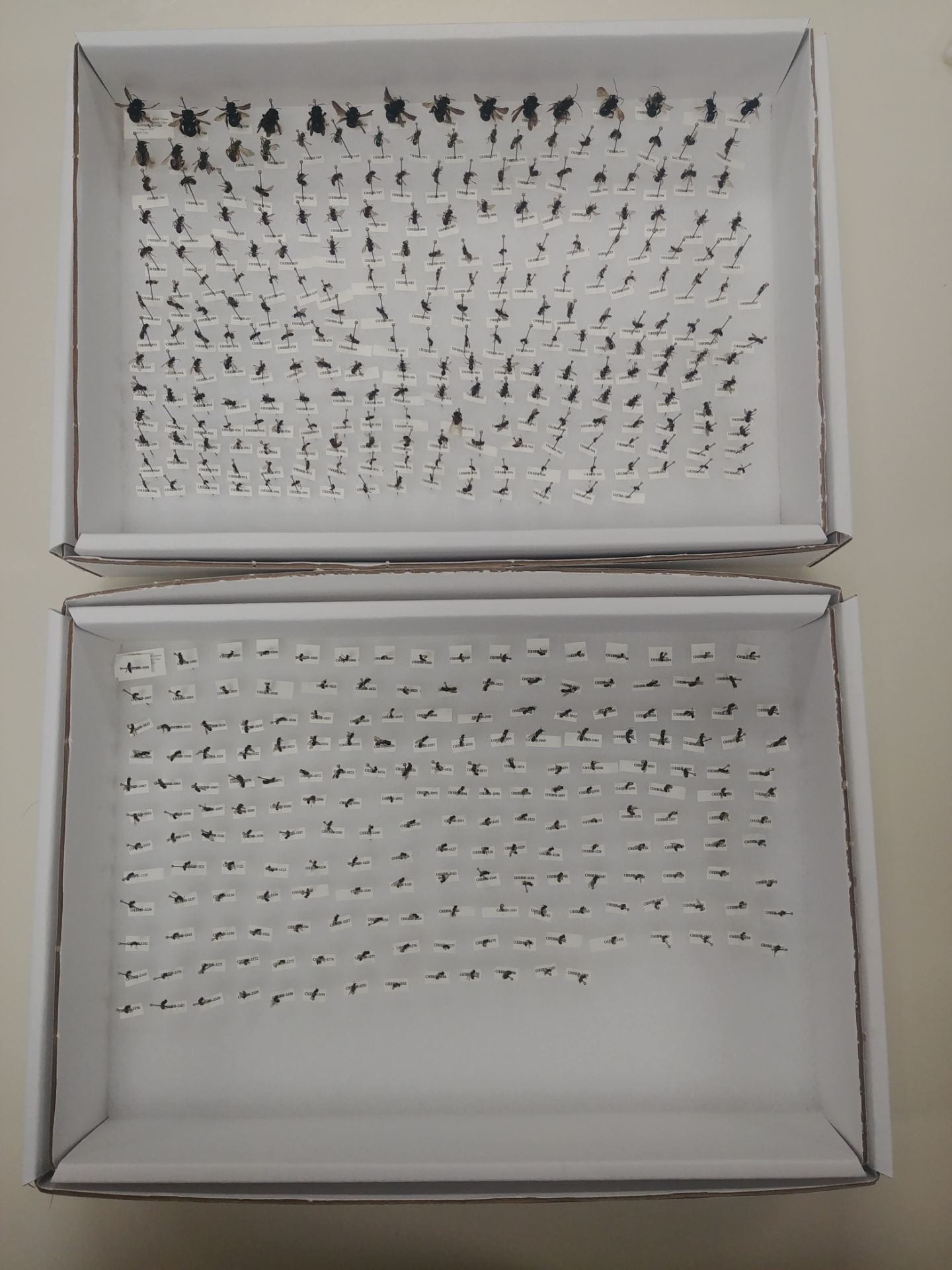
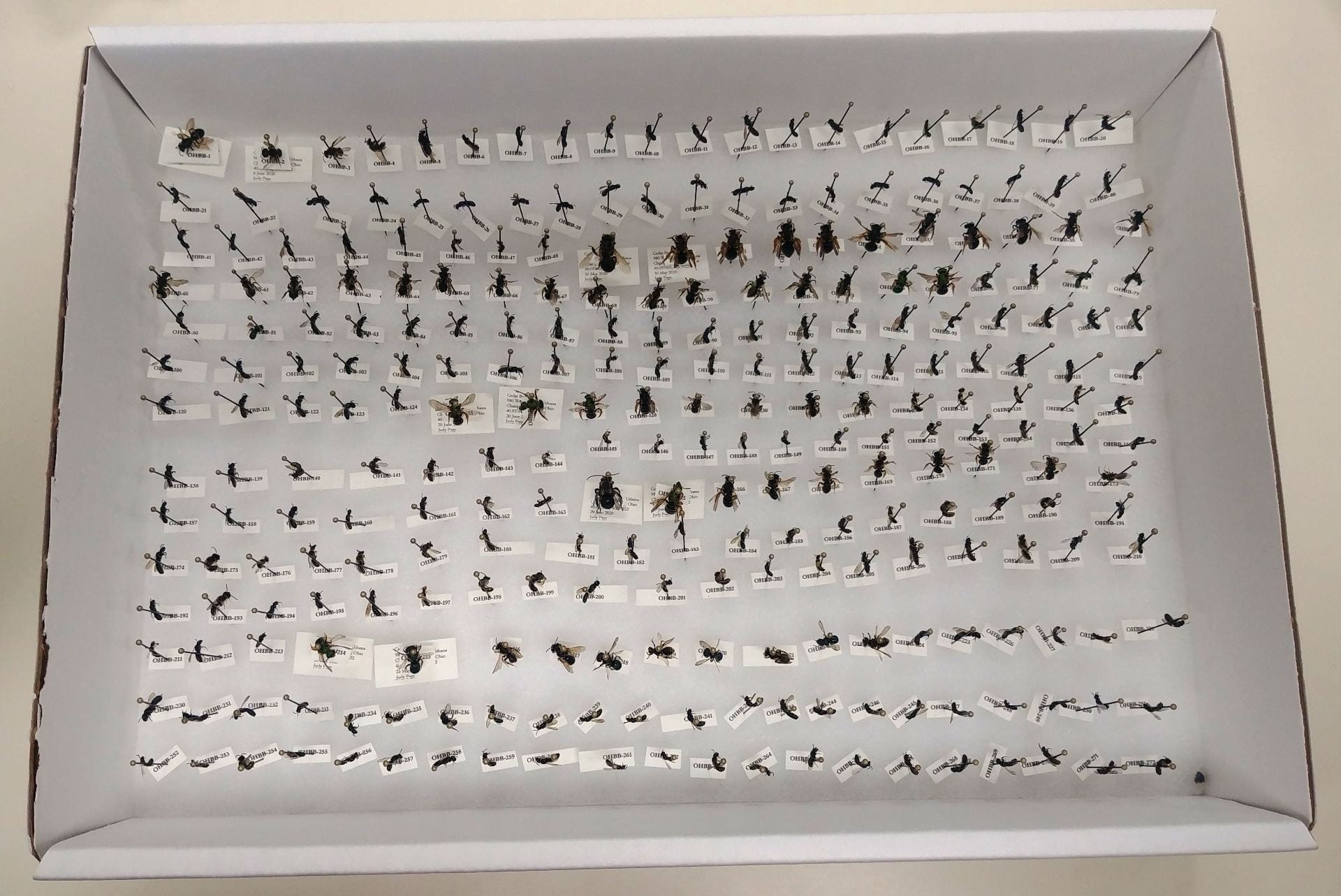
These two boxes are just one sample date, which is extremely abnormal. But how many bees did we collect in just this one date?
For this one sample date, we ended up pinning 450 bees! That is an average of 18+ bees per bowl, which is a lot more than I ever got in my kit and definitely more than I would have ever expected to get from any of the kits. They were a mix of bees, with small carpenter bees (Ceratina spp), black mining bees (Calliopsis andreniformis), and dull green sweat bees (Lasioglossum spp) being the most abundant.
I reached out to Sam Droege to get an estimate of the “normal” number of bees per bowl. He responded that it is normal to get 0.5 bees per bowl in midsummer (so one bee for every two bowls), so this kit was definitely abnormal. Even in the spring when there is normally a lot more bees that get in the bowls, the average tends to only bee 5-7 bees per bowl. So hopefully this is already our highest number of bees per week.
Podcasts:
Since sorting and pinning bees is a long drawn out process that doesn’t require much mental energy, I often try to listen to podcasts to keep myself engaged. We have been listening to PolliNation Podcasts and Oologies in the lab so far. We have many days of podcasts in our future, so if you have recommendations, feel free to share them below.
That is all I have for now. I’ll have more updates later.
A big shout out to MaLisa Spring for her coordination of the Ohio Bee Survey! I know everyone appreciates MaLisa’s leadership and unending willingness to share her bee knowledge through training, posts and more than a little hand-holding. The bee specimen return rate is a testament to the project’s success under MaLisa’s guidance.
And, many thanks to everyone who participated at every level in this year’s survey. Whether you collected for a few weeks or for the entire season (or simply read along and shared in the progress), you were an integral part of this survey’s success! Together, we have taken great strides (particularly in this difficult year!) in the effort to detail Ohio’s bee fauna.
In case you haven’t already registered for next week’s One Week (Virtual) Insect University, let me invite you to join us for a free. daily pollinator-focused webinar from October 26th through 30th. Our speakers include Jamie Strange, Heather Holm, Olivia Carril, Jennifer Thieme and Doug Tallamy. Find details and the registration link here. Consider the InsectU program a small thank you for your work to conserve our insect diversity.
Best wishes to all for a safe and healthy fall and winter!
Thanks to everyone who was able to get their kits to a drop off day! Combined with early drop offs, we are up to 113 kits that have been returned! That is about a 75% return rate, which is really impressive for a community science project in a normal year, not even counting a pandemic. I know several more people are still working on getting your kits to either Akron or Newark, so hopefully we can get the return rate to above 80%.
We filled our lab freezer twice over with all of the kits from this week! I greatly appreciate that Dawes Arboretum is allowing us to use one of their chest freezers for this project. This is about a quarter of the kits in this freezer, so their help is greatly appreciated. Also shout out to Dr. Karen Goodell for getting some temporary extra freezer space on Friday while MaLisa was getting even more kits from NE Ohio.
It was great to see many of you (from a distance and wearing masks). We still have a lot of work ahead of us. We are working on hiring a lab assistant and will be ramping up our sorting/washing/drying/pinning capacity soon!
Many thanks to those of you who also donated financially to the project! We will write thank you cards in a few weeks once we get all of our ducks in a row.
Pinning Parties?
Many people asked about pinning opportunities. Obviously, the originally planned 50 person pinning parties are not an option due to the pandemic and hoping the pandemic would be over in 6 months was wishful thinking on my part. However, it does sound like we can have limited numbers of people come to the lab to help pin specimens there.
Once I get things sorted in the lab a bit better, I will send out info here with sign up dates where you can join me in the lab in Newark. The main caveat is that the lab will be limited to the number of people who can visit at one time due to covid precautions. As the number of covid cases in Ohio continue to rise to all time highs, we must be as careful as possible. Thus, at this time, I am planning to take things slowly along with keeping the lab capacity low (max 2 people in addition to me). I’d much rather the sorting and pinning stage take an extra year than to have any of my participants (or myself) catch covid while helping with the project. That also means the projected timeline for identification of specimens will take a while as well, as I cannot identify things until they are pinned.
Anyways, I will try to keep everyone updated on opportunities and progress. My main progress from last week was on acquiring the samples, so I don’t have much else to add at this time.
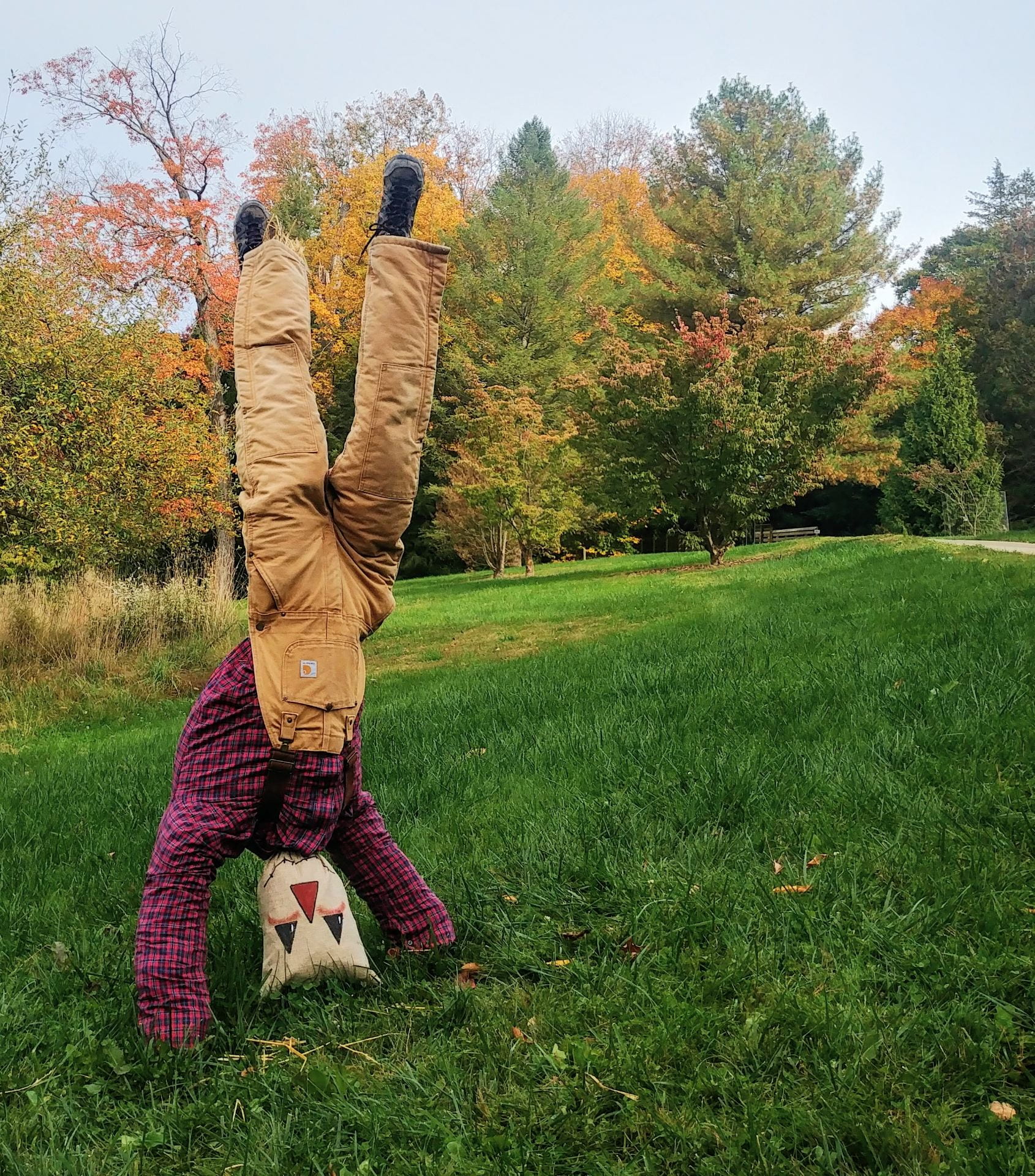
Everything may be topsy-turvy because of the pandemic, but we can at least count on some nice fall colors and the occasional scarecrow. People who dropped their kits off at Dawes Arboretum also got to see their scarecrow contest.
Enjoy this lovely scarecrow from Dawes Arboretum and try to enjoy the fall colors while they last!
I’m working on sending out the reminder emails to those who signed up to drop off their kits on a particular day. So expect those soon! And if you haven’t signed up to drop off your kit for a day this week, please go back through your email to fill out the drop off survey ASAP. We have an 80% response rate now, so I am pretty excited!
Other frequently asked questions: Will I get a report for my results?
Yes! Everyone who participated will be emailed a list of species that was collected and identified from their site. For people collecting at parks and other locations, I will also send the report to that agency as well. Note that the focus will be on the bees, so only a select amount of the bycatch will be identified and counted. The list will mostly be focused on bee species and whatever else we can identify and pin properly. If we are able to identify anything else, we will try to include that in the reports. Any remaining bycatch will be given to other researchers and archived in a museum for future use.
Are you still going to do pinning training?
I am still working out the logistics for one on one pinning training for people who can make it to Newark. These will have to be scheduled in advance, but once I have the details down I will try to make them available here or via direct email. I am still trying to make sure we get all of the collection dates input into the database so we can have large batches of labels available first.
Will you do a zoom meeting to show us the sorting and pinning process?
I got our microscope camera working, so I can at least show people some bees up close and personal. I will schedule a date later in the fall to show everyone some bees.
Sorting updates:
I will be moving away from facts of the week and instead start doing periodic sorting update posts. These will likely become only monthly posts, but we shall see.
I started sorting out specimens from one kit, just to start to get a flow to sorting going.
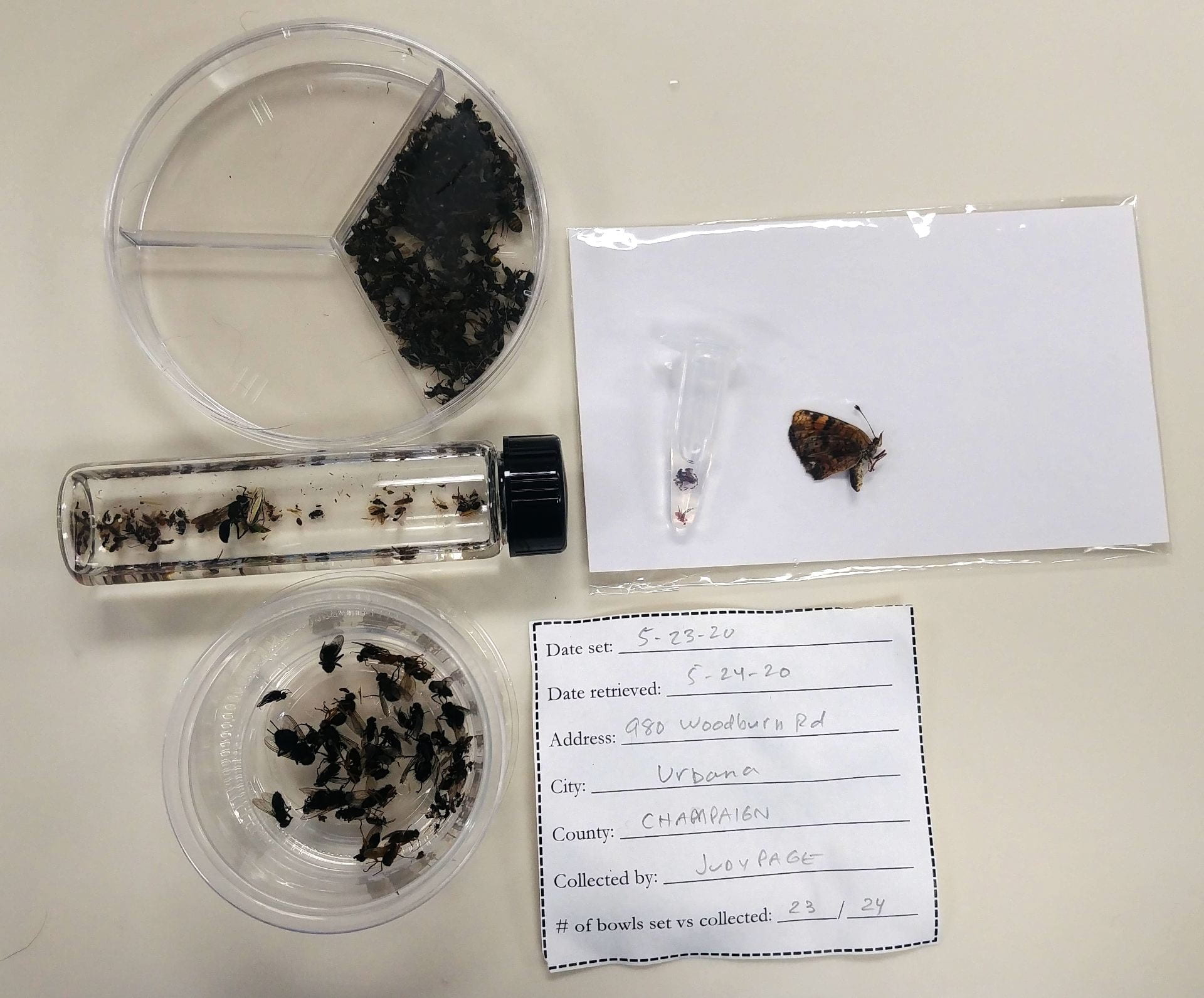
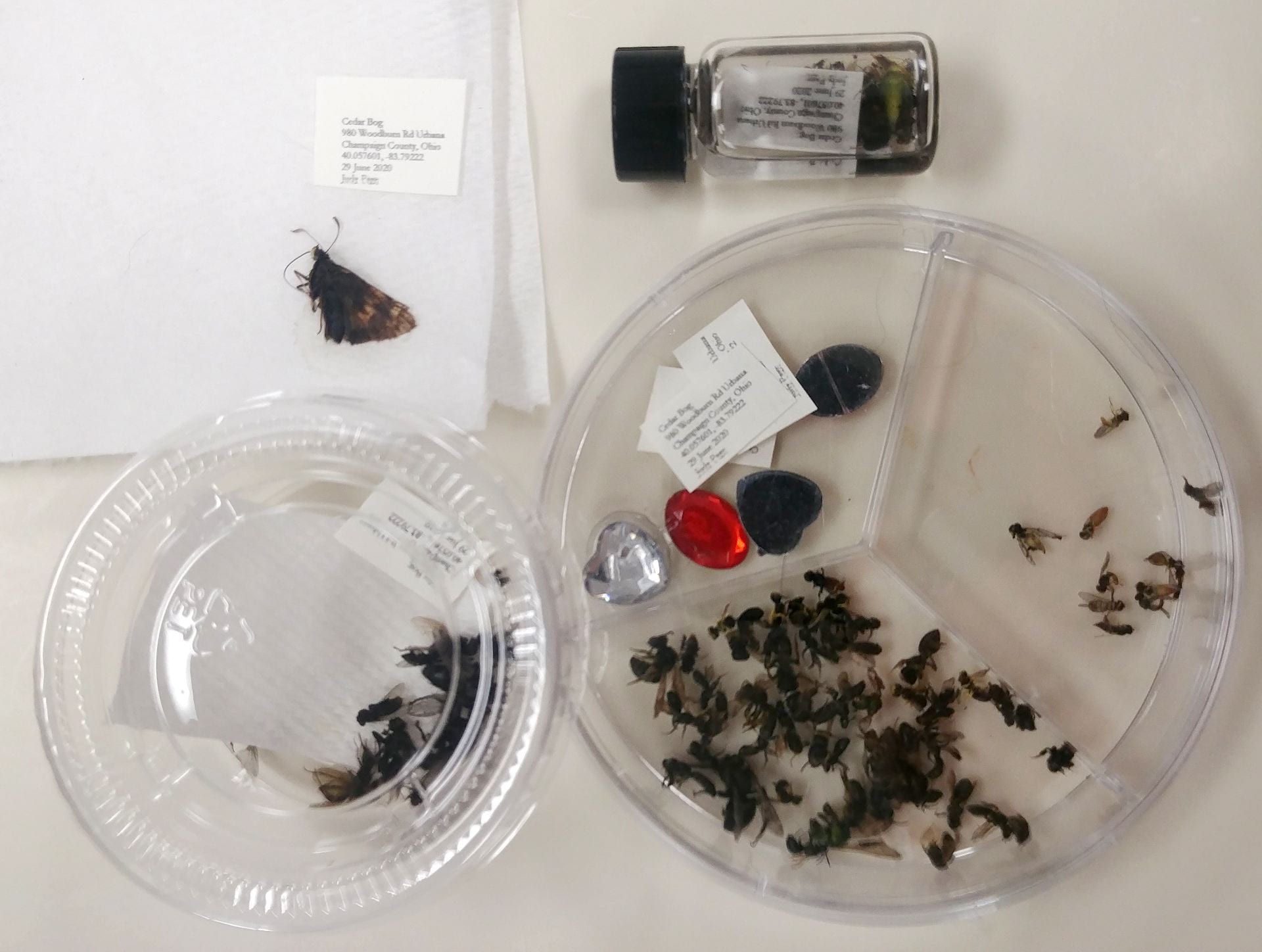
Here you can see the specimens are sorted by taxa, with bees in the petri dish, flies in the solo cup, butterflies destined to be enveloped, spiders in the tiny vial, and all other bycatch in the larger vial.
Same as above, but this also shows the hoverflies that were separated out and I had labels created by this point.
Once the bycatch is sorted, we can move on to washing the bees. I place the bees in little fabric bags and seal the bags with beaded zip ties. Then we swish them around in soapy water to clean them and dislodge any dirt sticking to them. Then comes the drying stage.
To maximize time efficiency, we bought an inexpensive tabletop mini-dryer. This allows us to dry several batches of bees at once to prepare them for pinning.
Here you can see several batches of bees in their bags. We tumble air dry until they are nice and fluffy again.
Once the bees are nice and dry, we move on to pinning them. Large bees get pinned through the thorax, but the smaller bees are instead glued to the pins to be processed more quickly (and easily as pinning tiny things is challenging).
Pinned and glued specimens, almost ready to go!
Once the bees are pinned, we add specimen labels. For the first step, we add individual specimen labels so we can keep track of them, and add date/location labels to the first in the series. Then once we know how many were collected in a series, we can make the right number of collection labels for the rest of the specimens.
So what have I found so far?
Well, a heck of a lot of bees! Now, I might have made a mistake in my choice of first kit to sort, in that this kit seems to have a LOT of bees. Checking the responses for the guestimation question, many people responded saying they think they only got 10-20 bees a week. Meanwhile, this collector guestimated that they got between 50 and 150 bees a week, and it looks like they are pretty close with their guestimation so far!
I have not yet pinned these specimens from their kit, but the petri dish was practically overflowing with bees!
It is officially sweater weather and perhaps even pumpkin spice late season in central Ohio. I’m sure the rest of Ohio has also experienced the recent drop in temperature that likely brings a sharp decrease in bee activity. So feel free to wrap up sampling if it is getting too chilly in the morning.
Drop off information:
Thanks again to everyone who has completed the drop off survey! We have improved to about a 67% completion rate, so if you haven’t filled out the survey yet, please do so. I will send a reminder email later this week directly to those who I do not yet have a completed survey. If you are having trouble filling out the survey or are unsure how to get the gps coordinates, just fill out what you can and leave a comment at the end so I can try to help.
Early Drop off locations: If you want to turn in your kits before mid-October, consider dropping off your kit to the Akron or Newark locations.Be sure to email or call the location in advance so they know you plan to drop off any specimens and can make sure someone is there to accept them.
OSU Newark Campus: Goodell Lab in Adena Hall (contact MaLisa Spring spring.99@osu.edu)
The Dawes Arboretum in Newark (contact Livia Raulinaitis lhraulinaitis@dawesarb.org)
Akron Biological Field Station (contact Lara Roketenetz ldr11@uakron.edu or Dr. Randy Mitchell rjm2@uakron.edu) – only an early drop off location.
What to drop off:
Your sample box with specimens. Please write your name and county on the top and side of the box with sharpie. Please also label any additional boxes or containers if you ran out of space in your initial box.
All remaining sampling supplies, including any remaining bee bowls/paint strainers/etc.
A copy of any permits that you acquired to sample at your site (applies to people sampling at parks and preserves)
Optional: If you are able, please consider making a donation to help with the cost of the pinning and curation supplies. Thanks to all of our successful bee collectors, we are in need of thousands of vials, pins, collection boxes, and other curatorial supplies. A donation of $5 buys a pack of pins, and $70 buys an insect drawer for long term specimen storage, so every little bit helps! Anyone can donate to the project here: https://www.giveto.osu.edu/makeagift/OnlineGivingDonation.aspx?fund=317067&gs=include Thanks to those who have already donated!
Will I get a report for my results?
Yes! Everyone who participated will be emailed a list of species that was collected and identified from their site. For people collecting at parks and other locations, I will also send the report to that agency as well. Note that the focus will be on the bees, so only a select amount of the bycatch will be identified and counted. The list will mostly be focused on bee species and whatever else we can identify and pin properly. If we are able to identify anything else, we will try to include that in the reports. Any remaining bycatch will be given to other researchers and archived in a museum for future use.
Are you still going to do pinning training?
I am still working out the logistics for one on one pinning training for people who can make it to Newark. These will have to be scheduled in advance, but once I have the details down I will try to make them available here or via direct email. I am still trying to make sure we get all of the collection dates input into the database so we can have large batches of labels available first.
Will you do a zoom meeting to show us the sorting and pinning process?
I got our microscope camera working, so I can at least show people some bees up close and personal. I will schedule a date later in the fall to show everyone some bees.
Bee facts of the week:
Since I am running out of different genera to cover in the facts of the week, I figured I would cover some general bee biology instead, this week focusing on the impacts of temperature on bees.
Insects are generally ectotherms, which is just a fancy word to say they are generally dependent on the temperature of the surrounding environments and tend to slow down when things get colder. Another example of an ectotherm are reptiles, which we often call “cold blooded.”
Being an ectotherm means that most insects do not move as fast (or at all) in colder weather, especially under temperatures of 40 degrees F. This also means that the insects are likely to be more active once things warm up again, assuming they have not died off from a hard frost in the meantime.
One notable exception that are able to resist the cold are bumblebees, which are capable of using their large muscles to generate some heat and fly later into the season when most other bees are gone.
Above is a view inside a bumblebee nest, where you can see the bright red glow of the heat created from their thoraxes. However, after a certain point in the season, most of the bumblebee colony dies off and only the new queens survive. These new queens leave the nest, mate, and then go out to find a safe spot to overwinter.
Meanwhile, honey bees (which are not native), stay alive all winter as a colony.
This second video shows the honey bee hives in winter. Although the video is meant to be a promo video to sell the camera imaging system, it is still cool to see the heat generated by the hives themselves.
I will hopefully have another bycatch post for next week, but I am skipping this week.
Is that a bee?
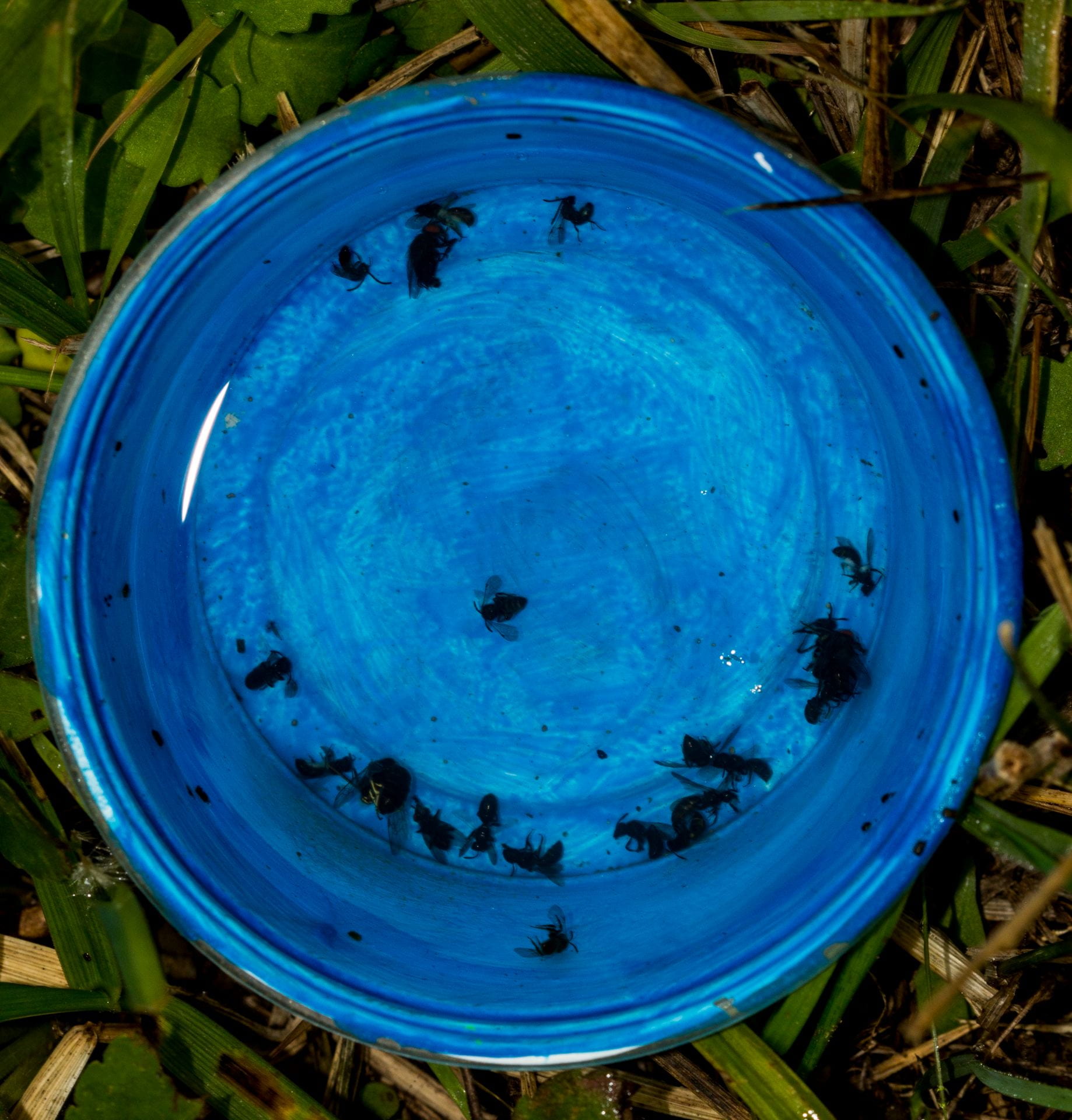
In this section, I will show a photo of a bee bowl and let you guess how many of the insects are actually bees. Don’t worry about properly identifying bees in your bowls. This is just so you can start to recognize some of the bees and get an idea of how many bees you actually have.
How many bees do you see? Are there any bees at all in this cup?
.
.
.
.
Okay, did you make your guesses?
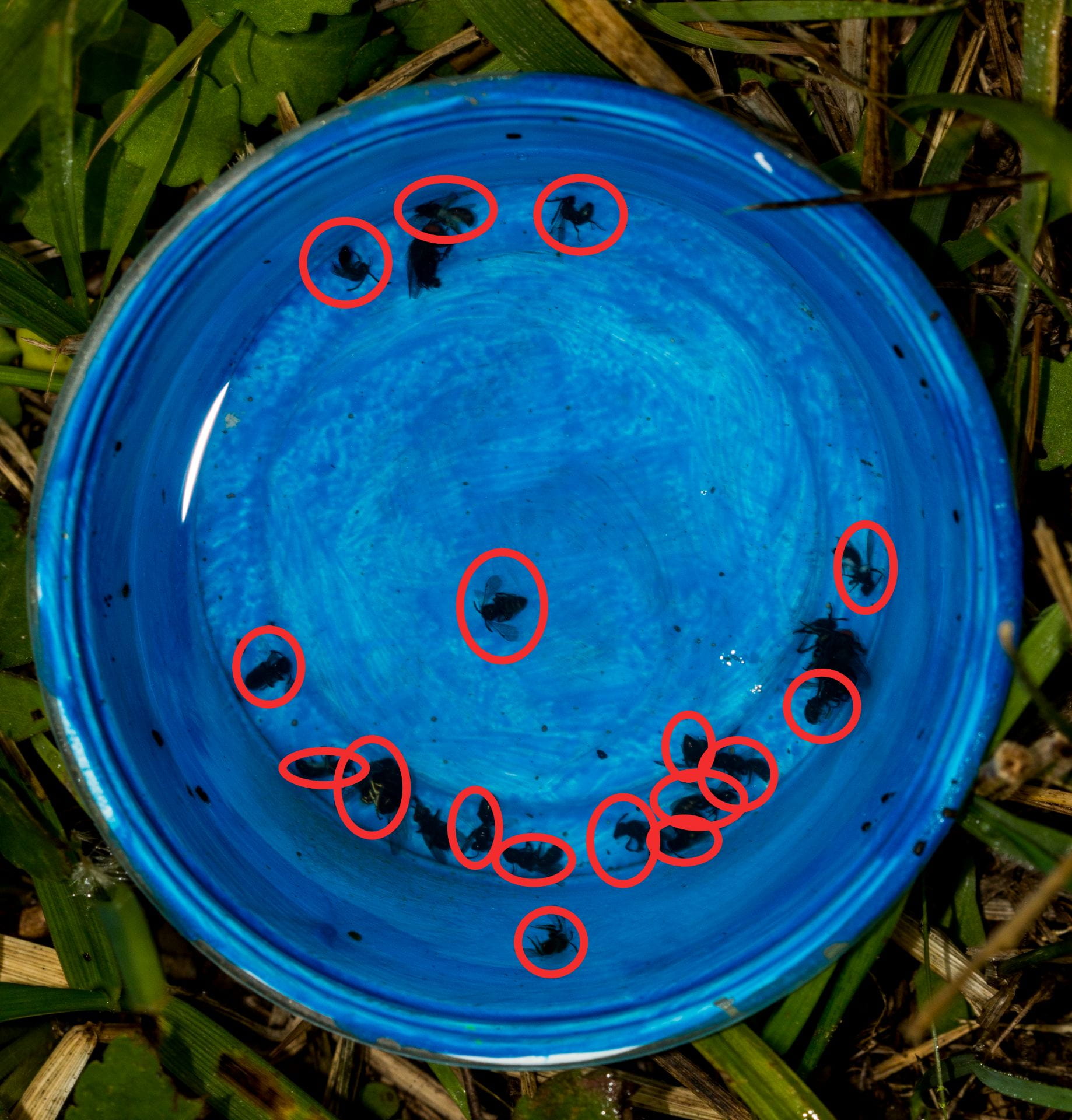
There are 18 bees in this cup! The bees appear to be mostly in the family Halictidae. There are also at least three flies, which are not circled.
And that is all I have! Please be sure to check your email and respond to the drop off survey to figure out when/where to drop off your specimens.
Drop off information:
Thank you to everyone who has completed the drop off survey! About half of the participants have filled it out, so if you haven’t yet, please double check your emails from last week and fill out the survey (even if you already turned in your kit!)
If you can’t make it to one of the drop off days in the email, I should have reached out to you with an attempt to connect you with neighboring county collectors if you have completed the survey. I will be going back through the list again shortly to send out reminder emails to those who haven’t completed it.
Early or Late Drop off locations: If you want to turn in your kits before mid-October, consider dropping off your kit to the Akron or Newark locations.Be sure to email or call the location in advance so they know you plan to drop off any specimens and can make sure someone is there to accept them.
OSU Newark Campus: Goodell Lab in Adena Hall (contact MaLisa Spring spring.99@osu.edu)
The Dawes Arboretum in Newark (contact Livia Raulinaitis lhraulinaitis@dawesarb.org)
Akron Biological Field Station (contact Lara Roketenetz ldr11@uakron.edu or Dr. Randy Mitchell rjm2@uakron.edu) – only an early drop off location.
What to drop off:
Your sample box with specimens. Please write your name and county on the top and side of the box with sharpie. Please also label any additional boxes or containers if you ran out of space in your initial box.
All remaining sampling supplies, including any remaining bee bowls/paint strainers/etc.
A copy of any permits that you acquired to sample at your site (applies to people sampling at parks and preserves)
Optional: If you are able, please consider making a donation to help with the cost of the pinning and curation supplies. Thanks to all of our successful bee collectors, we are in need of thousands of vials, pins, collection boxes, and other curatorial supplies. A donation of $5 buys a pack of pins, and $70 buys an insect drawer for long term specimen storage, so every little bit helps! Anyone can donate to the project here: https://www.giveto.osu.edu/makeagift/OnlineGivingDonation.aspx?fund=317067&gs=include Thanks to those who have already donated!
Will I get a report for my results?
Yes! Everyone who participated will get a list of species that was collected at their site. For people collecting at parks and other locations, I will also send the report to that agency as well.
Are you still going to do pinning training?
I am still working out the logistics for one on one pinning training for people who can make it to Newark. These will have to be scheduled in advance, but once I have the details down, I will try to make them available here or via direct email. I am still trying to make sure we get all of the collection dates input into the database so we can have large batches of labels available first.
Will you do a zoom meeting to show us the sorting and pinning process?
I am still working out our microscope camera situation, but I would like to make it so that people can watch specimen sorting and identification. Still working on the logistics for that (and I am not sure if the scope also has a mic and how that interfaces with the computer, so tbd). Don’t worry, I will let you know once I get things up and running 🙂
Bee facts of the week:
As I mentioned previously, I have already covered many of the common groups of bees in Ohio. Since we have covered most of the easy, common things, that means I have no choice but to show you some uncommon bees that are likely overlooked or generally uncommon.
Which brings us to the Panurgine bees (Family Andrenidae, Subfamily Panurginae). Technically, we already covered one group of Panurgine bees: the genus Calliopsis. Right now, there are two genera of Panurgines that we might expect to see:PseudopanurgusandPerdita (though Perdita are sometimes referred to as Fairy Bees). Both are rather small, black bees, similar in size to the yellow faced bees (Genus Hylaeus), though the yellow faces bees tend to be thinner overall and will never have hairy legs or abdomens. You might also confuse them for really small dull green sweat bees, but the Panurgine bees should not have any metallic reflections, and lack a curved basal vein (which would be extra hard to see from a photo).
A female Pseudopanurgus photographed by Amy Schnebelin. Note the hairy legs and abdomen to differentiate from Hylaeus.
I have only photographed one Pseudopanurgus in Ohio and it was after I had collected it. Both Amy Schnebelin and Bill Stitt have photographed at least 5 individuals foraging on flowers. Meanwhile, Amy is the only one to have submitted photographs of living Perdita to iNaturalist for Ohio. If you look at her photos, you can see just how small the Perdita bees are as they are barely larger than the individual goldenrod flowers! Given how small these bees are, we might be overlooking them when photographing them, but it is likely they are generally uncommon. However, hopefully one or two of them get in our pan traps so we can identify them to species.
It took me a bit to choose another “bycatch” group that we haven’t already covered without giving you another group of flies to identify. And then I realized, I covered Skippers previously, but I did not cover butterflies! So this week, I will cover our lovely butterflies that sometimes accidentally fall into out cups.
This cup is unusual, as it is the highest number of butterflies I have caught in a week, and they somehow all decided to go into the same bowl. They are all Crescents (genus Phycoides) of some sort.
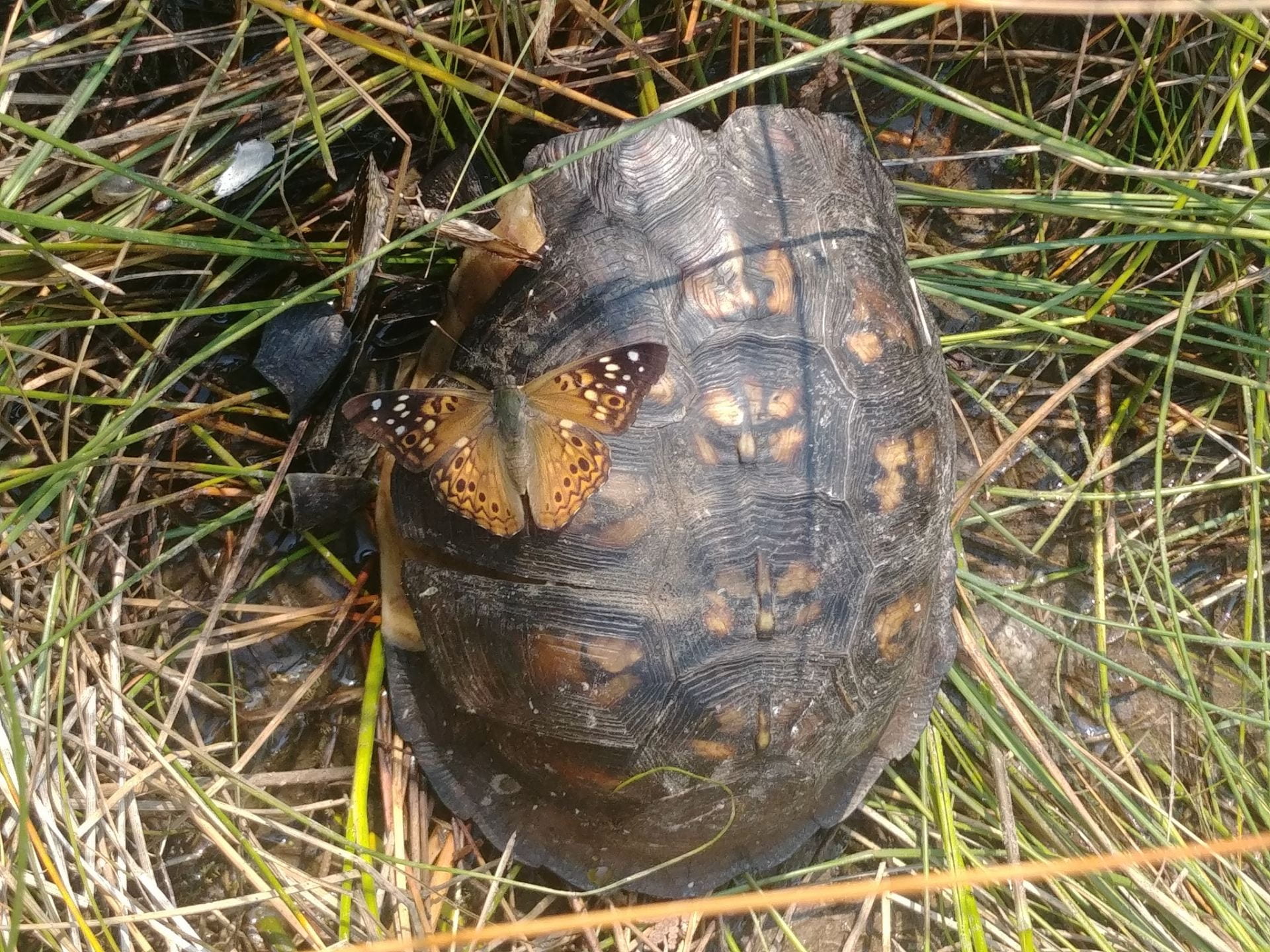
You might also occasionally find butterflies foraging on things you wouldn’t expect, like mud puddles, scat, sweaty humans, or even dead things like this turtle. I’ve had a few Hackberry Emperors land on me and start trying to feed, which is probably an indication that I needed both to drink more water, but was also due for a shower. They forage on these somewhat odd places to get minerals and other nutrients not easily found in their otherwise plant based diet.
The easiest way to differentiate butterflies from moths is based on their wing positioning (wings often held up over the back) and the antennae that are clubbed at the ends. The skipper antennae generally come to a point a the end and moth antennae generally do not have a club of any sort.
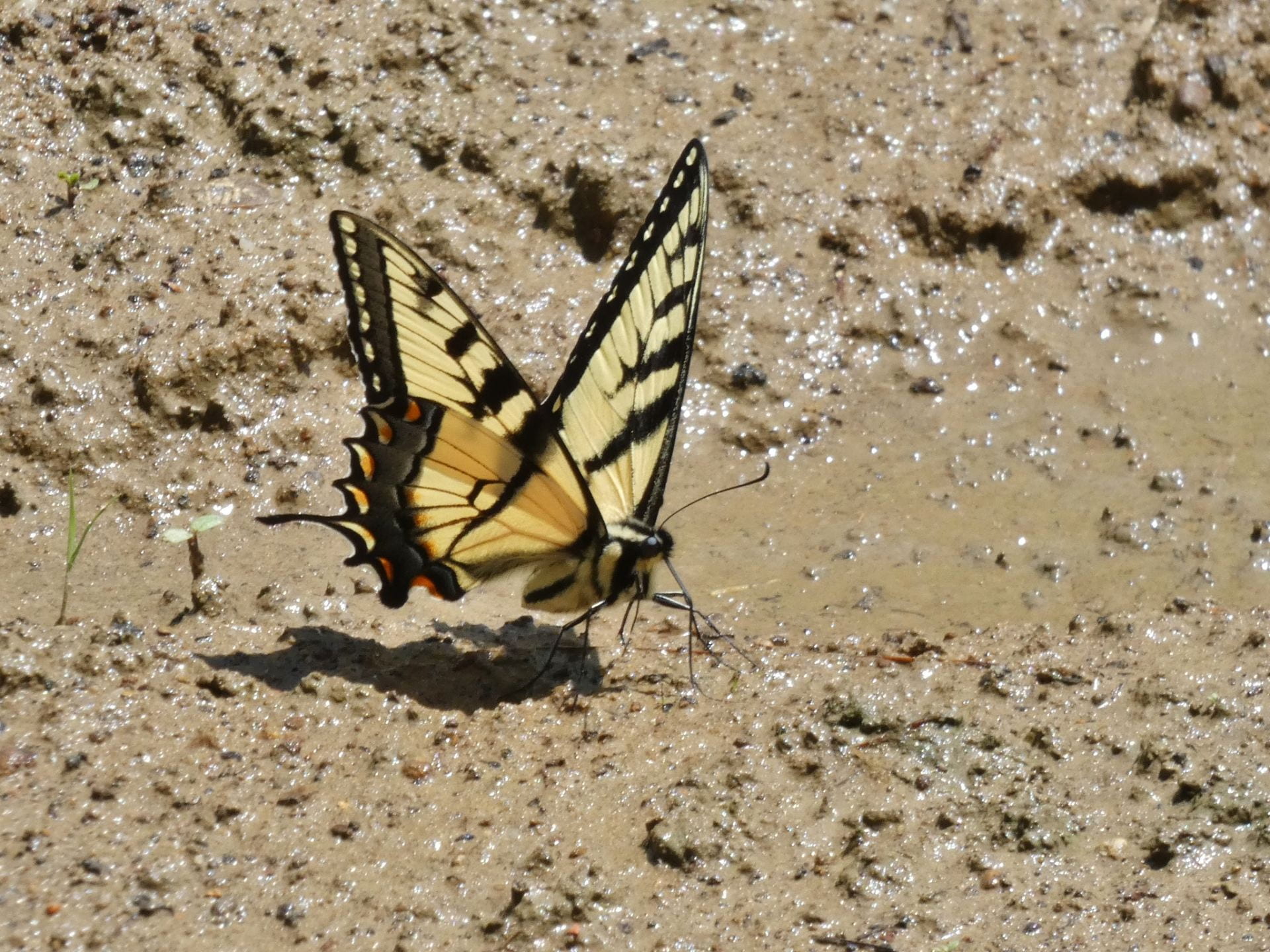
This Eastern Tiger Swallowtail was one of several that was “puddling” at this muddy spot.
As people have asked me a few times, I am trying to make sure that as much of the bycatch as possible goes to good use. This survey is unprecedented in Ohio not just for the bees, but also the bycatch. I’ve already made efforts to make sure the other groups of bycatch have someone willing to look through them, and the Lepidoptera are no exception. I made sure that we acquired some cellophane envelopes for the Lepidoptera bycatch, which we can then store in index card boxes. Similar to Odonata, the most space efficient long term storage method for leps is actually in special clear envelopes, so that is what we will be doing as well. Thankfully, most of the butterflies are somewhat easy to identify, or we can utilize the computer vision of iNaturalist or LepSnap to at least get us to a genus level ID pretty quickly. Moths, meanwhile, are much trickier to identify from a photograph, but we will still archive them.
Is that a bee?
In this brief section, I will show a photo of a bee bowl and let you guess how many of the insects are actually bees. Don’t worry about properly identifying bees in your bowls. This is just so you can start to recognize some of the bees and get an idea of how many bees you actually have.
How many bees do you see? Are there any bees in this image at all?
.
.
.
.
Okay, did you make your guesses?
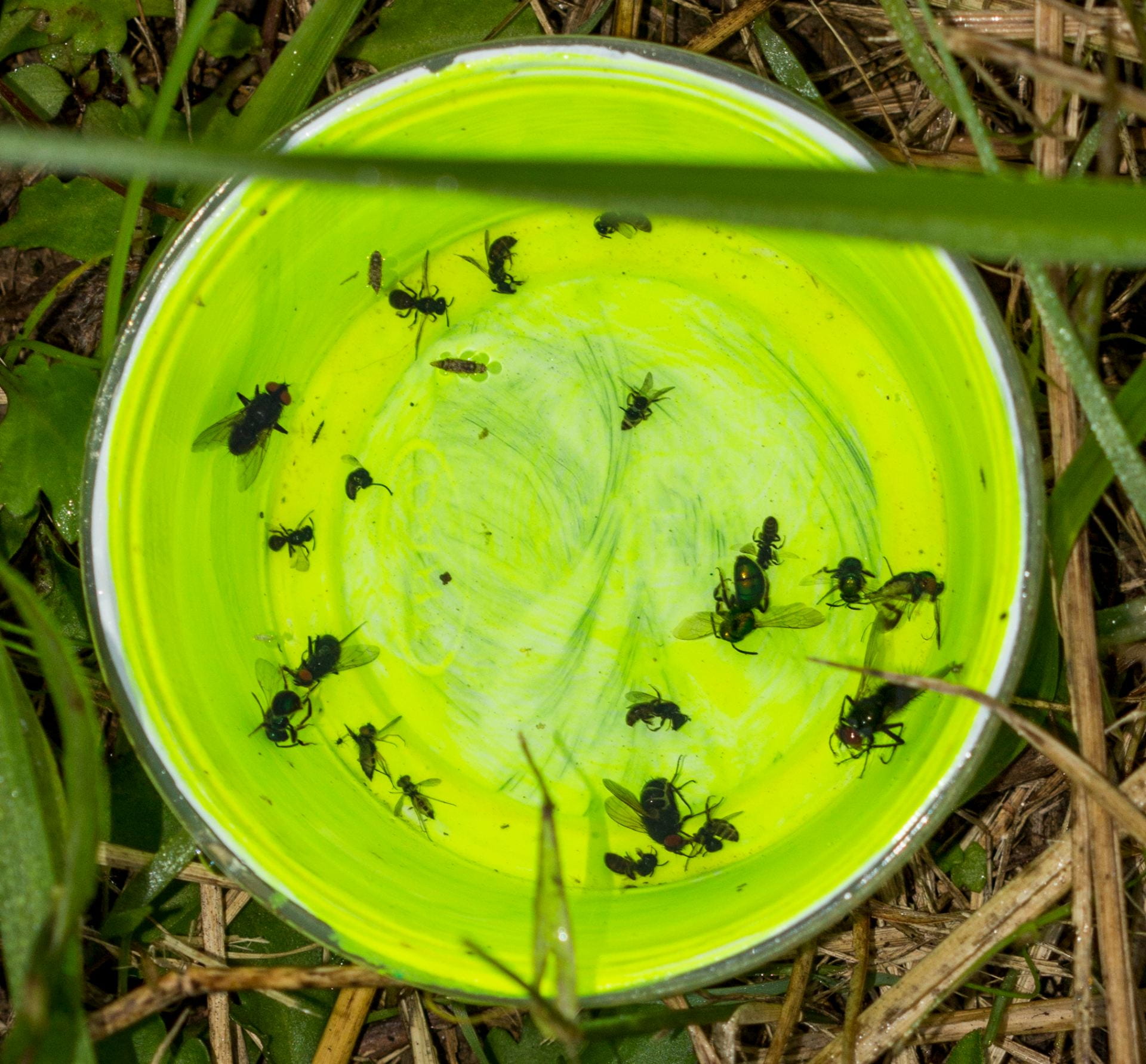
There are at least 13 bees in this bowl! Most of them look to be in the family Halictidae, with at least 2 bright green sweat bees. There are also a few flies, leafhoppers, and thrips in the image. This was the cup with the most bees from my last sample effort. Most of my other cups had none or one or two bees. I can tell flight season is almost over for most of the bees.
And that is all I have! Please be sure to check your email and respond to the drop off survey to figure out when/where to drop off your specimens.
Best wishes,
MaLisa
*Edit: Well, I forgot to update the title after I copied it, so likely the automated emails will all go out saying this is for Sept 20th. Oops. I updated the title to reflect the correct date.
Winter is coming!
Or rather, fall is quickly on its way, and with it, the first hard frost. Once you have a hard frost in your area, there will be fewer bees out flying. So I recommend to stop collecting after that date and instead start to focus on getting the samples to one of the drop off locations. I know some people in the northern reaches of Ohio have already had light frosts, so keep an eye out! (and also harvest any remaining summer vegetables in your garden so those don’t get frosted either) 😉
Drop off information:
All collectors should have gotten the information for the drop off week via direct email yesterday. If you did not get an email, please check your junk folder and email MaLisa to confirm. For those who have already responded to the drop off day survey, thank you! I will be in touch shortly with those needing additional assistance getting their kits to the drop off days.
Early Drop off locations: If you want to turn in your kits before mid-October, consider dropping off your kit to the Akron or Newark locations.Be sure to email or call the location in advance so they know you plan to drop off any specimens and can make sure someone is there to accept them.
OSU Newark Campus: Goodell Lab in Adena Hall (contact MaLisa Spring spring.99@osu.edu)
The Dawes Arboretum in Newark (contact Livia Raulinaitis lhraulinaitis@dawesarb.org)
Akron Biological Field Station (contact Lara Roketenetz ldr11@uakron.edu or Dr. Randy Mitchell rjm2@uakron.edu)
What to drop off:
Your sample box with specimens. Please write your name and county on the top and side of the box with sharpie. Please also label any additional boxes or containers if you ran out of space in your initial box.
All remaining sampling supplies, including any remaining bee bowls/paint strainers/etc.
A copy of any permits that you acquired to sample at your site (mostly applies to people sampling at parks and preserves)
Optional: If you are able, please consider making a donation to help with the cost of the pinning and curation supplies. Thanks to all of our successful bee collectors, we are in need of thousands of vials, pins, collection boxes, and other curatorial supplies. A donation of $5 buys a pack of pins, and $70 buys an insect drawer for long term specimen storage, so every little bit helps! Anyone can donate to the project here: https://www.giveto.osu.edu/makeagift/OnlineGivingDonation.aspx?fund=317067&gs=include
What happens after you drop off the specimens?
I want to give a brief overview of how things will hopefully go for the next few months.
All boxes go into our freezers, where we will organize them by county
I cross check the provided gps coordinates with appropriate county, so then we can use that location data on the labels
We input each sample date from each kit into the database, so we can make batch labels for each sample period
We create the sampling event labels and make duplicate labels for bycatch specimens
We begin processing specimens! (Note: due to the ongoing pandemic we will not be having pinning parties, but can allow people to visit the lab to help sort and process specimens. Details on how you can help with this process will be forthcoming once I get more things up and running)
We sort the specimens by taxa: bees, robberflies, hoverflies, butterflies/moths, all other flies, and all other bycatch. The bees, robberflies, and hoverflies will all be pinned. The Lepidoptera (butterflies and moths) will be placed in clear envelopes. All remaining flies and other bycatch will be stored separately to be given to other research labs to process. Select counties will have spiders delivered to Dr. Rich Bradley to contribute to the Ohio Spider Survey.
Bees are washed, dried, fluffed, and pinned.
More labels will be created for each individual pinned specimen.
Once bees are pinned, then MaLisa can start the identification process. The first round of identification will be to genus for all bees. Then MaLisa will go through the harder groups and identify things to species, which tends to take more time to identify lower.
Once things have been identified*, MaLisa will send you a collection report to let you know what we found in your kit. People who opted to get duplicates will also be notified at this time. *Note: at this time, we are unsure exactly how many bees are in the kits. If we end up with 100,000 instead of 10,000 bees, then it will take much longer to get things pinned and in turn, take longer to get everything identified. We will have a better idea once we get started processing specimens, but I do not have a solid timeline for how long it will take to get everything pinned and identified.
What about next summer?
At this time, we are not sure if we will be doing another bowl survey next summer. I want to make sure we can process all the specimens we currently have before committing to another summer of large quantities of specimen collection. I am working on a smaller project that involves targeting specific floral specialists, but the details for that project are still in the works.
Bee facts of the week:
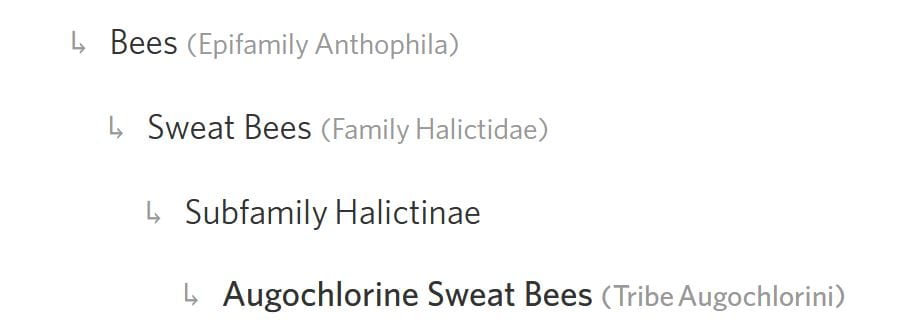
As I mentioned last week, I have already covered many of the common groups of bees in Ohio. However, there is one group that I missed: the bright green sweat bees! Granted, I did already cover the genus Agapostemon, but I did not go into detail about the other green bees in the Tribe Augochlorini.
The Striped Sweat bees in the Genus Agapostemon are in the Tribe Halictini, not Augochlorini. The bees of today’s post are all in the tribe Augochlorini.
The bright green sweat bees are stunning! But differentiating the different genera requires a careful eye.
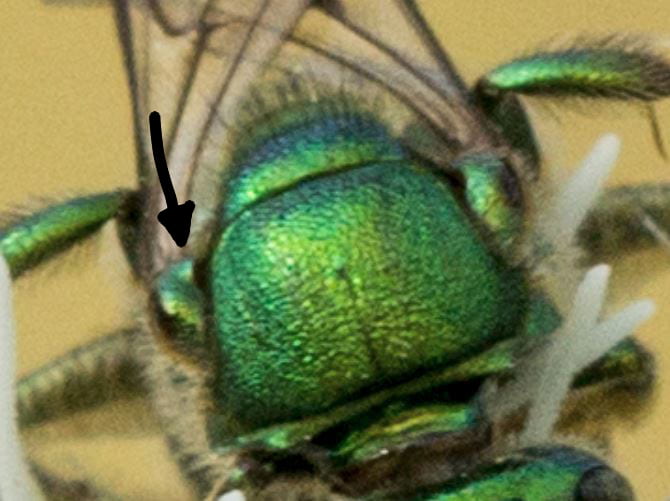
The bright green bees all look rather similar from a distance. The easiest to differentiate is the genus Augochloropsis, which has as distinctly metallic color on bean shaped tegula (imagine a shoulder pad right above the wing), whereas the other two genera in Ohio (Augochlora and Augochlorella) have brown and oval tegulas. Augochloropsis is also a bit larger than the latter two, similar in size to the Agapostemon genus.
In this case, the tegula have a little bend and are mostly metallic, making this the genus Augochloropsis.
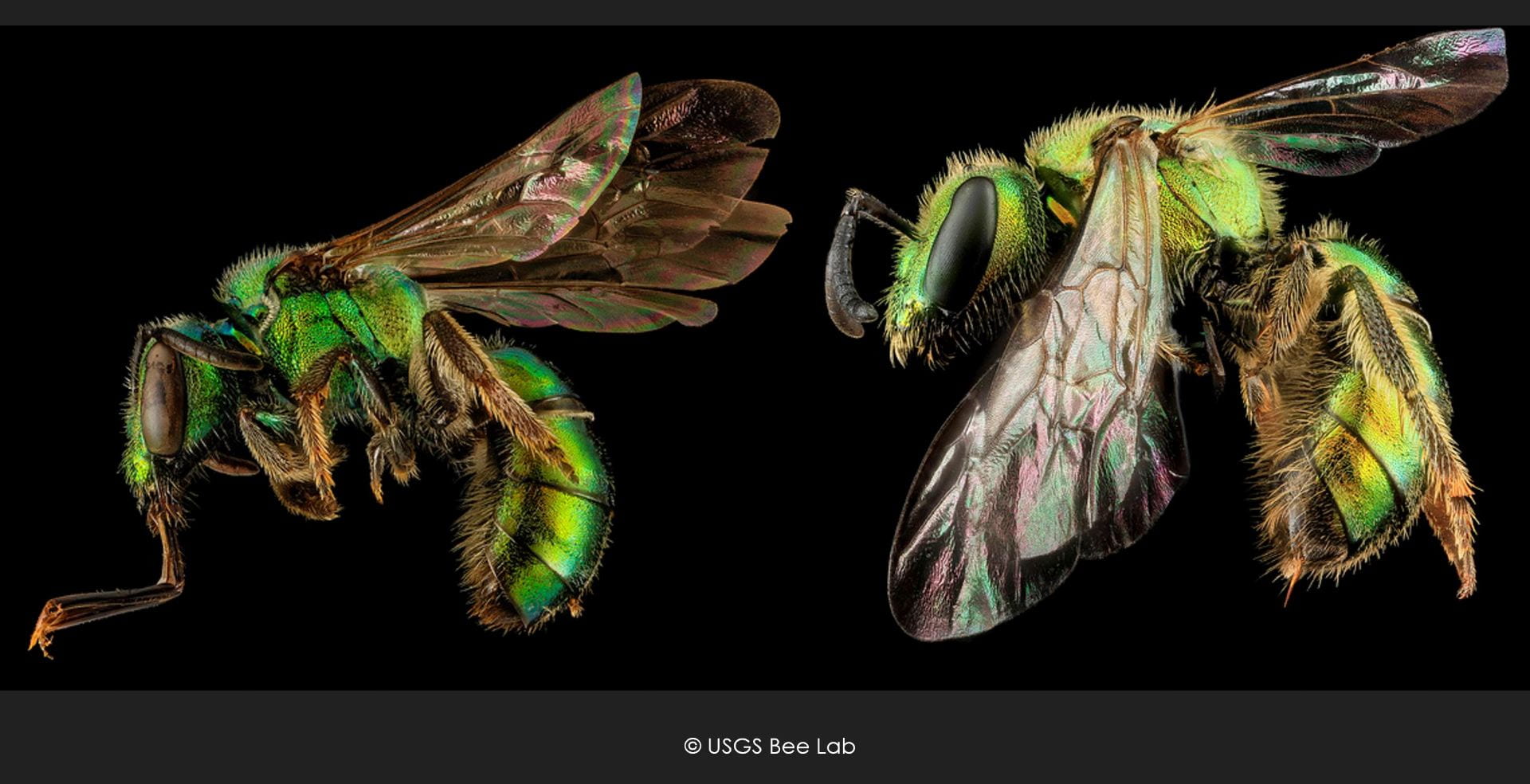
Differentiating Augochlora from Augochlorella can be a bit more tricky. For example, see the image below and try to guess which is which.
One is Augochlora and the other is Augochlorella. But which is which? They look similar, right?
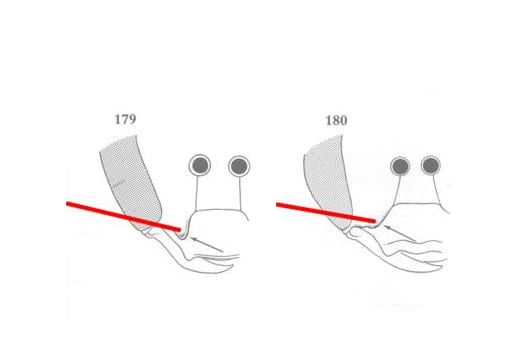
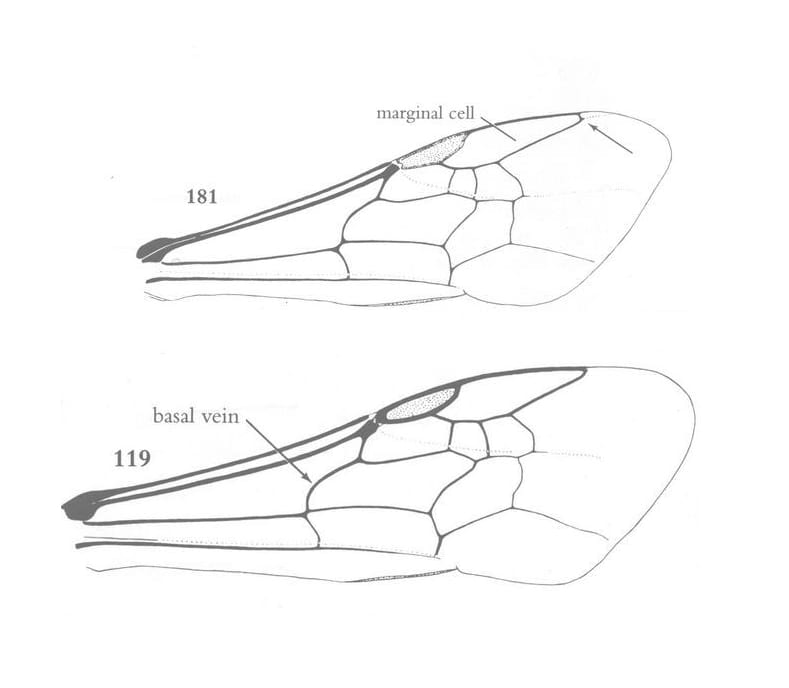
The key difference between the two genera is how the marginal cell meets the edge of the wing (truncate/bent or at a point) and also the shape of the face.
Comparing face shapes (where the lateral margin of clypaeus meets the parocular area): Augochlora on the left and Augochlorella on the right. Images from Discoverlife.org
To compare the marginal cells, look closely where the end of the cell meets the edge of the wing. Is it truncated (bent) or does it meet at a point? The top is truncated, which indicates it is Augochlora. The bottom meets at a point, which is consistent with Augochlorella. Images from Discoverlife.org
Anyways, there are some nitty gritty ID tips for the tricky green bees. Aren’t you glad I am going to be helping with all the bee IDs for this project?
Drop off information:
A few people have reached out about dropping off their boxes. As of right now, I am planning a drop off week on October 12-16th where I will stop at a few designated locations across the state to meet people that day to get their bees. Right now, I have drop off sites planned in the following counties: Hamilton, Licking, Summit, Lucas, Wayne, and Champaign counties. Once solidified, these details will be emailed directly to participants (not just posted on the blog here), so watch your email!
Early Drop off locations: If you want to turn in your kits before mid-October, consider dropping off your kit to the Akron or Newark locations.Be sure to email or call the location in advance so they know you plan to drop off any specimens and can make sure someone is there to accept them.
OSU Newark Campus: Goodell Lab in Adena Hall (contact MaLisa Spring spring.99@osu.edu)
The Dawes Arboretum in Newark (contact Livia Raulinaitis lhraulinaitis@dawesarb.org)
Akron Biological Field Station (contact Lara Roketenetz ldr11@uakron.edu or Dr. Randy Mitchell rjm2@uakron.edu)
What to drop off:
Your sample box with specimens. Please write your name and county on the top and side of the box with sharpie. Please also label any additional boxes or containers if you ran out of space in your initial box.
All remaining sampling supplies, including any remaining bee bowls/paint strainers/etc.
A copy of any permits that you acquired to sample at your site (mostly applies to people sampling at parks and preserves)
Optional: If you’re able, please consider making a donation to help with the cost of the pinning and curation supplies. Thanks to all of our successful bee collectors, we are in need of thousands of vials, pins, collection boxes, and other curatorial supplies. For those interested, information on how to donate will be included in the drop off emails.
Freezer boxes:
I’ve had a few people reach out to say their boxes are getting pretty full in their freezer. If you have the extra freezer space, you can use another box or plastic takeout container to store the overflow. Alternatively, if you happen to be traveling to the Newark or Akron area, you can organize to drop off part (or all) of your kit. Please email MaLisa if you plan to drop off anything before October.
Collection kit sampling reminder:
For those of you with collection kits, this is your reminder to try to put out your traps sometime this week, weather permitting. Please wait at least 7 days from your last sample date. If you want to wait to sample once every two weeks now, that is fine as well! You do not have to stick to the weekly sampling regimen.
So that is 17 different groups of bees that I have covered. I will take a short break in covering the bees this week and will hopefully resume next week with another group. Otherwise, feel free to check out more bee taxa in our Bees of Ohio field guide.
What’s that bycatch?
Sometimes other small insects or arthropods also land in our traps. Although they are not our intended focus of this project, I will try to give a little bit of info about different groups we might see in our traps. So hopefully you learn a little entomology along with all of our awesome bee knowledge. If you want a specific group covered that you are seeing a lot of in your traps, let me know!
Any ideas what bycatch I will cover this week?
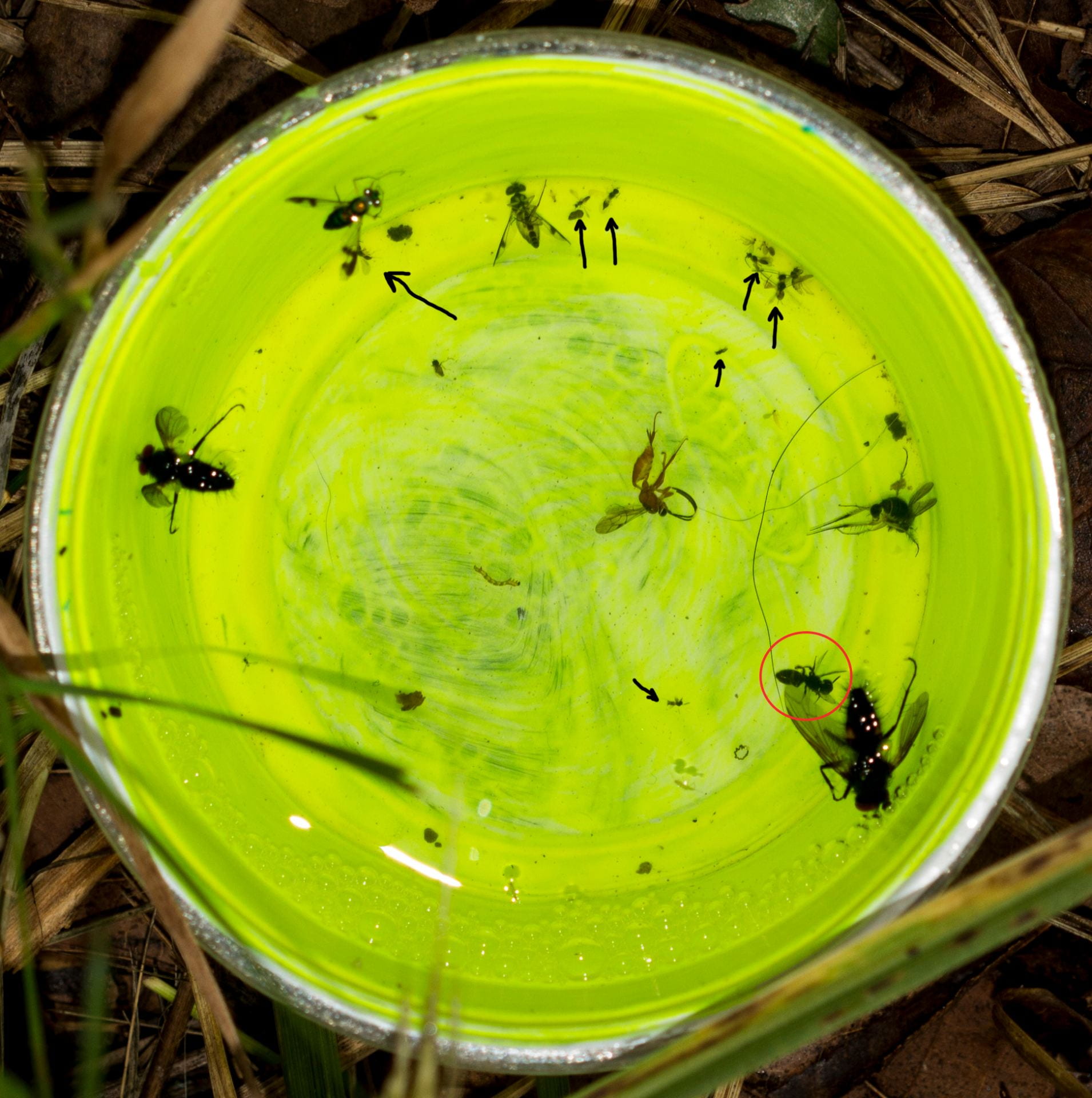
This week I will cover parasitic wasps! In this case, the micro-hymenoptera, meaning the super tiny wasps that are mostly smaller than a fleck of black pepper. So all those tiny things indicated with the black arrows are parasitic wasps. The only bee in the bowl is circled in red. There are also some longlegged flies and other flies in the bowl as well.
Don’t believe me that those tiny specks are actually wasps? Well, take a closer look with this magnified view! Note the constricted waist, long antennae, and two pairs of wings. Though the second pair of wings can be really hard to see or very reduced, so that isn’t always the best character to go by. And again, remember how small we are talking here, as most of these wasps would be naught but a speck of black to the naked eye.
To get another sense of scale, consider the following parasitic wasp which is rather large for one of the micro-hymenoptera.
This wasp somehow got stuck on one of my datasheets, so I decided to write next to it indicating a wasp was here ( <– waspy). Disregard my abysmal penmanship, but you get the idea for size.
Now that I have at least attempted to give a sense of scale for just how tiny these are, let’s get into some biology for these beasts. To broadly explain it, they are all parasites or parasitoids of other organisms. They also tend to be super specialists, often targeting only a small group of insects (like aphids or certain species of aphids), or targeting only eggs of certain insects (like the egg parasitoid of the Brown Marmorated Stink Bug). For a broader introduction to the world of micro-hymenoptera, see: http://chrisraper.org.uk/blog/?page_id=98and https://bugguide.net/node/view/12325
This wasp specializes on aphids and bends forward to inject eggs into living aphids. The larvae develop inside the aphids before “mummifying” them.
There are easily several thousand species of parasitic micro-hymenoptera in Ohio, though identification is an extreme challenge. Moreover, many species of micro-hymenoptera such as these are still being described, meaning we do not yet have names for them. In fact, these are the focal organisms of the Johnson Lab at the Triplehorn Insect collection.
The wing venation also tends to be much reduced, sometimes to only the leading edge of the wing.
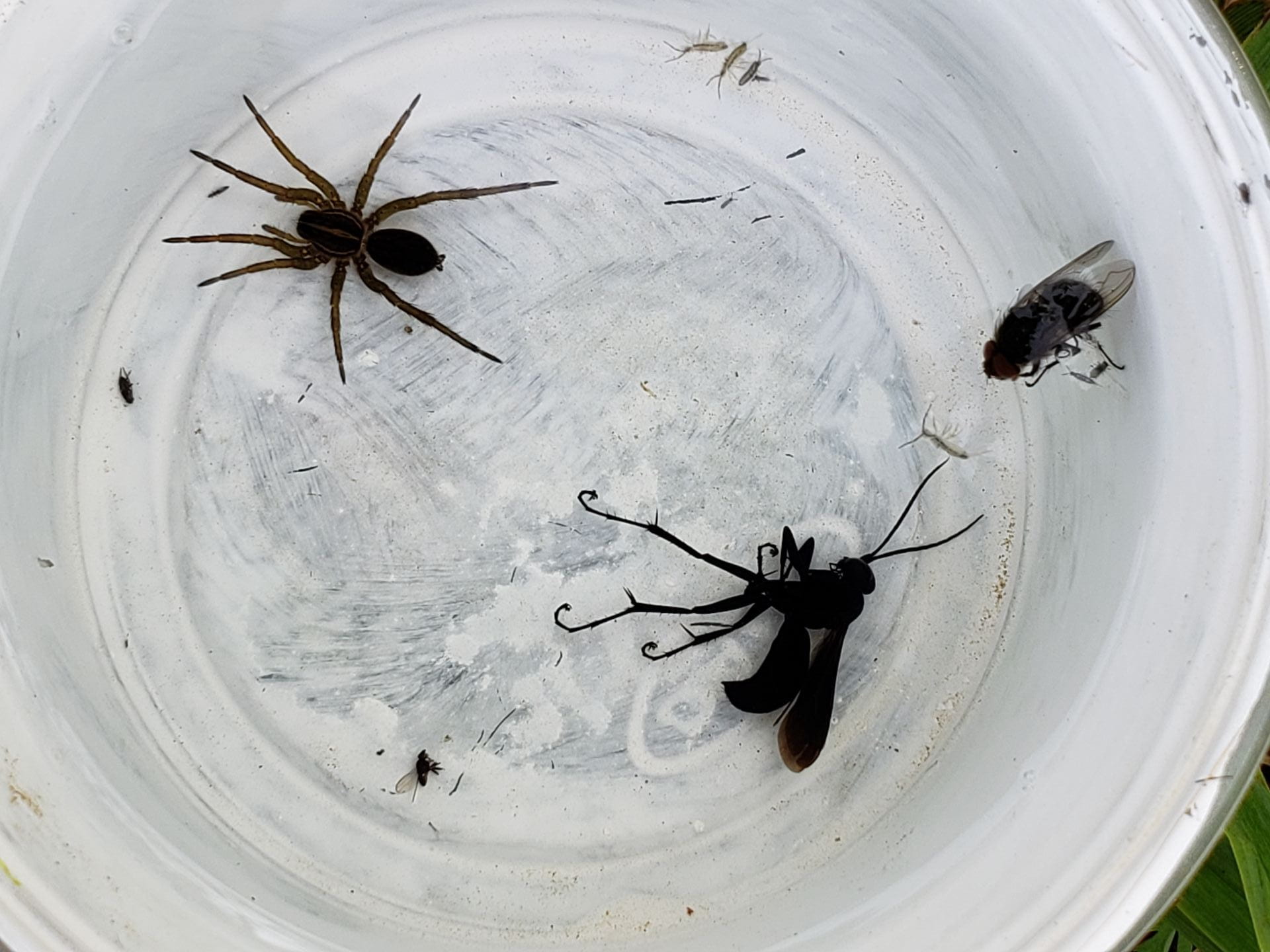
Also, although a normal sized wasp, I figured I would throw in this other wasp that was collected in a bowl and photographed by Heath White.
Similar to the chicken or the egg debate, Heath asked the question: “Which came first, the wolf spider or the spider wasp?” *inserts laugh track* I do not have a good answer for that question, so I will let you all ruminate on the potential answer.
So anyways, for those not familiar, there are a group of wasps that specialize on spiders. Specifically, they inject the spiders with a paralytic to paralyze them and then drag them back to their lair. There, the baby wasps take their good ole time slowly eating the provisioned spiders. I’ve only photographed one spider wasp, which was so intent on dragging its jumping spider prey home, that it did not hesitate to drag the spider over my waiting hand. I’m just glad there are not human sized versions of these wasps.
Is that a bee?
In this brief section, I will show a photo of a bee bowl and let you guess how many of the insects are actually bees. Don’t worry about properly identifying bees in your bowls. This is just so you can start to recognize some of the bees and get an idea of how many bees you actually have.
How many bees do you see? Do you recognize any?
.
.
.
.
Okay, did you make your guesses?
Aha! It was another tricky week, but no bees are visible in this photograph! There still could be a bee hiding under the skipper, but no bees are visible at the very least. There are two longlegged flies (greenish thin flies floating at the surface) and a few other types of flies. Otherwise, not much else in this bowl.