The Aphasia Initiative @ OSU East by Leonie Ly

“It’s a lot of help… I don’t like to get out much but I love coming here. I have to walk with a cane, and it bothers me when people watch and judge me. So this helps me actually get out and meet with people… It lets me know I’m not alone” -Tanikia S.

“I don’t like to go nowhere, I just like coming here!” -Eva M.


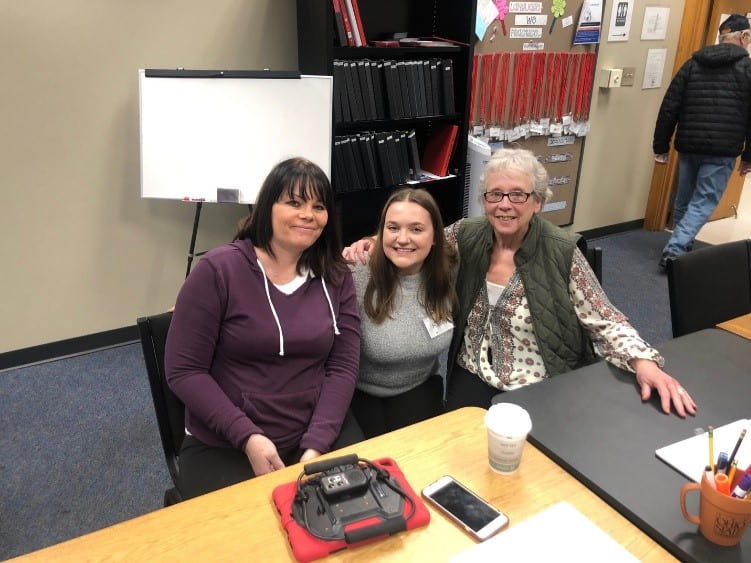
Group photo with two of our founding members. Pictured from left: Melody Culbert, Tanikia S., Eva M., Leonie Ly, SLP Graduate Student Clinician

The communication group known to immeasurably impact lives is expanding: The Aphasia Initiative has a brand new satellite location on Columbus’s near East side!  Patients traveled from as far as Sunbury to attend two successful pilot events in December 2022.  This innovative effort, originally pioneered by Speech-Language Pathologists on OSU’s main campus, later became a passion project of Melody Culbert, MA, CCC-SLP.  Melody was inspired to expand the Aphasia Initiative when placed at East Hospital as a graduate student in 2019.  As pandemic restrictions lifted, a need for social interaction in the healing process became enhanced; for individuals with aphasia and other speech disorders, this was even more significant.  Presently, this effort has already become a reliable highlight in some members’ weekly schedules, as they navigate society with their communication differences.  For community members around the near East side particularly, accessibility to free programs that offer increased efforts in functional life participation can be crucial.


The communication group utilizes activities informed both by evidence based practice, and the meaningful exchanges innately brought out by the soul of the community, to create an impactful experience.  Every Wednesday, members gather to participate in activities that enhance multimodal expressive and receptive language.  Structured conversation prompts given by therapists target expressive language and simultaneously provide opportunities for self-expression and connection.  Sharing personal goals focuses on sequencing and planning strategies, while also opening up chances for support for individual achievements.  Writing and signing get-well-soon cards allows practice in alternative communication modalities, and most importantly, uplifts members of the community in vulnerable times.  We hope that the Aphasia Initiative at OSU East can continue to bring light into this brilliant community.


The Aphasia Initiative East meets on Wednesdays from 1-2:30pm at OSU Outpatient Care East: 543 Taylor Ave, Columbus, OH 43203. Contact Melody Culbert at melody.culbert@osumc.edu for more information and program registration. Join us for time filled with joy and connection!

Aphasia Initiative Gives Back through Volunteer Service

by Frank DeVito

For the second consecutive summer, the Aphasia Initiative has volunteered at the Grange Insurance Audubon Center. The center offers engaging hands-on activities and opportunities for people of all ages to connect with nature in the heart of downtown Columbus.

Members, with the support of undergraduate and graduate students, helped the center with a wide variety of tasks such as: preparing camp materials, restocking brochures and backpacks, and organizing the library. Members also were able to support campers by reading stories aloud.

This partnership has been a wonderful experience for everyone. Please learn more about the Audubon Center at grange.audubon.org


Meet one of our HELP Group Facilitators: Emily Brown, MA, CCC-SLP, CBIS


Emily a speech-language-pathologist at The Ohio State University Wexner Medical Center. She earned her Master’s in Speech Language Pathology from Indiana University in 2016. Following graduation, she honed her clinical skills at Dodd Rehabilitation Hospital as part of the brain injury team. In March of 2019, she transitioned to the acute care speech pathology team within OSU.  She specializes in cognitive-communicative and dysphagia recovery in patients with acquired neurological impairments within the Brain and Spine Hospital. Specifically, she is passionate about the assessment and development of rehabilitation programs for patients with traumatic brain injuries. She is an active member of the American Speech Language Hearing Association and is a Certified Brain Injury Specialist.

Welcome Emily and thank you for supporting the OSU Aphasia Initiative!

COVID-19: Our Response, Our Efforts, & Our Future

I came across this quote that is so perfectly relevant given the events of the past 10 months:

A problem is a chance to do your best. – Duke Ellington.

Instead of planning our annual open house we are writing a newsletter; something we have wanted to do for quite some time but hadn’t gotten around to it. As I was sketching out what stories to highlight for this year in review, I can’t help but be grateful for the opportunity
to be better.

Because of the COVID-19 crisis, we immediately transitioned to an online group platform using technology that allowed us to educate students and provide services to persons with aphasia who were living across the country. We partnered with the Department of Occupational Therapy, taught their students about aphasia AND provided therapeutic OT services to our members. A new family support group was developed and we welcomed several new members to our community. And we finally have a newsletter!

As I reflect back on the past year, I am grateful for the community of clinicians, students, members, and care partners that dedicate so much time to support our program and were available and willing to help us respond to these difficult times. I am grateful that we were challenged to take risks, be creative, and do our best. While we are certainly ready for some normalcy, we remain energized to keep improving. I think there will be much to share in next year’s newsletter, too.


Time & Change

by Olivia Fox
My second semester as a participant in the Aphasia Initiative has come to an end. Just like last semester, my weekly attendance to therapy group quickly became one of the main things I looked forward to every week. Luckily, I will have the opportunity to spend my final semester at Ohio State participating in this wonderful program one last time. This experience has been nothing short of a blessing. Undergraduate students do not have many chances to practice hands-on learning outside of the classroom. As a senior looking ahead, the skills and the confidence that I have gained from the Aphasia Initiative have left me feeling prepared and more motivated than ever for my future graduate school journey. Before I ever started coming to these group therapy sessions last semester, I was nervous and slightly intimidated. While I had learned about Aphasia in multiple of my speech and hearing courses, I had never interacted with anyone who has it. I quickly realized that there was absolutely nothing to worry about. Getting to know the individual adults more and more every week is such a privilege. They all have different backgrounds, hobbies, interests, professions and loved ones that they are always eager to talk about. Prior to this experience, I wrongly assumed that I would not be able to communicate with most of the adults in depth about these parts of their lives. With the guidance of one of the speech language pathologists for this program, Arin, we learn what the strengths and weaknesses of each adult are and what tools and exercises we can use to best aid them in their communication. I have taken away so much more from this than I ever could have imagined. More so than ever this year, time has brought with it a lot of change. The COVID-19 pandemic has caused changes, both large and small, in just about every area of our lives. Adjusting to virtual learning and socialization has been difficult for everyone. Among many other things, the Aphasia Initiative therapy groups had to make the switch to virtual attendance. While the format this past semester was very different, I am thankful that we were able to continue with the program. Due to not being in the clinic, my role this semester became more observational, however this enabled me to learn valuable lessons from watching the graduate students run sessions. Especially during times of quarantine and lockdowns, I assume that these therapy groups became more of a support system than ever for many members. Throughout all the change that has occurred over time, the members have continuously been so encouraging and uplifting towards one another. Their motivation to constantly show up, work hard, be flexible and open with us has been inspiring. I believe that time and change of 2020 has only strengthened the friendships, relationships and impact of this program. As the Buckeye saying goes… “Time and Change Will Surely Show, How Firm Thy Friendship”

Voices of Excellence

Thank you OSU College of Arts & Sciences, Voices of Excellence podcast.  We love to talk about the Aphasia Initiative!


Jennifer Brello, clinical associate professor in the department of speech and hearing science, serves as the director of the Ohio State University Aphasia Initiative, a program for people living with loss of communication ability due to brain injury. Aphasia can make mundane tasks like ordering a cup of coffee very challenging, and Brello describes to host David Staley the benefits of therapy at the Initiative on this week’s episode of Voices of Excellence

Listen on Apple Podcasts: https://podcasts.apple.com/us/podcast/voices-of-excellence-from-arts-and-sciences/id1436204139#episodeGuid=tag%3Asoundcloud%2C2010%3Atracks%2F903430225


Zooming in on Interprofessional Practice Opportunities through Experiences in Service-Learning


Written by Theresa Mikolay and Meg Hartmann

As we approached our second year in the occupational therapy program amidst the COVID-19 pandemic, the service-learning experience with the Aphasia Initiative felt daunting. Most of us had never worked with people who have aphasia before, let alone try to deliver services via telehealth. We knew little about what to expect, other than this being a really unique opportunity albeit a very scary one.

Right away, it was evident as to how enriching these next six weeks would be. The members of the OSU Aphasia Initiative were incredible–they were willing to let us learn and work on our therapeutic skills while they consistently showed up each week, ready for whatever twist and turn we threw at them.

Occupational therapy plays an important role in the community health setting and when working with the members of the Aphasia Initiative. The community can either facilitate or inhibit occupational engagement, and it is important to acknowledge the variety of mechanisms of service delivery in terms of social programs, assisted living, day care, and more. By going out into the community, such as working with individuals involved in the Aphasia Initiative, we can play an integral role in helping them accomplish their goals based around the community, rather than solely through their disease state.

This experience also taught us how to communicate effectively with those who have communication disabilities. Telehealth presented us with the opportunity to use different methods of communication such as pictures, videos, charts, and tables–modifications we may not have utilized had we been in a clinic. Having never worked with a client who uses a speech generating device before, it was useful to learn more about the adaptive equipment that many people in this population use. We learned lessons in patience, how to be comfortable with silence, as well as how to encourage the use of adaptive devices for more successful communication, all of which are important as future occupational therapists.

This experience has built up our professional development through providing a safe space to learn how to work on an interdisciplinary team as well as practice evaluating, providing treatments, and discharging a client. Working with Speech-Language Pathology (SLP) students was one of the most enriching parts of this experience. Understanding what their role is in the interdisciplinary care team allowed for more thoughtful collaboration and insight into how they help clients in their own practice.

One example of this was with Nicole, an MA-SLP student. She helped us implement our treatment plans through providing tips as to how to best communicate with our client, such as using a PowerPoint and pictures when demonstrating each exercise. If our client was unable to understand what a direction was, Nicole was quick to jump in and explain what we were trying to say in a way that was easier for the client to understand. Having the presence and knowledge of an SLP allowed us to break down the communication barrier–each client became fully aware of what to do and how to do it. Understandably, this leads to improved patient outcomes because their home exercise program (HEP) was understood and could now be followed.

This collaboration demonstrated how each member of the care team has a unique and powerful impact in an individual’s plan of care. SLP’s knowledge in communication and language in the Aphasia community is important because everyone needs to be able to communicate in order to benefit from therapy. When SLPs help individuals communicate, occupational therapists are then able to come in and utilize their knowledge to help these individuals gain independence and control back in their everyday lives through meaningful occupations. This experience was not only informative, but it was enriching and gratifying in so many ways. We are so appreciative for this opportunity to interact and learn from the Aphasia Initiative and the SLPs.


My experience in service-learning

by Abby Nichols

I didn’t know what to expect when I decided to volunteer at the Aphasia Initiative. I had never directly communicated with anyone who has had a stroke or brain injury, but I have learned so much about aphasia in my Speech and Hearing major. From the start, I was so blown away at the enthusiasm and love all the participants have coming to the group each day. The way they all greeted each other and accepted one another no matter age, gender, or communication difference was so incredible to see. Everyone’s attitude was so contagious to one another, and made me feel so happy to be there, too.

I learned so much about how aphasia is so different from person to person. It affects everyone differently emotionally and physically. I also learned so much about using different ways to communicate: like whiteboards, Alternative and Augmentative Communication Devices, and writing. Everyone that goes has adapted so much and showed me how I can adapt to communicate and in other aspects of my life, too.

The biggest pleasure I had with coming was getting to know a little bit about everyone as a person. From talking about getting numbers for the Vietnam War draft, learning about the love Ross has for thrifting, Andrew’s love for sports, God, and math, Mike’s past with guitar and football, Suzi’s beautiful children, or Everett owning a farm. I was able to learn all these things, and many more, through communicating in a different way, and that is what made it amazing!

Learning Outside the Classroom

by Madilyn Majors

My experience with Aphasia Initiative this semester has been amazing. I came into the group knowing very little about aphasia and had never encountered someone who has aphasia. Furthermore, this group was beneficial beyond the realm of education, this group allowed me to take a class that fit my personality. I love having the opportunity to interact with others of all backgrounds, and aphasia initiative gave me such an amazing outlet to pursue this. In addition to giving the learning support that student’s need, aphasia Initiative has been known for giving amazing support to the members. I have watched as this semester has progressed connections between members have become stronger, and deep conversations are had by many that result in growth. This group really sets the standard for what support is. They are with you through the hardships and will cheer you on through every achievement you have no matter how small. This support doesn’t end simply at the members. I found that even I was being supported by those around me when I was learning how to better assist in the aphasia initiative. I was afraid I would say the wrong thing, or not do enough but with the constant encouragement of Professor Brello and the members in aphasia initiative I felt more comfortable to make mistakes and learn from them.

The Aphasia Initiative: One Big Family

By Paige Mobley

The members of this group have acquired neurogenic disorders as a result of, TBI or stroke,which affects their speech, language, motor functions, and limbs. The staff is composed of two phenomenal speech pathologists, Jen Brello and Arin Sheeler, along with both undergrad and graduate students. This is my 2nd year volunteering as an undergraduate student and this has been an educational blessing of an opportunity for me as a student. I absolutely love it!

Each session I learn something new from our members or about our members and being apart of this group has really opened my eyes. It has broken a lot of stigmas for me as well. When I first started volunteering, I was very intimidated, but overtime I’ve come to know these people and their families. I no longer see them as being disabled or in need of being fixed, but rather as strong and very intelligent people with greatly diverse personalities. Some of the main takeaways from this group are that aphasia, whether it be from a stroke or TBI, doesn’t look the same throughout all affected. It can affect anyone no matter your age, gender, race, ethnicity, size, etc. In addition, these people are not disabled like one may think. They do outstanding artwork, go to sporting events, go to concerts, cook, sew, have jobs, compete in athletic events, and so much more.

It’s phenomenal how the brain works and how these members have learned to use different low tech and high tech adaptations to overcome their daily challenges. Each one of them has a different story and background, but they have made one big family as the OSU Aphasia Initiative. It’s truly inspiring and I’ve never experienced an environment like it. I am so proud of the progress we’ve made as a program in expanding the amount of members we have and bringing more awareness of aphasia to the community by educating health professionals, community members, students, professors, and more. As I graduate, I will truly miss being apart of this so-called family and starting my day, once a week, with their smiling faces. Overall, the Aphasia Initiative has affirmed I am in the place I’m supposed to be as a future speech-language pathologist.

The Aphasia Initiative: A Lesson in Not Taking Oneself Too Seriously

by Elizabeth Mills

As a student volunteer for the Aphasia Initiative this past semester, I was able to take away a multitude of valuable lessons from this incredible group. Above all though, what resonated with me the most was learning about the power in not being afraid to make mistakes and the ability to find joy in these mistakes, an especially pertinent lesson for anyone, like myself, who tends to sweat the small stuff.

Knowing many of the language and communication challenges of Aphasia, I had the preconceived notion that there would be feelings of frustration, fear, and embarrassment amongst the group members. Although these moments of difficulty undoubtedly existed, there was an overwhelming sense of lightness, ease, and lack of pressure in the Aphasia Initiative. This was even in the face of this semester’s challenging new “Toastmasters” program, where members were encouraged to give speeches in front of the group. Were the speeches perfect? No!  Did members struggle with finding words, stringing together phrases, and sound substitutions? Yes! But there was very little shame surrounding these mistakes! Despite each member’s circumstances, they did not beat themselves up over these issues. Aphasia or not, this is a good lesson for everyone in not being too hard on oneself.

Not only were the members not bogged down by these mistakes, they were willing to laugh and find joy in them as well! On the first day of volunteering, a member accidentally said that his daughter was “400 years old.” I instantly thought to myself, “That was pretty funny, but is it appropriate for me to laugh?” Not a moment later the entire room was filled with a chorus of joyful belly laughs. I quickly realized the capabilities of joy and laughter as coping mechanisms in life’s difficult moments. On the last session I attended, I could not help but look around the room with a big smile on my face as members used silly impressions and vocal qualities to practice different speaking techniques. This was a perfect example of the Aphasia Initiative’s bright, optimistic climate that comes along with not being self-conscious of making mistakes and being perfect.

This ability to be silly, laugh, and not take oneself too seriously all stems from the Aphasia Initiative’s overwhelmingly supportive environment. The members face similar challenges, so they pour understanding and encouragement onto one another. I have observed one individual reassuring another to “take their time,” while struggling to find their words. I have seen everyone cheer as a member finally produced the target sounds of a word after many tries. During the “Toastmasters” speeches, I have witnessed members being surrounded by words of motivation and celebratory outbursts as they tackle the daunting task of speaking in front of others. Ultimately, we can all look to the Aphasia Initiative for an important lesson in how laughing about mistakes and not taking oneself too seriously fosters a joyful attitude, even in the face of hardship.

Transforming the Undergraduate Experience through Service Learning

by Allison Kinross

Aphasia Initiative has been one of the most transformative experiences I have had during my four year at Ohio State. Studying language development within the classroom is always interesting, but being able to engage in hands-on learning experience took my love for the major to entirely new level. Working under Arin and Jen gave me both observation hours and exemplary practices that I will be able to carry into the field.

My favorite part about working as a communication partner in the Aphasia Initiative is seeing the same members week after week. Their vulnerability in the group really shines when they share their stories with us and their peers. They might not always believe me, but I have seen tremendous amounts of progress in their language skills. Throughout our own communication activities, and the techniques their speech-language pathologists give them, they have made great strides in their communication confidence. I feel as though I have developed real friendships within the group.

After working with the group for three years, I developed a new passion for working with persons with aphasia. I hope to work in a hospital setting with stroke and traumatic brain injury patients after graduate school. My involvement in this program is what sparked my interest in the field and I could not be more thankful for the opportunities it gave me!

Service Learning for Speech Pathology Students

by Hailey Bell

I have been volunteering in the Aphasia Initiative for almost two years. Throughout my experience here, I have learned so much that I would not have learned any other way. I know how to assist people better and I have also learned so much about the members and their lives that I feel I can connect with them on a more personal level. Throughout the semesters, new members have not only been welcomed into the group but also our family. One of my favorite aspects of this group is how welcoming all the members are- this applies to accepting new students and also new members. Aphasia Initiative members want to help the students to learn, and the members also want new members to feel accepted because they understand how hard life can be. Every time I go to the Aphasia Initiative, I am inspired to work harder and to be more understanding, because you never know what people are going through.

I work at a local Whole Foods Market, and here I have been able to use the skills that the aphasia initiative has given me to help others. While at work, one of my coworkers was given a card from a customer that read “I have Aphasia” and listed some tips in order to help her talk to the customer. My coworker had never heard of Aphasia, and still struggled to make conversation with this customer. However, I was able to use the skills the members of the Aphasia Initiative have taught me in order to talk to the customer and show my coworker how to effectively communicate with somebody with aphasia. Until this moment, it did not dawn on me that my coworkers did not know what aphasia is. I was able to use this as a teaching moment, and now almost all of my coworkers know what aphasia is and know how to effectively use aphasia-friendly communication strategies. Without the Aphasia Initiative, I would have not learned any of these things and would not have been able to inform my coworkers about them either.

Looking forward, I am excited to see what my last semester in the Aphasia Initiative will bring me. I love meeting new members and also learning more about our current members. I am upset I am graduating and leaving this group behind, but I am so thankful for my time and experience her and know that it will forever make me a better speech-language pathologist. Thank you to Arin and Jen for organizing the group, and to all the members for coming each week!


Dr. Harnish Awarded Grant From NIH

Dr. Harnish Awarded $2.3 Million Grant from NIH to Investigate Genetic Links to Recovery from Aphasia

Stacy Harnish (Associate Professor in Speech and Hearing Science) with co-investigators Christopher Bartlett (Nationwide Children’s Hospital), Jeff Pan (Biomedical Informatics), Stephen Petrill (Psychology), David Osher (Psychology), and Vivien Lee (Neurology) were awarded a five-year, $2.3 million grant from the National Institute on Deafness and other Communication Disorders.  The project will investigate patient-specific factors that may influence response to therapy for language impairment after stroke, or aphasia.  Results from this work will assist with better estimation of prognosis for stroke survivors with aphasia, which could empower patients and families to make more informed health care decisions about how to pursue the most appropriate rehabilitation services based on their unique characteristics, such as genetics, cognitive skills, and brain structure after stroke.

Congratulations, Dr. Harnish!

Yoga Happiness

Yoga Happiness  by Anna Evans

In addition to our regular communication focused programming, we believe that it is important to address and support the other challenges our members face on a daily basis.  One of these areas of difficulty is mobility and balance.  In order to meet this need, we have partnered with Burgundie (Burg) Miceli, a local yoga instructor at Happiness Yoga Studio.

Burg initially became involved with our group after making a donation to our Open House Raffle and subsequently offering to teach yoga classes to our members.  Burg has a personal connection to our mission and cause since her mother has also experienced aphasia.  Since then, Burg has been working with our clients for almost a year and has taught 2 classes per month each semester.  We have been so lucky to have her as part of our team and enjoy every session with her.  Burg explains that “We have fun doing it! Even those that grumbled about doing yoga (you know who you are, wink wink!) still did what they could and enjoyed some aspect of it!”  Additionally, Burg reflects that she has seen significant improvement in the balance of our members.  “Overall, just being able to move their bodies and work on both left and right sides was good for everyone!”  Lastly, in addition to balance and strength training, Burg has also shared specific breathing techniques to help cope during stressful situations.

Just like many of our members, Burg is in a transition of her own.  In the next month, she will be moving to Missoula, Montana to work with aphasia clients full time at the Big Sky Aphasia Program at the University of Montana.  We are sincerely grateful for Burg and her contributions to the OSU Aphasia Initiative and wish her the best of luck in her next endeavor!

Art Therapy at the Initiative!

Art Therapy at the Initiative! by Anna Evans

Sure, art can be fun and relaxing but did you know it can even be therapeutic?  Here at the Aphasia Initiative, we recognize the importance and benefits of incorporating multiple modalities into our therapy and the recovery process of our members.

For the past two years, Tanya Pirasteh has been running art classes and coordinating different projects for our members.  Tanya originally became involved with the Aphasia Initiative through her friendship with our very own client, Max McClain!  Typically, Tanya runs art sessions twice per semester and our members love this opportunity for creative expression.  Her favorite part about working with the Aphasia Initiative is “introducing new artists and ideas… [the members] will generally try anything: they’re pretty fearless!  If I tell them to try and draw something a lot of people would consider difficult, they just go for it!”.  Additionally, Tanya notes that “the greatest outcomes I’ve seen personally are some genuinely great drawings in this group.  Keeping in mind a lot of folks are working with their non-dominant hand, it is really quite impressive.”

In addition to working and engaging with our members, Tanya has also “loved spending time communicating with some family members and getting to know the group as a whole. Jen and Arin are caring individuals and I have learned so much from being a teeny part of their work.”

We are excited to continue this creative partnership in the future and can’t wait to see what projects and ideas Tanya has in store for us!