First, we must look at how diamonds form naturally in the earth. The primary “ingredient” in diamonds is pure carbon that has been exposed to pressure of 50,000 times the earth’s atmospheric pressure and temperatures of 2500°F. All of the transformation takes place in upper mantle of earth at depths of 200 miles below the surface as shown in Figure 1.1.(Diamond Formation, 2015)

Figure 1.1 Formation of Diamonds in the Upper Mantle
Diamonds tend to form in 8 sided crystals but can also form in 12 sided crystals as well. No two diamonds are exactly the same, giving a variable value to each individual stone. They also vary in transparency, luster, dispersion of light, and color. Diamonds with low inclusions, white in color, and high refraction of light are more valuable than high inclusion, off white color, and low refraction of light diamonds. The variability of diamonds is also reflected in the style in which they form. There are three types of diamond deposits: Kimberlites, Lamproites, and Placer Deposits.
Kimberlite
The main form of diamond deposits are called kimberlites. Kimberlites are formed by a mixture of magma, minerals, rocks, and diamonds that create cone shaped pipes. These pipes are forced to the surface by volcanic activity and are found in lakes that were formed by inactive volcanic craters. The deposit is shaped like a champagne flute. The process is shown in Figure 1.2.(Kimberlite, 2015)

Figure 1.2 Kimberlite Diamond Formation
Lamproite
Another form of diamond deposits are called lamproites, which are formed like kimberlites except that boiling water and volatile compounds in magma corrode the overlaying rock. This results in a broader cone of diamond deposits at the surface. The deposit is shaped like a martini glass. The formation is shown in Figure 1.3.(Lamproite, 2015)
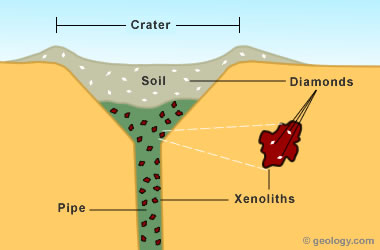
Figure 1.3 Lamproite Diamond Formation
Placer Deposits
The third form of diamond deposits are called placer deposits, which were formed by the erosion of diamond pipes millions of years ago. They are then transported by seasonal flooding and can be found by river sediment deposits. The formation is shown in Figure 1.4.(Placer Deposits, 2015)
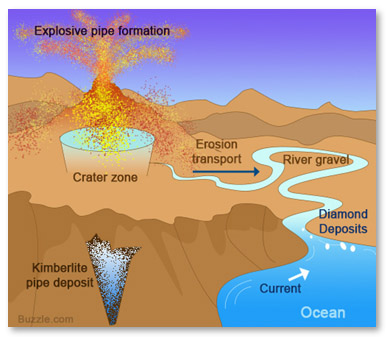
Figure 1.4 Pacer Diamond Deposit Formation
The environmental impacts of the formation of diamonds is something that we cannot control. The earth produces this gem and uses natural geothermal processes like volcanic eruptions to bring the diamonds to the surface.
The underlying formation process is important in the next step of the diamond commodity chain, diamond mining.
The diamond industry fact sheet. (n.d.). Retrieved December 5, 2015, from
diamondfacts.org website: https://www.worlddiamondcouncil.org/download/
resources/documents/Fact%20Sheet%20(The%20Diamond%20Industry).pdf
Hussain, S. S. (2009, June 26). A diamond’s journey: On the cutting edge.
Retrieved December 5, 2015, from NBC News website: http://www.nbcnews.com/
id/15842527/ns/world_news/t/diamonds-journey-cutting-edge/#.VmOj0HarTIV
How does the river side black diamond is formed?
Can I get the answer how the river side diamond is formed and looks the shapes
Can this answer be send in my email?
Black diamonds in river sand are often Carbonados — tiny single crystals of diamond that can be opaque brown to black in color.
The main deposits of such black diamonds are found in eastern South America and western Africa.
When tested for trace isotopes, these diamonds seem to be of extraterrestrial origin.
They may be the remnants of an asteroid that broke up in the atmosphere over 140 millions years ago, when eastern South America and western Africa were still connected to each other. By this theory, each continent’s black diamond deposits are remnants of one deposit laid down by that one event.
The black diamonds themselves would not have formed inside the asteroid however; they would have formed during the explosion of a star!
Specifically a red supergiant star going supernova can create diamond from its own carbon-rich materials, spewing vast tonnages of crystals into space. These drift around mingling with other debris from the blast. In time the debris joins dust clouds that collapse to form stars like our Sun. Out of all the black diamonds in the dust cloud that collapsed to form our Sun, about one percent ended up in the planets and planetoids that formed in orbit around our Sun. And of these a tiny fraction ended up in asteroids like the one that struck Earth. And out of all the diamond mass in that asteroid, we find a tiny fraction as river sand today.
I’ve found that no matter how hard, no matter how beautiful, and no matter how expensive diamonds are, they are honestly worse then being boring, because they simply dont represent anything except how hard it is to break there shell…dreadful.