Posts

The Relevance of Katherine Dunham in Times of Uncertainty

We were thrilled to have the Institute for Dunham Technique Certification in residence this week at Ohio State in Prof. Crystal Michelle Perkins’s Africanist movement practice class for first year Dance majors. IDTC was created in 1994 by Dr. Albirda Rose with the approval and input of Katherine Dunham, and the volunteer collective continues to train the next generation of expert teachers of the Dunham Technique. Penny Godboldo, Certified teacher and former co-director of IDTC, offered a lecture entitled “Survival/Resilience in Challenging Times Through the Wisdom of the Katherine Dunham Technique: A Way of Life,” and Rachel Tavernier, Master teacher and IDTC technique committee chair, offered a master class in Dunham Technique.

Socially distanced dancers in Prof. Crystal Michelle Perkins’s 1st year Africanist movement practice course at The Ohio State University move through barre exercises from Dunham Technique guided by Master teacher Rachel Tarvenier onscreen. Photo by Crystal Michelle Perkins.

Like other dance training organizations, IDTC members have had to modify their practices to continue sharing Dunham Technique. Rachel remarked that they decided to teach classes via Zoom twice a week solely on a donation basis so that students could continue their study and have an escape from the harshness of our times. They have discovered that by using Zoom, they are actually able to meet students from around the world—France, Mexico, Iran, South Africa, Australia, Japan, and Brazil in addition to students all across the U.S.—who may or may not have been able to attend the regular summer seminars, which are usually held in person but were cancelled this year due to COVID. Zoom enables a “world community” to gather around the practice of Dunham Technique. Even after the pandemic is over, they plan to continue to offer classes online.

Composite image of Penny Godboldo’s lecture for dance students at The Ohio State University on the continued relevance of Katherine Dunham’s technique and philosophy for contemporary dancers.

Penny noted that it also felt important to continue this work in light of the current political climate, and especially as a way to affirm Black lives and experiences. Katherine Dunham promoted cross-cultural understanding and developing the whole person in her classes. For Dunham practitioners, the technique is more than a physical practice—“it’s a way of life.” The things learned in the dance studio are carried out into the world, including the mutual relationship between self and community, which requires self-understanding. The current period of COVID-related isolation is actually good for developing this self-understanding, Penny said. “Isolation does not mean being alone … or that you can’t be in community with others … or that you can’t find comfort in yourself.” Instead, it offers a space for self-interrogation where we can find the causes that that we’re passionate about and keep moving, because “anytime we’re not moving, we’re not doing,” and we “have to do something!”

Event Announcement // A Conversation with Michael Idov

Audiences and Online Reception: Before and After COVID” is delighted to host Michael Idov, the Latvian-American creator of Russian films and tv shows, for a conversation about how Russian audiences have changed in the COVID-19 era, including his recent experiences filming in Russia. During this event, Idov will also discuss his award-winning spy drama The Optimists. This free event is open to the public and will feature a question-and-answer session moderated by Drs. Yana Hashamova and Alisa Lin from the Department of Slavic and Eastern European Languages and Cultures.

About Michael Idov

Michael Idov is the screenwriter of the Palme d’Or-nominated LETO (Cannes 2018), director of the acclaimed feature THE HUMORIST, the creator of hit Russian TV series LONDONGRAD and THE OPTIMISTS, and the author of four books, including the recent DRESSED UP FOR A RIOT (Farrar, Straus 2018). A Latvian-born American raised in Riga, Michael moved to New York in 1998, winning three National Magazine Awards for his writing in New York Magazine before changing his focus to film and TV. He and his wife and frequent collaborator Lily are currently based in Los Angeles.

Event Information

A Conversation with Michael Idov

Wednesday, November 18

4:00-5:00 p.m. (ET)

Registration for this Zoom webinar is required. Please fill-out the RSVP form by Tuesday, November 17th to receive the Zoom event link.

Event Announcement // Institute for Dunham Technique Certification (IDTC) Lecture-Discussion and Master Class

Institute for Dunham Technique Certification // Lecture-Discussion and Master Class

“Audiences and Online Reception: Before and After COVID” is delighted to host the Institute for Dunham Technique Certification (IDTC) for a two-part series on Tuesday, October 20th and Thursday, October 22nd from 5:20-6:35 p.m. (ET) via Zoom.

Tuesday, October 20th // Lecture-Discussion with Penny Godboldo

Join Penny Godboldo for the presentation “Survival/Resilience in Challenging Times Through the Wisdom of the Katherine Dunham Technique: A Way of Life.” This presentation will view our response to the COVID-19 Pandemic, the Black Lives Matter Movement, this divisive Election Season and the sense of isolation that permeates life in the U.S.A. today. Through the Dunham Technique, a comprehensive experience we can understand the wisdom of viewing life through the Mind/Body/Spirit experience and most importantly through the lens of Movement—the ultimate Black Experience.

Thursday, October 22nd // Dunham Technique Master Class with Rachel Tavernier

Master Teacher Rachel Tavernier will lead a Dunham Technique master class on Thursday, October 22nd. Dunham Technique is a vibrant African American dance form that engages the body, mind and spirit! Created by dance pioneer Katherine Dunham, the technique is informed by the traditional dances of the African Diaspora, as well as by modern and ballet. Dunham Technique creates strong, dynamic dancers who embody rhythm and grace. Classes in DT offer a variety of experiences, including breathing, isolations, floor work, barre work and progressions across the floor. In this class, dancers will learn the foundational movement of the Dunham Technique and will explore the intersection of Dunham technique and high-spirited, folkloric-inspired movement.

Event Information

Tuesday, October 20th // 5:20-6:35 p.m. (ET)

Lecture Registration—Open to the general public

Registration Deadline: Tuesday, October 20th at 12 p.m. (ET)


Thursday, October 22nd // 5:20-6:35 p.m. (ET)

Master Class Registration—Open to Ohio State Department of Dance students, faculty, and invited guests

Registration Deadline: Thursday, October 22nd at 12 p.m. (ET)

Learn more about the Institute for Dunham Technique Certification, Penny Godboldo, and Rachel Tavernier by visiting the “Presenters” page.

Photography credits (right-to-left): Bree Gant; courtesy of Rachel Tavernier.

Reception of Misinformation and Audience Responses

What Russia Really Thinks about Chernobyl?

Photo: <https://www.express.co.uk/showbiz/tv-radio/1145211/Chernobyl-what-does-Russia-really-think-about-Chernobyl-putin-state-media-propaganda>


Experiencing the spread of COVID-19, the growth of the pandemic, and witnessing the various international governments’ responses to the public health crisis reminded our graduate student, Maryam Bainazar, and me about the Chernobyl disaster and the Soviet government’s response to it. While she knows about Chernobyl only through the experience of her parents who left the Soviet Union in 1991, as well as media and scientific sources, I vividly remember the official government silence and slow response. Although I lived in Bulgaria, our government followed closely the USSR’s announcements and replicated them. The immediate few days after the accident and the release of radioactivity into the environment, all students in my city were practicing the opening of a local Spartakiad (sports competition) on the stadium. Nobody warned us or stopped the practice to minimize our exposure. According to scientists, approximately 25,000 square kilometers were contaminated, and my city is about 1,000 kilometers away from Chernobyl. With such memories resurrected, Maryam and I  decided to evaluate the Soviet government censored media coverage and general response to the public health crisis which occurred following the Chernobyl nuclear disaster, and to compare it to the current Russia’s government agents’ false COVID-19 narratives, circulating online. In addition to analyzing available public information disseminated in the 2-3 weeks after Chernobyl’s explosion, we will examine the reception of this information by collecting the oral history of participants who were affected by the disaster. Additionally, we are interested in the reception and circulation on social media platforms of COVID-19 false narratives.

Audience behavior and reception of film and media has shaped my research and teaching in the last several years. My last book, Screening Trafficking: Prudent and Perilous, analyzes the local and varied reception of internationally distributed anti-trafficking films. As part of this more general research in audience responses, my colleague Dr. Alisa Lin and I will host a conversation with the American-Latvian film creator Michael Idov on November 18 (4:00-5:00) and we’ll discuss his work on the creation of Russian films (Summer, 2018) and TV series (Optimists and Londongrad, both available on Amazon Prime Video), their reception, and any impact of COVID-19 on his work.

Event Announcement // Tahribad-ı İsyan Performance and Presentation

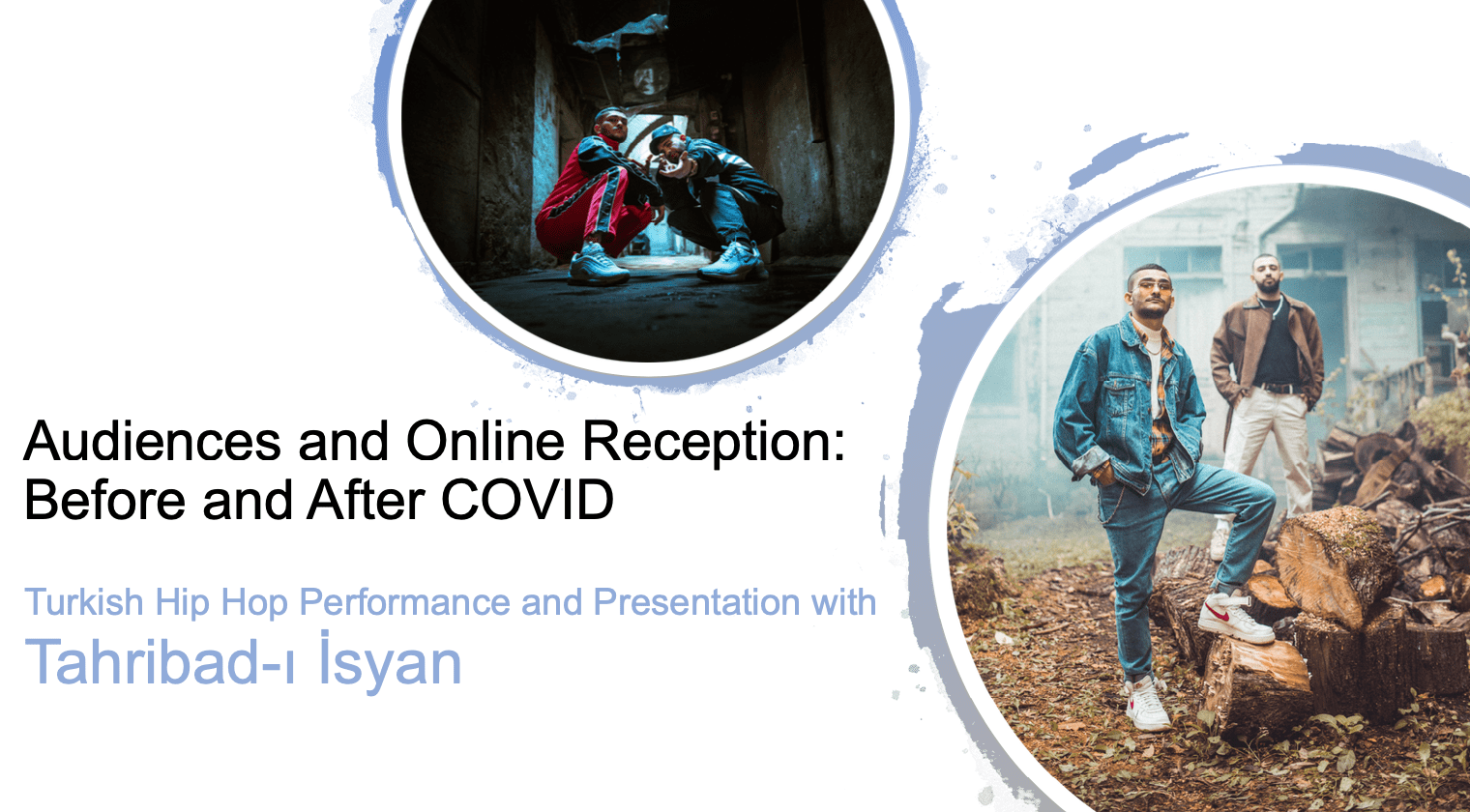
Tahribad-i Isyan Event Announcement. Image reads: Audiences and Online Reception: Before and After COVID Turkish hip hop performance and presentation with Tahribad-i Isyan

“Audiences and Online Reception: Before and After COVID” will host the Turkish hip hop group Tahribad-ı İsyan for a performance and presentation on Friday, November 13th from 9:30 AM-11:30 AM (ET) via Zoom.

Tahribad-ı İsyan will discuss how the company formed, the social messages central to their music, and their current work with refugees in Turkey. The presentation will be delivered in Turkish with English translation by urban rights activist Funda Oral. Following the presentation, Tahribad-ı İsyan will perform several of their hit songs and share in a question-and-answer session moderated by Dr. Danielle Schoon, Senior Lecturer in the Department of Near Eastern Languages and Cultures. This free event is open to the public.

Event Information

Tahribad-ı İsyan Performance and Presentation

Friday, November 13th

9:30-10:15 AM (ET): Tahribad-ı İsyan presentation with translator Funda Oral

10:15-10:45 AM (ET): Live concert by Tahribad-ı İsyan

10:45-11:30 AM (ET): Question-and-answer session

Registration for this Zoom event is required. Please fill-out the RSVP form by Wednesday, November 11th to receive the Zoom event link.

Learn more about Tahribad-ı İsyan by visiting the “Presenters” page.

Hip-Hop in the Time of COVID-19

Members of Tahribad-ı İsyan stand looking at the camera.

Photo courtesy of Tahribad-ı İsyan

My participation in this project is a continuation of my long-term fieldwork with dislocated Roma (“Gypsies”) in Istanbul, Turkey, particularly a young Turkish Roma hip-hop group called Tahribad-ı İsyan, which formed in response to an aggressive urban renewal project that demolished their neighborhood in 2010 (see https://pulitzercenter.org/reporting/turkey-tahribad-i-isyans-rap-rebellion). They have since been outspoken against Turkey’s urbanization policies and treatment of ethnic minorities. Turkish hip-hop artists are increasingly experiencing government censorship, yet these two young men continue to rap about social injustice. YouTube has become a prominent way to share their music and music videos online, in Turkey and beyond; music can be a means of expressing what is too dangerous to say on social media. Despite rapping the lyrics in Turkish, Tahribad-ı İsyan sees their audiences growing as their music circulates beyond Turkey. This opens up new questions about the simultaneous limitations and opportunities afforded by our current circumstances.

On November 13, 2020, at 9:30-11:30am EST, Tahribad-ı İsyan will offer a virtual concert on Zoom, followed by a question and answer session with the audience. Preceding the concert will be a presentation by Turkish activist, Funda Oral, about the origins of the group and their social impact. The direct experiences that the members of Tahribad-ı İsyan have had with displacement and their recent experiences with quarantine will serve to prompt important discussions about forced mobility and immobility, the role of technology in mediating the local and the global, and ethical concerns around censorship and personal safety in times of conflict and crisis. Additionally, I hope that this event with Tahribad-ı İsyan could forge new connections between OSU and Columbus’s own growing hip-hop scene, particularly regarding the role that local music plays in challenging displacement and marginalization as we consider what kind of city we want to develop and live in together.

The event is open to the public. It is also directed to my current students in TURK3350: Contemporary Issues in Turkey; SOC3200 Sociology of Immigration; and SOC3302 Technology and Global Society.

Event Announcement // Feldenkrais Method® Master Class with Alon Karniel

Alon Karniel Master Class Announcement consists of two images. Karniel stands against a white wall wearing and blue and black stripped shirt. Karniel leans forward arms to the right high diagonal. He is wearing all red.

Headshot photography by Rosen-Jones. Dance photography by Natasha Shakhnes.

Audiences and Online Reception: Before and After COVID is pleased to announce it will host Alon Karniel for a Feldenkrais Method® master class on Monday, November 2nd from 8:30 AM-10:00 AM (ET) via Zoom. This free event is open to the public and will feature a question-and-answer session moderated by Dr. Hannah Kosstrin, Associate Professor of Dance. No prior experience necessary.

About the Master Class

The Feldenkrais Method is a somatic approach to education and self-inquiry developed by Dr. Moshe Feldenkrais (1904-84), a renowned Israeli physicist, engineer and Judo master. In a group class, or Awareness Through Movement® lesson, the teacher verbally guides students through a particular movement sequence. These movements are performed with minimal effort, as easily and pleasantly as possible, with the aim of heightening kinesthetic sensitivity and improving the ability to detect differences so that the finer details of the self and surroundings can be better sensed. In this way, people effectively learn to become aware of what they are doing (as opposed to what they say or think they are doing), let go of unnecessary efforts and mobilize their intention into action.

Event Information

Feldenkrais Method® Master Class with Alon Karniel

Monday, November 2, 2020

8:30 AM – 10:00 AM (ET)

Registration for this Zoom event is required. Please fill-out the RSVP form by Friday, October 30th to receive the Zoom event link.

Learn more about Karniel by visiting the “Presenters” tab.

Dancing through the Pandemic, Jewishly

Theatrical dance artists’ work conditions changed overnight when COVID-19 shuttered theaters and canceled tours. These changes affect how audiences access and understand dance. My work in Audiences and Online Reception: Before and After COVID focuses on Jewish and Israeli choreographers’ experiences of COVID-19: how lockdowns during the pandemic affected and continue to affect reception to their work; how they maintain mobility online or in other ways when they are stuck in place or their movement is otherwise restricted; and what they foresee and hope for the future.

The research I pursue with this grant supports my current book project on Jewish choreographers who circulated between the Americas and the Middle East through migrations, dance touring, and intercultural collaborations between the 1950s and the 2020s. Central to my project are Jewish choreographers in cultural minorities and Jewish interracial, intercultural, and LGBTQ+ contexts in concert dance. I examine how the reception to these choreographers’ work in print newspaper reviews and online determined how audiences understood them. I show how Jewish choreographers’ work from diverse backgrounds engenders what I call “kinesthetic peoplehood,” a transnational phenomenon wherein people feel connected to or estranged from a diasporic community through bodily practices. Divergent reception to these artists’ work across national contexts, particularly in COVID-19 shifts from the theater to the screen and re-conceptions about how audiences can come together around dance performances, generates transnational narratives stratifying the Jewish diaspora.

I am excited to welcome dance artists for online events during the 2020–2021 academic year. These events are open to the Ohio State community and to the general public. The artists will share some of their work and talk with students and community members about what it has been like to be a working artist during the coronavirus pandemic. First up is Alon Karniel, who will give a Feldenkrais Method® master class on November 2 and discuss his experiences working in Israel during the pandemic. Stay tuned for details on this and other upcoming events!

This Is Where We Dance Now

This image shows a Zoom dance class.

Ohio State Professor of Dance Susan Van Pelt Petry leads dancers through a Hawkins-based spiral floor sequence in April 2020. This is just one example of how studio dance practices have moved online and into our homes during the COVID era. Image used with permission.

For my work as part of Audiences and Online Reception: Before and After COVID, I am delighted to be guest editing an issue of The International Journal of Screendance with Alexandra Harlig (OSU alum, 2019).

Teaching technique on Zoom, holding online dance film festivals, DJing house parties on Instagram, streaming archival performance documentation, making TikToks—the current era of quarantine and social distancing has rapidly rewritten the playbook for dance onscreen and dance online, impacting the dance field at every level. The long-term implications of this upheaval remain to be seen, but for the moment, we are seeing the culmination of a trend that has been unfolding over the past two decades or more: now all dance is screendance.

We are very excited for this issue, which considers both dance artists that have long viewed the Internet as a primary platform for sharing their work within vibrant online communities, and others who have been forced to innovate in response to sudden and radical changes to their practices.

The International Journal of Screendance is open access, and we look forward to sharing this work in May/June 2021. We are also planning roundtables and possibly a small symposium, so stay tuned for related events!!!!

Grant Announcement

Harmony Bench (Dance), Yana Hashamova (Slavic), Hannah Kosstrin (Dance), and Danielle Schoon (Near Eastern Languages and Cultures) are pleased to announce the receipt of a 2019-2020 Global Arts and Humanities Discovery Theme COVID-19 Special Grant.

Their project “Audiences and Online Reception: Before and After COVID” examines the impact of COVID-19 and quarantine experiences on artistic and cultural production by examining historical precedents, considering audiences in their social contexts, and imagining possible futures based on how audiences are currently forming.

Through a year-long series of online symposia (September 2020-April 2021), the project will forge a digital space where participants can exchange innovative mechanisms for developing and sharing research under current constraints while simultaneously deepening an understanding of the artistic and humanistic dimensions of the pandemic.

You can learn more about the project by visiting the About page. To stay up-to-date on the latest event information, sign-up for our mailing list on the Contact page.


Collaborator Headshots
Left-to-right: Harmony Bench (Dance), Yana Hashamova (Slavic), Hannah Kosstrin (Dance), and Danielle Schoon (Near Eastern Languages and Cultures)