Posts

Two Worlds, One War

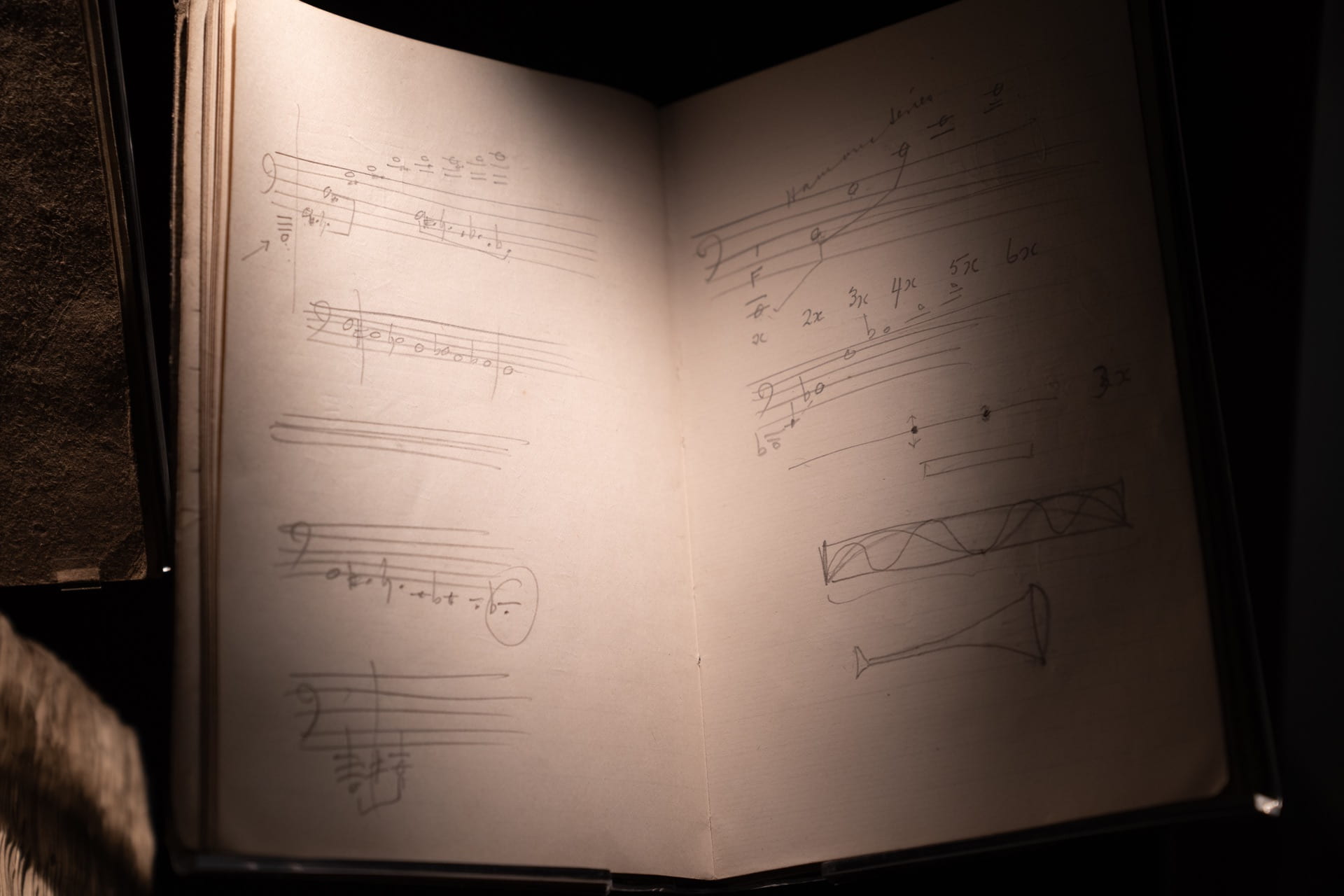
When we first arrived at Bletchley Park my initial impression was of a small, charming and quiet town. Reflecting on our class readings and discussions about the importance of the work done at Bletchley, it was hard to imagine such a small place played such a major role. The German High Command, Naval, Army and Air codes were broken here. Vital intelligence disseminated from Bletchley to the Allies provided an essential instrument in defeating the Nazis. I looked around in their first building, which had examples of German Enigmas and other methods of encryption. Several examples of sheer genius were on display, like the mathematician Daniel Jones. Mr. Jones created twelve symphonies to learn Japanese, tying individual letters and symbols to musical notes. I simply cannot fathom the type of genius that man had, yet at Bletchley this was ordinary.

Bletchley was the combination of many great minds of different fields and backgrounds. As our guide described, however, class at first determined entry to such a program. Aristocrats and officers coordinated recruitment. Without a recommendation you could not work: England was assuming the worst as the treachery of appeasement continued during the 1930’s. The facility at Bletchley was bought only a few months before the war began. The necessity of Bletchley and the need for intelligence pushed recruitment even further. One’s skill and talents were what mattered, not one’s sex, orientation or style.

Bletchley is an incredibly beautiful facility, a place which I would want to call home if I ever could afford it. The mansion, land, and water create a villa of peace and elegance. I feel a strange dichotomy when walking around this place. The people here were sealed away from the war, completely out of harm’s way, and lived in conditions that were not preferable but better than most.
London was being blitzed, armies in North Africa were being shattered all while this place remained pristine. The diversity present at Bletchley achieved some of the most remarkable feats of human history. Breaking the Nazi code ensured Allied supremacy in all theaters of the war. The people at Bletchley laid the foundations for the computer and the modern age.

They sacrificed parts of their lives and comfort while working without praise. Not until recently did the British government recognize them for their contributions. “Ordinary people doing extraordinary things” describes Bletchley Park. The communal war experience I felt was outside of Bletchley, sealed away in London. The mass evacuations, strife and insecurity of danger were far away. The People’s War is tied with the collective experience of war, with common struggle, sacrifice and loss being cornerstones of this commonality. Bletchley was sealed away, which secured its future but, in my opinion, separated it from “The People’s War.”

The Ordinary Solider

While in Normandy I had the opportunity to visit the La Cambe German Cemetery. This cemetery honors the German soldiers of World War II; in the middle is a hill-shaped mass grave of nearly 20,000 German soldiers. Also, as opposed to normal headstones, the cemetery contained smaller plaques. Most grave markers had no flowers, crosses, or items of remembrance by them, giving the place a uniformly plain appearance. One grave, however, was adorned with the typical offerings: Michael Wittmann’s grave. Wittmann was one of the most famous Panzer officers. In comparison to the other graves, his had flowers, candles, coins, and a cross. Buried with other tankmen killed alongside him, only his grave received this level of recognition. Professor Steigerwald noted that there was concern over whether neo-Nazi fanatics made pilgrimages to Wittmann’s grave.

The La Cambe German Cemetery.

Professor Steigerwald’s comment made me think about the recent rise in the alt-right. However controversial this might be, I think removing Wittmann’s grave would be a positive thing to do. It stymies neo-Nazis’ opportunity to worship a horrible killer, but at the same time would not hurt the remembrance of the ordinary Nazi solider. Through my research and reading during our spring seminar class I had the chance to learn about the ordinary German soldier. As in other countries they were drafted into the army without much of a choice. Thus, I think recognizing them is most important because it is a testament to the folly of war experienced on all sides, of the lack of choices many men faced. And with the 75thanniversary of the D-Day Invasion approaching, the persisting relevance of Nazi philosophy appears striking to me. There is a grave in the La Cambe that might be contributing further to the very problem that these men so bravely died fighting against. How does one grapple with this honoring of both sides fallen soldiers and the indiscriminate toll war takes on all sides? To me, I see recognition of the ordinary soldiers on both sides as the key to that answer.

The mass grave at the La Cambe German Cemetery


Michael Wittmann’s grave is pictured at top, surrounded by flowers, candles, and a cross. Coins have been laid on his marker. The two grave markers below are the tank crew members that died in the same incident at Wittmann, but no similar remembrances are left for them.


Close-up of Wittmann’s grave.

Churchill: A Marvel in Modern Memory

When visiting the Churchill War Rooms, I was most struck by the exhibit dedicated to the life of the man himself, Winston Churchill. In the dark, cavernous room, artifacts from throughout Churchill’s life were illuminated under bright lights and memorialized in great detail. In one step I went from looking at Churchill’s childhood report cards to an encasement of a magnificent velvet romper— a kind of socialite outfit representative of the leader’s flare. Filling an expansive room with such diverse Churchill relics went a long way to show how contemporary England lionizes its wartime leader. Although given to arrogance, crudeness, and histrionics, Churchill spun these features to be endearing, not condemnable. In fact, one station took visitors through a virtual circuit of Churchill’s zaniest quotes from adolescence to death. Strolling through the exhibit, it is clear that the collective memory of Churchill is still one of admiration. As a viewer, I smiled at the school records outlining Churchill’s disobedience. I laughed at the timeline showing Churchill’s never-changing daily ritual (which included several drinks, baths, and cigars). Walking through the exhibit, I began to understand why Churchill remains so revered by people across the world. His leadership showed grit, rebelliousness, and passion. During the Second World War, the Allies needed a leader to inspire the public toward victory at all costs. Churchill fulfilled that role.

It is no wonder why affixed to the central wall of the Churchill exhibit is a quote by Beverly Nichols of the Daily Telegraph stating, “he [Churchill] mobilised the English language and sent it into battle.” The leader used his gifts of rhetoric and performance to steel the Allied populations. When morale was low, like in the wake of Dunkirk and Pearl Harbor, Churchill called for perseverance and pushed the people to keep fighting. During a time of unprecedented destruction, the free world needed a leader willing to speak honestly and fervently to the people, and they got that leader in Winston Churchill. In a way, Churchill’s distinctive leadership during the war allowed his transformation from man to myth in the public memory.

In Search of the People’s War

By Matthew Bonner

I arrived in London on May 8th, immediately greeted by a refreshing English downpour and a warm fish and chips. Throughout our class discussions and readings over the Spring semester, we focused our analysis on piecing together the historical memories of England, France, Poland, and Germany regarding World War II. The British remember the war as a “people’s war,” where a mass mobilization of British society was required to fight in the total war. Under this national memory, the war impacted and was shaped by every British citizen, but is remembered as a unified effort of the whole British Empire.

As I wandered through the immense labyrinth of underground rooms that make up the Churchill War Rooms, I was searching for evidence of the “people’s war”. The underground bunker was a home to many British officers ranging from secretaries to intelligence officials who worked in top secret on planning the British war effort. One of the biggest contradictions I grappled with throughout the museum was how the war was a “people’s war” when the museum exhibits attribute so much of the success and focus of the British war effort to prime minister Winston Churchill. However, after exploring the exhibits and getting a sense of the greater British experience, it is clear that Churchill serves as a symbol for the “people’s war” interpretation. Churchill was a leader to rally behind during the war for millions of British citizens and “people”, inspiring officers, soldiers, and civilians in the mass mobilization needed for the war. For example, the museum’s Churchill exhibit traced Churchill’s life through his public speeches and private letters across his extensive career, and the emphasis on the will, strength, and unity of the English people needed during the war was evident.

A map room in Churchill’s War Rooms, where officials carefully mapped out troop movements and gathered intelligence to lead British and Allied war efforts.

As we made our day trip to Bletchley Park, the headquarters for the Allied decryption efforts, preconceived images came to mind of an expansive mansion where Oxford and Cambridge graduates worked together to piece together vital intelligence for the war. Instead, after touring the site, I was able to grasp the full extent of the multiple huts and buildings on the estate where thousands of men and women worked together in secret. The classified work at Bletchley was hidden from the worker’s families and even other members of the decryption efforts, as warning posters littered the various buildings ominously reading “The Walls Have Ears”. A majority of the thousands of workers at Bletchley were women, initially selected due to demonstrated skill and socioeconomic connections, and later expanding to additional women workers through assessments, such as logic tests in newspapers. Most of the men at the site were hand picked from Cambridge and Oxford. In fact, the Bletchley location is tied to these universities, as the site is equidistant between the two universities for ease of access and transportation. The “people’s war” memory exudes from the campus, as brilliant civilians sacrificed individual pride and worked tirelessly at various compartmentalized stations to decrypt German enigma messages and provide key intelligence to Allied forces regarding German troop movements, planned attacks, and intel on invasions such as D-Day. After the war, the Bletchley workers blended into the common historical memory of the “people’s war”, until 1970 when their work was declassified, and with it another chapter of the “people’s war” revealed and definition of “people” expanded.

One of the Bletchley Park huts, where men and women worked to provide valuable intelligence to the Allied war efforts – often for extreme working hours and in isolating conditions.

Ultimately, the “people’s war” historical memory interpretation inherently asks the question, who were the “people”? After touring the various sites in London and museums, such as the Imperial War Museum, it is obvious that the people included any and everyone, ranging from both women to men from London to the colonies. However, it is remarkable that the definition of “who” the “people” were expanded during the war to include group of peoples ranging from women to homosexuals, who were discriminated against, persecuted, and held in second and third class status in peacetime society. Furthermore, as England and the world remember the immense sacrifices and contributions made by the “people” during the war, these key members of the war effort are often left out of the historical memory. The gap between those who served and those remembered is closing, however it is important to understand the full extent of the “people” that served in England’s “people’s war” when considering the war’s legacy and impact.

Recognizing the People in the People’s War

A point of pride in many of the World War II museums we visited in London is the idea of “the People’s War,” a war that average British citizens endured with fortitude and determination. The exhibits at Bletchley Park, for example, earnestly honored the hundreds of diverse men and women who cracked Axis codes during the war. As we walked through the cramped, dark, and sweltering “huts” that the people worked in, we viewed images of women projected onto the walls as they solved complex equations. This was fitting, given that our tour guide made sure to mention how women made up the majority of the workforce at Bletchley before we went inside. While the ways the British government has avoided taking responsibility for its oppressive treatment of minority groups in the past is problematic, honoring the members of those groups is a step in the right direction for healing old wounds. Eighty years ago, it did not matter who worked in the cramped spaces or breathed the stale air of the huts; they needed all hands for the war effort.


The emphasis on the people reacting to the war, however, represents a significant change from British heroes celebrated in the past. “Great man” interpretations of history extoll the virtues of a limited number of men instead of the diverse population. The legacy of Sir Winston Churchill stands out today as an example, with the Churchill War Rooms being a testament to his lasting popularity. Located in the former command center for British military operations, a maze of exhibits praise his contributions to the war. The first interactive display, placed at the entrance to the museum, lets you fill in the blanks to his most famous speeches. A few rows over to the right, a long row of shiny medallions awarded to him are on display, next to a plaque claiming that he did not like to show them off to others. One poster still managed to stand out, however. It features the cigar-bearing Churchill rolling his sleeves up, with dozens of others behind him following suit; they are all “right behind” him. Here, the people play an important but secondary role: they rallied behind him, the unnoticed hands who carried Britain out of danger and Churchill to legend. In this regard, Bletchley Park and the Churchill War Rooms are not so different. Whether prominently or in the background, both museums recognize people who quietly went back to their lives at the end of the war. Switching the memorialization of war in museums to focus on these varied stories of the people will give us a better look at the challenges and tribulations that come with war. The perspectives of infantry men are just as important as those of generals; one without the other, and we don’t get the full history.


Shaping Young Minds: How We Share History

Throughout our time in Bayeux, I often noticed the way that the French memory of the war is presented to the people there. The first place where this was evident was in the museum in Caen. There was little to no ownership taken for any of the atrocities committed during the war. In their exhibit about the Holocaust, most of the examples of deportations given were from the Ukraine. As we had learned in this past Spring, France was often complicit in the deportation of Jews from their country, and yet this was never mentioned. There was also no mention of the collaboration of Vichy France with the Nazis. Besides a small exhibit about Petain, the leader of Vichy France, Vichy was only mentioned one or two times throughout the museum.

There was also a high level of dedication to the memory of the Resistance. While the Resistance was valuable in some ways, the museums made it seem like every person in France was actively resisting the Nazi occupation, which was not the case. This myth is played up to the point where one of the signs explaining the liberation of France stated that liberation would have been achieved “with or without the help of the Allies.”

While these sources of information are concerning to me as a historian, they are even more concerning to me as a future educator. There were many French school children at these museums. This is the information that they are receiving as the complete truth, which could be problematic as they continue their education. In each museum I grappled with not only how the information was presented to those children, but how information about war and history is conveyed to American students at our own historical sites. It is easy to look at museums in another country and pick them apart, but it is just as important to do this back in the US. It is important to me that my students are able to understand history in a holistic way, and thinking critical about the information we were presented with in Bayeux solidified this as a necessity in my classroom.

One of the panels explaining the role of the Resistance at the Museum in Caen.

One of the only pieces of propaganda which discussed the situation in France…

The “People’s” War?

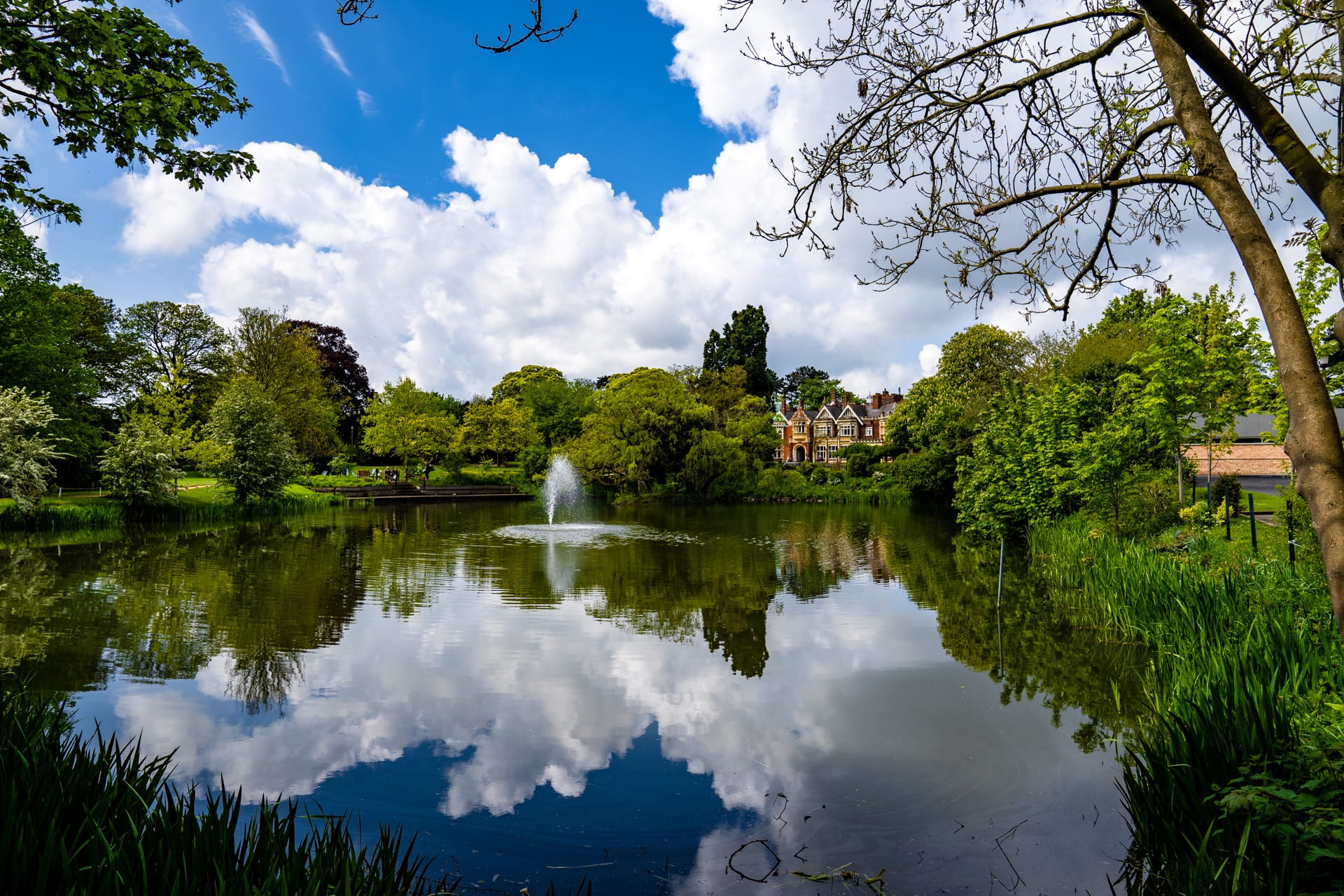
The lake at Bletchley Park.

The mansion at Bletchley Park.

We spent our first Friday in Bletchley Park, where the weather was perfect for an outside discussion about the British collective memory of the People’s War and more specifically who “the people” were. We came to the conclusion that those who are considered “the people” now may not have been considered as much during the war. The prime example of our conversation was the women who worked at Bletchley. Our guide made sure to emphasize the important work that the women of Bletchley did and how critical they were to success in operations such as Overlord. Of course, during the war women were seen as only temporary assets or assistants to the men who ran the show.

This conversation really resonated with me as we began discussing what it meant to be one of “the people” and what the qualifications were. I began to think about applying what that meant outside of a British framework and to think about the research that I conducted over the semester on the African Imperial Soldiers who fought to liberate France under General Charles de Gaulle. These men made up nearly 50% of the Free French Army, and their families and villages were exploited for labor that supplied the Allied war effort. Women at Bletchley, while seen as inferior, were still considered human. The Africans fought and labored for a national that merely saw them as bodies who were expendable. Hitler, too, saw Jews, Gypsies, and other undesirables” as cogs in his machine; they were less than human and therefore only worth the amount labor they could offer.

The suffering of the victims of the Holocaust is incomparable to the suffering of Africans subjected to colonial oppression – they are two very different sets of circumstances. But what this shows is how tailored the idea of a People’s War was to the white Anglo-Saxon Protestant experience, of which Winston Churchill was the perfect symbol. It is an experience that has only recently been able to account for the work that women did at Bletchley or even Alan Turing, who was gay. The framework, while unifying in Great Britain, has obvious limits that almost undercut the core ideas of what we would consider a People’s War today.

Parliament: A System in Crisis


I got the chance to tour the Parliament Building while I was in London. As it turns, an Ohio State alumnus works as a security officer and so offered my friends and I the opportunity to see the inside. As I explored Parliament, the grandeur of the art and monuments inside reminded me of the importance of the English form of democracy. Seeing all the paintings, statues, and plaques, I became reminded of the fact that Britain has always been a bastion of parliamentary democracy and that English Common Law was what laid the roots of the American system we abide by today. Such considerations garnered a sort of kinship with the English that I believe is a central aspect of the relationship between our two countries. With close ties like these, I feel as if the fate of the United States’ system of government is partially linked to that of England’s. Even when that system appears to be in crisis, perhaps the memory of what Britain stands for will serve as a rallying point for those reasonable enough to be civil about the UK’s most polarizing dilemma: Brexit.

As I listened to my guide, I concluded the current state of affairs in British Parliament is one wrought with just as much uncertainty as that of the United States. Rifts arise in current parties like UKIP, leading to the creation of new parties that only serve to accentuate the issue. MPs insult and shout at one another. Protests amass in the street daily regarding Brexit in Parliament Square. Amidst it all, Theresa May’s government is struggling to maintain power. As my tour guide said, Brexit has made the position of Prime Minister the most undesirable job in the world. With MPs becoming so angry that they are grabbing the ceremonial mace at the center of the floor and trying to hit one another with it, I understand how difficult it might be to see the light at the end of the tunnel.

Churchill’s Oratory in Britons’ Hearts

Winston Churchill’s oratory fascinates me. His wartime speeches, broadcast on the BBC from his underground War Rooms, sound like a bulldog looks. As though unmoved by bombings and setbacks, his voice steadily reassures the listener. The Imperial War Museums (IWM) gave great attention to his steeling of Britain’s will during World War II (especially by those speeches), but their focus on his personage makes me question whether they credit him or the “people” more for surviving the Battle of Britain.

The three IWM museums I visited—the Churchill War Rooms, IWM London, and the HMS Belfast—prominently feature testimonies from civil servants, Holocaust survivors, and sailors. Recordings in the War Rooms tell us that Churchill was demanding, picky, and easily irritated. Every cot in that cramped bunker borders a working room, and one air conditioning pipe connects them all. Anyone with wooden floors and central air may understand the problem: when Churchill took his daily “siesta” (an hour-plus nap), the entire complex quieted down. The museum leaves it unclear whether that silence arose from fear or respect.

Since Hitler hoped to topple Britain by terror and revolution, the War Room exhibit gives great credit to Churchill’s four wartime speeches for redoubling Britons’ will to defend their “island home.” Speech snippets are piped in to a lounge through a vintage radio, as though one is with family in the sitting room. Indeed, the War Rooms exhibition thrives on the “great man” theory of history: Churchill inspired the people to persevere and pushed his staff to excel. Churchill did not do everything, but life in the War Rooms did revolve around him.

The curators make little attempt to critique his policies or demonstrate that his speeches had a significant stabilizing effect on the populace. His speeches very well may have, but the curators, in their enthusiasm, just took it for granted that they did. Clearly, Churchill seared his words into the national memory on those nights, but the population was already steeled against Hitler, without egging-on from Churchill, from the very first bombing of the East End in September 1940. Britain has not forgotten the slight: in London, only the Blitz’s constellation of memorials rivals that of Trafalgar. Fire-bombing a poverty-stricken neighborhood can do that. Britons united through years of collective effort for victory, to be sure, but it is suffering which united them most.


Spray Paint and Air Raids

Just a few blocks from downtown London the street signs read in both English and Bengali. Historically, it is an immigrant community. One building, originally a Protestant church built by French Huguenots in the 1700s, has also been used as both a synagogue and a mosque (The Brick Lane Mosque). The streets themselves are narrow and littered with garbage, and the sidewalks are in disrepair. While the buildings are newer, they are a dim juxtaposition to the rest of London’s prim apartment buildings. Despite this decay, the area is famous for its street art, which is the illegal use of paint on the outside of buildings. While much of the art is incredibly skillful, it is symbolic of weak local rule of law in Whitechapel. Some artists choose to remain anonymous, but each has their own distinct style. The subjects range from pop culture to political commentary to original artistic inspiration. Pieces last anywhere from a few weeks to several years.

A street portrait of an ordinary local community worker, portrayed as powerful and unique.

This art attracts tourists from all over the world, but the East End also has unique significance in WWII history. This area bore the brunt of the Blitz and endured near-total destruction because of German raids. However, White Chapel has no infrastructural memory for WWII. In fact, this largely Bengali community is undergoing a struggle against gentrification and displacement. It was once an affordable place for immigrant families to start businesses and save enough to eventually move to the suburbs. However, it is slowly being taken over by hip and trendy coffee shops, boutiques, and other outside businesses. Not only is the cost of living on the rise, but the unique blend of culture is being chipped away by commercial business. Companies like Adidas and Gucci now own walls in the area and have created advertisements that mimic the style of street art. The local opposition to this commercialization is apparent: “tourists go home” is written on a nearby wall.

Local commentary on the gentrification of the neighborhood.

London’s wartime experience is often conveyed as the “People’s War”—the idea that the common man, woman, and child came together to achieve victory both at home and abroad. Perhaps in the 1940s WWII was the “People’s War,” but its modern-day legacy only belongs to some.  Westminster Abbey, St. Paul’s Cathedral, Parliament Square, the National Portrait Gallery, Hyde Park, the Victoria and Albert Museum. World War II memorials are as easy to find in London as tourist attractions and are often incorporated into sidewalks and walls. Westminster Abbey, an active site of worship, houses memorials to the Women’s Voluntary Service, to British and French soldiers, and even contained a U.S. Congressional Medal of Honor. Wartime legacy is casually featured in infrastructure all over the city—a city that withstood the German Blitz for several months. Hidden in posh and historical buildings are memorials, royal decrees, and commissioned works of art that commemorate the valor and loss of World War II. Generally, London and the West End of London are clean and trendy, yet still possess enough historical significance to maintain a powerful tourism industry.

An homage to the Jewish restaurant that used to operate in the building.

There are many possible reasons why the residents of the East End have never benefited from WWII tourism, unlike the city of London and the West End. The residents of the East End are probably not of the same families that endured the Blitz in the 1940s, so perhaps they do not share that cultural history with the rest of London. Perhaps the city of White Chapel chose not to commemorate such a devastating event when rebuilding. Perhaps in British memory it is only significant that iconic sites—like Westminster Abbey—managed to survive the Blitz. While the Germans valued the East End as a wartime target due to the manufacturing and shipping centers in the area, Britain’s collective memory of WWII fails to dignify the area as a site worth remembering.

The Workers’ War and the People’s War

Entrance to the first exhibit in the People's History Museum.

On Saturday, I experienced the thrill of almost missing my morning train from London to Manchester, UK. My destination was the People’s History Museum, a museum presenting the history of working people and democracy in the United Kingdom. I was drawn to the museum during our group’s visit to the Churchill War Rooms, which present the “great man” theory of history. While they were interesting and informative, I found Churchill’s continued, blatant imperialism disturbing. So I began looking for a museum on topics for which I care deeply: labor, workers, and democracy. Having spent a significant amount of time studying the history of working people and workers’ movements in the United States, I was looking for something just like the People’s History Museum.

The People's History Museum from outside.

The People’s History Museum from outside.

Walking up the stairs leading to the museum’s entry exhibit, I grabbed a punch card and “clocked-in” to the museum using a real 19th century punch-card machine as a factory whistle screamed in the background. I walked through the glass doors to an opening room filled with the exhilarating (and all too often, bloody and depressing) history of working people in the UK told through artifacts, propaganda, banners, and interactive exhibits. As I journeyed through slavery on to the industrial revolution and then into the late 19th century, I was struck by how similar the plight of the UK’s workers was to those in the United States.

I walked further, squinting to make out Keir Hardie’s hand-written speech notes as he worked toward the creation of the Labour Party. I saw huge, intricately painted trade union banners. I watched as the Great War initially brightened and then dimmed the dreams of workers. I saw the Great Depression create a groundswell of support for greater social welfare and a more caring government. I saw the rise of the Communist Party and the British Union of Fascists as the world inched ever closer to war. Then, Nazi Germany invaded Poland, Britain declared war, and World War II began.

The British call World War II “The People’s War.” And indeed, all suffered in the fight against fascism. However, the People’s History Museum does not dwell long on the war but rather on what came after. The British suffered immensely during the war—facing continuous bombing, rationing, and loss of life. But as the museum showed, in the decades leading up to the war, the problems plaguing the UK were more deep-rooted. In 1942, the wartime coalition government published the Beveridge Report, a document outlining a future welfare state in Britain. In 1945, Winston Churchill was unceremoniously thrown from government by a landslide Labour victory, bringing to power Clement Attlee, who would implement this welfare state.

A World War II era helmet sits atop a table. The radio next to it plays a BBC broadcast declaring Labour's landslide victory in 1945.

A World War II era helmet sits atop a table. The radio next to it plays a BBC broadcast declaring Labour’s landslide victory in 1945.

Now Win the Peace Poster

John Armstrong’s iconic poster design for the 1945 election campaign. He also designed Labour’s manifesto, Let Us Face the Future.

The Labour Government of 1945 made sweeping reforms to British society. This government is best known for its crowning achievement: the National Health Service. This was one of its many great reforms. But the Labour Government of ‘45 also set in motion a strategy for building houses. In a country as heavily bombed as the UK, this was desperately needed. The Labour government’s reforms were so popular, the Conservatives began campaigning on building more houses faster.

"Labour for Homes" Campaign Poster

A campaign poster urging voters who care about housing to vote Labour.

National Health Service Literature

Literature on the newly created National Health Service, which continues to provide world-class healthcare free at the point of service to everyone in the United Kingdom.

As I left the exhibit halls of the museum, I imagined the creation and implementation of the Government of ‘45’s sweeping reforms. Today, many cannot even fathom creating a single payer system in the United States. It seems that only seeing the experience of wartime—seeing what a nation can do when it wants to—can make some actually envision reform. When I think about the people’s war, I think about not only World War II, but the broader struggle of workers for freedom. Fascism arose in opposition to workers organizing for their rights. If we are truly to see World War II as a people’s war, we must not leave out the broader struggle of workers for freedom and democracy.

Fighting The People’s War: Extraordinary Hopes and Extraordinary Men

Throughout the spring semester and while in London, we focused on how the English saw World War Two as the “People’s War.” In this mentality, every person was a part of the war effort and contributed to it in some way. This was evident in all of the historical sites that we visited while exploring the British capital. In the Churchill War Rooms we saw the feelings of the people embodied in one extraordinary man. Though Churchill would probably not be considered one of the common people based on his parentage and life experiences, he truly prided himself on taking the mood of the people and being a source of inspiration. The museum at the War Rooms had an emphasis on why Churchill was a great leader and great Englishman and how he was the one who got the rest of the people through the tumultuous times of war. There were interactive displays entitled, “Why Churchill Was a Great Leader” where historians discussed why Churchill was able to be successful and a well-loved. I felt that these were very telling of the way that Churchill was thought of then and remembered now.

The principle of the “People’s War” was the most obvious at Bletchley Park. What amazed me at Bletchley was the dedication of those who worked there before they even knew what they were doing. All they knew was that they were being brought in for a government job that would be helpful to the war effort and they stepped up to do it. It was interesting to see how this huge operation was made possible through the work of so many extraordinary yet ordinary citizens.

The Imperial War Museum combined many of the principles demonstrated at the War Rooms and at Bletchley. An exhibit that stuck out to me was a poster of Field Marshal Bernard Montgomery and also the picture of Hitler that hung in his field office. The caption explained that the British people were enamored with Montgomery and would hang the poster outside of the cinema when they were playing war footage. So while the war was truly an effort of all the people we can still see how their hopes and inspiration often laid in a few extraordinary men.

Overall my experience in England showed me that World War Two is still remembered as the “People’s War.” While there were similar feelings about the war in the US, I have never gotten the feeling of collective sacrifice here that I did while visiting the sites in London. The war was personal in England. They were being berated with bombs and losing their homes family members in such a different way than the Americans.  It was very eye-opening to see how the effort of the people both at home and abroad made such a difference in the outcome of the war for the people of Great Britain.

Churchill’s military uniform

The bikes lined up at Bletchley Park, no one lived on site so thousands of people had to travel to and from the Park at all hours of the day and night.

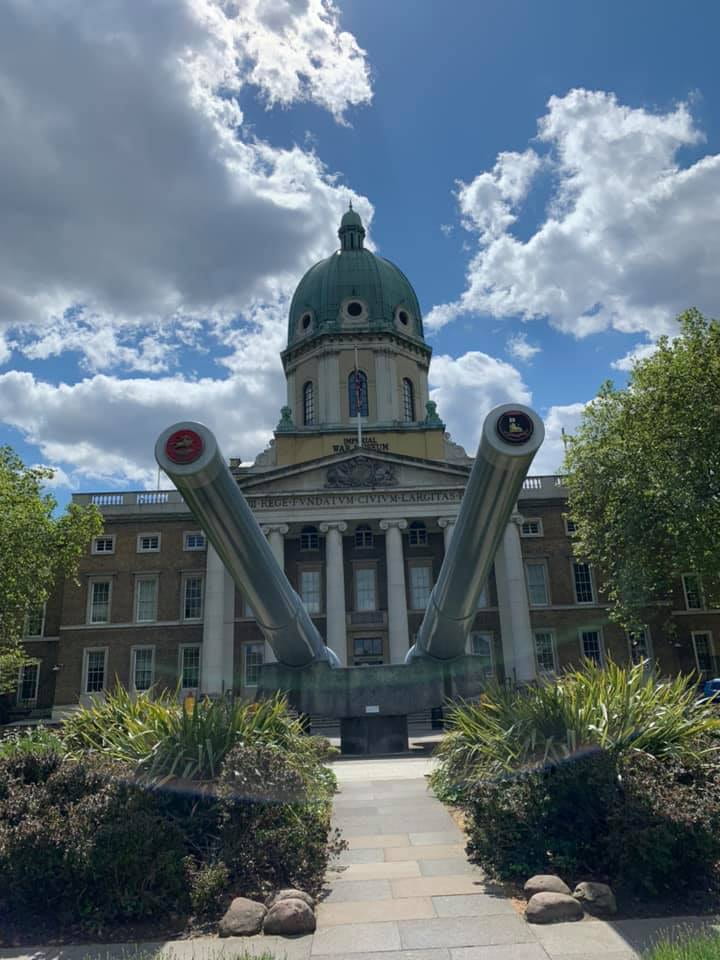
The front of the Imperial War Museum

From Devastation to Unity: The People’s War in England

     Throughout history, we generally regard the Second World War as being the British “People’s War”. For Britain, this war was a ‘total war’, meaning that every part of British society was somehow involved in the war. Whether it was the military conscription, air raids, the war economy, or something else that affected daily life in Britain, no British citizen remained untouched by the war; every Brit was in a similar position. Because of this, there was a feeling of unity among the British people as they fought this war together to liberate themselves from the grips of war and to return to their normal ways of life. This is why it is remembered as being a “People’s War.”

    As we traveled throughout London, I noticed this experienced embodied within several sites that we visited. The main place I noticed this was within the Churchill Museum and Cabinet War Rooms. Winston Churchill was the Prime Minister of England at the time, but despite this, he viewed himself as being the same as the other British citizens, with the only difference being that he would help lead them all to victory. I saw this evident in many of the exhibits in the museum where Churchill mentioned the Brits being a unity force against the enemy with a common purpose, such as on posters that stated “Let Us Go Forward Together.” However, I noticed this most significantly in the quote from Churchill which states, “We are all worms, but I do believe that I am a glow-worm.” This reinforces the idea that Churchill viewed himself as being the same as the other British citizens, and that he was just a leading force among them that worked towards unity and victory.


Winning With People

Thousands of allied decoders spent long days at Bletchley Park during World War II.  The job required considerable attention to detail and discipline.  In between twelve-hour shifts, workers had to sit under UV lamps; it was their only chance to encounter sunlight after working in smoky huts adorned with blackout curtains to protect them from axis bombs. In the park’s ornate mansion-turned museum, an exhibit featured recordings of the women who worked there. One woman noted that she wished she was married and having children, but she knew that her country needed her contributions. In the 1940s, the park was full of employees who put their lives on hold to contribute to the war effort. To me, Bletchley Park represents the “People’s War”:  British society mobilized on and off of the battle field, contributing to the war in masses. As our guide walked us past the mansion, through the gardens, and among the primitive huts where the decoders worked, this theme kept returning to my mind. Historians estimate that Ultra intelligence from Bletchley shorted the war by two to three years.

As we learned more about Bletchley, I asked myself—if my country became enmeshed in total war, would I give as much of my time and talent as the British did? The Leon family, British Aristocrats, realized the need for an intelligence epicenter. They rallied other wealthy families behind the cause and funded the property’s purchase. Aristocrats began intelligence operations at Bletchley, so it was natural that aristocratic women were the first to be hired there. Most of the park’s employees were women, and as demand for workers increased, searches were expanded to all reach all social classes. Women were recruited as they completed crossword puzzles in the newspaper and sent them to the government. After completing an interview, they agreed to work for the government without knowing any details about the work they would be doing. Instead, they waited for code words on the radio as their cue to report to their top-secret jobs. It’s estimated that Ultra intelligence, a product of Bletchley Park, shortened the war by two to four years, and the people who worked there made groundbreaking and war-shortening intelligence break throughs possible. Today, the park pays tribute to the allies’ secret weapon, an army of focused workers at Bletchley.

To learn more about Bletchley Park, checkout their website.

Social Divisions and Serial Killers

When I set off on a nighttime Jack the Ripper tour exploring the East side of London, I was expecting a lighthearted excursion (as much as a serial murder mystery tour could be) and an interesting way to explore a new part of the city with a tour guide. What I didn’t expect was to be educated on London’s history involving major class distinctions and the separation between East and West London.

Walking around the East side, I noticed numerous new, clean, and polished buildings that were architecturally magnificent. These newly developed buildings did not have the classical look I had become used to in West London. For example, the Lancaster Gate Hotel near Hyde park, where we were residing for our stay, was surrounded by illustrious white mansions. Although far from run down, one could tell that these buildings were not modern designs, unlike in the East.

Our tour guide told us that before World War II, Eastern London was overpopulated and impoverished. It was expected that buildings did not have electricity, plumbing, or clean air. Massive amounts of smog created by coal pollution made living there difficult and unhealthy. Lacking options for food some people had to rely on butchered cat meat to survive.

Meanwhile in the late nineteenth-century West, people were living under Queen Victoria’s eye, and resided in lavish buildings, had luxurious open spaces, and had access to expendable income. According to the tour guide, Queen Victoria did not care how the East was run because most people in the East were immigrants from places like Ireland, not true Englishmen. These men and women left their respective countries in hopes of starting anew in a place they thought was ripe with opportunity. Unfortunately, for most that was not the reality of their situation. Women had to rely on casual prostitution to even afford a place to sit for the night. Regardless of the debatable explanation of London’s past, the massive division between the rich and poor was undeniable.

Before I arrived in London, I learned that World War II damage to the poverty-stricken areas in the East gave the perfect excuse for government officials to tear down the unsightly buildings and start anew. Thus, while walking around in 2019 it is hard to imagine the area as anything other than beautiful and clean. A couple buildings from that time period remain in the area and completely stand out. Without those buildings it would be possible to completely wipe away London’s past of poverty and desperation.