Be sure to listen into the Saturday Farm Page on 88.9FM WLRY at 7 am and 7 pm on Saturday 4/20 to learn more the 4-H Vendors Craft Show in July. Vendors are needed! Listen in for all the details with 4-H advisor Cindy Gilfillen.
The Eagle Gazette

Grill Smart for Youth coming soon..!!! Teaching kids how to cook!!
For years by participating in MQP and carcass projects, Fairfield County youth have experienced raising livestock that produced quality product for the consumer. Unfortunately, some youth have seldom experienced how to properly season and grill the product they produce.

Understanding that few things can satisfy like the aroma, tenderness, juiciness, and deep rich flavor of a steak, loin chop or ground product grilled to perfection, on June 28 local youth can learn and experience how to correctly select, season, prepare and grill the perfect steak or ground product during Grill Smart for Youth.
Grill Smart is a program adapted by OSU Extension Beef Field Specialist Garth Ruff from the Barbecue Science class that is taught annually on campus at The Ohio State University. This program for local youth will take participants all the way from meat selection to safely serving a perfectly grilled masterpiece.
More specifically, during the 2 +/- hour Grill Smart for Youth class, participants learn to match the appropriate cooking methodology with a particular muscle or cut, gain an understanding of how or why different muscles are typically merchandised as steaks or roasts, and which cuts are best suited for preparation on the grill. Furthermore, those in attendance will learn about potential food safety issues when preparing meat and other food products.
Hosted in the Fairfield County Ag Center beginning at 11 a.m. on June 28, youth are invited to bring a steak or loin chop from home and learn how to safely season and prepare it on the grill. Participants will also season and grill ground beef that will be provided. The grill, seasoning and all other supplies will also be provided funded in part by the Fairfield County Cattlemen.
Youth should register today to participate in this opportunity to learn to select, prepare, grill and safely serve the perfect steak, chop or ground beef. Call the OSU Extension office (740-653-5419) for more information and to register.
POISON HEMLOCK Control Tip: Wait until Fall!
POISON HEMLOCK Control Tip: Wait until Fall!
It’s getting late to control poison hemlock this spring, especially once it’s this mature. However, now’s a good time to record its location and make plans in Oct/November to treat the new seedlings with 2,4-D ester.

TIME TO SCOUT FOR BAGWORMS
Bagworms are moth larvae (caterpillars) that develop within silk bags festooned with pieces of their host plants. They never leave their bags throughout their larval development. The caterpillars attach their bags to their plant hosts with a small stand of silk and extend their bodies a short distance out of the bag to feed.
Bagworm populations were on a rising trajectory from year to year in Ohio throughout the late 2010s peaking in 2020. However, the caterpillars were almost a no-show in 2021, 2022, and last year. Bagworms have a history of “now you see them, now you don’t,” but eventually “now you see defoliated brown shrubs!”
Did you know? Bagworms may feed on over 125 species of evergreen and deciduous woody plants in 45 plant families. The Entomological Society of America’s approved common name for the species is “Bagworm.” However, they are commonly called “evergreen bagworms” in the southern U.S. owing to the dominance of evergreens and thus the high likelihood of finding the caterpillars feeding on evergreen hosts.
In Ohio, it’s important to pay close attention to both deciduous trees and shrubs as well as evergreens. Overlooking deciduous woody plants during bagworm inspections allows infested plants to become reservoirs for infestations to spread to neighboring host plants, sometimes spreading from deciduous hosts to evergreens.
As the caterpillars mature, they begin weaving more and more host plant debris into the silk which provides structural stability as well as camouflage. This behavior makes bagworms one of the sneakiest general defoliators found in Ohio landscapes.
The overwintered eggs hatch within the female bags from last season. A percentage of the 1st instar caterpillars will produce a strand of silk to catch the wind and “balloon” the tiny caterpillars to new locations. This behavior is a key reason bagworms often appear on hosts far from trees and shrubs that were infested last season.
Although bagworm caterpillars may waft in on the wind to establish new bagworm beachheads, looking closely at trees and shrubs with last season’s
bags is a good way to detect this season’s crop of bagworms. A single female can produce 500 – 1000 eggs meaning that populations can climb rapidly.
Stopping bagworms from producing noticeable damage may include both passive and active approaches to management. The active approach is short-term while passive management is long-term.
The Active Approach
An active approach is to closely inspect susceptible trees and shrubs and apply properly timed insecticides. There’s a general rule with using insecticides that the bigger they are, the harder to kill. This is certainly true with bagworms. For example, early instar bagworms are highly susceptible to the naturally occurring biological insecticide Bacillus thuringiensis var. kurstaki (Btk) (e.g., Dipel, Thuricide, etc.). Caterpillars are much less susceptible once bags surpass 2/3″ in length. It’s appealing to use Btk products because they do not kill bio-allies such as predators and parasitoids that help provide natural control of bagworm populations.
The Passive Approach
A passive approach to bagworm management focuses on increasing the diversity of flowering plants in a landscape. It’s well documented that a wide range of enemies of insect pests are fueled by nectar. They are pollinators as well as predators or parasitoids. In other words, an effective long-term bagworm pest management strategy is to simply plant flowering plants that provide nectar.
Watering those Container Gardens
Containers are a great option if gardening space is limited, soil conditions are poor, or if you simply want more control over growing conditions. Growing food in adequately sized containers is easy and offers some advantages over growing in the ground. Many gardeners with plenty of garden space still grow certain things in containers. Gardening in containers allows the positioning of heat-loving crops, such as tomatoes and peppers, in full sun or where they will get reflected heat. Ornamental plants grouped in containers are an attractive addition to a deck, balcony or garden area.
Watering containers can be a little tricky. Overwatering and underwatering are the most common problems. Remember the water in a container is the only water the plants can get.
They cannot send their roots deeper to find water. Large plants drink a lot on warm summer days and they must be watered often. On the other hand, you don’t want to drown plants either. Water does not drain from a container as easily as it does in a garden. A good potting mix is essential for soil drainage.
The best guide to whether a container planting needs watering is to stick a finger 2 or 3 inches into the soil and see if it is moist. If it is dry, water. Check every day until you get a good sense of how often your plants need water. They may need watering every day during the warmest part of the summer. Water pots until the water starts to come out the bottom of the container. Then try the finger test again. Potting mixes can be difficult to rewet once they dry out. Often water will not penetrate these mixes and will just drain along the side of the container and out the bottom. If the soil is still dry an inch or two down even though water is draining out the bottom, try breaking up the top layer with your fingers or a trowel, poke some holes a few inches down, and then water again.
Garden Tip: BEST TIME TO WATER your Flowers and Vegetables!!
Focus on watering during morning hours or mid-day when leaves will dry off quickly, and if possible, avoid overhead irrigation. This helps reduce the potential for disease infections. Watering in the morning also reduces water loss from evaporation.

What can I do in my garden in early June?
In the Flower Garden
Remove yellowed foliage of spring-flowering bulbs
Pinch garden mums back for full, bushy plants and keep them from blooming too soon.
Apply mulches to woody plants and roses once the soil has warmed up and dried out a bit.
Remove spent rose blossoms and fertilize the plants
Remove (deadhead) spent blossoms from peonies and perennials.
In the Vegetable Garden
All vegetable crops should be in the ground by now.
Sow cabbage, brussels sprouts and cauliflower for fall garden transplants.
Sow more carrots and beets for continuous harvest.

Remove blossoms from newly established strawberry plants
Thin beets, carrots, and leafy vegetables.
Harvest mature asparagus beds for 6 to 8 weeks.
Protect ripening strawberries from birds.
Hill up or pull soil up against potato and sweet potato plants when they are 8 to 12 inches tall.
Thin apples, pears and peaches for larger fruit.
Side dress asparagus and rhubarb with aged manure or a 10-10-10 fertilizer.
Weed the garden regularly, before weeds go to seed. Shave off weeds in the garden using a sharp hoe.
In the Lawn
Mow the lawn regularly, removing no more than 1/3 the total leaf blade.
Suppress weeds in lawns by mowing at a height of 2 to 3 inches.
Don’t miss the 2024 Local Foods Programs..Mark your calendars NOW!
Join OSU Extension – Fairfield County as we learn about and visit local food producers in Fairfield County! Programs will begin in late June.
Thursday, June 27 | 10:30am-2:30pm | Grill Smart: Hands-on learning the science of grilling. $30 per person (limited to 16 participants) – Agriculture Center, 831 College Ave, Lancaster
Thursday, June 27 | 4:00-8:00pm | Grill Smart: Hands-on learning the science of grilling. $30 per person (limited to 16 participants) – Agriculture Center, 831 College Ave, Lancaster
Tuesday, July 9| 6:00-7:00pm | Mirabelle Farm and Vineyard, Free, 800 Winchester Southern Rd NW, Ashville
Friday, September 13| 10:00am-12:00pm | Don’s Prawns & More
Free, 7440 Coonpath Rd NE, Lancaster
To register, visit go.osu.edu/fclocal or call (740) 653-5419. For additional information view the Event Flyer. *Giveaways at each event, limited to the first 100 attendees. Attend three events and receive a free gift!
Thank you to our hosts: Mirabelle Farm & Vineyard and Don’s Prawns & More
WHAT’S EATING MY PLANTS???
Garden crops have a lot of enemies, but few are as non-selective and destructive as slugs. Unlike plant diseases and many insect pests, slugs are not host-specific and have a very diverse diet from asters to zinnias, with hostas being one of their favorites. As much as we hate them for the damage they do to our garden plants, we need to recognize slugs as an important part of the ecosystems because many species are decomposers and feed on fallen leaves, dead insects and dead worms. They are also food for snakes, toads, turtles and birds.
Slugs are easy to identify, but not always easy to find. They are basically snails without their protective shells. One of the most common slug species found in many Ohio gardens is the gray garden slug. They are typically less than an inch long and their plump, slimy bodies range in color from light gray to brownish black.
Most slug species overwinter as adults. In the spring or early summer, eggs are laid in moist areas near the soil surface, such as under dead leaves, rocks, mulch or flower pots. Baby slugs hatch when there is plenty of moisture present and begin feeding immediately. They resemble adults but are smaller and lighter gray in color.
Slugs are nocturnal and feed at night when we can’t see them. They prefer cool, dark, moist hiding places during the day. Cool, wet spring conditions are ideal for slugs, resulting in early, serious damage to plants. They destroy young seedlings and chew holes in hosta foliage, leaving them unattractive the entire season. Unfortunately, they don’t die in the middle of the summer when conditions get hot and dry. Slugs bury themselves in the soil or find a moist, well-protected spot where they remain in a state of suspended animation. They secrete a mucous-like cocoon around themselves and wait it out until there is enough rain or moisture to dissolve the mucous and soak the water into their bodies. They can loose as much as 50 percent of their weight during a dry spell and then regain it all after only two hours of rehydrating. Slug damage is often as serious in late summer as it is in the spring due to renewed soil moisture levels and higher populations.
Slugs secrete a slimy mucous trail as they move across plants and smooth objects. This prevents them from drying out and provides a protective track on which they glide across sharp surfaces. It can be seen as a silvery trail on leaves.
Several integrated pest management strategies can be used to control slugs.
One cultural control tactic is to reduce the favorable habitats where slugs live and reproduce. Since they require moist soil in which to lay their eggs and cool, moist, sheltered sites in order to hide during the day, open up the garden to allow more sun and air circulation so that the soil isn’t damp for extended periods of time. Keep mulch layers shallow; a uniform, one-inch layer will prevent rapid drying around the plants and will not retain excessive soil moisture. Since slugs also feed on decaying plant material, do not mulch with fresh grass clippings where slugs are a problem, and rake leaves from the garden beds in the fall.
Mechanical Control. Traps are a mechanical form of slug control. Trap boards or moist newspaper or carpet samples, about a square foot in size, can be placed around plants where slugs have been feeding. After a couple of days, check the underside of the traps and remove and destroy the slugs that have gathered there to hide. Inverted melon rinds set on the soil will also attract slugs but may make your garden look like a waste site or compost pile.
Slugs are also attracted to beer, so it is often used to trap slugs. A beer trap consists of a shallow container, such as a yogurt cup, buried to within a half inch of the rim and filled with beer. Slugs will find it irresistible, crawl in and drown. You may want to put a loose cover over the beer trap to shade it and prevent rain from diluting it.
Let’s look at chemical control measures . Since slugs are not insects, they are not controlled with insecticides, but rather with molluscicides applied as bait. Apply slug baits in the spring or fall when slugs are active. It is a good idea to irrigate before applying a bait to promote slug activity and apply it in the late afternoon or evening. Many baits contain metaldehyde. Although it is effective, it has its faults. It is rapidly inactivated by sunlight and water so has to be reapplied frequently. It cannot be used in vegetable gardens and can be toxic to pets that ingest it. Alternative baits are available that contain iron phosphate (ferric phosphate) as the active ingredient. Trade names include Sluggo and Escar-Go! Schultz Slug and Snail Bait and others. Although some experts consider iron phosphate baits to be slightly less effective than baits containing metaldehyde, they do have several advantages. They can be used more effectively under high moisture conditions because iron phosphate doesn’t readily dissolve in water, they can be used around edible crops and they do not pose a threat to pets, birds and other non-target species.
Source: Iowa State University Extension
AVOID THOSE MULCH VOLCANOS!!!
When done right, organic mulch, particularly hardwood bark mulch, will provide a wide range of benefits to trees and other woody ornamentals. The mulch serves as a stand-in for leaf litter found beneath trees in forests. Arguably, organic mulch may be the single most important component in healthy, sustainable Ohio landscape ecosystems.
Mulch moderates soil temperatures; preserves soil moisture; and suppresses weeds. Of course, mulch also enhances landscape aesthetics. As the mulch decays, it contributes to the organic content of the underlying soil which in turn supports soil biota and ultimately improves soil structure. Soil organisms exude sticky compounds that “glue” soil particles together creating soil aggregates (peds). Macropores in the aggregated soil bolster drainage and improve oxygen infiltration.
In contrast, bare soil beneath trees and shrubs allows soil temperatures to fluctuate widely. Water easily evaporates from the surface producing a boom-and-bust condition with soil moisture. Cracks in clay soils exacerbate the problem. Of course, bare soil also provides an open range for opportunistic weeds. 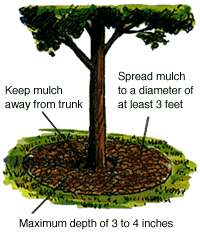
The proper application of organic mulch such as hardwood bark mulch starts with producing mulch rings as large as is practical. The mulch should be applied to a depth of no more than 2 – 3 inches. Mulch that finds its way onto the tree trunks should be pulled away from the trunk flare.
Mulch piled high on the main stems of trees has been called many names; some unsuitable for BYGL Alerts. The descriptive names for this horticultural horror include pyramid mulch, mountain mulch, and mulch mounds.
Mulch volcanoes produce a range of detrimental effects that wreak havoc on tree health from vascular strangulation to moisture starvation. Add in other stress-inducing issues and tree health can slip over the edge to slide towards tree removal and replacement.
The best advice we can share is to be aware of the depth of you incorporate in your landscape beds. Maybe you can simply fluff the mulch you have and lightly top dress existing mulch in your landscape beds. Also, remember with all of the all of the rainfall we have experienced it is best to simply allow the soils to dry before your begin your annual mulching chores!