All About Goats! 2025 Webinar

-Pressley Buurma, Ohio State University Extension in Seneca County, Agriculture and Natural Resources Educator

Are you interested in learning more about goat production? Join Ohio State University Extension Small Ruminant Team for the 2025 All About Goats! Webinar. This webinar series is going to answer producers burning questions concerning their own herd and help new producers become knowledgeable herdsman. Whether you raise goats for dairy, fiber or meat production or as pets- this webinar is for you! All youth livestock exhibitors are encouraged to attend.

The topics and dates for this series are as follows:

  • September 22- Goat Health and Care
  • October 6- Farm Business and Management
  • October 20- Goat Processing
  • November 3- Livestock Marketing
  • November 17- Hay and Grain Production
  • December 1- Coyote Management
  • December 15- Open Forum: Ask Me Anything

The webinar is hosted via Zoom from 7-8 p.m. EST. Registration is required and can be completed by visiting go.osu.edu/allaboutgoats25

If you have any questions, please contact Pressley at 419-447-9722 or buurma.20@osu.edu

Hay Quality 2025 . . . Been there, done that!

– Stan Smith, PA, Fairfield County OSU Extension

A forage probe might be the most valuable tool you use this year!

Once again when discussing hay harvest, we find ourselves in the midst of a conversation about timeliness and resulting quality concerns. It’s beginning to sound like a broken record or at very least an annual event. About all I can say is what most any Midwest farmer might say . . . been there, done that . . .

Yet again, in what’s seemingly become this annual occurrence of delayed hay harvest, quality forage, especially dry hay is in short supply throughout Ohio. This time it results largely from drought last summer, followed by wet, poor hay making spring weather of 2025. Combine that with spring pastures that matured quickly and became trampled due to wet grazing conditions and now, in mid-2025, we find the inventory of quality hay in much of Ohio remains critically low.

Unfortunately, it seems this may have become the norm for Ohio. With the National Ag Statistics Service (NASS) estimating Ohio hay making progress was less than half of normal at the end of May, after a similar lack of favorable hay harvest conditions continued throughout June, it’s apparent that Ohio cattlemen will again be faced with finding ways to make “feed” from hay that was harvested way past it’s prime.

As an example of the hay quality we’re seeing, a summary of six recent forage analysis’ from mixed grass hay made in June from throughout Ohio shows TDN of only 52% and an average Relative Feed Value of less than 90 on a dry matter basis.

I could tell you that’s not good, but perhaps a better way is to compare it to wheat straw. When you look up the “book values” for the feed nutrient content of straw you find that for the most part, this late made hay is little better than typical wheat straw. With so much first cutting Ohio hay being made in late June and beyond again this year, it leads me back to the same thought . . . been there, done that.

Feed of the quality referenced in the example above and being fed as long stem hay, even when offered in unlimited amounts, simply won’t satisfy the daily nutritional requirements of a cow most any time during the year. This include during her time of least nutritional need which is when she’s dry during mid-gestation. Without amendment, feeding this quality of forage for very long eventually results in cows with lesser body condition, delayed return to estrus, lower conception rates, lighter calf weaning weights, lower quality colostrum, and perhaps even weak calves at birth.

Processing or chopping mature, long stem, grass hay can increase the rate of forage digestion 30%

Considering that a forage supply and quality problem remains across Ohio, it’s not realistic to expect we can replace all the poor-quality hay being made this year with purchased hay or a properly made second or third cutting. While growing additional forages on Prevented Planting corn and soybean acres for harvest this fall may relieve some of the pressure, it’s apparent it’ll be necessary to find ways to most effectively utilize the lesser quality first cutting hay we presently have. Fortunately, there are options available to accomplish just that, and time to create and implement strategies that allow it without cow health suffering.

OSU Extension recently initiated a forage testing program that runs until at least the end of July. Find details at https://go.osu.edu/testyourhay. Take advantage of this opportunity, or at a minimum have your forages tested somewhere. A hay probe might be the most valuable tool you use this summer!

Once the quality of existing forages has been assessed, as the alternatives are considered for making feed from late made, poorly digestible forages, and stretching the supply of any high-quality forages that might be in inventory, consider this brief checklist:

  • We can’t say it enough, sample, test and inventory each lot of hay that’s made. Similar qualities of hay should be stored together in order that they can be found and fed at the most opportune times during the hay feeding season.
  • Can bunk feeding cows during the winter months be made an option? This allows for limited supplementation of extra energy and/or protein in the correct amounts at the correct times.
  • Could processing poor quality long stem hay into smaller particle size be made an option? Reducing the large particle size of mature long stem grass hay to two to 6 inches in length can increase the rate of forage digestion enough that it allows cows to consume 25-30% more forage daily.
  • Optimize the quantity and quality of subsequent hay cuttings this year by fertilizing now. At a minimum, applying 35 to 50 units of additional nitrogen will benefit future cuttings this year.

As the summer progresses continue to monitor forage quality and explore options for properly supplementing the hay we have in inventory. In the meantime, give serious consideration to how best you can grow additional feed yet this year, and get your forages tested for quality and plan to strategically supplement or process them into feed that’s more digestible.

The reality is the inventory of quality forages across Ohio is very short. Today we still have options and as we all know, we’ve been here and done this before. Even if you don’t believe it may now be the norm, do believe that we’ll be here again in the future. Perhaps it’s about time we just plan over the long haul for it!

If you are interested in forage testing, please contact Pressley at 419-447-9722.

Total Mixed Ration Feed Mixing Workshop

Dr. Kirby Krogstad, John Yost, and Jason Hartschuh are putting together a workshop in August on feeding dairy cattle, but it could also apply to producers who feed beef cattle using a TMR mixer. The workshop focus is on Basic nutrition, Forage safety, management, and value. TMR mixer operations, the importance of auditing your feeding program, and forages regularly. Along with protocol development, to keep your feed consistent. Sign up using the QR code or by visiting go.osu.edu/bdnfeederschool2025 

North American Manure Expo

The North American Manure Expo coming on July 30th and 31st in Wauseon, Ohio

The North American Manure Expo is coming to Wauseon Ohio on July 30th and 31st at the Fulton County Fairgrounds. This event was will showcase research, innovation and solutions found within manure management. The event brings manure haulers, applicators, brokers, nutrient management specialists, researchers, producers, manufacturers, custom operators and extension personnel together for two days of learning, networking and evaluation of new technology, research, equipment and opportunities. Over the two days we have tours, an industry trade show, live solid and liquid manure demonstrations and educational sessions.

The first morning of the Expo is dedicated to tours that showcase innovative manure solutions. Attendees can purchase tickets on-line or there may be room for walkups to one of the four tours:

Tour #1: Andre Farms & Stuckey Farms – visit one of Ohio’s largest Class II EPA composting facilities followed by a beef and grain operation that will showcase how they have gotten more out of compost through a variety of projects.

Tour #2: Bridgewater Dairy – see how this farm is leading the way in manure management and renewable energy. Tour guests will see their new methane digester, manure irrigation system and a manure pipeline, followed by hearing about their long-term approach to sustainability.

Tour #3: Precision manure irrigation – See the Rain360 irrigation system in action. Farmers and experts will cover the system’s real-world performance, economic benefits and environmental advantages.

Tour #4: Seiler Farms – This tour will showcase innovative water management practices including a two-stage ditch, a proven method for improving drainage, reducing nutrient runoff and enhancing water quality. See how they protect water resources while maintaining crop production.

Day one also includes manure pond agitation demonstrations with boats and sticks at a nearby dairy farm, manure separation demos, rapid manure transfer from tankers to frac tanks demonstrations, confined space safety training and the always popular pressurized hose release safety demonstration.

Day two of the Expo kicks off with 16 educational sessions in the morning. These are followed by both solid and liquid manure tanker and drag hose application demonstrations and a manure spill containment and stream water restoration demonstration.

Exhibitors will have booths in the trade show both days featuring new and manure innovative technology so you can visit and learn from these equipment makers. Puck will once again have their always-well-attended pump school.

Attendees can register online or just show up. For the full schedule, information on the educational sessions, registration information and to purchase tour tickets, visit ManureExpo.com.

Managing Heat Stress in Cattle: Tips for Summer Success

– Dr. Katie VanValin, Assistant Extension Professor, University of Kentucky

Not the first choice to minimize heat stress.

Temperatures and humidity are on the rise, and this combination makes cattle more susceptible to complications from heat stress. Cattle have a thermoneutral zone which is a range of temperatures and humidity where they do not need to expend extra energy to maintain their body temperature. When environmental conditions are outside of this zone than cattle are susceptible to cold or heat stress. Heat stressed cattle will exhibit increased respiration and panting to try and stay cool. Heat stress results in decreased feed intake, milk production, and average daily gains. Some cattle are more susceptible to heat stress than others, and it is important to understand that heat stress compounds other conditions such as fescue toxicosis, or respiratory disease intensifying complications from these conditions. While we have little control over weather patterns, there are several steps that can be taken to minimize the negative impacts of heat stress on the herd.

Provide adequate shade
Shade is critically important for combatting heat stress in beef cattle. In grazing animals, care should be taken to ensure cattle have access to natural shade from trees or artificial shade from shade structures. For cattle in confinement or dry lots, artificial shade sources might be a better long-term solution due to the impacts that cattle can have on tree health when provided continual access for longer periods of time. Shade structures can be portable or permanent, and both options can be effective at providing shade. Depending on the goals and needs of the operation, one option might be more practical than another. There are also plans available online for DIY construction of shade structures, as well as commercially available structures that can be purchased. Consider stability of the structure, as these structures will be susceptible to the elements, and some structures may fare better than others. A common mistake that is made with shade is not providing enough shade per animal. Beef cows need around 30-40 square feet of shade per head, with calves requiring 15-20 square feet. When looking at shade within a grazing system, proper planning can ensure that cattle have access to paddocks with ample shade during the hot and humid summer months. While it takes time to develop natural shade through tree plantings, this can be a worthwhile long-term investment to improve the utilization of the grazing system. As the saying goes, “The best time to plant a tree was 20 years ago, the second-best time is now.” For assistance with selecting tree species for pastures, reach out to your local county extension office.

Ensure clean and accessible drinking water
Cattle also need access to clean drinking water. Water intake is increased in larger cows, and in lactating cows compared to dry cows; water intake is also increased when temperatures are higher. Water requirements can reach upwards of 30 gallons per head per day for lactating cows under heat stress but may range from 15-30 gallons. Research shows that cattle drink less when water is dirty, so ensure cattle have access to clean drinking water at all times. This includes cleaning waterers and troughs regularly. Steps should be taken to prevent cattle from entering ponds, as wading and defecating in the water can increase dissolved solids and decrease consumption. It is important to monitor all water sources regularly to ensure cattle always have access, including natural water sources like ponds and streams, as dehydration can cause death quickly.

Consider forage type and fescue toxicosis
Forage type can also impact heat stress in beef cattle, especially in the fescue belt. Cattle grazing toxic endophyte-infected tall fescue, such as KY-31, and experiencing fescue toxicosis suffer from vasoconstriction, or constriction of the blood vessels, which makes it harder to dissipate heat and puts them at greater risk of heat-related complications and performance losses. One strategy to address this issue is pasture renovation—specifically, converting toxic endophyte-infected tall fescue to novel endophyte tall fescue. Novel endophyte varieties do not produce the toxic compounds found in traditional varieties but still contain the endophyte that provides persistence and stress tolerance to the plant. Pasture renovation can be costly, and not all fields are well suited for complete renovation. However, if renovation is being considered, a novel endophyte variety of tall fescue should be a top choice.

It’s important to note that the impacts of ergot alkaloids – the toxic compounds in infected fescue – can linger in cattle for weeks to months after removal from the pasture. For this reason, grazing cattle on novel endophyte tall fescue in the spring can be especially advantageous.

Interseeding legumes, such as clover, provides producers with another tool for mitigating fescue toxicosis. This has long been recommended as a tool for managing fescue toxicosis, but newer research highlights an added benefit beyond diluting consumption of toxic tall fescue. Compounds called isoflavones, especially those found in certain red clover varieties, may help alleviate the vasoconstriction caused by toxic fescue.

Producers can also consider incorporating warm-season or summer annuals into a portion of the operation. These forages can be grazed during the hottest months, allowing cool-season pastures time to rest. Take time to plan how these alternative forages can be strategically integrated into your grazing system.

Provide mineral supplementation
Mineral supplementation is important, but especially during heat stress. As cattle consume more water, urination increases, and along with that comes a loss of minerals. Cattle will crave salt, which should be provided in the form of a complete free-choice mineral supplement to cattle on pasture or can also be mixed directly into the feed for cattle in confinement. Avoid using a plane salt block to meet cattle’s desire to consume salt, because they are also losing other critical minerals such as potassium or magnesium which will not be replaced through consumption of a salt block alone. Keep a close eye on mineral feeders and ensure adequate consumption. A 50-lb bag of mineral formulated for 4 ounces per head per day should last 40 cows about 5 days, but it is important to remember that calves will also be visiting the feeder, so mineral may run out more quickly.

Adjust feeding schedule
Adjusting the feeding schedule can provide some relief for heat stressed cattle. Heat is produced as a byproduct of ruminal fermentation as cattle digest their feed. This heat production peaks about 4-6 hours after eating, so if cattle are consuming a large meal in the morning, the peak heat production would occur during the hottest part of the day. Feeding a larger portion of the daily feed in the late afternoon and evening will result in peak heat production occurring during the cooler overnight hours. Cattle are creatures of habit, so take time to slowly shift feeding towards the afternoon when hot temperatures are predicted in the extended forecast.

Modify handling practices
If possible, avoid working or transporting cattle during extreme heat events. If necessary, get cattle up early in the day before temperatures rise. This will also help to ensure the health and safety of livestock handlers as well, as people will also be at risk of developing heat-related illnesses.

Final thoughts
Summer heat events are common in the mid- and southern United States, so taking steps to improve the resiliency of the operation to heat stress will be beneficial for many years to come. Some practices like tree planting and forage renovation may take time but can have long lasting benefits. If you have any questions about managing heat stress in cattle, please reach out to Pressley at buurma.20@osu.edu or 419-447-9722

The New World Screwworm: Texas is at Risk but what about Kentucky (and the Midwest)?

– Dr. Michelle Arnold, Rminant Extension Veterinarian, University of Kentucky

Figure 1: NWS larvae are pale with encircling black spines and sharp mouth hooks. Accessed from “Update on New World Screwworm 2025”; Gleeson Murphy; Parasitology, Chemistry, Analytical Services (PCAS), USDA, APHIS, Veterinary Services.

The New World screwworm (NWS, Cochliomyia hominivorax) is a blow fly that is native to the Western Hemisphere. Unlike most species of blow flies, adult female screwworms do not lay eggs on dead and decaying flesh. Instead, they lay eggs on living mammals at the borders of fresh wounds or at the edge of body orifices. The larvae (maggots) feed on the host’s living flesh, causing extensive damage by tearing at the host’s tissue with sharp mouth hooks (see Figure 1). The term “myiasis” is used to refer to the infestation of wounds by fly larvae/maggots. The wound will become larger and deeper as more eggs hatch and larvae feed on the living tissue, which may result in secondary infection and death if left untreated. New World screwworm is a pest that poses a dangerous and significant agricultural, economic, and public health threat to livestock, wildlife, pets, and people.

Figure 2: Accessed from https://www.aphis.usda.gov/sites/default/files/nwspest-card.pdf

Adult New World screwworms are metallic blue or green blow flies about the size of a common housefly or a bit larger with three distinct stripes that run down the top (thorax) of the fly just behind the head with large orange eyes (see Figure 2). The Old World screwworm fly, (OWS, Chrysomya bezziana), is found in Africa, the Indian subcontinent, and southeast Asia. OWS and NWS are designated “the primary screwworms.” Cochliomyia macellaria (the secondary screwworm) is also a metallic blue blow fly with three distinct stripes that lives in the Americas and Caribbean, but the adult secondary screwworms primarily lay eggs on dead and decaying flesh (carrion). Although the secondary screwworm does not pose a threat to animal health, the adult flies and maggots look very similar to NWS, making confirmation of NWS myiasis much more challenging.

As mentioned previously, adult female NWS flies lay eggs on living mammals at the borders of wounds or at the edge of body openings on the mucous membranes. Almost any wound is attractive to the female, whether the wound occurred naturally (for example, from fighting, predators, thorns, disease, tick or insect bites) or was man-made (from shearing, branding, castrating, dehorning, tail docking, and/or ear-tagging). The most commonly infested wounds are navels of newborn animals and the vulva and perineum of their dams, especially if there was any trauma when giving birth. Flies are also highly attracted to velvet shedding in deer. Eggs may also be deposited on mucous membranes that enable maggots to invade through natural body openings including the nostrils and associated sinuses, the eye orbits, mouth, ears, and genitalia. One female fly can lay 200-300 eggs at a time and on average will lay 4 batches in her 10–30-day lifespan. Screwworm eggs are creamy and white and are deposited in a shingle-like raft on or near the edges of superficial wounds or body openings. This distinct pattern helps distinguish them from the eggs of other species of flies, which are generally not organized.

The eggs hatch within 12–24 hours and the larvae immediately begin to feed, burrowing head downwards into the living tissue. Larvae can usually be observed within the wound by the third day and are oriented with their rear ends up toward the surface. There can be as many as 200 maggots packed in deeply from a single infestation. Existing infestations often attract additional NWS female flies to lay their eggs, resulting in deep and gaping wounds that may contain hundreds or thousands of larvae in various stages of development. Large pockets of screwworms can also exist despite only small openings in the skin, but movement can be seen under the skin beneath the wound. Mature larvae can reach 17 mm in length (2/3 of an inch) and have spines that protrude from the body and wrap around in a spiral fashion, giving them the appearance of a wood screw and thus the name “screwworm”. Also, the name screwworm refers to the feeding behavior exhibited by the maggots as they burrow (screw) themselves deep into the wound. After developing through three larval stages in 5-7 days, the larvae leave the wound and drop to the ground, where they burrow into the soil to pupate. If the host dies before the larvae are mature enough to leave the wound and pupate, their survival is curtailed as they require living tissue as a food source. The duration of the life cycle in the ground is temperature and humidity dependent and can last from 7 days to 2 months, but the pupae cannot survive sustained temperatures below 46° F. The entire life cycle may be completed in as little as 3 weeks depending on temperature, moisture, and soil type.

New World screwworm was eradicated from the US, Mexico and Central America by repeatedly releasing sterile male flies that mated with wild female screwworms to produce unfertilized eggs. This “sterile insect technique” (SIT) was effective because males mate with multiple females while the female mates only once. This led to a reduction in screwworm numbers and eventually complete elimination from the US in 1966. This approach, along with regular active surveillance and animal inspections to prevent entry of any animal infested with larvae, proved highly successful and pushed the fly population south of Panama to the Darién Gap (along the border between Columbia and Panama) in 2006. APHIS maintains the only NWS pupae sterilization facility in North America known as COPEG, which stands for “Panama-United States Commission for the Eradication and Prevention of Screwworm”. Located in Pacora, Panama but managed jointly by USDA and Panama, COPEG produces, sterilizes, and releases 20 million pupae per week for maintenance of the barrier with the capacity to increase to 100 million pupae per week during an outbreak.

Figure 3: Screwworm movement northward beginning in 2023. Accessed from “Update on New World Screwworm 2025”; Gleeson Murphy; Parasitology, Chemistry, Analytical Services (PCAS), USDA, APHIS, Veterinary Services

The Darien Gap quarantine line held with only occasional cases in areas west of the Panama Canal until 2023, when the New World screwworm became reestablished north of the Panama Canal (Figure 3). There have been over 6,500 cases in 2024, and on 11/22/2024, Mexico notified APHIS of a positive detection. On February 26, 2025, APHIS announced it was shifting sterile fly dispersal to the northern most point in Mexico of the current outbreak. As of May 2025, the fly had moved as far north as Veracruz, Mexico. On May 11, 2025, U.S. Secretary of Agriculture Brooke Rollins suspended live cattle, horse, and bison imports from Mexico through U.S. ports of entry along the southern border since the most probable pathway for NWS to enter the country is through infested individuals or animals arriving at border crossings or interior ports of entry. APHIS is investing $109.8 million to keep the pest from spreading into North America with the goal of eradicating NWS in Central America and Mexico and re-establishing the biological barrier in the Darien Gap. The last time NWS was in the US was the Florida Keys outbreak in 2016-2017: 5 dogs, 2 pet pigs, 2 cats, 1 raccoon, and 135 Key Deer were affected (15% of the Key Deer population died) during the outbreak and it cost $3.2 million to finally eradicate the fly. Texas is at high risk for NWS because of its border with Mexico but what about Kentucky? Every state is at risk due to international travel of people, pets, and livestock. If you suspect NWS (see Box 1 below), immediately report any suspicious wounds, maggots, or infestations to a local accredited veterinarian, your State Animal Health Official, or a USDA veterinarian. Definitive field identification of screwworm adults and larvae can be difficult, even with a microscope, and can only be confirmed by submitting specimens for expert diagnosis. A USDA accredited veterinarian or state/federal authority will take the necessary samples and send them to NVSL for identification. The affected animal will be held in quarantine until official parasite identification is obtained and, if confirmed, treatment is administered until no larvae remain in the wound. Treatment is generally by application of organophosphate insecticides into infested wounds, both to kill larvae and to provide residual protection against reinfestation. A list of effective pesticides is available at https://www.aphis.usda.gov/sites/default/files/pesticides-for-nws.pdf. Preventive measures include the spraying or dipping of susceptible livestock with organophosphate compounds and, more recently, use of avermectins (ivermectin, doramectin) as subcutaneous injections to animals ‘at risk’. For more information, APHIS maintains a dedicated website at: https://www.aphis.usda.gov/livestock-poultry-disease/cattle/ticks/screwworm

Bovine Emergency Response Plan (BERP) Training

– Haley Shoemaker, OSU Extension AGNR Educator, Columbiana and Mahoning Counties

Become prepared to respond to a livestock accident scene.

With an estimated several hundred thousand head of cattle transported on roadways each day throughout the U.S., first responders are often tasked with responding to scenes involving loose or injured livestock.  To better prepare emergency response personnel to safely approach and work a livestock transportation incident, the Bovine Emergency Response Plan (BERP) training curriculum was developed.

This training, geared toward Fire, EMS, EMA, and law enforcement personnel, covers classroom sessions on scene assessment and triage, transportation hazards, mortality handling, and biosecurity while offering hands-on demonstrations and learning opportunities surrounding animal handling and trailer mechanics.

BERP training encourages participants to interact as a team, allowing for real-time discussion and learning in a controlled environment.  Following the class, each department represented also receives a manual and training notes to create their own unique response plan and build internal capacity.

To schedule a training, reach out to Pressley at buurma.20@osu.edu or 419-447-9722

Downy and Powdery Mildew

With the current weather patterns it is time to start scouting! Although downy and powdery mildew have not been discovered in Ohio yet, it is never too early to start scouting.

If you suspect Downy or Powdery Mildew, you can contact the extension office at 419-447-9722 or email Pressley at buurma.20@osu.edu to learn how to send samples to our Wooster lab for diagnosis.

Both Powdery Mildew and Downy Mildew can effect a wide host of specialty crops and ornamentals. Only a few of those crop species will be explained in this post however, if you want a complete list feel free to contact the extension office.

Downy Mildew

Downy Mildew is a fungal-like pathogen that varies depending on the species it is infecting. It typically spreads through airborne spores in water, on tools or people or through the wind. Downy Mildew thrives in cool moist environments specifically when the leaves are kept very moist. Downy mildew can spread rapidly within fields or greenhouses and can cause high yield loss.

Cucurbit Downy Mildew: is a foliar disease that can affect all varieties of cucurbits. Pay special attend to Cucumbers, Melon, Squash, Pumpkins and Watermelon as these are the host plants. Downy Mildew can cause defoliation, reduced plant health and decreased yields and has a potential to cause rotting.

Cuc DM-5compressed 50 QUALITYCucumber DM-6 50 QUALITY

Pictures of leaf spots caused by downy mildew. Pictures from OSU Vegetable Disease Facts

Brassica Downy Mildew: can affect the crucifer family, specifically in the cultivated plants and weeds. The specific host plants are Cabbage, Brussel Sprouts, Broccoli, Cauliflower, Radish, Turnip, Mustard, Collards and Kale. Including serious losses in the field, these crops will see significant loss after harvest and poor quality during packaging and shipping.

Pictures of downy mildew on mustard leaf (left) and radish leaf (right). Pictures from OSU Vegetable Disease Facts

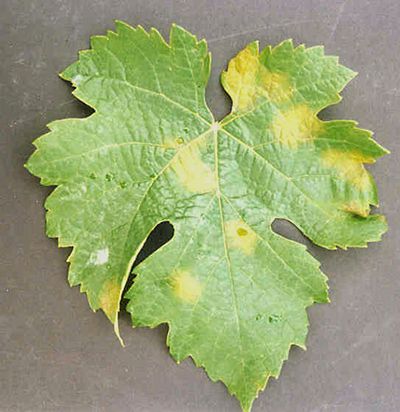
Grapes: can also be affected by Downy Mildew specifically the Vinifera vitis cultivars. Leaf symptoms will vary depending on leaf age, stage of infection and time of growing season. Signs can be seen on leaves, shoots and berries (all pictured below). Downy mildew can overwinter in dropped, infected leaves. For more information on Downy Mildew in Grapes, please visit https://ohiograpeweb.cfaes.ohio-state.edu/ipm/diseases/downy-mildew 

Pictures of leaves (left), shoots (center), and berries (right). Pictures from Buckeye Appellation

Powdery Mildew

Powdery Mildew is a fungal-like pathogen that is spread similar to downy mildew. One major difference however is that powdery mildew does not need water to germinate and spread. Powdery mildew is most often seen as a white powdery or cotton like patch on the leaves or stems although this will differ with the pathogen.

High Tunnels and Greenhouses: are adequate environments for powdery mildew to thrive. Removal of infected plants and effective sanitation are good management options. Tomatoes, Peppers and Eggplants are common host crops for powdery mildew.

GH Powdery mildew 3-2 50QUALITY

Pictures of powdery mildew in a high tunnel or greenhouse setting. Pictures from OSU Vegetable Disease Facts

Grapes: can also be affected by Powdery Mildew. Unlike downy mildew, they don’t need water to help spread or germinate. Optimal temperatures are often seen between 68-77 degrees F. Powdery Mildew can be seen on leaves, shoots and berries. For more information visit https://ohiograpeweb.cfaes.ohio-state.edu/ipm/diseases/powdery-mildew

Pictures of leaves (left), shoots (center), and berries (right). Pictures from Buckeye Appellation

Cucurbit: powdery mildew is often seen in early July and will not overwinter in Ohio. It is spread through the wind as spores are blown from fields to other areas. The optimal conditions are high temperature with high humidity.

Photo by Josh Amrhein from the Fruit, Vegetable, & Specialty Crop News

Resources:

Just-in-Time Ag Surveys

A research team from OSU (Extension, ATI, and AEDE) is conducting a survey on the role just-in-time or “gig” workers could play in the agricultural labor force across Ohio. If you operate a farm in Ohio, please consider filling out this survey.

If you are not a farm operator, but would still like to contribute, there is a separate survey for potential just-in-time agricultural employeesfound here.  

Regardless of which survey you complete, your responses will contribute valuable insights into this ongoing issue in the state’s farm economy. Both surveys are confidential and should take no more than 10-15 minutes.