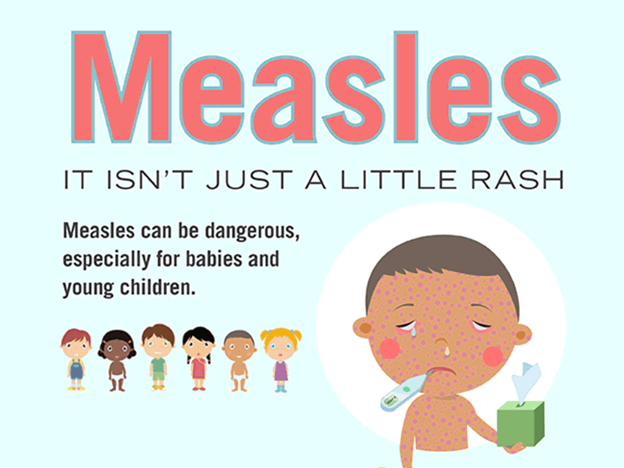
A runny nose and dry cough may appeared to be another annoying common cold to most parents. However, a blotchy red rash across the top of their children’s back may cause them to suspect otherwise. Unfortunately, the most alarming fact is that their child may have the measles, an infection that incubates in its host for 10-14 days (“Mayo Clinic”, 2018). After about 14 days the symptoms include fever, dry cough, runny nose, sore throat, a large skin rash with a red background (“Mayo Clinic”, 2018). Luckily, most children have been vaccinated for the measles, mumps, and rubella (MMR) twice between the ages of 9-15 months and then age 1-6 years old (“Center for Disease Control and Prevention [CDC]”, 2018). A child who has received the first shot has a 93% chance of not getting the infection and those who have both shots have a 97% chance (CDC, 2018). Nonetheless, the measles hasn’t been a health concern in the United States of America since the year of 2000. However, according to journalist Susan Scutti “A total of 387 individual cases of measles have been confirmed in 15 states from January 1 to March 28, according to the US Centers for Disease Control and Prevention” (2019).
One may be wondering how a disease that was eliminated nine years ago could’ve came back and spread like a wildfire. This specific measle outbreak was brought back into the United States by travelers from the Middle Eastern countries (Scutti, 2019). However, the highly contagious infection which spreads via coughing or sneezing, around unvaccinated children this is a serious issue. There are many reasons why parents don’t vaccinate their child such as fear of autism, religious reasons, and being un- or underinsured. Nonetheless, their children being unvaccinated and acquiring this infection causes the risk factors for their children, children who are not old enough, or who are also not vaccinated to increase (Scutti, 2019).
This led to the county of Rockland, NY to officiated a ban against all unvaccinated children in public places (Bever, 2019). These public places included churches, schools, and shopping centers but excluded playgrounds and other outside places (Bever, 2019). Bever states that there wasn’t any searching for unvaccinated children but if it was discovered that the children in any of these public places were unvaccinated then the parents were to be held accountable and fined $500.00 or sentenced to up to six months in jail (2019). Nonetheless, this didn’t last long due to Judge Rolf Thorsen halting the ban and stating that “Children are hereby permitted to return to their respective schools forthwith and otherwise to assemble in public places” (Bever, 2019). This decision was made due to many affluent parents beginning to sue Rockland county due to feeling like the county has gone beyond their legal duties and are denying the children’s right to congregate and assemble in public places (Bever, 2019).
In conclusion, even though the measles was eliminated in the year of 2000 and has been back into the country spreading like a wildfire this year due to many children being unvaccinated. Banning the children from public places such as schools and churches is unjust. Parents should vaccinate their children for their child’s protection. However, for those who do not for religious reasons should seriously consider the risk factors for their children and their social responsibility to the children that their children interact with in theses public places. Even though not vaccinating children is a huge issue, banning innocent children because of their parents choices is unreasonable.
Sources:
https://www.cnn.com/2019/04/19/health/new-york-measles-outbreak-passover-williamsburg/index.html
https://www.cdc.gov/measles/vaccination.html
https://www.cnn.com/2019/04/01/health/measles-total-cases-us-cdc/index.html
https://news.wjct.org/post/pinellas-measles-cases-jump-seven