Posts

Resources

https://www.worlddiamondcouncil.org/download/resources/documents/Fact%20Sheet%20(The%20Diamond%20Industry).pdf://www.heartsonfire.com/the-diamond-cutting-process.aspx#qG4ILKv2QqKEBISo.97

Diamond Guide: The Diamond Cutting Process | Hearts On Fire
Hearts On Fire crafts its diamonds like no other diamond brand in the world. Learn about the unique the diamond cutting process.
Blood Diamonds | Environmental Impact – Brilliant Earth
Environment. Due to inadequate planning and regulation, diamond mining has wreaked environmental havoc throughout Africa and other parts of the world.

http://money.howstuffworks.com/african-diamond-trade2.htm

Blood Diamonds in Africa – HowStuffWorks
Blood diamonds in Africa are the target of human rights groups, who want to end the illegal trade. Learn more about blood diamonds in Africa.

http://www.brilliantearth.com/blood-diamond-environmental-impact/

Blood Diamonds | Environmental Impact – Brilliant Earth
Environment. Due to inadequate planning and regulation, diamond mining has wreaked environmental havoc throughout Africa and other parts of the world.

Step 6:Retailing/Blood

The final step to the diamond pipeline is the process of the diamond jewelry being sold to the retailers from the consumer. The value of diamond jewelry sold each year is approximately US$72 billion. This amount includes the cost of the diamonds, metals and other gems.


360_congo_conflict_0720

“Experts claim that the illegal sale of blood diamonds has produced billions of dollars to fund civil wars and other conflicts in various African nations, including Sierra Leone, Angola, Liberia, Ivory Coast and the Democratic Republic of Congo. For example, in Sierra Leone a group known as the Revolutionary United Front killed, threatened, and even cut off the arms of people living and working in diamond villages until they were able to take control of the mines in the area.” The groups then move on to the next village then the next village to get what they want which are slaves digging up diamonds to make them as much money as they can. avoid buying blood diamonds because they do not want to seem like they are supporting how they are retrieving their diamonds. Although retailers and consumers try there hardest to avoid buying the blood diamonds, they are still rapidly smuggled and sold illegally.


ak-blood-diamond-28

Step 5: Jewelry Manufacturing

Manufacturers normally buy unset, polished diamonds in small amounts. After the manufacturers are done making sure the diamonds are pure they are then sold to jewelry designers, and retailers. Diamond jewelry can be produced by manufacturers but designed and commissioned by a diamond designer or retailer. Another process that is commonly used is the manufacturers design the jewelry themselves by in-house teams, then the diamonds are sold to retailers. Both manufacturing procedures are used often. To ensure retailers that the diamonds they received are from non conflicting, free sources there is somewhat of a declaration that is signed called the system of warranties . The system of warranties was put in place by the World Diamond Council, and is a very important part to the transportation of diamonds. The diamonds also go through something known as the Kimberly Process. This process is also done to ensure the purity and legitimacy of the diamonds.

Step 4: Cutting and Polishing

download (1)After the diamonds are sorted by their value, size and color they then have to through the cutting and polishing process. This is so that the diamond doesnt look like the rock that came straight from the Earths dirt, all rough and jagged edged no more than a shiny rock. People want tp be presented with something beautiful and worth buying, and thats why rough diamonds are cut, to look more like a gem rather than a rock.

imagesHowever, not just anyone can cut a diamond. Because it is an extremely difficult task, diamond cutting requires specialized knowledge, tools, equipment and techniques.  When the word “cut” is used, there are two elements that follow. The first element is the shape that the diamond is going to be cut into. A square, oval, round shaped triangle ect. “The second element is related to the specific quality of cut within the shape, and the quality and price will vary greatly based on the quality on how the diamond was cut.the diamond cutting process includes several steps: cleaving or sawing, bruting, polishing, and final inspection”.

  • Cleaving or Sawing-  This is the process of cutting the rough diamonds in separate pieces by saw or by laser.
  • Bruting-“the process whereby two diamonds are set onto spinning axles turning in opposite directions, which are then set to grind against each other to shape each diamond into a round shape. This can also be known as girdling”.
  • Polishing- This step is really self explanatory. This is where the facets are cut on to the diamond and this is what gives it its beautiful shine and sparkle.
  • Final Inspection-”the final stage of diamond cutting involves thoroughly cleaning the diamond in acids, and examining the diamond to see whether it meets the quality standards of the manufacturer.


https://www.worlddiamondcouncil.org/download/resources/documents/Fact%20Sheet%20(The%20Diamond%20Industry).pdf

Step 3: Sorting

sorting-and-valuation-2-8471019After mining, the rough diamonds are taken by a haul truck to sorting experts to be sorted. Diamonds can be sorted into many different categories. For example you can sort diamonds by color, shape, quality, and size. For the most part diamonds fall into the category of clear, tinted brown, or a yellowing tint when it comes to color. There are also very rare diamonds that are known as “fancies” which appear to be brighter colors, such as emerald, pink, or blue. Diamonds are considered more pure when it is colorless and there are no marks on them. But all diamonds have their own unique marks that are known as inclusions. Diamonds of greater quality are always sent to the gem market. The diamonds that are considered less valuable are used for purposes such as cutting and drilling.

Step 2: Mining

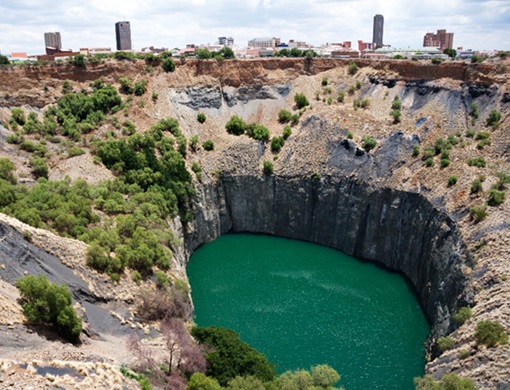
Diamond mining doesn’t just involve diggers with shovels. There is a process called diamond pipe mining that has to take place first in order to locate the diamonds. Pipe mining requires geologists to follow the trail of smaller diamonds to get to the source of the larger, harder crystals. After the pipe is found a shank is inserted into the soil directly at the ore bearing pipes. This is done to remove the soil covering the diamonds. The diamonds are not examined at the site of the mining in order to have better efficiency, instead they are examined and extracted from the ore at a different site.  There are 2 methods in diamond pipe mining which is open pit mining and underground mining.

  • Open pit mining is a process of surface mining. These rocks are extracted from open pits or borrow in the earth.
  • Unlike open pit mining, underground mining is done by digging into the earth

pipe mining

Diamonds are also extracted from alluvial deposits which is the building of walls and the diversion of rivers. Once spotted they are then removed from the sand, gravel, and clay that has been  naturally transported by water erosion and deposited along either the banks of a river, the shoreline or on the bed of a ocean. This whole process is called alluvial mining which has two methods  which are coastal mining and marine mining.

water mining

Diamond mining on a non-industrial scale is undertaken involving individuals, families and communities and using the most basic equipment, such as sieves and pans, this is known as artisanal mining.

Step 1: Find the source

Diamonds are made up of pure carbon and are naturally formed within rocks as minerals. They’re found in the upper mantel of the earth’s surface which goes as deep as 200 miles below the Earth’s surface. Being that deep in the Earth’s surface, the pressure is more than 50 thousand times the pressure that we’re used to. Transparency, luster, dispersion of light and color are the four main optical characteristics of diamonds. Diamonds are actually the hardest substance known to man. Also the only thing that can cut through a diamond is a diamond. Diamonds are known to come in 3 forms kimberlite, lanproite, and placer deposits. The activities that occur in volcanoes carry these diamonds to the Earth’s surface. A mixture of magma, minerals, rocks, and diamonds create these pipe shaped like cones as the mixture reaches the surface.  Diamonds are found all across the globe. Places that diamonds are found is

  • Africa
  • South Africa
  • Namibia
  • Botswana
  • the Democratic Republic of Congo
  • Angola
  • Tanzania
  • Sierra Leone
  • India
  • Russia
  • Siberia
  • South America
  • Brazil
  • Australia
  • Northern and Western Australia
  • China
  • United States

This is a picture of fresh out the dirt uncut diamonds

diamonds