Scien(tifi)c(e) Fiction: Footnotes and Anecdotes

Last week my students and I read three different scholars writing about Yury Tynianov, the formalist literary theorist, literary historian, and writer of historical anecdotes and biographical fiction.

It felt a bit odd, because one of those scholars was me.

I first explored Tynianov with my professor, Yury Konstantinovich Shcheglov, while I was still in graduate school. Prof. Shcheglov was fantastic — a wonderfully intelligent and deeply compassionate and thoughtful man whose knowledge of everything from eighteenth century Russian poetry to contemporary American fiction amazed and amused me in the years I knew him. (More about that last later.) His erudition was legendary, as was his absentmindedness. Once I met him in Van Hise Hall, the languages building at Wisconsin. “Angela,” he greeted me enthusiastically. “I’m so glad to see you! Do you know where the exit is?” We were on the fourth floor, a floor with glass doors opening out in several directions, including toward the parking lot where he kept his car while teaching. (No, he didn’t drive, but his wife did. Thank goodness on both counts.) I gently grasped his arm and turned him away from the elevators and toward the proper door.
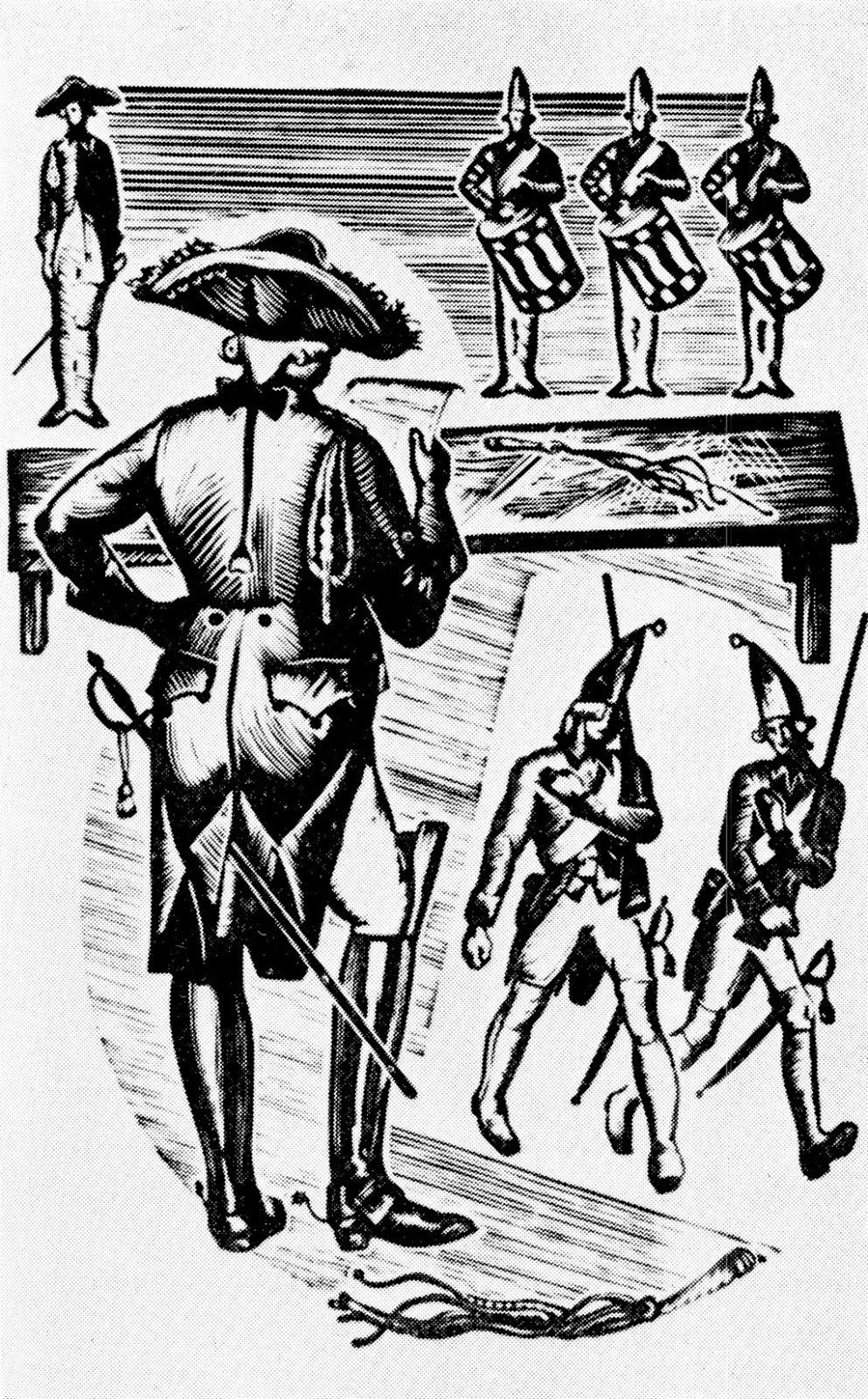
R.D. Yakhnin,
Illustration for Lieutenant Kizhe

One semester I did an independent study with Prof. Shcheglov, reading Tynianov’s three stories set in the reigns of Peter I, Paul I and Nicholas I, trying to isolate the characteristic that linked them. My conclusions?

Each story was “believable” not only because each was infused with a special paranoia unique to its respective tsar, but also because its language was inflected with vocabulary and verbal structures from the appropriate era. Tynianov was a chameleon, able to endow his narrators with just the right linguistic coloration.

My dissertation and first book emerged from that in-depth study of Tynianov, which meant that reading two chapters fromWriting a Usable Past with my students was for me a journey back to the years when I first wrote some of those sentences — over twenty years ago.

About the same time as me, another scholar was writing her dissertation at Columbia — Ludmilla Trigos, whose work on the Decembrist myth also brought her to study Tynianov. My book came out before her article on Kiukhlia, which in the scholarly world means she had to cite me rather than the other way around, though we probably had similar ideas simultaneously. (Avril Pyman, the third scholar, did not cite us.)

Prof. Pyman’s piece, in the Mapping Lives book we are using as a kind of “textbook,” detailed Tynianov’s theory and practice, and several of the students seemed frustrated that there was no real attempt to integrate the two. But both Milla and I, it seems to me, came up with our own ways to finesse this point, identifying the cutting back and forth from one consciousness and even location to another (Milla, in Kiukhlia, about Kiukhelbeker and Nicholas I during the Decembrist revolt) and a deliberately “have-your-cake-and-eat-it-too” explanation in The Death of the Vazir-Mukhtar (me) where Tynianov “footnotes” his sources for those who want to explore the contradictions and vacillations of his portrait of Griboedov.

In class we talked about archives and sources and readings: what was “true” and what needed to be documented. Tynianov famously stated: “where the document ends, that’s where I begin,” but he also tried to claim a status as a prophet, that sometimes he instinctually wrote something and only found the proof later. A complicated individual, but a talented one.
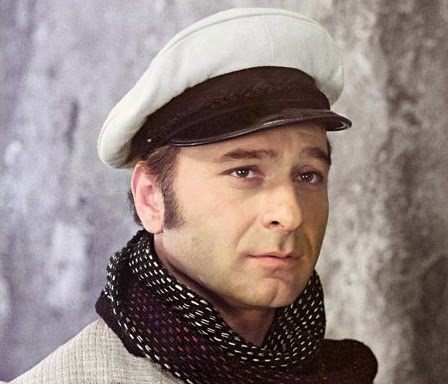
The protagonist of Twelve Chairs,
Ostap Bender, here in Gaidar’s classic film.

Speaking of which: Yury Konstantinovich. Some of his most brilliant published work was his commentaries to Ilf and Petrov’s novel Twelve Chairs. I tried to convince him to translate them into English for use as a teaching aid, but by then he had too many other projects he wanted to pursue.

He may have had a similar problem when I asked him to work with me back in 1992.

Faculty never get any “credit” for teaching independent studies; we do it out of our own intellectual interest and/or the goodness of our hearts. So when I asked Yury Konstantinovich to work on Tynianov with me, he proposed a bargain. “First, you will write a serious paper, 25-30 pages, by the end of the semester.” This was pretty scary for me at that stage, but I agreed. “And second, we will spend five-ten minutes at the end of every meeting talking about this paperback novel. I will mark pages for you to tell me: is this normal American English, or is it in some way linguistically marked, so that an American reader would find it unusual?” The novel was The Silence of the Lambs, and yes, much of it was unusual. Adorable, though, that this famous and brilliant scholar was so engaged with the culture around him that he was intensely curious about the literary language — even though he might not always know how to exit the building.

It’s all about your sources

An essay my students and I read this week argues that “sources have shaped the nature of biographies and the biographical method adopted” (William St Clair, “Biographer as Archaeologist,” in Mapping Lives).

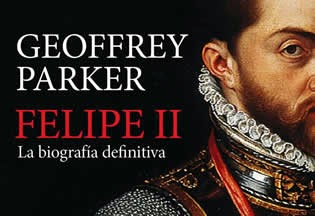
In exploring biography, we have been thinking precisely about sources. Historians have their own techniques; they visit archives, dig through files and folders, decipher handwriting and piece together their stories. Geoffrey Parker, who talked with us this week about his majesterial Imprudent King: A New Life of Philip II, even confided one of his research strategies that is more about the human than the document. Convinced by years of experience that archivists tend to withhold the “good stuff” until the bitter end, when they love to say “if only you had more time you could look through this lovely stack of materials,” he now tells the staff of archives that he’ll be leaving on a certain date, and then — if and when they pull that trick on him — announces: “oh, I’m actually staying another week.” He wants to make sure to get all the good stuff.

But what is “all the good stuff”? Does more evidence sometimes mean less certainty, to paraphrase St Clair?

In the preface to his famous Eminent Victorians, Lytton Strachey tells us to

row out over the great ocean of material and lower down into it, here and there, a little bucket, which will bring up to the light of day some characteristic specimen from those far depths to be examined with a careful curiosity.

Really? We love his narratives, but we can’t help thinking that one should be a bit more selective in choosing what to include in the life one is writing. This vivid image of dipping the “little bucket” doesn’t feel right for a scholarly crowd like my students. They want more research, not less, more material to choose from.

Another essay we read argued that the brief lives written by “new biographers” such as Strachey leave out too much; the chronological method, writes Mark Kinkead-Weekes, offers “less lucid reading, but greater and more complex understanding” (“Writing Lives Forwards,” Mapping Lives). Here we run into the question of “biographical method.” Prof. Parker had no doubt as to where his biography would begin (with the birth of Philip II), nor where it would end (with his death — though the posthumous “miracles” allowed him to extend somewhat!), but the 2012 Spanish version of his biografia definitiva runs to 1436 pages. It’s the rare fan of Philip II who wants to read that much about the man.

Beware the word “definitive,” warns Parker, who

found a new cache of documents after publishing this volume!

Kinkead-Weekes insists that chronological biographies are preferable; “we do not, alas, live our lives in themes but day by day,” he explains. And yet. The lure of writing a non-“definitive” biography is great. Certainly if and when I write my biography of Tynianov, the art of arranging the life will intrigue me more than taking every scrap of evidence into account. But then, I’m no Geoffrey Parker.

I had another line of inquiry in mind, though, when I sat down to write this. So here it is: What is a source, or what will be a source, in the Facebook Age?

Academics are ambivalent about Facebook. Many of us use it, though some feel guilty, or pretend they don’t spend much time on it. For the 21st century Facebook is a means of communication — I PM’d my old swim coach just last week, though I’m not positive he knows how to receive a private message — and I maintain that it also will be a source for future biographers. But at what cost?

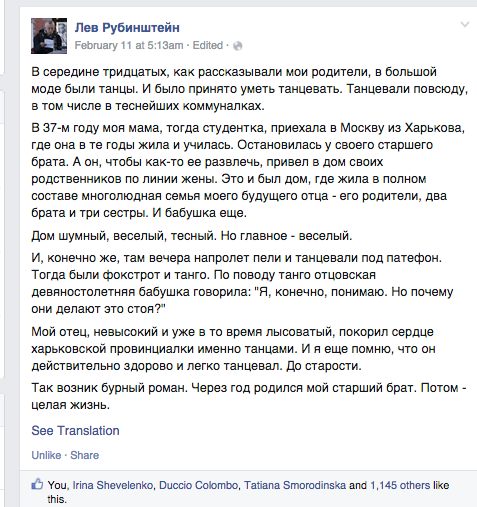
Yesterday I wandered onto the page of Lev Rubinstein, Muscovite and Russian conceptualist poet. I regularly mention Rubinstein in lectures — his Mama was washing the windowframe is a classic of its time — and I remember with pleasure a reading of his I went to in 1989, I think at the Teatr na doskakh (Theater on the Boards, a makeshift semi-underground theater in perestroika Moscow). But before yesterday I hadn’t contemplated Rubinstein as a private individual, and I certainly hadn’t considered him as a presence on Facebook.

A mutual acquaintance had “liked” his post reminiscing about how his parents met — in the 1930s, at an impromptu dance party in a Moscow communal apartment. Olga Sedakova (whose religious philosophical poetry had been the subject of one of the chapters of my student’s dissertation some years ago) then commented something on the order of “so your talent as a dancer is genetic — remember that evening at NLO?”

Memoirs can lie, and sometimes conversations are meant to be private. But what do we make of such a conversation conducted via social media? If we were to write a biography of Rubinstein, or of Sedakova, would we need to conduct research on their social media pages?

Rubinstein has 26,000 followers, now 26,001 including me. I think he’s smart, and his observations are fascinating. But two questions: does the number of followers equal a portion of a possible audience for biography, or does social media replace biography? And secondly, if poets are writing their memories and thoughts on FB etc, does that mean they are not writing poetry?