It’s all about your sources

An essay my students and I read this week argues that “sources have shaped the nature of biographies and the biographical method adopted” (William St Clair, “Biographer as Archaeologist,” in Mapping Lives).

In exploring biography, we have been thinking precisely about sources. Historians have their own techniques; they visit archives, dig through files and folders, decipher handwriting and piece together their stories. Geoffrey Parker, who talked with us this week about his majesterial Imprudent King: A New Life of Philip II, even confided one of his research strategies that is more about the human than the document. Convinced by years of experience that archivists tend to withhold the “good stuff” until the bitter end, when they love to say “if only you had more time you could look through this lovely stack of materials,” he now tells the staff of archives that he’ll be leaving on a certain date, and then — if and when they pull that trick on him — announces: “oh, I’m actually staying another week.” He wants to make sure to get all the good stuff.

But what is “all the good stuff”? Does more evidence sometimes mean less certainty, to paraphrase St Clair?

In the preface to his famous Eminent Victorians, Lytton Strachey tells us to

row out over the great ocean of material and lower down into it, here and there, a little bucket, which will bring up to the light of day some characteristic specimen from those far depths to be examined with a careful curiosity.

Really? We love his narratives, but we can’t help thinking that one should be a bit more selective in choosing what to include in the life one is writing. This vivid image of dipping the “little bucket” doesn’t feel right for a scholarly crowd like my students. They want more research, not less, more material to choose from.

Another essay we read argued that the brief lives written by “new biographers” such as Strachey leave out too much; the chronological method, writes Mark Kinkead-Weekes, offers “less lucid reading, but greater and more complex understanding” (“Writing Lives Forwards,” Mapping Lives). Here we run into the question of “biographical method.” Prof. Parker had no doubt as to where his biography would begin (with the birth of Philip II), nor where it would end (with his death — though the posthumous “miracles” allowed him to extend somewhat!), but the 2012 Spanish version of his biografia definitiva runs to 1436 pages. It’s the rare fan of Philip II who wants to read that much about the man.
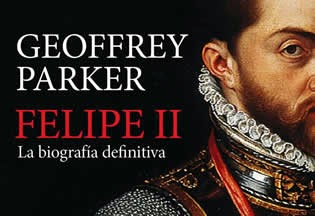
Beware the word “definitive,” warns Parker, who

found a new cache of documents after publishing this volume!

Kinkead-Weekes insists that chronological biographies are preferable; “we do not, alas, live our lives in themes but day by day,” he explains. And yet. The lure of writing a non-“definitive” biography is great. Certainly if and when I write my biography of Tynianov, the art of arranging the life will intrigue me more than taking every scrap of evidence into account. But then, I’m no Geoffrey Parker.

I had another line of inquiry in mind, though, when I sat down to write this. So here it is: What is a source, or what will be a source, in the Facebook Age?

Academics are ambivalent about Facebook. Many of us use it, though some feel guilty, or pretend they don’t spend much time on it. For the 21st century Facebook is a means of communication — I PM’d my old swim coach just last week, though I’m not positive he knows how to receive a private message — and I maintain that it also will be a source for future biographers. But at what cost?
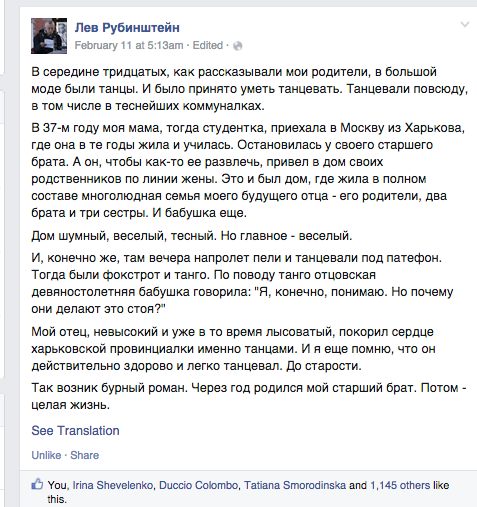
Yesterday I wandered onto the page of Lev Rubinstein, Muscovite and Russian conceptualist poet. I regularly mention Rubinstein in lectures — his Mama was washing the windowframe is a classic of its time — and I remember with pleasure a reading of his I went to in 1989, I think at the Teatr na doskakh (Theater on the Boards, a makeshift semi-underground theater in perestroika Moscow). But before yesterday I hadn’t contemplated Rubinstein as a private individual, and I certainly hadn’t considered him as a presence on Facebook.

A mutual acquaintance had “liked” his post reminiscing about how his parents met — in the 1930s, at an impromptu dance party in a Moscow communal apartment. Olga Sedakova (whose religious philosophical poetry had been the subject of one of the chapters of my student’s dissertation some years ago) then commented something on the order of “so your talent as a dancer is genetic — remember that evening at NLO?”

Memoirs can lie, and sometimes conversations are meant to be private. But what do we make of such a conversation conducted via social media? If we were to write a biography of Rubinstein, or of Sedakova, would we need to conduct research on their social media pages?

Rubinstein has 26,000 followers, now 26,001 including me. I think he’s smart, and his observations are fascinating. But two questions: does the number of followers equal a portion of a possible audience for biography, or does social media replace biography? And secondly, if poets are writing their memories and thoughts on FB etc, does that mean they are not writing poetry?

The “New Memoir”

Whenever you listen to Terry Gross on NPR, you’ll hear her say: “Next on Fresh Air, such-and-such a celebrity will join us to talk about her (or his) new memoir.”

A memoir, it seems, is a very specific genre. Instead of waiting, like Benjamin Franklin or Henry Adams, to write a full autobiography or a Bildungsroman-like narrative (I have in mind here The Education of Henry Adams), people today write memoir after memoir: the memoir of the first ten years of my life; the memoir of the “lost years”; the memoir of last week.

Tolstoy with his grandchildren circa 1909

This is not entirely new, of course. In his autobiographical trilogy Leo Tolstoy highlighted first Childhood, then Boyhood, then Youth (1852-56). And here, I suppose, I am approaching my subject: the mixing of fact and fiction.

Tolstoy named the hero of his book “Nikolenka,” little Nikolai — not Lyovushka. So while he was basing some of the events, and certainly many of the emotions and thoughts, on his own experiences growing up, Tolstoy was distancing himself from his own memories. Serialized in The Contemporary under the initials L.N., this work was not presented as a memoir, or even an autobiography per se. We talk about it as Tolstoy’s “autobiographical trilogy,” but we consider it to be fiction.

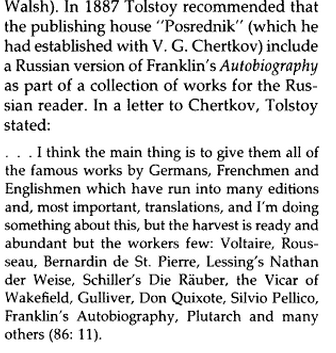
Tolstoy was influenced by, among others, Ben Franklin himself — although Franklin had called his own work “memoirs” and originally written them primarily for his son William, not for his admiring public. Unlike Tolstoy, Franklin did not publish his Autobiography in his lifetime, and the complicated publication history in the end involved various manuscript versions, translations into French and back into English, etc.

But Franklin’s work was at least an autobiography as we think of it — covering much if not all of his life and, importantly, not an auto-hagiography but rather a record of both positive and negative impulses and events.

After writing the above, about Franklin’s influence on Tolstoy, I went to check and found a significant literature debating whether or not Tolstoy read the Autobiography, particularly whether he read it as a young and impressionable man. (And now I have to violate blog protocol and give a footnote… see below.)

Regardless, we know that Tolstoy admired the work and the man.

My students and I spent last week thinking about the “New Biography” — the new direction in anti-Victorian biography started by Lytton Strachey in 1918 with his Eminent Victorians. In the “New Biography,” characters sometimes speak, and biographers usually take the opportunity of having access to letters and/or memoirs to choose the subjects’ own words, to allow the subjects to speak for themselves.

This gives the feeling of authenticity — a feeling that echoes how we respond to autobiography or memoir. If the hero of a biography said something him/herself, then it must be true, right?

Or not. I’ve asked my students to try and focus all semester on biography — rather than memoir or autobiography — and we continue to add to our list of questions in order to figure out the parameters of this genre, from ancient times to the present. So far the consensus is that biographies “feel” authentic when we know that they are based on primary sources, including documents, letters, and even memoirs. Strachey’s bibliography for each of his biographies made us think about how he was using and recasting his sources.

But yesterday a friend sent me a copy of a “new memoir” by Vladimir Kantor — a Russian writer and philosopher who visited Ohio State in 1995, when I was a new assistant professor. And let me tell you — though there is photographic evidence of our meeting, the stories Kantor tells of our mutual adventures are mostly fictional.

His memories don’t correspond to ours, and his memoirs are not “true.” We can “read” some actual people and events in what he has to say; other events and places seem completely made up.

I’m not saying that anyone will write Kantor’s biography, or mine, based on these or any other memoirs. But if they do… the “sources” will be fiction, not fact. Since I was there, I think I know.

What’s more, as we contemplate biography, we notice that biographers utilize certain quotes or anecdotes to support their understanding of their subjects, to “prove” that their portraits are true. In this course of his memoir (In the Midst of Time, or a Map of my Memory), Kantor uses his stories of me and other women he met at Ohio State to elaborate his thesis of the “naif” or ingenuous American, and I don’t mind at all. But I do remember some of the gentle falsehoods I told him at the time (after all, this Russian acquaintance of mine had no real need to know all the details of my life). And I wonder just who is the “naif.” Following the map of Kantor’s memory, you might just manage to get lost.

Barbara W. Maggs, “The Franklin-Tolstoy Influence Controversy,” Proceedings of the American Philosophical Society vol. 129, no. 3 (Sept 1985) pp. 268-277.

From Maggs’s article

Power is power — but must it be fame?

Thinking about the Caesars, I turned to the Ohio State History Department’s e-magazine Origins. I found there an interesting essay about Caesar Augustus which was published in August (appropriately enough).

My favorite quote about the life of Augustus is: “This story is usually told and appreciated like a power fantasy.” The author goes on to equate Augustus with power and to suggest that we exult in the positive aspects of his reign — fabulous wealth! artistic achievements! public works! glory and more glory! — without remembering the human tragedy, anguish, and poverty that accompanied them.

In other words, the man, and the biography of the man, obscure (some of the) historical circumstances around him.

Surely in part that is due to Plutarch and Suetonius?

I suppose I am looking forward to the religious turn my biography course is about to take. How will all the questions we’ve asked so far about life writing look different when we are no longer considering political figures? Or will the “saints” be political too, in their own way?

George Eliot has been quoted as saying that “a biography by a writer has a double interest, from the glimpses it gives of the writer as well as his hero” [quoted in Ira Bruce Nadel, Biography: Fiction, Fact and Form  (New York: St. Martin’s, 1984), 131].

Of course, all biographers are writers, and here Eliot is showing her prejudice. We have been trying to think about the writers behind the biographies written by Plutarch and Suetonius — the men themselves, their motivations, their lives; trying to discern these not just through introductory materials but through their writings: how they organize the material, what emphases they make, to what extent they themselves intrude into their narratives.

Reading anonymous “saints’ lives” will be a different experience. Because, of course, neither the writers nor the subjects are as interested in power as a politician, a philosopher, or a king. But they are all focused on fame and on defining what the trappings of fame might be.

Esli budem zhivy

Each blog has its own voice, just as each blogger has her own habits. I have been blogging at Manic Bookstore Cafe for almost three years, and have taken breaks (or indeed blogged simultaneously) on other projects, such as the Reading Anna Karenina Challenge and the 2014 Recipe Project.

So this will take a little getting used to. The design of the page faciliates more fun (so far this doesn’t feel fun!) and a more interactive voice. On the Manic Bookstore Cafe I announced this blog and promised to link to it in this post. As my course this semester exploring the genre of biography takes off (and as I come to understand u.osu.edu as a platform) I hope this blog will take off as well!