News Article With Hyperlink
When it comes to explaining how statistics are misused today I found a great article on medium.com titled “How to Lie with Statistics, Information Security Edition” by Tony Martin-Vegue which explains at a deeper level how statistics can be easily manipulated today. The website can be accessed using the hyperlink below.
https://medium.com/@tdmv/how-to-lie-with-statistics-information-security-edition-b0f373bdf5f
Some strengths and weakness that apply to this source come down to the website itself. The information itself, which is about statistical examples where data is misleading is well represented and properly backed up with additional sources. A weakness I found was the website it was found on. The website titled, medium.com is not the biggest website and had a blog feeling to the website which is not ideal when looking for a proper academic source. A strength is the page was published only 6 months ago which implies the page is filled with current and applicable information for readers.
Book
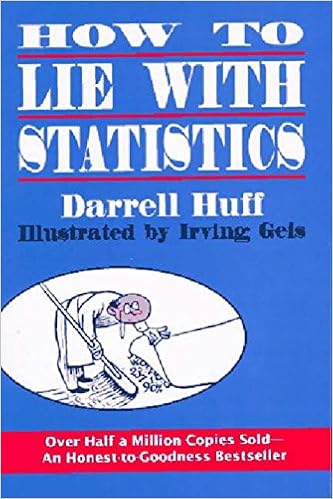
The book titled, “How To Lie With Statistics” written by Darrell Huff is yet another resource which allows readers to see how statistics can be misused today. Originally published in 1954 this book still holds relevance today as it guides readers in and out of examples where statistics are misused and manipulated for gain. I have read several excerpts and I can say I do not look at statistics the same way thanks to Huff’s analysis.
Video
An example of a video displaying misused statistics is the popular Ted Talk series Ted-Ed in the video titled “How Statistics Can be Misleading” narrated and edited by Mark Liddell. This video explains statistics in a fantastic way and allows viewers of all disciplines to grasp how simple it is today to confuse consumers using statistics. The example used by Liddell is choosing a hospital for your elderly grandparent who needs medical care. This source has nothing but strengths regarding the integrity of the source. Ted-ED is a growing series with hundreds of videos on hundreds of different topics with nothing but glowing remarks. They have fantastic speakers with backed up data and are unbiased and look to both sides for a solution.

Academic Journal With Full Citation
Another source is the academic journal titled “Statistics IV: Interpreting the Results of Statistical Tests” by Anthony McCluskey and Abdul Ghaaliq Lalkhen. This journal was published on Oxford Academic on December 1st in 2007. Along with the strength of being an accredited academic journal this source also presents everything when it comes to correctly interpreting statistics in today’s world. There are many examples today were statistics are correctly computed however when cited by individuals are incorrectly expressed and interpreted. This source examines that example and properly explains how to avoid this mistake. The excerpts from the journal can be found using the link
https://academic.oup.com/bjaed/article/7/6/208/508413
Full citation:
Continuing Education in Anaesthesia Critical Care & Pain, Volume 7, Issue 6, December 2007, Pages 208–212, https://doi.org/10.1093/bjaceaccp/mkm042
Writings From A Profesional
My final source comes in the form of a Professional Statistician named Morris Olitsky. In this source Olitsky comments how important statistics are and how they need to be used properly. Olitsky brings up an example from a news source that claimed over the last 10 years the cost of raising a child from ages 0 to 17 has surged 25 percent. Although this statistic was true the phrasing was incorrect to say this rate is surging. Olitsky mentions with yearly inflation values at around 2% which is compounded annually, this number of 25 percent increase is not as drastic as the media portrayed it. Olitsky said, “I’m not sure whether the misuse of statistics is best addressed through education in statistical literacy, some watchdog function such as factcheck.org, or something else. But we do have a national problem, which I think should be of interest to ASA and its members”.